Written by BBG and SKI December – 2016
Support of the internal market policy for growth:
Feasibility study concerning the actual implementation of a joint
cross-border procurement procedure by public buyers from different Member
EUROPEAN COMMISSION
Directorate-General for Internal Market, Industry, Entrepreneurship and SMEs DirectorateG — Single Market for Public Administrations
Unit G.4 — Innovative and e-procurement
Contact:Ivo Locatelli
E-mail: [email protected] European Commission
EUROPEAN COMMISSION
Directorate-General for Internal Market, Industry, Entrepreneurship and SMEs
Support of the internal market policy for growth:
Feasibility study concerning the actual implementation of a joint
cross-border procurement procedure by public buyers from different Member
1
LEGAL NOTICE
This document has been prepared for the European Commission however it
reflects the views only of the authors, and the Commission cannot be held
responsible for any use which may be made of the information contained
therein.
More information on the European Union is available on the Internet
(http://www.europa.eu).
Luxembourg: Publications Office of the European Union, 2017
ISBN 978-92-79-64806-9
doi: 10.2873/10021
© European Union, 2017
Reproduction is authorised provided the source is acknowledged.
Printed in Belgium
Europe Direct is a service to help you find answers
to your questions about the European Union.
Freephone number
(*)
:
00 800 6 7 8 9 10 11
(*) The information given is free, as are most calls (though
some operators, phone boxes or hotels may charge you).
-2-
This study is prepared for the European Commission by BBG and SKI.
Lead authors are Dana Mitea (BBG), Markus Theiner (BBG), Zannie Finderup (SKI), Claudia Fuchs (University of Economics and Business, Institute for Austrian and European Public Law) and Tobias Polzer (Queen's Management School, Queen's University Belfast). Please contact team leader Dana Mitea (BBG) for enquiries.
EUROPEAN COMMISSION
Directorate-General for Internal Market, Industry, Entrepreneurship and SMEs
Table of Content
ABBREVIATIONS AND DEFINITIONS ... 5
INTRODUCTION ... 9
1. EXECUTIVE SUMMARY ... 11
2. METHODOLOGY ... 13
3. GENERAL INFORMATION ON JCBPP ... 18
4. CASE DESCRIPTION ... 22
4.1. Joint procurement of standard software ... 22
4.1.1. Introduction and general framework ... 22
4.1.2. The planning phase of the JCBPP procedure ... 26
4.1.3. The tendering phase ... 28
4.1.4. The post award phase... 29
4.1.5. Other relevant aspects concerning the JCBPP project ... 29
4.1.6. Opportunities and challenges ... 31
4.1.7. To Sum up ... 33
4.2. The HAPPI Project: Purchase of innovative goods and services for active and healthy ageing... 33
4.2.1. The planning phase of the JCBPP procedure ... 36
4.2.2. The tendering phase ... 41
4.2.3. The post award phase... 41
4.2.4. Other relevant aspects concerning the JCBPP project ... 42
4.2.5. Opportunities and challenges ... 44
4.2.6. To sum up ... 46
4.3. Citrix Software and Appliances, 2016 – BBG-SKI ... 47
4.3.1. Introduction and general framework ... 47
4.3.2. The planning phase of the JCBPP procedure ... 48
4.3.3. The tendering phase ... 55
4.3.4. The post award phase... 56
4.3.5. Other relevant aspects concerning the JCBPP ... 56
4.3.6. Opportunities and challenges ... 58
4.3.7. To sum up ... 61
4.4. Joint cross border procurement (AP213 Geologische Versuche) – Brenner base tunnel ... 62
4.4.1. Introduction and general framework ... 62
4.4.2. The planning phase of the JCBPP procedure (decision making process, the market and product, the designed concept, strategy) ... 64
4.4.3. The tendering phase (from publication to award) ... 66
4.4.4. The post award phase... 67
4.4.5. Other relevant aspects concerning the JCBPP procedure ... 67
4.4.6. Opportunities and challenges ... 68
4.4.7. To sum up ... 69
5. COST BENEFIT ANALYSIS ... 71
5.1. CBA “Standard IT Software Packages and Maintenance through a reseller”/EPCO ... 71
5.2. CBA HAPPI ... 75
5.3. CBA “Software Procurement BBG-SKI” ... 80
-4-
5.5. Comparison and Lessons Learnt from the CBA ... 89
6. CONCLUSIONS ... 95
6.1. General information on the projects analysed ... 95
6.2. The contracting authorities ... 96
6.3. Products and services purchased... 97
6.4. Motivation/reason to conduct a JCBPP project ... 98
6.5. Support given to the projects ... 99
6.6. Procedural aspects ... 99
6.7. Language ... 100
6.8. E-Procurement aspects ... 101
6.9. Time invested ... 102
6.10. Opportunities and challenges ... 102
6.10.1. Opportunities ... 103
6.10.2. Challenges ... 103
6.11. Economic operators ... 105
6.12. Conclusions on legal aspects ... 106
6.12.1. General remarks ... 106
6.12.2. Findings of the study ... 107
7. RECOMMENDATIONS ... 112
7.1. Planning Phase ... 112
7.1.1. Demand and needs analysis ... 112
7.1.2. Market Analysis and Benchmarking ... 113
7.1.3. Partnership ... 114
7.1.4. Procurement Strategy ... 117
7.1.5. Decision making ... 118
7.1.6. Drafting of tender documents ... 119
7.2. Tender Phase ... 119
7.2.1. Publication of tender documents ... 119
7.2.2. Communication with bidders... 120
7.2.3. Opening of tenders ... 120
7.2.4. Validation and evaluation ... 120
7.2.5. Award ... 120
7.3. Post Award Phase ... 120
FURTHER LITERATURE ... 123
LIST OF TABLES ... 124
LIST OF FIGURES ... 125
EUROPEAN COMMISSION
Directorate-General for Internal Market, Industry, Entrepreneurship and SMEs
Abbreviations and Definitions
Abbreviations
BBG Bundesbeschaffung GmbH
BBT-SE Brenner Base Tunnel - Societas Europaea BCL Banque Centrale du Luxembourg
CA Contracting Authority
CB Central Bank
CBA Cost Benefit Analysis
CEO Chief Executive Officer
CIP Competitiveness and Innovation Framework Programme
CPB Central Purchasing Body
CSR Corporate Social Responsibility
DACH Region including Germany, Austria, Switzerland
DKK Danish Krone
DNB De Nederlandsche Bank
EC European Commission
ECB European Central Bank
EGTC European Groupings of Territorial Cooperation EHPPA European Health Public Procurement Alliance
EO Economic Operator
EPCO Eurosystem Procurement Coordination Office ESCB European System of Central Banks
etc. et cetera
EU European Union
EUR Euro
FA Framework Agreement
FAQ Frequently asked Questions
FHL Fédération des Hôpitaux Luxembourgeois
GIP RESAH Groupement d'intérêt Public - Réseau des Acheteurs Hospitaliers
GmbH Gesellschaft mit beschränkter Haftung
HAPPI Healthy Ageing – Public Procurement of Innovations
ICT Information and Communication Technology
ID Identity
IT Information Technology
JCB Joint Cross Border
-6-
LB Lead Buyer
MEAT Most Economically Advantageous Tender MercurHosp Mutualisation Hospitalière
MS EU Member State
N/A Not available
NHS National Health Service
NHS-CS National Healthcare Service - Commercial Solutions NUTS Nomenclature des Unités Territoriales Statistiques
OECD Organisation for Economic Co-operation & Development
OeNB Österreichische Nationalbank PCP Pre-Commercial Procurement PO Participating Organisation
PP Public Procurement
PPI Public Procurement of Innovation RESAH Réseau des Acheteurs Hospitaliers RUP Responsabile unico del procedimento CSA Coordination and Support Action (H2020) SCR Società di Committenza Regione Piemonte
SE Societas Europaea
SG Steering Group
SIGMA Support for Improvement in Governance & Management SKI Statens og Kommunernes Indkøbs Service A/S
SME Small and Medium-Sized Enterprise TED Tenders Electronic Daily
UK United Kingdom
EUROPEAN COMMISSION
Directorate-General for Internal Market, Industry, Entrepreneurship and SMEs
Definitions Aggregation of
demand Public sector purchasers from within the same body, and/or from different public sector bodies or other entities combining individual requirements to procure common goods and services from the market to achieve cost reduction through economies of scale.
Aggregation
techniques Techniques used to aggregate demand for public procurement. Awards Allocation of contracts in compliance with procedures described in EU
Directive 2014/24/EU and 2014/25/EU
Call-off Individual contracts that can be made throughout the term of a framework agreement
Candidate An economic operator that has sought an invitation or has been invited to take part in a restricted procedure, in a competitive procedure with negotiation, in a negotiated procedure without prior publication, in a competitive dialogue or in an innovation partnership. (Article 2, Directive 2014/24/EU)
Central
Purchasing Body Article 2, Directive 2014/24/EU defines a Central Purchasing Body as a contracting authority providing centralised purchasing activities and, possibly, ancillary purchasing activities.
Centralised purchasing activities
Article 2, Directive 2014/24/EU defines central purchasing activities as activities conducted on a permanent basis, in one of the following forms:
(a) the acquisition of supplies and/or services intended for contracting authorities,
(b) the award of public contracts or the conclusion of framework agreements for works, supplies or services intended for contracting authorities
Centralized
purchasing An aggregation technique including either activities using centralized procurement bodies (CPBs), purchasing on behalf of others, collaborations between entities and/or using of service
providers/entities to manage the purchasing process
Contract An agreement having a lawful object entered into voluntarily by two or more parties, each of whom intends to create one or more legal obligations and awarded according under Directives 2014/24/EU and Directives 2014/25/EU
Contracting authority or contracting entity
A buyer purchasing under Directives 2014/24/EU. Contracting authority means the State, regional or local authorities, bodies governed by public law or associations formed by one or more such authorities or one or more such bodies governed by public law.
Contractor Economic operator that has been awarded a public contract by a contracting authority.
Coordinating organisation
A coordinating organisation supports the lead buyer by taking over specific tasks, especially regarding cross-border issues like the coordination of the participating organisations.
Customer Contracting authorities that make use of the services of a central purchasing body.
Economic
Operator Any natural or legal person or public entity or group of such persons and/or entities, including any temporary association of undertakings, which offers the execution of works and/or a work, the supply of products or the provision of services on the market. (Article 2, Directive 2014/24/EU)
E-Procurement Electronic means of collecting demand information. Often these tools are integrated with the go-to-market and may offer online catalogues, scheduled purchasing of specific items, and links to established contracts with suppliers. The e-Tools may also extend into the post-contract phases and provide support for post-contract and supplier management.
EU Members States
-8- Framework
agreement
An aggregation technique that is defined by the EC Directive as: "an agreement between one or more contracting authorities and one or more economic operators, the purpose of which is to establish the terms governing contracts to be awarded during a given period, in particular with regard to price and, where appropriate, the quantity envisaged." (Article 33, Directive 2014/24/EU)
Joint cross border procurement
Joint cross border procurement means that two or more contracting authorities from different member states agree to perform certain specific procurements jointly. (Directive 2014/24/EU, Art. 38)
Joint
procurement Two or more contracting authorities that agree to perform procurements jointly (Article 38, Directive 2014/24/EU)
Lead buyer A lead buyer is acting as contracting authority and is responsible both for the project management (e.g. coordination with contracting authorities) and the execution of the procurement procedure.
Mini-tender Conducting a reopening of competition under a framework agreement
Negotiated
procedure Negotiated procedure means the procedure whereby the CAs consult the economic operators of their choice and negotiate the terms of the contract with one or more of these.
Open procedure Anyone interested in a specific contract will be invited to tender the competition in order to ensure maximum competition.
Participating organisation
A participating organisation is acting as a contracting authority in the procurement procedure and is not in charge of the process. It can act as intermediary or final buyer.
Potential bidder Economic operator interested in the tender procedure without necessarily placing an offer.
Procurement document
Any document produced or referred to by the contracting authority to describe or determine elements of the procurement or the procedure, including the contract notice, the prior information notice where it is used as a means of calling for competition, the technical specifications, the descriptive document, proposed conditions of contract, formats for the presentation of documents by candidates and tenderers,
information on generally applicable obligations and any additional documents. (Article 2, Directives 2014/24/EU)
Public contracts Contracts for pecuniary interest concluded in writing between one or more economic operators and one or more contracting authorities and having as their object the execution of works, the supply of products or the provision of services (Article 2, Directive 2014/24/EU).
Public
procurements CAs acquiring goods, services or works from an outside external source under Directive 2014/24/EU and Directive 2014/25/EU
Restricted procedure
The buyers limit the number of suppliers that are invited to tender for a contract.
Small and Medium-sized Enterprises (SMEs)
Independent enterprises or groups of enterprises with less than 250 employees, and with total annual turnover not exceeding 50 million euro, or a balance sheet not exceeding 43 million euro
Supplier Economic operator that supplies goods or services based on a public contract.
Tenderer/bidder An economic operator that has submitted a tender. (Article 2, Directive 2014/24/EU)
EUROPEAN COMMISSION
Directorate-General for Internal Market, Industry, Entrepreneurship and SMEs
Introduction
Scope and objective
This study has been prepared on behalf of the European Commission and was carried out from April to December 2016.
The main task of this project is to carry out a feasibility study on the possible implementation of Joint Cross-Border Public Procurement (JCBPP), in particular focusing on the legal, administrative and organisational aspects of four selected JCBPP projects.
The feasibility study also includes a cost-benefit analysis of the procedure, indicating the likely costs of carrying out a joint cross-border procedure and assessing the potential benefits produced by the use of this procedure (for instance, in terms of price gains, contract management, pooling of expertise, reduced transaction costs, etc.).
The study is based on an assessment of four projects in which buyers from different Member States (being individual contracting authorities, or central purchasing bodies as defined respectively in Articles 2(1)1 and 2(1)16 of Directive 2014/24/EU) published the call for tender and received the offers from economic operators. Thus, all cases analysed present the full procedure and are implying the implementation of a single call for tender for all the buyers. Parallel and coordinated procedures across various Member States in which buyers are located was not considered to fall within the definition of joint cross-border procurement proposed for this study.
It is important to mention that all projects analysed were implemented before the new Public Procurement Directives 2014/24/EU and 2014/25/EU were transposed into national legislation; thus, the national laws and regulations applicable at the respective time were different from the possibilities provided by the new directives. Nevertheless, the projects analysed were implemented using similar constructions to those allowed for in the new Directives.
Content
After the executive summary in chapter 1, chapter 2 describes the methodology used in this study.
Chapter 3 provides general information on joint cross border procurement and examines possibilities for conducting joint cross border procurement according to Directive 2014/24/EU.
Chapter 4 then analyses four joint cross border procurement cases:
Case 1: The first case deals with the joint cross border procurement of standard software of central banks in the Eurosystem. In this case De Nederlandsche Bank acted as lead procurer and launched a tender and awarded a contract for standard software on behalf of itself and for the benefit of a list of thirteen other central banks.
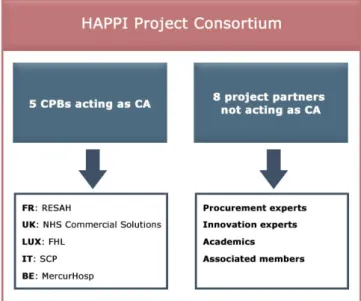
Case 2: The second case describes a joint cross border procedure for the puchase of innovative goods and services for active and healthy ageing. The tender was launched within the framework of the EU co-financed project HAPPI (Healthy Ageing – Public Procurement of Innovation). The consortium running the joint cross border tender involved five CPBs from different Member States, whereby REASAH, a French CPB, acted as lead procurer.
Case 3: The third case presents a JCBPP with two CPBs, the BBG from Austria and SKI from Denmark purchasing Citrix software and appliances. In this case BBG acted as lead procurer and SKI as participating oganisation. The two organisations concluded a framework agreement with three economic operators. The contract execution is conducted by both CPBs for their own customers.
Case 4: The fourth case is the only case dealing with JCBPP of construction works. What is also special in this case is that the JCBPP was conducted through a cross border joint entity, the Galleria di Base del Brennero – Brenner Basistunnel BBT SE, owned in equal shares by an Austrian and an Italian contracting authority respectively. The joint entity tendered drilling works throughout the whole area of the planned tunnel, both on Austrian and Italian territory. The procurement
-10-
procedure was implemented under Italian procurement law and was executed under Italian and Austrian contractual law, depending on where the works took place. Chapter 5 does a cost-benefit analysis of the four cases analysed. This analysis determines the most important costs and benefits identified by the involved parties in the respective JCBPP project. The cost-benefit analysis looks at qualitative and quantitative aspects and shows costs and benefits in terms of ‘monetary values’.
In Chapter 6, comprehensive conclusions taking into consideration the outcomes of the case analysis as well at the CBA are presented. This chapter summarizes the findings of the research, highlights the opportunities and challenges of joint cross border procurement and presents a comparative analysis of the four relevant JCBPP projects in defined areas. Moreover, the conclusions reflect on how certain challenges were faced in the described cases.
The last chapter (chapter 7) comprises recommendations for the implementation of JCBPP procedures based on the results of the research. It describes how to carry out joint cross border procurement procedures, how to foster legal certainty and to allow for effective contract management and monitoring. The recommendations take into consideration the three models of JCBPP described in Directive 2014/24/EU, so that contracting authorities can understand the benefits and challenges of each model and are able to assess which method is the most suitable for the envisaged procurement. They also include suggestions for each part of the chronological order applied to a tender procedure, starting from the planning of a tender to the contract management.
Hence, the recommendations constitute guidance from practitioners for practitioners.
The appendices provide the templates for the cost-benefit analysis, the interview guidelines for contracting authorities and the questionnaire for economic operators.
11
1.
EXECUTIVE SUMMARY
Joint procurement refers to a situation in which two or more contracting authorities conduct a procurement procedure together. The key characteristic of this specific procedure is that only one tender is published on behalf of all participating contracting authorities. The notion of joint procurement does not automatically imply any cross-border element as such. Joint cross-border procurement refers to the particular procurement procedure which involves contracting authorities from different Member States conducting a common tender by bundling their demands and acting jointly in the award of the contract.
There have already been some attempts to conduct JCBPP procedures in the European Union, despite the fact that until the implementation of Directive 2014/24/EU there were no explicit legal provisions to facilitate such forms of cooperation. Therefore contracting authorities faced both legal and practical difficulties, mostly due to conflicts between national public procurement rules and barriers preventing recourse to other Member States’ central purchasing body or the joint cross-border award of public contracts.
Currently existing literature still offers only a few contributions describing the use and impact of JCBPP and the limited practical experience there is in conducting such procedures has not been presented in an aggregated form so far.
This analysis is intended to help identify the best solutions for implementing JCBPP projects and offers concrete recommendations which should serve as a guideline for all interested stakeholders. The aim of the study is not to assess theoretical scenarios of JCBPP between contracting authorities in different Member States or to offer a legal analysis of factors that can influence the implementation of such projects. Its scope is to practically analyse projects that have been implemented in the past months or years and to highlight how they have been conducted, the obstacles or difficulties experienced by the participating contracting authorities and how they managed to overcome them.
Centralised – and therefore “joint” – purchasing techniques are successfully used in most Member States and the idea of exploring a cross-border dimension is generating more and more interest as it facilitates cooperation between contracting authorities across Europe and at the same time enhances the benefits of the Internal Market by creating better business opportunities for economic operators.
Thus, this feasibility study on the possible implementation of a JCBPP procedure consists of an
analysis of relevant JCPPP projects, including a cost benefit analysis, and draws conclusions based on the main issues which need to be considered when conducting a JCBPP. The results of the feasibility study have allowed the drafting of recommendations for the implementation of JCBPP procedures.
The feasibility study focuses on the legal, administrative and procedural aspects encountered in four selected JCBPP projects, taking into consideration country and sector-specific characteristics relevant to the implementation of such procedures.
The analysis of the case studies followed the chronological structure of a procurement procedure:
Pre-tender phase: focusing on the decision making process prior to the implementation of JCBPP
Tender phase: focusing on questions arising during implementation of the JCBPP from the publication of tender until the award of the contract
Post award phase: focusing on questions of operational procurement during the term of the contract
In a separate chapter, the main conclusions address the most important issues which have been identified as relevant when conducting a JCBPP: the contracting authorities and their relationship, the products to be purchased and the respective aspects of the market, the motivation behind conducting a JCBPP project, legal aspects and their implications, procedural considerations, the question of the applicable language, e-procurement related aspects, and the time needed for the implementation. This chapter also includes a summary of the responses received from economic operators surveyed and an overview of the main opportunities and challenges encountered in the projects analysed.
The study includes a scheme of recommendations based on these findings with respect to how to carry out joint cross-border procurement procedures, in order to foster legal certainty and to allow for economic measurement, monitoring and their improved practical application.
Main outcomes
The implementation of the analysed projects showed that JCBPP was legally possible even before the transposition of the 2014 Directives into national legislation and now, with the new provisions the legal basis allows even several ways of implementing such cooperations between contracting authorities from different Member States.
Although it seems that contracting authorities involved in the projects analysed had different motivations for the implementation of JCBPP, it can be concluded that they also had common targets which can be summarised as follows:
Achieving better prices and improved conditions
Reducing process costs through aggregation of procedures Exchanging best practice with other similar institutions
Creating networks and using the potential of the Internal Market
Improving knowledge of market, procedures, language, and “thinking outside the box” Availing of possibility to work together in order to change a market strategy (pricing) Encouraging innovation on the procurer and supplier side
Gaining access to new markets
The successful implementation of a JCBPP procedure depends mostly on: The right partners, which are committed to obtaining good results Sound project management
The markets addressed and their acceptance of JCBPP techniques An intelligent and well-designed procurement strategy
The main opportunities experienced by the contracting authorities involved seem to be: Lower process costs due to joint procurement
Economies of scale leading to better prices
Partnership and exchange of good practice with CAs from other MS Creating networks and using the potential of the Internal Market
Possibilities to work together in order to change a “difficult” market (pricing policies) Helping suppliers to discover new markets
Gaining know-how for future projects
Main challenges encountered in the JCBPP analysed seem to be:
Legal complexity related to national procurement laws and contractual provisions as well as product specific legislation
Rigid market structures and pricing policies
Complex or innovative goods or services, which are difficult to standardise Coordination of partners
Language
Communication with end-users
E-procurement tools, since they are designed to fit national requirements
All the projects analysed were able to find adequate solutions to these challenges and were successfully concluded. Even though language was expected to be the biggest challenge, it turned out to be manageable, while coordination proved to be the most time consuming issue to deal with. Overall it can be noted that the evolution of the legal framework dealing with JCBPP is still in progress. A number of questions will eventually need answering by additional case law. Yet, while the relevant legal provisions on the EU level show certain gaps, looking at the cases portrayed in this study, we may also conclude that from a legal point of view JCBPP initiatives are not necessarily only a risky endeavour, but open up various possibilities to explore the ways the various layers of legal provisions involved interplay and which opportunities they provide for optimally achieving the goal of enhancing efficiency in public procurement.
2.
METHODOLOGY
In light of the project´s predefined tasks, this feasibility study was structured in three main phases:
Phase one: Preparatory research phase: identification of relevant studies, mapping of relevant stakeholders and analysis of the existing legal, administrative and organisational framework for joint cross-border procurement scenarios at EU and Member State level
Phase two: Case study phase: data collection phase for the selected case studies with the aim of assessing the role and impact of legal, procedural and policy-based tools in order to enable and strengthen joint cross-border procurement for the stakeholders involved
Phase three: Analysis of data, including cost-benefit analysis
Each phase followed an individually designed methodology.
1. Phase one built on conceptual and empirical approaches to establish the connection between legal, administrative, and organisational aspects and their respective significance when carrying out joint cross-border procurement projects. Both general examination of the given legal and factual situation in certain Member States as well as selected case studies produced an overview of the rules and tools governing joint cross-border procurement projects in the present situation. Thus, the methodology for this stage included legal and applied research: a review of the relevant literature, drafting and delivery of online questionnaires for economic operators and structured interview guidelines for contracting authorities as well as the gathering and analysis of contractual models and documents. This work further enabled the determination of benchmarks for critical analysis applied in Work Phase two.
2. Phase two constituted the heart of the study and significantly relied on the case study method, using both legal and empirical data in order to identify, describe, and evaluate the general framework, requirements, and challenges of joint cross-border procurement projects as well as possible costs and benefits arising from JCBPP procedures. The most important aims were (i) to determine how stakeholders perceived and implemented tools to perform joint cross-border procurement projects and (ii) to measure and establish the functioning and efficiency of the procedural, organisational and policy-based actions taken.
The study not only focussed on the experience of contracting authorities using JCBPP but also tried to assess the impact this had on economic operators who participated in the procedures. Empirical data about the joint cross-border procurement projects were gathered from contracting authorities through interviews and from economic operators through online questionnaires.
Representatives of contracting authorities involved in JCBPP were interviewed personally using previously developed, structured guidelines and in cases where this was not possible, via Skype or telephone, using the same structured guidelines. For the interviews, it was envisaged that the most important players in the contracting authorities involved, namely the procurement expert, the legal expert and the respective project leader be questioned.
Before the personal interviews took place, the researchers informed the participants about all content-related questions, so that they could prepare accordingly and gather all relevant information well in advance. This form of interviewing aimed at a comprehensive survey of expert knowledge on the topic of research and was particularly suitable given the fact that research on the topic of joint cross border procurement is extremely rare and therefore not much literature is available, so that it is necessary to collect primary data directly from the practitioners.
A total number of 17 interviews with ten buying organisations and one coordinating organisation were conducted. In addition to this, 7 suppliers and 7 bidders returned questionnaire-based surveys. All interviews and questionnaires were drafted and conducted in English. Interviews lasted between two and three hours and a second round was carried out when necessary for clarification of open questions. As mentioned above, the authors of the study wanted to include not only input from the respective suppliers but also from bidders who participated in the tender, as it is important to collect the feedback of market representatives who could have a more critical opinion of the procedure than the winning bidder. Due to the relatively high number of bidders and suppliers involved, which are based all over Europe, it would have been difficult to organise and conduct personal interviews with their representatives. Therefore, the methodology chosen as the most appropriate in order to obtain as much data as possible was an online survey based on questionnaires. These questionnaires were distributed to the respective economic operators and were filled in electronically via SurveyMonkey, by the person who was directly involved in the preparation of the bid. The assumption was that an online questionnaire with only a few but very
precise questions would be easier to fill in and would thereby guarantee a higher participation rate than an attempt at personal interviews.
The conception of the interview guidelines for surveying contracting authorities and the questionnaires for economic operators was crucial in order to obtain the necessary information for a proper implementation of the comparative analysis of the case studies. Both the guidelines and the questionnaires were developed by practitioners working in a joint cross border procurement project who were assisted by the two academic researchers.
The interview guidelines contained questions relating to legal, administrative and organisational aspects of the study. For the cost-benefit analysis, a separate factsheet was developed (see below).
The analysis of the case studies followed the chronological structure of a procurement procedure: Pre-tender phase: focusing on questions and significant milestones in the
decision-making process prior to the implementation of joint cross border procurement projects and the necessary preparations, such as assessing organisational, administrative and economic benefits, benchmarking, establishing and preparing the tendering process, choice of law, drafting tender documents.
Tender phase: focusing on questions arising during implementation of the joint cross border procurement project, such as aspects of inter-organisational communication, communication with the bidders, opening and evaluation of tenders, award, re-opening of competition, possible review procedures.
Post award phase: focusing on questions of contract management, economic and management-based ex post evaluation and monitoring as well as on questions of legal remedies and competent jurisdiction.
As mentioned above, the case study also includes specific questions referring to economic aspects of the procedure (cost-benefit analysis). Cost-Benefit Analysis (CBA) is an instrument for investment appraisal that allows systematic calculation and comparison of the costs and benefits of a decision, (government) policy, or project in general. If the benefits connected with a certain initiative exceed the costs, the initiative is worth implementing. CBA can also help when comparing several alternative projects, in particular to determine the one that yields the highest net benefits.
A ‘CBA factsheet’ (see Appendix 1) was developed and distributed to the coordinating organisations, lead buyers and participating organisations. The factsheet comprised the following six sections:
1. Quantitative cost-benefit analysis (CBA) conducted within the scope of the JCBPP project. 2. Description of the method that was applied for the CBA.
3. Achieved price/s for the procured product/s.
4. Quantification of the total costs of the JCBPP project for different stages/areas in the procurement process.
5. Expected development of costs in future similar procurement projects.
6. (For lead buyers only:) Total value of the goods and services that were procured within the project, and shares of the project partner organisations.
The factsheet was deliberately designed so as to allow consideration of both cost reductions and cost increases for any particular component. For example, during the stage of searching for the technically best product(s), higher or lower costs could be possible for a procurement scenario within a JCBPP project in comparison to the baseline scenario (e.g. lower costs arising due to a best practice exchange among project partners, or higher costs incurred due to increased coordination demands among project partners). The respondents were also allowed to amend the factsheet if necessary. In total, eight factsheets were returned.
The case study method is a qualitative research method which provides sufficient tools for researchers to study the complex and new topic of JCBPP. This method allows the usage of a large variety of data in order to describe complex situations encountered while conducting the JCBPP procedure and to offer a comprehensive picture of the situation. By analysing four different projects in different Member States, the topic was not explored through just one lens but rather through a variety of lenses, which allowed for multiple facets of the phenomenon to be revealed and understood. The use of multiple data sources such as interviews, questionnaires and tender documents is also a strategy to enhance data credibility. The multiple sources approach enables a holistic understanding of the JCBPP phenomenon.
The goal of the case study was to describe the case in such a comprehensive way that readers feel as if they had been actively participating in the research. This would enable the readers to work out whether the findings could also be applied to other situations such as their own JCBPP procedures.
Since the four projects analysed are the only known successfully implemented JCBPP projects so far, the study results can be considered representative. Nevertheless, it must be acknowledged that it is particularly difficult to generate consistent conclusions and recommendations applicable to future projects based on the results of four very different case studies.
Interview partners
The initial plan was to analyse three JCBPP projects but during the implementation period of the study, it seemed important to also include an infrastructure project in order to add an additional perspective to the analysis.
For the purpose of analysing the EPCO case from different angles, the experience of the Dutch National Bank (De Nederlandsche Bank, DNB) as lead central bank (= lead buyer) and that of other two participating central banks (Banque centrale du Luxembourg (BCL) and Österreichische Nationalbank (OENB) as well as the perspective of EPCO as coordinator of the procedure were taken into consideration. In total, this procedure actually included the participation of 14 different banks, but a sufficient degree of saturation was achieved through the analysis of three examples. In the BBG-SKI case, team members from both centralised purchasing bodies were interviewed. Within the HAPPI project, the coordinator, Resah, as well as the buying organisations Fédération des Hôpitaux Luxembourgeois (FHL), NHS Commercial Solutions and Società di Committenza Regione Piemont (SCR) participated in the study. One of the five participants in this JCBPP procedure, MercurHosp, did not respond to the invitation; nevertheless, sufficient data was obtained from the other organisations.
BBT-SE participated in the interview through its branch in Austria where both the managing director and the project leader were interviewed.
3. Phase three: Analysis of data: once the empirical data was gathered and transcribed, it was analysed by the team members who developed an analysis guideline and thematically evaluated the results.
In the course of thematic analysis the team members performed a data reduction procedure by which qualitative data were segmented, categorized, summarized, and reconstructed in a way that captured the important concepts within the data set. Once this was done, they examined the data and drew conclusions. This analysis represents the basis for the scheme of recommendations, which was drafted in accordance with the results obtained.
The CBA was also part of phase three. There are multiple methods for CBAs, with different levels of scope and detail (see, e.g. European Commission [2015]1 for an overview of CBAs in different sectors of government). The main interest in relation to the CBA in the present study was to determine the most important costs and benefits identified by the parties involved in a JCBPP project.
As the projects investigated differed in terms of aims and scope, the intention was to conduct a CBA that combines quantitative and qualitative aspects. The quantitative CBA centred upon the measurement and comparison of costs and benefits in terms of ‘monetary values’ (see below). The qualitative comparison of costs and benefits was targeted at finding ‘common patterns’ across the projects.
Quantitative Elements of Cost-Benefit Analysis
A quantitative CBA requires the measurement of costs and benefits in ‘monetary values’. In the context of this study, costs and benefits were conceived of in either financial terms or time required to fulfil a procurement project. Deviating from a CBA in the ‘pure’ form, the method that was applied sought to compare the total (undiscounted)2 costs of a JCBPP project with its total (undiscounted) benefits, focusing exclusively on the effects for the coordinating organisations, lead buyers and participating organisations (i.e. costs and benefits for suppliers and for society as a whole3 were not considered).
The general approach of the quantitative CBA was to compare the actual values of the JCBPP project with ‘baseline’/’business as usual’ scenarios. For each stage, directly associated costs and labour hours were determined (one hour being valued at EUR 60, which was based on similar considerations in the German federal administration;4 this value was used because the German federal administration documents wage rates in detail). The baseline figures represent the costs
1ec.europa.eu/regional_policy/sources/docgener/studies/pdf/cba_guide.pdf
2 Discounting is the technique of calculating today’s value of a payment/stream of payments that will be received in the future.
3 For example effects for non-beneficiaries of the procured solutions and other side effects like changes in the market structure due to the
procurement.
4 Federal Ministry of Finance Germany (2016):
that would have been incurred if an organisation had undertaken the procurement alone. For all costs, net values 5were taken into consideration.
For each of the JCBPP projects, the extent to which quantitative cost-benefit considerations were present, and to what effect, was of interest. In order to obtain comparable data within and across the four JCBPP projects, and in order to derive total costs and benefits per project, the ‘CBA factsheet’ (see Appendix 1) sought to compare costs and benefits in all stages of the JCBPP initiatives, as well as the price(s) for the procured product(s)
Qualitative Elements of the Cost-Benefit Analysis
For the qualitative CBA, organisations were asked in the interviews to describe the most important costs and benefits of the respective JCBPP project, as compared with the ‘baseline’/’business as usual’ scenario (see Questions 5.1 and 5.2 in the Interview Guidelines/Appendix 2). Additionally, they were asked a question centered on the problem of whether (and to what extent) costs were expected to fall and benefits to increase if the procurement project were continued or repeated. The answers to those questions were examined in the CBA.
Method Applied for the Cost-Benefit Analysis
At the beginning of the study, it was planned to start from the CBAs that were conducted within the scope of the projects. However, despite several reminders, there were relatively few returns of complete factsheets by the organisations, and a CBA was disclosed only by one project (and here only for product price savings). Therefore, the analysis synthesised quantitative and qualitative information for each project, i.e. in order to obtain a more complete picture of costs and benefits, statements from the interviews complement the analysis of the factsheets. There is also comment on the differences between coordinating organisations, lead buyers and participating organisations in terms of costs and benefits
In the context of this study, risks associated with the projects are conceived of in broad terms (e.g. risks that arise from dealing with larger procurement volumes in a JCBPP project than in a ‘baseline’ setting): They are considered as potential costs and therefore are included as such in the CBA in the sections about risk management, even if they did not actually materialise.
In the following, each JCBPP project is first discussed individually by drawing on the questions in the ‘CBA factsheet’ and interview data (Sections 5.1-5.4). Second, there is a comparison among the projects and recommendations are given in section 5.5.
Methodological learnings
Since only a few joint cross-border procurements have been completed until now, there is a rather small sample group to work with. If the aim is to look at different types of JCBPP (e.g. the three types identified in Article 39 of Directive 2014/24/EU), the sample group is even slimmer. Therefore, quantitative analysis was not possible. However, it was possible to gain in-depth knowledge of the research topic by means of qualitative analysis.
A quantitative survey directed at the economic operators was developed and implemented, but especially as access to bidders and potential bidders was not provided by all the participating contracting authorities due to data protection reasons, only a limited number of responses was received. As a consequence, only a descriptive and not a proper statistical analysis could be conducted.
Moreover, the plan was also to interview the respective project leader, the legal advisor and the procurement specialist for each project but during the research phase it was found that in some cases the different functions were held by one person or that former persons in charge were no longer part of the organisation. Thus, the number of interviewees was somewhat smaller than originally intended but nevertheless included at least the respective project leaders per contracting authority.
The fact that most of the interviews were conducted in English entailed certain difficulties in the research process, such as misunderstanding of meaning and definition of procurement specific vocabulary.
Data protection reasons also prevented some of the contracting authorities from providing details on certain aspects such as prices and contractual provisions, which also influenced the way the CBA was conducted.
In the case of BBG-SKI however, all necessary data could be accessed and used for further analysis since both organisations were committed to the advancement of the study. In addition to this, it is important to mention that BBG was the only contracting authority with a data management tool in place which allowed the extraction of precise data (such as number of days used for the procedure
or providing an overview of all economic operators who downloaded the tender documents) and which provided this data for the study.
At the time these projects were implemented, JCBPP was still an innovative and rarely used method of procuring. The contracting authorities involved had to take risks and venture into unknown territory, which may have led to a perception of the project as particularly prestigious. It is possible that contracting authorities felt the need to justify their own decisions, potentially leading to the downplaying of problems (choice-supportive bias). In the majority of the case studies, however, concrete problems and challenges were explicitly mentioned and reflected upon.
3.
GENERAL INFORMATION ON JCBPP
The phenomenon of joint procurement has gained significantly more attention in the recent past, both within the EU as well as on an international level. Various recommendations highlight its potential to enhance efficiency in public procurement and promote the further development of necessary procedures.
However, as stated in Recital 71 of Directive 2014/24/EU, joint procurement can take many different forms, ranging from coordinated procurement through the preparation of common technical specifications for works, supplies or services that will be procured by a number of CAs, each conducting a separate procurement procedure, to situations where the CAs concerned jointly conduct one procurement procedure either by acting together or by entrusting one CA with the management of the procurement procedure on behalf of all CAs. Furthermore, it may be of an occasional or regular nature, it may rely on centralised procurement through CPBs, and/or it may comprise an element of cross-border collaboration. All of these situations present various challenges, especially as far as the legal conditions are concerned. While some modes of joint procurement have been subject to EU (and transposing Member States’) procurement law for quite some time, others have only recently entered the regulatory spotlight.
The latter particularly holds true for JCBPP. Although Directive 2004/18/EC has largely been understood as implicitly allowing JCBPP (see Recital 73 of Directive 2014/24/EU), there were profound legal and practical difficulties involved. Directive 2014/24/EU now for the first time expressly addresses the option of conducting JCBPP. Thus, Article 39 of Directive 2014/24/EU (“Procurement involving contracting authorities from different Member States”) is often referred to as a true regulatory innovation. Taken together with Articles 37 and 38 of Directive 2014/24/EU, this set of provisions has established a new regulatory framework for centralised and JCBPP on the EU level. As far as procurement in the utilities sector is concerned, the same applies for Articles 55 to 57 of Directive 2014/25/EU, which are of relevance in view of one joint cross-border case that is analysed below (the Brenner Base Tunnel Project and the BBT SE acting as joint cross border entity), but will however not be discussed separately in the course of this study due to their parallels to Articles 37 to 39 of Directive 2014/24/EU.
Basically, Article 39 of Directive 2014/24/EU acknowledges and provides a legal framework for three different types of cross border procurement: using a centralised body (JCBPP through a CBP), carrying out joint procurement (JCBPP through CAs), and the creation of joint cross border entities (JCBPP through a joint entity). Given their distinctive features, each of these models is governed by specific legal requirements, as will further be described below.
In any case, as Recital 73 of Directive 2014/24/EU emphasizes, the aim of the new rules established was to facilitate cooperation between CAs and to enhance the benefits of the Internal Market by creating cross-border business opportunities for suppliers and service providers by increasing legal certainty. These rules shall “determine the conditions for cross-border utilisation of central purchasing bodies and designate the applicable public procurement legislation, including the applicable legislation on remedies, in cases of joint cross border procedures, complementing the conflict of law rules of Regulation (EC) No 593/2008 of the European Parliament and the Council.” Against this backdrop the provisions of Article 39 of Directive 2014/24/EU primarily address the coordination of the public procurement rules that apply to JCBPP situations, yet only selectively also deal with the questions of the public/administrative and the contractual law applicable. On the whole, the Directive sets out important key parameters regarding the relevant PP rules in the various JCBPP situations; the EU legal framework, given the Member States’ scope of implementation, nevertheless remains fragmented, leaving significant matters such as aspects of legal review unregulated, thereby again raising a number of questions.
As a general restriction, Article 39 (1) of Directive 2014/24/EU states that CAs shall not apply JCBPP features for the purpose of avoiding the application of mandatory national public law provisions that are in conformity with EU law. Thus, the circumvention of national public law rules – such as the provisions on transparency and access to documents or specific requirements for the traceability of sensitive supplies (see Recital 73 of Directive 2014/24/EU) – cannot be a legitimate objective and renders the measures taken illegal.
JCBPP through a CPB
Article 39 (2) and (3) of Directive 2014/24/EU focuses on cross-border procurement through a CPB. These provisions basically guarantee that CAs can use the centralised purchasing activities offered by central purchasing bodies located in other Member States.
In their approach, the provisions are two-tiered. As a first step, Article 39 (2) of Directive 2014/24/EU obliges the Member States not to prohibit its CAs from using centralised purchasing activities offered by CPBs located in other Member States. Member States, when implementing the Directive, are, however, allowed to specify that their CAs may only have access to CPBs of other Member States that act as wholesalers (by buying, stocking and reselling), or as intermediaries (by awarding contracts, operating dynamic purchasing systems or concluding framework agreements to be used by CAs). Consequently, it is for the Member States to determine which centralised purchasing activities may be used by their CAs. A Member State may thus decide that its CAs are allowed to use the services of CPBs from other Member States only if they act as wholesalers but not as intermediaries, or they may restrict the allowance for cooperation to foreign CPBs acting only as intermediaries, leaving out CPBs acting as wholesalers (see Article 2 [1] 14 of Directive 2014/24/EU).
Subsequently, Article 39 (3) of Directive 2014/24/EU stipulates that the provision of centralised purchasing activities by a CPB located in another Member State shall be conducted in accordance with the national provisions of the Member State where the CPB is located. These national provisions shall also apply to the award of a contract under a dynamic purchasing system, the conduct of a reopening of competition under a framework agreement, and the determination pursuant to the rules governing framework agreements concluded with more than one economic operator (see Article 33 [4] of Directive 2014/24/EU). The interpretation of the provision’s wording (“shall be conducted in accordance with the national provisions of the Member State …”), however, raises various questions as to its range and the possible claim of exclusive applicability of the respective national law6.
JCBPP through CAs
According to Art 39 (4) of Directive 2014/24/EU, several CAs from different Member States may jointly award a public contract, conclude a framework agreement or operate a dynamic purchasing system. They may also, to a certain extent (see Article 33 [2] 2 of Directive 2014/24/EU: if the procedures are applied only between those CAs clearly identified for this purpose in the call for competition or the invitation to confirm interest and those economic operators party to the framework agreement as concluded), award contracts based on a framework agreement or on a dynamic purchasing system.
6 See Albert Sanchez-Graells, Collaborative Cross-border Procurement in the EU: Future or Utopia? pp 31 subsequent
Based on that, the necessary elements may either be regulated by an international agreement concluded between the Member States, or by the participating CAs themselves. In other words, Member States may agree upon specific JCBPP provisions by way of concluding an international treaty. In case of absence of such a treaty between the Member States involved, the CAs are obliged to establish an agreement. This agreement must determine the responsibilities of the parties, the relevant applicable national provisions, and the internal organisation of the procurement procedure, including the management of the procedure, the distribution of the works, supplies or services to be procured, and the conclusion of contracts. It is thus the CA’s duty to determine the applicability of the national rules of their respective Member States and the structure of the procurement procedure.
In that regard, Recital 71 of Directive 2014/24/EU highlights the importance of questions of responsibility: “Where several contracting authorities are jointly conducting a procurement procedure, they should be jointly responsible for fulfilling their obligations under this Directive. However, where only parts of the procurement procedure are jointly conducted by the contracting authorities, joint responsibility should apply only to those parts of the procedure that have been carried out together. Each contracting authority should be solely responsible in respect of procedures or parts of procedures it conducts on its own, such as the awarding of contracts, the conclusion of a framework agreement, the operation of a dynamic purchasing system, the reopening of competition under a framework agreement or the determination of which of the economic operators party to a framework agreement shall perform a given task.”
In this context, Art 39 (4) of Directive 2014/24/EU makes it clear that a participating CA fulfils its obligations pursuant to the Directive when purchasing from a CA which is responsible for the procurement procedure. However, when determining the responsibilities in an agreement between the CAs involved, specific responsibilities may be allocated among them. Both the allocation of responsibilities and the applicable national legal rules must be referred to in the procurement documents.
JCBPP through a joint entity
Lastly, the third alternative for JCBPP provided for by Article 39 of Directive 2014/24/EU is the creation of joint entities established under national or EU law. These entities, which may also include European Groupings of Territorial Cooperation under Regulation 1082/2006/EC (EGTC), will engage in procurement activities on behalf of the CAs that are based in different Member States. The provision also expressly mentions “other entities established under Union law”, thereby allowing for the establishment of entities that could act as CPBs on the European level.
According to Article 39 (5) of Directive 2014/24/EU, the applicable national procurement rules may either derive from the jurisdiction of the Member State where the entity is based or from the jurisdiction of the Member State where the procurement activities will be carried out. The authority to decide upon that matter lies with the competent body of the joint entity. This agreement may then either apply for an undetermined period or may be limited to a certain period of time, certain types of contracts or to one or more individual contract awards.
While the cases to be analysed in this study were implemented either at a time prior to the entering into force of Directive 2014/24/EU or at least prior to the entering into force of the respectively relevant national legal rules transposing the Directive, they had to a certain extent all been set up with a view towards the EU’s new regulatory concept for JCBPP. As will be shown in the analyses below, the four cases at hand can be categorised in the light of the threefold JCBPP-typology as laid out in the Directive. Thus, from a legal point of view, the study will especially engage with the different challenges the implementation of these various forms of JCBPP typically faces, examining the legal problems and questions that were regarded as decisive in each case, and the strategies that were discussed and implemented in order to overcome these barriers. Figure 3: JCBPP through a joint entity
4.
CASE DESCRIPTIONS
4.1. Joint procurement of standard software
4.1.1.
Introduction and general framework
In order to better understand the way the joint cross-border procurement procedure was conducted, it is necessary to explain the functioning and role of the coordinator of the procedure, the Eurosystem Procurement Coordination Office (EPCO).
EPCO was founded in 2008 in order to support joint cross-border procurement of the central banks of the Eurosystem / European System of Central Banks (ESCB). The main objective of EPCO is to use the synergies of the different central banks in order to achieve best value for money in the procurement of goods and services so as to comply with the principles of cost efficiency and effectiveness. The joint cross-border procurement initiative of the Eurosystem/ESCB Banks is based on the Decision ECB/2008/17 of the Governing Council of the European Central Bank establishing the framework for joint Eurosystem procurement7. More than 30 joint cross-border procedures have already been successfully implemented, while others are ongoing or planned.
There are different types of contracts and framework agreements under the EPCO’s umbrella, which can be categorised into two general approaches:
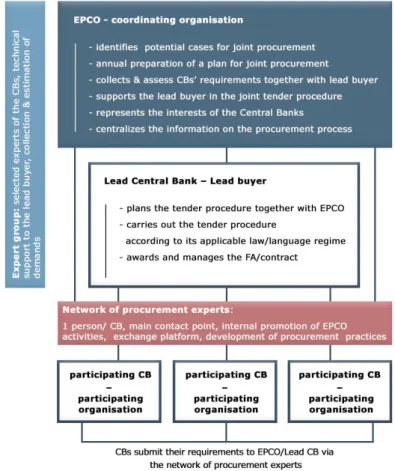
1. Standard joint contracts, where the needs and requirements of the central banks have to be known in depth before the procurement procedure is performed. All participating authorities are closely involved in the procurement.
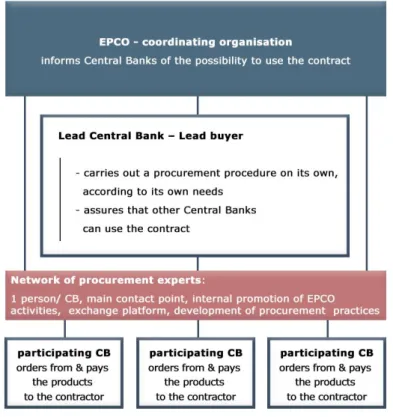
2. Piggy-backing, where a contracting authority carries out the procurement on its own but allows other contracting authorities the option of utilising the contract.
In the majority of cases, the contracts and framework agreements are centrally managed by one of the central banks, which takes the role of “leading central bank” with the support of EPCO, but they are implemented (ordered and paid for) directly by the participating central banks. There are different ways of involving the central banks in the tender procedures, ranging from pre-commitments on specific volumes, to an optional purchase with no commitment in advance depending on the type of procurement.
The interest of the central banks in participating in the different procedures depends very much on the specific product/service to be procured.
EPCO mainly procures the following product/services categories: Information Technology (28 %), Market Data Services (28 %), Banknote related items (12.5 %), Travel services (6.5 %) and a few procurements in other areas of goods and services8.
In its function as coordinator of joint procurement procedures, EPCO defines itself as sui generis central purchasing body. EPCO, – created by the Governing Council of the European Central Bank (ECB) - does not have legal personality of its own and acts as an office under the legal personality of the Banque Centrale du Luxembourg (BCL). In 2008, the Governing Council of the ECB appointed the Banque Centrale du Luxembourg (BCL) to host EPCO. The current mandate for BCL lasts until 31 December 2019. The mandate for EPCO itself is not limited in time but its activity is reviewed and evaluated by the EPCO Steering Committee. In each case, the ECB Governing Council nominates the bank that will act as hosting central bank.
According to the Decision of the Governing Council, EPCO fulfils the following tasks:
3. identifies potential cases for joint procurement that fall within or outside the scope of this Decision on the basis of procurement needs that central banks address to EPCO;
4. prepares and updates as necessary an annual procurement plan for joint tender procedures based on an assessment under point 1;
5. prepares common requirements in cooperation with the central banks participating in a joint tender procedure;
6. supports the central banks in joint tender procedures;
7. supports the central banks in procurement relating to common projects of the European System of Central Banks, if so requested by the central bank(s) leading the project
EPCO may also carry out tasks other than those specified above, notably to facilitate the adoption of best procurement practices within the Eurosystem and to develop the infrastructure (e.g. skills, functional tools, information systems, processes) required for joint procurement.
7 http://eur-lex.europa.eu/legal-content/EN/TXT/PDF/?uri=CELEX:02008D0017-20160112&from=EN 8 Data from 2015