Patterns of order processing
A study of the formalization of the ordering process
in order-driven manufacturing companies
Uitgever: Labyrint Publications Pottenbakkerstraat 15 – 17 2984 AX Ridderkerk
The Netherlands
Tel: + 31 (0)180 463962
Drukwerk: Offsetdrukkerij Ridderprint B.V., Ridderkerk
ISBN 90-5335-034-9
© 2004, G.A. Welker
Alle rechten voorbehouden. Niets uit deze uitgaven mag worden verveelvoudigd, opgeslagen in een geautomatiseerd gegevensbestand, of openbaar gemaakt, in enige vorm of op enige wijze, hetzij elektronisch mechanisch, door fotokopieën, opnamen, of enige andere manier, zonder voorafgaande schriftelijke toestemming van de uitgever. All rights reserved. No part of this publication may be reproduced, stored in a retrieval system of any nature, or transmitted in any form or by any means, electronic, mechanical, now known or hereafter invented, including photocopying or recording, without prior written permission of the publisher.
RIJKSUNIVERSITEIT GRONINGEN
Patterns of order processing
A study of the formalization of the ordering process in order-driven manufacturing companies
Proefschrift
ter verkrijging van het doctoraat in de Bedrijfskunde
aan de Rijksuniversiteit Groningen op gezag van de
Rector Magnificus, dr. F. Zwarts, in het openbaar te verdedigen op
donderdag 7 oktober 2004 om 16.15 uur
door
Geertruida Annigje Welker geboren op 27 april 1965
Promotor : Prof. dr. J. Wijngaard Copromotor : Dr. J. de Vries
Beoordelingscommissie : Prof. dr. D.C. Whybark Prof. dr. ir. J.C. Wortmann Prof. dr. A.H. van der Zwaan
Preface
My interest in the ordering process, more specifically in the coordination between Sales and Production, stems from my working experience at Smurfit De Halm Karton. Working at the logistical department, I was caught in the middle of all kinds of ambiguous situations concerning coordinating demand and production. Without these experiences I would not have been able to really understand the subject.
As a ‘logistical expert’ in planning, I thought it would be easy to plan a doctoral research and just work according to this planning in order to flow smoothly through it. However, I found out that there are all different kinds of hurdles to overcome. Starting out as a pragmatist I have learnt to become more of a scientist. Many people contributed to this learning process and to the fact that I succeeded in finishing this thesis.
Both Jacob Wijngaard and Jan de Vries played an important role in my doctoral research; they not only made it possible to switch over from industry to the university, but they also became my supervisors. In guiding me through the research they formed an ideal team. Jacob inspired me to extend my horizon by exploring new subjects, while his pragmatism helped me to move on whenever necessary. I enjoyed his enthusiasm about the empirical research and I am grateful for his confidence. Jan motivated me to become more of a scientist and triggered me to continue improving the analyses and writing by his conscientious way of reading my thesis. I thank both of them for the intense and personal involvement.
I am grateful to the members of the reading committee, Clay Whybark, Hans Wortmann and Ad van der Zwaan for their efforts and their useful comments on the manuscript. In the future I hope to share further ideas and co-operate with them, one way or another.
In total seven companies participated in this research. I will not name them, as they asked to remain anonymous. However, I would like to express my gratitude to the contact persons of each company, who made it possible for me to study the ordering processes thoroughly and to obtain all necessary data. Of course, I also thank all the people of the various companies who participated in the interviews or were involved any other way during my research. I enjoyed it very much to walk around and feel the intensity involved in order processing.
Furthermore, I like to thank all those people that supported me one way or another these last years. I thank Pauline Schröder for assisting me in coding the data in Atlasti, Christian Hut for updating Reference Manager, Aarnoud for helping me in graphically drawing the causal networks, Leonieke for helping me in all kinds of practical things concerning Atlasti and Reference Manager, Margré for improving my English, Martin for helping me to ‘grasp the tap’ of organizing the last phase of finishing the thesis and of course Ilse and Hans for wanting to be my paranimfs.
I was lucky to be surrounded by my colleagues of the Production Management Group: Jacob, Jan, Taco, Manda, Martin, Leonieke, Marjan, Marjo and Renny. They have created a very pleasant working atmosphere and were always willing to help me. With respect to doctoral defenses, we are like a relay team: the baton was passed on by Jan to Taco to Manda to Martin and now it is my turn. Leonieke, I pass on the baton to you! I also owe thanks to Klaske and Manon (who were always willing to listen and help), Hans van Polen (my buddy from the start), Cees Reezigt (my neighbor on the eight floor and ‘Bio5-boss’) and Dirk Pieter (an always present and pleasant companion at conferences). Furthermore, I thank all other colleagues that have lightened up my working days.
Many friends also played an important role in surviving these years. First of all, I thank the ‘ladies of De Halm’, Carin, Ellis, Harmien, Jacq-Anne, Nadja and Ursula. We have lived through many good and bad times, but our planned Sundays were always relaxed, pleasant and comforting. Of course, I also thank the ‘uncomplicated and easy-going ladies’, Aukje, Gwenny, Manda, Maryse and Nienke for the relaxation offered through our dates (shopping, dinners, movies and so on). I owe special thanks to Peter Veen who helped me to put the writing process into perspective. Furthermore, I would like to thank all my close friends and my family (Welker as well as De Vries) for their sympathy, friendship and patience. I am going to make it up to you all!
Special thanks go to my parents; my father always stimulated me to continue studying and accept new challenges. As a little girl, I wanted to be a teacher; my father agreed but also mentioned that I should pursue a teaching job at high school or university. My mother was and is always there to support me in combining work and family life. While I am writing this preface, she is taking care of my children.
Writing this thesis would have been impossible without Aarnoud. We both were unaware of the amount of workload and time required for the doctoral research. He helped me through the hard times and joined in celebrating the good times. His always-present support, both practical and emotional, has no equal. Daniëlle and Martijn supported me in their own way. When I started working at the University Daniëlle was 4 years old and Martijn only 2. It is fascinating to see how much they learnt in the years that I was writing this thesis. They not only learnt to read and write technically, but also to use these techniques for writing a paper and presenting it to their classmates. I enjoyed sharing our experiences. They always were there to comfort me with their hugs and kisses.
I dedicate this book to Aarnoud, Daniëlle and Martijn.
Gera Welker
CONTENTS
1 INTRODUCTION TO THE RESEARCH DOMAIN ... 1
1.1 Introduction... 1
1.2 Complexity of the ordering process ... 3
1.3 The use of IT applications in structuring the ordering process ... 4
1.4 Approaches to structuring the ordering process ... 6
1.5 Research Questions ... 9
1.6 Research process ... 11
1.7 Outline of the thesis ... 13
2 CONCEPTUALIZING THE ORDERING PROCESS ... 15
2.1 Introduction... 15
2.2 The ordering process: an overview ... 16
2.3 Influence of the customer order de-coupling point (CODP) ... 20
2.4 Three dimensions of the ordering process... 22
2.5 The logistical decision-making dimension... 24
2.6 Information processing... 26
2.7 Organizational setting ... 30
2.8 Summary and discussion... 33
3 FORMALIZATION OF THE ORDERING PROCESS... 37
3.1 Introduction... 37
3.2 Defining formalization ... 37
3.3 Formalization of the logistical decision making ... 40
3.4 Formalization of the information processing ... 44
3.5 Formalization of the organizational setting... 47
3.6 Considerations with respect to the degree of formalization ... 50
3.7 Summary ... 53
4 TOWARDS A CONCEPTUAL MODEL ... 55
4.1 Introduction... 55
4.2 A conceptual model of formalization of the ordering process ... 55
4.3 Operationalizing the influencing variables... 57
4.4 Complexity of the ordering process ... 62
4.5 Performance ... 65
4.6 Patterns of order processing ... 67
4.7 Summary ... 71
5 RESEARCH DESIGN ... 73
5.1 Introduction... 73
5.2 Using case study research ... 74
5.3 Selection of cases ... 76
5.4 Research protocol... 78
5.5 Analysis of data... 83
6 DESCRIPTION OF THE CASES ... 87 6.1 Introduction ... 87 6.2 Company A ... 88 6.3 Company B... 98 6.4 Company C... 109 6.5 Company D ... 120 6.6 Company E... 130
7 WITHIN- CASE ANALYSES... 143
7.1 Introduction ... 143
7.2 Analysis company A ... 144
7.3 Analysis company B... 149
7.4 Analysis company C... 156
7.5 Analysis company D ... 161
7.6 Analysis company E... 167
7.7 Summary ... 173
8 CROSS-CASE ANALYSIS ... 175
8.1 Introduction ... 175
8.2 Classifying the ordering processes ... 177
8.3 The passing-on pattern of order processing... 178
8.4 The puzzle-solving pattern of order processing ... 180
8.5 The compromising pattern of order processing ... 186
8.6 Discussion of main findings and concluding remarks... 191
9 CONSOLIDATION AND CONCLUSIONS... 195
9.1 Introduction ... 195
9.2 Consolidation of the framework... 195
9.3 The results of applying the framework... 198
9.4 Diagnostic value as perceived by the companies involved ... 200
9.5 Suggestions for further research... 201
References ... 203
Appendices... 211
Appendix I Questionaire Manager Sales ... 213
Appendix II Questionaire Managers Production ... 217
Appendix III Questionaire Employees Sales Function ... 222
Appendix IV Questionnaire Planning ... 227
Appendix V Legend Actor Activity Diagram... 233
Summary... 235
1 INTRODUCTION TO THE RESEARCH DOMAIN
1.1
Introduction
Manufacturing companies are increasingly confronted with higher market demands related to the flexibility, speed, and reliability of delivery. These demands force them to become increasingly customer-oriented. In their efforts to achieve customer-orientation, manufacturing companies may focus on producing a broad variety of products or on delivering the products as quickly as possible. At the same time, they must remain efficient through such means as reducing inventories or set-up times. As a result, the classic conflict between external objectives related to responsiveness and internal objectives related to efficiency appears to be intensifying within companies. In the search for a proper balance between these internal and external objectives, the ordering process plays an important role (Kritchanchai and MacCarthy 1999; Lin and Shaw 1998; Waller, Woolsey, and Seaker 1995). By means of the ordering process demand requirements and production capacity must be matched. On the one hand, the ordering process must contribute to the responsiveness of the company and its ability to act quickly and flexibly on customer demands. On the other hand, this process must ensure an efficient production process in order to keep abreast of the competition.
In practice, organizations appear to balance these conflicting objectives by making more extensive use of information technology (IT). This technology offers the potential to accelerate information processing, thereby increasing the accessibility of information as well as linking and integrating information about various business processes. One way in which IT can be used to enhance the ordering process is the implementation of Enterprise Resource Planning (ERP) systems, which integrate the information needed to coordinate demand and production. Such systems structure information-processing activities (e.g., order acceptance and order entry) according to a formalized model and specify the sequence in which they should take place. The implementation of an ERP system often reduces the number of man-hours needed to handle orders and translate customer specifications into production orders. IT can also be used to facilitate communication with customers, suppliers, and colleagues by means of Intranet and Internet. Customers may send their orders by e-mail, or sometimes even book them directly into the company’s production scheme. The roles of the parties involved in order processing (e.g., Sales, Planning and Production) change as a result, possibly leading to additional interpretations of these roles. Obviously, the use of IT influences the ways in which orders are processed within companies, and it may also influence the structuring of the ordering process by integrating order-processing functions to improve efficiency and respond more quickly to the requirements of customers (e.g. El Louadi 1998).
It is interesting to note, however, that the use of IT applications proceeds from the assumption that the ordering process can be modeled and formalized to some extent. Formalization is commonly defined as the degree to which activities, decisions, and behavior are controlled by formal rules and procedures (Daugherty, Stank, and Rogers 1992). Because activities and behavior are prescribed, the ways in which the various parties involved in the ordering process must handle orders are clearly specified. As a consequence, formalization may leave little leeway for improvisation (Volberda 1992). In the organizational literature it is argued that formalization can easily lead to inflexibility and rigidity (Prakken 1994; Volberda 1992). For example, a fixed delivery time for accepting customer orders may impede the company’s ability to respond flexibly to a customer request for delivery within this time frame. It is thus obvious that, while IT applications are used to structure the ordering process with the goal of becoming more responsive, developing and implementing the applications requires at least a certain degree of formalization. Such formalization, in turn, may lead to inflexibility. It seems paradoxical, therefore, that manufacturing companies would use formalization as a means of improving responsiveness. We will refer to this issue as the formalization paradox. This paradox raises the question of whether it is possible to formalize the ordering process and become more responsive as a result.
This study focuses particularly on the possibilities of formalization of the ordering process and on the effects of such formalization on balancing responsiveness and efficiency. This chapter introduces the domain of our research – formalization of the ordering process in manufacturing companies – and discusses the practical and theoretical relevance of the study. It begins by providing an overview of the complexity of the ordering process in manufacturing companies (Section 1.2). The following section (1.3) discusses how manufacturing companies try to cope with this complexity in practice and addresses issues of formalization relating to the use of IT applications in the ordering process. Section 1.4 discusses several theoretical approaches that have been proposed for dealing with structuring processes to achieve responsiveness while maintaining efficiency, focusing specifically on studies related to the ordering process. We argue that these studies do not provide a thorough examination of formalization of the ordering process. Both practical and theoretical contributions for structuring the ordering process form the basis for formulating the research questions in Section 1.5. Section 1.6 then describes the research process of the study and addresses the aim, method, and output of each research phase. The chapter concludes with an outline of this thesis (Section 1.7).
1.2
Complexity of the ordering process
The ordering process is the process in which customer orders are translated into product orders, resulting in the delivery of goods according to customer requirements for quality, time, and quantity. The ordering process must coordinate demand and production if customer requirements are to be fulfilled (e.g. Bertrand, Wortmann, and Wijngaard 1990). Because of their importance to this coordination, characteristics of both demand and the production system clearly influence the complexity of the ordering process. For example, because it is not always possible to predict when customers will place orders, what quantities they will order, or what combination of products they will order, demand can be uncertain. Production can be uncertain as well, due to such factors as unforeseen resource availability problems caused by machine breakdowns or constraints on employee availability. The availability of raw materials can also cause uncertainty, as suppliers may deliver the wrong quantity or at the wrong time. In a customer-oriented environment, uncertainty of demand is greater than it is in less customer-oriented environments, because customers have more specific and varying wishes concerning the products. Although it may be possible to estimate demand on an aggregate level in customer-oriented environments, it is often impossible to predict demand accurately on a detailed level (e.g. Konijnendijk 1992).
The organizational aspects of the ordering process are also complex, as the coordination of demand and production involves different disciplines or functions. The ordering process can be viewed as an interface process in which transactions or interactions involve at least two business functions (Parente 1998; Rho, Hahm, and Yu 1994). An interface process often implies strong interdependencies among the various parties involved. Sales and Production are reciprocally interdependent in the ordering process, as Sales provides customers with products made by Production. The production situation determines whether Sales must sell what Production has produced (make-to-stock situations) or Production must produce what Sales has sold (make-to-order and engineer-to-order situations) (Konijnendijk 1992). In customer-oriented environments, customers have a stronger hold on the ordering process, ordering products according to their own specifications. Production is therefore challenged to produce more customized products. More customer-specific demand results in greater product variety and frequently in shorter product life cycles (Forza and Salvador 2002). Such product proliferation often exerts pressure on operational efficiency. For example, economies of scale may be lost when Production must produce smaller batches.
The ambiguity of the order-processing situation also influences the coordination of demand and production. Sales and Production are confronted daily with ambiguous situations in which they must make trade-off decisions between customer-responsive action (accepting rush orders) and efficiency-related action (adhering to the planning
schemas) (Crittenden, Gardiner, and Stam 1993). Research on this subject indicates that the differences in the process characteristics, structure and culture between Production and Sales tend to increase the complexity of coordination (Konijnendijk 1992). Production and Sales have different and often conflicting interests (Parente 1998; Crittenden 1992). As stated by Konijnendijk (1992), Sales has an interest in maximizing turnover while Production has an interest in minimizing costs. In general, therefore, Sales tends to be strongly motivated to accept as many orders as possible and to accept delivery times that are sometimes difficult to realize. The ultimate goal of Production, on the other hand, is to make every effort to achieve optimal capacity utilization, through such measures as producing in large batches.
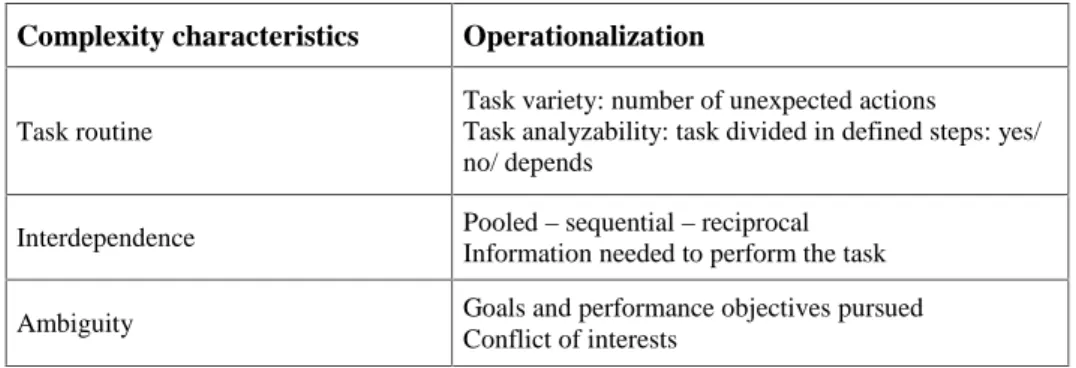
In summary, uncertainties of demand and production, interdependencies among the parties involved, and the ambiguity of goals and interests all contribute to the complexity of the ordering process. The ordering process is less complex (in terms of interdependency and ambiguity) in production situations with standardized orders than it is in situations in which orders are based on customer-specific demand (Kritchanchai and MacCarthy 1999; Lin and Shaw 1998; Waller, Woolsey, and Seaker 1995). In the latter situation, orders are less standardized, demand is more uncertain, and more information must therefore be exchanged between customers and Sales, and among the various parties involved in processing orders. In exchanging information, interdependencies among the parties are more intense, possibly leading to ambiguity in goals and interests. We therefore expect the ordering process in customer-oriented manufacturing companies to be more complex in terms of interdependency and ambiguity than it is in less customer-oriented contexts.
1.3
The use of IT applications in structuring the ordering process
Manufacturing companies face a challenge to structure their ordering processes in such a way as to maintain efficiency while becoming more responsive. In practice, it appears that many companies use IT to address the issue of structuring. In particular, companies seek to use IT applications to accelerate information processing, to facilitate access to information, and to integrate order-processing functions (El Louadi 1998).
As argued before, the use of IT applications proceeds from the assumption that the ordering process can be modeled and formalized to some extent. In this context, it means assuming that activities and decisions involved in the ordering process can be controlled by formal rules and procedures (Daugherty, Stank, and Rogers 1992). An activity or decision can be formalized when unambiguous rules can be given regarding the handling of the input. This handling of input must not be dependent on the interpretation by persons (Bots et al. 1990). It is recognized that not all activities or
decisions can be formalized, particularly ambiguous decisions requiring qualitative rather than quantitative measures (Shtub 1999). Studies of organizational structuring show that intuition and experience have important roles to play in handling decisions that must be made in complex environments with complex tasks. Intuition is seen as part of implicit mental models and experience of individuals, and is often referred to as tacit knowledge, as compared to explicit knowledge, which refers to formal models, rules, and procedures (Spiegler 2003). Some authors argue that it is difficult, if not impossible, to formalize tacit knowledge. According to Shtub, “(…) in reality many decisions are based on intuition and experience and it is very difficult (or impossible) to automate these decision-making processes” (Shtub 1999 p.9). On the basis of these notions, we assume that the complexity of the ordering process may be related to the possibilities of formalization of the ordering process.
As noted above, actors involved in the ordering process are often confronted with ambiguous situations in which intuition and experience play an important role in decision-making. Decisions regarding whether to accept rush orders represent one example of such a situation. When a customer requires an order to be delivered sooner than the stated delivery time, the decision to accept the order is based not only on the availability of material and capacity, but also on the importance of the customer and the extra production costs involved in rescheduling production. Rescheduling the order may also affect the timely delivery of other planned orders. Although information concerning the availability of material and capacity may be formalized, knowledge about the importance of the customer and the costs of rescheduling is often not explicit. In such situations, the exchange of information often depends on informal communication between Sales and Production.
In using IT to automate the ordering process, manufacturing companies often implement an Enterprise Resource Planning (ERP) system. ERP refers to software architecture designed to facilitate the flow of information among various enterprise-wide business functions, including manufacturing, logistics, finance, and human resources (Shtub 1999). They are therefore information systems for integrating various business processes. The ordering process is one of the business processes that can be captured within ERP applications. Experience has shown, however, that ERP applications do not always function adequately in order-processing practice. Research on the functioning of these applications reveals a number of fundamental shortcomings and weaknesses. One example is that ERP applications are often offered as application packages for which the processes are modeled according to a standard “branch-model” rather than as applications developed in-house with processes tailored to company-specific processes (Hong and Kim 2002). According to Swan et al. (1999), the notion of a universally applicable “best practice” – the standard branch model – is an illusion. Because of their unique contexts, most manufacturing companies prefer to add new functionalities to ERP systems or to reconfigure the applications (Swan, Newell, and Robertson 1999). It
is also acknowledged that ERP is not always capable of modeling all procedures of the companies that intend to use ERP (Hong and Kim 2002). Further, when a company has chosen an ERP application, users must be capable of both understanding and using the system (El Louadi 1998).
We assume that the implementation of ERP applications may be less successful when the application does not fit the unique order-processing situation, when the ordering process is insufficiently modeled, or when there is a lack of understanding about the application. Some of these problems partly arise as a result of formalization issues, as they relate to questions concerning the appropriate formalized model to be used for a specific order-processing situation and the feasibility of formalizing all aspects of the ordering process to the extent necessary to implement ERP systems. It is therefore interesting to develop a better understanding of these formalization issues with regard to structuring the ordering process.
1.4
Approaches to structuring the ordering process
In recent years, various approaches have been introduced for structuring processes in order to achieve responsiveness as a main competitive advantage. Analysis of these theoretical approaches shows that they can be distinguished according to the extent to which they emphasize the use of IT or empowerment as important elements of the design. Business Process Re-engineering (BPR) is an approach in which the possibilities of IT play an important role in restructuring or redesigning processes. But, for instance, the socio-technical approach stands in contrast to this approach, as does agile manufacturing, in which individual empowerment seems to play a more important role than IT in redesigning organizational processes. These differences in emphasis may relate to the formalization paradox mentioned above, in that the use of IT and the associated degree of formalization appear to be more or less opposed to improvisation and creativity in finding solutions for handling customer-specific demands. It is therefore logical to expect that these approaches would also address issues of formalization. We will now discuss the various approaches briefly to see if they provide further insight in formalization issues associated with structuring the ordering process. The Business Process Re-engineering (BPR) approach strongly advocates the use of IT to improve business performance. As stated by Hammer (1990), “(…) use the power of modern information technology to radically redesign our business processes in order to achieve dramatic improvements in their performance” (p.104). According to adherents of BPR, business processes should be the most important focus of organizations. A process focus means studying the ways in which orders are processed without considering functional boundaries or specialization (Peppard and Rowland 1995). Studies of re-engineering the ordering process emphasize mapping and analyzing the
ordering process based on the flow of orders within the company (see for instance Waller, Woolsey, and Seaker 1995; Shapiro, Rangan, and Sviokla 1992). While these studies suggest various guidelines for improving the ordering process, they do not address the ordering process from the perspective of formalization.
Pine (1993) introduced another approach to responding flexibly to changing customer demand. His work on mass customization proposes the use of various points of customization to produce customized products while maintaining volume production of standard products. Modularity (i.e., assembly using standard modules) is often used to address the problem of product proliferation. The enabling influence of IT is evident in this modularity approach. For example, specific software (e.g., product configurators) can be designed to support both customers and manufacturing companies in matching specific demands with the best-suited product modules. Forza and Salvador (2002) investigate the impact of these software programs on the organization of the ordering process. Their study explicitly addresses the necessity of rationalizing and formalizing knowledge retained by the actors responsible for various aspects of the configuration process in order to develop product configuration systems. The authors use a case study to show how knowledge transfer can succeed and result in an adequate product configuration system. They also describe some of the difficulties that can be encountered in implementing the system. These difficulties are related to the changing roles of actors involved in the process and to interfunctional cooperation in “consensus building on product model definition,” among other issues (Forza and Salvador 2002 p.97).
Another concept is time-based competition, introduced by Stalk and Hout (1990). In a time-based environment, they argue, it is necessary to compress time within every phase of the production creation and order cycle in order to achieve responsiveness. For example, they suggest offering customers more choice in less time by filling orders faster and having shorter processing times than competitors. For structuring the ordering process, Stalk (1988) proposes simplifying system procedures and improving computer-based technology to increase responsiveness. Kritchanchai and MacCarthy (1999) investigated responsiveness of the order fulfillment process, primarily based on concepts of time-based competition. Although their study makes the concept of responsiveness more tangible, it does not explicitly address issues of formalization.
Lean thinking is an approach focusing on the satisfaction of customer requirements, depending on how the customer perceives value. The first objective of lean thinking is to improve efficiency by eliminating unnecessary steps, aligning all steps in a continuous flow, and recombining labor into cross-functional teams. According to Womack and Jones (1994), companies can also become more flexible and responsive to customer wishes by implementing the lean approach. In addition to the concept of lean manufacturing, the concept of agile manufacturing was developed to meet the needs of organizations to become more flexible and responsive to customers (Gunasekaran 1999). Agile manufacturing is defined as the ability to thrive in a competitive
environment of continuous and unpredictable change by reacting quickly and effectively to changing markets. Sharp et al. (1999) examined the need for an agile manufacturing environment and found IT to be an important enabler for agility. Because an agile manufacturing environment must be dynamic and effective in meeting constantly changing goals and performance objectives, it requires multi-skilled and flexible people, a capacity for shifting job descriptions and skills, along with empowerment, teamwork, and continuous improvement. Organizing through teamwork automatically requires that teams have access to rapid and reliable communication and information systems for communicating and doing their work (Sharp, Irani, and Desai 1999). Although the concept of agile manufacturing apparently focuses on using IT to support empowerment and teamwork, it does not clarify the formalization issues associated with the process.
The socio-technical approach is focused on introducing whole task groups in order to accelerate information processing and to safeguard the implicit, personal (tacit) knowledge of those involved. Whole task groups are self-controlling and composed in such a way as to be responsible for a complete task. Such groups contain all of the expertise necessary to manage and control programmed events as well as such non-programmed events as specific customer requests (see Kuipers and Van Amelsvoort 1997). According to the socio-technical approach, the implementation of self-controlling teams may lead to the desired speed of information processing and responsiveness to changing customer preferences while preserving the necessary expertise.
The preceding discussion of approaches to structuring the ordering process clearly demonstrates the importance of structuring processes to increase responsiveness while maintaining efficiency. The importance of the ordering process in achieving responsiveness is also generally acknowledged (Kritchanchai and MacCarthy 1999; Lin and Shaw 1998; Waller, Woolsey, and Seaker 1995). While the approaches described above tend to emphasize using the enabling capacity of IT and empowerment as design parameters for achieving responsiveness, they do not discuss related formalization issues. The Forza and Salvador (2002) study of product configuration systems is the only study to address the issue of formalization in relation to knowledge transfer. Although they mention several implications of using formalized configuration systems in order processing, the study provides no deeper investigation of formalization of the ordering process itself. We conclude that, while studies tend to acknowledge the importance of the ordering process in achieving responsiveness, the ordering process has yet to be examined from the perspective of formalization. This study seeks to fill this gap.
1.5
Research Questions
The preceding discussion demonstrates that the ordering process is of great importance for manufacturing companies seeking to find a balance between fulfilling ever changing market demands and achieving an efficient production process. In practice, manufacturing companies often use IT applications, e.g. ERP, to help balance the internal and external objectives within the ordering process. Implementing IT applications assumes a certain degree of formalization, however. In other words, manufacturing companies must apparently formalize the ordering process to some extent in order to benefit from IT. The possibilities of formalization of the ordering process may be limited by the complexity of the order-processing situation. It is therefore interesting to investigate variables that influence the degree of formalization. Because studies also argue that formalization may have negative effects on flexibility and responsiveness, we are also interested in the effects of formalization of the ordering process.
This research seeks to develop a framework for describing and analyzing formalization of the ordering processes of manufacturing companies. The ultimate objective of the framework is to provide insight into variables that influence the degree to which the ordering process is formalized as well as the effects of formalization. With this insight, we hope to contribute to a more adequate design methodology for structuring the ordering process.
The ordering process concerns trade-off decisions involving the coordination of demand and production, information processing (with respect to translating customer orders into production orders), and the organizational setting of the interface function. Because the ordering process can be viewed as multidimensional, we take an interdisciplinary approach to the ordering process in developing the framework. To this end, we study formalization of the ordering process from various perspectives, integrating the insights thus obtained into the framework. First, we use perspectives from operations management to study the logistical decision-making involved in the ordering process. Second, we use perspectives from information management to elaborate the information processing aspects of the ordering process. Finally, we use perspectives from organizational theories to study the organizational setting of the ordering process.
The framework is also grounded on empirical data gathered from a study of five different companies. Because the framework integrates both theoretical and practical considerations regarding formalization of the ordering process, it represents an initial step in building theory to develop guidelines for designing the ordering process. This leads to the following main research questions:
1. How can we conceptualize formalization of the ordering process?
2. What considerations underlie the degree of formalization of the ordering process? 3. What are the positive and negative effects of formalization of the ordering process?
The first research question focuses on conceptualizing the phenomenon of the ordering process and, more specifically, on formalization of the ordering process. Because there is no consensus in the literature regarding either the definition or the scope of the ordering process, we begin by defining the ordering process more precisely. We conceptualize the ordering process as an interface process with three dominant dimensions: a logistical decision-making dimension, an information-processing dimension, and an organizational dimension. This conceptualization forms the foundation for modeling the ordering process in order to describe the process more thoroughly.
The next step is to conceptualize the formalization of the ordering process. Based on a discussion of various interpretations of the concept of formalization, we define formalization as the degree to which decisions, activities, and working relationships are controlled and coordinated by formal, explicit rules and procedures. We further elaborate and operationalize formalization for each dimension of the ordering process (i.e., logistical decision-making, information processing, and organizational setting). In addition, we investigate which of the three dimensions can be formalized and in what way.
The second research question concerns variables that influence the degree of formalization of the ordering process. On the basis of theory, we assume that demand characteristics and characteristics of the production system influence the complexity of the ordering process and the degree of formalization of the ordering process. While characteristics of demand and of the production system play a central role in this study, we also look for additional variables that may influence formalization of the ordering process.
To obtain a better understanding of formalization of the ordering process, we investigate the extent to which the complexity of the ordering process is related to the degree of formalization within this process. We assume that the complexity of the ordering process, which is characterized by such factors as interdependency and ambiguity, may hinder formalization. Formalization may also result in the routinization of activities and decisions, however, and may therefore reduce the complexity of the ordering process. For this reason, our empirical study not only investigates variables that influence the degree of formalization of the ordering process, but also examines the relationship between the complexity and the degree of formalization of the ordering process.
The third research question relates to the effects of formalization of the ordering process. The formalization paradox described above plays a central role in answering this research question. Organizations are pressured to formalize the ordering process – through the use of IT applications and other means - in order to be able to respond quickly and flexibly to customer demand. At the same time, however, we assume that formalization restricts the possibility of improvising on the basis of tacit knowledge and
may therefore result in rigidity and inflexibility. The positive and negative effects of formalization of the ordering process are therefore of considerable interest, particularly with regard to the contribution this process makes to the balance between responsiveness and efficiency.
The domain of our research is the ordering process in manufacturing companies. In studying the literature and building our conceptual model, we begin with all relevant production situations. We already argued that the ordering process is more complex in order-driven manufacturing companies, due to the more complex role of the ordering process in coordinating demand and production in these companies, thereby rendering formalization more difficult. The empirical study therefore focuses on order-driven manufacturing companies. We further justify the selection of cases in discussing the research design in Chapter 5.
1.6
Research process
The research process consisted of four main phases, in which both literature and empirical reality played important roles. We used case study research to study the ordering process in practice, as this method is particularly appropriate for presenting and studying phenomena in their real-life contexts (Yin 1994). This method also allowed us to observe the actual practice of formalization of the ordering process, resulting in an understanding of this phenomenon as the basis for generating meaningful, relevant theory (e.g. Meredith 1998).
This section discusses the research phases of this study (see also Table 1.1). Methodological aspects of the research, including the definition of our unit of analysis, our research protocol and research instruments are discussed further in Chapter 5. The goal of the first research phase was to explore the research domain in order to define and conceptualize formalization of the ordering process. To this end, we studied literature concerning both the ordering process and formalization. The resulting definitions of related concepts and classification of insights made it possible to arrive at a more elaborate conceptualization of formalization of the ordering process and to identify potential influencing variables. The interdisciplinary approach resulted in a conceptualization of the ordering process along three dimensions. Using the insights generated by the literature review, we developed a preliminary conceptual model to study formalization of the ordering process in practice.
In the second phase of our research, we aimed to test the adequacy of the preliminary conceptual model and to define the relationships assumed in the model. We conducted two exploratory case studies to gain further insight into the issues that confront manufacturing companies concerning formalization of the ordering process
(Welker and De Vries 2002). The findings of the exploratory case studies required further literature study. On the basis of the theoretical and practical insights thus obtained, we refined the conceptual model, operationalized the variables, and defined the relationships assumed to exist among the variables. We also developed a taxonomy of different order-processing patterns based on various combinations of demand and production characteristics.
Table 1.1 Overview of the research phases
Phase Aim Method Result
1 Define and conceptualize formalization of the ordering process (OP) and identify related variables
Literature study Classification of insights Definition of relevant concepts
Preliminary conceptual model
2 Test the adequacy of the conceptual model Define assumed relationships
Two exploratory case studies
Further literature study
Refined conceptual model Operationalization of variables
Taxonomy of order-processing patterns 3 Describe and analyze
relationships between variables and apply taxonomy
Five case studies Explanation of
relationships for each case
4 Consolidate the findings Relate findings of empirical study to theoretical insights obtained Generalization of findings Framework
The third phase of our research was the empirical research. On the basis of the conceptual model and the taxonomy, we elaborated a research protocol that we used to conduct an empirical study in five different manufacturing companies with customer-specific demand. We analyzed and discussed the data from each of the five companies separately on the basis of both the conceptual model and the taxonomy. The case analyses resulted in the classification of various ordering processes using the proposed taxonomy and explaining the relationships among the various influencing variables, and the degree of formalization and performance of the ordering process, as found in each company.
In the fourth and final phase of this study, our goal was to consolidate the findings of the five cases by means of a cross-case analysis in order to contribute to theory-building regarding formalization of the ordering process. We compared the findings of the five cases and related those findings to the theoretical insights we had obtained. We then consolidated the research findings into a framework for describing and analyzing formalization of the ordering process within manufacturing companies.
1.7
Outline of the thesis
The second chapter of this thesis focuses primarily on defining and conceptualizing the ordering process. We define the scope and boundaries of the ordering process and discuss the dominant dimensions of this process: logistical decision-making, information processing, and organizational setting. We argue that different order-processing situations can be distinguished on the basis of the position of the customer order decoupling point. We argue further that the three dimensions may vary according to the order-processing situation.
In the third chapter, we define the concept of formalization and conceptualize formalization of the ordering process according to the dimensions identified in Chapter 2. We elaborate operational measures for studying formalization along these three dimensions and argue that the degree of formalization of the ordering process can vary according to these dimensions.
In Chapter 4, we present our conceptual model for describing and analyzing the degree of formalization of the ordering process. We assume the characteristics of demand and production system to be interrelated and to affect the structuring of the ordering process and thus the degree of formalization of that process. We operationalize the variables used in the conceptual model and discuss the relationships assumed to exist between the influencing variables and degree of formalization along the three dimensions of the ordering process. We argue that the conceptual model allows us to distinguish various patterns of order processing.
Chapter 5 seeks to shed light on the methodological validation of our empirical study by discussing the selection criteria for the cases, the validity and reliability of the research methods, and the analytic generalizability of the results. The chapter also pays attention to some of the techniques used in describing and analyzing the data.
Chapter 6 describes the relevant variables, as identified in the conceptual model, for each of the cases studied. In Chapter 7, we analyze the relationships existing among the variables for each case and classify the order-processing pattern(s) for each case.
Based on the description and analysis of the separate cases, we conduct a cross-case analysis in Chapter 8 to discuss similarities and differences among the cases studied with respect to order-processing patterns and the degree of formalization. We first
generalize the findings for each order-processing pattern and then discuss the main findings of the empirical study.
We end the thesis by consolidating the framework and discussing the results of our research further in Chapter 9. We not only discuss the content-related value of our research, but also the analytical value of the conceptual model and the proposed taxonomy. Finally, we suggest directions for further research.
Figure 1.1 presents an overview of the outline of the thesis.
Figure 1.1 Outline of the thesis Research
design and research protocol (Chapter 5)
Conceptualizing the OP (Chapter 2) Formalization of the OP (Chapter 3)
Conceptual Model (Chapter 4)
Key variables and interrelationships operationalized
Description of the five cases studied (Chapter 6)
Within-case analyses (Chapter 7)
Consolidation and conclusions (Chapter 9) Cross-case analysis (Chapter 8)
2 CONCEPTUALIZING THE ORDERING PROCESS
2.1 Introduction
As discussed in the first chapter, the ordering process is an important logistical interface process in which demand and production must be matched. In literature, the ordering process is often considered as a business process. According to Davenport and Short (1990), a business process is “a set of logically related tasks performed to achieve a defined business outcome” (Davenport and Short 1990 p.12). They further argue that a process has two main characteristics: it includes both internal and external customers and goes beyond organizational (functional) boundaries. These characteristics apply to the ordering process as this process consists of a number of succeeding activities that are performed to achieve pre-defined performance objectives and which relate to different functional disciplines. According to Ould (1995), the ordering process is one of the core business processes because it concentrates on satisfying external customers and directly adds value in a way perceived by the customers. The ultimate goal of the ordering process is to satisfy the customers by delivering the ordered goods according to the order agreements. Starting point for our research is that the ordering process is a business process that involves various activities and is executed by various (functional) parties. Furthermore, it is an interface process in which demand and production must be matched.
The aim of this chapter is to conceptualize the ordering process in order to obtain a better understanding of the complexity and dynamics of the ordering process and the dimensions of the ordering process relevant in studying possibilities and consequences of formalization of the ordering process.
First, we give an overview of the literature with respect to the ordering process. In this literature study we focus on defining the scope attributed to the ordering process and the activities belonging to this process. This overview is reported in Section 2.2 and is consolidated by a definition of the ordering process. Section 2.3 discusses the influence of the customer order de-coupling point on the ordering process in order to discuss the differences in ordering processes per production situation. In Section 2.4 we argue that three different dimensions are significant for structuring the ordering process, namely the logistical decision-making, the information processing and the organizational setting and that these three dimensions are therefore relevant in studying formalization of the ordering process. The first dimension concerns the logistical decision-making and is discussed in Section 2.5. In Section 2.6 we elaborate the information-processing dimension of the ordering process and in Section 2.7 the organizational setting is discussed. This chapter ends with a summary and a discussion
of the relationship between the customer order de-coupling point and the three dimensions of the ordering processes (Section 2.8).
2.2
The ordering process: an overview
The ordering process is discussed in literature from various fields such as operations management, information management and marketing as well as in more general managerial literature. On the basis of several theoretical notions concerning the ordering process this section starts with a discussion of the definition and the scope of the ordering process.
In many cases the terminology with respect to the ordering process is rather confusing and ambiguous. The ordering process is referred to as the order fulfillment process, demand management, order processing, the order cycle and order management (Ballou 1999; Lin and Shaw 1998; Vollmann, Berry, and Whybark 1997; Waller, Woolsey, and Seaker 1995; Shapiro, Rangan, and Sviokla 1992; Bowersox, Closs, and Helferich 1986). Not only the terminology but also the scope attributed to the ordering process differs. Shapiro et al. (1992) take a broad definition in claiming that the ordering process starts with forecasting and capacity planning and ends with after sales activities like repair and maintenance. In this definition forecasting demand and planning capacity at medium term are included. Furthermore, in the study of Shapiro the ordering process concerns the complete course that an order goes through in a particular company. Other authors take a more narrow point of view by defining the ordering process from the moment a particular order enters the company (see for example Ballou 1999; Vollmann, Berry, and Whybark 1997; Bowersox, Closs, and Helferich 1986). They consider the administrative tasks concerning order processing as well as the physical activities like manufacturing as part of the ordering process. But, they all seem to emphasize other specific activities that take place within the ordering process. Waller et al. (1995) stress order quoting as the starting point of the ordering process. Vollmann et al. (1997) mention order-delivery-date promising as important part of the ordering process, while Lin & Shaw (1998) stress the planning of production, material and capacity. Ballou (1999) also pays attention to physical activities like extracting ordered items from inventory, and producing ordered items. Shapiro et al. (1992) explicitly name billing, returns and claims as part of the ordering process.
We notice that the activities mentioned by the various authors are mostly described in a chronological sequence from the moment a customer order arrives at a company until the customer order leaves the company in the form of finished goods and invoices. Therefore, we have clustered the different activities mentioned along with their chronological position in the ordering process in pre-sales, order processing, order
fulfillment and after-sales activities. Table 2.1 gives an overview of all activities addressed by the various authors.
Table 2.1 Overview of activities within the ordering process
Author Pre-sales Activities Order processing activities Order fulfillment activities After sales activities Shapiro et al. (1992) Order planning: Sales forecasting capacity planning Order generation Pricing Order receipt Order entry Order prioritization Scheduling Fulfillment Billing Returns + claims Post sales service
Vollmann et al. (1997) Forecasting Order entry Order delivery-date promising Physical Distribution Customer contact related activities Waller et al. (1995) Quotation Order Receipt Order acceptance Order entry Order Routing Order assembly and picking Shipping Installation Invoicing Bowersox et al. (1996) Order transmission Order processing Order selection Order transportation Customer Delivery + Follow-up Ballou (1999) Order preparation Order transmittal Order entry
Order filling Order status reporting
Lin & Shaw (1998) Order receipt Confirmation Planning of production, material and capacity Shop floor control
Inventory control Transport
In order to obtain a more detailed picture of the ordering process we will first describe the clusters of activities, as ideal types.
Pre-sales activities
The first group of activities is not directly linked to a specific customer order and can be defined as pre-sales activities. According to Shapiro et al. (1992), order planning is the first step in the order cycle. In their point of view the ordering process starts before there is an order or a customer. It begins with making a sales forecast by Marketing or Sales and a capacity planning by Operations or Manufacturing. The sales forecast specifies what Sales anticipates to sell in the next periods. The capacity plan specifies the capacity availability in the next period and results in plans concerning how much inventory will be created and how many people will be hired. These plans are examples of planning on the medium term in aggregated terms; they are not concerned with the details of individual orders or individual products offered.
Order processing activities
The order processing activities concern activities that are directly related to the handling of individual customer orders. This cluster of activities contains order quotation, order acceptation, order entry and order scheduling. We will discuss each of these activities in more detail.
Order quotation is related to specifying to the customer the product configuration, price and delivery time that matches the customer requirements (Waller, Woolsey, and Seaker 1995). When a product has to be configured to match the customer wishes, a product configurator is often available to select or configure the appropriate product.
Order acceptance is the activity in which order information of the customers is checked and is entered in the order information system. The checking of order information concerns (Ballou 1999; Waller, Woolsey, and Seaker 1995):
- the accuracy of the information such as item description, item number, quantity and price,
- the customer’s credit limit and - the availability of the requested items.
In production situations in which production is triggered by a customer order it is necessary to check if the requested delivery date is realizable or if a due date has to be assigned to the specific order. Vollmann et al. (1997) call this activity the order-delivery-date promising. If the company has a backlog of orders for future deliveries, the order-promising task is to determine when the delivery can take place.
After checking the order information and the delivery date the order is mostly entered in an order information system. Often, an order confirmation form is produced and the order is officially accepted (see Waller, Woolsey, and Seaker 1995). Sometimes, for example in cases of capacity shortage, it is necessary to make an order selection and prioritization (Shapiro, Rangan, and Sviokla 1992).
In most order-driven manufacturing companies, the next activity in the ordering process is the planning of production, materials and capacity (Lin and Shaw 1998). Shapiro et al. (1992) call this activity scheduling and refer to it as the step in which the
orders get slotted into an actual production or operational sequence. The customer orders have to be planned in a production scheme. This scheduling is an important input for purchasing, producing materials, and planning capacities on the short-term. Often, the scheduling of customer orders is the activity in which the order information is translated into production orders or work orders for the shop floor. Depending on the production scheme these production orders are released to the shop floor.
Order fulfillment activities
After the order is administratively processed the next main activity is fulfilling the order. The fulfillment activity is the physical activity to acquire the items requested through production, purchasing or stock retrieval, to pack them for shipment, to ship them and sometimes to install the items at the location of the customer (Ballou 1999; Waller, Woolsey, and Seaker 1995). Associated activities are the scheduling of the shipments and preparing the shipping documentation.
After sales activities
The last activity is the actual delivery of the products ordered to the customer. But also billing or invoicing is sometimes mentioned as part of this activity (Waller, Woolsey, and Seaker 1995; Shapiro, Rangan, and Sviokla 1992). Ballou (1999) pays attention to order status reporting, which refers to tracking and tracing the order through the order cycle to keep the customer informed about the order status and possible delays in order processing or delivery. This tracking and tracing is also important in finding possible errors during the process when handling returns and claims (Shapiro, Rangan, and Sviokla 1992). Shapiro et al. also consider post sales services like maintenance and repair as part of the ordering process.
Discussion
As mentioned before, starting point for this study is that the ordering process is an interface process in which demand and production must be matched. Analysis of the activities of the ordering process as described in the literature studied, shows that a very broad range of activities is attributed to the ordering process. Only the second cluster of activities, the ‘order processing activities’ are directly related to the processing of a customer order and are also concerned with the coordination between demand (as specified in customer orders) and production.
Analyzing the pre-sales activities we see that these activities take place before actual orders arrive at a company and are not directly related to the processing of specific customer orders. We do not consider these pre-sales activities as belonging to the ordering process itself. The order fulfillment activities take place after customer specifications are translated into a production order and are not concerned with coordinating demand and production. These activities are related to the manufacturing process and as such are not considered as part of the ordering process. The after sales
activities include delivering the product, invoicing and possibly returns and claims. It is clear that these activities are important in dealing with customers and are closely related to the customer service. But, they are only indirectly involved in the processing of orders and the coordination between demand and production. The after sales activities are also not considered as part of the ordering process.
In this section, we described and analyzed the scope of the ordering process. We limit the scope of the ordering process to the processing of specific customer orders. More accurately, we define the ordering process as the business process in which customer orders are translated into production orders to attain realizable order agreements. In other words, by means of the ordering process the company and the customers create a commitment to product specifications, order quantities and the timing of delivery.
2.3
Influence of the customer order de-coupling point (CODP)
In translating customer orders into production orders and realizable order agreements the ordering process has a central role in coordinating demand and production. This role depends on the position of the customer order de-coupling point (CODP), as the CODP indicates how far a customer order penetrates in the goods flow (Hoekstra and Romme 1987). Based on the position of the CODP1 four production situations can be identified: - Engineer-to-order (ETO): products are specifically designed, developed and
produced for a particular customer.
- Make-to-order (MTO): products are manufactured on the basis of mostly standard raw materials.
- Assemble-to-order (ATO): products are built of standard modules, but the final assembly is based on specific customer orders.
- Make-to-stock (MTS): products are standard and are produced on stock.
Figure 2.1 shows these four production situations for the basic goods flow of a company. Viewing from the CODP all upstream planning activities (towards the supplier) are based on forecasts and all downstream planning activities (towards the customer) are based on customer orders.
With respect to the production situations, it should be noted that in practice manufacturing companies might have varying mixes of positions. The CODP-positions may vary for different product groups or product-market-combinations and even for individual customer orders.
1 Hoekstra & Romme (1987) define also a fifth position of the CODP, namely make and ship to stock.
Figure 2.1 Possible positions of the CODP (Based on Hoekstra & Romme, 1987)
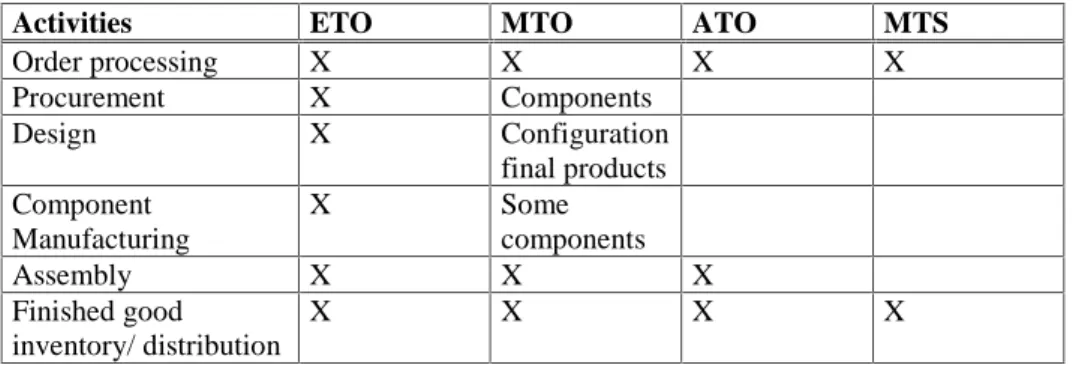
The position of the CODP determines which planning activities are based on forecasts and which activities are based on customer orders. The activities on the customer side of the CODP are referred to as ‘online’ activities that can only be started once a customer order arrives at the company (Bozarth and Chapman 1996). Depending on the position of the CODP, a customer order has more or less direct influence on production-related activities. According to Bozarth and Chapman (1996), in ETO-situations a customer order not only triggers the order processing activities, but also activities regarding procurement, design, manufacturing and finished goods inventory. On the other side, in MTS-situations the customer order only triggers the order processing activities and the activities regarding finished goods inventory. Table 2.2 sums up the relevant activities triggered by customer orders per position of the CODP.
The overview in Table 2.2 demonstrates that individual customer orders have the most direct influence on production in ETO-situations and the influence decreases when the CODP is positioned more downstream. In order to process customer orders in an ETO-situation, it is necessary to exchange information with Procurement and Design to be able to decide on order acceptation. But, to process a customer order in an
MTS-Raw material Parts End product Parts manufacturing Assembly ATO Order MTS Order MTO Order ETO Order Suppliers Customers
situation, it is only necessary to check the availability of the ordered items in the finished goods inventory. As a consequence, the coordination between demand and production will be more complex in ETO- and MTO-situations than in ATO- or MTS-situations and therefore the role of the ordering process in achieving coordination between demand and production will be more complex. In general, we conclude that the position of the CODP affects the complexity of the ordering process, in terms of number and interdependency of decisions and parties involved. In other words, we argue that the CODP is a main indicator of the order-processing situation and influences the structuring of the ordering process.
Table 2.2 Activities triggered by customer orders per position of the CODP
Activities ETO MTO ATO MTS
Order processing X X X X Procurement X Components Design X Configuration final products Component Manufacturing X Some components Assembly X X X Finished good inventory/ distribution X X X X
Based on Bozarth & Chapman, 1996, p.65
In the remainder of this chapter we will further elaborate the dimensions relevant in structuring the ordering process and thus relevant in the formalization of this process.
2.4 Three dimensions of the ordering process
In further exploring the structuring of the ordering process we study the ordering process from different perspectives. The perspectives are related to the definition of the ordering process. In order to deliver the right products at the right time, customer demand must be translated into production orders by means of the ordering process. We argued that to attain realizable order agreements demand and production must be coordinated and that the ordering process thus has an important role in coordinating demand and production. The role of the ordering process is visualized by modeling this process as an input-output system on a rather abstract level (see Figure 2.2).
Figure 2.2 Modeling the ordering process
From this model it is clear that within the ordering process information of customer demand has to be processed and matched with information of production constraints to specify production orders and come to order agreements with customers.
Coordinating demand and production is in the first place a logistical decision-making process. Decisions must be taken concerning accepting orders, allocating capacity and materials, promising delivery times and prioritizing orders to arrive at realizable order agreements. In order to make these decisions, frequently, a huge amount of information must be processed and exchanged between the actors involved in the ordering process. These actors are often part of different functional disciplines depending among others on the organizational setting of the ordering process. It can therefore be concluded that the logistical decision-making, the information processing and the organizational setting are three important dimensions of the ordering process. Distinguishing between these three dimensions is particularly helpful to explore further the complexity and dynamics of the ordering process, as coordinating demand and production consist of the logistical decisions to be taken and the associated information processing and information exchange between the actors involved. By discussing the logistical decision-making, the information processing and the organizational setting of the ordering process we are able to explore in more detail the structuring issues per dimension that are relevant in further investigating formalization of the ordering process. The three distinguished dimensions are therefore considered as the foundation of our framework to describe and analyze formalization of the ordering process. In the following sections we address the three dimensions of the ordering process to discuss the relationships between the dimensions and structuring the ordering process.
Ordering Process Customer Demand Order Agreements Production Orders Production Constraints Other Influences