The Placebo Effect: Dissolving the Expectancy Versus
Conditioning Debate
Steve Stewart-Williams and John Podd
Massey UniversityThe authors review the literature on the 2 main models of the placebo effect: expectancy theory and classical conditioning. A path is suggested to dissolving the theoretical impasse that has long plagued this issue. The key is to make a clear distinction between 2 questions: What factors shape placebo effects? and What learning mediates the placebo effect? The reviewed literature suggests that classical condi-tioning procedures are one shaping factor but that verbal information can also shape placebo effects. The literature also suggests that conditioning procedures and other sources of information sometimes shape conscious expectancies and that these expectancies mediate some placebo effects; however, in other cases conditioning procedures appear to shape placebo effects that are not mediated by conscious cognition.
The placebo effect is a topic of interest to psychologists and health practitioners in a wide variety of areas, and the question of the mechanisms underlying this effect is gaining increasing atten-tion. In this article, we review the literature related to the two main approaches to the placebo phenomenon: expectancy theory and classical conditioning. According to expectancy theory, placebo effects are mediated by explicit (consciously accessible) expect-ancies. In contrast, according to the classical conditioning ap-proach, they are conditioned responses (CRs).
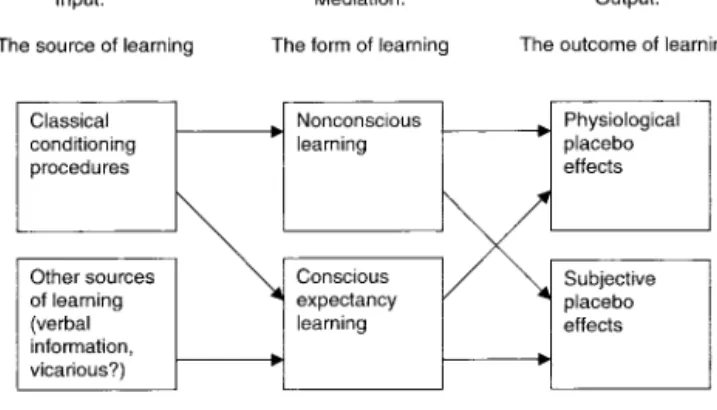
We begin with the problematic issue of defining placebos and placebo effects, and we then turn to the question of whether these effects actually exist. Having established that they do, we shift the focus to the main task of the article: determining the roles of expectancy and conditioning in the placebo effect. This task is divided into two parts. The first has the aim of clearing up the confusion that exists in the placebo literature concerning the rela-tionship between conditioning and expectancy. These approaches are often pitted against one another, under the assumption that either expectancy theory or classical conditioning accounts for the placebo effect. We reject this view, arguing that the two ap-proaches are compatible. One stumbling block is the assumption that classical conditioning is a particular form of learning, neces-sarily distinct from expectancy learning. However, conditioning is defined in terms of stimulus inputs and their subsequent effects. Specifically, an organism has been classically conditioned when exposure to a contingency between a conditioned stimulus (CS) and an unconditioned stimulus (US) results in a relevant change in the organism’s state or behavior. This leaves open the question of what mechanisms mediate conditioning. In some cases,
condition-ing procedures lead to nonconscious learncondition-ing, and the effects of conditioning are not cognitively mediated. In other cases, though, conditioning effects are mediated by conscious expectancies. Thus, expectancy theory provides an explanation for some exam-ples of classical conditioning. Furthermore, expectancies are not shaped only by conditioning procedures, but also by factors such as verbal information and observational learning (Kirsch, 1997; Rachman, 1977).
The next section applies the results of this analysis to the placebo effect. In the wake of the analysis, the question is no longer whether expectancy theory or classical conditioning ac-counts for the placebo effect. Instead, one is left with several distinct questions concerning (a) the sources of learning in the placebo effect, and (b) the mediation of such effects. First, are any placebo effects examples of classical conditioning? In other words, do conditioning procedures shape placebo effects? If so, are these effects mediated by explicit expectancies, or do they involve learning that is not cognitively mediated? Second, are there pla-cebo effects that are not a product of conditioning procedures? If so, are these effects mediated by expectancies? Our review sug-gests that some placebo effects are indeed examples of classical conditioning. Of these, some are mediated by explicit expectancies and some are not. On the other hand, some placebo effects are not examples of classical conditioning, as they are shaped by verbal information rather than conditioning procedures. These effects are presumably always mediated by explicit cognition. Our overall conclusion is that expectancy theory provides a partial account of the mediation of placebo effects, and conditioning procedures are one among several factors shaping such effects.
Definitions
Issues of definition have been fundamentally problematic in the placebo field (Gru¨nbaum, 1981). To try to bring some order to the proliferation of definitions for the terms placebo and placebo
effect, we begin with a description of the archetypal placebo event.
We then show that different definitions emphasize different as-pects of this schema and vary in how broadly they interpret those aspects on which they focus. Finally, we present the definitions that guide this review.
Steve Stewart-Williams and John Podd, School of Psychology, Massey University, Palmerston North, New Zealand.
This article was supported by a Bright Future Top-Achiever Doctoral Scholarship, administered by the Foundation for Research, Science, and Technology. We thank Malcolm Johnson for stimulating discussion and guidance.
Correspondence concerning this article should be addressed to Steve Stewart-Williams, School of Psychology, Massey University, Palmerston North, New Zealand. E-mail: [email protected]
The archetypal placebo event occurs in a medical setting. A physician gives a patient a pill that, unbeknownst to the patient, is merely a sugar pill. This is the placebo. Presently, the patient’s health improves, apparently because of the belief that the pill was a pharmacological agent, effective for the condition. This is the placebo effect.
Although the description is simple, distilling definitions from it is not. Many reasonable definitions can be concocted that fit these facts. Consider the term placebo. The narrowest definition would limit use of the term to sugar pills given by physicians to sick patients. No one accepts such a narrow definition, but problems occur as soon one tries to broaden it. To begin with, we might broaden the term to include any “substances, given in the guise of active medication, but which in fact have no pharmacological effect on the condition being treated” (Kirsch, 1985a, p. 238). This definition highlights the inertness of the intervention and is broad enough to accommodate inert pills, capsules, liquid medicines, topical creams, and injections. It can also accommodate the exotic array of medicines that have been prescribed by healers in the past but which are now viewed as placebos, such as lizard’s blood, tiger’s penis, crocodile dung, fox lung, spider web, snake oil, and powdered Egyptian mummy (M. Ross & Olson, 1981; Shapiro & Shapiro, 1997). Substances used to treat one condition are some-times used as placebos for others. These are known as active
placebos. Implicit in the concept of an active placebo is the idea
that a placebo need not be inert in any absolute sense but only in relation to a particular effect that is expected or sought by the placebo recipient or provider.
This is a good start, but it is necessary to go further and expand the definition to include procedures as well as substances (Shapiro & Morris, 1978; Wickramasekera, 1985). This broader definition is presupposed in the fact that control procedures used in clinical medical trials are typically labeled placebos. These include pla-cebo surgery (which involves opening the patient up but not performing any operation), placebo acupuncture (e.g., needling nonacupuncture points), and the use of machines that have not been turned on (such as transcutaneous electrical nerve stimulation devices; Hro´bjartsson & Gøtzsche, 2001; Moerman & Jonas, 2000).
The next question is whether the definition should encompass psychotherapeutic procedures. We argue that this is acceptable, but there are justified concerns to which we must attend (Kirsch, 1978; Lambert & Bergin, 1994; Wilkins, 1984). These trace to the suggestion that placebos are inert. The trouble is that placebos sometimes appear to have genuine effects. In the case of placebo substances and physical procedures, this seems to pose no prob-lem; one can just assume that they are physically inert but not psychologically inert (Kirsch, 1985a). However, if placebos are defined as agents that act through psychological rather than phys-ical mechanisms, extending the placebo concept to psychothera-pies becomes problematic. Indeed, the result would be that all psychotherapies are placebos by definition. This is clearly an undesirable conclusion. However, the problem is not with the idea that a psychotherapeutic technique could be a placebo (presumably not every imaginable psychotherapy is effective); the problem is with defining placebos as agents that act through psychological mechanisms. Why does it seem inappropriate to call all psycho-therapies placebos? Presumably, it is because this might suggest they are inert, and we know they are not. But this suggests that, in
our ordinary understanding of the term, inertness is more important than mechanisms.
Unfortunately, this leaves the original concern: Defining place-bos as inert seems to imply that they cannot produce effects. Our solution is that placebos should be considered inert only in the sense that they have no inherent powers to produce a given effect. Inherent powers are those that are “in” a substance or procedure. Later we discuss how the same placebo can lead to different effects depending on what the recipient is told about it or the recipient’s conditioning history with it. In such cases, the cause of the differ-ence could not be in the placebo, for the same placebo is used. The cause must be in the recipient. Defining placebos this way captures the intuition that placebos are inert but without ruling out the possibility that they can result in placebo effects. Placebo effects are effects that, though attributable to the administration of a substance or procedure, are not due to the inherent powers of a substance or procedure. If they occur at all, they must be due to some relevant belief or learning in regard to the placebo. Further-more, with the criterion of inherent powers, it is no longer prob-lematic to extend the placebo concept to psychological procedures. A psychotherapy placebo is simply a psychological procedure that has no inherent power to produce an effect. So, for instance, if a procedure works only because a person believes it will, it is a psychotherapy placebo. Otherwise it is an active treatment. Note that the response to an active treatment may be partly due to its inherent powers and partly to a placebo effect.
In the foregoing discussion, we began with a focus on the archetypal placebo, the sugar pill, and then found a suitably broad phrase (substances or procedures) to cover this aspect of the scenario. There was also an unstated assumption that the medical setting was a defining characteristic. Both of these initial emphases can be challenged. First, instead of starting with the sugar pill, some theorists focus on the physician’s actions more generally, or on the entire therapeutic context. For instance, according to the
common factors approach, placebos should be defined as elements
that are common across all or most therapies (e.g., the empathy of the healer, the provision of a diagnosis), as opposed to those aspects that vary across different maladies (Critelli & Neumann, 1984). Placebo effects are then defined as the effects of these nonspecific factors. The common factors approach raises the same problems associated with defining placebos in terms of psycho-logical mechanisms: Aspects of therapy best viewed as active components, such as empathy, would be labeled placebos; further-more, inert pills would not be classed as placebos because they are not common to all therapies (Kirsch, 1985a). In short, the original sense of the word is lost.
An alternative approach is to maintain the focus on substances and procedures but not specify that these must mimic therapeutic substances or procedures. Then, rather than defining placebo ef-fects as changes in health-related variables, they would include any change related to the administration of a placebo. We favor this approach, as it brings the definitions more closely into line with common usage. There are, for example, experiments investigating the effects of nonmedical placebos such as placebo coffee (decaf-feinated coffee presented as regular coffee) and placebo alcohol, and the effects of these substances on healthy volunteers are regarded as placebo effects (Kirsch & Weixel, 1988; Newlin, 1989). Furthermore, there is a body of research on the placebo effect in healthy nonhuman animals (Ader, 1985; Herrnstein,
1962; S. Ross & Schnitzer, 1963). Implicit in this usage is the idea that placebos and placebo effects need not occur in medical settings.
Finally, it is sometimes argued that placebo effects are, by definition, desirable effects. After all, the word placebo comes from the Latin meaning “to please,” and the archetypal placebo event involves an improvement in health. The undesirable effects of inert agents have been dubbed nocebo effects, and the agents producing them nocebos (Hahn, 1997). Just as inert agents can produce analgesia, they can also produce hyperalgesia (Benedetti & Amanzio, 1997). In the latter case, the inert agent would be a nocebo and the hyperalgesia a nocebo effect. However, there are several problems with the placebo–nocebo distinction. Inert agents may sometimes simultaneously produce both desirable and unde-sirable symptoms. For example, the response may mimic not only the healing effects of drugs and other treatments, but also some of their side effects (Shapiro, Chassan, Morris, & Frick, 1974). In such instances, we would have to say that the agent in question is both a placebo and a nocebo. It would be more parsimonious to say that the same agent (a placebo) can simultaneously produce both desirable and undesirable effects. Another problem is that the same effect might be desirable for one person but undesirable for an-other. For instance, placebo immunosuppression may be undesir-able to most people but desirundesir-able to people suffering an autoim-mune disorder (Olness & Ader, 1992). In this case, we would have to say that the former group had taken nocebos but the latter placebos, and we could not know which we had administered until we had established whether the recipients considered the effects desirable or not. Furthermore, although the same effect was pro-duced in both cases, and presumably through the same mecha-nisms, by labeling one a placebo effect and one a nocebo effect, we would in effect be treating it as two different phenomena, simply because it was desirable to one group but not the other. These considerations lead us to suggest that, despite the origin of the word placebo, the desirability of the effect should not be part of the definition, and the terms placebo and placebo effect should cover the whole field.
Bearing in mind the various points we have raised, we define our terms as follows.
A placebo is a substance or procedure that has no inherent power to produce an effect that is sought or expected. A placebo effect is a genuine psychological or physiological effect, in a human or another animal, which is attributable to receiving a substance or undergoing a procedure, but is not due to the inherent powers of that substance or procedure.
The Placebo Effect: Fact or Fiction?
It is one thing to define a phenomenon, but it is quite another to show that there exists something in the world to which that definition corresponds. In the past few years, several commenta-tors have argued that the placebo effect is small or nonexistent (Hro´bjartsson & Gøtzsche, 2001; Kienle & Kiene, 1997). In this section, we assess the evidence for and against this position. We argue that, despite claims to the contrary, the placebo effect is a genuine and potentially important phenomenon.
Much of the evidence presented in support of the placebo effect has come from placebo-controlled drug trials. These trials rarely
include a no-treatment, or natural history, control group against which to compare any changes in the placebo group (Hro´bjartsson & Gøtzsche, 2001). As a result, there is no way to know that the participants would not have improved without the placebo. Appar-ent placebo effects may have been due to confounding factors, such as spontaneous remission, regression to the mean, patients seeking alternative treatment when the placebo fails to work, or health-related behavioral changes associated with following a medical regimen, such as refraining from drinking alcohol (Kienle & Kiene, 1997; Kirsch & Sapirstein, 1999; M. Ross & Olson, 1981).
A recent meta-analysis of placebo-controlled clinical trials aimed to assess the magnitude of the placebo effect while avoiding this potential pitfall (Hro´bjartsson & Gøtzsche, 2001). Among the inclusion criteria was that the chosen studies must include a placebo group and a no-treatment control group. A total of 114 studies were located, including both medical and psychotherapy trials. By comparing the magnitude of change in the placebo groups with that of the no-treatment groups, Hro´bjartsson and Gøtzsche (2001) were able to estimate the magnitude of the placebo effect. Their conclusion was that these effects are less widespread and weaker than formerly believed. They found sig-nificant placebo effects only with studies that used continuous measures as opposed to dichotomous data (e.g., cured vs. not cured) and only when subjective rather than objective measures were used. A separate analysis of the placebo effect for pain treatment yielded a significant result, but the effect size was relatively small.
At first glance, this result appears to challenge existing wisdom on the placebo effect, suggesting that the phenomenon is confined to small changes in pain report and maybe some other subjective experiences. However, there are good reasons to think that the effect is both real and more powerful than Hro´bjartsson and Gøtzsche (2001) concluded. Their meta-analysis had several no-table deficiencies. First and most important, it lumped together studies ranging across 40 different maladies (Ader, 2001; Brody & Weismantel, 2001; Greene et al., 2001; Kirsch & Scoboria, 2001). These included conditions as diverse as hypertension, asthma, Raynaud’s disease, alcohol abuse, anxiety, and marital discord. As Ader (2001) noted, “evaluating the effects of (different) placebo interventions by combining studies on different disease processes may be analogous to evaluating the efficacy of an active drug by combining the results from studies of its effects on different disease processes” (p. 295). Placebo effects in some conditions may have been obscured by their inclusion with conditions that are not susceptible to such effects (Kirsch & Scoboria, 2001). It would only make sense to combine these diverse studies if it were main-tained that placebos are effective across all disorders. However, this is not a position that any placebo researchers hold (Ader, 2001).
A more meaningful analysis would have involved assessing the magnitude of the placebo effect separately for each different condition.1
Of the 40 maladies represented in Hro´bjartsson and Gøtzsche’s (2001) study, however, only 1 (pain) had a large enough pooled sample that a separate analysis was possible. Im-portantly, in this condition the researchers did find a placebo effect. It is not the case that they found no placebo effects for any
1Alternatively, they could have done a moderator analysis to compare placebo effects across conditions (see Overton, 1998).
other malady; instead, the issue simply could not be decided (Ader, 2001). In many cases, though, there was a nonsignificant trend in the direction of a placebo effect, and had the pooled sample been large enough in such cases, significant effects may have been found. As for the finding that no placebo effects were found in studies that used dichotomous data, it should be noted that these data could smother some clinically meaningful effects. For in-stance, a 50% reduction in smoking would be classed as not cured, but may nonetheless be a placebo effect with important health implications (Greene et al., 2001).
Thus, the Hro´bjartsson & Gøtzsche (2001) meta-analysis does not allow one to evaluate whether there are clinically meaningful placebo effects in any condition other than pain. However, other evidence strongly suggests that placebos can have important ef-fects on a number of parameters, both subjective and objective. The first point to emphasize is that the criticism that conclusions about the placebo effect are based on placebo-controlled studies without no-treatment control groups applies almost exclusively to the clinical literature. There is also a body of experimental litera-ture that is perfectly well controlled. The studies we now review, and those cited throughout this article, all include no-treatment control groups or some other method that allows for the proper assessment of placebo effects.
Table 1 lists effect sizes for a representative sample of well-controlled studies, including both subjective and objective effects. All except 2 of the 16 effect sizes are equal to or greater than 0.50 standard deviations, a medium effect size (Cohen, 1977). Looking first at subjective effects, the condition in which researchers have
most thoroughly investigated the placebo effect is pain (Benedetti & Amanzio, 1997; Kleijnen, de Craen, van Everdingen, & Krol, 1994). A variety of placebos have produced analgesia in people experiencing pain of various sorts. These include chronic head-aches (de Craen, Tijssen, de Gans, & Kleijnen, 2000; Spanos et al., 1993) and pain produced by a number of different means in experimental settings (Benedetti, Amanzio, Baldi, Casadio, & Maggi, 1999; de Jong, van Baast, Arntz, & Merkelbach, 1996; Montgomery & Kirsch, 1996, 1997; Price et al., 1999; Voudouris, Peck, & Coleman, 1985, 1989, 1990). Another condition for which there is good evidence of a placebo effect is depression. Kirsch and Sapirstein (1999) conducted a meta-analysis comparing placebo pills with no-treatment for depression and reached the conclusion that at least 50% of the short-term response to antidepressants was a placebo effect. Other placebo-induced changes in subjective experience include changes in self-reports of arousal (Kirsch & Weixel, 1988) and sedation (Jensen & Karoly, 1991).
Although the best-corroborated placebo effects pertain to the influence of placebos on subjective states, objective effects have also been demonstrated. This includes one of the major findings in the placebo field, namely, that placebo analgesia is often associ-ated with the release of endorphins in the brain. This is shown by the fact that the administration of naloxone, a substance that blocks endorphin receptors, sometimes also blocks placebo analgesia (Benedetti & Amanzio, 1997; Levine, Gordon, & Fields, 1978). A related discovery is that conditioning with nonopioid analgesics can shape a placebo analgesic effect that involves nonopioid pain mechanisms in the nervous system (Amanzio & Benedetti, 1999).
Table 1
Effect Sizes (ds) for a Sample of Placebo Studies Using Appropriate Controls
Study Placebo manipulation d
Amanzio & Benedetti (1999) Injected saline solution increased tolerance to ischemic arm pain. d is based on Figure 3B, p. 488.
0.52 De Pascalis et al. (2002) Bogus analgesic cream decreased induced finger pain.
Average d is based on “high expectation,” “100% drug” groups for concurrent pain intensity (a) and
unpleasantness (b).
0.45 (a) 0.50 (b)
Fillmore et al. (1994) Coffee (a) and alcohol (b) placebos affected sensorimotor performance.
1.28 (a) 1.22 (b) Fillmore & Vogel-Sprott (1992) Coffee placebo enhanced (a) or impaired (b) sensorimotor
performance, depending on experimenter-induced expectancies.
0.98 (a) 0.69 (b) Ho et al. (1988) Reduced facial swelling following dental surgery for placebo
ultrasound (a) and stationary placebo ultrasound (b).
0.77a(a) 0.78a(b) Jensen & Karoly (1991) Increased sedation following a high dose vs. a low dose
bogus oral drug. Average d based on “Order 1” means and standard deviations in Table 1, p. 147.
0.84
Kirsch & Sapirstein (1999) Meta-analysis (19 studies) of antidepressant medications’ placebo effect (p. 313).
0.79 Luparello et al. (1968) Airway reactivity in presence of bogus allergen. d for
asthmatic group from Table 1, p. 820.
1.26 Price et al. (1999) Ratings of heat-induced pain reduced by bogus topical
analgesic for both intensity (a) and unpleasantness (b). d is based on control vs. “strong” placebo only.
0.57 (a) 0.60 (b) Spanos et al. (1993) Perceived pain reduction from migraine/tension headaches
following bogus “subliminal conditioning” for one (a) or four (b) sessions.
0.39 (a) 0.81 (b)
Note. d estimates were calculated as the mean of the experimental group minus the mean of the control
group, divided by the pooled standard deviation (Cohen, 1977). All associated significance tests yielded p⬍.05. ad estimated from t: d⫽t公n
There are various other objectively measurable placebo effects. Self-reports of increased arousal and sedation are sometimes as-sociated with increases and decreases in blood pressure and heart rate (Frankenhaeuser, Jarpe, Svan, & Wrangsjo, 1963; Kirsch & Weixel, 1988). In patients prone to asthma, a placebo inhaler can induce bronchoconstriction or prevent the development of suggestion-induced bronchoconstriction (Butler & Steptoe, 1986; Luparello, Leist, Lourie, & Sweet, 1970). Placebos can even reduce facial swelling following dental surgery (Ho, Hashish, Salmon, Freeman, & Harvey, 1988). Overall, the evidence sug-gests that the placebo effect is a genuine phenomenon, found in both subjective and objective parameters.
Theories of Placebo Mechanism
According to our definition, placebos have no inherent power to produce a given effect. Somehow, though, they can bring about the effects expected or sought. For instance, a placebo taken in the guise of an analgesic does not directly act on the opioid system or any other pain system, but taking the placebo can lead to the activation of these systems. Various attempts have been made to account for such effects, the two main approaches being expect-ancy theory and classical conditioning. The former construes pla-cebo effects as a product of expectations, whereas the latter con-strues them as CRs. These approaches are the focus of the remainder of this review.
The expectancy and conditioning approaches are typically treated as competing perspectives (Brody & Brody, 2000; Har-rington, 1997; Peck & Coleman, 1991; Turner, Deyo, Loeser, Von Korff, & Fordyce, 1994). In the past decade or so, a lively debate has emerged concerning which is the better approach. In several experiments, Voudouris et al. (1989, 1990) attempted to show that the conditioning approach is superior to expectancy theory in accounting for placebo effects in humans. On the other hand, Kirsch (1991, 1997) has argued that conditioning explanations, at least in their traditional form, are unable to account for the full range of placebo phenomena, whereas expectancy theory can. In the following sections, expectancy theory and classical condition-ing accounts of the placebo effect are outlined. Then we consider how these approaches are related and how they contribute to the production of placebo effects.
Expectancy Theory
Expectancy theory has gained ground over recent years, and the expectancy construct has largely replaced related mentalist con-structs in the placebo field, such as faith and hope (Peck & Coleman, 1991). Expectancy theory embodies a common under-standing of the placebo effect: A placebo produces an effect because the recipient expects it to. The placebo elicits an expec-tation for a particular effect, and the expecexpec-tation produces that effect. According to this view, placebo effects are a subcategory of expectancy effects, and placebos an expectancy manipulation. Whereas the classical conditioning approach has been applied both to humans and to other animals, the expectancy approach has been used almost exclusively to explain placebo effects in humans (although, as we argue later, this need not be the case). Expectancy theorists do not necessarily hold that expectations alone can ac-count for all placebo effects, but they do view expectancies as the
single most important variable involved. The expectancy account of the placebo effect does not rule out the influence of the thera-peutic relationship, the provider’s expectations, or sociocultural factors. Nonetheless, on an expectancy account, the effects of such factors come through their influence on the placebo recipient’s expectancies.
The expectancy interpretation of the placebo effect has a num-ber of interesting implications. One is that drug advertising may lead to more powerful placebo effects. Walsh, Seidman, Sysko, and Gould (2002) reported that the response to both antidepressant medication and placebos in trials of antidepressant medication has increased over the years, perhaps because of an increased belief among members of the public in the efficacy of drugs. Note, though, that if the claims made for a placebo are too extreme, placebo effects may be less likely, as implausible claims are unlikely to influence expectancies (Kirsch & Weixel, 1988). An-other implication is that a drug or treatment whose only inherent effect is to suppress the symptoms of an illness may also indirectly help to heal the underlying cause because the mere suppression of symptoms is likely to boost people’s belief that the treatment is working and thus their expectation of a cure. Some implications of the expectancy account are more disquieting. For example, listing for patients the possible side effects of a drug may increase the likelihood they will experience these side effects. Similarly, diag-noses and progdiag-noses may sometimes create desirable and undesir-able placebo effects (Hahn, 1997). Finally, expectancy theory predicts that people with hypochondriacal tendencies are at in-creased risk for the development of the physical or mental health problems they expect and fear.
An important question facing any expectancy interpretation of the placebo effect is how expectancies produce placebo effects. One possibility is that the effects of expectancies are a product of anxiety reduction (Lundh, 2000). In a therapeutic context, taking a placebo may create the expectation that one will get better; this may lead to a reduction in anxiety, which may in turn boost immune system functioning (Turner et al., 1994). Another possi-bility is that the effects of expectancies are mediated by changes in other cognitions. For instance, a placebo-induced expectation of analgesia may lead to decreased self-defeating thoughts and im-ages and a greater frequency of coping cognitions, and this in turn may lessen the experience of pain (Peck & Coleman, 1991; Spa-nos, Perlini, & Robertson, 1989). A further possibility is that placebo-induced changes in expectancy produce changes in behav-ior, and the new behaviors directly influence health outcomes (Bootzin, 1985; Turner et al., 1994). For example, pain patients, expecting improvement in their condition, might resume a normal daily schedule, which may lead to improved mood and help to distract them. Both of these factors may reduce pain experience (Peck & Coleman, 1991).
A major obstacle for these explanations of expectancy effects is that none can account for placebo effects in healthy individuals or for the simultaneous occurrence of both desirable effects and undesirable side effects (Kirsch, 1997). Furthermore, the anxiety-reduction hypothesis implies that the specific content of the ex-pectation is unimportant; all that matters is the effect an expecta-tion has on anxiety. There is evidence, though, that different expectancies lead to different placebo effects, at least in the case of subjective experiences. For example, at least two studies have found that expectations of analgesia in particular areas of the body
result in analgesia only in those areas (Benedetti, Arduino, & Amanzio, 1999; Montgomery & Kirsch, 1996).
Kirsch’s (1985b, 1990) response expectancy theory avoids some of these pitfalls. Response expectancies are anticipations for the occurrence of nonvolitional responses, such as pain, emotional responses, sexual arousal, and nausea. Kirsch maintains that re-sponse expectancies are the most important single factor both in the placebo effect and in hypnosis (Kirsch, 1994) and are among the factors contributing to phobic, depressive, and other psycho-logical disorders (Kirsch, 1990). According to Kirsch’s (1997) immediacy hypothesis, at least some of the effects of expectancies on subjective variables are unmediated. That is, an expectation for a subjective experience leads directly to that subjective experience, without any intermediate causal links. For example, the expecta-tion of depression directly causes depression, and the expectaexpecta-tion of anxiety directly causes anxiety. Less plausibly, Kirsch’s (1997) model also implies, for instance, that the expectation of pain relief is pain relieving and that the expectation of sexual arousal is sexually arousing. The immediacy hypothesis only applies to sub-jective experiences and their immediate physiological correlates (e.g., autonomic responses such as heart rate and blood pressure). Kirsch (1997) proposed that for other objectively measurable placebo effects, other variables may have to mediate the effects of expectancies. As such, variables such as anxiety reduction, al-though they may not provide a complete account of all placebo effects, may contribute to some.
Classical Conditioning: The Placebo Effect as a
Conditioned Response
The second major approach to the placebo effect stems from the classical conditioning paradigm. Early formulations described the process like this: Through the pairing of a neutral stimulus with a US (a stimulus that elicits an unconditioned response; UR), the neutral stimulus becomes a CS; that is, it acquires the capacity to elicit a response similar or related to the UR. This response is known as a conditioned response (or CR). The classic example is Pavlov’s dogs, which salivated in response to a bell that had previously been paired with the administration of food (Pavlov, 1927). Applying the conditioning framework to the placebo effect, the drug or active ingredient is the US, and the unlearned response to the active ingredient is the UR. In the course of a medical regimen (or any other situation in which drugs are taken), the US is paired with neutral stimuli such as pill casings or syringes, or more generally, with objects, places, people, and procedures. These stimuli are initially “neutral with respect to eliciting the unconditioned effects of the active drug” (Ader, 1997, p. 140). But through repeated association with the US, they become CSs, capable of eliciting an effect similar or related to that of the active drug. This effect is the CR. Within the conditioning framework, a placebo is a CS, and a placebo effect a CR.
It might be argued that, although the conditioning approach is applicable to objective or physiological placebo effects, it cannot encompass subjective effects. However, this is not the case. First, it is generally held that subjective states can be conditioned (e.g., Davey, 1997; Staats & Staats, 1958). More important, though, if one assumes that subjective states are always embodied in the brain, then objective measurements could in principle be made of the physiological correlates of any subjective state. From this
perspective, the subjective– objective distinction refers only to the method of measurement used. There is no reason to think that conditioning should apply when we use one form of measurement rather than another (e.g., when we measure analgesia by endorphin release rather than by verbal report). As such, there is no theoret-ical barrier to supposing that the conditioning account may apply to all examples of the placebo effect.
Most research cited in support of the classical conditioning account of the placebo effect has been performed on nonhuman animals, including dogs, rats, and mice (Ader, 1985; Herrnstein, 1962; Pavlov, 1927; S. Ross & Schnitzer, 1963). It is not that the approach has only been applied to placebo effects in nonhuman animals; instead, the animal research has been used to support the conditioning approach in general, under the assumption that the same framework applies to placebo effects in humans. In an article titled “Placebo Effect in the Rat,” Herrnstein (1962) reported that in rats previously conditioned with injections of amphetamine, an injection of saline produced behavior similar to that produced by the amphetamine. Researchers have also been able to establish placebo analgesia in nonhuman animals (Fields & Price, 1997). Other placebo effects observed in animals include drug-mimicking responses to anticholinergic drugs, insulin, and scopolamine hy-drobromide (Voudouris et al., 1990).
One of the most dramatic demonstrations of a placebo effect in nonhuman animals involved conditioned immunosuppression in rats. Ader and Cohen (1975) paired a novel saccharine-flavored liquid with the immunosuppressant cyclophosphamide. After a number of pairings, the saccharine solution administered alone brought about a decreased immune response in the rats (Ader & Cohen, 1975). The saccharin solution had become a CS (placebo), capable of eliciting immunosuppression (the placebo effect). Ader’s groundbreaking experiments caused a stir, for it was gen-erally held at the time that conditioning procedures could not influence the immune system (see Harrington, 1997). Many of Ader’s results mesh well with the regularities uncovered in clas-sical conditioning research. First, as would be predicted from the general finding that a stronger US produces a stronger CR, rats given two doses of cyclophosphamide during the conditioning stage later exhibited greater conditioned immunosuppression than those given only one dose. Second, the extent of immunosuppres-sion depended on the schedule of reinforcement. Third, in the absence of CS–US pairings, the conditioned immunosuppression typically extinguished (Ader, 1985). The finding that immunosup-pression can be conditioned has been well replicated (Ader & Cohen, 1982, 1991; Ghanta, Hiramoto, Solvason, & Spector, 1987; Krank & MacQueen, 1988; McCoy, Roszman, Miller, Keely, & Titus, 1986).
Difficulties in Choosing Either Expectancy or Classical
Conditioning
Expectancy theory and classical conditioning are both appealing approaches to the placebo effect. Often they are pitted against one another (Kirsch, 1991; Voudouris et al., 1989, 1990). We have already stated our opposition to this view. To begin making our case, we first note some of the difficulties that arise when this either-or approach is adopted. First, many of the findings reported in the placebo literature can be explained equally well by both approaches (although, misleadingly, they are often presented as
evidence for one or the other). Take, for instance, the finding that placebo injections are more effective than placebo pills and cap-sules (de Craen et al., 1999; Kaptchuk, Goldman, Stone, & Stason, 2000). This finding can be interpreted within the classical condi-tioning framework. As noted, a stronger US leads to a stronger CR (Wickramasekera, 1985). Injections typically contain stronger doses than do pills or capsules, so it would be predicted that placebo effects based on conditioning with injections would be larger. However, the same finding can also be construed in terms of expectancies. An expectancy theorist might argue that people expect injections to have stronger effects than pills or capsules, and it is this expectation that gives rise to the larger placebo effect. Both approaches are also able to explain other findings, such as that taking more placebos produces a stronger effect (Byerly, 1976; de Craen et al., 1999).
Another attempt to choose between the two accounts relates to nonhuman animals. The mere fact that researchers have found placebo effects in animals such as rats and dogs, as well as in humans, may suggest that a conditioning account is necessary. The rationale for this view might be as follows: Classical conditioning occurs in a wide range of species and can therefore account for the placebo effects observed in humans and other animals; expectancy theory, on the other hand, confines placebo effects to humans, as other animals do not possess the higher cognitive functions that are the subject matter of expectancy theory. Therefore, the existence of placebo effects in other animals argues for a conditioning interpretation over expectancy theory. The problem with this ar-gument is that it stems from a view of cognition in nonhuman animals that is probably not accurate. The dangers of anthropo-morphism are well recognized, but there is also a danger of making the opposite mistake: viewing characteristics common to humans and other animals as uniquely human. (Of course, this danger is greater when one is dealing with complex and closely related species such as chimpanzees than when one is dealing with, say, sea slugs.) Certainly, other animals are not able to label their expectancies with language, but this does not rule out the possi-bility that at least some have representations or conscious experi-ences that could be called expectations. As such, the expectancy theory of placebo effects may be applicable to humans and non-humans. This possibility undermines the argument that placebo effects in nonhuman animals rule out expectancy theory.
The Relationship of Expectancy to Classical Conditioning
These attempts to choose between conditioning and expectancy theory have been unsuccessful. The problem is not, however, that there is no evidence enabling theorists to choose. Instead, the problem is with the idea that it is a matter of choosing either conditioning or expectancy theory. Before being able to specify the role of expectancy and conditioning in the placebo effect, we need to take a detour and clarify the relationship between these two approaches. In our view, the key to thinking clearly about this issue is the idea that classical conditioning can and should be defined purely in terms of stimulus inputs and subsequent outputs. Conditioning occurs whenever a certain type of input (exposure to a CS–US contingency) has the result that subsequent input of the CS results in a relevant output (the CR; Bolles, 1979). This is not to deny that conditioning has a mechanism but only to claim that it can be defined without reference to mechanisms. If it were
discovered tomorrow that all we thought we knew about the mechanisms of conditioning was false, we could still identify certain event sequences as examples of conditioning.2
The upshot is that to claim that some placebo effects are examples of classical conditioning is to say only that they fit the input– output pattern that defines conditioning. It is not necessarily the case that a specific form of learning is involved, distinct from expectancy formation.
Having defined conditioning in this way, it is possible to state clearly the different ways in which expectancies and conditioning phenomena might be related. First, it may be that all instances of conditioning are mediated by expectancies. That is, exposure to a CS–US contingency results in the formation of a generalized expectancy that the CS will be followed by the US. Subsequent exposure to the CS elicits a specific expectancy that the US will follow, and this expectancy produces the CR. (Of course, expect-ancies may also be shaped outside the context of classical condi-tioning.) Alternatively, it may be that no instances of conditioning are mediated by conscious expectancies. Conditioned learning may be entirely distinct from expectancy formation. Finally, it may be that some instances of conditioning are mediated by conscious expectancy but others are not. Our goal in the following sections is to establish which of these three possibilities best fits the evidence. Our analysis leads us to favor the third option, and this conclusion provides a foundation for our subsequent exploration of the roles of conditioning and expectancy in the placebo effect.
Early Interpretations of Classical Conditioning
The traditional behaviorist view of classical conditioning casts it as an automatic, noncognitive process (Watson, 1924). According to the stimulus substitution model, the CS in effect stands in for the US, activating the same response. The CS acquires the power to elicit this response purely through the pairing of CS and US. The efficacy of such pairing was held to be dependent on factors such as temporal contiguity (the close relationship of the CS and US in time), and the strength of the CS–CR relationship was thought to be a function of the number of times the CS and the US were paired (Pavlov, 1927). Also, early theorists assumed the
equipo-tentiality principle: the idea that any stimulus could be paired with
any other with equal effect (Seligman & Hager, 1972).
2A qualification is needed here. It is possible to block the expression of a behavioral CR, for instance, using an injection of curare (Solomon & Turner, 1962). Nonetheless, we would still say that conditioning has taken place. Bearing this in mind, a more precise definition might specify that conditioning has occurred when exposure to a CS–US contingency results in learning such that later exposure to the CS would elicit a particular output in the normal course of events. This may seem to challenge our claim that the key focus of conditioning is inputs and outputs. However, the qualified definition is in fact compatible with our position. Granted, it makes reference to intervening learning; however, there has never been any doubt that something is learned that mediates the CS–CR connection. The point is that the precise form of learning, the exact mechanism, is not part of the definition of conditioning. As for the fact that conditioning can be said to have occurred even in the absence of expression of the CR, in defining conditioning in terms of the outputs that would occur in the normal course of events, we are still defining it in terms of outputs. Conditioning can be understood without reference to mechanisms, but not without reference to inputs and outputs.
Although this may still be the popular view of classical condi-tioning, this early formulation is outdated (Rescorla, 1988). For one thing, temporal contiguity is not an essential element in conditioning situations. In taste-aversion learning, for instance, the US may occur many hours after the CS (Berridge, 1999; Garcia & Koelling, 1966). In a book coauthored with J. L. Hager, M. E. P. Seligman recounted a personal example of a conditioned taste aversion (CTA; Seligman & Hager, 1972). Once, hours after eating a steak with Be´arnaise sauce, Seligman experienced stomach flu. The next time he ordered this favorite meal, he found to his chagrin that the prospect evoked nausea. The sauce had become a CS for the US of nausea, despite the long interstimulus interval. A related discovery is that classical conditioning depends on factors such as the evolutionary relevance of a stimulus to members of a species. For instance, some fears and phobias are more readily acquired than others, and those most readily acquired appear to relate to recurring threats faced by humans’ hunter– gatherer ancestors, such as snakes and spiders (Buss, 1999; O¨ hman & Mineka, 2001; Seligman, 1970). Both CTAs and predispositions to certain fears are examples of a phenomenon known as biological preparedness. Preparedness contradicts the equipotentiality principle.
Research has also undermined the idea that the CS simply substitutes for the US in releasing the UR. Siegel discovered that sometimes the CR goes in the opposite direction to the UR. In such cases, it is known as a conditioned compensatory response. In a classic experiment, Siegel (1975) conditioned rats with morphine. Later the rats were exposed to the same environmental stimuli that had been associated with the morphine but did not receive the drug. The CR was in the opposite direction to the effects of morphine, and the rats apparently experienced hyperalgesia rather than analgesia. Siegel (1984) suggested that compensatory CRs allow the organism to maintain a normal physiological state de-spite the impending administration of a drug and that they help to explain tolerance to drugs. At first glance, the compensatory CR to morphine appears to challenge a conditioning account of the placebo effect, as there are reports of analgesia in response to placebo morphine (e.g., Pavlov, 1927). This is an issue to which we return later.
Cognitive Interpretations of Conditioning Effects
Although the terminology of the classical conditioning para-digm allows us to avoid the use of cognitive terms, this does not necessarily mean that a cognitive interpretation of conditioning effects is inappropriate. One early dissenter from the view that the effects of conditioning are due to an automatic, noncognitive learning process was Tolman (1932). Tolman denied that animals (including humans) undergoing conditioning procedures simply acquired a mindless link between a stimulus and a response and argued instead that they acquired a cognition concerning the rela-tionships among events. In other words, the conditioning proce-dures taught animals “what leads to what.” For many decades, such a view was a minority position within psychology. This changed during the cognitive revolution of the 1960s, during which conditioning effects were reinterpreted in cognitive terms (Kihlstrom, 2002). Classical conditioning was reinterpreted in terms of the organism predicting environmental events (Kamin, 1969), and operant conditioning was interpreted in terms of the
organism learning to control events (Maier & Seligman, 1976; Seligman, Maier, & Solomon, 1971).
One of the important advances was the discovery that condi-tioned learning does not depend simply on the pairing of CS and US but on the information value of the CS. Conditioning effects are most likely when the CS is a good signal that the US will occur with some nonzero probability (see Rescorla, 2000, for a qualifi-cation). A CS is a good signal when it precedes the US and when the occurrence of the US is contingent on the CS (Wasserman & Miller, 1997). If the CS coincides regularly with the US but also occurs frequently in the absence of the US, the CS provides no useful information and consequently no learning takes place (Res-corla, 1968, 1988). In addition, if an animal has already learned one CS for a US, it will not learn a second, because the second CS provides no information not already provided by the first (a phe-nomenon known as blocking) (Kamin, 1968, 1969). Thus, during conditioning, the organism learns that the CS is a reliable and unique signal for the occurrence of the US. This information allows it to prepare for the US (Rescorla, 1988). By this view, conditioned salivation prepared Pavlov’s (1927) dogs for the in-gestion of food, and Siegel’s (1975) compensatory response was a preparatory response with the function of maintaining homeostasis during the period of the morphine’s activity. Applying this ap-proach to the placebo effect, the CS (placebo) does not simply acquire the capacity to elicit a response initially elicited by the active ingredient; instead, the CS becomes a signal that the active ingredient is about to be administered, and the CR (placebo effect) is a response to this information.
There are a number of reasons why this interpretation might be called a cognitive interpretation. One is that it stresses the infor-mation value of the stimulus. Another is that, given that classical conditioning results in learning that prepares the organism for probable future events, it is natural to speak of the organism as having an expectancy concerning these events. Starting with Tol-man (1932) and Zener (1937), a number of theorists have used the language of expectancies to describe conditioning. For instance, according to the Rescorla–Wagner model of associative learning in animals (Rescorla & Wagner, 1972), classical conditioning leads to a change in associative value, where the associative value can be interpreted as “the strength of the subject’s beliefs that A will be followed by a particular reinforcer” (Mackintosh, 1983, p. 190). Once classical conditioning is construed as a process leading to the acquisition of expectancies, the possibility of reconciling condi-tioning with expectancy theory starts to seem enticingly close. Expectancy theory claims that placebo effects are a product of expectancies; cognitive theories of classical conditioning maintain that conditioning leads to the acquisition of expectancies. At this point, though, caution is necessary. The question is, when theorists talk about expectancies in these two contexts, are they talking about the same thing? Before we can answer this question, we need to clarify one problematic aspect of the expectancy construct.
Clarifying the Expectancy Construct
The issue that must be decided is whether expectancies should be defined as explicit (consciously accessible) mental content, or whether the word should also embrace implicit or nonconscious
content.3
Some expectancy theorists in the placebo field take the former view, including Montgomery and Kirsch (1997), who de-scribed expectancies as “conscious thoughts” (p. 108). Others maintain that expectancies may also be implicit or unconscious (e.g., Hahn, 1997). We favor the former, more restrictive, option, for several reasons. The main one is simply that this is how the research pertaining to the role of expectancies in the placebo effect and other areas has treated the matter, as demonstrated by the fact that expectancies are measured using self-report. If expectancy theorists really wished to claim that placebo effects are sometimes due to implicit expectancies, then why would they go to the trouble of measuring expectancies in this way? Regardless of the outcome, they could claim that expectancies were involved.
Other reasons to stipulate that expectancies are explicit come from reflection on conditioning phenomena. Consider CTAs. If we accept the extended definition of expectancies, Seligman’s condi-tioned aversion to Be´arnaise sauce would have to be interpreted as an (implicit) expectation that if he were to eat the sauce, he would become nauseated again. But Seligman reported that this was not what he expected at all, as he had subsequently learned that his illness was due to a virus rather than food poisoning (Seligman & Hager, 1972). Nonetheless, the aversion remained. This shows that CTAs happen despite expectancies (as the word is usually used) about the probable outcomes of eating the foods in question. Also, if one accepts that implicit expectancies can be formed during conditioning, one would have to attribute expectancies to the simplest organisms that can be conditioned, such as sea slugs. Given that expectancies are complex cognitions, this would be misleading (Kirsch, Lynn, Vigorito, & Miller, in press). These points lead us to conclude that expectancies should be defined as consciously accessible.
Does Classical Conditioning Involve Acquiring Explicit
Expectancies?
It is now possible to specify the relationship between classical conditioning and expectancy. The cognitive interpretation of clas-sical conditioning lends itself to expression in terms of expectan-cies; however, contingency learning does not necessarily imply conscious cognition. After all, it is possible to imagine that a computer (which is presumably not a conscious entity) could detect and respond to contingencies, just as it could detect and respond to simple contiguity. Conditioning may lead an organism to act as if it has acquired a conscious expectancy when in fact it has not. Although various theorists have described conditioning in terms of expectancies, some have remained neutral about whether these are consciously accessible cognitions (e.g., Tolman, 1932). As such, it is unclear whether they were talking about expectancies as we have defined them.
However, other theorists appear to hold that, at least in some instances, conditioning involves the acquisition of conscious ex-pectancies (Bolles, 1972; Dawson, 1973). There is some reason to accept this position. The strength of a CR is often determined by a variety of factors other than the information value of the relevant CS, including verbal information about a CS–US contingency (Davey, 1997). For instance, merely informing people of the contingency can generate an involuntary physiological response to a stimulus in the absence of any CS–US pairings (Dawson & Grings, 1968). The most parsimonious explanation for the fact that
both verbal information and conditioning procedures can have the same effect is that this effect is mediated by the same mechanism. Verbal information about a contingency presumably shapes a reportable expectancy concerning that contingency, and it is this that produces the CR. Therefore, it is reasonable to suppose that conditioning procedures may also exert their influence by shaping reportable expectancies. This conclusion makes sense of various other findings, including the finding that participants’ expectancies prior to undergoing conditioning procedures often help to shape the outcome of these procedures (Davey, 1997; but see Unger, Evans, Rourke, & Levis, 2003). We have reached an important conclusion regarding the relationship of expectancy to classical conditioning: At least in some cases, explicit expectancies mediate classical conditioning. Later we show how the placebo literature further supports this conclusion.
Conditioning Without Awareness in Humans
Before turning to the literature on the placebo effect, there is one last question: Is classical conditioning in humans always mediated by explicit expectancies? A relevant body of research concerns whether conditioned learning can take place in the absence of awareness of the CS–US contingencies. Although awareness of contingencies during conditioning does not necessarily imply a later expectancy (Dawson, 1973), if and when conditioning takes place without awareness, this does imply the lack of an expecta-tion. The literature on conditioning without awareness traces back at least to Adams (1957) and Razran (1961), and recent debate on the issue was sparked by the suggestion that conditioning in humans never occurs in the absence of awareness (Lovibond & Shanks, 2002; Manns, Clark, & Squire, 2002; Shanks & Lovibond, 2002; Wiens & O¨ hman, 2002). The issue is thus long-standing and
3The issue of defining conscious awareness is thorny. However, there is a relatively straightforward yardstick for determining whether a brain event is conscious in a human. According to Dennett (1991), “A hallmark of states of human consciousness is that they can be reported” (p. 307). As such, we view an expectation as consciously accessible in a human if it is reportable. Note that this is a criterion for consciousness in humans and not a definition of consciousness in general. As noted, we need to be mindful of the possibility that some nonhuman animals have conscious experiences and expectancies. If verbal report were taken as a definition of conscious awareness, rather than a criterion in the human instance, this would rule out consciousness in even closely related species purely on definitional grounds.
Even in humans, verbal report is not an unproblematic indicator of consciousness. Although we can conclude with some confidence that if a person reports a mental state, that state is conscious, we must be more cautious in concluding that the absence of verbal report indicates the absence of consciousness. As Shanks and St. John (1994) noted, “Tests of verbal recall tend to be less sensitive to small amounts of knowledge than other behavioral measures” (p. 394). On this ground, they rejected verbal report as an index of consciousness. The problem with such a policy is that, although other measures are sensitive to smaller amounts of knowledge, it is never clear that this is conscious knowledge (Baeyens, De Houwer, & Eelen, 1994; Catania, 1994). So, we are left with this choice: Do we wish to accept, with the appropriate reservations, an imperfect measure of consciousness (verbal report), or do we wish to adopt some other behav-ioral measure that simply does not address the question of consciousness? If we intend to pursue this question at all, it seems that, at least for now, the former is the only option.
vexed. Nonetheless, several findings provide persuasive evidence that conditioning in humans is not always cognitively mediated. We have already mentioned CTAs, which “unlike much of clas-sical conditioning, [cannot] be seen as a ‘cognitive’ phenomenon, involving expectations” (Seligman & Hager, 1972, p. 8). More-over, a number of physiological processes in humans and other animals are amenable to conditioning procedures but are unlikely to be associated with any change in subjective awareness and therefore could not be the subject of an expectation. These include blood pressure, hormone levels, and immune response (summa-rized in Turkkan & Brady, 1985). Our overall conclusion, then, is that classical conditioning is sometimes mediated by the creation or adjustment of an explicit expectancy, whereas in other cases the CS–CR link is not mediated by conscious cognition.
Explaining the Placebo Effect: The Empirical Literature
The foregoing discussion clarifies the relationship between ex-pectancy theory and classical conditioning. So far, however, no conclusions have been drawn about the mechanisms involved in the placebo effect. In our view, the best way to proceed in this task is to pose questions in two domains.1. Factors shaping the placebo effect: Do conditioning pro-cedures shape placebo effects? Do other sources of in-formation shape placebo effects?
2. The mediation of the placebo effect: Are placebo effects mediated by explicit expectancies? Are placebo effects the product of nonconscious learning processes? With these questions in mind, we can now investigate the mech-anisms underlying the placebo effect. Although impressive progress has been made on this topic, some early studies framed the issue as expectancy versus conditioning. Consequently, in addition to detailing the studies, where necessary we reinterpret them in terms of the theoretical analysis in the previous section (The Relationship of Expectancy to Classical Conditioning) and with an eye toward answering the questions posed above.
The relevant literature dates back to an experimental paradigm introduced by Voudouris et al. (1985). This was initially intended to show that classical conditioning procedures could produce pla-cebo effects in humans. The generalized form of the experiment is as follows. Participants were informed that they would be testing a powerful new analgesic cream. The cream was in fact an inert placebo. The experiments consisted of three main phases: a pretest, a conditioning session, and a posttest. In the pretest, each partic-ipant experienced a series of trials of pain stimulation, sometimes with and sometimes without the placebo cream. The pain was most commonly produced iontophoretically by driving positive ions into the skin, which causes prickling at low levels and a cramping sensation at high levels (Voudouris et al., 1990). Participants indicated how much pain they were experiencing, typically using a visual analogue scale. The placebo cream was applied in half the pretest trials. The magnitude of the placebo analgesic effect was then calculated for each participant by subtracting the average level of reported pain with the placebo from the average level of reported pain without. In two of the studies using this experimental design (Montgomery & Kirsch, 1997; Voudouris et al., 1985), a
small placebo analgesic effect was found in this first phase; that is, even before any experimental manipulation, less pain was reported when the placebo was administered than when it was not.
The second session involved a conditioning manipulation. Again, each participant received the painful stimulation, some-times with the placebo cream and somesome-times without. However, the experimenters secretly altered the level of pain stimulation for some participants during those blocks of trials in which the pla-cebo cream was applied. For instance, during the conditioning phase of two of the studies using this basic design (de Jong et al., 1996; Voudouris et al., 1990), participants rated their pain expe-rience on a 100-point scale (0⫽no pain; 100⫽extreme pain).
During the no-placebo trials, all participants received pain stimu-lation at the level they rated 50. But during trials with the placebo cream, the stimulation was secretly turned down to 25 for half the participants. For the rest of the participants the level of stimulation remained at 50.
The third and final phase in each study was identical to the first. Each participant received the same level of pain stimulation across a number of trials, some with the placebo, and some without, and again the magnitude of the placebo effect was calculated. A comparison of the magnitudes of the pretest and posttest placebo effects for each participant allowed the researchers to determine the effect of the conditioning manipulation. The general result was that the conditioning manipulation influenced the size of the pla-cebo analgesic response. When, in the second session, participants experienced lowered levels of pain stimulation coupled with the placebo, the cream produced a higher level of placebo analgesia in the third session than it had in the first. Voudouris et al. (1985) concluded that placebo effects could be conditioned in humans. In light of the previous discussion we can agree with this conclusion, as long as all that is meant is that conditioning procedures can influence the magnitude of the placebo effect. The experiment as outlined says nothing about what was learned during the condi-tioning procedure. It is possible that this example of classical conditioning was mediated by nonconscious learning or by con-scious expectancies.
Conditioning and Expectancy in the Placebo Effect: Early
Investigations
Voudouris et al. (1989, 1990) used variations on the experimen-tal design described to investigate the roles of classical condition-ing and expectancies in the placebo effect. Their view was that the two approaches could be pitted against one another. However, we argue that instead of pitting expectancy theory against classical conditioning, they pitted verbal information against a conditioning procedure.
In the pretest phase of the first of the two studies (Voudouris et al., 1989), all participants experienced a verbal expectancy manip-ulation. During the informed consent protocol, they read a set of written instructions designed to create the expectation that the cream would produce analgesia. In the conditioning phase, the level of stimulation was secretly lowered for half the group during the with-placebo trials and secretly raised for the other half during the with-placebo trials. Thus, both groups were given the same expectancy manipulation, being led to expect a reduction in pain when using the cream, but the second group experienced a condi-tioning manipulation that went in the opposite direction to this
expectancy. The idea was that this would place the expectancy interpretation in conflict with the classical conditioning account. The results were that participants in the first group (for whom the level of pain stimulation had been lowered) experienced increased placebo analgesia in the posttest phase, whereas those in the second group (for whom the level of stimulation had been raised) experienced less analgesia. So, when the conditioning manipula-tion and the expectancy manipulamanipula-tion went in opposite direcmanipula-tions, the placebo effect followed the conditioning manipulation. The researchers concluded that conditioning but not expectancy shapes the placebo effect, and that learning overrides the participants’ expectations. They also noted that “the data provide preliminary evidence to refute Kirsch’s assertion that response expectancies are more important than conditioned learning in their contribution to the occurrence of placebo phenomena” (Voudouris et al., 1989, p. 115).
In light of our earlier discussion, we would question this con-clusion. There are in fact several possible interpretations. First, the effects of the conditioning manipulation may have been mediated by expectancies (de Jong & Arntz, 1993). In other words, the conditioning manipulation may have boosted the placebo effect because it boosted people’s expectations that the cream would be effective.4
Rather than supporting classical conditioning over ex-pectancy theory, the results may have shown only that the condi-tioning procedure was able to undo or reverse the effects of prior information on people’s expectancies. On the other hand, it may be that the conditioning manipulation led to nonconscious learning and that this was more influential than the verbal information. All we can conclude is that conditioning procedures can shape placebo effects, and their effects may be more powerful than those of verbal information. The role of expectancies remains unclear.
In the next study (Voudouris et al., 1990), participants were exposed to one of two verbal expectancy manipulations. Half the participants were informed that the cream was a powerful analge-sic, and half were told it was ineffective. Then, half the participants in each of these two groups experienced the conditioning manip-ulation. The level of pain stimulation was secretly lowered for these participants during those trials in which the placebo was applied. There were thus four experimental groups. The first received the analgesia expectancy manipulation; the second, the no-analgesia expectancy manipulation; the third, both the analge-sia expectancy manipulation and the conditioning manipulation; and the fourth, the no-analgesia expectancy manipulation plus the conditioning manipulation. The two groups that underwent the conditioning manipulation demonstrated an enhanced placebo ef-fect. However, the magnitude of enhancement was no greater in the conditioning group that received the verbal analgesia expect-ancy manipulation. Furthermore, of the two groups receiving only a verbal expectancy manipulation, there were no significant dif-ferences between those told the cream was a strong painkiller and those told it was ineffective.
Again, rather than pitting expectancy theory against classical conditioning and showing that conditioning but not expectancy shapes placebo effects, the study simply compared the effects of a conditioning procedure with the effects of verbal information, showing that the conditioning procedure had more effect on the subsequent placebo effect than did the verbal manipulation (Voudouris et al., 1990). Whether conscious expectancies were involved remains uncertain. If a clear effect of the verbal
manip-ulation had been found, it would be reasonable to think that expectancies were involved in this example of classical condition-ing. Nonetheless, the fact that the verbal manipulation did not produce an effect does not eliminate this possibility. We again have no way to know whether the effects of the conditioning procedure were mediated by expectancies.
Do Expectancies Mediate Conditioned Placebo
Analgesia?
Several studies followed from other research groups aiming to address this question, and the overall pattern of evidence favors the view that the Voudouris conditioning effect is mediated by con-scious expectancies. The first of these studies (de Jong et al., 1996) included the same three phases as the initial experiments (pretest, conditioning trial, and posttest), and included both a conditioning manipulation and a verbal expectancy manipulation. However, de Jong et al. (1996) made several important innovations. For a start, they assessed the participants’ expectancies both before and after the conditioning manipulation, to determine whether the manipu-lation had produced a change in expectancies. A second innovation was the incorporation of a new experimental group. In addition to the groups used in the Voudouris et al. (1985, 1990) studies (namely, a group for whom the level of pain stimulation was secretly turned down and a control group), the researchers included an “informed pairing” group. Participants in this group underwent the conditioning manipulation but were told beforehand that the level of pain stimulation was being turned down during the trials with the placebo.
This provided a way to test the view that the effects of the conditioning manipulation were mediated by expectancies against the view that the manipulation resulted in learning without aware-ness. (Note that this is not to pit expectancy against conditioning but to determine whether the conditioning effect was due to conscious cognition.) In an expectancy interpretation, the condi-tioning procedure boosts the subsequent placebo effect because the participants in the conditioning group attribute the decrease in pain to the placebo cream (Montgomery & Kirsch, 1997). This in-creases their expectation that the cream will produce analgesia and results in the stronger placebo effect. On the other hand, if the participants knew that the level of pain stimulation was being lowered, they would not attribute the reduction in pain to the cream, and consequently there would be no enhancement of their expectancies, or of the placebo effect. According to a nonexpect-ancy interpretation of the effects of the conditioning procedure, the simple contingency between the cream and the reduced pain would be sufficient to bring about an enhanced placebo effect. Knowl-edge of the true source of the pain reduction would have no effect on the magnitude of the placebo analgesia. By including both an informed pairing group and an uninformed group, it was therefore possible to test whether the effects of the conditioning manipula-tion were mediated by explicit expectancies.
4The authors acknowledged this possibility and noted that expectancy theory and classical conditioning may overlap rather than being distinct or competing accounts (Voudouris et al., 1990). Some of the conclusions they drew, though, such as that learning overrides expectancy, imply that they view them as separate processes.