I
Developing a law and policy framework to regulate cyber bullying
in South African schools
by
CATHRINE ANNA HILLS
submitted in accordance with the requirements
for the degree of
DOCTOR OF LAWS
at the
UNIVERSITY OF SOUTH AFRICA
SUPERVISOR: PROF SA COETZEE
CO-SUPERVISOR: PROF CA WASCHEFORT
JANUARY 2017
II
DEDICATION
This dissertation is dedicated to my son, Alexander Hills. May you always work hard to achieve your dreams.
III
ACKNOWLEDGEMENTS
Foremost, I would like to give my deepest gratitude to my supervisors: Prof SA Coetzee, you are not only a supervisor, but a mentor and friend as well. I cannot measure the value of everything I have learned from you. Prof CA Waschefort, a deep thank you for your input, insights, and continuous efforts in helping me to complete my research.
I would also like to acknowledge my husband for supporting and encouraging my studies. Thank you for explaining IT concepts to me, helping me with formatting problems, and for your willingness to always discuss my dissertation. I love you.
To my parents: For encouraging me to follow my dreams, your unconditional support, and for my education.
Lastly, I would like to thank all the participants in the study. You have made an invaluable contribution to this report.
IV
DECLARATION
I, Riana Hills, student number 426-093-05 declare that
DEVELOPING A LAW AND POLICY FRAMEWORK TO REGULATE CYBER BULLYING IN SOUTH AFRICAN SCHOOLS is my own work and that all the sources that I have used or quoted have been indicated and acknowledged by means of complete references.
I have not previously submitted this work, or part of it, for examination at Unisa for another qualification or at any other higher education institution.
____________________ CA Hills
____________________ Date
V
ABSTRACT
Cyber bullying is a growing phenomenon in schools all over the world, and it is evident that cyber bullying presents certain unique problems for schools in the regulation thereof. From the number of different definitions of cyber bullying, it is also evident that there is no clear concept of the exact nature of cyber bullying, and how it should be addressed in schools. The existing legal framework in South Africa can be used to address cyber bullying in schools, but there is no legislation or policy that is directly aimed at the regulation of cyber bullying at school level.
The purpose of this research is to develop a law and policy framework for the effective regulation of cyber bullying in schools. Firstly, a literature review was conducted to determine the nature of cyber bullying and to examine how cyber bullying in American schools is regulated by law. Secondly, a literature study determined the human rights obligations with regard to protecting learners against cyber bullying, and reviewed how current South African law and policy speaks to addressing cyber bullying in schools. In order to investigate the occurrence of cyber bullying in South African schools practically, a case study was conducted at a South African school. All the resources mentioned above were used to develop an education-specific law and policy framework to address cyber bullying in South African schools effectively. This framework includes a suggested insertion in the South African Schools Act, draft Guidelines for the regulation of cyber bullying in schools, draft provisions for schools’ Codes of conduct for learners and an information brochure on cyber bullying.
Keywords: Code of conduct, communication technology, constitution, cyber bullying, education law, human rights obligations, information and legal framework, misconduct.
VI Table of Contents
List of appendixes ... XI List of abbreviations and acronyms ... XI List of abbreviated titles of laws and policies ... XII List of tables XIII
Definition of key terms ... XIV CHAPTER 1
INTRODUCTION ... 1
1.1 Introduction ... 1
1.2 Background to the study ... 2
1.3 Motivation for the research ... 7
1.4 Research problem ... 8
1.5 Aim and objectives of the research ... 8
1.6 Significance of the study ... 9
1.7 Research methodology ... 10
1.7.1 Research paradigm ... 11
1.7.2 Research approach and design ... 12
1.7.3 Population and sampling ... 15
1.7.4 Literature review ... 16 1.7.5 Data collection ... 16 1.7.5.1 Literature study ... 17 1.7.5.2 Questionnaires ... 18 1.7.5.3 Document analysis ... 18 1.7.5.4 Interviews ... 19 1.7.5.5 Focus groups ... 19
1.7.6 Data analysis and interpretation ... 20
1.9 Ethical considerations ... 21
1.10 Scope of the study ... 24
1.11 Assumptions ... 24
1.12 Chapter division ... 24
1.13 Conclusion ... 25
CHAPTER 2 CONCEPTUALISING CYBER BULLYING, THE SCHOOL AND THE LAW ... 26
2.1 Introduction ... 26
2.2 The distinct nature of cyber bullying ... 26
2.2.1 The definition and types of cyber bullying ... 26
VII
2.2.3 The unique nature of cyber bullying ... 39
2.3 Challenges to regulate cyber bullying in schools ... 42
2.3.1 The anonymous nature of cyber bullying ... 42
2.3.2 School jurisdiction ... 43
2.3.3 The nature of technology ... 44
2.3.4 Learners technologically more savvy than educators ... 45
2.3.6 Bully profiles changed ... 46
2.3.7 Cyber bullying goes unreported ... 46
2.3.8 Human rights challenges ... 47
2.3.9 Identifying new stakeholders... 47
2.4 Literature review on management of cyber bullying in schools ... 48
2.4.1 Awareness ... 49
2.4.2 Policy ... 50
2.4.3 Monitoring and accountability ... 51
2.5 The regulation of school cyber bullying in the United States of America 51 2.5.1 American case law regarding freedom of speech in schools ... 52
2.5.2 Cyber bullying legislation and policy in the United States of America ... 58
2.5.2.1 American State legislation on cyber bullying ... 58
2.5.2.2 American policies regarding cyber bullying in schools ... 63
2.5.3 Civil and criminal liability of cyber bullies in terms of American law ... 71
2.6 Conclusion ... 74
CHAPTER 3 SOUTH AFRICAN LAW AND POLICY FRAMEWORK ON CYBER BULLYING ... 76
3.1 Introduction ... 76
3.2 The South African Constitution ... 77
3.3 Cyber bullying as a violation of human rights ... 79
3.3.1 Children’s rights and the best interests of the child principle ... 80
3.3.2 Human dignity ... 90
3.3.3 Freedom of expression ... 92
3.3.4 Right to education ... 101
3.3.5 Right to privacy ... 106
3.3.6 Just administrative action ... 107
3.4 Cyber specific IHRL ... 109
3.4.1 The African Union Convention on Cyber Security and Personal Data Protection ………..109
3.4.2 Council of Europe Convention on Cybercrime ... 113
3.5 South African legislation and common law ... 114
3.5.1 Criminal law remedies against cyber bullying ... 115
VIII 3.5.1.2 Assault ... 118 3.5.1.3 Extortion ... 118 3.5.1.4 Child Abuse ... 119 3.5.1.5 Criminal defamation ... 119 3.5.1.6 Crimen iniuria ... 120
3.5.1.7 The Criminal Law (Sexual Offences and Related Matters) Amendment Act 32 of 2007 ... 120
3.5.1.8 The Child Justice Act 75 of 2008 ... 122
3.5.1.9 The Films and Publications Act 65 of 1996 ... 124
3.5.1.10 Cybercrimes and Cybersecurity Bill ... 125
3.5.1.11 Promotion of Equality and Prevention of Unfair Discrimination Act 4 of 2000………126
3.5.2 Civil law responses ... 126
3.5.2.1 An interdict ... 127
3.5.2.2 Defamation ... 128
3.5.2.3 Negligence ... 130
3.5.3 Education specific law and policy ... 131
3.6 Conclusion ... 135
CHAPTER 4 RESEARCH METHODOLOGY AND DESIGN ... 137
4.1 Introduction ... 137
4.2 Research paradigm ... 138
4.3 Qualitative research approach ... 139
4.4 Socio-legal case study design ... 140
4.5 Population and sampling ... 141
4.6 Data collection methods ... 143
4.6.1 Literature study ... 143
4.6.2 Questionnaires ... 143
4.6.3 Interviews ... 149
4.6.4 Focus groups ... 151
4.6.5 Document analysis ... 152
4.7 Validity and reliability ... 153
4.8 Pilot study ... 154
4.9 Data analysis ... 155
4.10 Ethical considerations ... 156
4.10.1 Research must be worthwhile and not make unreasonable demands on participants ... 156
IX
4.10.3 Voluntary participation ... 157
4.10.4 Adverse consequences and risk of harm ... 158
4.10.5 Anonymity and confidentiality ... 158
4.11 Plagiarism ... 159
4.12 Conclusion ... 160
CHAPTER 5 DATA PRESENTATION, ANALYSIS, INTERPRETATION AND RESEARCH FINDINGS ... 161
5.1 Introduction ... 161
5.2 Document analysis: code of conduct for learners ... 161
5.3 Interview with the school principal ... 164
5.4 Interview with the LO educator ... 167
5.5 Interview with the school discipline officer ... 171
5.6 Summary of findings in the three interviews ... 174
5.7 Focus group ... 177
5.8 Summary of findings in the focus group ... 181
5.9 Learner questionnaire ... 182
5.10 Summary of data in the questionnaires ... 192
5.11 Triangulation and summary of all the data in the case study ... 192
5.12 Summary of important findings in the case study ... 194
5.13 Conclusion ... 195
CHAPTER 6 FINDINGS, CONCUSION AND RECOMMENDATIONS: A LAW AND POLICY FRAMEWORK TO REGULATE CYBER BULLYING IN SOUTH AFRICAN SCHOOLS ... 196
6.1 Introduction ... 196
6.2 Summary of findings, conclusions and recommendations ... 196
6.2.1 Conceptualising cyber bullying ... 197
6.2.2 Guidelines from American law on cyber bullying ... 201
6.2.3 Human rights and cyber bullying ... 203
6.2.4 Current South African law and policy framework... 208
6.2.5 Practical problems identified in case study ... 210
6.3 Assumptions ... 213
6.4 A legal framework for the regulation of cyber bullying ... 214
6.4.1 Suggested insertion in the Guidelines for the Consideration of Governing Bodies in adopting a Code of conduct for Learners ... 214
6.4.2 Suggested insertion in the Regulations for Safety Measures at Public Schools ………..214
X
6.4.4 Draft provisions for schools’ Codes of conduct for learners ... 224
6.5 Information brochure on cyber bullying ... 225
6.6 Suggested future research ... 236
6.7 Conclusion ... 237 Appendix A ………..255 Appendix B ………..256 Appendix C ………..257 Appendix D ………..258 Appendix E ………..259 Appendix F ………..260
XI
List of appendixes
Note: Some of the documents in the appendixes refer to the researcher as CA Mienie, the researcher changed her surname to Hills during the writing of this dissertation.
Appendix A Letter requesting participation and consent from the principals
Appendix B Letter requesting informed consent from principals, school counsellors and educators requesting participation and consent from the principals
Appendix C DoBE: permission letter to the researcher on an official letterhead
Appendix D Letter requesting learner participation and consent from parents of underage learners
Appendix E Letter requesting participation and assent from underage learners
Appendix F Unisa ethical clearance certificate
List of abbreviations and acronyms
DoBE Department of Basic Education
ICT Information and communication technology
IHRI IHRL LO MEC
International Human Rights Instrument International Human Rights Law
Life Orientation
XII
List of abbreviated titles of laws and policies
ACHPR African Charter on Human and Peoples’ Rights
ACRWC African Charter on the Rights and Welfare of the Child
African Convention on Cyber Security
African Union Convention on Cyber Security and Personal Data Protection
CRC Convention on the Rights of the Child
Children’s Act Children’s Act 38 of 2005 Child Justice Act Child Justice Act 75 of 2008
ICESCR International Covenant on Economic, Social and Cultural rights
ICCPR International Covenant on Civil and Political Rights
Films and Publications Act
Films and Publication Act 65 of 1996
Guidelines for Code of conduct
Guidelines for the Consideration of Governing Bodies in adopting a Code of conduct for Learners
Schools Act South African Schools Act 84 of 1996
Sexual Offences Act Criminal Law (Sexual Offences and Related Matters) Amendment Act 32 of 2007
South African Constitution
Constitution of the Republic of South Africa, 1996
Regulations for safety measures
Regulations for safety measures at public schools
Regulations to prohibit initiation practices
Regulations to prohibit initiation practices in public schools
Beijing Rules United Nations Standard Minimum Rules for the Administration of Juvenile Justice
Riyadh Guidelines United Nations Guidelines for the Prevention of Juvenile Delinquency
XIII List of tables
Table 1 Characteristics of a qualitative enquiry
Table 2 Data collection methods
Table 3 Ethical considerations
Table 4 Recognised types of cyber bullying learners perceive as constituting cyber bullying
Table 5 Forms of cyber bullying that the learners were subjected to
Table 6 Forms of cyber bullying learners committed
Table 7 Learners’ access to cyber bullying platforms
Table 8 Percentage of learners who used a specific platform to cyber bully or have been the victim of cyber bullying via a specific platform
Table 9 Percentage of learners having access to cyber bullying platforms which are regulated by parents and/or the school
XIV
Definition of key terms
Code of conduct for learners
A Code of conduct for learners is an instrument pertaining to the discipline in schools. It is drawn up by the school governing body, and must comply with the Constitution of the Republic of South Africa, 1996, all the provisions of relevant education legislation and policy.1
Information and communication technology (ICT)
In order to understand the concept of cyber bullying, one must first understand the meaning of information and communication technology. The most relevant definition can be found in TechTerms.com.2 It describes Information and
Communication Technology (ICT) as “technologies that provide access to information through telecommunications. It is similar to Information Technology (IT), but focuses primarily on communication technologies. This includes the Internet, wireless networks, cell phones, and other communication mediums”.
Cyber bullying
Cyber bullying is defined as “the use of information and communication technologies to support deliberate, repeated, and hostile behaviour by an individual or group that is intended to harm others.”3 (cf. chapter 2)
International human rights instruments
This concept refers to legally binding treaties, covenants and conventions that define the duties of State Parties to the treaty, covenant or convention as part of
1 For more information, see section 8 of the South African Schools Act 84 of 1996. In this report
the consolidated South African Schools Act 84 of 1996 as amended by the Education Laws Amendment Act 100 of 1997, Education Laws Amendment Act 48 of 1999, Education Laws Amendment Act 53 of 2000, Education Laws Amendment Act 57 of 2001, Education Laws Amendment Act 50 of 2002, Education Laws Amendment Act 1 of 2004, Education Laws Amendment Act 24 of 2005, Education Laws Amendment Act 31 of 2007), Basic Education Laws Amendment Act 15 of 2011 was used. (Hereinafter referred to as the Schools Act).
2 http://www.techterms.com/definition/ict, (Last accessed on 1 December 2016).
3 Kift, S., Campbell, M. and Butler, D. ‘Cyberbullying in social networking sites and blogs: legal
issues for young people and schools’ 2009/2010(20) Journal of Law, Information and Science 61 at 62.
XV
international law in ensuring the human rights of individuals and groups.4 This
includes regional human rights instruments such as the African Charter on the Rights and Welfare of the Child.
Law and Policy Framework
Law can consist of all forms of law and includes common law, statutory law, indigenous law and case law. A law, thus legislation, is “a written statute enacted by those legislative bodies which have the authority to make laws”.5
Policies are not seen as legislation, because they are not adopted by the legislature, as mentioned above.6 Policies are adopted by the Executive branch of Government,
or by organs of state.7 Policy is not law, and thus not mandatory, but plays a role in
law, as it can be used to complement and inform existing law.8
In this research, law and policy is referred to as a single framework, which recognises the fact that although policy is not binding law, it will be used to complement the suggested legislation.
Learner
A learner is any “person receiving education or obliged to receive education.”9 It is
important to note that for purposes of this study, “child” refers to a person under the age of 18 years.10 When reference is made to learners in this study, it refers to
learners who are protected by the “child’s best interests” standard, e.g. children under the age of 18 years (cf. chapter 4).11
4 Human rights-based approaches to programming. Glossary of human rights terms
https://www.crin.org/en/library/publications/glossary-human-rights-terms (Last accessed on 1
December 2016).
5 Botha, C. Statutory interpretation: an introduction for students. 2012 Juta at 3.
6 Coetzee, S.A. ‘Education law sources regulating classroom management’ in Coetzee, S.A. and
Van Niekerk, E.J. (ed). An educator’s guide to effective classroom management. 2015 Van Schaik 195-203 at 196-197.
7 Ibid. 8 Ibid.
9 Schools Act (note 1).
10 Section 28 of the South African Constitution. Hereinafter referred to as the South African
Constitution.
11 Coetzee, S.A. and Mienie, C.A. ‘The “best interests of the child” standard in education: An
XVI School
A ‘school’ in this report refers to a public school which enrols learners in one or more grades between grade eight and grade 12.12 The focus of this research is on
learners between grade eight and 12, and thus the use of a secondary school.
School governing body13
In this study a school governing body refers to a statutory body established in terms of section 16(1) of the South African Schools Act 84 of 1996 (hereinafter referred to as the Schools Act). This body is responsible for the governance of a public school.
School principal
School principal is defined as an educator appointed or acting as the head of a school.14
Social media
“A group of Internet-based applications that build on the ideological and technological foundations of Web 2.0 and that allow the creation and exchange of user-generated content.”15 This may include “magazines, internet forums, weblogs,
social blogs, micro-blogging, wikis, social networks, podcasts, photographs or pictures”.16
Misconduct in schools
For the purposes of this study, misconduct in schools refers to learner misconduct as set out in schools’ Codes of conduct for learners.17 Cyber bullying may constitute
12 Department of Basic Education. 2010b. Education Information standards: Dictionary of education
concepts and terms 2010 at 105.
13 Ibid. 14 Ibid.
15 Kaplan, A.M. and Haenlein, M. ‘Users of the world, unite! The challenges and opportunities of
social media’ http://www.slideshare.net/guestef2b2f/social-media-definition-and-classification, (Last accessed on 1 December 2016).
16 Purusothaman, U.R. ‘Cyber bullying: A study’ 2013(2)(4) International Journal of Logistics &
Supply Chain Management Perspectives 483 at 483.
17 For more information, see: Misconduct of learners at public schools and disciplinary proceedings
Published under General Notice 6903 of 2000 (PG 144 of 4 October 2000) as amended by General Notice 2591 of 2001 (PG 72 of 9 May 2001).
XVII
a form of misconduct and a crime at the same time. For example, a learner who cyber bullies another learner:
May be charged with misconduct (e.g. contravening the school’s Code of conduct for learners). The learner may be found guilty (after a disciplinary hearing conducted by the governing body) of committing a specific form of misconduct and a disciplinary measure could be imposed. The form of misconduct and the disciplinary measure must be provided for in the school’s Code of conduct for learners. The disciplinary measure could be suspension, for example. There is a requirement set down by the court in Antonie v Governing Body, Settlers High School that both the form of misconduct and the sanction for the misconduct must be included in the code of conduct.18
May be charged with (the crime of) crimen iniuria. The charge is laid with the police and will be investigated by the police, there will be a court hearing and the court will decide on the sanction. The sanction cannot be suspension from school. Learners may also face a civil claim for damages for instances of defamation. See Le Roux and Others v Dey for an example of where the learners were sentenced to community service (in the criminal case) and damages were allocated to the plaintiff (in the civil case).19
18 2002 (4) SA 739 (C).
1
CHAPTER 1
INTRODUCTION
would you kill someone?20
because you can. not with a knife
a gun
or your own two hands. the words you say your devious ways
makes somone's life a living hell. you called him gay
the poor thing, poor thing. you called him weak the poor thing, poor thing. you pushed him beyond his limits.
his life was taken his own two hands murder can be invisible
its happend. it can.
but you can change it. change your ways. brush away the rainy days.
apoiligize for those evil ways.
because in the end, it realy pays. and for all you poor things, no more need for the sighs i promis, promis that you will get by.
there realy is no reason to die
you can always turn a ink blot, into a butterfly(sic)
by Teresa Motherway
1.1 Introduction
This chapter briefly explains the background to the research problem – the research aim and objectives as well as the methodology used to achieve these objectives.
20 This poem was posted on a website dedicated to Ryan Patrick Halligan, a 13-year-old American
teenager who committed suicide after being cyber bullied.
http://www.ryanpatrickhalligan.org/Dedications/dedications.htm (Last accessed on 1 December 2016). The poem is quoted verbatim from the website.
2 1.2 Background to the study
In this study a distinction is made between traditional and cyber bullying. Traditional bullying is defined as “intentional peer-victimisation, either physical or psychological, that can involve teasing, spreading rumours, deliberate exclusion from group activities and physical violence such as hitting and kicking.”21
Numerous studies have been done on traditional bullying, and it is recognised as a common experience during childhood.22 It is prevalent on various continents and not
limited to a specific culture.23 The nature of bullying and the link to cyber bullying is
discussed in more detail in Chapter 2 (cf. section
2.2 T).
With the emergence of technologies such as cellular telephones and the internet that are freely available to children, a new form of bullying has surfaced.24 This type of
bullying is commonly called cyber bullying. Although the concept of cyber bullying is elucidated in Chapter 2, it is essential for the purpose of intelligibility to define it briefly here. The term cyber bullying was first coined by Bill Belsey. He defines cyber bullying as “the use of information and communication technologies to support
21 Fleming, L.C. and Jacobsen, K.H. ‘Bullying among middle-school students in low and middle
income countries’ 2009(25)(1) Health Promotion International Oxford University Press 73 at 73.
22 Blake, P. and Louw, J. ‘Exploring high school learners’ perceptions of bullying’ 2010(22)(2)
Journal of Child and Adolescent Mental Health 111 at 111.
23 Williams, J.H. and Veeh, C.A. ‘Continued Knowledge Development for Understanding Bullying
and School Victimization’ 2012 (51) Journal of Adolescent Health 3 at 3-5. “For example, in a sample from countries in Asia and Africa, researchers found prevalence rates of bullying behaviours and school victimization of 31.4% in India, 40% in South Korea, 36.3% in South Africa, and 31% in Taiwan (1-5). Prevalence rates in Australia at 47.3% and the United States at 29.9% are also comparable with other countries (6, 7).”
24 Beale, A.V. and Hall, K.R. ‘Cyberbullying: What school administrators (and parents) can do’
2007(81)(1) Clearing House: A Journal of Educational Strategies, Issues and Ideas 8 at 8. For statistics of cyber bullying in South Africa, see Evans, S. ‘SA can't live without cell phones’ http://www.timeslive.co.za/business/article348468.ece/SA-cant-live-without-cellphones (Last accessed on 1 December 2016).
A study carried out by Johannesburg-based market research company, Synovate found that 86% of South Africans who participated in the study believe they cannot live without their cell phones. The study showed that:
87% of respondents used the alarm clock function.
82% used their phones to snap pictures with the camera.
66% listened to or downloaded music on their phones.
71% played games on their phones.
Almost a third sent and received e-mails, while 46% used their phones for internet browsing.
3
deliberate, repeated, and hostile behaviour by an individual or group that is intended to harm others.”25
Shariff states that “cyber bullying has roots in traditional bullying that takes place in the physical school setting; however, the medium of cyber-space allows it to flourish in distinct ways and creates numerous challenges.”26 Due to the nature of cyber
bullying, schools may face specific, hard to address problems when regulating cyber bullying.27 These problems may include the following:28
The anonymity of electronic media.
The fast pace of development in electronic media may make it hard for educators to understand relevant electronic forums.
It is easy for learners to send disparaging comments about fellow learners to a large audience in a short space of time.
Learners punished for cyber bullying may claim that a school lacked the authority to punish them as the act of cyber bullying may have occurred outside the school or school hours.
The posting of bullying content can reach a much wider audience than originally intended. See Le Roux and Others v Dey for example.29
There are many different forms of cyber bullying. Thus, any definition of cyber bullying, or any legislation and policy addressing cyber bullying should be wide enough to include all forms of cyber bullying. Recognised forms of cyber bullying include:30
Flaming – Online fights using electronic messages containing angry or vulgar language.
Harassment – Repeatedly sending nasty, mean and insulting messages.
25 Kift, Campbell and Butler (note 3) at 62.
26 Sharrif, S. and Hoff, D.L. ‘Cyber bullying: clarifying legal boundaries for school supervision in
cyberspace’ 2007(1) International Journal of Cyber Criminology 76 at 77.
27 Shariff, S. Confronting cyber-bullying: what schools need to know to control misconduct and
avoid legal consequences. 2009 Cambridge University Press at 39.
28 Lane, D.K. ‘Taking the lead on cyberbullying: why schools can and should protect students
online’ 2011(96) Iowa Law Review 1791 at 1795–1796; Manuel, N.R. ‘Cyber-bullying: its recent
emergence and needed legislation to protect adolescent victims’ 2011(13) Loyola Journal of Public Interest Law 219 at 229.
29 Le Roux (note 19).
30 Hayward, J.O. ‘Anti-cyber bullying statutes: threat to student free speech’ 2011(59) Cleveland
4
Denigration – ‘Dissing’ or disrespecting someone online; sending or posting gossip or rumours about a person to damage his or her reputation or friendships.
Impersonation – Pretending to be someone else and sending or posting material to get that person in trouble or damage their reputation.
Outing – Sharing someone’s secrets or embarrassing information or images online.
Exclusion – Intentionally and cruelly excluding someone.
Cyber bullying remains a relatively under-researched phenomenon.31 Limited
studies show that cyber bullying exists in South Africa.32 Existing South African
legislation protects learners in schools from bullying in general,33 but there is no
legislation or policy directly aimed at regulating cyber bullying in schools.34 To
understand education specific legislation, one must first understand the unique position of public schools in the South African legal system. As already mentioned, public schools are organs of state, and thus bound by all the provisions in the South African Constitution.35 In terms of certain provisions in the South African
Constitution, South Africa, and thus schools as organs of state, is bound by a number of international obligations.36 These provisions include section 39(1) (the
interpretation clause), section 231 (dealing with international agreements), section 232 (dealing with international customary law), and section 233 (dealing with the
interpretation of legislation) (cf. section 3.2
T).37
Secondly, because the South African Constitution is the supreme law of the country, it is of great importance to public schools, and relevant provisions must be analysed in detail. The South African Constitution guarantees a number of rights in the Bill of
31 Badenhorst, C. ‘Legal responses to cyber bullying and sexting in South Africa’ CJCP Issue
Paper No. 10 August 2011 at 5.
32 A study done by the Centre for Justice and Crime Prevention in 2009, found that one in three
young South Africans interviewed had experienced cyber bullying at school (Burton, P. and Mutongwizo, T. ‘Inescapable violence: Cyber bullying and electronic violence against young people in South Africa’ CJCP Issue Paper No. 8, December 2009). See also ‘Bullying on the rise – Study’ http://www.news24.com/SouthAfrica/News/Bullying-on-the-rise-study-20120723 (Last accessed on 1 December 2016).
33 Moodley, I. ‘Cyber bullying: A legal framework for South African educators’ 2012(27) South
African Journal of Public Law 539 at 540.
34 Ibid.
35 Western Cape Minister of Education and Others v Governing Body of Mikro Primary School
140/2005 (2005)ZASCA66 at paragraph 20.
36 Coetzee, S.A. and Mienie, C.A. ‘South African educators’ mutually inclusive mandates to
promote human rights and positive discipline’ 2013(31)(1) Perspectives in Education 87 at 88.
5
Rights. A public school, as an organ of state and a juristic person, is bound by these rights.38 Rights such as the right to equality, the right to human dignity, the right to
freedom and security of the person, and children’s rights impact directly on both cyber bullies and victims of cyber bullying. These rights, and the way they are interpreted by South African courts were examined to determine what impact they have on the cyber bully, the victim of cyber bullying and the rights and duties of the
public school (3.3
C).
General national law is the law that applies and is enforced in South Africa. The word ‘general’ indicates that it is law that applies generally (such as the Children’s Act);39 as opposed to education specific law (such as the Schools Act) that is
national law applicable only to the education sphere. These laws may include legislation, case law and common law. Legislation such as, inter alia, the Schools Act and the Children’s Act are relevant to cyber bullying in South African schools.40
Furthermore, because of the nature of cyber bullying, it may have criminal and civil legal implications as well. These implications were examined in Chapter 3 (cf.
section 3.5
S).
In broad terms Education Law can be defined as law (general and education specific national law) regulating education. Legislation such as the Schools Act and policy documents such as the Guidelines for the Consideration of Governing Bodies in Adopting a Code of conduct for learners,41 and the Regulations Relating to the
Prohibition of Initiation Practices are relevant to cyber bullying in South African
38 South African Constitution (note 10) at section 8(1).
39 In this report the Consolidated Children’s Act as amended by the Children’s Amendment Act 41
of 2007 and Child Justice Act 75 of 2008 updated to Government Gazette no 33076 of 1 April 2010 was used. Hereinafter referred to as The Children’s Act.
40 Regulations to prohibit initiation practices in schools. (Government Notice 1589 of 2002).
Government Gazette 24165, 13 December 2002. Hereinafter referred to as the Regulations to prohibit initiation practices.
41 South Africa (Republic). 1996. Guidelines for the consideration of governing bodies in Adopting a
Code of conduct for Learners.(General Notice 776 of 1996). Government Gazette 1800, 15 May 1996 at paragraph 11(m). Hereinafter referred to as Guidelines for Code of conduct.
6
public schools42 (cf. section 3.5
S). It is important to understand that policy is not mandatory. Guidelines can be adopted as policy just as policy can be given the force of law if adopted as sub-ordinate legislation (regulations).
Coetzee identified unique characteristics of public schools that courts should take into account when considering cases dealing with searches and seizures. I contend that courts and school governing bodies also have to consider these contextualising characteristics when deciding cases dealing with cyber bullying. The contextualising characteristics identified by Coetzee with a few additions, are,43inter alia:
The majority of occupants of schools are minors. Numerous IHRL instruments guarantee child learners, as minors, special protection against harm. Educators and learners are in a public law relationship. A learner in this public law relationship is entitled to protection under the Bill of Rights because the Bill of Rights is an undertaking by the state (of which the education authorities form a part) to protect and guarantee the rights and freedoms of the individual in this vertical (authoritative) relationship. This is thus a case of the vertical application of the Bill of Rights.
Schools are juristic persons and organs of state and as such they (and educators as their functionaries) are bound by the Bill of Rights. Educators are not only representatives of the state but also representatives of the parents because they act in loco parentis.
It is important to keep in mind that due to the professional status of educators, they are held to a high standard of reasonableness in instances of negligence; e.g. where, for example, nothing was done about cyber bullying. Similarly, due to their professional status, the maxim “ignorance of the law is no excuse” applies to educators in criminal cases; e.g. where an educator sexually harass a learner by sending nude photos, and/or ‘love’ messages to the learner.44
In the South African context the right to education is seen as central, in that it speaks to the development imperatives of the South African Constitution.
42 Regulations to prohibit initiation practices (note 40).
43 Coetzee, S.A. ‘Education law, policy and public documents on searches and seizures in South
African public schools’ 2009(72)(1) Journal for Contemporary Roman Dutch Law 26 at 28-29.
7
The primary purpose of a school is teaching and learning. It is important to rid schools of negative practices that may influence the quality of teaching and learning.
From the paragraphs above it is clear that addressing cyber bullying in schools presents a number of unique challenges. The question whether the laws, policies and methods of regulating traditional bullying in schools is sufficient to also regulate cyber bullying in schools, needs to be answered. Before this question can be answered, one must understand the difference between the impact of traditional bullying and the impact of cyber bullying. The differences in the nature of cyber bullying and traditional bullying was examined and listed in chapter 2 (cf. section
2.2.3 The unique nature of cyber bullying).
Once the question regarding the current legal situation in South Africa is answered in the negative, a legal framework for regulating cyber bullying in South African schools can be developed. In order to develop an effective framework in line with the South African Constitution, one must study IHRL, general South African law, as well as education specific South African law and policy and foreign law. Chapters 2 and 3 of this dissertation contain a literature study of these legislative frameworks.
1.3 Motivation for the research
The topic of cyber bullying first came to my attention through newspaper articles. My interest was heightened when I watched a haunting YouTube video dedicated to the victims of cyber bullying who committed suicide, some of them as young as 13 years old.45 Another chilling YouTube video documents the pain of a cyber bullying victim,
Amanda Todd.46 An added dimension of cyber bullying when compared to traditional
bullying, is the fact that the victim cannot escape the reach of the bully. The bully follows him or her home on his or her cellphone, tablet or computer. Furthermore, the humiliation is made public and millions of people can become online witnesses to the learner’s humiliation. Children do not have the emotional resources to deal with being bullied and learner victims of cyber bullying should be regarded as a vulnerable group that needs protection.
45 See http://www.youtube.com/watch?v=P1mKK_FeJKc (Last accessed on 1 December 2016). 46 Ibid.
8
The fact that cyber bullying is on the increase in South Africa (cf. footnote 32), and a lack of child centred and education specific cyber bullying laws in South Africa was the main reason for choosing to research cyber bullying in schools.
1.4 Research problem
The question that needs to be answered is what should be included in the existing South African law and policy framework to regulate cyber bullying in South African schools effectively? In order to answer the question stated above, I investigated the following sub-problems:
What is cyber bullying (cf. CHAPTER 2)?
What guidelines can be taken from American law with regard to regulating
cyber bullying in schools (cf. section 2.5
T)?
What protection do human rights offer against cyber bullying in schools (cf.
section 3.3
C)?
What is the current South African law and policy framework for regulating cyber
bullying in schools (cf. 3.5
S)?
What are the current problems that the participant school experience with regard to cyber bullying, and how is the school handling those problems (cf. Error! Reference source not found.)?
1.5 Aim and objectives of the research
The overall aim of this study is to develop a law and policy framework for the effective regulation of cyber bullying in schools. This framework is based on the international human right requirements for protection of learners, the current South African legal framework, examples from foreign (American) law, and the results from a study on the current situation in a selected South African school.
The objectives achieved by this study were:
1. To determine the definition, nature and forms of cyber bullying.
9
3. To explore human rights obligations that provide for the protection of learners in schools against cyber bullying.
4. To review current South African law and policy and how it may speak to cyber bullying in schools.
5. To get a practical view on the occurrence of cyber bullying by investigating the phenomenon and how it is dealt with in a selected South African school.
6. To develop an education-specific law and policy framework to address cyber bullying in South African schools effectively.
1.6 Significance of the study
In General Comment no 13, the Committee on the Rights of the Child stresses that “Measures to end violence must be massively strengthened and expanded in order to effectively put an end to these practises which jeopardize children’s development and societies’ potential non-violent solutions for conflict resolution.”47
Among other acts of violence mentioned in paragraph 21(g) of the Comment are “Psychological bullying and hazing by adults or other children, including via information and communication technologies (ICT’s) such as mobile phones and the Internet (known as cyber bullying)”.48 This study thus speaks directly to one of the
directives set by the Committee on the Rights of the Child.
From the pilot study, it was already clear that schools were hungry for more information regarding cyber bullying. By taking into account the needs at school level to inform the legal framework that I have developed, I ensured that the research had practical value on ground level. Woolman and Fleisch49 accurately
summarises the careful balance when legislating education:
When lawyers argue [about education], they tend to cherry pick the evidence to be found in educational policy statements and the secondary literature. …they seem uninterested in how primary and secondary schools actually work… they engage[d] in the most arid and
47 General Comment No.13 (2011) The right of the child to freedom of all forms of violence
CRC/C/GC/13 http://www2.ohchr.org/english/bodies/crc/docs/CRC.C.GC.13_en.pdf (Last accessed on 1 December 2016).
48 Id at paragraph 21(g).
49 Woolman, S. and Fleisch, B. The Constitution in the classroom: Law and education in
10
disengaged ruminations on what our basic law required…. Educators were perfectly content to discuss policy. But they appeared constitutionally incapable of discussing; in a meaningful or subtle fashion, the law and its ramifications for the state of education in this country [South Africa] … they tend to eschew engagement with the sophisticated constitutional, statutory and regulatory arrangements that bracket education policy. Nor do you see most educators looking at legal texts for support of their propositions.
Although this is a legal study and the research was done from a legal viewpoint, the practical situation in South African schools was not discounted and was used to inform the law and policy developed. Thus, a study based on the needs of schools, governing bodies, learners and educators informed the research and the development of the legal framework.
In this study, the following contributions towards a law and policy framework were developed:
an insertion in paragraph 11 of the Guidelines for Code of conduct an insertion in paragraph 4A in the Regulations for safety measures
draft guidelines for the prevention and regulation of cyber bullying in public schools
draft provisions for schools’ Codes of conduct for learners information brochure on cyber bullying.
Although the findings in the research cannot be generalised, these contributions can be adopted by any public school, and the suggested insertions in paragraph 11 of the Guidelines for the consideration of governing bodies and the Regulations for safety measures has national applicability. This study can also be replicated in any public school, and the school can then use the findings to adapt the Draft provisions for schools’ Codes of conduct for learners (cf. 6.4.4 Draft provisions for schools’ Codes of conduct for learners) to suit the specific needs of the school.
1.7 Research methodology
In this section, the research paradigm, approach and design, the type of data, and the corresponding methods for data collection and data analysis are explained. The “epistemological, ontological and methodological premises of the research” is
11
referred to as the research paradigm or basic set of beliefs that guide a researcher’s actions.50 Because the paradigm “informs and guides the approach taken” it was
essential to address the paradigm first.51
1.7.1 Research paradigm
This research falls in the paradigm of critical realism, which is supportive of qualitative and quantitative research designs.52 Roberts states that critical realism is
important for the advancement of social science methodology, especially qualitative research.53 Critical realism is defined as:54
a specific form of realism whose manifesto is to recognize the reality of the natural order and the events and discourses of the social world and holds that we will only be able to understand – and so change – the social world if we identify the structures at work that generate those events and discourses.
One of the main characteristics of critical realism is that context is recognised. Bryman explains that “appreciation of context is crucial to critical realist explanations because it serves to shed light on the conditions that promote or impede the operation of the causal mechanism.”55
This means that a scientific attitude to social research is maintained while recognising the “reality of the natural order and the events and discourses of the social world”.56 Due to the complex nature of cyber bullying, it is important for any
research on this phenomenon to recognise the specific context in which cyber bullying takes place. Another important contextual matter is the complex and unique nature of education law and policy regulating the South African school system.
50 O’Reilly, M. and Kiyimba, N. Advanced qualitative research: A guide to using theory. 2015 SAGE
at 3.
51 Ibid.
52 Bryman, A. Social research methods. 2012 Oxford University Press at 57.
53 Roberts, J.M. ‘Critical realism, dialectics, and qualitative research methods’ 2014(44)(1) Journal
for the Theory of Social Behaviour 1 at 1.
54 Bryman (note 52) at 57. 55 Id at20.
56 Carlsson, S.A. ‘Critical realism: A way forward in IS research’ in Ciborra, R. Mercurio, M. de
Marco, M. Martinez, M. and Carignani, A. (Eds.) Proceedings of the Eleventh European Conference on Information Systems 2003 Naples, Italy at 2-3.
12
Because critical realism “emphasises that social action takes place in the context of pre-existing social relations and structures, which have both constraining and facilitating implications for actions”,57 this paradigm enforces the statement made
below that law must not be studied in isolation (cf. section
1.7.2 Research approach). It further facilitates the recognition of the social and human aspect of cyber bullying.
As for the “critical” part of critical realism, this paradigm enabled me to introduce “changes that can transform the status quo,”58 and thus advance the research
objective of developing an education-specific law and policy framework to address cyber bullying in South African schools effectively.
1.7.2 Research approach and design
It has been argued that law must not be studied in isolation from the societal context, as law is aimed at creating an ordered society and to influence human behaviour. In socio-legal studies, attempts are made to use social scientific and comparative approaches to research to understand and study the law better.59
The University of Bristol Law School describes Socio-legal studies as the type of research where:60
we consider law in the context of broader social and political theories. We look at whether and how law is implemented and enforced, at the exercise of discretion, the nature of disputes and disputing, and crime and criminal justice. By exploring law’s connections with broader social and political forces – domestic and international – we gain perspective on ideology, culture, identity and social life.
One of the main reasons for conducting legal research is to study sources of law applicable to understanding a legal problem and to find a solution in the law. However, socio-legal research requires a law-in-context investigation. The
57 Smith, C. and Elger, T. ‘Critical realism and interviewing subjects’ Working Paper Series
SoMWP-1208, December 2012 at 6.
58 Bryman (note 52) at20.
59 Van Hoecke, M. Methodologies of Legal Research: Which Kind of Method for What Kind of
Discipline? 2011 Oxford: Hart Publishing at 7.
60 http://www.bristol.ac.uk/law/research/centres-themes/socio-legal-studies.html (Last accessed on
13
qualitative approach is the best suited approach for such research because the legal research requires typical qualitative data collection methods such as literature study and document analysis while the socio part is addressed best by interviews and focus groups (cf. sections 4.6.2 Questionnaires and
4.6.4 Focus groups).
Another reason for following the qualitative approach is that this approach allows a researcher to see the research topic through the eyes of the participants.61 In this
case, the participants were the learners, educators, and school principal that have to face cyber bullying in school context.
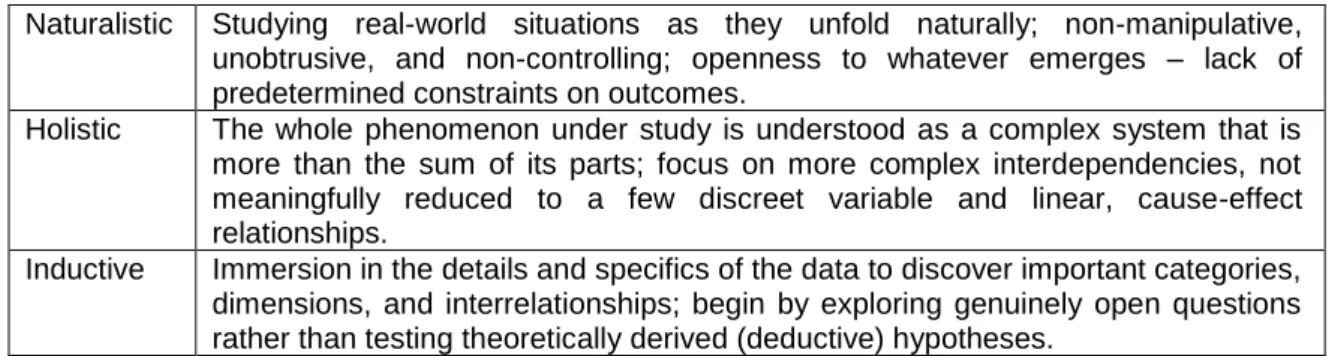
The following table by Durrheim neatly summarises the characteristics of qualitative inquiry.62
Table 1: Characteristics of a qualitative enquiry
Naturalistic Studying real-world situations as they unfold naturally; non-manipulative, unobtrusive, and non-controlling; openness to whatever emerges – lack of predetermined constraints on outcomes.
Holistic The whole phenomenon under study is understood as a complex system that is more than the sum of its parts; focus on more complex interdependencies, not meaningfully reduced to a few discreet variable and linear, cause-effect relationships.
Inductive Immersion in the details and specifics of the data to discover important categories, dimensions, and interrelationships; begin by exploring genuinely open questions rather than testing theoretically derived (deductive) hypotheses.
Source: Reprinted from Research in practice (p 48) by Terre Blanche, M.,
Durrheim, K. and Painter 2006 Juta
The characteristics mentioned above, especially the naturalistic and holistic nature of a qualitative enquiry, enabled me to study the complex nature of a real-world problem (cyber bullying), and the inductive nature of this enquiry made it possible to identify categories of cyber bullying and find answers to the unique problems that the selected school faces in regulating cyber bullying by immersing myself in the data. This enquiry thus led me to the needs that have to be addressed in the
61 Bryman (note 52) at 380.
62 Durrheim, K. ‘Research design’ in Terre Blanche, M., Durrheim, K. and Painter, D. Research in
14
education-specific law and policy framework for regulating cyber bullying in schools to not only prevent cyber bullying but also to provide sufficient protection to victims of cyber bullying when it occurs.
There is a close link between critical realism, socio-legal studies, the qualitative approach and case study design. Critical realism recognises the importance of the context of research; socio-legal studies argue that law should not be isolated from the social context; the qualitative research approach allows a researcher to view the research through the eyes of the participants, and thus in context; and a case study design focuses on studying a phenomenon in its actual context. This research will thus include a socio-legal case study.
Yin defines the case study research design as
an empirical inquiry that investigates a contemporary phenomenon in its real-life context, when the boundaries between phenomenon and context are not clearly evident, and in which multiple sources of evidence are use(d).63
In line with the definition by Yin, the phenomenon of cyber bullying in a particular school was investigated. The school was thus the “case”. One of the advantages of a case study is that it enables the researcher to study data in the specific context, in this instance the school environment. Another advantage is that it enables the researcher to understand and explain complex situations in real environments.64
One of the criticisms against case studies as a qualitative design is that it is not possible to make a generalised conclusion from a single case study, or that information may not be valid.65 Case study researchers do not aim for generalisation
but to produce findings that are transferable.66 Transferability refers to whether the
results in a qualitative study can be used in other contexts or settings.67
63 Yin, R.K. Case study research: Design and Methods. 1994 SAGE at 13. 64 Bryman (note 52) at 4.
65 Lindegger, G. ‘Research methods in clinical research’ in Terre Blanche, M., Durrheim, K. and
Painter, D. Research in practice. 2006 Juta 455–475 at 461; Bryman (note 52) at 74.
66 Rule, P. and John, V. Your guide to case study research. 2011 Van Schaik at 105.
15
Transferability can be established by carefully documenting the approach used, so it can be adopted by other researchers to follow.68
The scope of this research falls in South African law and policy. As the same law and policy will regulate cyber bullying in all public schools, this study has a high transferability value.
1.7.3 Population and sampling
Population is defined as “a group of elements or cases, whether individuals, objects, or events, that conform to specific criteria, and to which we intend to generalize (or in qualitative research ‘transfer’) the results of the research.”69
To make sure the proposed legal framework for the effective regulation of cyber bullying in schools has practical applicability, a case study was completed in a selected secondary school.
I used purposive sampling. This means that subjects are chosen because they are in the position and have the ability to provide information that are relevant to the topic under investigation.70 During sampling, representativeness is important.71 The
sample selected must represent the population from which the conclusions will be drawn.72 In the selected school, my sample consisted of the school principal, the Life
Orientation educator (LO) Educator, the discipline officer of the school (an educator at the participant school in charge of dealing with discipline at the school), 4 school counsellors and the learners in the grade 9 LO classes.
Theoretical sampling is a form of purposive sampling.73 This means:74
68 Ibid.
69 McMillan, J.H., McMillan, J.and Schumacher, S. Research in education: Evidence based inquiry
2006 Prentice Hall at 119.
70 Bryman (note 52) at 418. 71 Durrheim (note 62) at 49. 72 Ibid.
73 Bryman (note 52) at 418.
16
the process of data collection for generating theory whereby the analyst jointly collects, codes and analyses his data and decides what data to collect next and where to find them, in order to develop his theory as it emerges.
Bryman states that this form of sampling is a continuous process.75 Keeping
sampling open was extremely important due to the sensitive nature of my study. One must keep in mind that the bullies and the victims may be known to the rest of the learners. This might have prevented full participation in my studies. Theoretical sampling, however, allowed me to adapt as information emerged.
1.7.4 Literature review
In this study the researcher distinguishes between a literature review and literature study. Coetzee explains in a Report Back to her M and D students that:76
For me, the difference between a literature review and a literature study is that a review is used to determine what is written on a specific topic, e.g. what literature is available on the specific topic. A literature review provides the framework against which you will interpret your data. A literature study on the other hand is a data collection method, e.g. where documents are used to collect data.
A literature review is an essential part of any research. The literature review allows
the researcher to acquaint herself with the available body of knowledge on the
research topic, to place her research in this existing body of knowledge and to
interpret her findings in the framework of this body of knowledge.
77A literature
review was done to put the concepts of traditional bullying and cyber bullying into
context (cf. section
2.2 T).
1.7.5 Data collection
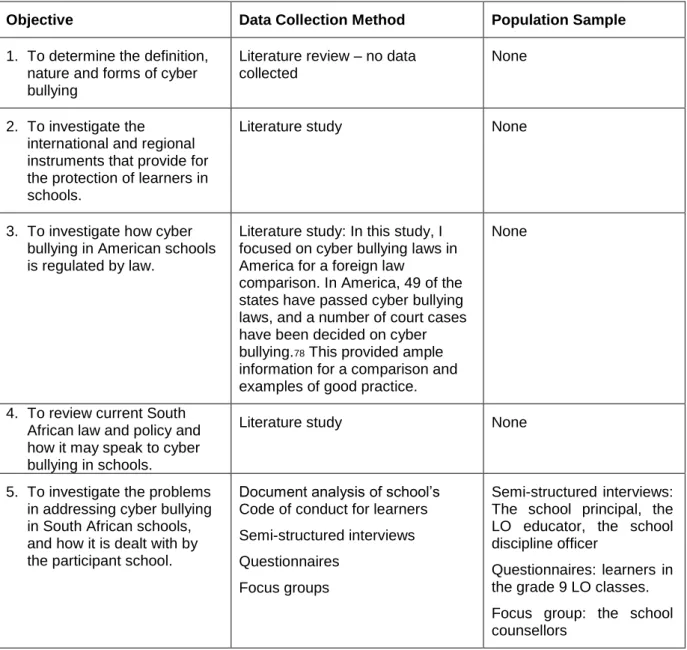
The following table summarises the objectives of the research and the data collection methods I used to achieve those objectives.
75 Bryman (note 52) at 419.
76 Coetzee, SA. 2015. Report Back to M and D group, May 2015. Personal communication between
students and supervisor. Although the use of this source is unusual, no other source that so clearly explained the difference between a literature study and a literature review could be found.
17
Table 2: Data collection methods
Objective Data Collection Method Population Sample
1. To determine thedefinition, nature and forms of cyber bullying
Literature review – no data collected
None
2. To investigate the international and regional instruments that provide for the protection of learners in schools.
Literature study None
3. To investigate how cyber bullying in American schools is regulated by law.
Literature study: In this study, I focused on cyber bullying laws in America for a foreign law
comparison. In America, 49 of the states have passed cyber bullying laws, and a number of court cases have been decided on cyber bullying.78 This provided ample
information for a comparison and examples of good practice.
None
4. To review current South African law and policy and how it may speak to cyber bullying in schools.
Literature study None
5. To investigate the problems in addressing cyber bullying in South African schools, and how it is dealt with by the participant school.
Document analysis of school’s Code of conduct for learners Semi-structured interviews Questionnaires
Focus groups
Semi-structured interviews: The school principal, the LO educator, the school discipline officer
Questionnaires: learners in the grade 9 LO classes. Focus group: the school counsellors
1.7.5.1 Literature study
A literature study was done to determine the human rights obligations for regulating cyber bullying in South African schools, as well as current South African legislation that may be used to regulate cyber bullying in schools (cf.
CHAPTER 3
). It was also used to investigate the laws and policy dealing with cyber bullying in the United States of America for examples of best practice, or possible shortcomings (cf. section 2.5 T).
78 Mienie, C.A. ‘Managing cyber-bullying in schools: Lessons from American and Australian law’
18 1.7.5.2 Questionnaires
Questionnaires normally consist of “… open-ended items for qualitative responses, and other questions that elicit demographic information” from participants.79 I
believed this to be the most appropriate method to extract data from learners. Because there is a great possibility that the victim and the offender may be in the same class, the victim of cyber bullying might be exposed to the cyber bully further if focus groups were used to collect data. Victims might also not be comfortable to open up to me as a stranger. I thus opted for questionnaires because that ensured the best protection of the learner victims’ anonymity.
I followed the process of constructing questionnaires explained by Peterson:80
1. Review the information requirements necessitating a questionnaire.
2. Develop and prioritise a list of potential research questions that will satisfy the information requirements.
3. Assess each potential research question carefully. 4. Determine the type(s) of questions to be asked.
5. Decide on the specific wording of each question to be asked. 6. Determine the structure of the questionnaire.
7. Evaluate the questionnaire.
One of the methods in ensuring effective questionnaires is a pilot study. A pilot study uses a small number of participants to identify possible problems with the data collection instruments, before the main study is started.81 These steps were
invaluable in developing the questionnaires for the learner participants, and are discussed in more detail in chapter 4 (cf. section 4.2 R).
1.7.5.3 Document analysis
Webster, Lewis and Brown define documentary analysis as “the study of existing documents, either to understand their substantive content or to illuminate deeper
79 Kanjee, A. ‘Assessment research’ in Terre Blanche, M., Durrheim, K. and Painter, D. Research
in practice. 2006 Juta 476-498 at 490.
80 Peterson, R.A. Constructing effective questionnaires. 2000 SAGE at 13-14. 81 Kanjee (note 79) at 490.
19
meanings which may be revealed by their style and coverage”.82 The Code of
conduct for learners of the selected school in Gauteng was studied to determine whether they make adequate provision for cyber bullying.
1.7.5.4 Interviews
According to Alvesson, the field of interviews are divided up as follows:83
1. Structure: This can be divided up into structured, semi-structured and unstructured interviews. 2. Size: Will a single person or a group of persons be interviewed?
3. Communication media: The media of interviews may be face-to-face, telephonic or electronic. 4. Category: The category of persons interviewed may call for specific considerations, for
example special ethical measures have to be considered when interviewing children.
For the purpose of objective 5 of this study, a school principal, school discipline officer and an LO Educator were interviewed to evaluate whether the school has plans and policies regarding cyber bullying in place. These interviews also include questions regarding incidences of cyber bullying at school, and the responses of the school, parents, victims and bullies to such incidences. The interviews were all semi-structured, face-to-face, single person interviews. The interview process is discussed in more depth in chapter 4 (cf. section 4.6.2 Questionnaires).
1.7.5.5 Focus groups
A focus group was used to determine the views of school counsellors regarding cyber bullying in schools. What makes focus groups important for studying the context of cyber bullying in schools, is that focus groups give a researcher the opportunity to see how individuals make sense of, and construct meanings towards a certain phenomenon in a collective manner.84 A focus group was conducted with the
school counsellors for their unique perspective on the effects and causes of cyber bullying in the school. In focus group studies, participants can present their own
82 Strydom, H. and Delport, C.S.L. ‘Information collection: document study and secondary analysis’
in De Vos, A.S., Strydom, H., Fouche, C.B. and Delport, C.S.L. Research at grassroots. 2011 Van Schaik 341–375 at 377.
83 Alvesson, M. Interpreting Interviews. 2011 SAGE at 9–10. 84 Bryman (note 52) at 504.
20
views, but they also get to hear the views of other participants.85 This nature of focus
groups raises specific ethical dilemmas (See section
4.10.5 Anonymity and confidentiality). During the focus group, the school counsellors did not disclose the names or particulars of any learners when giving examples of instances of cyber bullying at school. This addresses the issue of anonymity. All the participants in the group were also assured of the confidentiality of the information given in the consent forms.
1.7.6 Data analysis and interpretation
During data analysis, data is reduced. With qualitative research, this involves “grouping textual material into categories like themes ...”86
There are many ways to interpret qualitative data. There is no single methodological framework for interpreting this form of data, and it will depend on the purpose of the research.87 This is discussed in more detail in chapter 4. The analysed data was
interpreted and used to develop an education-specific law and policy framework for regulating cyber bullying in schools.
1.8 Research quality and integrity
Quality assurance and verification of data in research is critical.88 By referencing
responsibly and correctly and ensuring the data is reliable and valid, the researcher can ensure that research was done responsibly.89
Vithal and Jansen indicate a number of ways to ensure validity:90 All of these steps
were followed to ensure the research quality and integrity.
85 Finch, H., Lewis, J. and Turley, C. ‘Focus groups’in Ritchie, J., Lewis, J., Mcnaughton Nicholls,
C. and Ormston, R. Qualitative research practice 2014 SAGE 211–242 at 212.
86 Bryman (note 52) at 13.
87 Schurink, W., Fouche, C.B. and De Vos, A.S. in De Vos, A.S., Strydom, H., Fouche, C.B. and
Delport, C.S.L., Research at grassroots 2011 Van Schaik 397–423 at 400.
88 Maree, K. and Van der Westhuizen, C. Head start in designing research proposals. 2009 Juta at
28.