Technical Report
Number 802
Computer Laboratory
ISSN 1476-2986Latent semantic sentence clustering
for multi-document summarization
Johanna Geiß
July 2011
15 JJ Thomson Avenue Cambridge CB3 0FD United Kingdom phone +44 1223 763500 http://www.cl.cam.ac.uk/c
2011 Johanna Geiß
This technical report is based on a dissertation submitted April 2011 by the author for the degree of Doctor of Philosophy to the University of Cambridge, St. Edmund’s College.
Technical reports published by the University of Cambridge Computer Laboratory are freely available via the Internet:
http://www.cl.cam.ac.uk/techreports/ ISSN 1476-2986
multi-document summarization
Johanna Geiß
Summary
This thesis investigates the applicability of Latent Semantic Analysis (LSA) to sentence clustering for Multi-Document Summarization (MDS). In contrast to more shallow approaches like measuring similarity of sentences by word overlap in a traditional vector space model, LSA takes word usage patterns into account. So far LSA has been successfully applied to different Information Retrieval (IR) tasks like information filtering and document classification (Dumais, 2004).
In the course of this research, different parameters essential to sentence clustering using a hierarchical agglomerative clustering algorithm (HAC) in general and in combination with LSA in particular are investigated. These parameters include, inter alia, information about the type of vocabulary, the size of the semantic space and the optimal numbers of dimensions to be used in LSA. These parameters have not previously been studied and evaluated in combination with sentence clustering (chapter 4).
This thesis also presents the first gold standard for sentence clustering in MDS. To be able to evaluate sentence clusterings directly and classify the influence of the different parameters on the quality of sentence clustering, an evaluation strategy is developed that includes gold standard comparison using different evaluation measures (chapter 5). Therefore the first compound gold standard for sentence clustering was created. Several human annotators were asked to group similar sentences into clusters following guidelines created for this purpose (section 5.4). The evaluation of the human generated clusterings revealed that the human annotators agreed on clustering sentences above chance. Analysis of the strategies adopted by the human annotators revealed two groups – hunters and gatherers – who differ clearly in the structure and size of the clusters they created (chapter 6).
On the basis of the evaluation strategy the parameters for sentence clustering and LSA are optimized (chapter 7). A final experiment in which the performance of LSA in sentence cluster-ing for MDS is compared to the simple word matchcluster-ing approach of the traditional Vector Space Model (VSM) revealed that LSA produces better quality sentence clusters for MDS than VSM.
I would like to thank ...
... my supervisor Dr Simone Teufel for her valuable support and guidance throughout the last years.
... Dr Aurelie Herbelot, Jette Klein-Berning, Benjamin Becker, Ole Esleben, Dr. rer. nat. Johannes Fieres and Dorothea Weithoener for annotating the sentence sets. Without them this work would have not been possible.
... Andrew Ross for proofreading and valuable tips on the English language.
... my office partner and friend Katia Shutova, it would have been difficult without you. ... Stuart Moore for showing me the English seaside and that diving in UK can be fun.
... Dr Thomas T¨urck for his time whenever I needed someone to talk, for an unforgettable day of Christmas baking and proper German schnitzel.
... my friends in Germany for their friendship, support and skype calls.
... my parents, who always believed in me and supported me throughout my PhD journey. ... Benny for travelling back and forth, for enduring my moods and quirks and for just being there all the time.
Finally I would like to thank my two examiners Dr Kalina Bontcheva and Dr Stephen Clark for their thorough and friendly approach and their comments and suggestions.
This research was made possible by a Cambridge European Trust Bursary, a Charter Stu-dentship from St Edmund’s College, a Computer Lab Departmental Award and a EPSRC Doc-toral Training Award.
Contents
1 Introduction 15
2 Background and motivation 19
2.1 Multi-document summarization . . . 21
2.1.1 Sentence clustering in summarization . . . 23
2.1.2 LSA in summarization . . . 25
2.2 Motivation . . . 27
3 Semantic spaces, algorithms and implementation 31 3.1 Standard vector space model . . . 31
3.1.1 Term weighting . . . 32
3.1.2 Similarity calculation . . . 33
3.1.3 Disadvantages of VSM . . . 34
3.2 Latent Semantic Analysis . . . 34
3.2.1 Latent Semantic Analysis: the basics . . . 34
3.2.2 Introduction to Singular Value Decomposition . . . 37
3.3 Data set . . . 41
3.4 Implementation . . . 42
3.4.1 Preparation . . . 42
3.4.2 Clustering . . . 45
3.5 Clustering algorithm . . . 45
4 Parameters in sentence clustering 49 4.1 Clustering algorithm parameter . . . 49
8 CONTENTS
4.2 Vocabulary . . . 52
4.2.1 Index vocabularies in IR . . . 52
4.2.2 Varying vocabularies for sentence clustering . . . 55
4.3 Size of semantic space . . . 56
4.4 Optimal number of dimensions . . . 57
5 Evaluation strategy 61 5.1 Gold standard evaluation . . . 61
5.2 Existing gold standards for sentence clustering . . . 62
5.3 Inter-annotator agreement in sentence clustering . . . 64
5.4 Creation of guidelines for human sentence clustering . . . 65
5.4.1 Characteristics of a cluster . . . 66
5.4.2 Spectrum of similarity within a cluster . . . 67
5.4.3 Discourse within a cluster . . . 70
5.4.4 Standardized procedure for sentence clustering . . . 70
5.5 Evaluating sentence clusters against a gold standard . . . 71
5.5.1 Requirements for an ideal evaluation measure . . . 71
5.5.2 Description of evaluation measures . . . 73
5.5.3 Evaluation of evaluation measures . . . 80
5.5.4 Discussion of evaluation measures . . . 81
5.5.5 Comparability of clusterings . . . 83
5.6 Chapter summary . . . 87
6 Human generated sentence clusterings 89 6.1 Human annotators . . . 89
6.2 Results . . . 91
6.2.1 Hunters and gatherers . . . 92
6.2.2 Semantic differences in human generated clusterings . . . 99
6.2.3 Inter-annotator agreement . . . 100
7 Experiments for optimizing parameters 103
7.1 Fine-tuning the clustering algorithm . . . 103
7.1.1 Statistical significance . . . 104
7.1.2 Results . . . 104
7.1.3 Discussion . . . 106
7.2 The influence of different index vocabulary . . . 109
7.2.1 Statistical significance . . . 110
7.2.2 Results . . . 111
7.2.3 Discussion . . . 113
7.3 The influence of different sized spaces . . . 114
7.3.1 Statistical significance . . . 115
7.3.2 Results . . . 116
7.3.3 Discussion . . . 116
7.4 The optimal number of dimensions . . . 118
7.4.1 LSA pattern . . . 118
7.4.2 The optimal number of dimensions: dependence ont . . . 119
7.4.3 The optimal number of dimensions: dependence on the LSA space . . . 120
7.4.4 The optimal number of dimensions: dependence on vocabulary . . . . 122
7.4.5 Discussion . . . 124
8 Final Experiments – comparison of LSA and VSM 125 8.1 Comparison of LSA and VSM . . . 127
8.2 Results . . . 128
8.3 Discussion . . . 130
8.4 Chapter summary . . . 134
9 Conclusion 137
Bibliography 139
A Guidelines for sentence clustering 149
List of Figures
2.1 Framework of an automatic text summarization system . . . 20
3.1 Vector space for a small sample corpus . . . 32
3.2 SVD in image compression . . . 37
3.3 Singular Value Decomposition . . . 39
3.4 Reduced Singular Value Decomposition . . . 40
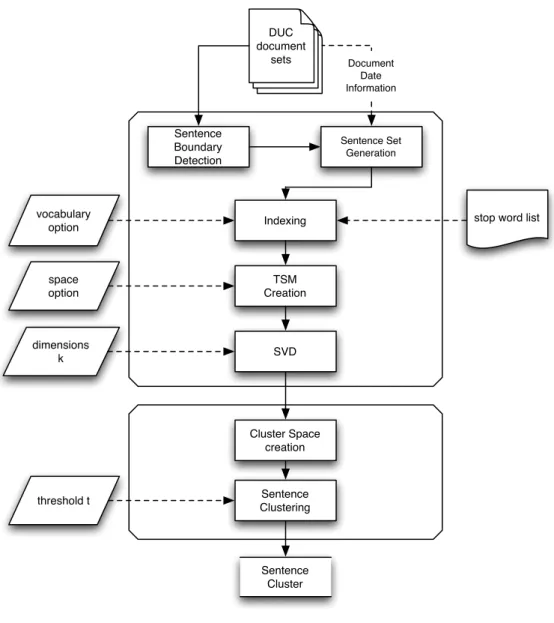
3.5 System framework of BOSSEClu . . . 43
4.1 Dendrogram for a sample data set . . . 51
4.2 LSA pattern in IR . . . 58
5.1 Homogeneity and completeness in a sample set of clusters . . . 72
5.2 Example for cluster homogeneity . . . 72
5.3 Example for cluster completeness . . . 73
5.4 Preference of homogeneity over completeness . . . 73
5.5 Behaviour of evaluation measures . . . 82
5.6 Set diagram of two clusterings for one data set . . . 84
7.1 Dendrograms for clusterings of EgyptAir dataset witht = 0.5andt= 0.25 . . 107
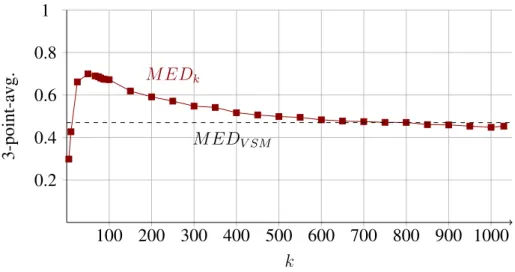
7.2 LSA pattern in sentence clustering . . . 118
7.3 Optimal number of dimensions in relation to the thresholdt . . . 119
7.4 Optimal number of dimensions in relation to number of sentences . . . 120
7.5 Optimal number of dimensions in relation to index vocabularies . . . 123
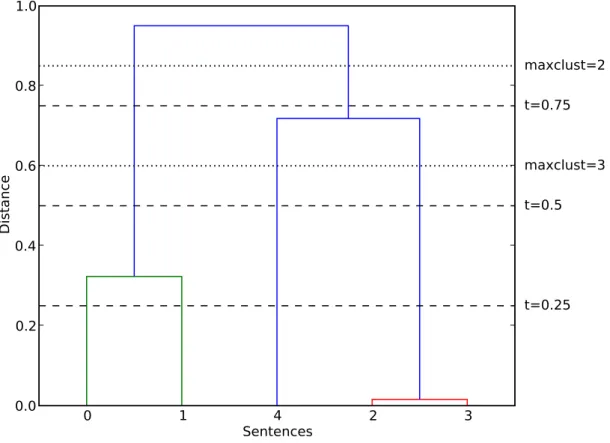
8.1 Dendrogram for a sample data set . . . 127
List of Tables
3.1 TSM for a small sample corpus . . . 32
3.2 Sample data set from Deerwester et al. (1990) . . . 35
3.3 Term-by-document matrixB . . . 35
3.4 Cosine term similarity in traditional VSM . . . 36
3.5 Cosine term similarities in LSA space . . . 36
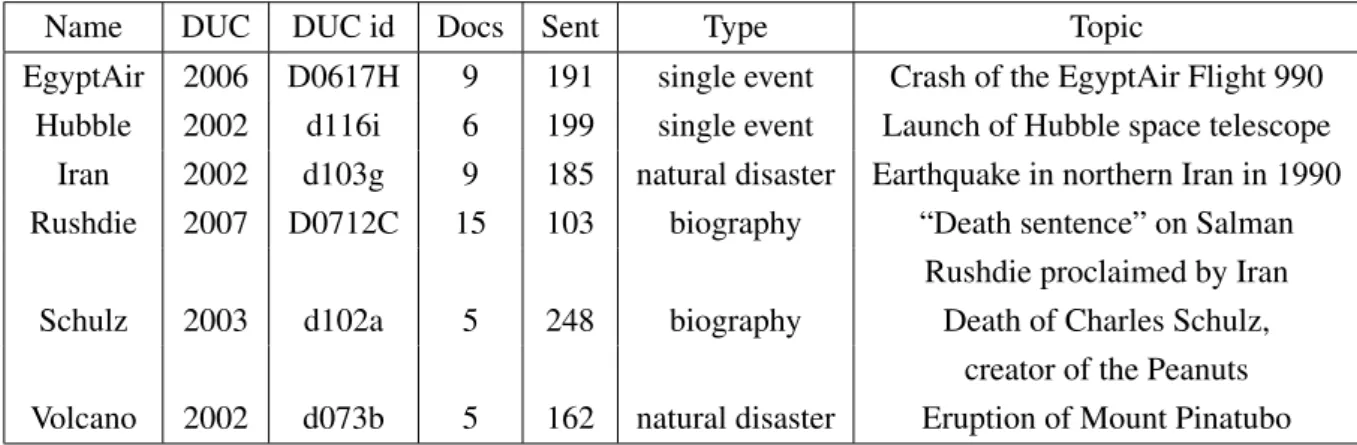
3.6 Details of sentence sets . . . 42
4.1 Differences in indexing methods for MED . . . 52
4.2 Differences in indexing methods for Cranfield II . . . 53
4.3 Summary of experiments on MED and Cranfield II using BOSSEClu . . . 53
5.1 Results of requirement test for evaluation measures . . . 80
5.2 Random changes to Judge A’s clustering . . . 81
5.3 Comparison of three options to equalize the number of sentences in two clus-terings . . . 85
5.4 Comparison of two options for adding irrelevant sentences . . . 87
6.1 Details of manual clusterings . . . 90
6.2 Comparison of clusterings for the Schulz sentence set . . . 92
6.3 Comparison of clusterings for the Iran sentence set . . . 93
6.4 Comparison of clusterings for the Rushdie sentence set . . . 94
6.5 Inter-annotator agreement between the human annotators . . . 101
7.1 Evaluation of the Iran EgyptAir subset against GGS for different values oft . . 105
7.2 Evaluation of the Iran EgyptAir subset against HGS for different values oft . . 105
14 LIST OF TABLES
7.4 Number of clusters and singletons in relation tot . . . 108
7.5 Intra- and inter-cluster similarity for the EgyptAir sentence set . . . 108
7.6 Size of different index vocabularies . . . 110
7.7 Evaluation of the Iran EgyptAir subset against GGS for different index vocab-ularies . . . 111
7.8 Order of precedence of index vocabularies for GGS . . . 112
7.9 Evaluation of the Iran EgyptAir subset against HGS for different index vocab-ularies . . . 112
7.10 Order of precedence of index vocabularies for HGS . . . 113
7.11 Size of different latent semantic spaces . . . 115
7.12 Evaluation of clusterings created in different sized latent semantic spaces . . . 116
7.13 Optimal number of dimensions for theLARGER LOCALLSA clustering space . 124 8.1 Sentence vectors in LSA space . . . 126
8.2 Sentence vectors in traditional vector space . . . 126
8.3 Vbetascores for each sentence set . . . 128
8.4 AverageVbetascores for different combinations of the data set . . . 129
8.5 Detailed results for LSA and VSM . . . 129
8.6 Comparison of clusters . . . 131
8.7 Comparison of a cluster created by LSA, VSM, and a gatherer . . . 131
8.8 Comparison of sentence clusters created by LSA, VSM, and a hunter . . . 132
Chapter 1
Introduction
The beginning is the most important part of the work.
PLATO
In this thesis I will examine redundancy identification for Multi-Document Summarization (MDS) using sentence clustering based on Latent Semantic Analysis (LSA) and its evaluation. The task of multi-document summarization is to create one summary for a group of documents that largely cover the same topic. Multi-document summarization is becoming increasingly important as the rapid development of the internet increases the amount of textual information available online.
The greatest challenge for MDS lies in identifying redundant information within a group of documents. To prevent repetition in a summary the MDS system needs to be able to detect similar and overlapping information and include it in the summary only once. On the other hand redundant information is a good measure of importance. Information that is given in most of the documents must be relevant to the topic and should be included in the summary, whereas information that is only present in one document might be omitted.
Sentence clustering can be used to find repeated information by grouping similar sentences together. There are different methods to identify similar sentences. Some systems use shal-low techniques for detecting similarities in sentences, e.g., word or n-gram overlap. Others use deeper syntactic or semantic analysis. The resulting clusters represent subtopics of the doc-ument set, where one cluster ideally describes one subtopic. The clusters can be ranked for summary worthiness by distribution over documents. To avoid repetition, one sentence can be chosen or generated for each cluster to represent that subtopic in the summary.
Redundancy identification and sentence clustering is a central step in MDS. If redundant information is not detected, the summary will be repetitive and not very informative. If the most important subtopics of the document set are not identified, the summary will not properly
16
reflect the content of the source documents. Therefore it is necessary and useful to examine sentence clustering for MDS in detail.
In the course of this thesis I will examine the applicability of Latent Semantic Analysis (LSA) to sentence clustering. In contrast to more shallow approaches like measuring similarity of sentences by word overlap in a traditional vector space model, LSA takes word usage patterns into account. The analysis considers not only the similarity between the surface form of the sentences but also the underlying latent semantic structure within the sentences. At the same time this approach is largely language independent, except perhaps for a stop word list or a tokenizer, and is not reliant on deep syntactic and semantic analysis of the source documents. So far LSA has been successfully applied to Information Retrieval (IR) tasks such as information filtering and document classification (Dumais, 2004). However, its influence and capability for sentence clustering for MDS has not been thoroughly studied. In this research I will examine the influence of different parameters on sentence clustering using LSA and give an account of how the parameters can be optimized.
Sentence clustering has been used as an early step in automatic text summarization, but its functionality and performance have not been given sufficient attention. In most approaches the clustering results are not directly evaluated. Usually the quality of the sentence clusters are only evaluated indirectly by judging the quality of the generated summary. There is still no standard evaluation method for summarization and no consensus in the summarization community on how to evaluate a summary. The methods at hand are either superficial or expensive in time and resources and not easily repeatable. Another argument against indirect evaluation of clustering is that troubleshooting becomes more difficult. If a poor summary was created it is not clear which component, for example information extraction through clustering or summary genera-tion (using, e.g., language regeneragenera-tion) is responsible for the lack of quality. However, there is no gold standard for sentence clustering available to which the output of a clustering system could be compared. Therefore I develop a strategy to build a gold standard for sentence cluster-ing in MDS. I design a set of guidelines and rules that are given to human annotators. I compare the clusterings created by the human judges and evaluate their inter-annotator agreement.
Another challenge is the comparison of sentence clusters to the gold standard. Numerous evaluation methods are available. Each of them focusses on different properties of clustering and has its own advantages. I describe and evaluate the most widely used and most promising measures.
The thesis is organized as follows: Chapter 2 introduces MDS, highlighting some MDS systems using sentence clustering and LSA. Chapter 3 gives an overview of the models and implementation used. Chapter 4 gives an account of the problems occurring when clustering sentences and the parameters that need to be considered when using LSA. Chapter 5 explains the evaluation strategy, introduces the concept of a gold standard evaluation, explains how to create a gold standard for sentence clustering, and compares different evaluation metrics. Chapter 6 presents the results of the comparison of human generated clusterings. The results
of the parameter optimization experiments are given in chapter 7. Chapter 8 compares the performance of LSA in sentence clustering for MDS with the baseline approach using VSM. Finally Chapter 9 summarizes the contributions of this thesis.
Chapter 2
Background and motivation
Alles Gescheite ist schon gedacht worden. Man muss nur versuchen, es noch einmal zu denken.1
Wilhelm Meister’s Wanderjahre
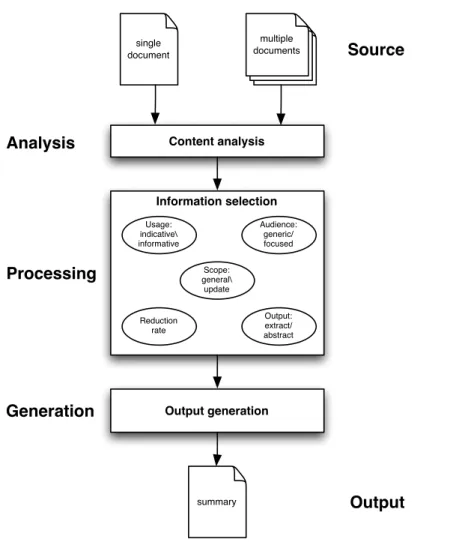
JOHANNWOLFGANGGOETHE The advent of the internet and easy access to computers and the global network has led to an increasing amount of information, most of it textual. Nowadays anyone connected to the internet can access information about virtually anything from all over the world, at his or her fingertips. Anyone can contribute to the internet and not only consume but also produce in-formation. The number of websites has grown from 100,000 in 1996 to over 270 million in January 20112. This development is leading to information overload. To avoid drowning in information, the flow needs to be filtered and the content condensed. Automatic text summa-rization can help by providing shortened versions of texts. It is a technique where a computer program creates a shortened version of a text while preserving the content of the source. In the course of shortening no important information must be omitted and no information should be repeated. The summary contains the most important information from the original text. In general every automatic text summarization system involves three basic steps – analysis, pro-cessing and generation (see figure 2.1). In the first step the document(s) to be summarized are analysed, e.g., redundant information is identified. In the next step, processing, the information for the summary is selected, for example the most important clusters of redundant information are selected. During generation the actual text of the summary is generated, for example by including one sentence for each cluster in the summary.
Although all summarization systems have these three stages in common, different systems produce different summaries. There are numerous types of summaries with different
charac-1All intelligent thoughts have already been thought; what is necessary is only to try to think them again. 2 http://news.netcraft.com/archives/2011/01/12/january-2011-web-server-survey-4.htmllast visited 14.02.2011
20 single document Source multiple documents Content analysis Information selection Analysis Processing Reduction rate Output: extract/ abstract Audience: generic/ focused Output generation Generation Output Usage: indicative\ informative Scope: general\ update summary
Figure 2.1:Framework of an automatic text summarization system
teristics (see figure 2.1). The first aspect is thesource to be summarized; this can be a single document or multiple documents.
Another group of characteristics relates to the content. One such characteristic is the audi-ence. The summary might be targeted to a generic audience, so that the summary reflects all major themes of the original text(s). If a query is provided, e.g., by a user, he or she is only interested in a specific aspect and the summary will be targeted to meet the information need. Another feature is the scope of a summary. A general or background summary will give all available information, assuming the reader has no prior knowledge of the topic, whereas in an update summary only the latest developments are considered. The produced summary can be indicative or informative. An indicative summary provides information about the topic of the text(s) and indicates what the text is about. It does not necessarily contain content from the source. An informative summary contains the main statements of the source. It can stand in place of the original document(s) whereas an indicative summary can only support the decision to read the original text(s) or not.
reduc-tion rate determines the length of the summary and the output type indicates if an extract or abstract should be created. An extract consists entirely of material from the source; usually sentences are selected from the source and pasted into a summary. An abstract on the other hand includes sentences that are not necessarily present in the source. For example new sen-tences are (re-)generated from the source text. If sensen-tences that were not directly connected in the source are concatenated to form an extract, the produced summary might lack in readability, coherence and clarity, for example when anaphora are not resolved. Sentences in an abstract are (re-)generated from source sentences or phrases and the problems of readability and coherence are solved during generation. The creation of an extract is easier and more robust. The output always contains grammatical sentences as they are taken from the source directly. For generat-ing an abstract more complex methods are required and the output might not always consist of grammatical sentences only. In this thesis I will concentrate on methods for creating informative and general summaries of multiple documents that are targeted at a general audience.
The internet offers access to many websites of newspapers or news agencies. Most news websites from the same region or country report about the same events and sometimes even for an extended period of time. For example when there is a major natural disaster all newspapers and news agencies publish reports about this event during the following days or weeks. This results in information overlap. Information is repeated, even within the same newspaper or agency. Therefore the amount of redundant information is growing and the reader often reads the same piece of information over and over again. Multi-document summarization can help to avoid repetition and to provide the reader with condensed non-redundant information. Thus users can quickly familiarize themselves with a topic that was previously described by a large cluster of documents.
2.1
Multi-document summarization
In MDS one summary is created for a set of documents. These document sets can contain ar-ticles from different sources, e.g., from different newspapers on different dates or documents retrieved by an information retrieval system in response to a query. The documents in a set are related to each other, with content related to the same event, person or topic. The Document Understanding Conferences (DUC) (DUC, 2007) provide such sets of documents. DUC was established in 2001 to offer a forum for summarization researchers to compare their methods and results on common test sets given standardized evaluation methods. DUC was annually held by NIST3from 2001 until 2008, when DUC became part of the Text Analysis Conference
(TAC) as summarization track. Over the years different summarization tasks were addressed, for example single document summarization, multi-document summarization, and update sum-marization. Each year a set of document clusters and an evaluation scheme were provided. The document clusters (hereinafter referred to as DUC clusters) consist of documents from various
22 2.1. MULTI-DOCUMENT SUMMARIZATION newswires such as AP or New York Times. These articles were extracted from different corpora like TIPSTER (Harman and Liberman, 1993), TREC (TREC, 2011) and AQUAINT (Linguistic Data Consortium, 2002). The actual DUC clusters were created by NIST assessors who chose topics and selected 10 to 50 documents related to each topic.
The documents within a set overlap in information and thereby include redundant infor-mation. Irrelevant to single document summarization, information overlap is one of the biggest challenges to MDS systems. While repeated information is a good evidence for importance, this information should be included in a summary only once in order to avoid a repetitive summary. The idea behind this is that information that is repeated throughout a collection of articles about the same event must be important for the understanding and comprehension of the described episode. The task is to identify the information that is common to most of the articles and rep-resent that piece of information only once in the summary. The problem is that almost certainly the documents in a set are written by different authors with different writing styles and vocabu-laries. So the content might be the same or very similar but the surface of the articles might be very different.
Different approaches to recognize redundancy in text are used. Goldstein et al. (2000) de-veloped maximal marginal relevance for MDS (MMR-MD) for detecting redundant sentences when creating extraction based multi-document summaries in response to a user query. The MMR-MD is used to minimize redundancy and maximize relevance and diversity of a sum-mary. First the texts to be summarized are segmented into passages (sentences, phrases or paragraphs). Passages are treated as bags of words and cosine similarities between passages and a query are calculated. The cosine similarity of a passage and a query is given by the co-sine of the angle between two vectors describing the passage and the query (section 3.1.2). All passages with a cosine score below a certain threshold are discarded, that is to say all passages that are not relevant to the query are removed. Then the MMR-MD metric is applied to the re-maining passages, determining those passages that are summary worthy, i.e., which are relevant to the query but different to other passages already selected for the summary. Similarity calcu-lation for passages is here based on the cosine similarity in a traditional vector space. Thus the redundancy detection is based on word overlap. In the end the passages are combined follow-ing some summary cohesion criterion, e.g., rankfollow-ing by relevance or time. A similar approach to redundancy removal is used in NeATS (Lin and Hovy, 2002), which combines well known tech-niques from single document summarization. Important content is determined by identifying key concepts in a document set and ranking the sentences of that document accordingly. The sentences are selected and filtered using the position of a sentence in a document, stigma words (words that usually cause discontinuity in summaries like conjunctions or pronouns) and MMR. The remaining sentences are ordered chronologically and, where necessary, the sentences are paired with an introductory sentence.
A similar approach is used in MEAD (Radev et al., 2004). The system also uses statistical methods to determine which sentences to include in a summary. The sentences are compared to a centroid vector of a document set. A centroid consists of words that represent a cluster
of documents. For each sentence a score is calculated using the similarity to the centroid, the position in the document, the word overlap with the first sentence in the document and a redundancy penalty that measures the word overlap with other sentences.
These three approaches use word overlap to measure redundancy after the summary worthy sentences were already identified. The statistical methods used are fast and robust. They are largely independent of language, domain and genre.
The system described in Barzilay and Elhadad (1997) incorporates different techniques. Common information is identified by building lexical chains using nouns and noun compounds. The documents are segmented and lexical chains are built within these segments by using WordNet relations. This approach enriches the surface form of a noun with meaning, by in-cluding a word and its sense in a specific sentence in a lexical chain. Each chain consists of similar words and the similarity of the words is only based on WordNet relations of the word senses. The chains are scored and for the strongest chains sentences are selected to be included in the summary. For scoring chains and selecting sentences for the strongest chains, the algo-rithm uses word count and word overlap. Since the scope of WordNet is limited and most of the entries are nouns, only part of the texts can be used for finding lexical chains.
Barzilay and McKeown (2005) uses a text-to-text generation approach. In order to create a coherent abstract they try to identify common clauses within sentences by aligning syntac-tic trees and combining these fragments into a new sentence. For this approach clusters of sentences are used as input.
The latter two approaches require deeper syntactic and semantic analysis than the other systems described. This makes them dependent on languages and maybe even domains. On the other hand the systems rely not only on the surface form of text but also on the meaning of words.
Sentence clustering is often used as a first step in MDS to identify redundant information. In sentence clustering, semantically similar sentences are grouped together. Sentences within a cluster overlap in information, but they do not have to be identical in meaning. In contrast to paraphrases, sentences in a cluster do not have to cover the same amount of information. For each cluster one sentence can be selected or as in Barzilay and McKeown (2005) be generated to be included in the summary. In the next section I introduce some systems using clustering and describe them in more detail.
2.1.1
Sentence clustering in summarization
For single document summarization Aliguliyev (2006) presents a summarization system based on sentence clustering. The sentences from a document are clustered so that the intra-cluster similarity is maximized while the inter-cluster similarity is minimized. For similarity calcu-lation between the sentences the cosine measure is used and the sentences are represented as
24 2.1. MULTI-DOCUMENT SUMMARIZATION vectors of features (here words). For each cluster a representative sentence is chosen by deter-mining the proximity to other sentences in the cluster and to the cluster centre. The similarity of these sentences to the title is calculated and the sentences are ranked in descending order by their relevance score (the weighted sum of the two similarity measures). Sentences are added to the summary until the desired length of the summary is reached. In this approach the recog-nition of redundancy is based on word overlap. The similarity between sentences is calculated using the traditional vector space model. In this model two sentences are similar the more vector features (here words) they have in common.
Sentence clustering for multiple documents in described in Seno and Nunes (2008). The sentences of the documents are clustered using an incremental clustering algorithm. The first cluster is created by selecting the first sentence from the first document. For all following sentences it is decided if the sentence should belong to an existing cluster or if a new cluster is created. The decision is based on a similarity threshold. In the described study two similarity measures were tested: (i) word overlap and (ii) cosine measure. The word overlap metric determines the number of words a sentence and a cluster have in common in proportion to the total number of words in that sentence and that cluster. The best results were achieved when the threshold for world overlap was 0.2, i.e., a sentence was only assigned to a cluster if the word overlap score with that cluster was larger than 0.2. The second metric tested was the cosine similarity between a sentence and the centroid of a cluster. Here a centroid consists of terms that are representative for the cluster. Two methods for selecting the words for the centroid were introduced involving tf-idf (term frequency-inverse document frequency) and tf-isf (term frequency-inverse sentence frequency). The best sentence clusters were achieved using the tf-idf centroid with a threshold of 0.3. The clusterings created by the system were evaluated on a corpus of 20 sets of news articles. A reference clustering corpus was created by the first author of that paper.
Marcu and Gerber (2001) present a system where non-overlapping elementary discourse units (edus) are assigned importance scores and are clustered using a C-Link clustering algo-rithm. They claim that large clusters with a high intra-cluster similarity can reliably represent key information of the documents. The clusters are ranked according to the position ofedus in the documents, the importance of edus, and intra-cluster similarity. For each most important cluster oneeduis selected for the summary, until the target summary length is reached. This ap-proach takes discourse information into account. Anedu is about the size of a clause. However the similarity calculation is again based on word overlap between the single units.
A different strategy is used in Hatzivassiloglou et al. (1999, 2001). The system described is called SIMFINDER. It serves as analysis component for a multi-document summarizer de-scribed in McKeown et al. (1999) that incorporates text reformulation for abstract generation (Barzilay, 2003). In SIMFINDER similarity between paragraphs (mostly containing one sen-tence) is determined using a range of linguistic features. These features include primitive features based on single words or simplex noun phrases and composite features that combine primitive features pairwise. The primitive features include word co-occurrence, matching noun
phrases, WordNet synonyms or shared proper nouns. Once the similarities between any two text passages are calculated, a non-hierarchical clustering algorithm is used to group similar text units into clusters. Each cluster is then represented by one sentence in the summary. MultiGen (Barzilay, 2003) analyses the sentences in each cluster and regenerates a sentence from the information common to all sentences in that cluster.
For the evaluation of SIMFINDER a set of 10,535 manually marked pairs of paragraphs was created. Two human annotators were asked to judge if the paragraphs contained common information. They were given the guideline that only paragraphs that describe the same object in the same way or in which the same object is acting the same are to be considered similar. They found significant disagreement between the judges but the annotators were able to resolve their differences. SIMFINDER found 36.6% of the similar paragraphs with 60.5% precision. Unfortunately the evaluation looked only at pairs of paragraphs and not at clusters. Due to the linguistic features, SIMFINDER is language dependent. Apart from the WordNet feature, the similarity calculation is again based on simple word overlap enriched with some syntactic analysis. The WordNet feature is limited to nouns and verbs present in WordNet. Although WordNet keeps growing it only partially describes the English language and the relationships between words.
The approaches described above did not evaluate the sentence clusters produced directly but evaluated only the resulting summaries. There are two problems with indirect cluster evaluation: (i) There is no consensus in the summarization community of how best to evaluate a sum-mary. The evaluation methods used are either superficial, like ROUGE (Lin, 2004), which counts overlapping units between two summaries, or expensive in time and resources, like Pyramids (Nenkova and Passonneau, 2004). Hence the results are rarely comparable. (ii) A correct classification of sentences into clusters cannot be verified. If the resulting
sum-mary is of poor quality it is difficult to determine which component is responsible. Thus a clearly laid out strategy for evaluating sentence clusterings for MDS is needed.
2.1.2
LSA in summarization
There are some approaches that incorporate LSA in their MDS systems. Steinberger and Kriˇst’an (2007) developed an algorithm for single document summarization using LSA and apply it to the problem of MDS. Their system works as follows: first a term-by-sentence ma-trix (TSM) Ais created where each row represents a term and each column represents a sen-tence. The cells of the matrix contain weighted term frequencies. Singular Value Decompo-sition (SVD) is applied to Awhich breaks down the original TSM into r base vectors which are linearly independent (for details see section 3.2). The result of SVD are three matrices T,
26 2.1. MULTI-DOCUMENT SUMMARIZATION rank the sentences of the document collection. For each sentence the length of the correspond-ing vector in the rankcorrespond-ing matrix is calculated. The sentences with the highest scores (length of vector divided by(number of terms)0.4) are selected for the summary. To avoid
redun-dancy only sentences that are not similar to sentences already in the extract, measured with the cosine similarity in the original term space, are added to it. The evaluation was done on 50 DUC 2005 clusters containing 1300 documents in total. The resulting extracts were evaluated with ROUGE. The MDS system scored better than 27 other systems and worse than 5. In this approach SVD helps to capture the relationships between words by analysing co-occurrence patterns. Thus terms and sentences can be grouped on a more semantic basis than on word overlap only. The authors claim that each singular vector (rows inDT) represents a salient and recurring word usage pattern. They assume that each word usage pattern describes one topic in the document collection. Thus the topics of a document collection are represented by the singular vectors and the magnitude of the singular value represents the degree of importance of the corresponding pattern within the document set. The authors assume that the sentence that best represents this pattern will have the largest index value within the singular vector. The importance and the coverage of the word usage patterns within the sentences are taken into ac-count by calculating the length of the sentence vectors inS2DT . The authors seek to choose sentences for their summary that have the greatest combined weight across all important topics. The problem is that in this approach the number of topics is linked to the number of singular values. In SVD the number of singular values and vectors is equal to the rank of the matrix, which is the number of linearly independent rows or columns ofA. To reveal the latent seman-tic structure and the themes in a document collection the dimensions are reduced (for details see section 3.2). Choosing the number of dimensions to keep also determines the number of topics. The unresolved problem is to determine the number of topics relevant for the document collection in advance, when the system claims to be fully automatic. The relation between word usage pattern and topic is debatable: is one word usage pattern equal to a topic of a document collection? In addition, even if there is a one-to-one relationship between patterns and topics, why are sentences selected that have the highest score over all topics? One could also choose one sentence for each topic. Also, only the resulting extracts were evaluated using ROUGE, where N-grams are compared to human written abstracts. A problem here is that human written abstracts are compared to extracts. ROUGE only takes matches of N-grams into account, but since humans created the abstracts, the content of the summaries compared can be similar but the words used can be very different. But evaluation of summaries is an open and very contro-versial problem. There was no evaluation of whether the sentences selected for the summary really do represent the most important topics of the document collection.
Another approach using sentence clustering and LSA is described in Bing et al. (2005). After a term-by-sentence matrix is built and factorized using SVD the sentences are compared pairwise. The sentences with the highest similarity are merged to a sentence cluster, called a fake sentence. This cluster and the rest of the sentences are used to create a new matrix and again (after applying SVD) all sentences are compared pairwise and so on. This process
is repeated until the predefined number of clusters is reached. For each cluster the centroid sentence is determined. The centroid sentences are then sorted and included in the summary. This approach was tested on a dataset consisting of 20 documents clusters of7-9news articles from various websites. Judges were asked to grade the 20 extracts created by the system using a score between 1 (bad summary) and 5 (good summary). 75% of the summaries were marked with a score of 3 or 4. In this system only matrix D is used to cluster the sentences. I think it is unreasonable that the singular values are not taken into account since they correspond to the importance of each concept within the document collection. It is very time and memory consuming to build a new matrix and perform SVD every time two sentences are joined. The fake sentenceis longer than the other sentences, therefore will score higher similarity with other sentences and attract more sentences. Again only the summary was evaluated as human judges were asked to score the summary. The judges were not provided with other summaries, to which they could compare the automatically created abstracts. It is not clear which instructions the judges received or if they had access to the original documents.
The Embra system for DUC 2005 (Hachey et al., 2005) uses LSA to build a very large semantic space to derive a more robust representation of sentences. In this space not only the documents that are summarized are included but also other documents from the DUC 2005 and AQUAINT corpus. First a term-by-document matrix (TDM) is created, SVD is applied and the resulting submatrices are reduced to 100 dimensions. From the submatrices a sentence representation is built, where each sentence is represented by a vector that is the average of the vectors of the words the sentence contains. This sentence representation is then passed to an MMR-style algorithm, which determines relevancy and redundancy (see above). The sentences with the highest MMR score are selected for the summary. In contrast to Goldstein et al. (2000) here the redundancy calculation is not based on single word overlap but on the word usage patterns revealed by LSA. SVD was performed on a term by document matrix, but it was not evaluated how the size of a semantic space influences redundancy identification.
The approaches described here all lack the evaluation of the influence of LSA on detecting redundant information. Only indirect evaluation of the redundancy identification was carried out by evaluating the resulting summary. The influence of parameters like the number of dimen-sions (k), size of the semantic space or vocabulary included have not been properly analysed. However these parameters might have a great impact on the quality of redundancy identification. Once again in order to optimize these parameters a direct evaluation of the sentence clusters is required.
2.2
Motivation
Sentence clustering integrates well in a MDS system creating general or query-related abstracts. Given a set of related documents, the documents are split into smaller units like paragraphs, sen-tences, snippets and words. The units are clustered separately or simultaneously. The retrieved
28 2.2. MOTIVATION clusters of different sized units represent the theme of the document set. Afterwards the clusters are handed over to a language generation system, e.g., MultiGen (Barzilay, 2003), which creates an abstract.
The prerequisite for an MDS system is one or more sets of documents that relate to the same topic, which in case of news articles can be, e.g., a person, an aspect of a person’s life or an event like a natural disaster or a general election. For this thesis it is assumed that a document classifier is in place which groups documents into topic groups.
For an MDS system it is vital to find out what a given set of documents is about. The premise is that the documents in a set are about the same matter. The assumption is that the information that most often recurs in the documents is the main subject of the texts. But in different documents the same or similar pieces of information might be given by different sen-tences, wordings or expressions. Redundancy identification and removal is therefore a crucial step in MDS. As described in the previous sections, often redundancies are removed after the content for the summary has been selected (Goldstein et al., 2000; Lin and Hovy, 2002; Radev et al., 2004). This approach is not well suited for MDS. If the documents to be summarized overlap considerably, which is the optimal starting position for any MDS system, there will be many sentences that are very similar. Thus clustering the sentences first by theme is less costly in time and resources.
Clustering is a well established method for identifying redundancy (see section 2.1.1). It can also be used to rank clusters by their summary worthiness. The idea behind sentence clustering is to find repetitive and hence similar information. Information that is repeated throughout a collection of articles about the same event must be important for the understanding and com-prehension of the described episode. To find redundant information within a document set, different surface forms of the same or very similar information are grouped together. Once these groups of text units are found they are ranked. The best clusters represent the topics of that document set. In many MDS approaches, the text units that are grouped into clusters are sentences. The similarity between sentences is often measured by the number of terms they share. To overcome the problems of different word forms and synonyms, stemming and Word-Net (Fellbaum, 1998) are often used. These approaches are language dependent and rely on the coverage of WordNet.
Clustering using LSA is largely independent of the language, unlike approaches that require deeper linguistics analysis. It has also the advantage that the similarity estimation is not based on shallow methods like word matching. Incorporation of LSA takes underlying latent semantic structures in form of word usage patterns into account. Thus the problem of synonymy is avoided.
The first step towards multi-unit clustering is to examine the most obvious unit – the sen-tences. Sentences are reasonably easy to identify. There are several sentence boundary detectors available, e. g., RASP (Briscoe et al., 2006). A sentence is normally the largest grammatical unit. In traditional definitions a sentence is often described as a set of words expressing a
com-plete thought (Chalker and Weiner, 1994). In Peters (2004) the functions of a sentence are described as making statements, asking questions, uttering commands and voicing exclama-tions.
In this thesis the focus lies on summarizing multiple news articles. The advantage of the journalistic writing style is that journalists usually try to be explicit and precise. Wikipedia (2011b)4describes the news style as follows:
“Journalistic prose is explicit and precise, and tries not to rely on jargon. As a rule, journalists will not use a long word when a short one will do. They use subject-verb-object construction and vivid, active prose [...]. They offer anecdotes, examples and metaphors, and they rarely depend on colorless generalizations or abstract ideas. News writers try to avoid using the same word more than once in a paragraph [..].”
Thus fragmentary sentences, exclamative or imperative sentences will remain the exception. Alternatively other text units like words, paragraphs or snippets could be used for identifying redundant information in news articles. However they have some disadvantages over sentences. Single words are too small to be used as a clustering unit. The meaning of a word often depends on the context. One word alone does not cover a whole piece of information. On the other hand, paragraphs, which contain more than one sentence, are too large a unit for clustering in MDS. The sentences of a paragraph might contain sentences with slightly different topics or themes. In clustering for redundancy identification it is important that the units used cover a whole piece of information and ideally only one. However this problem of multiple themes might also occur with sentences. Desirable would be a unit smaller than a sentence that covers exactly one topic, thought or theme. Thadani and McKeown (2008) call the textual representation of a basic unit of information in a document a nugget, but in their experiments they use a concept-annotated corpus. Finding information nuggets in text requires stable and reliable information extraction techniques using deep semantic and syntactic analysis. Thus it is best to start with the best unit at hand – sentences.
I first look at the parameters that could influence the quality of sentence clusterings using LSA. These have not previously been evaluated in detail in relation to sentence clustering for MDS. First, basic indexing techniques like stemming or stop word removal are tested on IR cor-pora (section 4.2). I will then investigate how different index vocabularies influence sentence clustering. The index vocabulary determines the terms that form the basis on which sentences are compared and similarity between them is calculated. For IR it is often claimed that the nouns of a sentence carry the most meaning and that they are the distinctive features. I will ex-amine different strategies to create index vocabularies and assess their influence on redundancy identification using sentence clustering (section 4.2.2).
30 2.2. MOTIVATION The first sentence cluster experiments are carried out on the Microsoft Research Paraphrase Corpus (Dolan et al., 2004; Dolan and Brockett, 2005). Here I test and evaluate the basic clustering algorithm parameters like linkage and distance metric. In more detail I will examine the clustering thresholdtfor the cophenetic distance. This threshold determines where a cluster tree produced by hierarchical agglomerative clustering (HAC) is cut to be split into flat clusters. This parameter might have a great impact on the quality of the clusterings.
Another important parameter I examine is the size of the clustering space, which is deter-mined by the number of sentences included (see section 4.3). There are different hypotheses about how the size of the corpus might influence the structure and quality of the semantic space. One approach assumes that a large corpus or an additional background corpus leads to a more robust and accurate semantic space. A different strategy says that a general background corpus might bias term relations and that a smaller localized corpus is more sensitive to small effects. The influence of different sized corpora on sentence clustering for MDS has never been studied before. I will test three space options (local, extended and global) and how they affect sentence clustering.
One of the most important parameters for any LSA application is the number of remaining dimensionsk. I also study how kinfluences the quality of sentence clustering and whether the optimal value forkdepends on other parameters liket, cluster space size or vocabulary.
I will also compare the performance of LSA in sentence clustering with the simple word matching approach of VSM. This comparison will show if the usage of underlying latent se-mantic structures in a text helps to create better sentences clusters for redundancy identification. A strong evaluation strategy is needed to evaluate the influence of different parameters on clustering quality and to compare different approaches. I decided to use a gold standard compar-ison strategy (see chapter 5 for details), where the clusterings created by my system BOSSEClu
are compared to a ground truth. Since no gold standard was available for sentence clustering in MDS, I decided to create the first compound gold standard for sentence clustering with the help of human annotators. In this context, guidelines were designed to guide the annotators and help them to create consistent clusterings that comply with the same standards. In course of the creation of a gold standard for MDS, I will also study how humans cluster similar sentences and which strategies they use.
Also important for evaluation are the measures used. Since many different evaluation met-rics are available, I will examine their properties and evaluate which measures are best suited for sentence clustering in MDS.
Chapter 3
Semantic spaces, algorithms and
implementation
And now for something completely different. MONTYPYTHON In this chapter I describe the different semantic spaces, algorithms and the implementa-tion used throughout this thesis. Secimplementa-tion 3.1 introduces the standard Vector Space Model (VSM). Section 3.2 explains Latent Semantic Analysis (LSA) and how it incorporates Sin-gular Value Decomposition (SVD) to reveal the latent semantic structure within a text collec-tion. An overview of the implementation and structure of my sentence clustering system called BOSSECluis given in section 3.4. Section 3.5 introduces the clustering algorithm.
3.1
Standard vector space model
The standard vector space model (hereinafter referred to as VSM) is a model for representing text in a vector space based on the bag of words approach. It was first presented as a model for Information Retrieval (IR) in Salton (1979) and was used in the System for the Mechani-cal Analysis and Retrieval of Text (SMART) information retrieval system (Salton, 1971b) (on which see Dubin (2004)).
In VSM, text units of a corpus are represented by vectors. Traditionally a whole document is used as a text unit, but any other text unit like paragraphs or sentences can be used just as well. Each dimension of a vector corresponds to a term that is present in the corpus. A term might be, e.g., a single word, n-gram or a phrase. If a term occurs in a document the value of that dimension is non-zero. Values can be binary (1 →term is present in the document, 0 →
term is not present in the document), frequencies of terms in the document, or term weights. A whole text corpus can then be represented by a term-by-document matrix A. Consider the following example: a sample text corpus containing the following three sentences:
32 3.1. STANDARD VECTOR SPACE MODEL s1 It’s rainingcats anddogs.
s2 Amanis taking hisdogfor a walk.
s3 Amantakes hiscatto the vet.
The termsman,catanddogare used for indexing. The corpus can then be represented by the term-by-sentence matrix (TSM)Ain table 3.1.
s1 s2 s3
cat 1 0 1
dog 1 1 0
man 0 1 1
Table 3.1:TSM for a small sample corpus
Figure 3.1 shows a graph of the vector space drawn by the terms. The sentences are repre-sented as vectors in space.
cat dog man s1 1 1 s2 1 s2
Figure 3.1:Vector space for a small sample corpus
The advantage of VSM is that within this model similarities between documents or a query and a document can be calculated.
3.1.1
Term weighting
The idea behind term weighting is to assign a weight to represent the importance of a term. The raw frequency of a term only states how often a term occurs in a document without measuring the importance of that term within the document or within the whole collection. Different weighting schemes are available. The most common and popular one is the tf-idf weighting scheme (Salton and McGill, 1986). It combines local and global weighting of a term. I will use a modified version calledntf-idf since earlier experiments showed that using this modified scheme led to a slight increase in retrieval performance than using the raw term frequency (tf).
Local term weighting For local term weighting I will use the normalized term frequency (ntf) (Haenelt, 2009). It measures the importance of a term within a document.
ntfi,m = freqi,m
maxj,m
(3.1) The normalized term frequency ntfi,m is the fraction of the frequency freqi,m of term ti in documentDmand the highest frequencymaxj,mof any termtnin documentDm. This formula assign a higher weight to terms that occur often in a document.
Global term weighting (idf) The inverse document frequency (idf) (Sp¨arck Jones, 1972) measures the importance of a term within the document collection.
idfi = logN
ni
(3.2) HereN is the number of all documents in the collection andniis the number of documents that termioccurs in. A term that occurs in every document of the collection gets a loweridf value. This reflects the fact that it is not as significant for the distinction between documents as terms that occur rarely throughout the document collection. For sentence clustering this scheme was adopted to use sentences instead of documents. Thus the global weighting scheme is renamed toisf – inverse sentence frequency.
This results in thentf-isf weighting scheme:
wi,m =ntfi,m×isfi (3.3)
where the weightwof a termiin a sentencemis defined by the product of the local weight of termiin sentencemand the global weight of termi. Dumais (1990) did some experiments on weighting schemes and LSI and concluded that using weighting has a positive effect on retrieval performance.
3.1.2
Similarity calculation
A very popular similarity measure is the cosine similarity. This measure is based on the angleα
between two vectors in the VSM. The closer the vectors are to each other the more similar are the documents. The calculation of an angle between two vectors~a and~bcan be derived from the Euclidean dot product:
~a·~b=|~a||~b| ·cos(α) (3.4) This states that the product of two vectors is given by the product of their norms (in spatial terms, the length of the vector) multiplied by the cosine of the angle α between them. Given equation 3.4 the cosine similarity is therefore:
cos(α) = ~a·~b
|~a||~b| (3.5)
34 3.2. LATENT SEMANTIC ANALYSIS
3.1.3
Disadvantages of VSM
Within the VSM only similarities between documents or between a query and documents can be calculated within one space. If terms were to be compared to each other another space would have to be drawn. In a term space, where the terms represent the dimensions, the terms are considered to be linearly independent, which means their relations to each other are not taken into account. Furthermore in the traditional vector space the similarity calculation is based only on word matching. Each dimensions of a vector corresponds to a term. Two documents with a similar topic but different vocabulary will not be placed next to each other. Only documents that overlap in vocabulary will be considered similar.
3.2
Latent Semantic Analysis
Latent Semantic Indexing (LSI) was developed as a special vector space approach to concep-tual IR (Deerwester et al., 1990). It attempts to overcome two common problems of search engines – synonymy and polysemy. In the standard VSM (Salton, 1971b), the terms are as-sumed to be independent and thus term associations are ignored. By contrast LSI re-expresses a co-occurrence matrix in a new coordinate system. The idea is to uncover the latent semantic structure of a document collection, i.e., to find hidden relations between terms, sentences, doc-uments or other text units. This is achieved by using high-order co-occurrence (Kontostathis and Pottenger, 2006). Unlike methods like VSM relying on literal word overlap for similarity calculation, LSA relies on “a derived semantic relatedness measure” (Foltz et al., 1998). This measure reflects the semantic similarity between words that are used in similar context, e.g., synonyms, antonyms, hyponyms or compounds.
The technique is called LSI when it is applied to IR otherwise it is called LSA
3.2.1
Latent Semantic Analysis: the basics
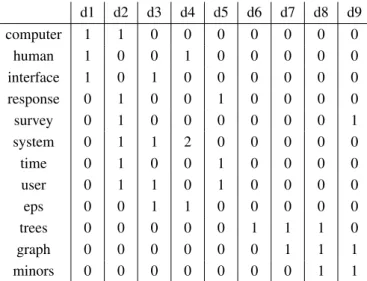
I will explain the functionality of LSA using an example from term similarity calculation. Con-sider table 3.2, which consists of 9 titles from technical reports from Deerwester et al. (1990). The data set can be represented by the term-by-document matrix B shown in table 3.3. Each column describes a document, each row a term. Each cell entry indicates the frequency of a term occurring in a document. This term-by-document matrix B can be used to calculate the simi-larity between terms. When calculating similarities between terms each term is represented as a vector in the Cartesian coordinate system for the standard vector space where the documents define the dimensions. To calculate the similarity of two terms in a vector space, the distance between the two term vectors can be measured using the cosine similarity measure (see section 3.1.2). A cosine of−1implies that the compared vectors point into opposite directions whereas vectors that have the same direction receive a cosine of1. The cosine function for two vectors
d1:Humanmachineinterfacefor Lab ABCcomputerapplications d2: Asurveyofuseropinion ofcomputer system response time
d3: TheEPS user interfacemanagementsystem
d4:Systemandhuman systemengineering testing ofEPS
d5: Relation ofuser-perceivedresponse timeto error measurement d6: The generation of random, binary, unorderedtrees
d7: The intersectiongraphof paths intrees
d8:Graph minorsIV: Widths oftreesand well-quasi-ordering d9:Graph minors: Asurvey
Table 3.2: Sample data set from Deerwester et al. (1990). Underlined words occur in more than one title and are selected for indexing.
d1 d2 d3 d4 d5 d6 d7 d8 d9 computer 1 1 0 0 0 0 0 0 0 human 1 0 0 1 0 0 0 0 0 interface 1 0 1 0 0 0 0 0 0 response 0 1 0 0 1 0 0 0 0 survey 0 1 0 0 0 0 0 0 1 system 0 1 1 2 0 0 0 0 0 time 0 1 0 0 1 0 0 0 0 user 0 1 1 0 1 0 0 0 0 eps 0 0 1 1 0 0 0 0 0 trees 0 0 0 0 0 1 1 1 0 graph 0 0 0 0 0 0 1 1 1 minors 0 0 0 0 0 0 0 1 1
Table 3.3:Term-by-document matrixBfor the sample data set from table 3.2
of a frequency matrix in standard vector space can only return values in the range[0,1], because in the traditional VSM all vectors lie within the positive quadrant. The values in any frequency matrix are always positive – a negative frequency count is not possible. A cosine of 0for two vectors in standard vector space means that their distance is maximal which implies that they are maximally dissimilar. In contrast to VSM, values in an LSA matrix can be negative so the cosine of two vectors in a LSA space can have a value anywhere in the range of[−1,1].
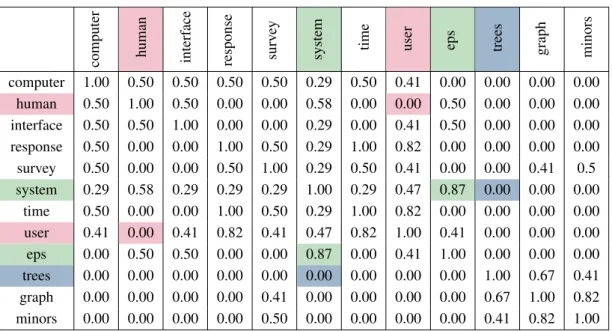
Using the rows of the term-by-document matrixBshown in table 3.3 the cosine similarity for all term pairs in standard vector space were calculated and are given in table 3.4. A cell in that table gives the similarity between the two corresponding terms. The terms “system” and “EPS” (coloured in green in the tables below) co-occur three times in the sample data set and their cosine is 0.87, the highest measured in this example (apart from identical terms). The terms “human” and “user” (coloured in red in the tables below) have a cosine of 0, the lowest value possible in the standard VSM, as they never co-occur directly.
co-36 3.2. LATENT SEMANTIC ANALYSIS
computer human interf
ace
response surv
ey
system time user eps trees graph minors computer 1.00 0.50 0.50 0.50 0.50 0.29 0.50 0.41 0.00 0.00 0.00 0.00 human 0.50 1.00 0.50 0.00 0.00 0.58 0.00 0.00 0.50 0.00 0.00 0.00 interface 0.50 0.50 1.00 0.00 0.00 0.29 0.00 0.41 0.50 0.00 0.00 0.00 response 0.50 0.00 0.00 1.00 0.50 0.29 1.00 0.82 0.00 0.00 0.00 0.00 survey 0.50 0.00 0.00 0.50 1.00 0.29 0.50 0.41 0.00 0.00 0.41 0.5 system 0.29 0.58 0.29 0.29 0.29 1.00 0.29 0.47 0.87 0.00 0.00 0.00 time 0.50 0.00 0.00 1.00 0.50 0.29 1.00 0.82 0.00 0.00 0.00 0.00 user 0.41 0.00 0.41 0.82 0.41 0.47 0.82 1.00 0.41 0.00 0.00 0.00 eps 0.00 0.50 0.50 0.00 0.00 0.87 0.00 0.41 1.00 0.00 0.00 0.00 trees 0.00 0.00 0.00 0.00 0.00 0.00 0.00 0.00 0.00 1.00 0.67 0.41 graph 0.00 0.00 0.00 0.00 0.41 0.00 0.00 0.00 0.00 0.67 1.00 0.82 minors 0.00 0.00 0.00 0.00 0.50 0.00 0.00 0.00 0.00 0.41 0.82 1.00
Table 3.4:Cosine term similarity for the sample data set from table 3.2 in standard vector space.
occurrence into account. LSA on the other hand takes more information into account and pro-vides a better representation of term relations. Table 3.5 shows the cosine values for term-to-term similarities calculated in LSA space from the matrix Bin table 3.3. Thus tables 3.4 and 3.5 show the similarity scores for the same data once calculated in standard vector space (table 3.4) and once in LSA space (table 3.5).
computer human interf
ace
response surv
ey
system time user eps trees graph minors computer 1.00 0.21 0.85 0.99 0.85 0.30 0.99 0.99 0.25 -0.05 0.04 0.07 human 0.21 1.00 0.68 0.06 0.11 0.99 0.06 0.22 0.99 -0.01 -0.01 -0.02 interface 0.85 0.68 1.00 0.77 0.63 0.75 0.77 0.86 0.72 -0.15 -0.09 -0.06 response 0.99 0.06 0.77 1.00 0.83 0.16 1.00 0.99 0.11 -0.08 0.01 0.05 survey 0.85 0.11 0.63 0.83 1.00 0.20 0.83 0.82 0.15 0.48 0.56 0.59 system 0.30 0.99 0.75 0.16 0.2 1.00 0.16 0.31 0.99 0.005 0.003 0.003 time 0.99 0.06 0.77 1.00 0.83 0.16 1.00 0.99 0.11 -0.08 0.01 0.05 user 0.99 0.22 0.86 0.99 0.82 0.31 0.99 1.00 0.27 -0.09 -0.01 0.02 eps 0.25 0.99 0.72 0.11 0.15 0.99 0.11 0.27 1.00 -0.02 -0.02 -0.03 trees -0.05 -0.01 -0.15 -0.08 0.48 0.005 -0.08 -0.09 -0.02 1.00 0.99 0.99 graph 0.04 -0.01 -0.09 0.01 0.56 0.00 0.01 -0.01 -0.02 0.99 1.00 0.99 minors 0.07 -0.02 -0.06 0.05 0.59 0.003 0.05 0.02 -0.03 0.99 0.99 1.0
Table 3.5:Cosine term similarity for the sample data set from table 3.2 in LSA space
In LSA co-occurrences of higher order are taken into account. For example “human” and “user” have a similarity value of 0.22 in the LSA space instead of 0 in the VSM. The rela-tion between the terms are second-order via co-occurrences with “system”: “human” co-occurs
twice with “system” and “system” co-occurs twice with “user”. Other co-occurrence chains are: “human-interface-user”, “human-computer-user”, “human-EPS-user”.
An example of third order co-occurrence is the pair “trees” (coloured in blue) and “system”. They receive a similarity value of0.005 in the LSA space instead of0in standard VSM. Their co-occurrence chain is “trees-graph-survey-system”. In the standard vector space, the two lat-ter pairs receive a similarity value of 0 and are both marked as not similar. In LSA space these pairs are discriminated, they receive different cosine values based on their different co-occurrence patterns. LSA allows one to find more relationships between terms and to get a more differentiated view on the data set and its underlying relations. To calculate these underlying relations Singular Value Decomposition (SVD) is used.
3.2.2
Introduction to Singular Value Decomposition
Singular Value Decomposition (SVD) is a method from the field of linear algebra. The purpose of SVD is to diagonalize any t×dmatrixA. The diagonalization corresponds to a transition to a new coordinate system (Lang and Pucker, 1998). This transition brings forth the latent semantic structure of a document set.
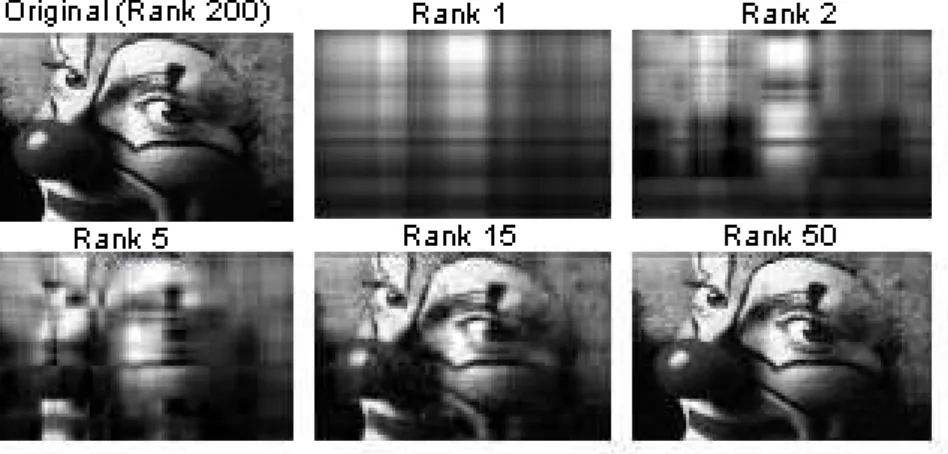
To explain the effect of SVD, I will use an example from image compression, where SVD is used to optimize the relation between image quality and file size. Figure 3.2 shows pictures of a clown with different quality.
Figure 3.2:SVD in image compression: View them×nimage as a matrix. The rank of this matrix was reduced fromr= 200tok= 1,2,5,15,50. Hardly any difference is visible between the rankk= 50approximation of the image and the original, but the file size is reduced fromm×ntok(m+n). (Source: Persson (2007))
Any picture can be seen as a matrix, where each cell contains a number that corresponds to a colour or a grayscale. The upper left image in figure 3.2 shows the original picture, a matrix of rank r = 200. The rank (r) of a matrix is the smaller of the number of linear independent rows and columns. SVD is used to reduce the rank and thereby the file size of the image. If the rank is reduced tok = 1ork = 2the image of the clown is not recognizable. The clown can
38 3.2. LATENT SEMANTIC ANALYSIS be recognized in the rank15(k = 15) approximation but the image is blurred. At rankk = 50
hardly any difference between the approximation and the original image can be detected, but the file size is reduced fromm×ntok(m+n).
The clown can be recognized because SVD emphasizes the most essential features and information while unimportant details are suppressed. On the highest level of abstraction (rank-1 approximation) only the very basic structure of the image is depicted. SVD ranks the features by importance for the image. By reducing the rank tok, only the firstkfeatures are kept.
One aims to find the optimal rank approximation where all and only the important informa-tion is shown. If the important features are not all captured the picture cannot be recognized, whereas if too many features are kept the data structure is unnecessarily large.
In the example in section 3.2.1 SVD finds concepts and relations between terms in the term-by-document matrixBand ranks them by importance. Only thekmost important concepts are kept, and the term similarity is calculated on the basis of the reduced matrix. The benefit of this reduction to the optimal rank-kapproximation is that the term similarity calculation is only based on the most characteristic features of the document collection at hand. The noise that blurs theclear view on the hidden relations is suppressed.
Mathematically speaking the characteristic concepts of a term-by-document matrix are its eigenvectors. First I will explain Eigenvalue Decomposition (EVD) for square matrices from which SVD for rectangular matrices is derived. The goal of EVD is to find eigenvectors~xthat point in the same direction asAx, i.e., vectors that satisfy equation 3.6.
A~x=λ~x (3.6)
Hereλis an eigenvalue, which determines the scaling of the corresponding eigenvector~x. For example the eigenvectors for the following matrixCof rank3are~x1,~x2 and~x3:
C= 2 0 0 0 9 0 0 0 4 ⇒ ~x1 = 0 1 0 ~x2 = 0 0 1 ~x3 = 1 0 0 λ1 = 9 λ2 = 4 λ3 = 2
In the case of a diagonal matrix the eigenvectors are the canonical unit vectors, i.e., the vectors spanning the coordinate system. Equation 3.6 can be solved by subtractingλ~xto obtain:
(A−λI)~x= 0 (3.7)
HereIis the unit matrix – a diagonal matrix where the main diagonal consists only of ones. If this equation has a non-trivial solution, thenA−λIis not invertible, which means there is no
B−1 = (A−λI)−1 that fulfilsB−1B = BB−1 = I. From that it follows that the determinant
of(A−λI)has to be0: