Teaching Models in Science: An Experiment with ICT in
Classroom
Dr. Anil Kumar
Principal and Senior Lecturer, DIET, (SCERT)Dilshad Garden, Delhi, India
ABSTRACT AIM
The aim of the present study was to see the effect of ICT Based teaching and learning on the academic achievement of students in science and math subjects.
SAMPLE
Two Govt. Senior Secondary School located in Dilshad Garden, Delhi were taken in this study and 148 students of class VI participated in the study. These students were divided in equal number of two groups i.e. 74 in Experimental and 74 in Control group. In both the groups there were an equal number of boys and girls. Both the groups of students were taught 30 days each.
METHOD
In the present study Investigator administered the pre-test achievement test in science and math subject on 148 students. Test had 30 items (containing fill in the blanks, true false etc.) carrying 1 mark each (total test is of 30 marks).
Teaching for control group occurred in their regular classrooms. Lesson planning was done in advance for control group. Selected topics and its contents were taught by the investigators as per their scheduled time. Lesson ended with summary and recapitulation.
Experimental group were exposed to use ICT based technology. They were taught with the help of multimedia CD having figures, text, explanation related to the content. Investigator was present to explain the various concepts taken for teaching through the use of computer and CD-ROM. Teaching occurred for 35 minutes of a period for thirty days to complete the content assigned by the subject teacher in both control and experimental groups.
FINDINGS
Administration of the post-test was conducted after the instructional treatment and delivery of classroom teaching. Both the experimental and control groups.
It was found that the students taught through ICT have scored excellent in Science and Mathematics after treatment.
Keywords: ICT Based Teaching, Traditional Teaching, Achievement in Science and Mathematics.
INSTRODUCTION
Traditionally it is believed that every teacher teaches in the way he was taught by his favorite teacher. Therefore the traditional methods of teaching kept perpetuating without evaluation for a quite long time. But the emergence of modern technology, psychology and philosophy in the field of education has brought tremendous changes in the teaching and learning methodologies. There have come several formal techniques, approaches and models which are gaining popularity now a day due to their usability and effectiveness. Even then, most of teachers especially in social sciences use old-fashioned techniques of transferring the knowledge and understanding involved in these courses. This often results into lessoning of interest and lack of predestined outcomes. Resulting, the whole process of taking up the social sciences at school level comes under a big question. To avoid such uninvited situations it is necessary to devise and use state of art mechanisms and technologies in the realm of teaching of social sciences.
Teaching is an eternal process of human development. Hence, Pre Service Teacher Education can never be considered as sufficient to meet the needs of teachers and pupils in the times to come. There emerges a need to educate and refresh the In Service Teachers in the upcoming aspects of teaching learning in classrooms. This study inclusively deals with the teachers already active in schools and taking social sciences at secondary level. The term in-service teacher education programme connotes any programme provided to teachers already working in schools, with the explicit purpose of updating and renewing their knowledge, technical skills, etc., for enhancing their efficiency. In-service teacher education can be seen as a continuation of pre-service teacher education. In fact, the relevance of in-service education can be understood only when viewed in this context. Even in the case of an effective pre-service programme, the impact on recipients can wear out over time. Teaching, being creative and individualistic requires periodic rejuvenation of teachers’ attributes and upgrading of their technical know-how. Even a school teacher who has been ‘an outstanding B.Ed. student’ who begins his/her teaching career with great enthusiasm, equipped with an initial amount of technical know-how and the positive feedback received while 'under training', needs improvement.
Over the years, every batch of students that a teacher faces is a new batch whose entry behavior makes unforeseen demands on the same teacher, for which he/she is obviously not prepared. Most often, teachers deal with such conflict by resorting to the use of 'authority' which they assume they have over students. In-service education which includes the training of teachers in the area which have emerged recently by conducting workshops and seminars and can be used as best and innovative practice by the institute would continually help effective teachers stay effective.
TRADITIONAL VS ICT BASED LEARNING
Traditional instruction is a systematic way of planning, communicating, and delivering content in the classroom. This method provides strong structure to students that help them to concentrate on their academic task. The traditional instructional approach assumes that all students learn in the same way. The role of the learners in traditional instruction as a passive listener, in this context teacher controlled learning environments are considered for delivering instructions.
Information and Communication Technology are electronic or computerized devices and associated with human interactive materials that enable the user to employ them for a wide range of teaching and learning processes in addition to personal use. The rapid development in Information and Communication Technology (ICT) and the use of computer in education have made it easier for users to access, deliver and store knowledge. Furthermore, the ability of Information and Communication Technology to deliver information quickly, correctly and attractively in the form of multimedia has also made learning more enjoyable. An enjoyable learning scenario is a necessity to effective instruction. Besides being an instruction that students enjoy, effective instruction also enables students to acquire specific skills, knowledge, and attitudes (Watkins, Gary Lynn, (1996).
In ICT based teaching –learning instructions are learner centered and highly individualized that seeks a high level of learner involvement. It is focused and targeted on learner’s interest and curiosity. It is flexible to explore diverse possibilities. Many ICT based learning programs do indeed make use of stimulants like pictures, graphics, sounds, videos etc. ICT can bring both the best instructional process to the student. It also brings about the convergence of a stimulating and encouraging environment of learning to meet learning objectives.
MULTIMEDIA LEARNING
The modern research in the field of multimedia has often created an unwarranted hype about the superior nature of the multimedia-based learning compared to the traditional teaching methods. However, it is of paramount importance that modern day educationists realize the key factors behind the initial success of multimedia and decipher the key features that differentiate Multimedia-based instruction from the traditional methods. Only after we go through this process would we be able to understand the long-term impacts of multimedia and also realize the ways in which we can create synergy between multimedia and education. Emerging as a precious asset in pedagogy, technology is viewed as a potential element that can influence traditional education. The goals of using multimedia in education are to enhance teaching and learning and to increase the efficiency and effectiveness of the educational organization. Multimedia has been popular in this age of Science and Technology. It means an integration of sound, still images, animation video and text along with computing technology.
There is indeed a more away from the “transmission” or “passive-learner” model of learning to the “Experiential learning” or “active learner model”. In some instances teachers may become more like guides and mentors, facilitators of learning, leading students along a learning path, not the primary providers of information and understanding. The students not teachers become the core of the teaching & learning process. This is a sensitive and highly politicized subject among educators, so educational software is often positioned as “enriching” the learning process, not as a potential substitute for traditional teacher based methods. An interactive use of multimedia in schools involves the students themselves.
SIGNIFICANCE OF ICT BASED LEARNING AND MULTIMEDIA
A number of studies (cited in Najjar, 1996) have been conducted in the area to ascertain the effectiveness of multimedia instruction. Analysis has been done by Bosco, (1986), Fletcher, J. D. (1990), and Tan and Leong, (2003) by examining 200 over studies. The information included sciences, foreign languages and electronics. The control group normally learnt the information via classroom or lecture combined with hands-on experiments. The comparison group learnt information via interactive videodisks or computer based instruction. The achievement of learning was measured via test taken at the end of the lessons. Over this wide range of students, meta-analysis found that learning was higher when computer-based education was used. In conventional teaching most of the time is consumed for input out put and less time is left for process. But in teaching with multimedia CD, the input and output time is reduced and process time is increased. When the process time is increased the time of student’s activities, discussion, correlation with other subjects, brain storming learning etc. will increase. When we do teaching with the help of multimedia CD we get more time for the process phase
which is more important in a period of 45 minutes or one hour. At secondary level, the study of science comprise of physics, chemistry and biology. Al natural science which are later used in applied science like engineering medical and pharmacy etc. hence they need to be properly and clearly understand by the student for their best utilization in the future.
Now-a-days it is the need to prepare our students for the 21st century. But in the conventional method the text book as the main teaching tool alone is insufficient to meet the need of the students as they find it difficult to visualize the concept and to grasp information that is presented either verbally or in text. The interactive multi-media enhance effective self-learning among students. The concept of theory as well as practical can be taught with the help of animation graphics, sound etc. for example the basic concept of human body systems can be explained through graphics. However, enjoyable scenario is a necessity to effective instructions. In order to achieve effective instructions instructor need to create an enjoyable learning environment and one of the methods is to use of multimedia teaching instructions. The use of multimedia enables both synchronous and asynchronous learning. Studies conducted over the years have indicated that the use of multimedia can address different learning styles of students. The investigators felt that Multimedia has contributed a lot to the field of education. Coming from a science background it craves investigator to study more about the contribution of education thoroughly. The present research has been conducted to study the contribution and effectiveness of ICT based learning in comparison to conventional methods of learning.
OBJECTIVES OF THE STUDY
1. To study the effect of ICT teaching on the achievement of students in Science subject. 2. To study the effect of ICT Teaching on the achievement of students in Math subject. 3. To compare the effectiveness of ICT teaching and traditional teaching.
METHODOLOGY OF THE STUDY
In order to make sample representative, a random sampling technique was applied by using “draw of lots” in which every individual gets equal chances of being selected. Thus, from a total of 332 students of class-VI were matched on their age and sex. Only those students were chosen who were of 11 to 11.5 years of age and equal number of boys and girls was chosen. Hence, only 176 students were found meeting the matching criterion. Finally 72 students were selected from Girls School by using ‘draw of lots’ technique. Similarly, 76 boys were selected from Boys School. The selected students were divided in two groups. Therefore, out of 72 girls 36 were provided ICT teaching in science and Math and rest group of girls was provided traditional teaching. Similarly out of 76 boys 38 were provided ICT teaching and rest were provided traditional teaching in science and math.
Phase I- Pre-test
Investigator administered the pre-test in math and science subject on 148 students. Test had 30 items (containing fill in the blanks, true false etc.) carrying 1 mark each (total test is of 30 marks). Students were asked to fill in the entries, before distributing test papers to them, important instructions were given to them.
Phase II- Treatment
Conduction of pre-test was followed by treatment to experimental group. Conventional method was employed to teach Control group. Teaching for control group occurred in their regular classrooms. Lesson planning was done in advance for control group. Selected topics and its contents were taught by the investigators as per their scheduled time. Lesson ended with summary and recapitulation.
Experimental group was exposed to computer and ICT based material. They were taught with the help of computer. Investigator was also present to explain the various concepts taken for teaching through the use of computer and CD-ROM. Teaching occurred for 35 minutes of a period for thirty days to complete the content assigned by the subject teacher in both control and experimental groups.
Phase III- Administration of the post-test after the instructional treatment of thirty days, Post-test was administered to both the experimental and control groups.
TOOLS AND TECHNIQUES
The content of pre-test was related to knowledge about the topics which they have studied in their previous class V. Pre-test and post test for this study consisted of objective type test items i.e. fill in the blanks, multiple choice questions, matching type etc). In each of the test, there were 30 items, carrying 1 mark each. Test items were based on the objectives of education related to cognitive, affective and psychomotor domains like knowledge, comprehension and application etc. A post test was designed from the content of NCERT Science books of class VI. The content was chosen under the assistance of the subject teachers of the selected school. The content was selected which is not taught by the regular teachers of the class VI.
DISCUSSION OF RESULTS
Table 1: The Mean score on pre-test and Post Test of Control Group (traditional Teaching) science and math
Variables N Mean score in Science Mean Score in Math
Pre-test 74 14.40 15.75
Post-test 74 16.15 17.50
Fig:1 Showing comparison in Pre and Post test score of Science and Math of Traditional Teaching. Table 1 and Figure 1 reveal that there is a negligible improvement in the result of the students in science and math taught through traditional methods of teaching.
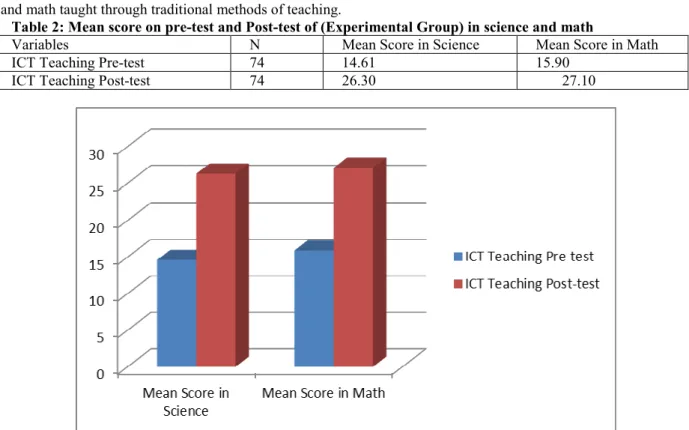
Table 2: Mean score on pre-test and Post-test of (Experimental Group) in science and math
Variables N Mean Score in Science Mean Score in Math
ICT Teaching Pre-test 74 14.61 15.90
ICT Teaching Post-test 74 26.30 27.10
Fig:1 Showing comparison in Pre and Post test score of Science and Math of ICT Teaching.
It is evident from Table 2 and Figure2 that mean value of Pre-test is 14.61 and post- test mean of experimental group is 26.30. Thus it can be inferred that ICT teaching is effective in learning Science in terms of academic achievement. ICT overcomes the physical ICT barriers of classrooms as it enables the students to see visually with various visual, auditory and text based effects.
Table 3: Mean, S.D. of post test scores and mean difference of Control Group and Experimental Group in science and math
GROUPS MEAN OF POST
TEST in Science MEAN POST TEST in OF Math
S.D OF
POST-TEST in Science S.D OF POST-TEST in Math
CONTROL GROUP 16.15 17.50 10.09 11.70
EXPERMIMENTAL
GROUP 26.30 27.10 9.16 11.81
Table 3 shows mean score of students in science on post-test taught through conventional method is 16.15 whereas mean score of student taught through ICT is 26.30, similarly mean score in math in post-test is 17.50 and 27.10 of control and experimental group respectively. From this it is clear that on an average the performance of experimental Group on Post test is found to be better than the control group on posttest.
Table 4: Computed t-value of the mean difference of control and experimental group in science
Compared Variable Group N Mean S.D Df t-VALUE
Score in Science CONTROL GROUP 74 16.15 10.09
146 6.4070 EXPERIMENTAL GROUP 74 26.30 9.16
Table 4 indicates that the mean in pre test and post tests of control group and experimental group is 16.15 and 26.30 respectively. Computed standard deviation of post tests scores for control and experimental groups is 10.09 and 9.16 respectively. Calculated t value is 6.40 which is greater than the table value at 0.05 level of significance.
Table 5: Computed t-value of the mean difference of control and experimental group in math
Compared Variable Group N Mean S.D Df t-VALUE
Score in Math CONTROL GROUP 74 17.50 11.70
146 4.9670 EXPERIMENTAL GROUP 74 27.10 11.81
Table 4 reveals that the mean in Math subject in pre test and post tests of control group and experimental group is 17.50 and 27.10 respectively. Computed standard deviation of post tests scores for control and experimental groups is 11.70 and 11.81 respectively. Calculated t value is 4.9670 which is greater than the table value at 0.05 level of significance.
Thus it can be inferred that ICT based teaching is effective in the learning of science and math as compared to the conventional mode of teaching in terms of academic achievement. On the basis of the analysis of the results, the learners in ICT and conventional method for both experimental and control group a set of findings can now be discussed to clarify the effectiveness of these two methods. Thus it has been concluded that ICT based teaching overcomes the physical barriers of classrooms as it enables the students to use computer with various visual, auditory and text based effects in educational that increases the efficiency and effectiveness of the educational organization as compared to the conventional teaching in which the use of blackboard is the main support.
CONCLUSION
The interactive nature of ICT provides immediate and comprehensive feed back to students. Leaning form ICT is an active and engage process. The ICT system presents stores, retrieves and transmits audio, video graphic and textual information. These kinds of systems can have powerful impact on the learner’s problem solving abilities and can generate a positive effect. ICT based learning is increasingly used to complement or replace conventional teaching methods. With the rapid progression in the multimedia technologies, it has become feasible to integrate multimedia technology into the teaching and learning process. What has been the conventional teacher-centered approach is now seeing a shift into one which emphasis is on student-centered learning. Traditional educational content can now be transformed into interactive multimedia content by using authoring packages. It has enabled the teacher to innovate his/her instructional design by presenting the educational content in an interactive and multi-sensory manner rather than the traditional single media format. This infusion of ICT into teaching and learning has altered instructional strategies in educational institutions.
REFERENCES
1. MHRD (1986) National Policy on Education – 1986, Delhi: Ministry of Human Resource Development, New Delhi
2. Naijar, L. J. (1996). Multimedia information and learning. Journal of Educational Multimedia and Hypermedia, 5, 129-150.
3. Sansanwal, D.N. & Singh, P.(1991) Models of Teaching. Society for Educational Research & Development, Baroda, 1991.
Vol.1, No. 1, 2006, pp. 18 – 25.
5. Sansanwal, D.N.(2000) Jerk Technology. Journal of Indian Education, Vol. XXVI, No. 1, 2000, pp 17 – 22. 6. Tan, L. H., & Peggy, L. (2003). Professional Development of ITE Teachers through Learning Circles,
Teacher Education Institute, China.
7. Tyagi, H K (2012) Effect of School, Gender, Age, Qualification and Experience on Role Stress: An Empirical Study on Educational Administrators of Eritrea International journal of Modern management Sciences ,Florida, USA Sept,2012, vo1(i), ISSN 2168-5479
8. Tyagi, H K (2014) Influence of General Mental Ability, Study Habits, Reading ability and Socio-economic Status on the academic Achievements of Students, International Journal of Education and Extension (IJEE),Baraktullah University Bhopal, (Jan-2014) Vol.2,Issue 2, ISSN:2278-537X
9. Tyagi, H K (2014) Influence of Psycho- Social Factors on the Academic Achievements of Students, International Journal of Modern Social Sciences, Florida, USA February 2014, 3(1): page: 44-50,ISSN:2169-9917
10. Tyagi, H K (2015) Inculcation of Values through Literature among Children: An Evaluation of NCERT English Textbook of Class- V, Journal of Teacher Education, and Research, Ram-Eesh Institute of Education, Vol. 10, No. 1,June 2015, ISSN 2454-1664,
11. Tyagi, H K (2015) Psycho-Social Factors Causing Stress: A Study of Teacher Educators, Journal of Education and Practice ISSN 2222-288X Vol.6, No.4 (2015)
12. Tyagi, H K (2016) Teaching Excellence and Innovative Practices: A Case Study of National Awardee Teachers of India Journal of Education and Practice,(Online)Vol.7,No.1,2016. www.iiste.org ISSN 2222-1735 (Paper) ISSN 2222-288X
13. Tyagi, Harish Kumar and Priti (2017) Influence of family environment, organizational climate and teaching aptitude on the training success of pre-service teachers, International Journal of Advances Research and Development, Vol-2, Issue 5, PP- 405-408, Year 2017.
14. Tyagi, Harish Kumar and Priti (2017)Correlates of training success: A Study of pre-service elementary teachers, International Journal of Academic Research and Development, Vol-2, Issue No. 5, PP- 548-552, September 2017,
15. Watkins, G. L. (1996). Effects of CD-ROM Instruction on Achievement and Attitudes (multimedia computer Assisted Instruction). Dissertation Abstracts International, 57(04), 1446.