Design and Implementation of Netdude,
a Framework for Packet Trace Manipulation
Christian Kreibich
University of Cambridge Computer Laboratory
JJ Thomson Avenue, Cambridge CB3 0FD, United Kingdom
christian.kreibich @ cl.cam.ac.ukAbstract
We present a framework for inspection, visualiza-tion, and modification oftcpdumppacket trace files. The system is modularized into components for dis-tinct application purposes, readily extensible, and capable of handling trace files of arbitrary size and content. We include experiences of using the system in several real-world scenarios.
1
Introduction
In today’s computer networks, traffic varies greatly in content and volume, making network analysis a difficult process. Researchers, developers, and sys-tem administrators use traffic capturing tools ( snif-fers) to obtain traces of network traffic to gain bet-ter understanding of traffic characbet-teristics. Storing traffic flows in a standardized form allows them to investigate the effects of misconfigurations and pro-gramming errors, to process traffic using appropri-ate tool chains, and most importantly, to make the occurrence of observed phenomenareproducible. Among the plethora of tools available for this pur-pose, three freely available ones constitute the de-facto standard: thelibpcaplibrary1
provides a low-level application programming interface (API) to fil-ter and infil-tercept packets, tcpdump presents these packets in textual format, and ethereal2 provides a graphical user interface (GUI) for capturing, fil-tering, and inspecting packets, supporting a large number of networking protocols and sniffers. Interestingly, tools that also allow the user to edit
captured traffic have so far been limited to problem-specific solutions. The current state of the art is disappointing: developers create repositories of
typ-1
http://www.tcpdump.org
2
http://www.ethereal.com
ically unreleased, purpose-specific, throw-away pro-grams, inconveniently written at thelibpcaplevel. Yet many of these tools would be useful to a larger audience. This practice violates a number of well-accepted software engineering principles, such as component reuse and the avoidance of cut-and-paste practices, code redundancy, and duplication of ef-fort.
To improve this situation, we presentNetdude, the
network dump data displayer and editor, a frame-work designed to support different packet manipu-lation paradigms (from APIs to convenient GUIs), emphasizing code reuse, extensibility, and scalabil-ity. All components presented in this paper are fully implemented and publicly available.
The rest of this paper abstract is structured as fol-lows: Section 2 presents the architecture of frame-work, including design goals and implementation de-tails. Section 3 gives examples of using the frame-work, followed by a description of our experiences using the system in real-world scenarios in Section 4. Finally, Section 5 summarizes the paper.
2
Architecture
We first present our design goals for the framework and then describe how these goals lead us to the architecture we eventually implemented. In the re-mainder of this section, we illustrate how the frame-work components can be used in selected scenarios.
2.1
Design Goals
1. Multiple usage paradigms
The user must be able to manipulate trace files at the desired level of interactivity and abstrac-tion. We neither want to enforce only an API,
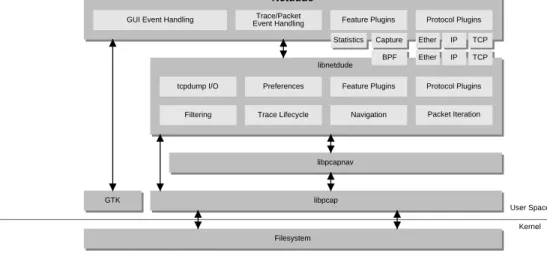
User Space Kernel Filesystem libpcap libnetdude libpcapnav tcpdump I/O Netdude GTK Navigation Trace Lifecycle Filtering
Preferences Feature Plugins
Packet Iteration Protocol Plugins GUI Event Handling Event HandlingTrace/Packet Feature Plugins Protocol Plugins Ether IP TCP Ether IP TCP Statistics Capture
BPF
Figure 1: Architecture of the Netdude Framework.
thus asking all users of the framework to be-come developers, nor a GUI, forcing developers to use a graphical interface that may not be flexible enough. Programmers must find the framework usable at a convenient level of ab-straction that allows them to focus on relevant aspects of their algorithms without getting dis-tracted by details of packet reading & writing, trace file navigation, etc. The framework must eliminate the need to hand-write trace file ac-cess, filtering, iteration and protocol demulti-plexing code anew for every application. 2. Openness & Extensibility
To programmers, we want to provide maximum flexibility in making their code interact with our framework. Since networking code is typ-ically rather low-level, the programming lan-guage must not limit the usability of the frame-work to a certain language or execution envi-ronment. Both programmers and GUI users must have a means to extend the framework using components that they develop themselves or obtain from other developers.
3. Small-scale Editing
The framework must allow the manipulation of packets at a fine-grained level of detail, down to individual bits in the protocol headers and byte sequences in packet payloads. It also must provide the user with means to delete, move, swap, duplicate and erase packets, and to allow easy saving of changes made to a trace file. 4. Large-scale Editing
The framework must allow the manipulation
of arbitrarily large trace files (subject to the maximum allowable file size on the operating system used), particularly files that are much larger than the system memory capacity. Traf-fic trace files easily reach sizes in the Gigabyte range, thus simply loading files into memory at startup is not an option.
The first goal excludes library-only or application-only designs since either would exclude one of the desired user groups. The second goal demands a widely used system programming language; we have decided to implement all library components in the C language to facilitate easy binding to other lan-guages and to provide a largest-possible common denominator. The remaining two goals suggest con-centrating the packet manipulation code in a library that can then be used by other programs.
2.2
Implementation
These goals lead to a layered architecture, illus-trated in Figure 1. In the bottom layer, libpcap
handles elementary trace file operations: opening and saving traces, sequential reading and writing of packets.
libpcapnavis a thin wrapper aroundlibpcapthat
removes the limitations of sequential read access to packets stored in a trace. Between packet reads, users can jump to arbitrary locations in the trace file, identified by packet timestamps or fractional offsets in the file (e.g., 0.5 identifies the middle of the
file). This library works similarly totcpslice3, but features a more robust algorithm for packet stream synchronization.
libnetdude is the core of the framework, where
most of the packet editing functionality is imple-mented. It provides abstract data types and APIs for handling trace files, regions of trace files, pack-ets, filters, and packet iterators. libnetdude can handle arbitrarily large traces: it never loads more than a configurable maximum number of packets into memory at any time. Since one of our design goals was the ability to perform arbitrary packet in-sertions and deletions, simplemmap()ing of regions of the trace file is not an option. Rather, trace files are edited at the granularity of trace areas, whose borders are defined using timestamps or fractional offsets understood by libpcapnav. The layers of modified trace areas are carefully maintained by
libnetdude, always providing a consistent view of
the trace file to the user. The modified trace ar-eas are stored in temporary storage, astrace parts. Figure 2 illustrates these concepts.
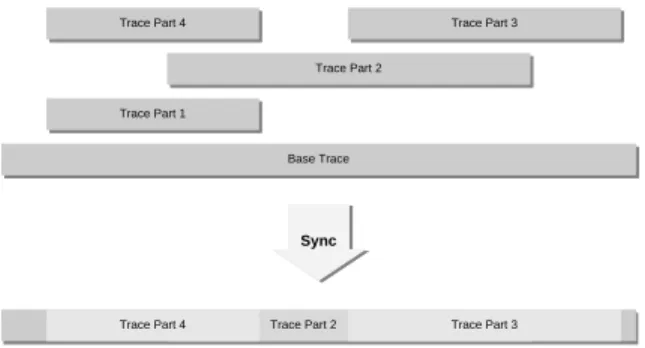
When accessing a packet, the library always uses the trace part in the uppermost layer at the cur-rent offset. When a trace file is saved, the trace area layers are flattened onto the original trace file, honoring any inserted or removed packets, to yield the trace file the user created. The process is il-lustrated in Figure 3. Note that packet insertion and deletion are straightforward in this approach: the actual composition of packets in a trace area can change but trace parts are still aligned on their original boundaries.
libnetdudeprovides a number of other features:
• Its plugin architecture enables extensibility in
two ways: protocol pluginsallow interpretation of arbitrary protocol data, whereasfeature plu-ginsprovide building blocks (e.g., anonymizers, statistical analyzers or flow demultiplexers) in a reusable fashion.
• Packet initialization turns raw packet data into
structured protocol headers, as much as the in-stalled protocol plugins permit. After that, it is easy to obtain, say, the TCP header of a packet. Nested protocols (such as IP tunnels) are sup-ported. Developers thus need no longer write their own protocol demultiplexers in each ap-plication. 3 http://www.tcpdump.org/other/tcpslice.tar.Z Base Trace Trace Part 1 Trace Area 1 Trace Area 2 Trace Area 3 Trace Part 3 Trace Part 2 Trace Part 4
Figure 2: Editing different trace areas causes result-ing trace parts to be layered on top of the original trace file. Base Trace Trace Part 1 Trace Part 3 Trace Part 2 Trace Part 4 Trace Part 2
Trace Part 4 Trace Part 3
Sync
Figure 3: When saving a trace file, the layered parts are flattened onto the original trace file.
• Access to the familiar tcpdump output:
libnetdudecan associate each open trace file
with its own tcpdump process. The user can then obtaintcpdumpoutput at the granularity of individual packets with a single function call. As usual, details of the output can be controlled using tcpdump’s command line options. Since
libnetdude can be configured to use any
lo-cally installedtcpdumpbinary, changes made to
tcpdumpremain visible inside the framework.
• An observer/observee API for objects like trace
files, packets, packet iterators, and trace parts allows seamless integration of the library into the surrounding application, without exposing unnecessary internal state. Users can register callbacks that are invoked when certain events occur in the monitored items.
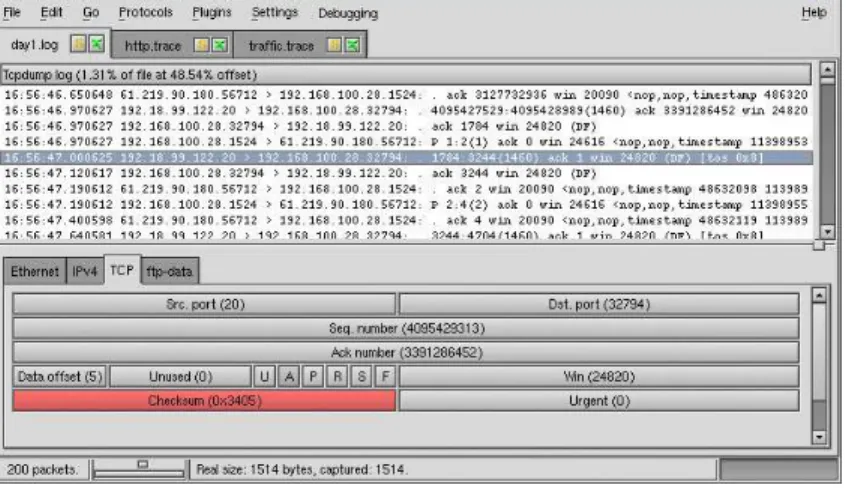
Finally, the Netdude framework provides a GUI ap-plication that uses all components described above. The main window is shown in Figure 4. The appli-cation allows non-developers to open and save trace files, jump to arbitrary locations in the trace files, modify protocol header fields and payload content in configurable trace areas, and access the installed feature plugins.
Figure 4: Main window of the Netdude GUI, with three trace files opened and the TCP header of the selected packet displayed. The red highlighting indicates that the TCP checksum in this packet is incorrect.
3
Framework Usage
We illustrate the usage of the framework in two examples: packet iteration and accessing selected protocol headers in a packet. Figure 5 shows
libnetdudecode for these scenarios.
3.1
Packet Iteration
Using libnetdude, packet iteration is done in two steps: first the area of the trace that the user wants to iterate is specified, then an iterator instance is used in a for()-loop. Using the GUI, the user defines the trace area conveniently using a dialog. The iteration is then done implicitly when the user performs an action that can be applied to multi-ple packets (e.g., setting a header field to a certain value, or fixing checksums).
3.2
Accessing Protocol Data
Using libnetdude, the user obtains a handle for the desired protocol by specifying the layer in the network stack and the identifier of the protocol com-monly used at that layer (e.g., IPPROTOxxx values at the network layer). Then the user requests a pointer to this protocol’s header data in a packet at the desired nesting level. Using the GUI, the user first selects a packet from the list of packets cur-rently loaded into memory. The GUI then provides access to the individual protocol headers contained in that packet. The user selects the desired proto-col header and directly manipulates the header bit fields as visualized by the responsible plugin (e.g.,
using pull-down menus for fixed-range values, or en-try fields for variable fields).
#include <libnd.h> #include <netinet/in.h> #include <netinet/tcp.h>
void iterate_tcp_dports(const char *tracefile) { LND_Trace *trace; LND_PacketIterator pit; LND_TraceArea area; LND_Protocol *tcp; struct tcphdr *tcphdr; /* Obtain handle to TCP protocol */
if (! (tcp = libnd_proto_registry_find(LND_PROTO_LAYER_TRANS, IPPROTO_TCP))) { /* Protocol not found -- handle accordingly. */
}
/* Open the trace file: */
if (! (trace = libnd_trace_new(tracefile))) { /* Didn’t work -- appropriate error handling. */ }
/* Set the trace’s active area to the second half of the file. */ libnd_trace_area_init_space(&area, 0.5, 1.0);
libnd_trace_set_area(trace, &area);
for (libnd_pit_init(&pit, trace); libnd_pit_get(&pit); libnd_pit_next(&pit)) { /* Request the TCP header of the current packet. */
tcphdr = (struct tcphdr *) libnd_packet_get_data(libnd_pit_get(&pit), tcp, 0); if (tcphdr)
printf("Dest. port: %u\n", ntohs(tcphdr->th_dport)); }
}
Figure 5: Alibnetdudeexample, iterating the sec-ond half of a trace and printing out the destination ports of all TCP packets in that area.
4
Real-world Use Cases
The original catalyst for the creation of Netdude was our work on TCP/IP network traffic normaliza-tion [HKP01]. This was a typical scenario for small-scale editing. In order to test our normalizations, we needed to create very specific packet constellations, for example specific values for the IP TTL field, the
TCP flag bits, and IP fragments with valid and in-valid fragment offsets. Using the Netdude GUI, we gave individual packets the desired features and re-played the manipulated trace files through the nor-malizer.
The second use case was in the domain of high-speed network monitoring equipment. The sub-ject of study was Nprobe, a scalable multi-protocol network monitor [MHK+03]. The goal was to evaluate system performance under various traffic loads. We used libnetdude to create traffic pat-terns that triggered different hotspots in the sys-tem. We then wrote an IP address mapping plugin
forlibnetdude, that maps those traces to disjunct
IP address ranges so that we could replay multi-ple instances of the traces in parallel to expose the probe to high volumes of traffic.
At the moment we are using Netdude in order to test intrusion detection system (IDS) signatures. The classic approach is to experiment with a signa-ture for a network-based IDS [Pax98][Roe99], test-ing whether the IDS reacts correctly when replaytest-ing a trace file. It is often more straightforward to ma-nipulate the traffic itself and not the signature, par-ticularly when testing the resilience of a new signa-ture against variation in traffic patterns and corre-sponding false positive rates. Netdude’s small-scale editing capabilities have proven most helpful in this scenario.
5
Summary
Netdude is a framework for tcpdump packet trace inspection, visualization and modification. Its mod-ular design allows users to interact with the frame-work at different abstraction levels: a low-level trace navigation wrapper forlibpcap, a high-level API with convenient types for performing common packet manipulation tasks in libnetdude, and a GUI application that allows both small- and large-scale editing previously impossible without writing code.
The system has been in development for three years now. The use cases that allowed us to apply the framework so far have confirmed our goals of simpli-fying the development of packet manipulation code and encouraging the re-use of components devel-oped in other projects. We have implemented a number of plugins for purposes such as IP address translation, TCP flow demultiplexing, and
statisti-cal analysis. One of the main goals for future re-leases is a scripting interface tolibnetdude. We hope that the authors of networking code con-sider using the Netdude framework for their fu-ture packet manipulation needs, and provide useful functionality in the form of plugins forlibnetdude
or the Netdude GUI as a benefit to the commu-nity. Netdude is provided with a BSD license, hosted on SourceForge, and can be obtained at
http://netdude.sf.net.
Acknowledgments
We would like to thank Vern Paxson and Mark Handley for inspiration and helpful feedback. We also thank the Netdude user community for valu-able ideas, comments, and contributions, particu-larly Daniel Stodden and Euan Harris, who also provided valuable comments on the paper. Thanks also to the Castle Pub in Cambridge for hosting our brainstorming sessions.
References
[HKP01] Mark Handley, Christian Kreibich, and Vern Paxson. Network Intrusion De-tection: Evasion, Traffic Normalization, end End-to-End Protocol Semantics. In
Proceedings of the 9th USENIX Security Symposium, August 2001.
[MHK+
03] Andrew Moore, James Hall, Christian Kreibich, Euan Harris, and Ian Pratt. Architecture of a network monitor. In
Passive and Active Measurement Work-shop Proceedings, pages 77–86, La Jolla, California, April 2003.
[Pax98] Vern Paxson. Bro: A System for Detecting Network Intruders in Real-Time. Computer Networks (Ams-terdam, Netherlands: 1999), 31(23-24):2435–2463, 1998.
[Roe99] Martin Roesch. Snort: Lightweight Intrusion Detection for Networks. In
Proceedings of the 13th Conference on Systems Administration, pages 229–238, 1999.