• No results found

Shrinkage Estimation For Penalised Regression, Loss Estimation And Topics On Largest Eigenvalue Distributions.

N/A
N/A
Protected

Academic year: 2021

Share "Shrinkage Estimation For Penalised Regression, Loss Estimation And Topics On Largest Eigenvalue Distributions."

Copied!
147
0
0

Loading.... (view fulltext now)

Full text

(1)

SHRINKAGE ESTIMATION FOR PENALISED REGRESSION,

LOSS ESTIMATION AND TOPICS ON LARGEST

EIGENVALUE DISTRIBUTIONS

A Dissertation

Presented to the Faculty of the Graduate School

of Cornell University

in Partial Fulfillment of the Requirements for the Degree of

Doctor of Philosophy

by

Rajendran Narayanan

August 2012

(2)

c

2012 Rajendran Narayanan

(3)

SHRINKAGE ESTIMATION FOR PENALISED REGRESSION, LOSS ESTIMATION

AND TOPICS ON LARGEST EIGENVALUE DISTRIBUTIONS

Rajendran Narayanan, Ph.D.

Cornell University 2012

The dissertation can be broadly classified into four projects. They are presented in four

different chapters as (a) Stein estimation for

l

1

penalised regression and model selection, (b)

Loss estimation for model selection, (c) Largest eigenvalue distributions of random matrices,

and (d) Maximum domain of attraction of Tracy-Widom Distribution.

In the first project, we construct Stein-type shrinkage estimators for the coefficients of a

linear model, based on a convex combination of the Lasso and the least squares estimator.

Since the Lasso constraint set is a closed and bounded polyhedron (a crosspolytope), we

observe that under a general quadratic loss function, we can treat the Lasso solution as a

metric projection of the least squares estimator onto the constraint set. We derive analytical

expressions for the decision theoretic risk difference of the proposed Stein-type estimators

and Lasso and establish data-based verifiable conditions for risk gains of the proposed

esti-mator over Lasso. Following the Stein’s Unbiased Risk Estimation (SURE) framework, we

further derive expressions for unbiased esimates of prediction error for selecting the optimal

tuning parameter.

(4)

of the unknown location parameter

θ

using an estimator

d

(

X

) is often accompanied by a loss

function

L

(

d

(

X

)

, θ

). Performance of such an estimator is usually evaluated using the risk of

d

(

X

). We consider estimating the loss function using an estimator

λ

(

X

) which is conditional

on the actual observations as opposed to an average over the sampling distribution of

d

(

X

).

In this context, we consider estimating the loss function when the unknown mean vector

θ

of a multivariate normal distribution with an arbitrary covariance matrix is estimated using

both the MLE and a shrinkage estimator. We derive sufficient conditions for inadmissibility

of the unbiased estimators of loss for such a random vector. We further establish conditions

for improved estimators of the loss function for a linear model when the Lasso is used as a

model selection tool and exhibit such an improved estimator.

The largest eigenvalue of the Gaussian and Jacobi ensembles plays an important role in

clas-sical multivariate analysis and random matrix theory. Historically, the exact distribution

for the largest eigenvalue has required extensive tables or use of specialised software. More

recently, asymptotic approximations for the cumulative distribution function of the largest

eigenvalue in both settings have been shown to have the Tracy-Widom limit. Our main

results concern using a unified approach to derive the exact cumulative distribution function

of the largest eigenvalue in both settings in terms of elements of a matrix that have explicit

scalar analytical forms.

In the fourth chapter, the maximum of i.i.d. Tracy-Widom distributed random variables

arising from the Gaussian unitary ensemble is shown to belong to the Gumbel domain of

attraction. This theoretical result has potential applications in any situation where a multiple

comparisons is needed using the greatest root statistic.

(5)

BIOGRAPHICAL SKETCH

Rajendran Narayanan spent his formative years in the city of Kolkata, India and finished

his higher secondary schooling from St. Lawrence High School, Kolkata. Upon completion,

he obtained his Bachelors degree in Statistics (Honours), Mathematics and Economics from

St. Xavier’s College, Kolkata in 1999. He then completed his Masters degree in Applied

Statistics and Informatics from the Department of Mathematics at the Indian Institute of

Technology, Mumbai, India in 2002.

After two years of working in the industry as a Business Analyst, he swtiched to applied

industrial research working as a Scientist with the GE Global Research Centre, Bangalore,

India. Following which, Rajendran began his graduate studies in Statistics at the Department

of Statistical Science at Cornell University, Ithaca, U.S.A. in 2006. Upon completion of his

PhD in August 2012, he would be joining the Indian Statistical Institute in Kolkata as a

Visiting Scientist.

(6)

Dedicated to my mother and to the memory of my high school teacher, Shri Lal Bahadur

Singh.

(7)

ACKNOWLEDGEMENTS

There have been numerous people in several capacities who have been very instrumental

during my PhD life. I have been very fortunate to have Prof. Martin Wells as my thesis

supervisor. He has been great at articulating my intuition into a rigorous framework and

helping me concretise the right questions to ask. As a research mentor, I particularly thank

him for the ample time and free rein he has given me to explore various areas of

mathemat-ical statistics in addition to retaining humour and exercising patience during my ebb times

in research. With his unbridled optimism and infectious enthusiasm, he has nurtured and

actively supported my quest for a holistic development by indulging me in several of my

non academic pursuits. Suffice it to say that I have learned a lot about life well beyond the

domain of research through my discussions with him on a myriad of subjects.

I wish to express my sincere thanks to my committee members, Prof. Rob Strawderman

and Prof. Michael Nussbaum. Rob’s keen insight and great attention to detail has played

a crucial role in this thesis. In particular, he pointed a flaw in my proof on the domain of

attraction of the Tracy-Widom distribution and later helped me tide over a key step in the

new proof of the theorem. I sincerely thank him for exposing me to inference of stochastic

processes and the dedication he has displayed towards my learning at graduate school. My

special thanks to Michael for directing me to the literature on empirical risk minimisation

and helping me formalise my geometric ideas of embedding lasso in a cone.

I have been lucky to have had the opportunity to present and discuss my thoughts on the

first chapter of the thesis with Prof. Dominique Fourdrinier who had valuabale comments

on how to cogently structure the material in the chapter.

(8)

Special thanks are in order for Diana Drake. She has been an indispensable source of

sup-port; from rescuing me from all the problems I usually landed up in school (owing to my

tomfoolery and innate procrastinating self) to bringing back to life my quasi dead car two

days before Christmas. None of this work would have been possible without the unseen

support staff of Malott Hall who provided a clean and aesthetic environment to work.

Surviving the course work phase wouldn’t have been possible without Caitlin and Kirsten.

Dave was particularly helpful in dusting off my rusted concepts of real analysis and enhancing

my mathematical experience in general. Thanks to Michael Grabchak for being the sceptical

inquirer of my half-baked proofs in addition to presenting the Marxist (of the Groucho type)

perspective during our endless debates about politics, society and cinema over innumerable

pints. Several hours over coffee and beer were spent on philosophical excursions, self

re-flection and jollity with Matti. Apart from being the sounding board on some eigenvalue

proofs, the monk-like Inder has been a close comrade discussing with me, everything from

the sublime to the ridiculous. Anand, Suresh and Vivek were phenomenally easy-to-live-with

house-mates who not only bore the brunt of my “Cries and Whispers” but also provided

great fodder for scientific thinking. The unyielding courage and passion for the quest for

“truth” displayed by Vatsan and Saikat will remain a learning experience for life. Leifur,

Darcy, Mekala and Ryan have been fantastic friends who’ve lent patient ears to many of

my rants and ramblings. Thanks to Jon for being ever ready for badminton and beer. The

positive spirit of Matt, Krishna’s benevolent attitude and Joyjit’s encouraging words have

also played a key role during this phase. The last lap of this journey has been extremely

easy due to the witty, calm and tolerant Kalyani whose ability to handle my neurotic self

(9)

borders on quixotic lines. My heartfelt acknowledgements to Chapter House for providing

the platform for my interactions with most of the people mentioned in this paragraph.

I am very grateful to Venu and my sister Shobana to have given me a lot of support and

having extended unparalleled warmth during my breaks to their house. Finally, I would like

to thank my mother who is not only a genuinely liberal friend but also a massive source of

inspiration who has taught me to think independently.

(10)

TABLE OF CONTENTS

Biographical Sketch

. . . .

iii

Dedication

. . . .

iv

Acknowledgements

. . . .

v

Table of Contents

. . . .

viii

List of Tables

. . . .

x

List of Figures

. . . .

xi

1

Shrinkage Estimation for

l

1

Penalised Regression

1

1.1

Introduction

. . . .

1

1.2

Shrinkage Estimators

. . . .

6

1.2.1

Main Results

. . . .

8

1.3

Alternative Shrinkage Estimators

. . . .

9

1.3.1

The Lasso Embedded into a Cone

. . . .

9

1.3.2

An Augmented Estimate

. . . .

11

1.3.3

Estimators in the augmented setting

. . . .

12

1.3.4

A James-Stein Form

. . . .

14

1.4

Prediction Risk

. . . .

16

1.5

Simulation

. . . .

20

1.6

Proofs of Section 1.2.1 Results

. . . .

23

1.7

Discussion

. . . .

31

1.8

Tables and Figures

. . . .

32

1.9

Estimators under a general constraint set

. . . .

42

2

Loss Estimation

47

2.1

Introduction

. . . .

47

2.2

Loss Estimation for MLE

. . . .

50

2.2.1

Examples

. . . .

54

2.3

Loss Estimation for Improved Estimators

. . . .

55

2.4

Loss Estimation for the Lasso

. . . .

60

2.4.1

Risk Difference Expression

. . . .

61

2.4.2

Conditions for Improved Loss Estimators for Lasso

. . . .

65

2.4.3

Example

. . . .

67

2.5

Simulation

. . . .

69

2.6

Discussion and Future Work

. . . .

76

3

Largest Eigenvalue Distribution

79

3.1

Introduction

. . . .

79

3.1.1

The Wishart distribution

. . . .

80

3.1.2

Double Wishart Setting

. . . .

83

3.1.3

Multiple Integrals and Determinants

. . . .

84

(11)

3.2.1

Gaussian Orthogonal Ensemble

. . . .

90

3.2.2

Extensions to GUE/GSE

. . . .

97

3.3

Results for Jacobi Ensemble

. . . .

98

3.4

Moments of the greatest root statistic for the bivariate case

. . . 108

3.5

Discussion

. . . 110

4

Domain of Attraction of Tracy-Widom Distribution

111

4.1

Introduction

. . . 111

4.2

Tracy-Widom Distribution

. . . 113

4.3

Domain of Attraction

. . . 115

4.4

Simulation

. . . 123

(12)

LIST OF TABLES

1.1

JS Estimate versus Lasso for

n

= 200

, p

= 100

, σ

2

= 1

. . . .

32

1.2

JS Estimate versus Lasso for

n

= 200

, p

= 100

, σ

2

= 100

. . . .

33

1.3

JS Estimate versus Lasso for

n

= 200

, p

= 100

, σ

2

= 9000

. . . .

33

1.4

JS estimate versus the Lasso for

n

= 2000

, p

= 100

, σ

2

= 9000

. . . .

36

1.5

JS Estimate and Lasso for the diabetes data

. . . .

38

1.6

JS Estimate and Lasso for the diabetes data

. . . .

39

1.7

JS Estimate and Lasso for the diabetes data

. . . .

40

2.1

Percent Risk Gains using improved loss estimator for diagonal and arbitrary

covariance matrix

. . . .

55

2.2

Percentage Risk Gains for different Active Sets for

n

= 1000 and

p

= 100

. .

71

2.3

Weibull fits of

l

2

for different error variance and active sets

. . . .

76

4.1

TW Statistics

. . . 115

4.2

Comparison of some statistics of simulated max TW with true Gumbel

. . . 125

(13)

LIST OF FIGURES

1.1

n

= 200

, p

= 100

, σ

2

= 1. Shrinkage Factor vs JS Estimate Risk Difference

.

34

1.2

n

= 200

, p

= 100

, σ

2

= 9000. Shrinkage Factor vs JS Estimate Risk Difference

35

1.3

n

= 2000

, p

= 100

, σ

2

= 9000. Shrinkage Factor vs JS Estimate Risk Difference

37

1.4

Prediction Risk Comparisons for the Diabetes Data

. . . .

41

1.5

Risk Difference between the Shrinkage Model and the Lasso

. . . .

41

2.1

QQ

plot of

l

2

with Weibull Distribution for

n

= 1000

, p

= 100

, σ

2

= 1

. . .

72

2.2

QQ

plot of

l

2

with Weibull Distribution for

n

= 1000

, p

= 100

, σ

2

= 300

. .

73

2.3

QQ

plot of

l

2

with Weibull Distribution for

n

= 1000

, p

= 100

, σ

2

= 2000

.

74

2.4

QQ

plot of

l

2

with Weibull Distribution for

n

= 1000

, p

= 100

, σ

2

= 6000

.

75

4.1

Limit corresponding to GUE and GOE

. . . 124

4.2

QQ plot of Max TW (GUE) with theoretical Gumbel

. . . 126

(14)

Chapter 1

Shrinkage Estimation for

l

1

Penalised

Regression

1.1

Introduction

There has recently been considerable attention on applying shrinkage ideas to model

selec-tion and parameter estimaselec-tion in regression models. Compared with ordinary least squares

(OLS), shrinkage methods often improve the prediction accuracy and, if a defined constraint

set has edges or corners, some parameter estimates can be shrunk exactly to zero. A very

popular method in this regard is the Lasso, proposed by Tibshirani [

45

]. Its popularity stems

from the fact that it serves the dual role of model selection and estimation. In particular,

when the number of variables is large, a common situation in genomics, astronomy and

meteorological data among other fields, the problem of variable selection is combinatorially

hard. The Lasso is a very effective method in such situations. It is obtained by minimising

the error sum of squares subject to an

l

1

norm constraint on the regression coefficients. In

other words, the Lasso estimate, ˆ

β

t

, is obtained as

ˆ

β

t

= argmin

β

L

t

k

y

k

2

2

(1.1)

where

L

t

=

{

β

R

p

:

P

p

j

=1

|

β

j

| ≤

t

}

. The equivalent Lagrange multiplier formulation is

given by

ˆ

β

t

= argmin

β

k

y

k

2

2

+

λ

p

X

j

=1

|

β

j

|

(1.2)

(15)

The solutions to (

1.1

) and (

1.2

) are sparse, thus making the Lasso popular among

prac-titioners as a model selection procedure. There has been increasing interest in the sparse

solution’s theoretical properties. Knight and Fu [

28

] provide consistency results for Lasso

type problems under some regularity conditions on the design matrix. They further

pro-vide the limiting distribution of the Lasso solution. Zhao and Yu [

57

] provide a condition

which serves as a necessary and sufficient condition for the Lasso to select the true model.

More recently, Chatterjee and Lahiri [

8

] propose a modified bootstrap method to provide

approximations of the distribution of the Lasso estimator. They also prove consistency in

estimating the asymptotic bias and variance. There are numerous papers establishing

vari-ous other theoretical properties and extensions in varivari-ous other settings. Candes and Tao [

7

]

examine the restricted isometry property that serves as a condition for the coding matrix to

satisfy to recover a sparse and corrupted signal. Their result focuses on the uniform

Gaus-sian ensemble in the noiseless setting and an under-determined system (

n

=

γp

for some

γ

(0

,

1)). They prove that there exists some

α >

0 such that all sparsity patterns with

s

αp

can be recovered with high probability in the asymptotic setting. Wainwright [

51

]

gives a necessary and sufficient condition that the sample size

n

, the problem dimension

p

,

and the sparsity

s

have to satisfy for recovery of the true sparsity with high probability.

In addition, he also provides the thresholds based on the eigenvalues of a random Gaussian

design matrix to recover the true sparsity with a high probability.

Shrinkage estimation has, arguably, been one of the most active research areas in statistics

over the last several decades. For a random vector

X

having a multivariate normal

distribu-tion,

N

p

(

θ, I

p

), the usual estimator

X

is the uniform minimum variance unbiased estimator

(16)

(MLE) of the mean vector. It has a constant risk and is also a minimax estimator. However,

when the dimension of the parameter space exceeds two, the MLE becomes inadmissible.

James and Stein [

22

] proved that the, now classical, estimator (1

a

k

X

k

−2

)

X

dominates

the MLE for 0

< a <

2(

p

2) and that

a

=

p

2 gives the uniformly best estimator in this

class.

One of the many possible extensions and generalisations of the canonical setting of Stein

estimation is when the parameter space is restricted. An early work in this area was done

by Bock [

5

] who proposed Stein-like estimators for the multivariate normal distribution with

identity covariance matrix when the mean vector is constrained to lie in a closed and

con-vex polyhedron. A remarkable fact proved there is that the domination of the Stein-type

estimator over the MLE was dependent on the

codimension

of the face of projection of the

MLE onto the constraint set and not just on the ambient dimension. Sengupta and Sen [

40

]

considered the case when the parameter space is a positively homogeneous cone. Since Stein

type estimators dominate the MLE, they construct Stein-type estimators that dominate the

restricted MLE under various forms of conical restrictions. A further extension of this idea,

proposed by Kuriki and Takemura [

30

] developed shrinkage estimators when the parameter

space was constrained to be a closed and convex set with a smooth or piecewise smooth

boundary. Their estimators are derived by considering a sequence of polytopes converging

to the constraint set and looking at the limit of the corresponding shrinkage estimators to the

polytopes. Bock’s estimator turns out to be a special case of this result when the constraint

set is polyhedral.

(17)

min-imax estimators for various estimation problems, which are simultaneously asymptotically

minimax over a range of restricted parameter spaces [e.g.

q

-balls] as in Donoho [

13

], and

Donono and Jonstone [

14

]. The present work has close connections to the normal means

problem and minimax estimation over the 1-ball. A key observation in our exercise has been

the role of sparsity in risk domination. A basic result in this direction is that the

James-Stein estimator for the normal means problem is adaptive asymptotic minimax over 2-balls,

see for example [

14

], but not asymptotically minimax over

q

-balls for

q <

2 [

13

]. Minimax

estimators for

q

-balls, with

q <

2, generally perform well when the parameter of interest

is sparse and, for the normal means problem, thresholding estimators were introduced to

achieve asymptotic minimaxity in this setting. We observe both in simulation and real data

analysis that the extent of sparsity in the data has a direct bearing in the amount of risk

dominance noticed.

In the estimator we consider, the shrinkage factor lies between 0 and 1. Our proposed

esti-mator becomes the Lasso solution when the shrinkage factor equals one. Lasso thus acts as a

boundary case for the proposed shrinkage estimator. This is also corroborated in simulations

when we observe that when the true number of nonzero coefficients proportional to the total

number of variables in a model is large, the shrinkage factor is closer to 0 and we note large

risk gains of the shrinkage estimator over the Lasso. However, when the true number of

nonzero coefficients as a proportion of the total number of variables in the model is few, the

adaptive shrinkage factor is closer to one and we will see that the decision theoretic risks of

the shrinkage model and the Lasso are comparable.

(18)

the Lasso solutions treating the problem as a convex programming problem. The seminal

paper by Efron et al. [

17

] on least angle regression (LARS) provides a robust computational

algorithm to compute the entire Lasso solution path with the running time of a single least

squares fit. The latter algorithm also provides

C

p

as an output of the fitting process as a

tool for selecting the optimal tuning parameter for model selection.

We treat the Lasso as a projection of the least squares estimator onto the constraint set

L

t

;

geometrically a

p

-crosspolytope, and propose shrinkage estimators of the regression

coeffi-cients in the linear model setting. In this setting, we can also view the Lasso as the restricted

MLE on

L

t

. We then establish closed form analytical formula of the risk difference between

the proposed shrinkage estimator and Lasso and give conditions for dominance of the

pro-posed estimator over the Lasso. In addition, we also give data based closed-form expressions

for estimates of prediction risk. Opting for a more conservative model selection approach, we

use the smallest prediction risk as the criterion for choosing the optimal shrinkage estimator.

In Section

1.2

we give the results pertaining to estimation of risk of the regression

parame-ters and establish conditions of dominance over Lasso and the results are proved in Section

1.6

. In Section

1.4

we derive explicit analytical expressions for unbiased estimates of the

prediction risk which are important for model choice tuning parameter selection. In Section

1.5

we present the simulation methodology followed by a presentation of an idea on ensuring

sparsity using our approach in Section

1.3.1

. Next we present some simulation results and

some results of analysis performed on real data, we use the diabetes data for this purpose

(19)

1.2

Shrinkage Estimators

Throughout the chapter, we denote ˆ

β

0

as the ordinary least squares (OLS) estimator and

ˆ

β

t

as the Lasso estimator for any arbitrary tuning parameter. Under a general quadratic

norm, the Lasso is a metric projection of the least squares estimator on the compact and

convex constraint set. As such, we also refer to the Lasso as the projection estimator. Using

the least squares estimator and the projection estimator, we can construct an improved (a

Stein-type) estimator for the coefficients of the linear model as

ˆ

β

φ

= ˆ

β

t

+ (1

φ

(

·

))( ˆ

β0

β

ˆ

t

)

,

(1.3)

where

φ

(

·

) is a real-valued function called the shrinkage factor, such that 0

< φ

(

·

)

<

1. The

natural question is why should the above equation be called the improved estimator. We

have imposed the Lasso constraint on the regression coefficients, i.e. ,

β

L

t

. The first term

in the right hand side of (

1.3

) refers to the projection of ˆ

β

0

onto

L

t

. This term captures

the maximum possible information about the unknown coefficients given the OLS estimates.

In other words, because ˆ

β

t

L

t

, it corresponds to the component of the observation that

conforms to the prior belief indicating

L

t

as the set in which a reasonable estimate should lie.

On the other hand, ( ˆ

β

0

β

ˆ

t

) corresponds to the deviation of the observation from the prior

belief. As such, we would like to shrink this component to get improved estimators. We get

the following as boundary cases:

φ

(

·

) = 0 gives ˆ

β

0

, the least squares estimator indicating

no shrinkage and

φ

(

·

) = 1 gives ˆ

β

t

, the projection estimator or Lasso indicating complete

shrinkage.

To choose the shrinkage factor,

φ

(

·

), we use the results of Bock [

5

], and Kuriki and Takemura

(20)

face of projection of the least squares solution on the polytope and

l

2

denotes the squared

length of projection between the least squares solution and the Lasso. Observe that, the

results in [

5

] and [

30

] treat the constraint set as fixed, in the sense that they are not indexed

by a tuning parameter. However, in the case we consider, the constraint set

L

t

is indexed

by a tuning parameter and owing to the nature of the algorithms performing Lasso, the

codimension of the face of projection,

m

and the squared length of projection,

l

2

changes for

each value of

t

. Consequently, what we obtain is a sequence of shrinkage estimators indexed

by

t

as opposed to a fixed shrinkage estimator proposed in [

5

] and [

30

]. Hence the choice of

t

for optimal estimator selection is important, addressed in Section

1.4

.

Define the difference in loss functions due to Lasso and OLS as

L

10

=

k

β

ˆ

t

β

k

2

Σ

− k

β

ˆ

0

β

k

2

Σ

.

Define the difference in loss functions due to ˆ

β

φ

and OLS as

L

φ

0

=

k

β

ˆ

φ

β

k

2

Σ

− k

β

ˆ

0

β

k

2

Σ

.

L

= ∆

L

φ

0

L10

gives the difference in the loss functions of ˆ

β

φ

and the Lasso. Let ∆

R

denote the difference in risk between ˆ

β

φ

and the Lasso.

R

=

E

β

[∆

L

]

=

E

β

[∆

L

φ

0

]

E

β

[∆

L10

]

= ∆

R

φ

0

R

10

.

where ∆

R

φ

0

denotes the risk difference between ˆ

β

φ

and the least squares estimator and ∆

R

10

(21)

1.2.1

Main Results

We state the main results of this chapter below and give their proofs in Section

1.6

. Theorem

1.1

provides an unbiased estimator of the risk difference between the Lasso solution and the

least squares solution, i.e., it gives an expression for

[

R

10

such that

E

β

[

[

R

10

] = ∆

R

10

. In

what follows, we consider the standard linear model

Y

=

+

where

X

is a design matrix

having

n

observations on

p

variables and

N

(0

, σ

2

), independent of

X

. It is well known

that if

σ

2

is known, then ˆ

β0

N

(

β, σ

2

(

X

T

X

)

−1

). We denote Σ

−1

=

σ

2

(

X

T

X

)

−1

.

Theorem 1.1.

An unbiased estimator of the risk difference between the Lasso and the least

squares estimator is given by

[

R

10

=

l

2

2

m

where

l

2

=

k

β

ˆ

0

β

ˆ

t

k

2

Σ

and

m

is the codimension

of the face of projection of the least squares vector on the Lasso constraint set.

Note that

m

equals the number of zero components as estimated by each sequence in the

Lasso solution path. Theorem

1.2

provides an unbiased estimator of the risk difference

between ˆ

β

φ

and the least squares estimator, i.e., it gives an expression for

\

R

φ

0

such that

E

β

[

\

R

φ

0

] = ∆

R

φ

0

.

Theorem 1.2.

An unbiased estimator of the risk difference between

β

ˆ

φ

and the the least

squares estimator is given by

[

R

φ

=

φ

2

l

2

2(

m

2)

φ

4

l

2

φ

{

β

ˆ

0

T

Γ ˆ

β

0

2 ˆ

β

0

T

Γ ˆ

β

t

+ ˆ

β

t

T

Γ ˆ

β

t

}

, where

Γ = Σ

J

,

J

is the Jacobian of the transformation corresponding to the metric projection of

the least squares estimator on the Lasso constraint set.

Define

d

R

=

\

R

φ

0

[

R

10

. This gives an unbiased estimator of ∆

R

=

R

( ˆ

β

φ

, β

)

R

( ˆ

β

t

, β

).

In the spirit of Stein estimation, the following proposition gives a sufficient condition for ˆ

β

φ

to be an improved estimator of

β

over the Lasso.

Theorem 1.3.

Under the conditions of Theorem

1.2

,

β

ˆ

φ

dominates the Lasso if

2

< m <

l

2

+ 2

and

φ

2

l

2

2(

m

2)

φ

4

l

2

φ

{

β

ˆ

T

(22)

Proof.

Define

d

R

=

\

R

φ

0

[

R

10

. It follows that if

d

R

0, then

E

[

d

R

]

0 which further

implies ∆

R

φ

0

R

10

. The expression in the proposition follows trivially by plugging in the

estimates as obtained in Theorem

1.1

and Theorem

1.2

and noting that 0

< φ <

1.

Note that (

1.3

) has the following Baranchik form, ˆ

β

φ

= ˆ

β

t

+ (1

φ

(

·

))( ˆ

β0

β

ˆ

t

) where

φ

(

·

) =

r

(

l

2

)(

m

2)

/l

2

where

r

(

l

2

) is a nondecreasing function of

l

2

and 0

< r

(

l

2

)

<

1.

Choosing

r

(

l

2

) = exp(

1

/l

2

) satisfies the requirement. In Section

1.6

we state and derive

some properties of treating Lasso as the projection estimator. We derive the divergence of

the difference between the least squares estimator and the proposed shrinkage estimator in

Proposition

1.2

which is used to prove Theorem

1.2

.

1.3

Alternative Shrinkage Estimators

The Lasso produces a sparse model, however, the shrinkage estimator proposed here loses

on sparsity but has decision theoretic risk gains over the Lasso estimate. As stated earlier,

L

t

is a closed convex polytope. Consequently, although the metric projection of the least

squares solution onto the polytope is unique, it is not an orthogonal projection. We can get

an orthogonal projection if the constraint set is a subspace or a cone instead of a polytope.

In this section, we discuss a potential approach of retaining sparsity as obtained by Lasso in

addition to conditions of decision theoretic risk domination for a James-Stein type estimator

by embedding the Lasso constraint set in a cone.

1.3.1

The Lasso Embedded into a Cone

Recall that the solution set

P

of a finite system of linear inequalities

A

T

X

B

is a convex,

(23)

poly-tope. Let

V

1

= (

t,

0

, . . . ,

0),

V

2

= (0

, t, . . . ,

0)

. . . , V

p

= (0

, . . . , t

) denote

p

vectors in

R

p

. Note

that each point

V

j

has

p

components. The Lasso constraint set

L

t

, is the convex hull of the

points

V

1

, V

2

, . . . , V

p

, referred to as the p-crosspolytope. This is the higher dimensional

ana-logue of the regular octahedron. Consider the following fact from finite dimensional vector

spaces,

X

=

L

+

L

where

X

R

n

and

L, L

are orthogonal subspaces. Such an orthogonal

decomposition is not possible if

L

is a polytope instead of a subspace. However, we can

resort to the theory of cones where polar sets play the role which orthogonal complements

play in the theory of subspaces. Recall that a set

C

such that, if

x

C

then

λx

C,

λ

0

is called a cone (the positive orthant is a simple example). For any arbitrary subset

S

R

n

we define its polar cone as

S

p

=

{

Y

R

n

|h

Y, X

i ≤

0

,

X

S

}

. Note that

S

p

is a cone

even if

S

is not. The following Lemma called the Moreau decomposition, can be thought of

as an extension of the projection theorem on subspaces to cones.

Lemma 1.1.

Let

C

R

n

be a cone. If

X

R

n

admits an orthogonal decomposition

X

=

Y

+

Z

, with

Y

C

,

Z

C

p

and

h

Y, Z

i

= 0

, then

Y

and

Z

are the projections of

X

onto

C

and

C

p

respectively. Conversely, if

X

R

n

has a projection onto

C

, then it also has

a projection onto

C

p

and both projections constitute an orthogonal decomposition of

X

.

We can rewrite the definition of a polar cone as

S

p

=

X

S

{

Y

|h

X, Y

i ≤

0

}

.

In the above equation, the polar cone of any set is being written as an intersection of

homogeneous half-spaces. We further have

S

pp

=

Y

S

p

{

X

|h

Y, X

i ≤

0

}

.

(24)

interior point of the set

S

, then

S

p

is just the origin and as such,

S

pp

is the whole space,

R

n

.

The above results and the following Lemma can be found in [

44

].

Lemma 1.2.

S

pp

is the intersection of all homogeneous half-spaces which contain

S

. Every

polar set

S

p

is an intersection of half-spaces. Hence

S

ppp

=

S

p

holds for every subset

S

R

n

.

We associate with an arbitrary set

S

R

n

, the cone

G

S

=

X

1

R

n

+1

|

X

S

pp

.

(1.4)

In the other direction, we can define the map

D

S

˜

=

X

R

n

|

X

1

˜

S

,

S

˜

R

n

+1

.

(1.5)

G

is called the

homogenising operator

and we can think of

D

as an “inverse” operator to

G

.

1.3.2

An Augmented Estimate

In what follows in this section, treat the least squares estimate vector as being an

observa-tion in

R

n

to keep it distinct from the notation of the polar cone. As defined earlier, let

L

t

:=

{

β

R

p

:

P

p

j

=1

|

β

j

| ≤

t

}

. For the sake of exposition in this section, we assume the

tuning parameter

t

to be fixed. Applying the homogenising operator

G

, let

C

=

G

L

t

. Thus

C

is the smallest cone in

R

n

+1

that contains the

n

dimensional Lasso constraint set. In other

words, we can say that

L

t

which lies in

R

n

has been embedded into the cone

C

which is in

R

n

+1

. To facilitate orthogonal projection of the observed least squares vector onto the cone

of constraints, we need to convert the observed least squares in

R

n

to an observed vector in

(25)

We know ˆ

β

0

N

(

β,

Σ

−1

). Let

Y

N

(1

,

) be independent of ˆ

β

0

, for some small

. Define

the augmented multivariate normal vector as

˜

X

=

X

y

where

y

is a realisation of the normal random variable

Y

drawn independent of ˆ

β

0

. Thus,

˜

X

N

( ˜

β

,

Σ) where ˜

˜

β

=

β

1

. Also note that

C

=

β

1

R

n

+1

|

β

L

t

R

n

pp

.

(1.6)

Further,

˜

Σ =

Σ

−1

n

×

n

0

n

×1

0

n

.

Let

C

p

denote the polar cone of

C

. Consequently, from Lemma

1.1

, we get

e

X

=

X

f

c

+

X

g

c

p

(1.7)

where

X

f

c

is the projection of

X

e

onto

C

and

X

g

c

p

is the projection of

X

e

onto the polar cone

of

C

and

h

X

f

c

,

g

X

c

p

i

= 0.

1.3.3

Estimators in the augmented setting

In the augmented problem, we consider ˜

β

, the augmented set of parameters (augmented

by 1) to lie in the cone

C

R

n

+1

. We could think of the Lasso solution as the restricted

maximum likelihood estimate of the original problem, when the parameter space is restricted

(26)

C

R

n

+1

. For this case, we have

f

X

c

denoting the restricted MLE of ˜

β

.

Consider shrinkage estimators based on the restricted maximum likelihood estimate as

(1

φ

)

X

f

c

. Essentially, we have converted the Lasso problem to an equivalent problem

in a dimension higher to be able to take advantage of orthogonal decomposition to cones.

Thus, the loss difference in estimating ˜

β

between the shrinkage estimator and the restricted

maximum likelihood estimate is

L

=

k

(1

φ

)

X

f

c

β

˜

k

2

− k

X

f

c

β

˜

k

2

=

k

g

X

c

p

+ (1

φ

)

X

f

c

β

˜

k

2

− k

X

g

c

p

+

X

f

c

β

˜

k

2

=

k

g

X

c

p

+ (1

φ

)

X

f

c

β

˜

k

2

− k

X

e

β

˜

k

2

.

(1.8)

Therefore, the risk difference is given by

R

=

E

β

[∆

L

]

=

E

β

[

k

g

X

c

p

+ (1

φ

)

X

f

c

β

˜

k

2

− k

X

e

β

˜

k

2

]

Writing ˆ

X

φ

=

g

X

c

p

+ (1

φ

)

X

f

c

=

E

β

[

k

X

ˆ

φ

β

˜

k

2

]

E

β

[

k

X

e

β

˜

k

2

]

=

E

β

[

k

X

ˆ

φ

X

e

+

X

e

β

˜

k

2

]

E

β

[

k

X

e

β

˜

k

2

]

=

E

β

[

k

X

e

X

ˆ

φ

k

2

]

2

E

β

[

h

X

e

β

˜

,

X

e

X

ˆ

φ

i

]

Applying Lemma

1.3

to the second term in the right hand side above we get,

=

E

β

[

φ

2

k

X

f

c

k

2

2div

{

φ

X

f

c

}

]

.

Thus, a necessary and sufficient condition for improving over the restricted maximum

(27)

same analytical form as (

1.28

) with

k

X

f

c

k

2

likened to

l

2

. Note however that the divergence

term here is difficult to evaluate owing to a lack of an analytical expression for the point of

projection of a vector to a polyhedral cone. Computational evaluation of the projection and

the corresponding evaluation of the divergence term is currently work in progress. Recall

that

L

t

C

.

C

is the smallest cone in a higher dimension containing the Lasso constraint

set. Traversing along the shortest path from

X

f

c

to

L

t

, one would reach the Lasso constraint

set, thus obtaining sparsity along with risk gains over Lasso.

1.3.4

A James-Stein Form

In (

1.3

), we considered formulation of an estimator in the classical James-Stein framework.

In Section

1.3.1

, we considered an idea to ensure sparsity in addition to gains in decision

theoretic risk where the choice of the shrinkage factor

φ

is clearer. We now look at shrinkage

estimators of the Lasso of the following form.

ˆ

β

alt

φ

= (1

φ

) ˆ

β

t

.

(1.9)

Define the difference in loss functions due to the estimator in (

1.9

) and the Lasso as

L

alt

=

k

β

ˆ

φ

alt

β

k

2

Σ

− k

β

ˆ

t

β

k

2

Σ

.

(1.10)

The right hand side of (

1.10

) can be written as

L

alt

=

k

β

ˆ

φ

alt

β

ˆ

t

+ ˆ

β

t

β

k

2

Σ

− k

β

ˆ

t

β

k

2

Σ

=

k

β

ˆ

alt

φ

β

ˆ

t

k

2

Σ

2

h

β

ˆ

t

β,

β

ˆ

t

β

ˆ

φ

alt

i

(28)

which further simplifies to

L

alt

=

φ

2

k

β

ˆ

t

k

2

Σ

2

h

β

ˆ

t

β

ˆ

0

+ ˆ

β

0

β, φ

β

ˆ

t

i

=

φ

2

k

β

ˆ

t

k

2

Σ

2

h

β

ˆ

0

β, φ

β

ˆ

t

i

+ 2

φ

h

β

ˆ

0

,

β

ˆ

t

i −

2

φ

k

β

ˆ

t

k

2

Σ

= (

φ

2

2

φ

)

k

β

ˆ

t

k

2

Σ

+ 2

φ

h

β

ˆ

0

,

β

ˆ

t

i −

2

h

β

ˆ

0

β, φ

β

ˆ

t

i

.

(1.11)

Let ∆

R

alt

denote the risk difference between the proposed alternative shrinkage estimator

and the Lasso. In other words, ∆

R

alt

denotes the expectation of (

1.11

). Applying Lemma

1.3

to the last term in (

1.11

) we get,

R

alt

=

E

β

[(

φ

2

2

φ

)

k

β

ˆ

t

k

2

Σ

+ 2

φ

h

β

ˆ

0

,

β

ˆ

t

i −

2div

{

φ

β

ˆ

t

}

]

.

(1.12)

where for any

p

-vector

w

= (

w1

, w2, . . . , w

p

), div(

w

) denotes the divergence of the vector.

Observe that all the terms in the content of the expectation operator in (

1.12

) is independent

of the parameter

β

. In order to compute the expectation of the last term in (

1.12

), we can

use the product rule of divergence as follows. Given a vector

F

and a scalar valued function

ψ

, we have

div(

ψF

) =

O

ψ

·

F

+

ψ

div(

F

)

,

(1.13)

where

a

·

b

denotes the dot product of two vectors

a

and

b

. In this case, writing

φ

(

l

2

) =

c/l

2

for some suitable choice of the constant function

c

, it can be shown that

O

φ

= 2

∂φ

∂l

2

( ˆ

β

T

0

Σ

β

ˆ

0

T

Σ

J

β

ˆ

t

T

Σ + ˆ

β

t

T

Σ

J

)

= 2

∂φ

∂l

2

( ˆ

β

0

β

ˆ

t

)

T

Σ(

I

J

)

.

(1.14)

where

I

is the

p

×

p

identity matrix and

J

is the Jacobian of the transformation corresponding

to the metric projection of the least squares vector onto the Lasso constraint set

L

t

, dervied

(29)

of zeroes as estimated by any solution in the Lasso solution path. We can thus write the

divergence term in (

1.12

) as

div(

φ

β

ˆ

t

) = 2

∂φ

∂l

2

( ˆ

β

0

β

ˆ

t

)

T

Σ(

I

J

)

·

β

ˆ

t

+

φ

(

p

m

)

(1.15)

Consequently, we get an unbiased estimator of the risk difference between ˆ

β

alt

φ

and ˆ

β

t

as

\

R

alt

= (

φ

2

2

φ

)

k

β

ˆ

t

k

2

+ 2

φ

h

β

ˆ

0

,

β

ˆ

t

i −

4

∂φ

∂l

2

( ˆ

β

0

β

ˆ

t

)

T

Σ(

I

J

)

·

β

ˆ

t

2

φ

(

p

m

)

(1.16)

Choosing

φ

such that

\

R

alt

0 almost everywhere and strictly negative on a set of positive

measure would give an estimator that would dominate Lasso in this framework. Although

such an estimator would have smaller decision theoretic risk compared to the Lasso in

addi-tion to retaining sparsity as obtained using the Lasso, a good choice of the shrinkage factor

φ

in this context is not clear, since this functional form of the estimator doesn’t fall under

the purview of the classical James-Stein framework. This prompts us to propose a shrinkage

estimator in the classical framework as given in (

1.3

).

1.4

Prediction Risk

An important application of the unbiased estimate of risk calculations in the previous section

is to model selection. In this section we develop a model and tuning parameter selection

methodology. We will apply Efron’s ideas [

16

], where Stein’s Unbiased Risk Estimate (SURE)

is used to construct estimates of prediction risk. Define,

err

i

= (

y

i

µ

ˆ

i

)

2

and

Err

i

=

E

0

(

y

i

0

µ

ˆ

i

)

2

where

E

0

denotes the expectation over

y

0

i

(

µ

i

, σ

2

) independent of

y

with ˆ

µ

i

held fixed. Suppose

µ

ˆ

=

m

(

y

) be any rule for estimating

µ

from

y

. Using the fact that

(30)

we get, (

y

i

µ

i

)

2

+ (

µ

i

µ

ˆ

i

)

2

= (

y

i

µ

ˆ

i

)

2

+ 2(ˆ

µ

i

µ

i

)(

y

i

µ

i

)

,

so that

E

(

k

y

0

µ

ˆ

k

)

2

=

E

(

k

y

µ

ˆ

k

)

2

+ 2

n

X

i

=1

cov( ˆ

µ

i

, y

i

)

(1.17)

=

E

(

k

y

µ

ˆ

k

)

2

+ 2

σ

2

df

µ

)

.

where

df

µ

) =

n

P

i

=1

cov( ˆ

µ

i

, y

i

)

2

.

Note that for a linear estimation rule as in the least squares

estimate, the covariance term in (

1.17

) equals

σ

2

H

ii

where

H

ii

denotes the

i

th

diagonal entry

of the hat matrix. In the same spirit as the least squares case, the covariance term in (

1.17

)

is also called the

degrees of freedom

of the model. Thus, a covariance penalty is added to

the error sum of squares to unbiasedly estimate the prediction risk of the model.

Since cov(ˆ

µ

i

, y

i

) is not an observable statistic, we need some way to estimate it. We use

Stein’s lemma for the purpose. Suppose ˆ

µ

i

:

R

n

R

is absolutely continuous in the

i

th

coordinate for

i

= 1

, . . . , n

. If

E

|

µ

ˆ

i

∂y

i

|

<

for each

i

, then

n

P

i

=1

cov(ˆ

µ

i

, y

i

)

2

=

E

(div ˆ

µ

)

where div(ˆ

µ

) =

n

P

i

=1

µ

ˆ

i

∂y

i

. Hence div(ˆ

µ

) is an unbiased estimator of the degrees of freedom of

the model. As such, we can define an Unbiased Estimate of Prediction Risk as follows:

P R

µ

) =

k

y

µ

ˆ

k

2

n

+

2

df

[

µ

)

n

σ

2

.

(1.18)

Let ˆ

µ

=

X

β

ˆ

0

be the ordinary least squares fit and ˆ

µ

L

=

X

β

ˆ

t

be the Lasso fit. An unbiased

estimate of prediction risk of the ordinary least squares model is given by

P R

µ

) =

k

y

µ

ˆ

k

2

n

+

2

σ

2

n

p.

An unbiased estimate of the prediction risk of the Lasso model is given by

P R

µ

L

) =

k

y

µ

ˆ

L

k

2

n

+

2

σ

2

Figure

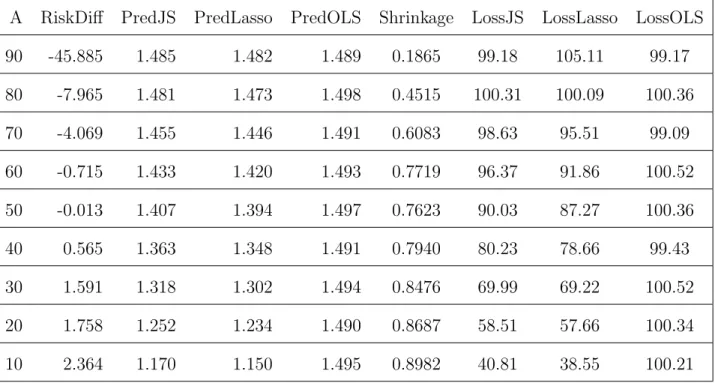
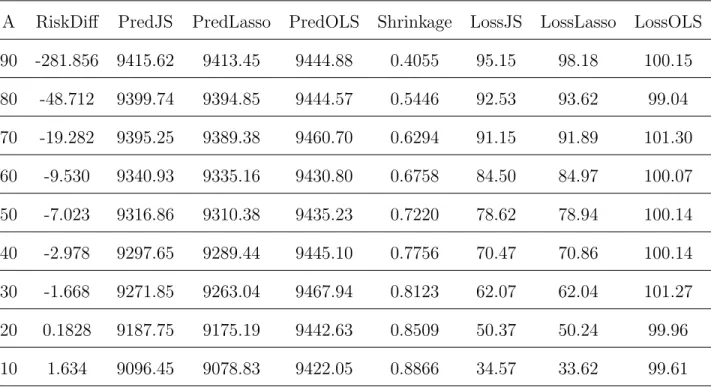
Table 1.1 – JS Estimate versus Lasso for n = 200, p = 100, σ 2  = 1
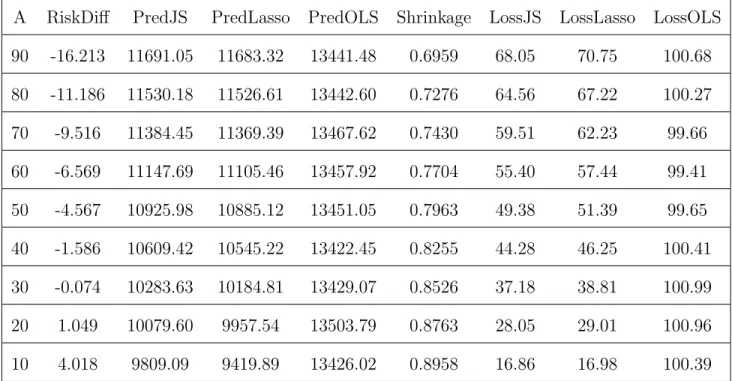
Table 1.3 – JS Estimate versus Lasso for n = 200, p = 100, σ 2  = 9000
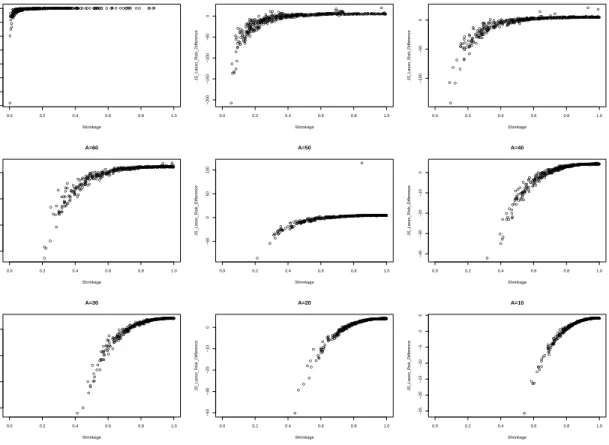
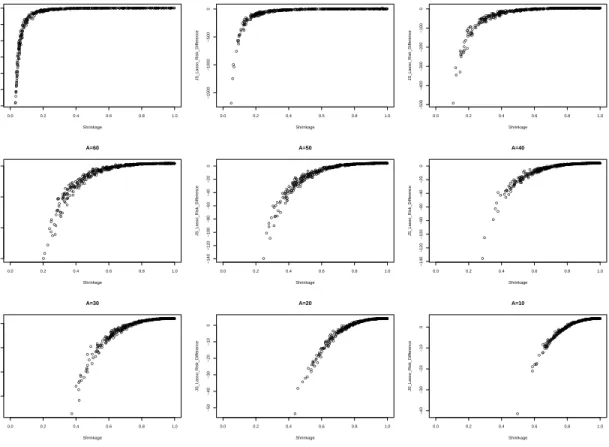
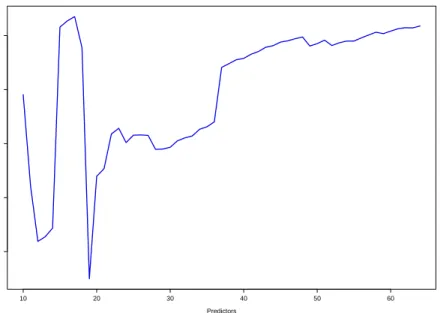
Figure 1.1 – n = 200, p = 100, σ 2 = 1. Shrinkage Factor vs JS Estimate Risk Difference
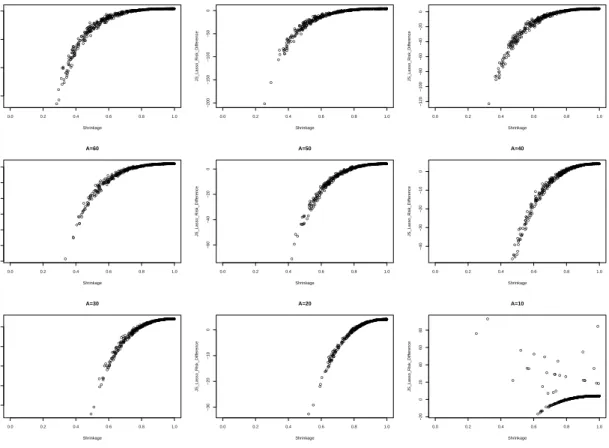
Figure 1.2 – n = 200, p = 100, σ 2 = 9000. Shrinkage Factor vs JS Estimate Risk Difference
+7

References

Related documents

Insurance; environment; pollution; environmental insurance; first-party insurance; third-party insurance; first-party insurance for the benefit of a third party; statutory

This research study focuses upon the theoretical construct of self-efficacy, the improvement of college and career readiness as it relates to high school students, the importance

Croix County has a number of completed and ongoing land information improvement projects including Public Land Survey System remonumentation, geodetic control, parcel mapping,

The % removal of fluoride ion increased with the increase in added cationic surfactants concentration and decreased with the increasing [anionic surfactant], nonionic

Although the actual correlation level between L1/L5 channels should be validated during the next solar maximum, Figure 7 parametrically illustrates the expected availability

However, very small quantities of several organic acids are produced during primary fermentation, and under adverse conditions, bacteria in wine can produce enough

Although income protection is a higher priority in 2010, only one in four business owners – 24 percent -- has an individual disability insurance (IDI) policy, and only 4