Average Tree Solution and Core for Cooperative
Games with Graph Structure
著者
IGARASHI Ayumi, YAMAMOTO Yoshitsugu
year
2012-06
シリーズ
Department of Social Systems and Management
Discussion Paper Series;no.1293
Department of Social Systems and Management
Discussion Paper Series
No.1293
Average Tree Solution and Core for Cooperative Games
with Graph Structure
by
Ayumi IGARASHI and Yoshitsugu YAMAMOTO
June 2012
UNIVERSITY OF TSUKUBA
Tsukuba, Ibaraki 305-8573
JAPAN
AVERAGE TREE SOLUTION AND CORE FOR COOPERATIVE GAMES WITH GRAPH STRUCTURE
AYUMI IGARASHI AND YOSHITSUGU YAMAMOTO
Abstract. This paper considers cooperative transferable utility games with graph structure, called graph games. A graph structure restricts the set of possible coalitions of players, so that players are able to cooperate only if they are connected in the graph. Recently the average tree solution has been proposed for arbitrary graph games by Herings et al. The average tree solution is the average of some specific marginal contribution vectors, and was shown to belong to the core if the game exhibits link-convexity. In this paper the main focus is placed on the relationship between the core and the average tree solution, and the following results were obtained. Firstly, it was shown that some marginal contribution vectors do not belong to the core even though the game is link-convex. Secondly, an alternative condition to link-convexity was given. Thirdly, it was proven that for cycle-complete graph games the average tree solution is an element of the core if the game is link-convex.
1. Introduction
In many settings of cooperative games players gain more benefits by cooperating rather than by acting on their own. A subgroup of players is called a coalition and the total profit they can obtain from cooperation is called its worth. If the players are able to divide the worth of a coalition(transferable utility), there arises a question of how to allocate the worth to each player. A classical set-valued solution is the core, the set of payoff vectors which satisfy the following conditions. First, the worth of the whole set of players (the grand coalition) is distributed among the players (efficiency),
!
i∈N
xi=v(N).
Next, no coalition receives less than its worth (non-domination),
!
i∈S
xi≥v(S), for all S⊆N withS #=∅.
If a payoff vector is an element of the core, no coalitions can do better than that by their own. Thus, the payoff vector prevents the collapse of the grand coalition. The core, however, has two possible problems: it might be empty, and it might contain many elements. To overcome this problem, several single-valued solutions have been introduced.
The Shapley value is the most well-known single-valued solution, see Shapley [10]. At the Shapley value each player is promised the average of all his marginal contributions to any coalition
that he joins. The Shapley value is an element of the core if the game exhibits convexity. However, it is not always true that any coalitionScan form and achieve worthv(S). In many cases cooperation among players rely on their communication structure.
We study cooperative games with limited communication structure represented by an undirected graph. These so-called graph games were introduced by Myerson [8]. A group of players is only able to cooperate if they are connected in the graph. The best known single-valued solution for such games is the Myerson value, which is characterized by efficiency and fairness. The Myerson value coincides with the Shapley value when the underlying graph is complete. Van den Nouweland and Borm [7] showed that the Myerson value lies in the core if the game exhibits convexity and the underlying graph is cycle-complete.
Herings et al. [5] proposed the average tree solution on the class of cycle-free graph games. The average tree solution is the average of marginal contribution vectors over a set of rooted spanning trees. Herings et al. proved that the corresponding solution is in the core if the game exhibits superadditivity, while the Myerson value or the position value may not. The condition of superadditivity was relaxed to a weaker one by Talman and Yamamoto [12].
In Herings et al. [6] the average tree solution was generalized for the class of arbitrary graph games. They constructed a specific set of rooted spanning trees, called admissible spanning trees. The generalized average tree solution coincides with the Shapley value when the underlying graph is complete and with the average tree solution as defined by Herings et al. [5] when the underly-ing graph is cycle-free. They also introduced the notion of link-convexity for graph games. For games with complete graph, link-convexity coincides with convexity, but in general the condition is weaker than convexity. For games with a cycle-free graph, link-convexity is even weaker than superadditivity. Herings et al. also claimed that the average tree solution is in the core if the game is link-convex. Baron et al. [1] defined the average tree solution with respect to trees constructed by Depth First Search (DFS) and Breadth First Search (BFS). When the underlying graph is complete, the average tree solution with respect to DFS trees coincides with the Shapley value and the solution with respect to BFS trees yields the equal surplus division.
In this paper we discuss the relationship between the core and the average tree solution. We first show that some link-convex graph games have some marginal vectors not in the core. Secondly, we refine link-convexity to the condition that ensures the average tree solution belongs to the core in arbitrary graph games. Thirdly, we prove that for the class of cycle-complete graph games satisfying link-convexity the average tree solution is an element of the core.
This paper is organized as follows. Section 2 is a preliminary section on games with graph structure. Section 3 introduces the average tree solution for arbitrary games with graph structure. Section 4 relates the average tree solutions to the core. Section 5 gives some conclusions.
2. TU-games with communication structure
We consider cooperative transferable utility games with graph structure, called graph games introduced by Myerosn [8]. A graph game is represented by a triple (N, v, L) where N is a set of n players, v : 2N
→ R a characteristic function that assigns the worth to coalitions, and
L ⊆ { {i, j} |i #= j, i, j ∈ N} is a collection of communication links between players. The pair (N, L) is called an undirectedgraph with N the set ofnodes, being the players of the game, and
L the collection of edges (links) between the nodes. In case L ={ {i, j} | i #= j, i, j ∈ N} the game {N, v, L} is said to have full communication structure and is simply denoted by (N, v). A payoff vector x∈Rn is an n-dimensional vector giving payoff x
i to player i∈N. For simplicity
we denotex(S) ="i∈Sxi forS∈2N.
Next we give several notations for an undirected graph. For a graph (N, L) and a subsetK⊆N, the setL(K) is given by
L(K) ={ {i, j} ∈L|i, j∈K}.
A sequence of different nodesP ={i1, i2, . . . , im} is apath fromi1 to im in the graph (K, L(K))
if {ik, ik+1} ∈ L(K) for all k ∈ {1,2, . . . , m−1}. The path P is denoted by i1 ∼K im, where
i1 ∼ im stands for a path in (N, L). Two nodes i, j ∈ N are connected in (K, L(K)) if either
i =j or there exists a path i ∼K j. For a pathP ={i1, i2, . . . , im} the number, m−1, is said
to be the length of P. A path between i1 and im is shortest if the length is minimal among all
paths connecting i1 to im. A graph (N, L) is connected if any two nodes i, j ∈N are connected
in (N, L). A subset of nodes K ⊆N is said to be a connected subset of N when the subgraph (K, L(K)) is connected. The collection of all connected subsets of K in (K, L(K)) is denoted by
CL(K), i.e., CL(K) := {S | S ⊆ Kis a connected subset of K}. A subset K" of K is called a connected component of (K, L(K)) if K" is maximally connected, that is,K" is connected but the
set K"∪ {j} is not connected for any j ∈K\K". The collection of all connected components of
(K, L(K)) is denoted by ˆCL(K), i.e., ˆCL(K) :=
{S|S⊆K is a connected component ofK}. A sequence of nodes{i1, i2, . . . , im} is called acycle in a graph (N, L) if
(i) m≥3,
(ii) all nodesi1, i2, . . . , imare different,
(iii) im+1=i1,
(iv) {ik, ik+1} ∈Lfork= 1,2, . . . , m.
A graph is said to be atree if it is connected and does not contain any cycle. Aspanning tree of (N, L) is a tree containing all the nodesN. A graph is said to becycle-free when it does not contain any cycle. A graph is said to becomplete when any two of its nodes are connected by an edge. A graph is said to becycle-completeif the following holds: if{i1, i2, . . . , im, i1}is a cycle in the graph (N, L)
cycle, they trivially satisfy the requirement of cycle-completeness. The class of complete graphs is another class of graphs that are cycle-complete.
In this paper it is assumed without loss of generality that in a graph game (N, v, L), (N, L) is always connected in the graph (N, L), i.e.,N ∈CL(N). We also assume that players of a coalition
S ∈2N are able to cooperate only if all players of S can communicate directly or indirectly with
each other, i.e.,S∈CL(N). ForS
∈CL(N), the worthv(S) is the maximum amount of payoff a
coalitionS can obtain for its players.
Superadditivity and convexity are defined below, referring the definitions in Talman and Ya-mamoto [12]. Convexity of (N, v, L), however, is originally defined in this paper.
! (N, v) is superadditive if
v(S) +v(T)≤v(S∪T)
for allS, T∈2N satisfyingS∩T =∅. ! (N, v, L) is superadditive if
v(S) +v(T)≤v(S∪T)
for allS, T ∈CL(N) satyisfyingS∪T ∈CL(N) andS∩T =∅. ! (N, v) is convex if
v(S) +v(T)≤v(S∪T) +v(S∩T) for allS, T ∈2N.
It is equivalent to
v(S)−v(S∪ {i})≤v(T)−v(T∪ {i}) for allS, T ⊆N\ {i}satyisfyingS ⊆T. ! (N, v, L) is convex if
v(S) +v(T)≤v(S∪T) +v(S∩T)
for allS, T∈CL(N) satyisfyingS∪T ∈CL(N) andS∩T ∈CL(N)∪ {∅}.
For a graph game (N, v, L) a payoff vectorxis said to be efficient ifx(N) =v(N). The core, denoted by Core(N, v, L), of a graph game (N, v, L) is the set of efficient payoff vectors that are not dominated through any connected coalition,
Core(N, v, L) :={x∈Rn
The core of a game (N, v) with full communication is denoted by Core(N, v), i.e., Core(N, v) :={x∈Rn
|x(N) =v(N) andx(S)≥v(S) for allS∈2N}.
Given a graph game (N, v, L), Myerson [8] defined the restricted game (N, vL) as
vL(S) = !
T∈CˆL(S)
v(T), forS∈2N.
Notice that the core of a graph game Core(N, v, L) equals the core Core(N, vL) of the restricted
game (N, vL) with full communication.
3. The average tree solution
In this section we provide two definitions of the average tree solution, the solution given by Herings et al. [6] and the solution constructed by Depth First Search algorithm. To describe the average tree solution we first give some definitions of directed graph.
3.1. Definition of directed graph. A graph (N, A) isdirected ifA⊆N×N, i.e.,A is a set of ordered pairs of nodes. An ordered pair of nodes is called anarc. For a graph (N, A) a sequence
{i1, i2, . . . , im}is adirected path if (ik, ik+1)∈A for allk∈ {1,2, . . . , m−1}. ForA⊆N×N let
L(A) ={ {i, j} |(i, j)∈A}, i.e., undirected version ofA. A directed graph (K, T) is said to be a rooted treeif the undirected graph (K, L(T)) induced byT is a tree and each node has at most one arc entering the node. Clearly, a rooted tree has exactly one node that no arc enters, which is called theroot, and there is a unique directed path from the root to every node. Arooted spanning tree (N, T) is a rooted tree containing all the nodes N. For a given rooted spanning tree (N, T) and a subsetK⊆N, the setT(K) is given by
T(K) :={(i, j)∈T |i, j∈K}.
For a given rooted spanning tree (N, T), for each nodei∈N we define its sets of successors and descendants as
sucT(i) ={j∈N |(i, j)∈T},
desT(i) ={j∈N |j=ior there is a directed path fromitoj in (N, T)},
respectively. A nodej∈N is said to be an ancestor ofi∈N ifj#=iand there is a directed path fromj to i.
3.2. Admissible coalitions. To generalize the average tree solution to the class of arbitrary graph games, Herings et al. [6] consider a collection of admissible coalitions constructed as follows.
Definition 3.1 (Admissible Coalitions). For a graph (N, L), B={B1, B2, . . . , Bn} ofn subsets
(i) For alli∈N,i∈Bi, and for somej∈N,Bj=N;
(ii) For alli∈N andK∈CˆL(Bi\ {i}),K=Bj and{i, j} ∈Lfor some j∈N.
Definition 3.2. For a graph (N, L), letB={B1, B2, . . . , Bn}be a collection of admissible
coali-tions. Define the directed graph (N, TB) as
TB:={(i, j)|i, j∈N, Bj ∈CˆL(Bi\ {i})}.
According to Lemma 3.2 in Herings et al. [6] the above collection of admissible coalitionsBhas the following property.
Lemma 3.3 ([6]). For a graph (N, L), let B = {B1, B2, . . . , Bn} be a collection of admissible
coalitions. Then, (N, TB)is a rooted spanning tree.
We denote the collection of the rooted spanning trees of Definition 3.2 by BADM. Herings et
al. [6] defined their average tree solution with respect to the rooted spanning tree ofBADM.
Definition 3.4. For a graph game (N, v, L), the marginal contribution vector yT ∈ Rn
corre-sponding toT ∈ BADM is the vector of payoffs given by
(3.1) yT
i =v(Bi)−
!
K∈Cˆ(Bi\{i})
v(K), i∈N.
According to Herings et al. [6], the average tree solution is defined as follows.
Definition 3.5 (Herings et al. [6]). On the class of arbitrary graph games (N, v, L), the average tree solution is defined by
(3.2) y¯= 1
|BADM|
!
T∈BADM yT.
3.3. Depth First Search Tree. Now we introduce a tree growing algorithm, calledDepth First Search(DFS), and define the average tree solution based on the collection of rooted spanning trees constructed by DFS. We prove that the setBDFSof thus obtained rooted spanning trees is always
a subset ofBADM.
The psudocode of DFS is presented as follows.
Algorithm 1Depth First Search
Input: a connected graphG= (N, L)
Output: a spanning tree ofGwith predecessor functionp, and two time functionsdandf
1: k←0,S← ∅
2: choose any noder(as root)
3: k←k+ 1
4: colourrblack 5: set d(r) :=k 6: addr toS
7: while S is nonemptydo 8: consider the top nodeiofS
9: k←k+ 1
10: if ihas an uncoloured neighbourj then
11: colourj black
12: set p(j) :=xandd(j) :=k
13: addj to the top ofS
14: else 15: set f(i) :=k 16: removei fromS 17: end if 18: end while 19: return (p, d, f)
The DFS procedure computes the predecessor functionpand two time functions, the discovery time function d and the finishing time function f. The function p forms the subgraph (N, T), where
T ={(u, v)|u=p(v), v∈N\ {r} }.
Since it is assumed that (N, L) is connected, the resulting graph (N, T) is a rooted spanning tree, called adepth first search tree (DFS tree for short). Several properties of DFS tree are given here.
Lemma 3.6. For a graph(N, L), letT ∈ BDFSandS
∈CL(N). Letv
1be the first node discovered
by DFS in S. Then it follows that
(3.3) desT(v)⊆desT(v1) for allv∈S\ {v1}.
Proof. It holds from the construction of DFS tree. !
Theorem 3.7. For a graph (N, L), let BDFS be the collection of rooted spanning trees of (N, L)
follows that
BDFS
⊆ BADM.
Proof. Consider any T ∈ BDFS. We will prove that the collection of descendants for each node
i∈N,B={desT(1), desT(2), . . . , desT(n)
}, satisfies the conditions (i) and (ii) of Definition 3.1. From the definition of a descendant,i∈desT(i) for alli
∈N. Since (N, T) is a rooted spanning tree there exists a rootrsuch thatdesT(r) =N. Hence, condition (i) is satisfied. Condition (ii) also
holds since for alli∈N andK∈CˆL(desT(i)
\ {i}),there exists a nodej∈sucT(i) such thatK=
desT(j) and
{i, j} ∈L. Thus concludes that B ={desT(1), desT(2), . . . , desT(n)
} is a collection of admissible coalitions.
Now, let T" := {(i, j)| i, j ∈N, desT(j)∈CˆL(desT(i)\ {i})}. Then it follows that T = T".
Therefore,T ∈ BADM. !
The average tree solution over a set of DFS trees is defined as follows.
Definition 3.8. For a graph game (N, v, L), the marginal contribution vector xT ∈ Rn
corre-sponding toT ∈ BDFS is the vector of payoffs given by
(3.4) xT
i =v(desT(i))−
!
K∈Cˆ(desT(i)\{i})
v(K), i∈N.
Definition 3.9 (Average Tree Solution). On the class of arbitrary graph games (N, v, L), the average tree solution constructed by DFS is given by
(3.5) x¯ = 1
|BDFS|
!
T∈BDFS xT.
To distinguish from the average tree solution of Definition 3.5, the average tree solution con-structed by DFS is denoted by ¯x.
4. Average Tree Solutions and the Core
This section studies conditions for graph games such that average tree solutions belong to the core. We first introduce link-convexity given by Herings et al. [6] and present an alternative condition for arbitrary graph games to make the average tree solution be in the core. Next we give the class of graph games such that link-convexity ensures that the average tree solution is an element of the core.
4.1. Link-convexity.
Definition 4.1 (Link-convexity). (N, v, L) is link-convex if (4.1) v(S) +v(T)≤v(S∪T) + !
K∈CˆL(S∩T)
v(K) for allS, T∈CL(N) that satisfy
(LC1) S\T ∈CL(N) andT\S∈CL(N)
(LC2) (S\T)∪(T\S)∈CL(N) (LC3) N\S ∈CL(N) orN
\T ∈CL(N).
It was shown in Herings et al. [6] that for games on a complete graph link-convexity and convexity coincides with each other and that for games on a cycle-free graph link-convexity is even weaker than superadditivity.
Concerning arbitrary graph games satisfying link-convexity the following is claimed in Herings et al. [6].
Claim 4.2(Herings et al. [6]). Let(N, v, L)be a link-convex game. Then, the average tree solution ¯
y is an element of the core.
Herings et al. [6] proved Claim 4.2 by showing that all the marginal contribution vectors of Definition 3.4 are in the core of the game, i.e.,
(4.2) yT ∈Core(N, v, L) for all T∈ BADM.
From the above, ¯y∈Core(N, v, L) holds since the core is a convex set.
We give here an example of link-convex game and its marginal contribution vectorsyT ∈Rn.
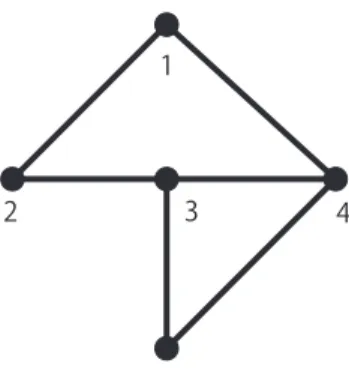
Example 4.3. Consider the graph game withN :={1,2,3,4,5}andL:={{1,2},{1,4},{2,3},{3,4},{4,5}} in Figure 1. The characteristic function values are given by
v({1}) = 0 v({1,4}) = 1 v({1,2,4}) = 1 v({1,2,3,4}) = 10 v({2}) = 0 v({2,3}) = 6 v({1,3,4}) = 2 v({1,2,3,5}) = 7 v({3}) = 0 v({3,4}) = 1 v({1,4,5}) = 7 v({1,2,4,5}) = 7 v({4}) = 0 v({3,5}) = 6 v({2,3,4}) = 9 v({1,3,4,5}) = 13 v({5}) = 0 v({4,5}) = 1 v({2,3,5}) = 6 v({2,3,4,5}) = 9 v({1,2}) = 1 v({1,2,3}) = 6 v({3,4,5}) = 7 v({1,2,3,4,5}) = 19 v({1,3}) = 0 v({1,5}) = 0 v({1,2,4}) = 0 v({1,2,5}) = 0 v({2,4}) = 0 v({2,5}) = 0 v({1,3,5}) = 0 v({2,4,5}) = 0 It is a routine to see that this graph game is link-convex.
2
5
4 3
1
Figure 1. counter graph
Consider a tree T1 := {(1,2),(2,3),(3,5),(5,4)} ∈ BADM in Figure 2. We obtain the
corre-sponding marginal contribution vector as follows.
yT1 1 =v({1,2,3,4,5})−v({2,3,4,5}) = 19−9 = 10 yT1 2 =v({2,3,4,5})−v({3,4,5}) = 9−7 = 2 yT1 3 =v({3,4,5})−v({4,5}) = 7−1 = 6 yT1 4 =v({4}) = 0 yT1 5 =v({4,5})−v({4}) = 1−0 = 1. Then we have yT1( {2,3,4}) = yT1 2 +y T1 3 +y T1 4 = 2 + 6 + 0 = 8< v({2,3,4}) = 9. It follows that yT1 #∈Core(N, v, L).
Similarly letT2:={(2,1),(1,4),(4,5),(5,3)} ∈ BADMin Figure 3 and the corresponding marginal
contribution vector is as follows.
yT2 1 =v({1,3,4,5})−v({3,4,5}) = 13−7 = 6 yT2 2 =v({1,2,3,4,5})−v({1,3,4,5}) = 19−13 = 6 yT2 3 =v({3}) = 0 yT2 4 =v({3,4,5})−v({3,5}) = 7−6 = 1 yT2 5 =v({3,5})−v({3}) = 6−0 = 6. Then we have yT2({2,3,4}) = yT2 2 +y T2 3 +y T2 4 = 6 + 0 + 1 = 7< v({2,3,4}) = 9,
hence
yT2
#∈Core(N, v, L).
These vectors are counter-examples to the statement (4.2).
2 5 4 3 1 Figure 2. T1 2 5 4 3 1 Figure 3. T2
4.2. Revised link-convexity. The next condition should replace to link-convexity for the average tree solution to lie in the core.
Definition 4.4 (Revised link-convexity). (N, v, L) is revised link-convex if (4.3) v(S) +v(T)≤v(S∪T) + !
K∈CˆL(S∩T)
v(K) for allS, T∈CL(N) that satisfy
(RL1) S\T ∈CL(N) orT
\S∈CL(N)
(RL2) S∪T ∈CL(N)
(RL3) N\S∈CL(N) orN\T ∈CL(N).
IfS, T ∈CL(N) satisfy (LC1) and (LC2), these two sets also satisfy (RL2). Additionally, it is
clear that (RL1) is a weaker condition of (LC1) and (RL3) coincides with (LC3). Thus in general revised link-convexity is a stronger condition than link-convexity.
Theorem 4.5. Let (N, v, L) be a revised link-convex game. Then, the average tree solution x¯ is an element of the core.
Proof. Since the core is a convex set, it suffices to prove that for every T ∈ BDFS the marginal
vectorxT with respect to tree T ∈ BDFS is an element of the core, i.e.,
xT ∈Core(N, v, L) for allT ∈ BDFS.
Take any treeT ∈ BDFS and letxT be the corresponding marginal contribution vector. We will
show that
from which it follows thatxT ∈Core(N, v, L).Take anyS∈CL(N). The subgraph (S, T(S)) has
components S1, S2, . . . , Sm, which are all rooted trees with rootsr1, r2, . . . , rm. Let r1, r2, . . . , rm
be indexed such that
(4.4) m1< m2⇒des(rm1)⊆des(rm2) ordes(rm1)∩des(rm2) =∅.
Fork= 0, . . . , m, letDk:=des(r
1)∪des(r2)∪ · · · ∪des(rk), with the convention thatD0=∅. For
k= 0, . . . , m, those successors ofSk in the treeT that lie outside S are denoted byδ(Sk) :={i|
(j, i)∈T, j∈Sk, i#∈Sk} ={i1, i2, . . . , il}. We writeR :={r1, r2, . . . , rm} andI :=#mk=1δ(Sk).
For a node i ∈ I we define ∆(i) := {r ∈ R | des(r) ⊆ des(i)}, ∆∗(i) := {r ∈ R | des(r) ⊆
des(i),"r"∈R\ {r} s.t.des(r)⊆des(r")⊆des(i)}. Note that #
r∈∆(i)des(r) =
#
r∈∆∗(i)des(r).
For i ∈ N we simply denote Di := des(i). Consider some k ∈ {1,2, . . . , m} and suppose
δ(Sk)#=∅. Take anyih∈δ(Sk) and the following two sets
U :=S∪Dk−1∪Di1∪Di2∪ · · · ∪Dih−1
W :=Dih.
ThenU, W ∈CL(N) and satisfy the following three conditions of Definition 4.4. (RL1) W\U =Dih\(#r∈∆(ih)Dr) =Dih\(#r∈∆∗(ih)Dr)∈CL(N)
(RL2) U∪W =S∪Dk−1∪D
i1∪Di2∪ · · · ∪Dih−1∪Dih ∈C
L(N)
(RL3) N\W =N\Dih ∈CL(N).
Now it follows from revised link-convexity that forih∈ {i1, i2, . . . , il},
v(S∪Dk−1∪(Di1∪Di2∪ · · · ∪Dih−1)) +v(Dih) ≤v(S∪Dk−1 ∪Di1∪Di2∪ · · · ∪Dih−1∪Dih) + ! r∈∆∗(ih) v(Dr)
By repeated application of this argument, it follows that (4.5) v(S∪Dk−1) + ! i∈δ(Sk) v(Di)≤v(S∪Dk) + ! i∈δ(Sk) ! r∈∆∗(i) v(Dr).
Notice that this formula (4.5) is also valid if δ(Sk) = ∅, since S∪Dk−1 = S ∪Sk ∪Dk−1 =
S∪Drk∪Dk−1=S∪Dk.By repeated application of the last inequality (4.5), we see that
(4.6) v(S) + m ! k=1 ! i∈δ(Sk) v(Di)≤v(S∪Dm) + m ! k=1 ! i∈δ(Sk) ! r∈∆∗(i) v(Dr).
Recall that rm is the first node discovered by Depth First Search in S. From lemma 3.6, it
follows that
Hence, everyDrk fork= 1,2, . . . m−1 appears exactly once in the right-hand side, i.e., m ! k=1 ! i∈δ(Sk) ! r∈∆∗(i) v(Dr) = m!−1 k=1 v(Drk). Sincev(S∪Dm) =v(D rm), we obtain v(S∪Dm) + m ! k=1 ! i∈δ(Sk) ! r∈∆∗(i) v(Dr) = m ! k=1 v(Drk). Therefore, (4.8)⇔ v(S) + m ! k=1 ! i∈δ(Sk) v(Di)≤ m ! k=1 v(Drk) ⇔ v(S)≤ m ! k=1 (v(Drk)− ! i∈δ(Sk) v(Di)) = m ! k=1 xT(Sk) =xT(S). !
Corollary 4.6. Let (N, vL)be a convex game. Then, the average tree solution x¯ is an element
of the core.
Proof. LetS, T ∈CL(N) satisfy the conditions (RL1)∼(RL3) of revised link-convexity. Convexity
of (N, vL) implies that
vL(S) +vL(T)≤vL(S∪T) +vL(S∩T)
⇔ v(S) +v(T)≤v(S∪T) + !
K∈CˆL(S∩T)
v(K).
Thus the game (N, v, L) is revised link-convex. It immediately follows from Theorem 4.5 that the average tree solution is an element of the core. ! 4.3. Cycle-complete graph. As we have seen in the previous section, for arbitrary graph games link-convexity is not a sufficient condition to make all the marginal contribution vectors lie in the core. In this section we consider games on the class of cycle-complete graphs, which includes the class of cycle-free and complete graphs. It will be proved that the marginal contribution vectors belong to the core for arbitrary cycle-complete graph games satisfying link-convexity.
4.3.1. Convexity on cycle-complete graph games. Van den Nouweland and Borm [7] presented that convexity of (N, v) is a necessary and sufficient condition for convexity of (N, vL). We prove
that convexity of (N, v, L) is a necessary and sufficient condition for convexity of (N, vL) when the
underlying graph is cycle-complete, following the proof given by Van den Nouweland and Borm [7].
Theorem 4.7. Let (N, L) be a cycle-complete graph. (N, v, L) is a convex game if and only if (N, vL)is convex.
Proof. Suppose that (N, v, L) is convex. LetS, T∈CL(N) be such thatS∪T ∈CL(N) andS∩T ∈
CL(N)∪ {∅}. Then, from convexity of (N, v, L), it holds that
vL(S) +vL(T)≤vL(S∪T) +vL(S∩T)
⇔v(S) +v(T)≤v(S∪T) +v(S∩T).
For the converse part, suppose (N, vL) is convex. Leti
∈N andS⊆T ⊆N\ {i}. It suffices to show thatvL(S ∪ {i})−vL(S) ≤vL(T ∪ {i})−vL(T), i.e., (4.7) ! K∈CˆL(S∪{i}) v(K)− ! K∈CˆL(S) v(K)≤ ! K∈CˆL(T∪{i}) v(K)− ! K∈CˆL(T) v(K).
Now, letEdenote the set of connected components containing at least one nodejwith{i, j} ∈L, i.e.,
E:={E∈CˆL(S)
| ∃j∈E s.t.{i, j} ∈L},
and letEi:={i}∪#E∈EE. By definition, we haveEi∈CˆL(S∪{i}), and for everyE∈CˆL(S∪{i})
such thatE#=Ei it holds thatE∈CL(S). As a consequence, we obtain
! E∈CˆL(S∪{i}) v(E)− ! E∈CˆL(S) v(E) =v({i} ∪($ E∈E E))−! E∈E v(E). Similarly, we have ! F∈CˆL(T∪{i}) v(F)− ! F∈CˆL(T) v(F) =v({i} ∪($ F∈F F))−! F∈F v(F),
whereF :={F ∈CˆL(T)| ∃j∈F s.t.{i, j} ∈L}. Hence, (4.7) is equivalent to
v({i} ∪($ E∈E E))−! E∈E v(E)≤v({i} ∪($ F∈F F))− ! F∈F v(F).
Next we will consider the relationship between the set E and F. Since S ⊆T, there exists a uniqueF∈ F withE⊆F, for allE∈ E. Here, we will show that for each F ∈ F,
∃!E∈ E s.t.E⊆F, or"E∈ E s.t.E⊆F.
Assume that there are E1, E2 ∈ E(E1 #=E2) and F" ∈ F such that E1 ⊆F" and E2 ⊆F". Let
j1∈E1 andj2∈E2be such that{i, j1} ∈Land{i, j2} ∈L. Note that{j1, j2} #∈LsinceE1 and
E2 are connected components of S, respectively. Sincej
1, j2 ∈F" ∈CˆL(T), there exists a path
j1∼F# j2. Sincei#∈T, there is a cycle fromitoioverj1andj2in (N, L). However, since a graph
(N, L) is cycle-complete this should imply that{j1, j2} ∈L, which leads to a contradiction. Hence
we can number the elements ofE andF as follows:
wheret≥sandEk⊆Fk for allk∈ {1,2, ..., s}.
Now, we can use the properties of the game (N, v, L). For allk=s+1, s+2, . . . , t,Fk ∈CL(N),
{i}∪(#sh=1Fh)∈CL(N) and{i}∪(#th=1Fk)∈CL(N). Moreover, (N, v, L) is superadditive when
(N, v, L) is convex. Superadditivity of the game (N, v, L) implies (4.8) v({i} ∪($ F∈F F))≥v({i} ∪( s $ h=1 Fh)) + t ! h=s+1 v(Fh). For allk= 1,2, . . . , s, Fk∈CL(N), {i} ∪( s $ h=k+1 Fh)∪( k $ h=1 Eh)∈CL(N), Fk∩({i} ∪( s $ h=k+1 Fh)∪( k $ h=1 Eh)) =Ek∈CL(N) and Fk∪({i} ∪( s $ h=k+1 Fh)∪( k $ h=1 Eh)) ={i} ∪( s $ h=k Fh)∪( k$−1 h=1 Eh)∈CL(N).
Convexity of the game (N, v, L) implies
v({i} ∪( s $ h=1 Fh))−v(F1)≥v({i} ∪( s $ h=2 Fh)∪E1)−v(E1) .. . v({i} ∪( s $ h=k Fh)∪( k$−1 h=1 Eh))−v(Fk)≥v({i} ∪( s $ h=k+1 Fh)∪( k $ h=1 Eh))−v(Ek) .. . v({i} ∪Fs∪( s$−1 h=1 Eh))−v(Fs)≥v({i} ∪( s $ h=1 Eh))−v(Es).
Adding all thesesinequalities, we obtain
v({i} ∪( s $ h=1 Fh))− s ! h=1 v(Fh)≥v({i} ∪( $ E∈E E))−! E∈E v(E). (4.9)
Now, (4.8) and (4.9) readily imply (4.7). !
Theorem 4.8. Let (N, L) be a cycle-complete graph and let (N, v, L) be a convex game. Then (N, v, L)is link-convex.
Proof. Let S, T ∈ CL(N) satisfy (LC1)∼(LC3) of Definition 4.1. When S∩T = ∅, S ∪T =
assume thatS∩T #∈CL(N), i.e.,
(4.10) ∃i1, i2∈S∩T such that"pathi1∼S∩T i2.
Sincei1, i2∈S∈CL(N),
∃pathi1∼S i2
LetPS be the shortest path among the above paths. Since i1, i2∈T ∈CL(N),
∃pathi1∼T i2
LetPT be the shortest path among the above paths. By assumption (4.10), PS has at least one node inS\T andPT has at least one node inT
\S. ThusPS andPT are different. Letρ(i 1, i2)
denote the sum of the lengths ofPS andPT. Leti∗
1, i∗2∈S∩T be such that
ρ(i∗1, i∗2) = min{ρ(i1, i2)|i1, i2∈S∩T,"pathi1∼S∩T i2}.
For i∗
1 and i∗2, the corresponding PS and PT form a cycle. By the assumption that (N, L) is a
cycle-complete graph, there exists a edge between any two nodes in the cycle. Thus,{i∗
1, i∗2} ∈L,
which leads to a contradiction and we conclude that S∩T ∈ CL(N). Convexity of the game
(N, v, L) implies thatv(S) +v(T)≤v(S∪T) +v(S∩T) =v(S∪T) +"K∈CˆL(S∩T)v(K).
!
Theorem 4.9. Let(N, L)be a cycle-complete graph and let(N, v, L)be a link-convex game. Then, the average tree solution x¯ is an element of the core.
Proof. We will prove this theorem in a similar way to the proof of Theorem 4.5.
Take any treeT ∈ BDFSand letxT be the corresponding marginal vector. Take anyS ∈CL(N),
and consider the subgraph (S, T(S)). It has componentsS1, S2, . . . , Sm, which are all rooted trees
with rootsr1, r2, . . . , rm. Letr1, r2, . . . , rmbe indexed such that
Fork= 0, . . . , m, letDk:=des(r
1)∪des(r2)∪ · · · ∪des(rk), with the convextion thatD0=∅. For
k= 0, . . . , m, those successors ofSk in the treeT that lie outside S are denoted byδ(Sk) :={i|
(j, i)∈T, j∈Sk, i#∈Sk} ={i1, i2, . . . , il}. We writeR :={r1, r2, . . . , rm} andI :=#mk=1δ(Sk).
For a node i ∈ I, we define ∆(i) := {r ∈ R | des(r) ⊆des(i)}, ∆∗(i) := {r ∈ R | des(r) ⊆
des(i),"r"∈R\ {r} s.t.des(r)⊆des(r")⊆des(i)}. Note that#
r∈∆(i)des(r) =
#
r∈∆∗(i)des(r).
Fori∈N, we simply denoteDi:=des(i).
Consider somek∈ {1,2, . . . , m} and supposeδ(Sk)#=∅. Take anyih∈δ(Sk) and consider the
following two sets
U :=S∪Dk−1∪Di1∪Di2∪ · · · ∪Dih−1
W :=Dih.
We will show that U, W ∈ CL(N) satisfy (LC1)∼(LC3) of Definition 4.1. From the proof of
Theorem 4.5, we obtainW\U, N\W ∈CL(N).
Next we will prove that
U\W ∈CL(N), (U
\W)∪(W\U)∈CL(N).
First, we consider whetherU\W is connected or not. Since U∩W =#r∈∆(ih)Dr,
U\W =U\(U∩W) =S ∪Dk−1∪(Di1∪Di2∪ · · · ∪Dih−1)\ $ r∈∆(ih) Dr = $ p∈{1,2,...,m} Sp∪ $ p∈{1,2,...,k−1} Drp∪(Di1∪Di2∪ · · · ∪Dih−1)\ $ r∈∆(ih) Dr = $ p∈{1,2,...,m} rp'∈∆(ih) Sp∪ $ p∈{1,2,...,k−1} rp'∈∆(ih) Drp∪(Di1∪Di2∪ · · · ∪Dih−1). (4.12) By definition ofS1, S2, . . . , Sm,
Sp⊆Drp andDrp∈CL(N) for allp∈ {1,2, . . . , m}
⇒Sp⊆Drp andDrp∈CL(N) for all p∈ {1,2, . . . , k−1}(rp#∈∆(ih)).
(4.13) Sincei1, i2,· · ·, ih−1∈δ(Sk), (4.14) Sk∪Di1∪Di2∪ · · · ∪Dih−1 ∈C L(N). In addition,rk#∈∆(ih) implies (4.15) Sk ⊆ $ p∈{1,2,...,m} rp'∈∆(ih) Sp.
In order to proveU \W ∈CL(N), from (4.12)∼(4.15), it suffices to show that $ p∈{1,2,...,m} rp'∈∆(ih) Sp∈CL(N). Let ˆS:=#p∈{1,2,...,m} rp'∈∆(ih)
Sp. SinceS1, S2, . . . , Sm∈CL(N), in order to prove ˆS∈CL(N), it suffices
to show that
for allm1, m2∈ {1,2, . . . , m}(rm1, rm2 #∈∆(ih), m1#=m2),
there exists a pathi∼Sˆj for any i∈Sm1, j∈Sm2.
Now consider two distinct indexesm1, m2∈ {1, . . . , m} (rm1, rm2#∈∆(ih), m1#=m2). Without
loss of generality we suppose that m2 > m1. From (4.11) we find that des(rm1) and des(rm2)
satisfy
des(rm1)⊆des(rm2) ordes(rm1)∩des(rm2) =∅.
(I) Whendes(rm1)⊆des(rm2), consider the following two cases.
(i) Suppose" r∈R\ {rm1, rm2}such thatdes(rm1)⊆des(r)⊆des(rm2).
Take anyi1∈ Sm1, i2 ∈Sm2. SinceT is a rooted spanning tree of the graph (N, L),
(N, L(T)) is connected. Hence, there exists a path from i1 ∈ Sm1 to i2 ∈ Sm2 in
(N, L(T)), that is,
∃pathi1∼i2.
LetPT be the shortest path among the above paths. By i
1, i2∈S∈CL(N) it holds
that
∃pathi1∼S i2
LetPS be the shortest path among the above paths. Since S
m1 andSm2 are
compo-nents of (S, T(S)),PT has at least one node that lies outsideS. Thus,PT is different
fromPS. Letρ(i
1, i2) denote the sum of the lengths ofPT andPS determined byi1
andi2. Leti∗1∈Sm1, i∗2∈Sm2 be such that
ρ(i∗1, i∗2) = min{ρ(i1, i2)|i1∈Sm1, i2∈Sm2}.
Meanwhile, by the assumption, "r ∈ R\ {rm1, rm2} such that des(rm1) ⊆des(r)⊆
des(rm2),P
T does not contain any nodes inSother than those inS
m1, Sm2. Therefore,
the corresponding PT and PS for i∗
1, i∗2 form a cycle. By the assumption that (N, L)
is a cycle-complete graph, there is a edge between any two nodes in the cycle. Thus,
{i∗1, i∗2} ∈L, which leads toSm1∪Sm2 ∈C
(ii) Suppose∃r∈R\ {rm1, rm2}such thatdes(rm1)⊆des(r)⊆des(rm2).
Let R∗ = {r ∈ R | des(r
m1) ⊆ des(r) ⊆ des(rm2)}. Assume that there is a node
r∈R∗ such thatr∈∆(i
h), i.e.,des(r)⊆des(ih). Byrm1#∈∆(ih), it holds that
des(ih)∩des(rm1) =∅or des(ih)#des(rm1),
which implies
des(r)∩des(rm1) =∅or des(r)#des(rm1).
This contradicts the fact thatr∈R∗. Hence, r#∈∆(i
h) for all r∈R∗. Therefore,
Sp⊆ $ rq∈R rq'∈∆(ih) Sq for allrp∈R∗, which implies (4.16) $ rp∈R∗ Sp⊆ $ rq∈R rq'∈∆(ih) Sq = ˆS. Next, letR∗:={r π(1), rπ(2), . . . , rπ(z)}(rm1 =rπ(1), rm2=rπ(z)) and letrπ(1), rπ(2), . . . , rπ(z)
be indexed such that forq= 2,3, . . . , z,
des(rπ(q−1))⊆des(rπ(q)) and"r∈Rs.t.des(rπ(q−1))⊆des(r)⊆des(rπ(q)).
From the result of (i),
Srπ(q−1)∪Srπ(q) ∈C L(N) forq= 2,3, . . . , z. Hence, $ rp∈R∗ Sp= z $ q=1 Srπ(q)∈C L(N),
and from (4.16) we obtain
∃path i∼Sˆj for alli∈Sm1, j∈Sm2.
(II) When des(rm1)∩des(rm2) = ∅, let a∈N be the last common ancestor of rm1 andrm2 in
(N, T). Letr"∈Rsatisfy
|des(r")|= min{ |des(r)| |r∈R, a∈des(r)}.
Analogously, we obtain
∃ path i∼Sˆr" for alli∈Sm1, ∃ path j∼Sˆr" for allj∈Sm2.
Thus,
∃path i∼Sˆj for alli∈Sm1, j∈Sm2.
Therefore ˆS∈CL(N), i.e.,U
\W ∈CL(N).
Now we obtain U \W, W \U ∈ CL(N). From i
h ∈ δ(Sk), there exists a node j ∈ Sk ⊆
U\W such that{j, ih} ∈L. Moreover,ih∈W \U. Thus (U\W)∪(W \U)∈CL(N).
Hence,U andW satisfy the following conditions of link-convexity. (LC1) U\W ∈CL(N) andW \U ∈CL(N)
(LC2) (U\W)∪(W\U)∈CL(N)
(LC3) N\W ∈CL(N).
Now link-convexity of the game implies that for allih∈ {i1, i2, . . . , il},
v(S∪Dk−1 ∪(Di1∪Di2∪ · · · ∪Dih−1)) +v(Dih) ≤v(S∪Dk−1∪Di1∪Di2∪ · · · ∪Dih−1∪Dih) + ! r∈∆∗(ih) v(Dr).
By repeated application of this argument, it follows that (4.17) v(S∪Dk−1) + ! i∈δ(Sk) v(Di)≤v(S∪Dk) + ! i∈δ(Sk) ! r∈∆∗(i) v(Dr).
Notice that this formula (4.17) is also valid if δ(Sk) = ∅, since S ∪Dk−1 = S ∪Sk ∪Dk−1 =
S∪Drk∪Dk−1 =S∪Dk. Repeating the same argument in the proof of Theorem 4.5 completes
the proof. !
Corollary 4.10. Let (N, L)be a cycle-complete graph and let(N, v, L)be a convex game. Then, the average tree solution x¯ is an element of the core.
Corollary 4.11. Let (N, L)be a cycle-complete graph and let(N, v)be a convex game. Then, the average tree solution x¯ is an element of the core.
Proof. Convexity of the game (N, v) readily implies convexity of the game (N, v, L). Then, the corollary follows immediately from Corollary 4.10. !
5. Concluding remarks
In this paper we have discussed the relationship between the core and the average tree solution. We gave an alternative condition that should replace link-convexity for the average tree solution to be an element of the core of arbitrary graph games. For the class of games with a cycle-complete graph structure, we found that link-convexity guarantees that the average tree solution belongs to the core. In general, revised link-convexity is weaker than convexity and link-convexity is weaker than superadditivity for games with a cycle-free graph. Thus the average tree solution lies in the core for a class of games such that the previous solutions such as the Myerson value and the position value can be outside of the core. This result suggests that the average tree solution can be more stable allocation rule compared to the others.
6. Acknowledgments
We are grateful to Prof.Yukihiko Funaki for insightful comments on our research. We have benefited from valuable comments by Prof.Ryuichiro Ishikawa. We appreciate the feedback from the faculty members of Policy and Planning Sciences. Finally, we give sincere thanks to all of the members of our research group, team PhilOpt.
References
[1] R. Baron, S. B´eal,E. R´emila, and P. Solal: Average tree solutions and the distribution of Harsanyi dividends.
International Journal of Game Theory40(2011) 331–349. [2] J.A.Bondy and U.S.R. Murty,Graph Theory, Springer (2008).
[3] P. Borm, G. Owen, and S. Tijs: On the position value for communication situations.SIAM Journal of Discrete Mathematics5(1992) 305–320.
[4] G. Demange: On group stability in hierarchies and networks.Journal of Political Economy,112(2004) 754-778. [5] P.J.J. Herings, G. van der Laan, and D. Talman: The average tree solution for cycle-free graph games.Games
and Economic Behavior 62(2008) 77–92.
[6] P.J.J.Herings, G. van der Laan, D. Talman, and Z. Yang: The average tree solution for cooperative games with communication structure,Games and Economic Behavior68(2010) 626–633.
[7] A. van den Nouweland and P. Borm: On the convexity of communication games,International Journal Game Theory 19(1991) 421–430.
[8] R.B. Myerson: Graphs and cooperation in games,Mathematics of Operations Research,2(1977) 225-229. [9] R.B. Myerson: Game Theory: Analysis of Conflict, Harvard University Press (1991)
[10] L. Shapley: A value forn-person games. In H.W. Kuhn and A.W. Tucker (eds.): Contributions to the Theory of Games II, Princeton University Press, Princeton, NJ (1953) 307–317.
[11] M. Slikker and A. van den Nouweland: Social and Economic Networks in Cooperative Game Theory, Kluwer Academic Publishers (2001)
[12] D. Talman and Y. Yamamoto: Average tree solution and subcore for acyclic graph games. Journal of the Operations Research Society of Japan,51(3)(2008) 203–212.
Graduate School of Systems and Information Engineering, University of Tsukuba, Tsukuba, Ibaraki 305-8573, Japan