Ilkogretim Online - Elementary Education Online, 2020; 19 (4): pp. 2074-2085 http://ilkogretim-online.org.tr
doi:10.17051/ilkonline.2020.763331
Developing e-module local wisdom based for learning at
kindergarten In Jambi, Indonesia
Hendra Sofyan*, Universitas Jambi, Indonesia,[email protected]
ORCID: 0000-0001-7332-9905
Sofia Hartati, Universitas Negeri Jakarta, Indonesia, ORCID: 0000-0002-3849-6297 Evita Anggereini, FKIP University of Jambi, Indonesia, [email protected]
ORCID: 0000-0002-0603-4522
Nyimas Muazzomi, Universitas Jambi, Indonesia, [email protected] ORCID: 0000-0002-9752-7954
Syahrul Ramadhan, Universitas Negeri Yogyakarta, Jalan Colombo No. 1, Karangmalang, Yogyakarta, Indonesia,ORCID:0000-0002-2661-2537
Abstract. The learning at Kindergarten all over Indonesia uses Area learning model, Central learning model, Group learning model, and Classical learning model. The guidelines for these four learning models, in particular and complete, let alone in the form of electronics (e-module) is not available yet. The purpose of this research is to develop a valid, appropriate, and effective e-module local wisdom based for Kindergarten. The method of this research was Research and Development (R and D) referring to ADDIE (Analysis, Design, Develop, Implement, and Evaluate) model. Based on the results of validation of experts and field test, then this product development, e-module local wisdom based has been proven valid (both materials and design) to be used in the learning and effectively to improve motivation in the learning. E-module developed in this research is extremely recommended to be used and utilized by Lecturers, Students, and Teachers of PG-PAUD.
Keywords: E-module, central, area, group, classical learning
Received: 02.11.2019 Accepted: 18.04.2020 Published: 15.09.2020 INTRODUCTION
The implementation of the learning process at Kindergarten (TK) in all over Indonesia uses various models. However, there are four most popular models and mostly used, such as Area Learning Model, Central Learning Model, Group Learning Model, and Classical Learning Model (Hurlock, 1978; Masnipal, 2018). These four models help teacher and students a lot in the learning process to focus and concentrate on the learning itself. Those four learning models are designed based on the curriculum, Weekly Activity Plan Program/Weekly Learning Implementation Plan (RKM/RPPM) and Daily Activity Plan/Daily Learning Implementation Plan (RKH/RPPH) (Sofyan, 2014).
During the daily learning process, the teacher must prepare all media used in the learning process, especially Daily Activity Plan or more popular as RKH/RPPH, because based on this plan the teacher can conduct the learning process in one day. The guideline of Area learning model, Central learning model, and Group learning model, in particular, is still incomplete and tends to be less practical. The previous research by Sofyan (2014) shows that the handbook module for Area learning model, central learning model, and Group learning model being developed still needs to be improved either the display or its practicality. Besides that, a practical learning guideline such as the electronic module even does not exist yet and not being developed yet.
The role of learning modules becomes pivotal nowadays (Atas, 2017). The researchers had conducted some experiments known as module development research which try to analyze, design, and examine the effectiveness of the module itself, included comparison study which tries to demonstrate the effectiveness of a module compared to other modules, or about the effectiveness of learning and the usage of the module compared to the learning process without
modules. That research has triggered improvements in the process of selecting and arranging modules, including the arrangement of the module with local wisdom-based and the usage of technology provided nowadays.
To make kids’ development can develop optimally as early as possible, probably kids need to be exposed to the environment where they can do exploration and obtaining experiences, especially the environment which is close to them. Local wisdom based means a set of plan and setting about the purpose, content, and learning materials arranged by education unit in accordance with various local potency, local characteristics, local superiority, local needs, and each other’s environment and the way used as the guideline of organizing learning activity to achieve certain purpose of education (Kurniawati, Wahyuni, & Putra, 2017; Patta, 2016).
The newest research and development had been more innovative and led to the usage of multimedia with sophisticated IT (Information Technology). The usage of IT extremely affects the progress of learning media innovation. It is a must that educators are required to use ICT in the learning process in the classroom. The usage of ICT can ease materials delivery, which is abstract such as in the learning materials at Kindergarten (Sofyan & Anggereini, 2019; Sofyan et al., 2019).
Electronic Module is one of the media with computer assistance in it, and there are animation pictures, symbols, and how it works. Electronic module can accommodate low ability students to accept the lesson because it can give effective climate with more individuals’ way, never forget, never get bored, very patient in running the instruction such as required by the program used (Hafsah, Rohendi, & Purnawan, 2016). The minimum usage of IT in TK learning makes the researcher have the initiative to develop electronic module.
This research create electronics module local wisdom based containing area learning model, central learning model, group learning model, and classical learning model and other supporting components. This developed product will greatly help teachers in the learning process. This research focused on developing electronic module which then can be used by Lecturers of PAUD, Teachers of PAUD, and Students of PAUD in recognising, understanding, and implementing central, area, classical, and group learning model with local wisdom based at Kindergarten. Therefore, the purposes of this research are as follows:
1. Developing valid e-module based on experts’ assessment with local wisdom based at Kindergarten.
2. Developing proper e-module based on teachers’ assessment and student’s assessment with local wisdom based at Kindergarten.
3. Developing an effective e-module local wisdom based. Local Wisdom
Nowadays local wisdom gets special attention from various stakeholders starting from the policy issued by the province and subdistrict which is then implemented through the school such as The Authority of the provincial government according to PP 25 in 2000 about curriculum development aiming for digging the potency of certain regions optimally. One of the effective ways is that making local wisdom to be a subject at school (Sagala, 2010), the local subject can be developed later and will become the particular trait of local potency, local superiority, as mentioned by the following expert. Local wisdom is curricular activity to obtain competence in line with local characteristics, local potency, and prospect of local development included local superiority which its materials can be grouped into the existed subject (Jamaris, 2013).
Electronic Module
E-module is a form of learning material presentation arranged systematically into certain learning units, and presented in the form of electronic format, in which each learning activity in it is connected to link as navigation so that the students can be more interactive with the program such as video, animation, and audio (Atas, 2017). Application 3D Pageflip Professional is used to arrange E-Module Local Wisdom Based.
Learning Model in Kindergarten Central Learning
Central approach is PAUD implementation approach which focuses on kids in its learning process the centre is game and kids in the circle by using four kinds of scaffolding to support kids’ development, such as (1) scaffolding of game environment; (2) scaffolding before the
game; (3) scaffolding during the game; and (4) scaffolding after the (Latif, 2016).
In developing central, according to Jackman, the curriculum of kids’ development can be developed and enlarged through Language and literacy, literature, Math, science, social studies, art, sensory centres, music and movement, puppets, and dramatic play (Jackman, Beaver, & Wyatt, 2014).
The learning emphasises on the support for interest development, potency, and strength of the kids. Playing is considered as the work until kids are given opportunities to start from development until finishing the task and finish the work “start and finish” such as beam centre, micro role-play centre, big role-play centre, faith and belief centre, Art centre, preparation centre, and natural materials centre (Phelps, 2006).
Area learning
Area learning model gives more opportunities to the students to choose/do their activities based on their special interest. The learning is designed to fulfil the specific needs of the students and respect cultural diversity and emphasises on the learning experiences for the kids, activity choices, and centre of activities and the role of the family in the learning process
(Sofyan, 2014). Meanwhile according to Drake (2003) that game for kids can be done by using
various Area set around the familiar environment of the kids such as creating artificial area like kitchen, available space in the house, bedroom, doctor clinic, airport, library, shoes store, restaurant, cinemas, park, supermarket, and so on.
Group Learning
The group learning model is the learning pattern in which the kids are divided into some groups (usually to be three groups), each group conducts different activity from another. In one meeting, kids are encouraged to complete 2 – 3 activities in the group in turn. If in group turn there are kids who have completed the task faster than others, then he/she can continue to another activity as long as there is space in other groups (Hayati, 2014). Group learning model gives opportunity to students to get close to their daily life. In this model, the room corner is arranged based on the group of knowledge such as surrounding environment, development, godliness, family, and culture (Sofyan & Anggereini, 2019; Sofyan et al., 2019).
Classical Learning
Classical learning is the learning pattern in which at the same time, the activity is done by all kids in one class (classical). This learning model is the most initial model used in Kindergarten. With the available learning facilities which generally are limited and lack of attention and interest from the kids. The process of classical activity is done by all students in one class, in one unit of time with the same activity. The organisation of kids in initial activity and at the end of the activity generally is conducted with classical activity. In classical activity, the technique/method that can be used is singing, talking, telling, praying together, and so on (Sofyan & Anggereini, 2019; Sofyan et al., 2019).
METHODS Development Model
Development model used refers to the ADDIE (Analysis, Design, Develop, Implementation, and Evaluation) model. ADDIE Model was chosen for this research because of some reasons such as this model is a procedural model which is a descriptive model showing the clear and careful stages to produce a product.
Based on the development model adapted from the ADDIE Model, the procedures of this research covered five stages. Analysis Stage, the researcher conducted analysis and thought about e-module product by identifying the curriculum, program, theme, kids development aspect, and e-module product in accordance with the targets of the students. Product Design, at this stage, the researcher designs the media of new product development (e-module). Development Stage, the researcher developed e-module product, then validated by the experts of learning media. Implementation Stage, this is the stage of applying e-module product which is being developed. Here the researcher conducted fit and proper test and effectiveness test. Evaluation Stage, this is the process of showing e-module product being developed success and in line with the target at the analysis stage.
Design Try Out
Design try out of the product in this research aimed to know the validity, appropriateness, and effectiveness of the product being developed. The stages of product try out in this research and development were conducted through four ways as follows.
Validity Test
The initial draft of the product which had been arranged needed to go through validity test first before they try out in the field. Validity test in this research was conducted by media expert and material expert until obtaining feedback and suggestion related to the product being developed. After getting product validation, then it was revised until it received valid criteria from the experts.
Initial Field Try Out
After gaining validation test from the expert, then the initial field tries out was conducted to know the responses from the lecturer, the students, and the teachers towards e-module local wisdom based being developed. This try out was aimed to know the properness of e-module being developed.
Field Test
This research used a quasi-experimental research method with a non-equivalent control group design. In the field study, research subject was not randomly assigned to the experimental group and control group, and both groups took pre-test and post-test. For the experimental group, a pretest was given to know students’ motivation at the beginning before the learning treatment by using e-module. Meanwhile, post-test was conducted to investigate the effect of using e-module in this group. For the control group, a pre-test was given before applying the traditional learning, followed by post-test at the end of the learning process.
Research Samples
E-module local wisdom based that had been validated by validators then tried out on subjects of the group try out as the users of the product that had been developed. Group try out was conducted at PG-PAUD University of Jambi and Kindergarten within Jambi City consisting of 8 districts. The number of samples involved in this research is as follows:
Table 1. Total samples
No Samples N 1 Experts 4 2 Lecturers 8 3 Teachers 112 4 College Students 127 5 PAUD Students 56
Instruments and Techniques of Data Collection
questionnaires. Open questionnaires were given to the expert of module design and the experts of materials during the validation by the experts. The instrument of collecting the data used for the try out of electronic module product local wisdom based that would be given to lecturers, teachers, and students were to see their perception towards electronic module local wisdom based on central materials, area, and group at Kindergarten thoroughly in the form of open and closed questionnaires. The field test was to know the effectiveness of electronic module local wisdom based by using observation sheets.
To materials’ validator, the questionnaires were given based on four indicators such as the suitability of the materials and the syllabus, aspect content and materials, aspect of learning and language (Ramadhan, Mardapi, Prasetyo, & Utomo, 2019; Ramadhan, Mardapi, Sahabuddin, & Sumiharsono, 2019). To media validator, the questionnaires were given based four indicators such as cover design and size of module, picture and animation design, video and audio by the module, font and combination of colours and background. The indicators of questionnaires given to students, teachers, and lecturers were the display of electronic module product, the clarity of the writing, the ease of in the usage, the attractiveness of the pictures, animation, video, and the suitability of materials to the learning purposes. Pre-test and post-test were used to obtain the information on the effectiveness of e-module being developed based on the results of observation of responses from the students in the Kindergarten. The observation sheets were made based on the aspects of verbal and non-verbal.
The technique of Data Analysis
Descriptive statistics and inferential statistics were chosen to answer the research questions. Descriptive statistics were to answer the validity and practicality of e-module being developed. Then inferential statistics were used to count the results of observation towards students’ activity from the experimental group and control group in pre-test and post-test (effectivity of e-module).
After conducting try out, then analysis was done by counting positive responses showed in the questionnaires through percentage. According to Arikunto (2010), calculating the percentage of respondents’ responses from each question can be done by using the following formula:
𝑅𝑅𝑅𝑅= 𝑡𝑡ℎ𝑒𝑒𝑡𝑡𝑡𝑡𝑡𝑡𝑡𝑡𝑡𝑡𝑡𝑡𝑡𝑡𝑡𝑡𝑡𝑡𝑡𝑡𝑠𝑠𝑠𝑠𝑡𝑡𝑠𝑠𝑒𝑒𝑚𝑚𝑡𝑡𝑚𝑚𝑣𝑣𝑚𝑚𝑠𝑠𝑚𝑚𝑡𝑡𝑜𝑜𝑒𝑒𝑡𝑡𝑠𝑠ℎ𝑠𝑠𝑠𝑠𝑠𝑠𝑠𝑠𝑠𝑠𝑡𝑡𝑠𝑠𝑒𝑒𝑣𝑣𝑡𝑡𝑠𝑠𝑣𝑣𝑡𝑡𝑠𝑠𝑡𝑡𝑒𝑒 × 100%
RS = Percentage of responses with certain criteria
From the results of that calculation, then the perception of validators, students, teachers, and lecturers towards validity and properness of the product of e-module local wisdom based could be concluded from the criteria (Excellent, Good, Fair, Poor) which has a high percentage.
Table 2. The convention guideline of respondents’ responses
Percentage of Obtained Score (%) Effectiveness
X >76 Excellent
50< X ≤ 75 Good
25 < X ≤ 50 Fair
X≤ 25 Poor
Inferential statistics were done by using SPSS18.0 SPSS. The results of the pre-requisite test of the research showed that pre-test and post-test score for the experimental group and control group were not distributed normally. The assumption of this research was not fulfilled
because α <0,05; therefore, statistical analysis non-parametric was chosen to examine the
hypothesis conducted by using SPSS 18.0 version. The analysis was done by using Wilcoxon test to see the significant value between pre-test and post-test from the control group and experimental group. Man-Whitney U Test was used to analyse the significance value of pre-test
and post-test from the control group and experimental group. The interpretation of the results was explored deeply in discussion by connecting the results and the relevant theory from the previous results.
RESULTS The Display Of E-Module Product
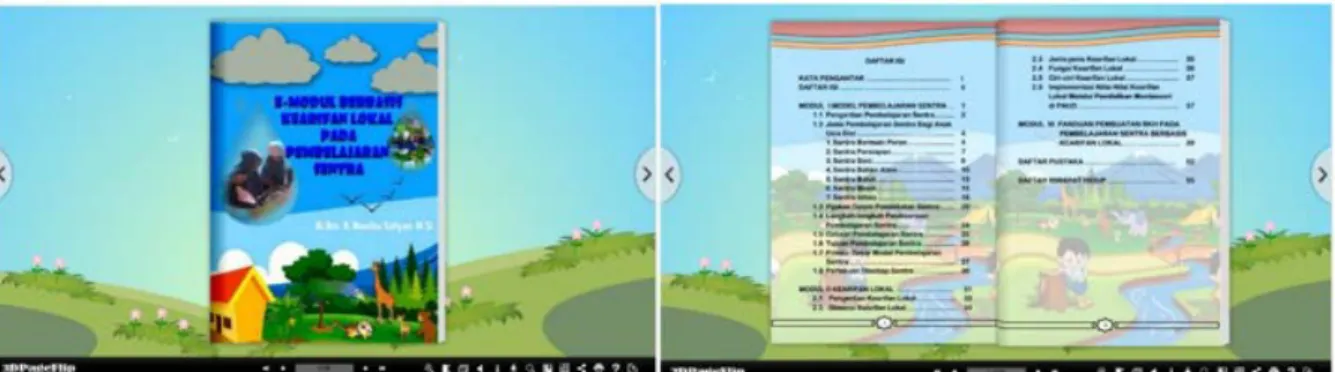
The Display of E-Module in Central Learning Model
FIGURE 1. Cover and list of content of e-module in central learning model The Display of E-Module in Area Learning Model
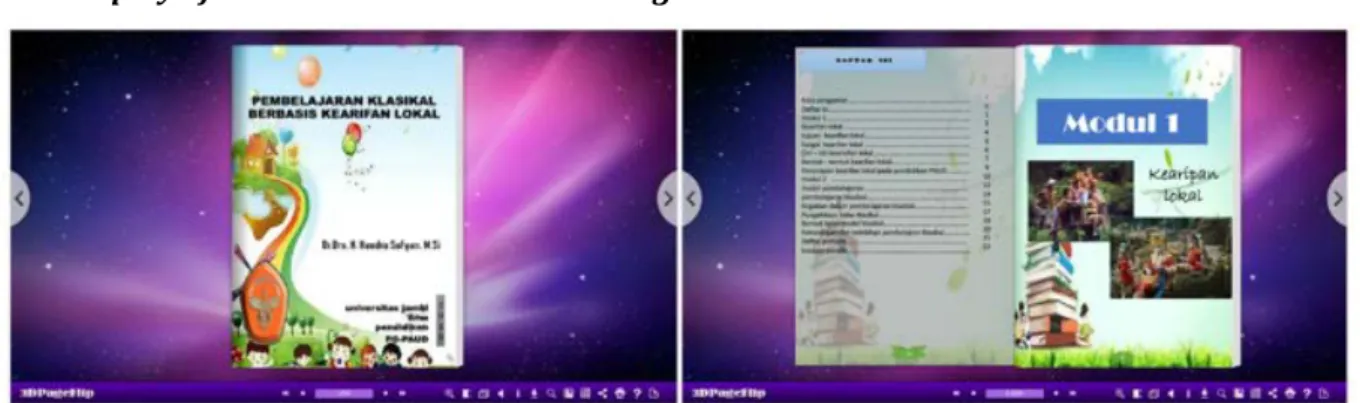
FIGURE 2. Cover and list of contents of e-module in area learning model The Display of E-Module in Group Learning Model
The Display of E-Module in Classical Learning Model
FIGURE 4. Cover and list of content of e-module in classical learning model Validity Test
1) Validation Result Analysis of Developing Materials of Central Area Learning, Group, and Classical.
Table 3. Results of materials’ validation
No E-Module Components Percentage (%) Category
1 Central Learning Model 83.33 Excellent
2 Area Learning Model 73.33 Good
3 Group Learning Model 81.6 Excellent
4 Classical Learning Model 80.36 Excellent
Validation by materials’ experts is conducted once on each learning model. From the table of materials’ validation results towards the development of e-module local wisdom based in the central model obtained score 40 with percentage 83,33% in “excellent criteria”. In Area learning model obtains score 47 with percentage (73.33%) is at “good criteria”. In the model of group learning obtains score 49 or 81,6% at “excellent criteria”. In the classical learning model obtains score 45 or 80,36% is at “excellent criteria”.
2) The Results of Design Validation Analysis in Developing Central Area Learning, Group, and Classical.
Table 4. The results of design validation
No E-Module Components Stage 1 Stage 2
Percentage (%) Category Percentage (%) Category
1 Central Learning Model 89.58 Excellent 93.75 Excellent
2 Area Learning Model 65 Good 91.67 Excellent
3 Group Learning Model 58.33 Good 93.33 Excellent
4 Classical Learning Model 71.6 Good 71.6 Good
Validation by design expert was conducted twice. From the table of validation results by design experts 1 (first) towards the development of e-module local wisdom based model in central learning obtains score 43 with percentage 89,58% in “excellent” criteria. In the area, learning model obtains score 39 or 65% is at “good” criteria. In the group learning model obtains score 35 or 58.33% is at “good” criteria. And in the classical learning model obtains score 63 or 71.50% is at “good” criteria.
At the second validation of developing e-module in central learning model, obtains score 45 with percentage 93,75% in “excellent” criteria. In the area learning model obtains score 55
or 91,67% is at “excellent” criteria. In the group learning model, obtains score 56 or at 93.33% is at “excellent” criteria. In the classical learning model obtains score 88.64 or 71.59% is at “good” criteria.
Data on Fit and Proper Test
1) The Analysis of Students’ Responses towards The Development of E-module for Central Area Model, Group, and Classical.
Table 5. The results of students’ responses analysis
No E-Module Components Percentage (%) Category
1 Central Learning Model 84.16 Excellent
2 Area Learning Model 86.13 Excellent
3 Group Learning Model 83.09 Excellent
4 Classical Learning Model 83.94 Excellent
In e-module of central learning model obtains score 2862 from 34 students with percentage 84.16% in “excellent” criteria. In the area learning model obtains score 2584 from 30 students with percentage 86.13% at “excellent” criteria. In group learning model obtains score 2576 from 31 students with percentage 83.09% at “excellent” criteria. In the classical learning model obtains score 2686 from 32 students with percentage 83.94% is at “excellent” criteria.
2) The Analysis of Teachers’ Responses towards The Development of e-module in Central Model, Area, Group, and Classical.
Table 6. The results of teachers’ responses analysis
No E-Module Components Percentage (%) Category
1 Central Learning Model 85.96 Excellent
2 Area Learning Model 84.2 Excellent
3 Group Learning Model 86.1 Excellent
4 Classical Learning Model 84.68 Excellent
In e-module of central learning, model obtains score 2149 from 25 teachers with percentage of 85.96% in “excellent” criteria. In the area learning model obtains score 2526 from 30 teachers with percentage 84.2% in “excellent” criteria. In the group learning model obtains score 2490 from 29 teachers with percentage 86.10% is at “excellent” criteria. In the classical learning model obtains score 2371 from 28 teachers with percentage 84.68% is at “good” criteria.
3) The Analysis of Lecturers’ Responses towards The Development of e-module for Central learning, Area, Group, and Classical.
Table 7. The results of lecturers’ responses analysis
No E-Module Components Percentage (%) Category
1 Central Learning Model 77 Good
2 Area Learning Model 76 Good
3 Group Learning Model 76 Good
4 Classical Learning Model 73.5 Good
percentage 77% is at “good” criteria. In the are learning model obtains score 152 from 2 lecturers with percentage 76% is at “good” criteria. In the group learning model obtains score 152 from 2 lecturers with percentage 76% is at “good” criteria. In the classical learning model obtains score 147 from 2 lecturers with percentage 73.50% is at “good” criteria.
Data of Effectiveness Test
In this stage, the researcher investigates the results of observation towards the activity of teaching and learning at the experimental group (uing e-module local wisdom based) and control group (traditional learning) at Kindergarten. The results of research evaluation are classified into three parts, they are: (1) control group evaluation: discussing the result of pretest and posttest of control group; (2) experimental group evaluation: discussing the results of pre-test and post-pre-test of experimental group, and (3) significance pre-test of control group and experimental group: focusing on the results of post-test from control group and experimental group.
1. The hypothesis of Control Group.
Table 8. Statistical test
post_c - pre_c
Z -,217a
Asymp. Sig. (2-tailed) ,828
a. Based on negative ranks. b. Wilcoxon Signed Ranks Test
Pre-test and post-test hypothesis of the control group are to prove if the usage of traditional learning model gives significant effect towards students’ achievement. The hypothesis of control group states that: (1) Ho: There is no significant difference between pretest and posttest score from the control class, (2) H1: There is significant difference between pretest and posttest score from the control class.
The results of statistical test is P Score or (asymp.sig) = 0,828 with α = 0,05. The decision
is that value p > α, thus Ho is accepted. This means there is no significant difference between
pretest and posttest from the control class taught by using traditional treatment.
2. Experimental Group Evaluation
The evaluation focuses on describing pretest and posttest from the experimental group. The significance test from pretest and posttest from experimental group describes students’ results in pretest and posttest.
Table 9. Statistical test
post_e - pre_e
Z -4,418a
Asymp. Sig. (2-tailed) ,000
a. Based on negative ranks. b. Wilcoxon Signed Ranks Test
Pretest and posttest hypothesis of experimental group is to prove whether the usage of e-module local wisdom based gives significant effect towards students’ learning motivation. Pretest and posttest hypothesis from the experimental group states that: (1) Ho: there is no significant difference between a score of pretest and posttest from experimental class, and (2) H1: there is significant difference between pre-test and post-test from experimental class.
The results of statistical test, the value of P or (asymp.sig) = 0,000 with α = 0,05. The
decision is P-value > α, thus Ho is rejected. This means that there is a significant difference
between pretest and posttest from experimental group taught by using e-module local wisdom based being developed. Therefore, this product is effective to improve the quality of the learning process.
3. Significance Test of Control Group and Experimental Group
To investigate the effectivity of treatment on control group and experimental group, posttest evaluation for the control group and experimental group is conducted. The significance test of these groups is explored to answer the hypothesis: (1) Ho: there is no significant difference between post test control and post test experimental group, (2) H1: there is a significant difference between posttest control and post test experimental group.
Table 10. Statistical test of posttest-posttest of the experimental and control group
Score
Mann-Whitney U 243,500
Wilcoxon W 771,500
Z -3,642
Asymp. Sig. (2-tailed) ,000
a. Grouping Variable: CLASS
The results of statistical test are that the score of P (0,000) <α (0,05), until Ho is
rejected. The results of this research show that there is significant difference between post-test of control group and post test of experimental group. This means the usage of e-module local wisdom based product in experimental group gives effect and motivation in learning for the kids in Kindergarten. Therefore, product e-module local wisdom based is effective to improve the activity and motivation of Kindergarten students.
DISCUSSION and CONCLUSION
Developing e-module local wisdom based is conducted through the stages of development in the ADDIE model. The selection of developing electronics module by using ADDIE model is because this model is more general and more systematics. The results of material validation of e-module in area learning model obtains “good” criteria”. Overall, the validation assessment of e-module materials is already excellent. The results of design validation towards e-module being developed shows that central learning model, area, and group obtains “excellent” criteria, while in the classical learning model obtains “good” criteria. Based on the results of validation by experts above, then this product development in central, area, group, and classical learning model fulfils valid criterial for materials in the e-module.
Based on the students’ assessment in general towards four of learning models obtain excellent criteria. Based on the assessment from teachers, in general, obtains excellent criteria, while based on the assessment from lecturers, in general, obtains good criteria. These results show that e-module used in this research is extremely proper to be used.
To know the effectiveness of e-module being developed, the researcher experiments. The analysis results show that there is no significant difference between pretest and posttest in the control class taught by using traditional treatment. Other findings show that there is significant difference between pre-test and post-test from experimental group taught by using e-module being developed.
Besides that, the result of this research shows that there is significant difference between posttest of control group and posttest of experimental group. This means the usage of the product in experimental group gives better effect compared to the control group. Therefore, this product is effective to improve the activity and motivation of students at Kindergarten.
The effectiveness of this research is also supported by local wisdom approach, which is used in arranging the e-module. The neighbourhood surrounding the students gives contribution in developing the aspects of kids development, skill, knowledge, and behaviour (Prochner, 2010, 2015). The learning by including local wisdom can keep the environment sensitivity with the local society, and this will survive for a very long time. Besides that, building the awareness of knowledge and action, local context is developed through local history,
geography, and ecology. The residents who can be the thematic area in the learning (Smith & Williams, 1999).
The usage of supporting learning materials such as comic media and local wisdom can improve the implementation of learning process and motivates the students. Supporting learning materials such as comic books, modules, or books can be the facilities for the teachers in optimising the learning for the students (Kurniawati et al., 2017). Waridah and Aman (2015) explains that learning experience at school which is relevant to the students’ life can assist them to solve the problem faced in the daily life itself and also gives learning on how to socialise with the society. The findings of this research are in line with the findings by Rufii (2015) who explains that the learning using module can encourage the students to study. The learning using e-module as supporting teaching material in the learning process aims to ease the teacher in implementing the teaching and learning activities.
The novelty results of this research create electronics module local wisdom based containing area learning model, central learning model, group learning model, and classical learning model and other supporting components. Based on the results of expert validation and field try out, then the product of develoment e-module on central, area, group, and classical learning model has been proven valid (both the materials and the design), appropriate to be used in the learning, and effective to improve the motivation in learning. E-module developed in this research is extremely suggested to be used and utilised by the lecturers, students, and teachers of PG-PAUD. Besides that, this e-module has been designed in accordance with the standard of curriculum 2013. However, the test towards this product is still limited, either in the case of materials or the samples used. It is expected that in the future, more in-depth and larger scopes of research can be conducted.
REFERENCES
Arikunto, S. (2010). Prosedur penelitian. Jakarta: rineka cipta.
Atas, D. P. S. M. (2017). Panduan Penyusunan e-Modul Jakarta: Direktorat Jendral Pendidikan Dasar dan Menengah. Kementrian Pendidikan dan Kebudayaan.
Drake, J. (2003). Organising play in the early years: Practical ideas and activities for all practitioners: Routledge.
Hafsah, N. R., Rohendi, D., & Purnawan, P. (2016). Penerapan media pembelajaran modul elektronik untuk meningkatkan hasil belajar siswa pada mata pelajaran teknologi mekanik. Journal of Mechanical Engineering Education, 3(1), 106-112.
Hayati, N. (2014). Strategi Pembelajaran Anak Usia Dini.
Hurlock, E. B. (1978). Perkembangan Anak edisi keenam. Jakarta: Erlangga.
Jackman, H., Beaver, N., & Wyatt, S. (2014). Early education curriculum: A child's connection to the world: Cengage Learning.
Jamaris, M. (2013). Orientasi baru dalam psikologi pendidikan (New orientation in educational psychology). Bogor: Ghalia Indonesia.
Kurniawati, A. A., Wahyuni, S., & Putra, P. D. (2017). Utilizing of comic and Jember's local wisdom as integrated science learning materials. International Journal of Social Science and Humanity, 7(1), 47. Latif, M. (2016). Orientasi Baru Pendidikan Anak Usia Dini Teori & Aplikasi (New orientation Education
Early Childhood Theory & application): Prenada Media.
Masnipal. (2018). Menjadi Guru PAUD Profesional. Bandung: PT Remaja Rosdakarya.
Patta, R. (2016). Membumikan kearifan lokal menuju kemandirian ekonomi (Inaugurated local wisdom towards economic independence) (Vol. 1): SAH MEDIA.
Phelps, P. (2006). Beyond centers and circle time: Scaffolding and assessing the play of young children. Tallahassee, FL: The Creative Center for Childhood Research and Training.
Prochner, L. (2010). A history of early childhood education in Canada, Australia, and New Zealand: UBC Press.
Prochner, L. (2015). The history of kindergarten as new education: Examples from the United States and Canada, 1890–1920 The Development of Early Childhood Education in Europe and North America (pp. 289-308): Springer.
Ramadhan, S., Mardapi, D., Prasetyo, Z. K., & Utomo, H. B. (2019). The development of an instrument to measure the higher order thinking skill in physics. European Journal of Educational Research, 8(3), 743-751.
Ramadhan, S., Mardapi, D., Sahabuddin, C., & Sumiharsono, R. (2019). The estimation of standard error measurement of physics final examination at senior high schools in Bima regency Indonesia. Universal Journal of Educational Research, 7(7), 1590-1594.
Rufii, R. (2015). Developing module on constructivist learning strategies to promote students' independence and performance. International Journal of Education, 7(1), 18.
Sagala, S. (2010). Konsep dan makna pembelajaran (Concepts and meanings of learning). Bandung: alfabeta.
Smith, G. A., & Williams, D. R. (1999). Ecological education in action: On weaving education, culture, and the environment: SUNY Press.
Sofyan, H. (2014). Perkembangan Anak Usia Dini dan Cara Praktis Peningkatannya (Early childhood development and practical ways to improve). Jakarta: Infomedika.
Sofyan, H., & Anggereini, E. (2019). Developing the reference books of center, area and group learning models based on environment and thematic in early childhood education Universal Journal of Educational Research, 7(10), 2208-2213. doi: 10.13189/ujer.2019.071019.
Sofyan, H., Anggereini, E., & Saadiah, J. (2019). Development of E-modules based on local wisdom in central learning model at kindergartens in jambi city. European Journal of Educational Research, 8(4), 1137-1143. doi: 10.12973/eu-jer.8.4.1139
Waridah, & Aman. (2015). Pengembangan perangkat pembelajaran tematik-integratif tema menghargai jasa pahlawan berbasis sosiokultural di sekolah dasar (The development of theme-Integrative learning devices respects the services of sociocultural-based heroes in elementary schools). Jurnal Prima Edukasia, 3(2), 213-226.