Calhoun: The NPS Institutional Archive
Theses and Dissertations Thesis Collection
2013-09
Cyber-security curricula for basic users
Zepf, Arthur L.,IV
Monterey, California: Naval Postgraduate School
NAVAL
POSTGRADUATE
SCHOOL
MONTEREY, CALIFORNIA
THESIS
Approved for public release; distribution is unlimited CYBER-SECURITY CURRICULA FOR BASIC USERS
by
Arthur L. Zepf IV September 2013
Thesis Advisor: Zachary Peterson
REPORT DOCUMENTATION PAGE Form Approved OMB No. 0704–0188 Public reporting burden for this collection of information is estimated to average 1 hour per response, including the time for reviewing instruction, searching existing data sources, gathering and maintaining the data needed, and completing and reviewing the collection of information. Send comments regarding this burden estimate or any other aspect of this collection of information, including suggestions for reducing this burden, to Washington headquarters Services, Directorate for Information Operations and Reports, 1215 Jefferson Davis Highway, Suite 1204, Arlington, VA 22202–4302, and to the Office of Management and Budget, Paperwork Reduction Project (0704–0188) Washington, DC 20503.
1. AGENCY USE ONLY (Leave blank) 2. REPORT DATE September 2013
3. REPORT TYPE AND DATES COVERED
Master‘s Thesis
4. TITLE AND SUBTITLE
CYBER-SECURITY CURRICULA FOR BASIC USERS
5. FUNDING NUMBERS 6. AUTHOR(S) Arthur L. Zepf IV
7. PERFORMING ORGANIZATION NAME(S) AND ADDRESS(ES)
Naval Postgraduate School Monterey, CA 93943–5000
8. PERFORMING ORGANIZATION REPORT NUMBER
9. SPONSORING /MONITORING AGENCY NAME(S) AND ADDRESS(ES)
N/A
10. SPONSORING/MONITORING AGENCY REPORT NUMBER
11. SUPPLEMENTARY NOTES The views expressed in this thesis are those of the author and do not reflect the official policy or position of the Department of Defense or the U.S. Government. IRB Protocol number ____N/A____.
12a. DISTRIBUTION / AVAILABILITY STATEMENT Approved for public release;distribution is unlimited
12b. DISTRIBUTION CODE 13. ABSTRACT (maximum 200 words)
There have been only a small number of attempts at creating a cyber-security curriculum that can be used to teach children the concepts of cyber security and information assurance. There is a significant shortage of attempts at creating a computer-security curricula and cyber-security training for people who have only basic computer skills. Also, the integration of computer-security and information assurance principles into formal and accepted primary and secondary education is nearly non-existent. Our research has been aimed at evaluating the current computer-security curricula according to widely accepted educational standards. The objective is to (i) create a set of requirements to analyze the effectiveness of computer-security curricula, (ii) determine the best current disseminated cyber-security curriculum for children, (iii) and make recommendations for a cyber-security curriculum by utilizing the best traits of the surveyed programs. Literature includes studies on previously created computer-security curricula; and the most effective means of teaching children new concepts. Our research questions include: Is it important for a curriculum to be flexible enough to affect a variety of age groups? Is it important for a computer-security education to be interactive and motivational? Is it possible to teach difficult computer-computer-security concepts in a way that children can understand?
14. SUBJECT TERMS Computer-security, cyber-security, education, curriculum, non-technical computer users, Internet safety.
15. NUMBER OF PAGES 93 16. PRICE CODE 17. SECURITY CLASSIFICATION OF REPORT Unclassified 18. SECURITY CLASSIFICATION OF THIS PAGE Unclassified 19. SECURITY CLASSIFICATION OF ABSTRACT Unclassified 20. LIMITATION OF ABSTRACT UU
NSN 7540–01–280–5500 Standard Form 298 (Rev. 2–89)
Approved for public release;distribution is unlimited
CYBER-SECURITY CURRICULA FOR BASIC USERS
Arthur L. Zepf IV Lieutenant, United States Navy
B.S., U.S. Naval Academy
Submitted in partial fulfillment of the requirements for the degree of
MASTER OF SCIENCE IN COMPUTER SCIENCE
from the
NAVAL POSTGRADUATE SCHOOL September 2013
Author: Arthur L. Zepf IV
Approved by: Zachary Peterson Thesis Advisor
Mark Gondree Thesis Co-Advisor
Peter Denning
ABSTRACT
There have been only a small number of attempts at creating a cyber-security curriculum that can be used to teach children the concepts of cyber security and information assurance. There is a significant shortage of attempts at creating a computer-security curricula and cyber-security training for people who have only basic computer skills. Also, the integration of computer-security and information assurance principles into formal and accepted primary and secondary education is nearly non-existent. Our research has been aimed at evaluating the current computer-security curricula according to widely accepted educational standards. The objective is to (i) create a set of requirements to analyze the effectiveness of computer-security curricula, (ii) determine the best current disseminated cyber-security curriculum for children, (iii) and make recommendations for a cyber-security curriculum by utilizing the best traits of the surveyed programs. Literature includes studies on previously created computer-security curricula; and the most effective means of teaching children new concepts. Our research questions include: Is it important for a curriculum to be flexible enough to affect a variety of age groups? Is it important for a computer-security education to be interactive and motivational? Is it possible to teach difficult computer-security concepts in a way that children can understand?
TABLE OF CONTENTS
I. INTRODUCTION...1
A. MOTIVATION ...1
B. WHY TEACH CHILDREN? ...2
C. FINDING AN EFFECTIVE CURRICULUM ...4
II. RELATED WORK ...5
A. COMPUTER-SECURITY TRAINING IN UNDERGRADUATE PROGRAMS ...5
1. University of Nebraska–Omaha ...6
2. U.S. Naval Academy ...6
a. USNA SI110 Course Learning Objectives ...7
b. USNA SI110 Course Themes ...8
3. Other Examples ...8
B. COMPUTER-SECURITY TRAINING IN ELEMENTARY SCHOOL PROGRAMS ...8 1. CERIAS ...9 2. CS Unplugged ...11 3. Cyber(smart:) ...12 4. CyberSmart! Curriculum ...13 5. CyberCitz ...15 6. i-SAFE ...17
C. FEDERAL GOVERNMENT CYBERSECURITY TRAINING PROGRAMS ...19
1. Stop.Think.Connect ...19
2. StaySafeOnline.org ...20
a. Grades K–2: ...21
b. Grades 3–5: ...21
c. Middle and High School: ...22
3. iKeepSafe ...22
4. Netsmartz ...24
5. State Government Cyber-security Curriculum Standards ...25
a. NYS Education Law–Section 814: Courses of Study in Internet Safety ...26
D. SUMMARY ...26
III. CURRICULUM FRAMEWORK...27
1. Curriculum Standards...29
2. Curriculum Objectives ...32
IV. SURVEY RESULTS OF CURRENT COMPUTER-SECURITY PROGRAMS ...35
A. CERIAS ...35
B. CS UNPLUGGED ...37
D. CYBER SMART! ...41 E. CYBER CITZ ...43 F. I-SAFE ...45 G. STAYSAFEONLINE.ORG ...47 H. I-KEEPSAFE ...49 I. NETSMARTZ ...50 V. SURVEY RESULTS ...53 A. HIGHEST-RATED PROGRAMS ...55
B. COMMONLY MISSED CRITERIA ...55
1. Assessment Plans ...55
2. Special Needs of Children ...55
C. EFFECTIVE CURRICULUM TRAITS...56
1. Organization ...56
2. Ease of Use and Portability ...57
3. Multiple Learning Approaches ...58
4. Narrative or Central Theme ...58
5. Assessment Plans ...58
a. Preliminary Assessment ...59
b. Sub-topic Assessment ...59
c. Curriculum Completion Assessment ...59
6. Utilizes Feedback ...60 VI. CONCLUSION ...61 A. EVALUATION OF WORK ...61 B. FUTURE WORK ...61 C. CONTRIBUTIONS...62 APPENDIX ...63
A. EXAMPLES OF SURVEYED CURRICULA ...63
1. University of Nebraska-Omaha ...63
2. U.S. Naval Academy ...65
3. CS Unplugged ...66 4. i-SAFE Curriculum ...67 5. StaySafeOnline ...68 6. NetSmartz ...69 7. NetSmartz ...70 LIST OF REFERENCES ...71
LIST OF FIGURES
Figure 1. CERIAS Safe Instant Messaging Lesson Plan. From [14]. ...10
Figure 2. CS Unplugged—Information Hiding Lesson Plan. From [15]. ...12
Figure 3. Hector‘s World—Narrative created to Teach Cyber-safety to children. From [17]. ...13
Figure 4. CommonSenseMedia Grade 3–5 Worksheet—Information Hiding. From [6]. ...14
Figure 5. CyberCitz – Social Networking Lesson. From [18]. ...16
Figure 6. i-SAFE Cyber Ethics Lesson for Grades 9–12. From [19]. ...18
Figure 7. Stop.Think.Connect ―Tips and Advice‖ Sheet. From [20]. ...20
Figure 8. Faux Paw, The Techno Cat; StaySafeOnline.org. From [23]. ...23
Figure 9. Matrix Table for Implementation into current curricula. From [22]. ...24
Figure 10. CommonSenseMedia Curriculum Category Descriptions. From [6], [7]. ...57
Figure 11. IASC 1100 Course Outline. From [9]. ...63
Figure 12. IASC 1100 Course Outline, page 2. From [9]. ...64
Figure 13. SI110 Course Outline for CyberSecurity Course, Mandatory for all Midshipmen. From [37]. ...65
Figure 14. CS Unplugged Lesson Plan for Information Hiding. From [15]. ...66
Figure 15. I-SAFE Curriculum Scope Description. From [19]. ...67
Figure 16. StaySafeOnline Activity Sheet Example. From [36]. ...68
Figure 17. NetSmartz Discussion Handout—Information Hiding. From [24]. ...69
LIST OF TABLES
LIST OF ACRONYMS AND ABBREVIATIONS
STEM Science, Technology, Engineering, and Mathematics NAEYC National Association for the Education of Young Children AMLE Association for Middle Level Education
NSTA National Science Teachers Association
NIST National Institute for Standards and Technology CNCI Comprehensive National Cybersecurity Initiative NICE National Initiative for Cybersecurity Education UNO University of Nebraska at Omaha
USNA United States Naval Academy USMA United States Military Academy
CERIAS Center for Education and Research in Information Assurance and Security
CAE/IAE Center of Academic Excellence in Information Assurance Education
NCWIT National Council of Women and Information Technology SLTT State, Local, Tribal and Territorial
NCPC National Crime Prevention Council NCSA National Cyber Security Alliance
ACKNOWLEDGMENTS
I would like to thank my thesis advisors for providing the motivation and inspiration for my work.
Thanks are due to all the members of my cohort at the Naval Postgraduate School. It is through your help and friendships that I gained so much experience and knowledge. Most importantly, I would to thank my wife, Christina N. Zepf. Without your support, patience, understanding, and love, this work would never have been finished. I am very lucky to have you in my life. Charlotte, you gave me love, inspiration, and a much needed balance with my work.
I.
INTRODUCTION
A. MOTIVATION
During the last decade, the number of cyber-attacks and threats that Internet users are exposed to has exponentially grown. There is a significant need for everyday Internet users to understand and implement computer-security principles in online interactions. The Symantec Corporation suggests that almost 50% of cyber-attacks occur because basic users do not demonstrate simple security principles [1]. We believe that all basic Internet users should be exposed to a formal computer-security curriculum. Users who learn and practice cyber-security concepts do not only greatly reduce the chance that they are susceptible to cyber-attack, but they could also have a direct impact on the spread of attacks that permeate cyberspace. At the same time, organizations that require their employees to possess basic understanding of computer-security concepts could greatly reduce the negative effects of ignorant Internet actions [2]. Our research aims to survey the current landscape of computer-security curricula for non-technical users under the age of eighteen. We hope to determine the curriculum with the most effective means of teaching cyber-security concepts to children. We believe that teachers who utilize a computer-security curriculum that is accredited by a national academic organization can have a direct impact on this problem and will ensure their students‘ online safety and security.
The necessity for cyber-security training and education in public institutions and in private industry is directly linked to the growing threat landscape. In 1996, the National Institute for Standards and Technology (NIST) identified eight principles and fourteen practices that ―provide a common ground for determining the security of an organization and build confidence when conducting multi-organizational business‖[3] so that cyber-security and information assurance could be maintained by any organization. Later in 2000, NIST went on to expand this cyber-security education initiative to post-secondary and elementary students. This is illustrated in the introduction of the National Initiative for Cybersecurity Education-(NICE) framework, created after a cyber-security review completed by the Bush administration:
The unfortunate reality is that relative to the magnitude of the threat, our ability and willingness to deal with threat have, on balance, changed for the worse, making many of the analyses, findings, and recommendations of these reports all the more relevant, timely, and applicable today [4].
As a result of this report, President George W. Bush established the Comprehensive National Cybersecurity Initiative (CNCI). In May of 2009, President Obama‘s Cyberspace Policy Review included an action item to ―expand and train the workforce, including cyber-security expertise in the Federal government.‖ One major outcome of President Obama‘s directive was the National Cybersecurity Workforce Framework, developed by NICE, that is to be used to develop nation-wide initiatives ―focused on cybersecurity awareness, education, training, and professional development. Its goals are to encourage and help increase cyber-security awareness and competence across the nation and to build agile, highly skilled cyber-security workforce capable of responding to a dynamic and rapidly evolving array of threats‖ [4].
B. WHY TEACH CHILDREN?
Since there has been a drastic need for the growth of professionals with an understanding and experience with security principles, cyber-security education has shifted to the forefront of the federal cyber-warfare initiative. Some federal programs have emphasized the importance of beginning this training as early as possible in educational experiences. Many states have followed the lead of NICE and begun to create their own computer-security curricula that are to be integrated by elementary and secondary school teachers. Just as administrators have seen that foreign language acquisition has been shown to be especially effective at early stages in child development, so too has it been argued that young students should learn secure computer use early in their careers [5]. American children are increasingly using computers, mobile and other Internet-connected devices. It is imperative that they are exposed to cyber-security principles that will protect them and their environments from negative experiences. The Common Sense Media organization advocates a need for ―Digital Literacy and Citizenship. This dynamic new world requires new comprehension and communication skills—as well as new codes of conduct—to ensure that these powerful
media and technologies are used responsibly and ethically‖ [6]. Establishing a baseline of computer-security knowledge may address demands of better security practices in this increasing threat landscape.
Computer-security education is fundamental to America‘s ability to stay protected and economically competitive and is important for a student‘s ability to safely navigate through an increasingly ―online‖ world [4]. Cyber-security issues flood all aspects of everyday life. According to the CommonSenseMedia organization, ―Kids and teens today are using the immense power of digital media to explore, connect, create, and learn in ways never before imagined. With this power, young people have extraordinary opportunities, and yet they face potential pitfalls…like cyberbullying, digital cheating, and safety and security concerns‖ [7]. The need to teach security principles to this age demographic is at an all-time high as of 2003, at which point 67% of children under the age of five and 75% of children ages 15 and older used a computer at home, statistics provided by the U.S. Department of Education [8]. Since then, it is believed these numbers have only increased, due in part to the changing use of computers in the educational process. In some states, schools provide computers to households that are unable to afford the purchase of a computer on their own. Through the assistance of computers, teachers are changing the dynamic of classrooms with a focus on technology. Teachers are using vastly different means of teaching their curricula to students. They have begun using an entirely different type of medium than teachers used a decade ago. Unfortunately, the importance of computer-security is not discussed in early educational environments. Rationale includes that there are too many technical complexities to teach in order to make a significant impact, or teaching computer-security concepts requires expensive resources. The very subject of cyber-security may be viewed as illicit, conjuring up negative connotations and various misconceptions. Generally, primary and secondary school teachers do not appear equipped with the tools to teach children about Internet safety and other computer security concepts because they don‘t have the knowledge themselves. A program that can teach children and teachers the basic tenets of cyber-security would set the standard for cyber-security curricula.
C. FINDING AN EFFECTIVE CURRICULUM
The goal of this research project is to survey the computer-security education landscape for curricula appropriate for young students. We desire to find a core set of modules covering those computer-security concepts that are pertinent to a wide audience, and may be integrated into curricula for STEM and non-STEM students. These cyber-security curricula should be intended to give students the foundation for future professional development in the cyber field.
Our study focuses on the examination of computer-security training modules for people with non-technical backgrounds early in their educational career, e.g., elementary school students. To-date, attempts to integrate computer-security and information assurance principles into primary education are very minimal. Our work attempts to determine the best designs, evaluate objectives of information assurance curriculums and delineate a set of requirements. After reviewing each independent curriculum, we make recommendations and consolidate the best features of these programs so that they may be utilized by teachers to create future lesson plans and assist in integrating into current curricula.
These training programs are tailored for primary and secondary school students, but a goal for future work is to be able to tailor these training modules for older audiences. The best curriculum would be malleable enough so it could be presented to undergraduate students and others with limited exposure to computer-security concepts.
II.
RELATED WORK
Previous work supporting the development of computer-security curricula has been focused on either education in undergraduate and graduate settings or training professionals in a work environment. There are a large number of programs devoted to teaching IT professionals and members of the private sector about computer-security. There have been only a handful of attempts to target younger audiences. In this section we will present cyber-security programs that have been developed to teach children ranging in age from 1– 18 years. We did not limit our research to one age group. Instead, we queried targeted programs that had an objective to teach people with no, or a very limited computer-security background. It is important to note that many of these programs do not date further back than 2009. We view this as evidence of the impact that President Bush‘s, and subsequently President Obama‘s, nation cyber-policy reviews have made.
Programs at the undergraduate level were low in number; we found only three that were specifically created to teach people with no computer or IT background. At the primary or secondary levels there were a much larger number, about nine different educational programs promoted teaching computer-security concepts and Internet safety. This included a couple of international programs, developed in New Zealand and Australia. During our search, we also found a number of U.S. government programs that ranged from federally mandated projects to grass-root initiatives. All of the programs had a similar goal: instructing cyber-security concepts from a minimal level of knowledge and increasing the level of complexity as the student becomes more acclimated with the subject.
A. COMPUTER-SECURITY TRAINING IN UNDERGRADUATE
PROGRAMS
According to the 2011 U.S. Department of Education report, students entering their first year at a four-year institution have used computers in the past and some may be very proficient in their usage. About 81% of students in college use a computer at home and 84% use a computer at school [8]. Some undergraduate universities have recognized the need to offer freshmen-level courses focused on cyber-security and information
assurance. We review some notable examples of these curricula here, as their goals—i.e., communicating core lessons to broad audiences—are similar to our own.
1. University of Nebraska–Omaha
The University of Nebraska-Omaha (UNO) provides an introductory information assurance class for every freshman [9]. The course is intended to teach principles of computer-security and to provide ―general awareness of computer-security issues among non-technical degree programs‖ to interested students throughout the campus. It was not intended to be a mandatory course for all students, but rather a supplement course to develop interest in IA. Since its creation in 2009, the course has attracted students from a broad-range of non-CS programs, including bioinformatics, music performance, psychology, public affairs and community service, and studio art.
UNO‘s IA class is comprised of lab exercises, discussion of current security articles, guest lectures by IA professionals and a research-oriented project at the end of the course. A course outline and learning objectives for IASC 1100 (Introduction to Information Security) is provided in the Appendix. UNO‘s initiative is notable in that it attempts to spread IA awareness earlier in academic careers than most academic institutions.
2. U.S. Naval Academy
Following President Obama‘s Cyberspace Policy Review, the U.S. Naval Academy (USNA) created a committee to review the possibility of creating a cyber-warfare course for all students, regardless of academic major or focus of study [10]. The result was a two-course sequence, the first part taught during the student‘s first year at the Academy, and the second course taught during their third year. Each course in the sequence is structured as two lecture hours and two lab hours per week. USNA struggled with how to deliver the course material to non-technical students when the course was commissioned to be a ―technical-core course,‖ a non-negotiable attribute as mandated by the USNA leadership [10]. The course syllabus targets developing students‘ understanding of the following: physical/virtual architecture of cyberspace, hands-on experience with cyberspace, DoD‘s five pillars of Information Assurance [11], and hands-on experience with some basic defensive and offensive practices in cyberspace. Each lab
requires the student to work at the command prompt. For example, in the ―Wireless Network Assembly‖ Lab, students are required to enter commands that create a wireless 802.11 network to communicate with their classmates. This may be daunting to many students with no previous exposure to networks, but USNA has created labs with instructor insertion into steps, so that the pace of lab events are controlled and systematic [10].
Based on student feedback, USNA found that
roughly 27 percent of the students felt they lacked some of the requisite knowledge/skills at the start of the course, but of those just 13 percent felt this deficiency was a problem. For each of the three main parts of the course, between 88–95 percent of the students indicated that they either had a much-better or somewhat-better understanding of the key issues involved [10].
In other words, as self-reported by the students after completion of the first year of instruction in 2010, ―the course learning objectives were met by about 90 percent of the students‖ [10]. Below are the some examples of the class‘s learning objectives [10]:
a. USNA SI110 Course Learning Objectives
Describe computers, operating systems, networks, the Internet and
the Web with respect to: digital representations of information, their basic operation and associated tools, and the underlying architectures and protocols and how they are vulnerable to attack.
Perform simple debugging and diagnosis: analyze and explain the output of programs and the results of shell commands and infer why certain actions are permitted or not in an information system.
Identify and describe the desired properties of secure information systems and the tools that are used to provide them. Explain representative attacks and select appropriate prevention and mitigation measures.
Explain, differentiate, and perform basic actions related to reconnaissance, attack, defense, and forensics of information systems.
Describe cyber scenarios in which user decisions affect security,
identifying the user‘s vs. the technology‘s responsibilities, and explain the consequences of potential user actions in terms of risk and the tradeoff between services and security.
b. USNA SI110 Course Themes
Input, processing, and output of data at various levels of abstraction.
The occurrence of and difficulty dealing with unexpected or improperly handled input to programs.
The tension between offering services and providing security.
Defense in depth; exploiting the access you have to gain the access you want (e.g., privilege escalation).
Attack and Defense viewed in terms of violating/protecting the Pillars of IA.
The user‘s role in security; technological limitations that attackers exploit to ―trick‖ the user.
3. Other Examples
In 2003, the U.S. Military Academy (USMA) developed a course to teach information assurance concepts to students without technical backgrounds, called ―The Policy and Strategy of Cyberwarfare (SS490) [12]. USMA‘s institutional goal focused on creating graduates with a firm understanding of IA to ―securing our infrastructure‖ in the future. In 2003, a member of the USMA CS department described the intended learning objectives for non-technical students as ―we just want them to have a realistic understanding of cyberspace and information security; an ability that we found lacking at the beginning of the course‖ [13]. These concepts were enforced through class discussions and basic hands-on laboratory experiences. A final capstone project was used to reemphasize important concepts. They were given a template for a real-world hot spot that gave the ―students a fictitious but plausible goal for the U.S. and a mission to brief the National Command Authority on a plan to use cyber-warfare to support achieving the goal‖ [12]. The course focused primarily on government policy towards cyber warfare, and did not give students the opportunity to explore IA concepts or security principles in other contexts.
B. COMPUTER-SECURITY TRAINING IN ELEMENTARY SCHOOL
PROGRAMS
The following programs were created to teach students about computer-security and Internet safety at K-12 levels. These programs have different usability and
procedures. Some require a proctor to teach the topics in a classroom or can be used at home individually or with a parent.
1. CERIAS
In 2002, Purdue University founded the Center for Education and Research in Information Assurance and Security (CERIAS). The center‘s focus has been to provide IA training and education opportunities, along with providing research to create IA training curricula for a variety of demographics. One target demographic for curricula development at CERIAS is children ages 5–18 [14]. One such lesson for this demographic is on the topic of safe instant messaging (see Figure 1). In this lesson, children are divided into three-person groups composed of a recorder, a sender and a decoy. The activity is to send messages between groups, and for each group to identify the decoy. The information hiding lesson‘s learning objectives state that ―students will learn that people online may not be who they think they are‖ and, thus, that the information they see online may not be from people they trust.
2. CS Unplugged
In 2009, Tim Bell founded ―CS Unplugged,‖ an online program that develops lessons teaching difficult computer science concepts without using a computer [15]. Designed by Bell and project contributors, these activities use cards, pen and pencil and other easily accessible materials, combined in activities modeled after children‘s games while illustrating some technical concept. These activities span numerous topics in computer science and, together, form a loose CS curriculum. Some of these activities cover security-relevant topics. For example, an activity on ―information hiding‖ challenges students to try and determine the average age of a group of children, without any participants in the group revealing their age (see Figure 2). Each child adds their age to a secret, random number. This value is then passed to the next child who adds their age to the total, and this step is repeated for each child. The final sum is returned to first child, who subtracts the secret random number from the total and divides by the number of children to get the average. If two people choose to collaborate, some information can be determined; if everyone holds their observations secret, then no information is shared. CS Unplugged demonstrates, when the materials and procedures are kept relatively simple, that it is possible to devise lessons allowing widespread dissemination of a complex topic by educators that might not otherwise attempt to communicate those concepts. There are no studies completed that determine the effectiveness of these created lessons. However, there are organizations like the National Council of Women and Information (NCWIT), who recommend the CS Unplugged program based on its ease of use and portability to any classroom [16].
Figure 2. CS Unplugged—Information Hiding Lesson Plan. From [15].
3. Cyber(smart:)
The Australian Communication and Media Authority (ACMA), an Australian government organization, created the program cyber(smart:). It is a ―national cybersafety and cybersecurity education program as part of the Australian Government‘s commitment to cybersafety‖ [17]. The program is intended to ―meet the needs of its target audiences of children, young people, parents, teachers and library staff.‖ The program uses online resources to teach important cyber-security topics. Cyber(smart:) has created a number of online resources for children ages 1–7. One primary resource of cyber(smart:) is their focus on a storyline called ―Hector‘s World.‖ This narrative presents basic topics like
information hiding, cyber bullying, and computer-security. When utilizing this curriculum, teachers will use the provided narratives along with a variety of different stories or videos that discuss subjects like strong passwords, viruses and pop-ups. The website also includes lesson plans with activities like classroom discussions, Internet safety games, and promotes online safety through real-life narratives of people in the news who have been negatively affected by not practicing cyber-security. The program is very comprehensive and utilizes a variety of different media and teaching modes to communicate target topics. As all of these lessons are coupled with online resources, if a classroom does not have enough computers for each student then some resources cannot be utilized; the offline activities, used alone, may not be designed to present sufficient coverage for their target learning objectives.
Figure 3. Hector‘s World—Narrative created to Teach Cyber-safety to children. From [17].
4. CyberSmart! Curriculum
The free CyberSmart! curriculum is a resource created by Common Sense Media [6]. This organization is ―dedicated to improving the lives of kids and families by providing
the trustworthy information, education, and independent voice they need to thrive in a world of media and technology.‖ They have created this curriculum that can be integrated into any school‘s current curriculum. Eighty lessons have been completed for the full K– 12 curriculum. Supporting materials include student handouts, assessments, educational videos, family tip sheets, and professional development resources. The handouts and lesson plans are easy to follow, with suggested discussion topics. An important feature of each lesson is that most of the lessons may be completed by being connected to the Internet or with only basic classroom materials needed, i.e., pen, paper, blackboard, etc.
5. CyberCitz
The state of Virginia passed legislation in 2006 that a new component to the education curriculum for grades K-12 be included to implement instruction on Internet safety for students. The CyberCitz program was created by James Madison University to assist educators in integrating cybersecurity training into existing curricula [18]. The resources provided give teachers discussion topics, links to complementary websites and background information on security concepts. However, there is not much interaction that is created by the educator guide, between students and faculty. It serves as an informational guide, rather than a tutorial or training module to be utilized by an educator. As stated in the introduction of the guide, it is ―organized in a way that addresses the ways middle-schoolers are using the Internet. It integrates ethical standards that can promote their use of the Web more wisely and responsibly.‖ CyberCitz emphasizes topics like social networking and gaming which are applicable to these demographics. The concepts that CyberCitz discuss are very important to understanding major computer-security subjects that put Internet users at risk. An improvement on the ―socialNetworking tutorial‖ could be to add interactive activities into the guide that actually have the class navigate through social networking sites to demonstrate protecting personal information. Students would benefit more from the CyberCitz lessons if there were interactive activities emphasizing the points described in each lesson. Rather than only focusing on classroom discussions or lectures. Below is an example lesson from the CyberCitz social networking lesson.
6. i-SAFE
i-SAFE is an electronic safety education program that was created to provide schools and school districts with curriculum materials and a variety of learning platforms. This curriculum provides teaching tools that have the goal of ―equipping students with the critical thinking and decision-making skills they need to be safe, responsible and technologically proficient cyber citizens in today‘s global society and economy‖ [19]. This program was originally created as a nonprofit Internet safety organization in 1998 and subsequently has grown into providing over 34 million children with cybersecurity training. The curriculum for pre-primary to secondary schoolchildren covers an extensive number of topics from Cyber Community Citizenship (e.g., appropriate, safe and responsible online behavior) to Intellectual Property (e.g., ethical and legal use of online information, copyright regulations, etc.). In order to access this curriculum a subscription can be purchased for an individual school or for a school district.
A sample lesson plan provides a lesson guide, learning objectives, materials needed, and procedures for completing the lesson. Only three lesson plans are viewable on their website to those without a subscription. The curriculum outlines are similar to other programs reviewed. Only a small number of materials are used in the example curriculums, such as materials to create posters and activity pages to be filled out during class discussions.
C. FEDERAL GOVERNMENT CYBERSECURITY TRAINING PROGRAMS
1. Stop.Think.Connect
In 2009, when Obama required a cyber-security federal policy review, the Department of Homeland Security created an initiative called ―Stop.Think.Connect‖ [20]. This campaign created a coalition in an effort to encourage much needed Federal agency and SLTT government leadership involvement ―to promote awareness about cyber threats and online safety practices both within their organizations and to the general public‖ [20]. Out of this collaboration has grown a partnership between different levels of the U.S. government and other national cyber-security campaigns to promote cyber-security training of children. The groups affiliated are:
National Crime Prevention Council
National Cyber-security Alliance
Netsmartz – a program of the National Center for Missing and Exploited Children (NCMEC).
Cyber-security Awareness Volunteer Education (C-SAVE)
Federal Trade Commission‘s (FTC) OnGuard Online.
United States Computer Emergency Readiness Team (U.S.-CERT)
The Stop.Think.Connect campaign is not a curriculum but an initiative to spread information about Internet safety. It provides tip sheets and other quick reference resources for children and parents to learn about safe Internet usage. In contrast, there are federal cyber-security training programs for children. Each of the programs are outlined in the following sections.
Figure 7. Stop.Think.Connect ―Tips and Advice‖ Sheet. From [20].
2. StaySafeOnline.org
The United States‘ National Cybersecurity Alliance has created the StaySafeOnline.org, devoted to ―educate and therefore empower a digital society to use the Internet safely and securely at home, work, and school, protecting the technology individuals use, the networks they connect to, and our shared digital assets‖ [21]. Like
ACMA‘s Cybersmart, NCA‘s StaySafeOnline uses classroom activities, scenario discussions and games to illustrate cyber concepts. StaySafeOnline also uses a fictional story, written by Jacalyn S. Leavitt, called ―Faux Paw the Techno Cat: Adventures in the Internet.‖ This story is a visual tool that teachers can use to reemphasize concepts learned in classroom activities. StaySafeOnline has similar functionality as its Australian counterpart, Cybersmart. It accumulates existing resources into one website where parents, teachers, and administrators can use them to teach cyber-security. This includes a K-12 resource report, listing the nation‘s leading cyber-security training programs and teaching resources for group delivery(Figure 14 in Appendix).
Three different sets of teaching materials were created for different age groups K-2nd grade, grades 3–5, and Middle & High School. Each age group has a different set of learning objectives:
a. Grades K–2:
It is essential that students understand and commit to not sharing personal information with anyone they meet online.
Reinforce that children should talk openly with their parents or guardian about what they see online and should always tell them if anyone asks for personal information.
Students must commit to follow the family and school rules about safety on the Internet and when playing online games.
b. Grades 3–5:
It is essential that students understand and commit to not sharing personal information with anyone they meet online. This includes their real name, address, phone number, financial information, school name, passwords, or other private information.
Reinforce that children should talk openly with their parents or guardian about what they see online and should always tell them if anyone asks for personal information or makes them feel uncomfortable.
Students must commit to follow the family and school rules set up to keep everyone safe while online.
c. Middle and High School:
It is essential that students understand and commit to not sharing personal information with people they view as ―friends‖ online. This includes their real name, address, phone number, financial information, school name, passwords, or other private information.
Although many students at this age level know basic ways to stay safe while online, they must also commit to ethical online users. Simple items to review include:
Post only what you would feel comfortable with the whole world seeing, including parents or college admissions personnel.
Never use the Internet to spread gossip, bully or hurt someone‘s reputation.
Students should understand what security tools are available to use on most computers to further protect themselves, their personal information, and their computer from viruses, spyware, and spam.
Students must also understand that they are in charge of their online experience and should manage it the way they would in the real world. If something or someone online makes them feel uncomfortable, they have the right to not respond, delete a post, and most importantly tell a trusted adult.
Students must commit to never meet in person with someone they met online.
3. iKeepSafe
The Internet Keep Safe Coalition ―is a broad partnership of governors and/or first spouses, attorney generals, public health and educational professionals, law enforcement, and industry leaders working together for the health and safety of youth online‖ [22]. The ―iKeepSafe‖ program [23] is an educational online resource that helps train educators, parents, administrators, and students about cyber-security and safety. There a four programs in the iKeepSafe suite of tools to deliver cyber-security training. The first program is ―iKeepCurrent‖ which is a newsfeed that is a ―constant source of headline-inspired curricula and professional development mixed with fresh, entertaining content‖ to be utilized as discussion topics between educators and students. Secondly, ―Generation Safe‖ is a tool that provides resources to help the ―whole school community navigate the digital environment by providing a comprehensive set of resources for all stakeholders;
professional development (training), incident management, and a comprehensive self-assessment.‖ The ―Faux Paw‖ cartoon series is a devised curriculum that is meant for elementary school children. Teachers have access to books, animated DVDs and lesson plans that are supplementary to the cartoon series.
Figure 8. Faux Paw, The Techno Cat; StaySafeOnline.org. From [23].
The C3 matrix below is a tool that educators can use that makes iKeepSafe‘s program a little different than other national programs. This matrix assists teachers in integrating three essential concepts into their existing technology or other type of curricula. The matrix is subdivided into three competency levels for specific subjects; basic, intermediate, and proficient.
Figure 9. Matrix Table for Implementation into current curricula. From [22].
4. Netsmartz
The Netsmartz program was created by the National Center for Missing & Exploited Children (NCMEC) ―that provides age-appropriate resources to help teach children how to be safer on- and offline. The program is designed for children ages 5–17, parents and guardians, educators, and law enforcement. With resources such as videos, games, activity cards, and presentations, NetSmartz entertains while it educates‖ [24]. Goals of the program are outlined as follows:
Educate children on how to recognize potential Internet risks
Engage children and adults in a two-way conversation about on- and offline risks
Empower children to help prevent themselves from being exploited and to report victimization to a trusted adult
Furthermore, educators are provided the opportunity to utilize teaching materials that are specifically created to facilitate education of different age groups. These groups span age ranges 5–7, 8–10, 11–13, 14–17, and Adult. Teachers are recommended to use the materials by first identifying the age group that they wish to teach and then the specific Internet safety topics they wish to implement into their current curriculum. Netsmartz addresses the following topics: Cyberbullying, Inappropriate content,
Predators, Revealing too much Information, Spyware, spam, and scams. Each one of these primary topics has sub-topics that educators can utilize to be more specific.
Netsmartz uses a variety of teaching materials for each sub-topic: Videos, activity cards, teachable recipes, Internet safety rules, Internet safety presentations, and handouts/activity worksheets. In the Appendix, Figure 15 is an example discussion sheet about ―Information Hiding‖ for the 5–7 age group. Figure 16 is an activity sheet about ―Basic Internet Safety‖ for the next age group, Intermediate (ages 8–10).
5. State Government Cyber-security Curriculum Standards
The Multi-State Information Sharing and Analysis Center (MS-ISAC) is a cyber-security collaboration among all fifty states. The mission of the MS-ISAC is ―to improve the overall cyber-security posture of state, local, territorial and tribal governments. Collaboration and information sharing among members, private sector partners and the U.S. Department of Homeland Security are the keys to success‖ [25]. This organization grew out of a small contingent of Northeastern states into being designated by the DHS as the primary means of information sharing. Their role is primarily centered on providing two-way sharing of information and early warnings on cyber-security threats between states. Another important objective is that they are vested in helping to coordinate training and awareness between the states. However, they only provide links to national training programs and do not actually endorse any of the resources.
Some states are cognizant of the need for cyber-security training at all education levels. In February 2012, Ohio conducted a security review that produced a cyber-security awareness program that utilizes the NICE framework [26]. The state of Virginia‘s Information Technologies Agency (VITA) created ―awareness‖ webpages that provide cyber-security resource links to its citizens. Going even further, the state of New York created a program that is to be implemented into all state education curricula.
a. NYS Education Law–Section 814: Courses of Study in Internet Safety
Below is an excerpt from the enacted New York State education law that was passed into law in 2010. This law is an example that ten states have enacted as a result of the Federal Cyber Initiative.
Any school district in the state may provide, to pupils in grades kindergarten through twelve, instruction designed to promote the proper and safe use of the Internet.
The commissioner shall provide technical assistance to assist in the development of curricula for such courses of study which shall be age appropriate and developed according to the needs and abilities of pupils at successive grade levels in order to provide awareness, skills, information and support to aid in the safe usage of the Internet.
The commissioner shall develop age-appropriate resources and technical assistance for schools to provide to students in grades three through twelve and their parents or legal guardians concerning the safe and responsible use of the Internet. The resources shall include, but not be limited to, information regarding how child predators may use the Internet to lure and exploit children, protecting personal information, Internet scams and cyber bullying.
New York State subscribes to the ―Stop.Think.Connect,‖ the Infinite Learning Lab, NetCetera, NCMEC, iKeepSafe campaigns as their primary resources for educators to provide cyber-security topics and training to their students.
D. SUMMARY
In this chapter, we presented examples of cyber-security curricula for non-technical persons. We have displayed the current techniques educators are using to teach children and others with non-technical backgrounds important computer-security concepts. We will use accreditation standards of national teaching programs to assess multiple traits of each ―state of the art‖ program presented above. By using the best features of each lesson, we hope to provide recommendations for the implementation and development of a syllabus that is most conducive for non-technical people to learn cyber-security.
III.
CURRICULUM FRAMEWORK
In this section, we will present the design and format metrics as prescribed by national curriculum accreditors for a primary and secondary-school curricula. We will present ways that other STEM curricula have been developed and what the standards are for an accreditation of a national curriculum. In the previous chapter we have discussed the current body of knowledge for teaching computer-security concepts and principles in primary and secondary education. Each program is slightly different in its development and how it appeals to students. Our objective is to develop a set of standards that allow an educator to assemble the best characteristics of every curriculum into their own tailored set that is most effective for their classroom.
Our work will strive to answer the following questions:
What pedagogical techniques and tools have been identified as the best for communicating cyber-security topics to a target audience of children, grades K-12?
What metrics are used to measure the effectiveness of these curricula?
What topics are currently missing or deficient in the existing literature, are these topics important, and how can we overcome these deficiencies?
How are children effectively trained in a subject of which they have no prior knowledge?
Our research work will also incorporate teaching strategies that have been utilized in other technical areas as well as computer-security. For example, the University of Wisconsin created a teaching aid that allows teachers of STEM topics to ―most effectively teach difficult concepts‖ [27]. This aid discusses the use of the following techniques: case studies, open-ended labs, open-ended quizzes, brainstorming, question-and-answer methods (i.e. Socratic), and practical examples. Many of their students expressed concern regarding the need for more industrial and practical examples ―to reinforce theory with practical applications‖ [27]. The same could be applied to illustrating technical security scenarios when teaching an unfamiliar audience. Even though this teaching aid was created for the development of undergraduate curricula, many of the strategies are applicable to a younger audience when developing a computer-security program:
Practical Examples-These examples will be used to connect computer-security theory with practical applications or real-world examples in order to help illustrate more effectively topics that are not as transparent.
Case Studies–Bringing real scenarios into the classroom as tangible evidence of topics. Cases could involve a number of concepts and could be used to tie in a number of sub-topics at the end of a module.
Open-Ended Quizzes–These can be used to stimulate student‘s creativity and to help students think beyond just new vocabulary.
Brainstorming–This technique is widely used to for an audience or class to generate their unique ideas about a sub-topic. This allows students to work together and add in their personal experiences to help illustrate or analyze a problem.
Question-and-answer Method–This will encourage students to actively participate through a Socratic method, rather than focusing on memorization, students are then encouraged to answer questions at the end of each sub-topic and module. This will stimulate more clarification, expansion, generalization, and applicability of every subject.
Utilizing effective teaching strategies for technical subjects will be just as important as creating the syllabus. ―As you plan to teach a subject, you must remember that the processes that students use to master the content of a lesson are just as important as the content itself‖ [28]. For example, a teaching instruction could be created for a subject like ―‗integrity‖‘ to be presented to a group of children. The topic will be unique to the audience, since this might be the first time that they have been introduced to the subject matter. This then allows for an evolution of the curriculum to occur. A proctor will be able to be innovative in the way they present the information, and therefore can consider different teaching approaches that will produce more effective lessons dependent on the class.
The intent is to gather all of the best tools of creating teaching theories and then to apply them to main ideas of computer-security. To reiterate, the main thrust of this study has been to investigate the current status of children‘s information assurance (IA) and computer-security education. In a 2009 survey paper titled ―An Exploration of the Current State of Information Assurance Education,‖ Cooper et al. conclude, ―Due to the relative newness of the field of study, to date, no accrediting body specifically considers or examines IA as an independent program of study‖ [29]. Currently, there is no formal
accreditation for private-sector or IA programs. However, four-year colleges and graduate-level universities can be certified as a member of The National Centers of Academic Excellence in Information Assurance Education (CAE/IAE) Program. The CAE/IAE Program is jointly sponsored by the National Security Agency and the Department of Homeland Security. To become a CAE/IAE, an institution must ―go through a rigorous two-phase evaluation process.‖ There has not been a similar focus applied to elementary or secondary computer-security programs.
The crux of teaching cyber-security education is being able to convey technical concepts in a concise and entertaining way to an elementary user. For the purposes of this work, we define a non-technical user as a person with either no or minimal exposure to computer-security concepts, and who does not believe they use computers in their daily lives more than average. According to the National Association for the Education of Young Children (NAEYC), ―[G]ood teaching begins with knowing the learners – what they are like developmentally, individually, and culturally‖ [30]. The NAEYC is the largest nonprofit association in the U.S. representing early childhood education teachers, paraeducators, center directors, trainers, college educators, families of young children, policy makers, and advocates [30]. Their goals are centered on promoting excellence in childhood education programs throughout the U.S. Their accreditation process is very stringent and is highly regarded throughout the nation. Since NAEYC sets the standard for educational/curriculum standards in the U.S., we use their standards to inform any model for effective cyber-security programs for children.
1. Curriculum Standards
We present our findings in a clear and concise manner that is centered on a pedagogical survey of cyber-security education. After having completed a review of many of the top cyber-security education programs, through close examination we present the best traits of each based on the educational standards of the NAEYC, the Association for Middle Level Education (AMLE) [31], and the National Science Teachers Association (NSTA) [32]. In order to be an accredited program, a curriculum must satisfy the following criteria: [31], [32], [33].
The program has a written statement of philosophy and uses one or more written curricula or curriculum frameworks consistent with its philosophy that address central aspects of child development.
A clearly stated curriculum or curriculum framework provides a coherent focus for planning children‘s experiences. It allows for adaptations and modifications to ensure access to the curriculum for all children.
The curriculum guides teachers‘ development and intentional implementation of learning opportunities consistent with the program‘s goals and objectives.
The curriculum can be implemented in a manner that reflects responsiveness to family home values, beliefs, experiences, and language.
Curriculum goals and objectives guide teachers‘ ongoing assessment of children‘s progress.
The curriculum guides teachers to integrate assessment information with curriculum goals to support individualized learning.
The curriculum guides the development of a daily schedule that is predictable yet flexible and responsive to individual needs of the children. The schedule provides time and support for transitions.
Includes both indoor and outdoor experiences.
Is responsive to a child‘s need to rest or be active.
Materials and equipment used to implement the curriculum reflect the lives of the children and families as well as the diversity found in society including:
Gender
Age
Language
Diversity of Abilities
Materials and Equipment
Provide for children‘s safety while being appropriately challenging.
Encourage exploration, experimentation and discovery.
Promote action and interaction.
Are organized to support independent use.
Are rotated to reflect changing curriculum and accommodate new interests and skill levels.
Accommodate children‘s special needs.
Materials and equipment used to implement the curriculum for infants and toddlers/twos encourage:
exploration, experimentation, and discovery.
sensory and motor learning.
practice of developing physical skills through self-initiated movement.
The curriculum guides teachers to incorporate content, concepts, and activities that foster:
social [development],
emotional [development],
physical [development],
language [development], and
cognitive development and
integrate key areas of content including literacy, mathematics, science, technology, creative expression and the arts, health & safety, and social studies.
The schedule provides children learning opportunities, experiences, and projects that extend over the course of several days and incorporates time for play, creative expression, large-group, small-group, and child-initiated activity.
The curriculum guides teachers to plan for children‘s engagement in play (including dramatic play and blocks) that is integrated into classroom topics of study.
These are the objectives that are necessary for curriculum development but there are other facets of teaching children that are important for a student‘s overall development and complete understanding of a topic. The NAEYC has grading criteria that emphasizes physical and cognitive development in the following areas: literacy, mathematics, science, technology, and social studies. Not every one of the criteria guidelines is relevant to our research, but each one has an important approach to teaching children different subjects.
2. Curriculum Objectives
Examples of syllabus development for young children are centered on incorporating a variation of teaching strategies. I.e., there are a variety of ways that a teacher can present the same topic to a class. The NAEYC [33] and the International Society for Technology in Education (ISTE) [34] give different examples of how to most effectively teach science subjects to children ranging from preschool through twelfth grade. The following are features of what a ‗successful implementation‘ by ISTE standards [35], AMLE standards [31], NSTA standards [32], and a NAEYC ‗accredited‘ computer curriculum [33] should use and select:
Environmental Design. [33] The curriculum should organize space and
select material in all content and development areas to stimulate exploration, experimentation, discovery, and conceptual learning. The intent of this criterion is that teachers will be intentional when organizing and presenting materials in the classroom.
Clearly Stated Learning Objectives. Does the curriculum clearly state the learning objectives for each lesson? Teachers should clearly discuss the purpose of each lesson so that students are aware of required material covered on future assessments.
Engaging Activities. Teachers should use multiple methods to deliver curricular materials, including in-person and web-based social and content-delivery mechanisms. One example is for students to critically think through a scenario, by providing solutions to the class when prompted by the teacher. By allowing students to demonstrate their own personal experiences, students will more quickly adapt to new subjects and be able to pull from requisite knowledge [33], [35]. The curriculum should utilize websites for independent student activities (self-guided, fun, non-teacher-directed). Are teachers using simulations or models in their teaching to help kids understand and appreciate difficult sub-topics [35]?
Classroom Displays. Teachers should create Classroom Displays that
help children reflect on and extend their learning. They should ensure that children‘s recent works predominate in Classroom Displays (e.g., art, emergent writing, graphic representation, and three-dimensional creations.) Predominate means appears in the majority or in more than half of the displays. One or more display areas are at children‘s eye level [33].
Reaffirmation/Reiteration of Topics. Teachers plan for children to
revisit experiences and materials over periods of days, weeks, and months. Evidence of this could include lesson plans, planning webs, photos, etc. Activities around a thematic unit or a set of materials that last for several
days, then continue at intervals for weeks or months [33]. By revisiting the topic, a teacher can ensure the comprehension of a sub-topic that is important to an overall objective or theme.
Organization of Time and Space. Teachers organize time and space on a
daily basis to allow children to work or play individually, in pairs, to come together in small groups, and to engage as a whole group. By creating opportunities for children to engage in group projects, teachers are intentionally promoting children‘s ability to learn from each other [33].
Create Experiences in Response to Children’s Interests and Needs.
Teaching staff reorganize the environment when necessary to help children explore new concepts and topics, sustain their activities, and extend their learning. Teachers‘ scaffold children‘s learning by modifying the schedule, intentionally arranging the equipment, and making themselves available to children. Also, teachers should use children‘s interest in and curiosity about the world to engage them with new content and developmental skills [33].
Teachers Demonstrate Knowledge. Teachers demonstrate their
knowledge of content and development areas by creating experiences that engage children in purposeful and meaningful learning related to key curriculum concepts. These can include created experiences based on spontaneous activities that emerge from a planned activity. Teachers could demonstrate technology by the actual use of machines and tools. Technology can be used by teachers or children in dramatic play [33] [35].
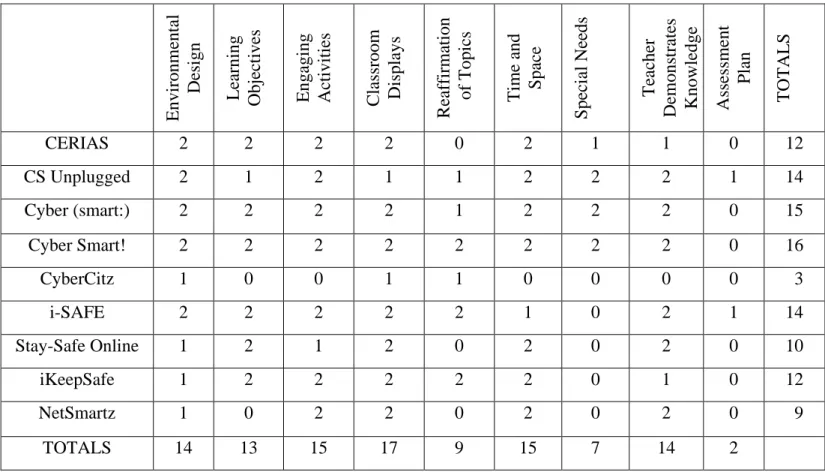
Assessment Plan. The program has a written plan for assessment that describes assessment purposes, procedures, and uses of the results. The plan should include conditions under which children will be assessed, timelines associated with assessments that occur throughout the year, ways to involve families in planning and implementing assessments, and methods to effectively communicate assessment information to families. Assessment methods should be aligned with curriculum goals, provide an accurate picture of all children‘s abilities and progress, are appropriate and valid for their stated purposes, provide meaningful and stable results for all learners, provide teachers with clear ideas for curriculum development and daily planning, and are regularly reviewed to be certain that they are providing the needed information [33].
These standards will be the benchmark for our survey of the widely-used cyber-security programs that were introduced. We will use these standards as objectively as possible when surveying each program.
![Figure 1. CERIAS Safe Instant Messaging Lesson Plan. From [14].](https://thumb-us.123doks.com/thumbv2/123dok_us/11022191.2989512/29.918.153.760.104.877/figure-cerias-safe-instant-messaging-lesson-plan.webp)
![Figure 2. CS Unplugged—Information Hiding Lesson Plan. From [15].](https://thumb-us.123doks.com/thumbv2/123dok_us/11022191.2989512/31.918.178.752.98.1069/figure-cs-unplugged-information-hiding-lesson-plan.webp)

![Figure 4. CommonSenseMedia Grade 3–5 Worksheet—Information Hiding. From [6].](https://thumb-us.123doks.com/thumbv2/123dok_us/11022191.2989512/33.918.183.745.115.1056/figure-commonsensemedia-grade-worksheet-information-hiding.webp)
![Figure 5. CyberCitz – Social Networking Lesson. From [18].](https://thumb-us.123doks.com/thumbv2/123dok_us/11022191.2989512/35.1188.130.1064.174.740/figure-cybercitz-social-networking-lesson.webp)
![Figure 6. i-SAFE Cyber Ethics Lesson for Grades 9–12. From [19].](https://thumb-us.123doks.com/thumbv2/123dok_us/11022191.2989512/37.918.187.667.134.829/figure-i-safe-cyber-ethics-lesson-grades.webp)
![Figure 7. Stop.Think.Connect ―Tips and Advice‖ Sheet. From [20].](https://thumb-us.123doks.com/thumbv2/123dok_us/11022191.2989512/39.918.190.719.92.879/figure-stop-think-connect-tips-advice-sheet.webp)
![Figure 8. Faux Paw, The Techno Cat; StaySafeOnline.org. From [23].](https://thumb-us.123doks.com/thumbv2/123dok_us/11022191.2989512/42.918.288.627.268.545/figure-faux-paw-techno-cat-staysafeonline-org.webp)
![Figure 9. Matrix Table for Implementation into current curricula. From [22].](https://thumb-us.123doks.com/thumbv2/123dok_us/11022191.2989512/43.918.141.780.139.440/figure-matrix-table-implementation-current-curricula.webp)