
n. 13 (2014) pp. 30-50
http://www.fsma.edu.br/si/sistemas.html
Abstract— This paper presents some scope, context, proposals and solutions related with the following topics: Decision-Theoretic Planning for Cloud Computing; An Architecture for Risk Analysis in Cloud; Risk-based Dynamic Access Control for a Highly Scalable Cloud Federation; Challenges of Operationalizing PACS on Cloud Over Wireless Networks; Environment, Services and Network Management for Green Clouds; Provisioning and Resource Allocation for Green Clouds; and Optimizing Green Clouds through Legacy Network Infrastructure Management.
Index Terms — Operation, Management, Security, Sustainability, Cloud Computing.
I. INTRODUCTION
HIS paper presents a mathematical model of decision planning for autonomic Cloud Computing based on the decision-theoretic planning model. It uses Markov decision process on the cloud manager to evaluate decisions and manage the Cloud environment. Also, it contributes to the state-of-art of Cloud Computing approaching the planning phase of the autonomic process with a mathematical model, considering two important factors, (1) the uncertainty of action’s results and (2) the utility of the actions. Both factors are needed when dealing with complex systems as a Cloud. [1].
Cloud computing offers benefits in terms of availability and cost, but transfers the responsibility of information security management for the cloud service provider. Thus, the consumer loses control over the security of their information and services. This factor has prevented the migration to cloud computing in many businesses. This paper proposes a model where the cloud consumer can perform risk analysis on providers before and after contracting the service. The proposed model establishes the responsibilities of three actors: Consumer, Provider and Security Labs. The inclusion of actor Security Labs provides more credibility to risk analysis making the results more consistent for the consumer [2].
Cloud Computing is already a successful paradigm for distributed computing and is still growing in popularity. However, many problems still linger in the application of this model and some new ideas are emerging to help leverage its features even further. One of these ideas is the cloud federation, which is a way of aggregating different clouds to enable the sharing of resources and increase scalability and availability. One of the great challenges in the deployment of cloud federations is Identity and Access Management. This issue is usually solved by the creation of identity federations, but this approach is not optimal. In this paper, we propose an access control system for a highly scalable cloud federation. The presented system is dynamic and risk-based, allowing the use of cloud federations without the need of identity federations. We also present results of a prototype implementation and show that it is scalable and flexible enough to meet the requirements of this highly dynamic and heterogeneous environment [3].
Clinics and hospitals are acquiring more technological resources to help providing a faster and more precise diagnostic, with the goal of making it more dynamic and effective. This is pushing health institutions to search for more modern equipment, with greater technological features. Besides last generation equipment, another problem faced by these institutions is enabling the connection of physicians to a Picture Archive and Communication Systems (PACS) from anywhere. With the use of communication resources increasingly present in everyday life, like Wireless-Fidelity (Wi-Fi), third generation of mobile telecommunications
technology (3G), fourth generation of mobile
telecommunications technology (4G), Worldwide
Interoperability for Microwave Access (WiMax) and other wireless networks that allow the connection of mobile devices, it becomes easier and cheaper to provide quality medical services at a distance. Diagnoses that needed a doctor to be present, for instance, can now be performed from anywhere, provided there is an Internet connection. Cloud-based PACS is shown to be efficient for archiving medical images, allowing access to exams and reports from anywhere, over wireless networks, regardless of the platform used for access [4].
Operation, Management, Security and
Sustainability for Cloud Computing
Carlos B. Westphall, Carla M. Westphall, Fernando L. Koch, Guilherme A. Geronimo, Jorge Werner,
Rafael S. Mendes, Paulo F. Silva, Daniel R. Santos, Ricardo F. Souza, Mauro M. Mattos, Sergio R.
Villarreal, Rafael Weingartner, Leonardo Defenti, Alexandre A. Flores, Rafael R. Freitas, and Gabriel
B. Brascher
Green cloud computing aims at a processing infrastructure that combines flexibility, quality of services, and reduced energy utilization. In order to achieve this objective, the management solution must regulate the internal settings to address the pressing issue of data center over- provisioning related to the need to match the peak demand. In this context, we propose an integrated solution for environment, services and network management based on organization model of autonomous agent components. This work introduces the system management model, analyses the system’s behavior, describes the operation principles, and presents a case study scenario and some results. We extended CloudSim to simulate the organization model approach and implemented the migration and reallocation policies using this improved version to validate our management solution [5].
The aim of Green Cloud Computing is to achieve a balance between the resource consumption and quality of service. In order to achieve this objective and to maintain the flexibility of the cloud, dynamic provisioning and allocation strategies are needed to regulate the internal settings of the cloud to address oscillatory peaks of workload. In this context, we propose strategies to optimize the use of the cloud resources without decreasing the availability. This work introduces two hybrid strategies based on a distributed system management model, describes the base strategies, operation principles, tests, and presents the results. We combine existing strategies to search their benefits. To test them, we extended CloudSim to simulate the organization model upon which we were based and to implement the strategies, using this improved version to validate our solution. Achieving a consumption reduction up to 87% comparing Standard Clouds with Green Clouds, and up to 52% comparing the proposed strategy with other Green Cloud Strategy [6].
This paper is structured as follows (section – title): Section II - Decision-Theoretic Planning for Cloud Computing; Section III - An Architecture for Risk Analysis in Cloud; Section IV - Risk-based Dynamic Access Control for a Highly Scalable Cloud Federation; Section V – Challenges of Operationalizing PACS on Cloud Over Wireless Networks; Section VI - Environment, Services and Network Management for Green Clouds; Section VII - Provisioning and Resource Allocation for Green Clouds; Section VIII - Optimizing Green Clouds through Legacy Network Infrastructure Management; and Section IX – Conclusions.
II. DECISION-THEORETIC PLANNING FOR CLOUD COMPUTING
A. Scope and Context
The decision-theoretic planning (DTP) problems were extensively researched during the last decades. The main problem with the decision-theoretic (or probabilistic) approach for the planning phase in autonomic computing is the need to provide extensive information about the transitions between system states. However, with the arise of Cloud Computing (CC), sensor networks and other technologies that enabled the monitoring and collection of large volumes of data, the information became abundant and the recommendation of utility to solve the contradictions between rules on large
rule-based polices [8], [9] must be taken seriously. On big data environments, the DTP problems no longer exist, enabling its application for the planning phase on the autonomic loop. This work presents a model that plans actions for CC management systems using a decision-theoretic approach. It contributes to the state-of-art in CC research by:
• (i) Adapting the decision-theoretic models, which was based on Markov Decision Process (MDP), to use in the planning phase of the autonomic management loop;
• (ii) Introducing decision-theoretic and MDP for planning in CC;
• (iii) Applying mathematical models on a concrete decision making scenario for self-configuration of CloudStack [10].
B. Literature Review
After some years, the definition of CC that has grown in acceptance was created by NIST [11]:
Cloud computing is a model for enabling ubiqui- tous, convenient, on-demand network access to a shared pool of configurable computing resources (e.g., networks, servers, storage, applications, and services) that can be rapidly provisioned and released with minimal management effort or service provider interaction. This cloud model is composed of five essential characteristics, three service models, and four deployment models.
Another important contribution to CC also can be found in [12]; “Cloud Computing: the need for monitoring”, where are stated some useful concepts to understand the fundamental elements of a Cloud.
As stated in [13], to deal with a complex system like a Cloud, it is necessary to be able to accurately capture its states. Beyond the well-known CC characteristics, like on-demand self-service, broad network access, resource pooling, rapid elasticity, measured service, etc. [11], [14], it is important to highlight the stakeholder heterogeneity characteristic. This characteristic is poorly defined and appears in some works like stakeholder, actors or roles.
In [14] the stakeholders are defined as roles: • Cloud Consumer;
• Cloud Provider; • Cloud Auditor; • Cloud Broker; • Cloud Carrier.
Litoiu at al. [15] presents four type of stakeholders: infras- tructure providers, platform providers, application providers and end users, although, it does not describe these stakeholders roles. In the same paper [8], there is a change on the terms used to present the stakeholders; the term actors is used instead of stakeholders. It places the actors in function of service models: Infrastructure as a Service (IaaS), Platform as a Service (PaaS) and Software as a Service (SaaS); introducing a whole different set of actors as layer owners, that are: IaaS owner, PaaS owner, SaaS owner and end users. Leimeister et al. [16] defines five actors in the CC value net- work: Customer, Service providers, Infrastructure providers, Aggregate services providers (aggregators), Platform provider and Consulting.
In [17], it can be observed a different definition of roles on Cloud environments. The work defines these roles as stakeholders and present the following concepts: Consumers,
Providers, Enablers and Regulators.
Letaifa et al. [18] present a definition of actors and roles in cloud computing systems as: Vendors, Developers and End users.
In Tan et al. [19], although the work focus is adoption (or not) of SaaS, it classifies stakeholders in three categories: SaaS infrastructure provider, SaaS provider and SaaS consumer.
There is no concise definition of CC stakeholders and interests. Furthermore, those distinct definitions may indicate that each Cloud implementation requires a specific stakeholder’s modeling.
C. Autonomic Computing
The Autonomic Computing (AC) concept was based on the human nervous system, which regulates critical functions such as heart rate and body temperature, in the absence of a conscious brain [20]. AC systems have many common points with Expert Systems (ES) but are less generic, applied to management and control of wide computational systems, while the ES are applied in a more generic way. The AC differs from ES principally when it addresses the ”action taking”, that was unusual in ESs, as stated in [21].
AC systems are based on MAPE-K control cycle, that consists in Monitor, Analyze, Plan, Execute and Knowledge elements. Figure 1 shows the MAPE-K life cycle.
Figure 1. Structure of and autonomic agent [1].
An autonomic system, as shown in [20], to be able to perform self-management, must present four main abilities:
• self-configuration - the ability of configure itself according to high-level policies;
• self-optimization - the capacity of optimize its use of resource;
• self-protection - autonomic systems must protect itself from malicious or incorrect user behavior;
• self-healing - the ability of detect, diagnoses and fix
problems.
In [9], the abilities were extended, adding four attributes of autonomic systems:
• self-awareness - the system must be aware of its internal state;
• self-situation - it should detect its current external operating conditions;
• self-monitoring - it has to detect changing circum- stances;
• self-adjustment - it has to adapt accordingly to external or internal changes.
D. Markov Decision Process
Broadly speaking, it can be said that the planning techniques developed in the Artificial Intelligence domain are concerned to obtain a course of actions which conducts the agent to a goal state or to an improvement in its condition. In deterministic planning approaches, each action leads to a single state. On the other side, the DTP is a non-deterministic way of modeling the decision taken problem where each action (or exogenous event) can lead the system state to more than one possible states with a certain probability.
To deal with probabilistic non-determinism, many mathematical tools must be used. A common framework used as underlying model to DTP is the MDP [22] that exposes the probabilistic relation between the system’s states. Another framework is the decision theory [23] which combines the probability theory with utility theory.
In order to model the planning problem for a stochastic dynamic system, it is necessary to present a basic problem formulation using a MDP. This work will model the problem according to [22], that presents the follow key elements: • a set of decision epochs;
• a set of system state; • a set of actions;
• a set of transition probabilities (state X action); • a set of rewards or costs for transitions.
Figure 2. A graphical representation of MDP [24].
The Figure 2 shows a graphical representation of a MDP, where the green circles are the states, the red circles represents the actions, the arrows are the transitions between states, the
numbers over the arrow are the probabilities to achieve a state, and the numbers indicated by the yellow arrows are the reward value of the transition.
E. Stakeholders, Interests and Cloud Computing
This work introduces the idea of interests. Interests have been implicitly referenced in many works that address the CC, like [25]. It is relevant to explain stakeholder’s concerns in a way that they lead the decisions on a cloud autonomic system. Sharma et al. [26] presents two approaches on decisions for dynamic provisioning: cloud provider centric and customer- centric. The paper differentiates them as follows:
Cloud provider centric approaches attempt to maximize revenue while meeting an applications SLA in the face of fluctuating workloads, while a customer- centric approach attempts to minimize the cost of renting servers while meeting the applications SLA.
This definition states important aspects of decision on CC management:
• different types of stakeholders have different interests over the Cloud;
• any decision method inherently carries the ability to benefit the interests of some stakeholders and harm another;
• the stakeholder’s interests are not always reconcilable given certain constraints of resources and service demand; Therefore, it is possible to postulate that an autonomic system that intends to manage a Cloud must guide its decisions in order to maximize the total satisfaction of the stakeholders.
III. ARCHITECTURE FOR RISK ANALYSIS IN CLOUD
A. Scope and Context
Cloud computing brings several challenges for the scientific community of information security. Major challenges cited are [27] [28] [29] [30]: data privacy of users, protection against external and internal threats, identity management, virtualization management, governance and regulatory compliance, Service Level Agreement (SLA) management and trust gaps.
A strategy to meet the challenges of information security in cloud computing is the risk analysis [31]. Several papers have worked on risk analysis on cloud computing [32] [33] [34] [35] [36] [37] [38], focusing on specific techniques for identifying and assessing risks.
Current solutions for risk analysis in cloud computing does not specify the agents involved and their responsibilities during the implementation of risk analysis. This uncertainty creates deficiencies in risk analysis, as:
• Deficiency in scope: occurs when the selection of security requirements is performed by the Cloud Service Provider (CSP) or an agent without sufficient knowledge. The CSP can specify security requirements vicious in their own environment, thus defrauding the results of the risk analysis. An agent unprepared may specify wrong or insufficient requirements, thus creating an incorrect risk analysis;
• Deficiency in adhesion to Cloud Consumer (CC):
occurs when the agent responsible for defining impacts ignores the technological environment and business nature of the CC. In this case, the specification can disregard the impact
scenarios relevant to the CC or overestimate scenarios that are not relevant, thus creating an incorrect risk assessment;
• Deficiency of reliable results: occurs when the quantification of the probabilities and impacts is performed by an agent who is interested in minimizing the results of the risk analysis. For example, if the analysis is performed solely by CSP, he can soften the requirements and evaluation of impacts, thus generating a satisfactory result for the CC. However, such results are incorrect.
The deficiencies outlined above can generate a lack of trust on the part of CCs in relation to risk assessments, as in current models where CSPs are performing their own risk analysis, without the participation of CCs or any other external agent.
This paper proposes a model of shared responsibilities for risk analysis in cloud computing environments. The proposed model aims to define the agents involved in the risk analysis, their responsibilities, language for specifying risks and a protocol for communication among agents.
B. The Proposed Architecture
The proposed architecture defines the sharing of responsibilities between three agents during the risk analysis. Information Security Labs (ISL) is an agent that represents a public or private entity which specializes on information security, eg an academic or private laboratory. The CC is an agent that represents the entity that is hosting their information assets in the cloud. The CSP is an agent that represents the entity being analyzed.
The three agents defined by the proposed architecture divide the responsibilities of running a risk analysis, according to the concepts defined by ISO 27005. In this context threats exploit vulnerabilities to generate impacts on information assets [31].
A risk analysis works with many variables. The variables used on proposed architecture are: (i) DE – Degree of Exposure, defines how the cloud environment is exposed to certain external or internal threat, (ii) DD – Degree of Disability, defines the extent to which the cloud environment is vulnerable to a particular security requirement, (iii) P – Probability, defines the probability of an incident occurrence, ie, a threat exploiting a vulnerability (iv) I – Impact, defines the potential loss in the event of a security incident, (v) DR – Degree of Risk, defines the degree of risk for a given scenario of a security incident.
The risk analysis of the proposed model is organized on two well-defined phases: risk specification and risk assessment.
The risk specification phase defines threats, vulnerabilities and information assets that will compose the risk analysis. At this stage it is also defined how to quantify the threats, vulnerabilities and assets specified.
The risk assessment stage comprises the quantification of the variables DE, DD and I, for threats, vulnerabilities and information assets, respectively. In this phase the quantification of variables of P and DR for each incident scenario is also performed (a combination of threat, vulnerability and asset information).
components of the architecture and the ISL, CSP and CC agents in the risk specification phase. Initially each agent must register on their respective registry component (Fig. 3 a, b, c). After their registration the ISL is responsible for identifying threats and vulnerabilities in cloud computing environments. Then the ISL specifies how to quantify threats and vulnerabilities.
Figure 3. Risk specification phase [2].
The architecture provides a language for the specification of risk, the RDL – Risk Definition Language. This language is used by ISL to specify threats and vulnerabilities. The RDL is specified in XML and contains information such as: risk ID; ISL ID; threat and \ or vulnerability ID and reference to a WSRA – Web Service Risk Analyzer. The WSRA is a Web Service specified by ISL to perform the quantify the Degree of Disability (DD) and Degree of Exposure (DE).
After developing its RDLs and WSRAs the ISL exports the records for the RDLs repository (Fig.3-d) and publishes WSRAs.
The responsibility of the CSP on the specification phase of risk consists in importing RDLs and implementation of calls to WSRAs (Fig.3-e).
ISL is responsible for the correct identification of threats and vulnerabilities. CSP is responsible for the correct execution of the quantification of threats and vulnerability. The CC agent is responsible for the identification of information assets and the quantification of impact, as this is the most fitting agent to express the cost of an information security incident.
In order to perform the identification of an information asset and quantifying an impact on this asset a CC must import the RDLs (Fig.3-f) and extend them including information on information assets and their impacts.
The method of quantification of impacts may be static or dynamic. In the static method the CC determines a fixed value for the impact and in the dynamic method the CC specifies a Web Service to quantify the impact. After specifying their information assets and their impacts the CC exports the extension to the RDL Extensions Repository (Fig.3-g).
C. Results and Discussions
With the information from the risk analysis the CC may decide to allocate or not their information assets in a particular CSP .
The proposed model aims to reduce the three main deficiencies presented by current models of risk analysis in the cloud: deficiency in scope, deficiency in adhesion and deficiency of reliable results.
The reduction in adhesion deficiency occurs when the proposed model includes the CC as a key agent in the process of risk analysis. The CC agent has an important role in risk analysis, defining information assets and quantifying impacts on these assets.
The CC is the most suitable agent for the definition of impacts. It is the agent which best understands the relevance of each information asset within its area of expertise. CSP and ISL agents are not able to identify or quantify the impacts on information assets. They are not experts in the business of CC. The proposed model acts to reduce the deficiency in scope by adding the ISL agent. ISL is an agent specializing in information security. It is the entity best suited to define security requirements, threats and vulnerabilities (specification of the RDLs), as well as to define how to qualify such threats and vulnerabilities (specification of the WSRAs).
The proposed model acts on the deficiency of reliable results because in our model the CSP has more restricted responsibilities than in models traditionally presented by related works.
Traditionally, the CSP is responsible for defining security requirements and the tests that are applied to evaluate the risk of their own environment. In this scenario, the risk assessment can be smoothed by CSP. The inclusion of the ISL agent removes responsibilities which are traditionally assigned to the CSP, such as the identification and quantification of threats and vulnerabilities, thus the result of the risk analysis more reliable.
The proposed model allows multiple ISLs defining RDLs and WSRAs jointly (Fig. 3). Thus, the definitions of risk can come from different sources and can be constantly updated in a dynamic and collaborative way, forming a large and independent base of risk definition for cloud.
The way WSRAs are specified is also a feature that impacts the improvement of scope. The use of Web Services to specify safety requirements allows them to be platform independent. It also allows the use of a wide variety of techniques for quantifying the threats and vulnerabilities because the only limit is set by the programming language chosen for implementation of WSRA.
Related works of risk analysis in the cloud do not consider the role of the CC agent on risk analysis. These works usually focus on the vulnerability assessment by the CSP, without considering the impact it will have on the vulnerability of the different information assets of the CC. The proposed model assigns the responsibilities of the identification and quantification of impact to the CC. Thus, the performing of risk analysis is shared among different agents, so the responsibility for quantifying the variables of risk analysis is not centered on a specific agent.
The CSP is the agent that will be analyzed; therefore it is not able to set any of the variables of the risk analysis, as this could make the results of risk analysis incorrect. The role of
CSP is only to inform the data requested by ISL, so to the own ISL performs the quantification of each information security requirement.
A CC can perform analysis on multiple CSPs before deciding to purchase a cloud service. It is also possible to perform periodic reviews of its current provider and compare them with other providers in the market, choosing to change CSP or not.
IV. RISK-BASED DYNAMIC ACCESS CONTROL
A. Scope and Context
Cloud computing is a model for enabling on-demand network access to a shared pool of computing resources [39]. It is widely adopted and provides advantages for customers and service providers.
As cloud computing grows in popularity, new ideas and models are developed to exploit even further its full capacity, increasing efficiency and scalability. One of these ideas is the deployment of cloud federations [40] [41]. A cloud federation is an association among different Cloud Service Providers (CSPs) with the goal of sharing data and resources [42].
However, to make such a scenario feasible it is necessary to develop authentication and authorization models for largely distributed, dynamic and heterogeneous environments.
This problem is usually treated by the deployment of identity federations. An identity federation is a model of identity management where identity providers and service providers share users’ identities inside a circle of trust [43].
This solution, nevertheless, is not optimal, since identity federations present problems such as the necessity of attribute and trust agreements, interoperability issues and, in practice, show limited scalability [44]. This paper shows that it is possible to provide authorization in cloud federations without the need for an identity federation.
The difference between cloud federations and identity federations is that cloud federations are built to share resources and identity federations are built to share users and identity information.
In this paper, we propose to use a risk-based dynamic access control to enable authorization in a cloud federation without the necessity, but allowing the possibility, of using identity federations.
B. Proposals and Solutions
In this paper we propose that it is possible to provide a way to establish cloud federations without the need for identity federations, by using risk-based access control. This can increase the scalability of this model and handle exceptional requests.
A. Cloud Federations
Figure 4 presents an overview of the cloud federation architecture that we are considering. This architecture is based on the common points found in the main federation projects currently being developed, some of which were described in Section II.
The main application scenarios for such federations are
medical, military and scientific collaborations, which require large storage and processing capabilities, as well as efficient information sharing.
In this architecture we have the following components: CloudProvider: this is the Cloud Service Provider (CSP) itself, who provides the infrastructure over which the virtual resources are allocated (they are represented by the clouds in the figure);
CloudManager: responsible for attaching a CloudProvider to the federation. It is composed of several services that deal with users, resources, policies, service-level agreements, security and the CloudProvider. It is modular so that it can be attached to different cloud management software just by changing one of its services.
FederationManager: responsible for coordinating the federation. It acts as a naming service and is also responsible for message passing.
Figure 4. Overview of the federation [3].
As shown in Figure 4, some of the participating clouds may form identity federations among themselves.
Under the point of view of a user there are two types of clouds in this architecture: a home cloud (his original CSP) and foreign clouds (the other clouds in the federation). Users can deploy and access resources in both types of cloud, but access control behaves differently for each case.
When users deploy a resource in their home cloud they may choose if it will be available for users of foreign clouds. In any case the user must upload an XACML policy file together with the resource, which will be used for ABAC.
Users may also deploy resources in a foreign cloud and it will automatically be available to every user of the federation. Finally, users may access resources in their home cloud or shared resources in foreign clouds.
When a user tries to access a resource in their home cloud, this request is handled by a classical ABAC model. Based on user attributes and XACML policies the system grants or denies the requested access.
When a user tries to access a resource in a foreign cloud, the system first verifies if both clouds are in an identity federation, in which case the access will also be handled by ABAC, but if there is not an identity federation between them, the “break-the-glass” mechanism is activated and the risk-based access control Policy Decision Point (PDP) is called.
The PDP is located in the cloud handling the access request (foreign to the requester) and the metrics and parameters of risk estimation are defined by the administrators of this cloud and the users who own the resources.
These metrics are informed in an eXtensible Markup Language (XML) file, containing definitions of risk metrics and how to measure and aggregate them, as well as a threshold level for granting access to the resource and possible obligations that users will have to follow. This file is known as a risk policy.
Each cloud provider must provide a set of basic metrics with their quantification rules. Those will be used to create a baseline risk policy for the provider. This guarantees that a cloud provider is able to maintain their minimal security requirements.
Each resource has its own risk policy, which must respect what is defined in the baseline policy, but may be extended to become more or less restrictive as the user desires. The XML file of the policy must be uploaded by users when they choose to deploy a shared resource.
If a user chooses to define a risk metric that is not available in the server, he/she must provide a way for the CSP to quantify this risk. This is done by defining a Web Service that will be called by the PDP upon the evaluation of the access request. The PDP will forward the access request to the Web Service, which will have to parse it, process it and return a numeric value representing the associated risk for the metric being evaluated.
To handle the access request for a given resource all of the metrics are valued, based on the rules defined by the CSP and the Web Services defined by the user. The chosen aggregation engine is used to reach a final risk value. This value is then compared to the defined threshold and, if lower, the subject is given special access.
Before granting access, however, the policy is analyzed in search of obligations that were defined by the user. Those obligations are stored in a system monitor, which will watch and log every user action once the access is granted.
C. Results
To validate our proposal and measure some performance characteristics we implemented the key parts of the federation system and the whole access control system.
The implementation used the Python programming language, the zeromq library to handle message passing, MySQL for persistence, the ndg-xacml library for XACML evaluations and the web.py framework for the web services.
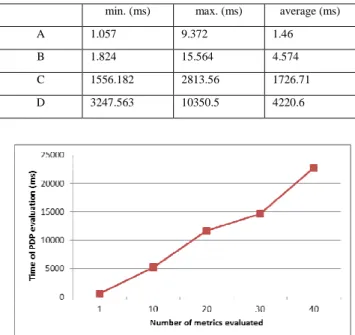
The infrastructure over which the federation was deployed was composed of two OpenNebula clouds running on a laptop with a 2,53GHz Core i5 processor and 4GB of RAM. All of the experiments were repeated 50 times to obtain the averages
and all of the times shown here refer only to the execution of the access control decision function, ignoring message passing between the clouds. Table I shows four different cases of access request. Case A represents 10 requests handled by local XACML only; case B represents a risk decision that involves 10 risk quantification rules performed locally; case C uses 5 local rules and 5 external (web service) rules; and case D represents a risk policy with 10 external risk quantification rules.
It is possible to see that the use of local risk quantification rules has no significant impact on performance, while the use of web services does affect performance, as expected, because of the HTTP invocations that must be performed for each metric.
Figure 5 shows the growth in time spent reaching an access decision as we increase the number of metrics which call web services in a risk policy file.
TABLE I. COMPARISON OF DIFFERENT ACCESS REQUEST CASES [3] min. (ms) max. (ms) average (ms)
A 1.057 9.372 1.46
B 1.824 15.564 4.574
C 1556.182 2813.56 1726.71 D 3247.563 10350.5 4220.6
Figure 5. Performance comparison with a varying different number of external metrics [3].
V. CHALLENGES OF OPERATIONALIZING PACS ON CLOUD
A. Scope and Context
Medicine is being perfected through the use of innovative technological solutions in various equipment with diverse applications, such as image processing, blood analysis, surgical assistance and distance patient control.
Inside hospitals and clinics for diagnostic imaging, it is usual to find PACS. PACS have the goal of managing the storage and exhibition of medical images. Through workstations, doctors have access to the PACS system where they manipulate images independently of their physical location.
Specialized physicians achieve diagnosis through the analysis of images or the reading of reports. But these physicians are not always present where the exam was
performed, especially in cases where the participation of a second doctor is necessary or in the case of training for resident physicians. The involvement of these doctors can happen with telemedicine.
Telemedicine comprehends the offering of services related to health care in cases where distance is a critical factor; such services are performed by health professionals using communication and information technologies for the interchange of information valid for diagnostics, prevention and treatment of illnesses and the continual education of health service providers, as well as research [45].
The practice of telemedicine is only made possible because of significant advances in communication systems. The possibility of connectivity to the World Wide Web from mobile devices, a constantly evolving technology, allows patients to obtain adequate medical care in less-favored regions, where there are no doctors or wired Internet connection available. Wi-Fi Networks, 3G, 4G, WiMax and other wireless networks are being constantly improved with higher data transmission rates, allowing access to content not explored before, which aim to improve, simplify and complement the services related to patient care and make them more efficient.
Cloud computing is currently the main theme of a lot of research in information technology. The possibility of sharing resources through clusters, virtualization and the ease of access to information attracts more and more information technology researchers. This technology is also a powerful tool to promote the homogenization or virtualization of space [46].
Images from radiological exams are used in clinics and hospitals for medical diagnosis. The inter-relation among clinics, hospitals and radiology departments are increasingly dependent of the accessibility of these images, from anywhere inside or outside of the health care unit [47].
The idea is to use cloud as a model for applications being delivered as services over the Internet. Cloud services are built in such a way that if a machine fails, the system resets, in order to prevent the service to crash or that the contractor knows that there was some kind of problem. Cloud computing enables the growth of processing and storage infrastructure for hospitals and clinics without causing much impact. Thus cloud based PACS enables medical activity from anywhere using computers or devices connected to the Internet.
B. Interoperability Challenges
Health charts, medical and laboratory reports, medical images and prescribed medicine are some of the items in a medical record, and those records are becoming more and more complex. Physicians in hospitals and clinics need a flexible resource that allows them accessing information and history for each patient, because they work and meet patients in several places; they need to be frequently following exams and giving support to several people.
Medical records occupy a great storage space and the management of these data is a challenging task for hospitals and clinics [48]. To solve those issues, these organizations
invest large amounts of money in infrastructure for communication, processing and storage of exams. Inside this infrastructure are equipment for ultrasonography, MRI, CT scans and radiography. Figure 6 shows the sending of medical images to the PACS.
The modalities, as known equipment’s, send images using Digital Image and Communication in Medicine (DICOM), a digital standard to store and transmit medical images, over a Wireless Local Area Network (WLAN) to a PACS located on a cloud. Communication from the medical equipment to the WLAN is achieved by using a device that connects to a Local Area Network (LAN), which in turn accesses the PACS that is on the cloud using the Internet.
Figure 6. Sending DICOM images to the cloud-based PACS [4].
C. Proposed Scenario
This work shows a cloud-based PACS solution, allowing exams to be performed in various equipment and transmitted over wireless networks, so that from any connected mobile device a doctor may have access to PACS exam images. Figure 7 shows diverse equipment such as cellphones, tablets and laptops accessing the cloud-based PACS over wireless connections, such as Wi-Fi, 3G, 4G or WiMax.
Figure 7. Accessing PACS through wireless networks [4].
The PACS system in the implementation is DCM4CHEE [49] [50], with a PostgreSQL database. The devices for test access were a laptop, a smartphone and a tablet, all of them with the Osirix application. All of them are using publicly available 3G and Wi-Fi connections. In every case the connection is successful, showing a mean time of 20 seconds to download a DICOM exam of a lumbar spine containing 100 images.
D. Identity Management Implementation
The PACS system was installed and configured on a Windows 2008 Server R2 virtual machine. On this same machine the Shibboleth, Apache 2.2, Tomcat 7, OPENLDAP, JASIG CAS, JDK 1.7 and PostgreSQL 9.2 services were configured.
Apache was configured to allow the use of Secure Sockets Layer (SSL) connections, and also to proxy its requests to Tomcat. Tomcat was configured to run the authentication and identity management applications.
The authentication server enables JASIG CAS SSO authentication via a web interface passing authenticated users to Shibboleth. CAS was set up to search for users in a Lightweight Directory Access Protocol (LDAP) directory.
With the server configured, Shibboleth was installed. The IDP application was installed and configured in Tomcat. To act as the service provider, the Shibboleth application must belong to a federation. TestShib was chosen as the federation, because it was created to test Shibboleth configurations (SPs and IDPs). An IDP was registered informing the hostname and digital certificate created earlier. Shibboleth was then configured to use TestShib’s metadata. The CAS Client receives shibboleth authentication. With this process ready Shibboleth is configured and authenticating users from JASIG CAS.
VI. ENVIRONMENT,SERVICES AND NETWORK MANAGEMENT FOR GREEN CLOUDS
A. Scope and Context
The load prediction models in traditional architectures and cloud computing environments are based on the analysis of historical data and demand increments from business models. This information makes it possible to pre-allocate resources. However, load prediction models are challenged (and frequently broken) when unexpected peaks of demand occur.
Approaches to dealing with the problems of load prediction models include the following: allow for a margin of on-line resources, i.e., over-provision resources; to turn on idle resources; and to temporarily use external resources on-demand (i.e., federated clouds), and others. Each of these approaches has its advantages and disadvantages. The challenge in green computing, as described by [51], is to exploit the balance between these approaches in order to address the pressing issue of data center over-provisioning related to the need to match the peak demand.
We propose a solution based on integrated environment, services and network management that promotes: equitable load distribution through techniques like virtual machines; predictive resource allocation models through historical load analysis and pro-active allocation methods; aggregate energy management of network devices; and integrate control over the environmental support units, which represent the larger share of energy consumption.
The objectives are the following: to provide flexibility of the system configuration that allows for the easy introduction of new elements in the managed environment and the configuration processing distribution among services; to provide a level of availability that keeps to higher standard SLA (Service Level Agreement) compliance rates and which contributes to system’s stability and security; to reduce cost in both capital and operational costs (CAPEX and OPEX), [52], to support the business predicates, and thus promote the acceptability of the proposed method; and to provide sustainability by using methods to reduce energy utilization and carbon emission footprints.
To achieve our objectives we propose an OTM (Organization Theory Model) for integrated management of a green cloud computing environment. It works based on organization models that regulate the behavior of autonomous components (agents) that view the environmental elements, network devices (e.g. switches, cards and ports) and service providers (e.g. processing servers, load distribution services, task processors and temperature reduction services). For example, the management system is able to turn off unused network devices and servers, turning off the environmental (cooling) support units. This is reactive to characteristics of the predicted system load. The controlling elements are able to coordinate between themselves aiming at a higher-level system’s objective, e.g. to keep overall energy utilization and SLA compliance metrics.
Our research advances the state of the art as follows: it introduces an organization theory model for integrated
management of the green clouds based on the concepts of organization models, network management, and distributed computing; it analyses the network and system’s behavior and operational principles; it validates the proposal demonstrating the system’s added-value in a case study scenario; and it improves a simulator (the CloudSim framework) to validate the green cloud computing management approach.
Our research was motivated by a practical scenario at our university’s data center. In the (not so distant) past, we applied the “traditional architecture” which was composed of diverse processing clusters configured to process different services. We faced the usual issues encountered in large data centers at that time: lack of rack space, which impacted flexibility and scalability; an excessive number of (usually outdated) servers, which impacted operation costs; the need of an expensive refrigeration system; and an ineffective UPS (Uninterruptible Power Supply) system, which was problematic to scale due to the number of servers involved.
With the use of cloud computing, we managed to consolidate the number of servers using virtualization techniques. Using this technology, we concentrated the predicted load on a few machines and kept the other servers on standby to take care of peak loads. The immediate results were very positive: reduction of rack space utilization; lower heat emission due to the reduction in server utilization, with consequent optimization of the cooling infrastructure, and, a quick fix for the problematic UPS system because we had less active servers.
As part of an institutional initiative towards sustainability and eco-friendliness, our next step was to optimize energy utilization [53] and reduce carbon emission. For this, we looked at solutions from the fields of green computing and, more specifically, green cloud computing. We noticed that there was room for improvement as we consolidated resources using cloud computing. For instance, there were periods in time when the VMs (Virtual Machines) were idle and the servers were underutilized. Based on the principles established by [54], our goal was to promote energy-efficient management and search for methods to safely turn off unused servers using an on-demand basis. The intuitive approach was to concentrate the running applications (configured per VMs) in a few servers and recycle server capacity.
Although appealing, this approach led to a major issue: service unavailability! A quick analysis concluded that it was related to the time required to bring up the servers during unpredictable peak loads. We concluded the following: the dimensioning is based on historic intra-day analysis of services demand. More specifically, it is based on the analysis of previous day’s demand plus a margin of the business growth that can be estimated as the amount of resources required for one service in a period of time; however, when dealing with services with highly variable workloads, that prediction becomes complex and often immature. Moreover, external factors can lead to unexpected peaks of demand. For that, we left a safety margin of resources available (e.g. 20% extra resources on standby). Besides the excessive energy utilization, this approach fails when the demand surpassed that
threshold; as a solution, we needed to bring up turned-off resources. The lapse of time between the detection of the situation and the moment that processing resources become available caused the service unavailability.
We analyzed several alternatives to overcome this issue that implements an OTM (Organization Theory Model) for integrated management of the green clouds focusing on: optimizing resource allocation through predictive models; coordinating control over the multiple elements, reducing the infrastructure utilization; promoting the balance between local and remote resources; and aggregating energy management of network devices.
Cloud computing is based on server virtualization functionalities, where there is a layer that abstracts the physical resources of the servers and presents them as a set of resources to be shared by VMs. These, in turn, process the hosted services and (may) share the common resources. The green cloud is not very different from cloud computing, but it infers a concern over the structure and the social responsibility of energy consumption [55], hence aiming to ensure the infrastructure sustainability [56] without breaking contracts.
B. Proposals and Solutions
To understand the problem scenario, we introduce the elements, interactions, and operation principles in green clouds. Green clouds emerged as a solution to save power by utilizing server consolidation and virtualization technologies. Fine tuning resource utilization can reduce power consumption, since active resources (servers, network elements, and A/C units) that are idle lead to energy waste. The target in green clouds is: how to keep resources turned off as long as possible?
The interactions and operation principles of the scenario are described below:
• There are multiple applications generating different load requirements over the day.
• A load balance system distributes the load to active servers in the processing pool.
• The resources are grouped in clusters that include servers and local environmental control units (A/C, UPS, etc.). Each server can run multiple VMs that process the requests for one specific application. Resources can be fully active (servers and VM on), partially active (servers on and VMs off), or inactive (servers and resource off). The number of servers and their status configuration is defined based on historical analysis of the load demand.
• The management system can turn on/off machines overtime, but the question is when to activate resources on-demand? In other words, taking too much delay to activate resources in response to a surge of demand (too reactive) may result in the shortage of processing power for a while. This reflects directly on the quality of service, as it could deteriorate the service availability level (even if this is a short time). On the other hand, activating more unnecessary resources causes resources to be left idle and wastes energy consumption.
that we see as a tendency of this area and seek like a goal. These aspects that are described below are the reference for what our model aims to fulfill. In comparison to green cloud, we infer the responsibility of consuming less energy in addition to ensuring the agreements predefined in the SLA.
• Flexibility: is state-aware of all equipment under its control, acting for when it will be necessary, not when it is needed, and plan their actions based in the information of the whole cloud. It is able to predict and execute necessary changes in hardware according to the demand of the cloud; such as slowing down an overheated CPU, turning on machines based on foreseen load coming, or triggering a remote backup in case of fire. It is able to interact automatically with public clouds [56], migrating or rising up new nodes on demand in remote clouds. It provides a better support for occasional workload peaks or DoS (Denial of Service) attacks.
• Availability: encompasses a new level by extending itself to the public clouds, allowing the creation of mirror clouds. It deals with context grouping automatically, being able to migrate these groups, or elements to public clouds.
• Cost reduction: by having an automated management based on previous experience and results, it can manage itself with minimal human intervention. It uses a 24/7 management system aiming to provide a better utilization of the resources. It will enlarge the equipments lifetime, decrease the downtime caused by human errors and reduce the expenses by adopting smart strategies for resource utilization. With inter- cloud communications it can adopt a minimalist configuration, ensuring local processing for most of their workload, and leaving the workload peaks to an external cloud.
• Sustainability: its structure has the ability to adopt goals for SLA, goals for energy consumption (average X kWh per day) or goals for heat emission (average Y BTU per day). The structure reacts with the environment events in order to fulfill the predefined goals. Events like UPS state down, temperature sensors accusing high degrees or fire alarms on. In parallel, adapts the environment dynamically in order to fulfill the internal goals; like decreasing the cooling system to reach consumption goals.
We propose that breaking the centralized management service in several little management services gives us the necessary elements to increase the “degree of freedom” of the cloud, creating the possibility to achieve a balanced situation between risk and consumption.
However, with several management services in the cloud we introduce a new problem: the management of these services becomes a complex job. For this, we use the principles of organization theory, to organize and classify such services, making them easier to control. Cloud management through the organization theory principles gives the possibility to auto configure the management system, since the addition of a new element (such as network device, VM, PM, UPS) is just a matter of including a new service in the management group.
Hence, we propose a proactive model for cloud management based on the distribution of responsibilities for
roles. In this approach, the responsibility for managing the elements of the cloud is distributed among several agents, each one in one area. These agents will individually monitor the elements of the cloud of their responsibility. They act in an orchestrated way aiming for the fulfillment of the standards (norms).
Such orchestration is based on the fact that the knowledge about the state of the cloud (as a whole) be shared by all agents, the existence of planning rules, to guide the actions of the agents, and the development of beliefs about the inner workflow of the cloud, that are constantly revised.
Since the data center structure is scaled and used to provide services, this remains only a tool to provide such services. Generally, service level agreements are established in order to clarify the responsibilities of each part - client and provider. We emphasize that these agreements should be kept at their level (i.e. service), making them purely behavioral rules (e.g. delay, fault tolerance) for the service, excluding structural and physical requirements. Without the details of the environment configuration in the agreement, the cloud becomes flexible. With the independence and flexibility to change the configuration of the structure, it can become dynamic and extensible.
It can allow for covering external agreement factors still critical to the data center infrastructure (i.e., energy consumption, hardware wear, among others), but not related to the agreement. Just as we live under the laws of physics, the cloud should also exist in well-defined laws, which we call norms. These norms express the rules of the service behavior established in the SLA and the internal interests of the cloud, which need to be considered.
For the various elements of the cloud to work efficiently, seeking the enforcement of these standards, they should be coordinated by external agents to the services they audited; managing, for example: enabling and disabling VMs; enabling and disabling PMs; configuration changes in VMs; and enabling and disabling network devices.
Since there is a wide range of elements to manage, the complexity would grow proportionally with the size of the cloud. To avoid such complexity we infer a hierarchy to the existing agents. We can make an analogy to a large company where there is a hierarchy to be followed and responsibilities being delegated. Just as in a company, there must be a system manager (the boss) that controls the entire environment. Following the hierarchy we have the coordinators who split the operations between their teams [57] in order to facilitate the division of tasks and responsibilities among its teams.
Depending on the situation, decisions will generate system operations or service operations, or both. System operations can be divided into VM management, servers management, network management and environment management. The service operations can be divided into monitor element, service scheduler and service analyzer.
The action of each role is directly reflected in the configuration of the structure as a whole. The system operations will act over the structure and environment in which the services are being processed. The services
operations will act over the service layer and the environment, acquiring information from both.
The four roles that operations system may be classified as are:
• VM management: responsible for the actions implied the virtual machines. It has an interface between the model and the virtual machines. As an example, creating or destroying a VM, changing your settings and even moving it from one host to other host (either from local or remote data center).
• Servers management: responsible for the actions implied the physical machines. It has an interface between the physical machines and the model. As an example, turning off and on a physical machine, changing the settings of the host operating system (e.g. such as BIOS - Basic Input/Output System, SMART - Self- Monitoring, Analysis, and Reporting Technology), hardware configurations (e.g. cooler and accelerometer), and backend equipment (e.g. such as storage devices, switches and site backups).
• Network management: Responsible for actions implied the network devices. It uses SNMP tools gathering traffic data and computing the utilization of each port on all the switches, minimizing the active network components, while turning off unused switches, and disabling unused ports saving energy.
• Environment management: responsible for actions outside the structure. It has an interface between the environment and the model. As an example, temperature control of the data center, control of power backup systems (e.g. UPS and generator), control over the accessibility of the data center (e.g. physical security).
The three roles that service system may be classified as are:
• Monitor element: responsible for the collection of information structure in general, and your understanding. It has the responsibility to keep the model aware of the state of the cloud by monitoring the servers, VMs, network traffic and so on. It is based on specific parameters previously configured by the System Manager, such as the use of a resource and its threshold notification, the availability of network links (binary data) or idleness of some element of the structure.
• Service scheduler: responsible for the cloud agenda. It has a proactive role in the model, planning the actions to be taken before the scheduled events. In an exchange of physical machines, for example, it will generate the following list of steps to be followed: test secondary UPS; enabling secondary server; and VM’s migration.
• Service analyzer: responsible for testing services and behavioral analysis. It has the role of auditing the service provided by the framework and understanding it. It makes sure that the service provided is in accordance with the norms to be followed, by inferring pre-established thresholds and alerting the system manager. It monitors the quality of service that is provided, and tries to relate it with the variations in the structure, finding patterns between the performance obtained and the variants elements.
Planning Rules and Beliefs:
• Planning rules: the basis of theoretical knowledge,
which relates contexts and objectives. They are used at times when decisions must be made, during the planning of actions. They are pieces of primitive knowledge gleaned from the experience of managers. We can take as an example of Planning Rules the following notions: if a VM increases the use of page swap ping, to decrease it, we will increase memory RAM (Random Access Memory); if the physical machine presents a high load, to decrease the load, we will move the VM with more processing to another physical machine; if the data center presents a high load, to decrease the general load, we will turn on more physical machines.
• Beliefs: empirical knowledge used to improve the decisions to be taken. In this we have the empirical understanding above the functioning of the cloud. The beliefs express the junction of practical knowledge (the premises), coming from the norms and empirical knowledge, originating from the historical data and past experiences. The beliefs must be reviewed frequently by all elements of the model, as well as the sharing of these reviews. We can take as an example of beliefs the following notions: the activation of a server type X represents an increase of Y degrees in Z minutes; the activation of a VM type A increases the consumption in B kWh; the VM type A supports C requests per second.
VII. PROVISIONING AND RESOURCE ALLOCATION FOR GREEN
CLOUDS
A. Scope and Context
We are also proposing two strategies for allocation and provisioning of PMs (Physical Machines) and VMs (Virtual Machines) using DVFS (Dynamic Voltage and Frequency Scaling) as an improvement of private clouds sustainability, transforming the Cloud into Green Cloud [5]. Green Clouds crave for efficiency of its components, so, we adopted positive characteristics of multiple existing strategies, developing hybrid strategies that, in our scope, aim to address:
- A sustainable solution to mitigate peaks in unpredictable workload environments with rapid changes;
- An optimization of the data center infrastructure without compromising the availability of services during the workload peaks;
- Balance between the sustainability of the infrastructure and the services availability defined on SLAs (Service Level Agreements).
This work was based on actual data collected by the university data center, that has multiple services suffering often with unexpected workload peaks, whether from attacks on servers or overuse of services in short periods of time. First, we propose an allocation model for private Clouds that aims to reduce the costs (energy and SLA fines) while improving the resource optimization. Second, we propose a provisioning model for private Clouds, turning them into Green Clouds, allowing the reduction of energy consumption and resource optimization while maintaining the SLAs with the integration of public Cloud resources. Third, after we validate our hybrid provisioning strategy, we have the opportunity to apply the hybrid provisioning strategy in a
![Figure 1. Structure of and autonomic agent [1].](https://thumb-us.123doks.com/thumbv2/123dok_us/11115847.2999868/3.892.68.427.572.945/figure-structure-autonomic-agent.webp)
![Figure 3. Risk specification phase [2].](https://thumb-us.123doks.com/thumbv2/123dok_us/11115847.2999868/5.892.72.396.248.467/figure-risk-specification-phase.webp)
![Figure 4. Overview of the federation [3].](https://thumb-us.123doks.com/thumbv2/123dok_us/11115847.2999868/6.892.460.791.439.716/figure-overview-of-the-federation.webp)
![Figure 6. Sending DICOM images to the cloud-based PACS [4].](https://thumb-us.123doks.com/thumbv2/123dok_us/11115847.2999868/8.892.458.800.372.645/figure-sending-dicom-images-cloud-based-pacs.webp)
![Figure 7. Accessing PACS through wireless networks [4].](https://thumb-us.123doks.com/thumbv2/123dok_us/11115847.2999868/9.892.68.424.128.406/figure-accessing-pacs-wireless-networks.webp)
![Figure 8. Typical network topology of a data center [68].](https://thumb-us.123doks.com/thumbv2/123dok_us/11115847.2999868/15.892.73.507.794.1114/figure-typical-network-topology-data-center.webp)
