Hodge theory for intersection space cohomology
MARKUSBANAGL EUGÉNIE HUNSICKER
Given a perversity function in the sense of intersection homology theory, the method of intersection spaces assigns to certain oriented stratified spaces cell complexes whose ordinary reduced homology with real coefficients satisfies Poincaré duality across complementary perversities. The resulting homology theory is well known not to be isomorphic to intersection homology. For a two-strata pseudomanifold with product link bundle, we give a description of the cohomology of intersection spaces as a space of weightedL2 harmonic forms on the regular part, equipped with a fibred scattering metric. Some consequences of our methods for the signature are discussed as well.
55N33, 58A14
1 Introduction
Classical approaches to Poincaré duality on singular spaces are Cheeger’s L2 cohomol-ogy with respect to suitable conical metrics on the regular part of the space[14;13;15] and Goresky and MacPherson’s intersection homology, depending on a perversity parameter. Cheeger’s Hodge theorem asserts that the space of L2 harmonic forms on the regular part is isomorphic to the linear dual of intersection homology for the middle perversity, at least when X has only strata of even codimension or, more generally, is a so-called Witt space.
More recently, the first author has introduced and investigated a different, spatial perspective on Poincaré duality for singular spaces [2]. This approach associates to certain classes of singular spaces X a cell complex IpxX, which depends on a perversity pxand is called anintersection spaceof X. Intersection spaces are required to be generalized geometric Poincaré complexes in the sense that when X is closed and oriented, there is a Poincaré duality isomorphism Hzi.IpxXIR/Š zHn i.IqxXIR/, wheren is the dimension ofX, pxandqxare complementary perversities in the sense of intersection homology theory, and Hz andHzdenote reduced singular (or cellular) cohomology and homology, respectively. The present paper is concerned with X
that have two strata such that the bottom stratum has a trivializable link bundle. The construction of intersection spaces for suchX, first given in[2, Chapter 2.9], is described here in more detail inSection 3. The fundamental principle, even for more generalX (see Banagl and Chriestenson[7]), is to replace links by their Moore approximations, a concept from homotopy theory Eckmann–Hilton dual to the concept of Postnikov approximations. The resulting (co)homology theory HIpx.X/ D H.IpxXIR/ or HIpx.X/DH.IpxXIR/isnotisomorphic to the respective intersection (co)homology IHpx.XIR/ or IHpx.XIR/. The theory HI has had applications in fibre bundle theory and computation of equivariant cohomology (Banagl[3]); K–theory (Banagl [2, Chapter 2.8]; Spiegel[35]); algebraic geometry (smooth deformation of singular varieties (Banagl and Maxim[8;9]), perverse sheaves (Banagl, Budur and Maxim[5]), mirror symmetry[2, Chapter 3.8]); and theoretical physics [2, Chapter 3;5]. Note for example that the approach of intersection spaces makes it straightforward to define intersectionK–groups byK.IpxX/. These techniques are not accessible to classical intersection cohomology. There are also applications to Sullivan formality of singular spaces: Given a perversity px, call a pseudomanifold X px–intersection formalifIpxX is formal in the usual sense. Then the results of[8]show that under a mild torsion-freeness hypothesis on the homology of links, complex projective hypersurfaces X with only isolated singularities, whose monodromy operators on the cohomology of the associated Milnor fibres are trivial, are middle-perversity (mS) intersection formal, since there is an algebra isomorphism from HImS.X/ to the ordinary cohomology algebra of a nearby smooth deformation, which is formal, being a Kähler manifold. This agrees nicely with the result of Chataur, Saralegi-Aranguren and Tanré [12, Section 3.4], where it is shown that any nodal hypersurface in CP4 is “totally” (ie with respect to an algebra that involves all perversities at once) intersection formal. Rational Sullivan models of intersection spaces have been investigated by M Klimczak[27].
A de Rham description ofHIpx.X/ has been given by Banagl[4]for two-strata spaces whose link bundle is flat with respect to the isometry group of the link. Under this assumption, a subcomplex Ipx.M/ of the complex .M/ of all smooth differ-ential forms on the top stratum M D X †, where † X is the singular set, has been defined such that for isolated singularities there is a de Rham isomorphism HIdR;px.X/Š zH.IpxXIR/, where HIdRj ;px.X/ DHj.Ipx.M//. This result has been generalized by Timo Essig[16]to two-strata spaces with product link bundle. In [4] we prove furthermore that wedge product followed by integration over M induces a nondegenerate intersection pairing\HIW HIdR;j px.X/˝HIdR;n jxq.X/!Rfor
complementary pxand qx. The construction of Ipx.M/for the case of a product link bundle (ie the case relevant to this paper) is reviewed here in detail inSection 6.2. In the present paper, we find for every perversity px a Hodge-theoretic description of the theory HIpx.X/; that is, we find a Riemannian metric on M (which is very different from Cheeger’s class of metrics) and a suitable space of L2 harmonic forms with respect to this metric (theextended weighted L2 harmonic forms for suitable weights) such that the latter space is isomorphic toHIz px.X/ŠHIdRj ;px.X/. Assume for simplicity that † is connected. If L denotes the link of † in X and M is the compact manifold with boundary@M DL† and interior M (called the “blowup” of X), then a metric gfs on M is called a product-type fibred scattering metric if near @M it has the form
gfsD dx2
x4 Cg†C
gL
x2;
wheregL is a metric on the link andg† a metric on the singular set; seeSection 2.
If †is a point, thengfs is a scattering metric. Given a weight c, weighted L2 spacesxcL2g
fs
gfs.M/are defined inSection 7. The
space Hext.M;gfs;c/ of extended weighted L2 harmonic forms on M consists of all those forms ! which are in the kernel of dCı (where ı is the formal adjoint of the exterior derivative d and depends on gfs andc) and in xc L2gfsgfs.M/ for
every >0; seeDefinition 7.1. Extended L2 harmonic forms are already present in Chapter 6.4 of Melrose’s monograph[30]. Then our Hodge theorem is:
Theorem 1.1 Let X be a (Thom–Mather) stratified pseudomanifold with smooth, connected singular stratum †X. Assume that the link bundleY !†is a product L†!†, whereL is a smooth manifold of dimension l. Let gfs be an associated product-type fibred scattering metric onM DX †. Then
HIdR;p.x X/ŠHext M;gfs;12.l 1/ px.lC1/
:
Aside from giving an analytic description ofHI cohomology in terms of harmonic forms, a nice aspect of this result is that it shows that there is a natural topological description of the space of extended harmonic forms on the right-hand side. In[25], the second author obtained a Hodge theorem for these spaces of forms, but thought of as relating to a conformally equivalent metric and with a different weight. However, the topological description in that paper is in terms of the topologically less natural IG spaces we consider below. Thus it is satisfying here to see that there is a natural cohomology describing these forms.
As a corollary to this description, we find that the spacesHext M;gfs;12.l 1/ px.lC1/ satisfy Poincaré duality across complementary perversities. We can see this duality achieved on forms using an appropriate Hodge star operator, as has been shown by the second author in [25]. Finally, it is worth noting that on the space of extended harmonic forms, integration does not give a natural well-defined intersection pairing on the right-hand side. Thus it would be interesting in the future to consider how to realize the intersection pairing on extended harmonic forms.
The strategy of the proof ofTheorem 1.1is as follows: First we relate HIdR;p.x X/ and z
H.IpxXIR/ to intersection cohomology and intersection homology, respectively. To do this, we introduce inSection 2the device of aconifold transitionCT.X/ associated to anX as in the Hodge theorem. The conifold transition arose originally in theoretical physics and algebraic geometry as a means of connecting different Calabi–Yau 3–folds to each other by a process of deformations and small resolutions; see[2, Chapter 3]for more information. Topologically, such a process also arises in manifold surgery theory when† is an embedded sphere with trivial normal bundle. The relation of HI toIH is then given by the following theorem.
Theorem 1.2 (homological version) LetX be an n–dimensional stratified pseudo-manifold with smooth nonempty singular stratum†X. Assume that†is closed as a manifold and the link bundleY !†is a product bundle L†!†, where the linkL is a smooth closed manifold of dimension l. Then the reduced homology HIz px.X/ of the intersection space of perversity pxis related to the intersection homology of the conifold transition CT.X/ofX by
z
HIjpx.X/ŠIGj.n 1 px.lC1/ j/.CT.X//;
where for a pseudomanifold W with one singular stratum of codimensionc,
IGj.k/.W/DIHjxq.W/˚ IH x q0 j .W/ im.IHjxq.W/!IHjqx0.W//; with qx.c/Dk 1and qx0.c/Dk.
Note that when bothpx.lC1/and the degreej are large, one must allow negative values for k in the quotient IGj.k/. Therefore, the perversity functions xq considered in this paper are not required to satisfy the Goresky–MacPherson conditions, but are simply arbitrary integer-valued functions. This, in turn, necessitates a minor modification in the definition of intersection homology. The precise definition of IHqx used in the
above theorem is provided in Section 4and has been introduced independently by Saralegi-Aranguren[31]and by Friedman[17]. In the following de Rham version of the above result, the link and the singular stratum are assumed to be orientable, as our methods rely on the availability of the Hodge star operator. When an intersection cohomology group IHpx.W/ depends only on the value of the perversity pxat one particular codimension, it will frequently be more convenient to label the group directly by the cutoff degree determined by the perversity. Thus we use the notation IH.jq/.W/ to mean that the integer q is the cutoff degree in the local cohomology calculation on the link. The Poincaré lemma for a cone on a closed manifold L then has the form
IH.jq/.cıL/D
Hj.L/ ifj<q;
0 ifjq:
Theorem 1.3 (De Rham cohomological version) LetX be ann–dimensional strati-fied pseudomanifold with smooth nonempty singular stratum†X. Assume that†is closed and orientable, and the link bundleY!†is a product bundleL†!†, where the linkL is a smooth closed orientable manifold of dimension l. Then the de Rham cohomology HIdR; px.X/can be described in terms of the intersection cohomology of the conifold transition by
HIdRj ;px.X/ŠIG.jjC1 k/.CT.X//;
wherekDl px.lC1/and for a pseudomanifoldW with one singular stratum, IG.jq/.W/DIH.jq 1/.W/˚ IH
j
.q/.W/
im.IH.jq 1/.W/!IH.jq/.W//:
We donotdeduce the cohomological version from the homological one by universal coefficient theorems, but prefer to give independent proofs for each version. The proof of the homological version uses Mayer–Vietoris techniques while the proof of the cohomological version compares differential forms in the various de Rham complexes onM. (The regular part of the conifold transition coincides with the regular partM ofX.) Finally, we appeal to a result (Theorem 7.2in the present paper) of the second author[25], which relates extended weightedL2 harmonic forms with respect to a fibred cusp metric gfc to the IG
j
.q/ arising inTheorem 1.3 above. This leads in a
natural way to fibred scattering metrics because fibred cusp metrics gfcD
dx2
x2 CgLCx 2g
on the conifold transition are conformal to 1 x2gfcD dx2 x4 C 1 x2gLCg†;
which is precisely a fibred scattering metric onX.
For n divisible by 4, and either l odd or Hl=2.L/ D0 (ie X a Witt space), the nondegenerate intersection pairing\HIW HIdR;n=2mS.X/˝HI
n=2
dR;mS.X/!Ron the middle
dimension n=2for the middle perversity has a signature HI.X/. It has been shown in [2, Theorem 2.28] that in the setting of isolated singularities, the signature of the homological intersection form Hn=2.ImSX/˝Hn=2.ImSX/!R is equal to the
Goresky–MacPherson signature coming from intersection homology of X. Banagl and Chriestenson[7, Theorem 11.3 and Corollary 11.4]generalized this result to a class of nonisolated singularities. We useTheorem 1.3to obtain results about the intersection pairing and signature on HIdR.X/. This turns out to be related to perverse signatures of the conifold transition, which needs not be Witt even whenX is. Perverse signatures are defined for arbitrary perversities on arbitrary compact oriented pseudomanifolds from the extended intersection pairing on intersection cohomology. These signatures are defined in the two-strata case by Hunsicker in[24]and more generally by Friedman and Hunsicker in[18].
Theorem 1.4 Let n be divisible by 4 and let X be an n–dimensional compact oriented stratified pseudomanifold with smooth singular stratum †X. Assume that the link bundle Y !†is a product bundle L†!†. Then the intersection pairing \HIW HIdRj ;px˝HI
n j
dR;xq.X/!Rfor dual perversities pxand qxis compatible
with the intersection pairing on the intersection cohomology spacesIG appearing in
Theorem 1.3. When X is an even-dimensional Witt space, then the signatureHI.X/
of the intersection form onHIdRn=;2mS.X/ is equal both to the signatureIH.X/of the Goresky–MacPherson intersection form onIHmSn=2.X/, and to the perverse signature
IH;m.S CT.X//, that is, the signature of the intersection form on
im IHmSn=2.CT.X//!IHxnn=2.CT.X//
;
wheremSis the lower-middle and xnthe upper-middle perversity. Further,
HI.X/DIH.X/DIH;m.S CT.X//DIH.Z/DHI.Z/D.M/;
where Z is the one-point compactification of X † and .M/ is the Novikov signature of the complementM of an open tubular neighborhood of the singular set.
Remark 1.5 The compactification Z appearing inTheorem 1.4 has one isolated singular point. Since X is even-dimensional, Z is thus a Witt space and has a well-defined IH–signature and a well-defined HI–signature. However, ifX satisfies the Witt condition, then CT.X/ need not satisfy the Witt condition and IH.CT.X// and HI.CT.X// are a priori not defined. Therefore, we must use the perverse signature IH;mS for CT.X/ as defined in[24;18].
We proveTheorem 1.4using de Rham theory, Siegel’s work[33], Novikov additivity and results of Banagl, Cappell and Shaneson[6]. Using different, algebraic methods and building on results of[2], parts of this theorem were also obtained by Matthias Spiegel in his dissertation[35].
Notation If f is a continuous map, then cone.f /denotes its mapping cone. For a compact topological space X, we denote bycX the closed cone and bycıX the open cone onX. Only homology and cohomology with real coefficients are used in this paper. Thus we will writeH.X/DH.XIR/. WhenM is a smooth manifold, H.M/ is generally, unless indicated otherwise, understood to mean de Rham cohomology. The symbol Hz.X/denotes the reduced (singular) homology of X, and Hz.X/ denotes the reduced cohomology.
2 The conifold transition and Riemannian metrics
Let X be a Thom–Mather stratified pseudomanifold with a single compact smooth singular stratum, †. Let M DX †. Assume that the link bundle of† is a product, L†. Let N X be an open tubular neighborhood of †. Fix a diffeomorphism
W N †ŠL†.0;1/ that extends to a homeomorphism
z
W N Š L†Œ0;1/
.z;y;0/.z0;y;0/ Šcı.L/†:
Define the blowup
M D.X †/[.L†Œ0;1//;
with blowdown mapˇW M !X given by the identity away from the boundary and by the quotient map from L†Œ0;1/ to.L†Œ0;1//=..z;y;0/.z0;y;0// near the boundary. The blowup is a smooth manifold with boundary Y D@M DL†. Let incW @M !M be the inclusion of the boundary, and denote the projections onto
the two components by LW Y !L and †W Y !†. By an abuse of notation, we will also use L and † to denote the projections from N †ŠL†.0;1/ to L and†, respectively. Let Y denote the projection from N †to Y DL†. Theconifold transitionof X, denoted by CT.X/, is defined as
CT.X/D.X †/[.L†Œ0;1//=..z;y;0/.z;y0;0//:
The conifold transition is a stratified space with one singular stratum L, whose link is †. However, CT.X/ is not always a pseudomanifold: If X has one isolated singularity †Dpt, then CT.X/DM is a manifold with boundary, the boundary constitutes the bottom stratum and the link is a point. Since the singular stratum does not have codimension at least two, this is not a pseudomanifold. If †is positive-dimensional, then CT.X/is a pseudomanifold. All of our theorems do apply even when dim†D0. Let ˇ0WM !CT.X/ be the blowdown map for the conifold transition of X, given by the quotient map. Note also the involutive character of this construction, CT.CT.X//ŠX.
The coordinate x in .0;1/ above may be extended to a smooth boundary-defining function on M, that is, a nonnegative function, x, whose zero set is exactly@M, and whose normal derivative does not vanish at@M. We can now define the metrics we will consider onM, which may in fact be defined on a broader class of open manifolds. Definition 2.1 Let M be the interior of a manifold M with fibration boundary
@M ŠY !†with fibre L and boundary-defining function x. Assume thatY can be covered by bundle charts UiŠViL whose transition functionsfij have
differen-tialsdfij that are diagonal with respect to some splittingT Y ŠTL˚H. A product-type
fibred scattering metricon M is a smooth metric that near @M has the form gfsD dx2 x4 C ds2 †C h x2;
whereh is positive definite on TLand vanishes on H.
Examples of such metrics are the natural Sasaki metrics[32]on the tangent bundle of a compact manifold, †. In this case, the boundary fibration of M DT†is isomorphic to the spherical unit tangent bundleSn!Y !†. We note that the condition on Y in this definition is necessary for it to make sense. If the coordinate transition functions do not respect the splitting ofT Y, then we cannot meaningfully scale in just the fibre direction. This is different from the four types of metrics below, which can be defined on any manifold with fibration boundary.
A special subclass of these metrics arises when the boundary fibration is flat with respect to the structure group Isom.L/ for some fixed metric dsL2 on L. In this case, we can require that the metricgfs be a product metric
gfsD dx2 x4 Cds 2 ViC 1 x2ds 2 L
on each chart.0; /UiŠ.0; /ViLfor the given fixed metric onL. In this case, we
say thatgfs is ageometrically flatfibred scattering metric onM. This flatness condition arises also in the definition ofHI cohomology; see[4]. This of course can be arranged when the boundary fibration is a product, as in the case we consider in this paper. Note that in the case that @M is a product L†, it carries two possible boundary fibrations: either W Y!†orW Y !L. A fibred scattering metric onM associated to the boundary fibration W @M !†is a fibred boundary metric on M associated to the dual fibrationW @M !L. Fibred boundary metrics onM associated to are conformal to a third class of metrics, called fibred cusp metrics. These two classes may be defined as follows:
gfb is called a (product-type)fibred boundarymetric if near @M it takes the form gfbD dx2 x4 C ds2 L x2 Ck;
where k is a symmetric two-tensor on @M which restricts to a metric on each fibre† ofW Y !L.
gfc is called a (product-type)fibred cuspmetric if near @M it takes the form gfcD dx2 x2 C ds2 LCx 2k; where k is as above.
In the case that †is a point, these two metrics reduce to the well-studied classes of b–metrics and cusp metrics, respectively (see eg [23]for more) and gfs becomes a scattering metric.
3 Intersection spaces
Intersection homology groups of a stratified space were introduced by Goresky and MacPherson in[20; 21]. In order to obtain independence of the stratification, they imposed on perversity functions pxW f2;3; : : :g ! f0;1;2; : : :gthe conditionspx.2/D0 and px.k/ xp.kC1/ xp.k/C1. Theorems1.2and1.3, however, clearly involve
perversities that do not satisfy these conditions. Thus in the present paper, aperversitypx is just a sequence of integers .px.0/;px.1/;px.2/; : : : /. (This is called an “extended” perversity; it is called a “loose” perversity in[26].)
Letpxbe an extended perversity. In[2], the first author introduced a homotopy-theoretic method that assigns to certain types of n–dimensional stratified pseudomanifolds X CW-complexes
IpxX;
theperversity-pxintersection spacesof X, such that for complementary perversities x
p andqx, there is a Poincaré duality isomorphism z
Hi.IpxX/Š zHn i.IxqX/
whenX is compact and oriented, whereHzi.IpxX/ denotes reduced singular cohomol-ogy of IpxX with real coefficients. IfpxD Sm is the lower-middle perversity, we will briefly write IX for ImSX. The singular cohomology groups
HIpx.X/DH.IpxX/;HIz px.X/D zH.IpxX/
define a new (unreduced/reduced) cohomology theory for stratified spaces, usually not isomorphic to intersection cohomology IHpx.X/. This is already apparent from the observation that HIpx.X/ is an algebra under cup product, whereas it is well known that IHpx.X/ cannot generally, for every px, be endowed with a px–internal algebra structure. Let us put HI.X/DH.IX/.
Roughly speaking, the intersection spaceIX associated to a singular spaceX is defined by replacing links of singularities by their corresponding Moore approximations, ie spatial homology truncations. LetL be a simply connected CW complex, and fix an integer k.
Definition 3.1 Astage-k Moore approximationof L is a CW complex L<k,
to-gether with a structural map fW L<k !L, such that fWHr.L<k/!Hr.L/ is an
isomorphism if r <k, and Hr.L<k/Š0 for allr k.
Moore approximations exist for every k; see eg[2, Section 1.1]. Ifk0, then we take L<kD¿, the empty set. IfkD1, we takeL<1to be a point. The simple connectivity
assumption is sufficient, but certainly not necessary. If L is finite-dimensional and k > dimL, then we take the structural map f to be the identity. If every cellular k–chain is a cycle, then we can chooseL<kDL.k 1/, the.k 1/–skeleton ofL, with
structural map given by the inclusion map, but in general, f cannot be taken to be the inclusion of a subcomplex.
Let X be an n–dimensional stratified pseudomanifold as inSection 2. Assume that the link L of† is simply connected. Let l be the dimension of L. We shall recall the construction of associatedperversity-pxintersection spaces IpxX only for such X, though it is available in more generality; see eg [7]. Set k Dl px.lC1/ and let
fW L<k!L be a stage-k Moore approximation toL. LetM be the blowup ofX
with boundary @M DY DL†. Let
gW L<k†!M
be the composition
L<k† fid†!L†D@M ,!M:
The intersection space is the homotopy cofibre ofg:
Definition 3.2 Theperversity-pxintersection space IpxX ofX is defined to be IpxX Dcone.g/DM[gc.L<k†/:
Poincaré duality for this construction is Theorem 2.47 of[2]. For a topological spaceZ, let ZC be the disjoint union of Z with a point. Recall that the cone on the empty set is a point and hence cone.¿!Z/DZC.
Proposition 3.3 Let pxbe an (extended) perversity and let c be the codimension of the singular stratum † in X. If px.c/ <0, then HIz px.X/ ŠH.M; @M/, and if
x
p.c/c 1, then HIz px.X/ŠH.M/.
Proof If px.c/ <0, then k >l and L<k DL with fW L<k !L the identity. It
follows that IpxX DM [@Mc.@M/ and
z
HIpx.X/D zH.M[@M c.@M//ŠH.M; @M/:
If px.c/c 1, thenk0, so L<kD¿. Thus,IpxX Dcone.¿!M/DMC and
z
HIpx.X/D zH.MC/ŠH.M/: Example 3.4 Consider the equation
y2Dx2.x 1/
isomorphism
V D fy2Dx2.x 1/g ! f2D2g
near the origin is given by Dxg.x/and Dy, with g.x/Dpx 1 analytic and nonzero near0. The equation2D2 describes a nodal singularity at the origin inC2, whose link is@IS1, two circles. All other points on the curve are nonsingular, as is easily seen from the gradient of the defining equation. It is homeomorphic to a pinched torus, that is,T2with a meridian collapsed to a point, or, equivalently, a cylinderIS1 with coned-off boundary, whereI DŒ0;1. The ordinary homology group H1.X/has rank one and is generated by the longitudinal circle (while the meridian circle bounds the cone with vertex at the singular point ofX). The intersection homology groupIH1.X/ agrees with the intersection homology of the normalization S2 of X (the longitude inX is not an “allowed” 1–cycle, while the meridian bounds an allowed2–chain), so
IH1.X/DIH1.S2/DH1.S2/D0:
The link of the singular point is@IS1, two circles. The intersection spaceIX of X is a cylinderIS1 together with an interval, whose one endpoint is attached to a point in f0g S1 and whose other endpoint is attached to a point in f1g S1. Thus IX is homotopy equivalent to the figure eight and
H1.IX/DR˚R:
Remark 3.5 As suggested by the previous example, the middle homology of the intersection space IX usually takes into account more cycles than the corresponding intersection homology group of X. More precisely, forX2k with only isolated singu-larities†, the group IHk.X/ is generally smaller than bothHk.X †/ and Hk.X/,
being a quotient of the former and a subgroup of the latter, while Hk.IX/ is generally bigger than both Hk.X †/and Hk.X/, containing the former as a subgroup and
mapping to the latter surjectively; see[2].
One advantage of the intersection space approach is a richer algebraic structure: The Goresky–MacPherson intersection cochain complexes ICpx.X/ are generally not al-gebras, unless px is the zero-perversity, in which case ICpx.X/ is essentially the ordinary cochain complex ofX. (The Goresky–MacPherson intersection product raises perversities in general.) Similarly, Cheeger’s differential complex .2/.X/ of L2– forms on the top stratum with respect to his conical metric is not an algebra under wedge product of forms. Using the intersection space framework, the ordinary cochain complex C.IpxX/ ofIpxX isa DGA, simply by employing the ordinary cup product.
Another advantage of introducing intersection spaces is the possibility of discussing the intersectionK–theoryK.IpxX/, which is not possible using intersection chains, since nontrivial generalized cohomology theories such as K–theory do not factor through cochain theories.
4 Intersection homology
We need to use a version of intersection homology that behaves correctly for extended perversities. More precisely, the singular intersection homology of[26], which agrees with the Goresky–MacPherson intersection homology, displays the following anomaly for very large perversity values: If A is a closed .n 1/–dimensional manifold and cıA the open cone on A, then the intersection homology ofcıA vanishes in degrees greater than or equal to n 1 px.n/, with one exception, namely, if the degree is 0 and 0n 1 px.n/, then the intersection homology of the cone is Z. Now if the per-versity pxsatisfies the Goresky–MacPherson growth conditions, then this exception can never arise, sincepx.n/n 2. But ifpxis arbitrary, the exception may very well occur. To correct this anomaly, we use the modification of Saralegi[31]and, independently, Friedman [17]. Let i denote the standard i–simplex and let ji i be the j– skeleton ofi. LetX be any stratified space with singular set†andpxbe an arbitrary (extended) perversity. LetC.X/DC.XIR/ denote the singular chain complex with R–coefficients of X. A singulari–simplexW i!X is called px–allowableif for every pure stratum S of X,
1.
S/ii kC xp.k/; wherekDcodimS:
(This definition is due to King[26].) For each iD0;1;2; : : :, let Cipx.X/Ci.X/ be the linear subspace generated by the px–allowable singulari–simplices whose image is not entirely contained in†. If 2Cipx.X/, then its chain boundary@2Ci 1.X/ can be uniquely written as @ Dˇ†Cˇ, where ˇ† is a linear combination of singular simplices whose image lies entirely in†, whereasˇis a linear combination of simplices each of which touches at least one point of X †. We set@0Dˇ and
ICipx.X/D f2Cipx.X/j@02Ci 1px .X/g:
It is readily verified that @0 is linear and.ICpx.X/; @0/is a chain complex. The version of intersection homology that we shall use in this paper is then given by
Friedman[17]shows that if px.k/k 2 for all k, then IHpx.X/ as defined here agrees with the definition of singular intersection homology as given by Goresky, MacPherson and King. IfA is a closeda–dimensional manifold, then
(1) IHipx.cıA/Š
0
ifia px.aC1/; IHipx.A/ ifi<a px.aC1/;
and this holds even for degree iD0, ie the above anomaly has been corrected. IfA is unstratified (that is, has only one stratum, the regular stratum), thenIHipx.A/DHi.A/.
IfAis however not intrinsically stratified, then one can in generalnotcomputeIHpx.A/ by ordinary homology, since IHpx is not a topological invariant anymore for arbitrary perversities px.
According to[17], IHpx has Mayer–Vietoris sequences: IfU;V X are open such thatX DU[V, then there is an exact sequence
(2) !IHipx.U\V/!IHipx.U/˚IHipx.V/!IHipx.X/!IHi 1px .U\V/! : Furthermore, if M is any (unstratified) manifold (not necessarily compact) andX a stratified space, then the Künneth formula
(3) IHpx.M X/ŠH.M/˝IHpx.X/
holds if the strata of M X are the products of M with the strata of X. (When x
p.k/k 2 for all k, this is Theorem 4 with R–coefficients in[26].)
Proposition 4.1 Let xq be an (extended) perversity and letc be the codimension of the singular stratumLin the conifold transition CT.X/. Ifqx.c/ <0, thenIHxq.CT.X//Š H.M/, and if qx.c/c 1, then IHxq.CT.X//ŠH.M; @M/.
Proof Set IjDIHjqx.Lcı†/and let sDc 1be the dimension of†. Then by(1)
and(3),
IŠH.L/˝IHxq.cı†/
DH.L/˝s 1 xq.sC1/H.†/DH.L/˝c 2 qx.c/H.†/:
Ifqx.c/c 1, that is,c 2 xq.c/ <0, thenID0, so IHqx.CT.X//ŠH.M; @M/ by the Mayer–Vietoris sequence of the open cover CT.X/DM [.Lcı†/ and the five lemma. If qx.c/ <0, that is, c 2 xq.c/s, then IDH.L†/, so IHxq.CT.X//ŠH.M/, again by a Mayer–Vietoris argument.
5 Proof of
Theorem 1.2
Let j be any nonnegative degree. Throughout this entire section, j will remain fixed and we must establish an isomorphismHIz jpx.X/ŠIGj.n 1 px.lC1/ j/.CT.X//, where lDdimL. Let M be the blowup of X and M its interior. Let c be the codimension of the singular set L in CT.X/ and cybe the codimension of the singular set †in X, that is,
cDn l and cyDlC1:
Set kD yc 1 px.yc/ and letfW L<k !L be a stage-k Moore approximation of L.
Then the intersection space IpxX is the mapping cone IpxX Dcone.g/ of the map gW L<k†!M given by the composition
L<k† fid†!L†D@M ,!M:
Let
WIHjqx.CT.X//!IHjqx0.CT.X//
be the canonical map, where xq.c/Dn 2 px.lC1/ j and xq0.c/D xq.c/C1. Note that the perversities xq andqx0 depend on the degree j. Then by definition
IGj.n 1 px.lC1/ j/.CT.X//DIHjxq.CT.X//˚coker. /:
The strategy of the proof is to compute intersection homology andHI near the singular stratum using Künneth theorems (“local calculations”), then determine maps (“local maps”) between these groups near the singularities, and finally to assemble this infor-mation to global inforinfor-mation using Mayer–Vietoris techniques. Our arguments do not extend to integer coefficients; field coefficients are essential.
We begin with the local calculations. Let B DH.L†/ be the homology of the boundary, TDH.M/ the homology of the top stratum, IDIHxq.Lcı†/, JDIHxq0.Lcı†/ andRDH.cone.f id†//. Again, we stress that the graded vector spacesI andJ depend on the degree j.
Lemma 5.1 The canonical inclusionL!cone.f /induces an isomorphism
kH.L/Š zH.cone.f //:
Proof The reduced homology of the mapping cone of f fits into an exact sequence !Hi.L<k/ f! Hi.L/! zHi.cone.f //!Hi 1.L<k/ f! Hi 1.L/! :
We distinguish the three cases iDk, i>k and i<k. If i<k, thenfonHi.L<k/
and on Hi 1.L<k/ is an isomorphism and thus Hzi.cone.f //D0. If i Dk, then
Hi.L<k/ D 0 and f on Hi 1.L<k/ is an isomorphism. Therefore, Hi.L/ !
z
Hi.cone.f //is an isomorphism. Finally, ifi>k, then bothHi.L<k/andHi 1.L<k/
vanish and again Hi.L/! zHi.cone.f // is an isomorphism.
Remark 5.2 Ifk0, thenL<kD¿and cone.f /DLC. It follows that in degree0, .kH.L//0DH0.L/Š zH0.LC/D zH0.cone.f //;
in accordance with the lemma.
Let v2cone.f / be the cone vertex and let QD.cone.f /†/=.fvg †/, which is homeomorphic to cone.fid†/. As the inclusionfvg †!cone.f /†is a closed cofibration, the quotient map induces an isomorphism
H .cone.f /;fvg/†DH.cone.f /†;fvg†/Š zH.Q/Š zH.cone.fid†//: By the Künneth theorem for relative homology,
H .cone.f /;fvg/†
ŠH.cone.f /;fvg/˝H.†/D zH.cone.f //˝H.†/: Composing, we obtain an isomorphism
z
H.cone.f id†//Š zH.cone.f //˝H.†/: Composing with the isomorphism ofLemma 5.1, we get an isomorphism (4) Hz.cone.f id†//Š.kH.L//˝H.†/:
Remark 5.3 Ifk0, thenL<k†D¿and thus cone.f id†/D.L†/C. This
is consistent with cone.f id†/ŠQDcone.f /† fvg † D LC† fvg † D fvg †tL† fvg † D.L†/ C:
It will be convenient to put aD xp.lC1/Cj l; then the relation
(5) aCkDj
Lemma 5.4 Ifj >0, then the isomorphism(4)induces an isomorphism Rj Š a M tD0 Hj t.L/˝Ht.†/:
(If a<0, this reads Rj D0.)Furthermore,
R0Š
R if k>0; R˚.H0.L/˝H0.†// if k0:
Proof We start by observing thatk is independent ofj. Now for j>0, reduced and unreduced homology coincide, so
Rj D zHj.cone.f id†//Š j
M
tD0
.kH.L//j t˝Ht.†/:
Using(5), j t k if and only if aDj kt. Thus Rj Š
a
M
tD0
Hj t.L/˝Ht.†/;
since if a>j andj <t a, thenj t <0, so that Hj t.L/D0.
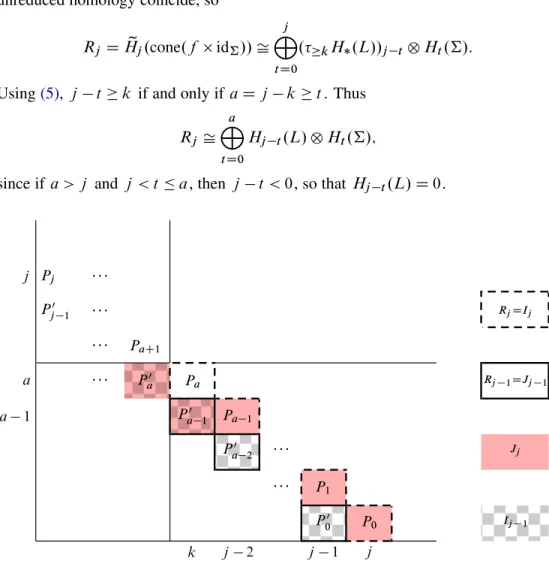
j Pj P0 j 1 a a 1 PaC1 Pa0 Pa Pa 10 k Pa 1 Pa 20 j 2 P1 P0 0 j 1 P0 j RjDIj Rj 1DJj 1 Jj Ij 1
In degree 0, we find
R0DR˚ zH0.cone.f id†//ŠR˚ .kH.L//0˝H0.†/
and .kH.L//0D0for k>0, whereas .kH.L//0DH0.L/ fork0.
With sDdim†, we have sC1Dn lDc and thus according to(1), IHxq.cı†/Š<s qx.sC1/H.†/DaH.†/
for
s 1 xq.sC1/Ds 1 xq.c/Dn l 2 .n 2 px.lC1/ j/Da: Consequently by the Künneth formula(3)for intersection homology,
Ij Š.H.L/˝IHqx.cı†//j Š.H.L/˝aH.†//j D a M tD0 Hj t.L/˝Ht.†/; Ij 1Š.H.L/˝IHqx.cı†//j 1 Š.H.L/˝aH.†//j 1D a M tD0 Hj 1 t.L/˝Ht.†/: Similarly for qx0, Jj Š.H.L/˝IHxq 0 .cı†//j Š.H.L/˝a 1H.†//j D a 1 M tD0 Hj t.L/˝Ht.†/; Jj 1Š.H.L/˝IHxq 0 .cı†//j 1Š a 1 M tD0 Hj 1 t.L/˝Ht.†/:
This concludes the local calculations of groups. We can get a bit of help understanding how these pieces fit together, at least when j¤0, by settingPt DHj t.L/˝Ht.†/
and letting Œj;aW Lj
tD0Pt !
La
tD0Pt be the standard projection if j > a and
the identity if j a. (Recall that when j <a and j <t a, then Pt D0 since
then j t <0 andHj t.L/D0.) Analogously, letPt0DHj 1 t.L/˝Ht.†/ and
define Œj 1;aW Lj 1
tD0Pt0!
La
tD0Pt0 to be the standard projection ifj 1>aand
the identity if j 1a.
We commence the determination of various local maps near the singularities. Let
loc
i W Ii!Ji the canonical map. Using the collar associated to the boundary of the
blowup, the open inclusion L†.0;1/ ,!M induces a map
ˇT
W B!T;
while the open inclusionL†.0;1/ ,!Lcı†induces maps
ˇI WB!I and ˇJWB!J such that (6) B ˇ I // ˇJ I loc J
commutes. The canonical inclusion L† ,!cone.f id†/ induces a map
ˇR WB!R: The diagram Bj ˇI j // Ij Lj tD0Pt Š OO Œj;a// La tD0Pt Š OO
commutes. The vertical isomorphisms are given by the cross product. For j >0, let 'locW Ij !Rj be the unique isomorphism such that
Ij ' loc //Rj La tD0Pt Š OO La tD0Pt Š OO
commutes, usingLemma 5.4. Since Bj ˇR j // Rj Lj tD0Pt Š OO Œj;a// La tD0Pt Š OO
commutes, we know that (7) Bj ˇI j // ˇR j Ij 'loc Š Rj
commutes also. Forj>1, let locW Ij 1!Rj 1be the unique epimorphism such that
Ij 1 loc ////Rj 1 La tD0Pt0 Š OO Œa;a 1 ////La 1 tD0Pt0 Š OO
commutes, usingLemma 5.4. Under the cross product, the commutative diagram Lj 1 tD0Pt0 Œj 1;a // Œj 1;a 1 '' La tD0Pt0 Œa;a 1 La 1 tD0Pt0 corresponds to (8) Bj 1 ˇI j 1 // ˇR j 1 ## Ij 1 loc Rj 1
and therefore this also commutes. For any j, the diagrams
Ij loc j // Jj La tD0Pt Š OO Œa;a 1 // La 1 tD0Pt Š OO and Ij 1 loc j 1 //Jj 1 La tD0Pt0 Š OO Œa;a 1 // La 1 tD0Pt0 Š OO
commute, showing that bothjloc andj 1loc are surjective. For j>1, letRj 1!Jj 1
be the unique isomorphism such that
Rj 1 Š //Jj 1 La 1 tD0Pt0 Š OO La 1 tD0Pt0 Š OO
commutes. Then, since loc and j 1loc are both under the Künneth isomorphism given by the projection Œa;a 1, the diagram
(9) Ij 1 loc j 1 //// loc #### Jj 1 Rj 1 Š ;; commutes (j>1).
Lemma 5.5 Whenj >1, the identity kerˇj 1J Dkerˇj 1R holds inBj 1.
Proof By diagram(9), in the casej >1 there is an isomorphismW Rj 1!Jj 1
such that locDj 1loc . According to diagram(8), ˇj 1R D locˇj 1I . Furthermore, ˇJ j 1Dj 1loc ˇ I j 1 by diagram(6). Hence ˇ R j 1.x/D locˇ I j 1.x/ vanishes if and only if locˇj 1.I x/Dj 1ˇloc j 1.I x/Dˇj 1.J x/ vanishes.
This concludes our investigation of local maps.
We move on to global arguments. The open cover CT.X/DM [.Lcı†/ with M \.Lcı†/DL†.0;1/'L† yields a Mayer–Vietoris sequence for intersection homology
Bj ˇ!j Tj˚Ij !IHjqx.CT.X// @! Bj 1 ˇj
1
!Tj 1˚Ij 1I
see(2). Similarly, there is such a sequence for perversityqx0: Bj ˇ 0 j !Tj˚Jj 0 !IHjxq0.CT.X// @! B j 1 ˇ 0 j 1 !Tj 1˚Jj 1:
The canonical map from perversity xq to xq0 induces a commutative diagram (10) Bj ˇj // Tj˚Ij // id˚loc j IHjqx.CT.X// @ // Bj 1 ˇj 1// Tj 1˚Ij 1 id˚loc j 1 Bj ˇ0 j // Tj˚Jj 0 //IHqx0 j .CT.X// @ // Bj 1 ˇ0 j 1// Tj 1˚Jj 1 The subset U D..0;1L†/[f1gL†cone.f id†/'cone.f id†/
is open in the intersection space IpxX. The open coverIpxX DM[U withM\UD L†.0;1/'L†yields a Mayer–Vietoris sequence
Bj ˇ 00 j !Tj˚Rj 00 !HIjpx.X/ @! B j 1 ˇ00 j 1 !Tj 1˚Rj 1;
the standard Mayer–Vietoris sequence for singular homology of topological spaces. We shall prove Theorem 1.2first for all j > 1. Using the commutative diagrams (7)and(8), we obtain the following commutative diagram with exact rows:
(11) Bj ˇj // Tj˚Ij // id˚'loc Š IHjxq.CT.X// @ //Bj 1 ˇj 1 // Tj 1˚Ij 1 id˚ loc Bj ˇ00 j // Tj˚Rj 00 // HIpx j .X/ @ // Bj 1 ˇ00 j 1// Tj 1˚Rj 1
There exists a (nonunique) mapW IHjxq.CT.X//!HIjpx.X/which fills in diagram(11) commutatively; see eg[2, Lemma 2.46]. By the four lemma, is a monomorphism. This shows thatHIjpx.X/ contains IHjqx.CT.X// as a subspace. Hence the theorem will follow from:
Proposition 5.6 Ifj >1, there is an isomorphism cokerŠcoker.
Proof Let us determine the cokernel of. LetBbe the restriction of idW Bj 1!Bj 1
to BW kerˇj 1!kerˇj 10 , that is, B is the inclusion kerˇj 1 kerˇj 10 . Let W im ! im0 be obtained by restricting . Applying the snake lemma to the commutative diagram 0 //im // IHjxq.CT.X// @ // kerˇj 1 // B 0 0 //im0 //IHjxq0.CT.X// @ //kerˇj 10 //0
yields an exact sequence
0!ker !ker !kerB!coker !coker !cokerB!0: Since kerBD0, we can extract the short exact sequence
0!coker !coker !cokerB!0: Asjloc is surjective, the diagram
Tj˚Ij //// id˚loc j im Tj˚Jj 0 //// im0
shows that is also surjective and thus coker D0. Therefore, we obtain an isomorphism
coker Š!cokerBDkerˇ
0 j 1 kerˇj 1 D kerˇj 1T \kerˇj 1J kerˇj 1T \kerˇj 1I ; since ˇj 1D.ˇj 1T ; ˇj 1I / andˇj 10 D.ˇj 1T ; ˇj 1J /.
Similarly, we determine the cokernel of. LetB be the restriction of idW Bj 1!Bj 1
to BW kerˇj 1 !kerˇj 100 , that is, B is the inclusion kerˇj 1kerˇj 100 . Let W im !im00 be obtained by restricting . Applying the snake lemma to the commutative diagram 0 //im // IHjqx.CT.X// @ // kerˇj 1 // B 0 0 //im00 //HIjpx.X/ @ // kerˇj 100 //0 yields an exact sequence
0!ker !ker!kerB!coker !coker!cokerB!0: Since kerBD0, we can extract the short exact sequence
As'loc is an isomorphism, the diagram Tj˚Ij //// id˚'loc Š im Tj˚Rj 00 ////im00
shows that is also surjective and thus coker D0. Therefore, we obtain an isomorphism
coker Š!cokerBDkerˇ
00 j 1
kerˇj 1: Asˇj 100 D.ˇj 1T ; ˇj 1R /, we have
kerˇj 100 Dkerˇj 1T \kerˇj 1R : ByLemma 5.5, kerˇj 1J Dkerˇj 1R and hence
cokerŠkerˇ T j 1\kerˇ R j 1 kerˇj 1T \kerˇj 1I D kerˇj 1T \kerˇj 1J
kerˇj 1T \kerˇj 1I Šcoker:
Now assume thatj D1. We need to consider the subcasesk0, kD1 and k>1 separately. We start withk0. In principle, we shall again use a diagram of the shape of(11), but the definition of loc changes. In this case, L<kD¿, cone.f id†/D .L†/C, R0 DR˚.H0.L/˝H0.†//, a1 and I0ŠJ0ŠH0.L/˝H0.†/.
The maps of the commutative diagram B0 ˇI 0 Š // ˇJ 0 Š I0 loc 0 Š J0
are all isomorphisms. The map L† ,! cone.f id†/, which induces ˇR, is the inclusion L† ,!.L†/C and thusˇR0W B0!R0 is the standard inclusion
monomorphism such that B0 ˇI 0 Š // p ˇR 0 "" I0 loc R0
commutes. (Note that for j 2, the map loc was known to be surjective, which is not true here.) Diagram(11)becomes
B1 ˇ1 // T1˚I1 // id˚'loc Š IH1xq.CT.X// @ //B0 ˇ0 // T0˚ _I0 id˚ loc B1 ˇ00 1 // T1˚R1 00 //HIpx 1.X/ @ // B0 ˇ00 0 // T0˚R0
There exists a (nonunique) mapWIH1qx.CT.X//!HI1px.X/which fills in the diagram commutatively. By the five lemma, is an isomorphism. To establish the theorem, it remains to be shown that coker vanishes. Since diagram(10)is available for any j, the argument given in the proof ofProposition 5.6still applies to give an isomorphism
coker Škerˇ 0 0 kerˇ0 D kerˇT0 \kerˇ0J kerˇT0 \kerˇ0I:
Since ˇ0I and ˇ0J are isomorphisms, we deduce that coker D0, as was to be shown. This concludes the case k0.
We proceed to the case kD1 (andj D1). ByLemma 5.4, R0DR, generated by the
cone vertex. We haveaD0and thus stillI0DH0.L/˝H0.†/, butJ0D0. Therefore,
kerˇJ0 DB0. The mapˇ0RW B0!R0 can be identified with the augmentation map W B0!R, a surjection. Let locW I0!R0 be the unique epimorphism such that
B0 ˇI 0 Š // DˇR0 !!!! I0 loc R0DR
commutes. There exists a map filling in diagram(11)commutatively. Such a is then injective. Using arguments from the proof ofProposition 5.6, we have
coker Škerˇ
T
0 \kerˇ J 0
kerˇT0 \kerˇI0 Dkerˇ
T
and
cokerŠkerˇT0 \kerˇ0RDkerˇ0T\ker: We recall from elementary algebraic topology:
Lemma 5.7 IfA andB are topological spaces andhWA!B is a continuous map, then the diagram
H0.A/ h // %% H0.B/ R commutes. In particular, kerhker.W H0.A/!R/. Applying this lemma tohDˇ0T, we have kerˇ
T
0 kerand thus cokerŠkerˇ T
0 Š
coker. This concludes the proof in the case kD1.
When k>1 (andj D1), then R0DR (Lemma 5.4),a<0, and I0DJ0D0. As
in the case kD1, the map ˇR0W B0!R0 can be identified with the augmentation
epimorphism W B0!R, but this time, there does not exist a map loc such that
locˇI 0 Dˇ
R
0 . We must therefore argue differently. By exactness and sinceˇ I 0 D0,
im.@W IH1qx.CT.X//!B0/Dker.ˇ0T; ˇ0I/Dkerˇ0T: Also,
im.@W HI1px.X/!B0/Dker.ˇT0; ˇ0R/Dkerˇ0T \ker: ByLemma 5.7, kerˇT0 ker and hence
im.@W IH1qx.CT.X//!B0/Dim.@W HI1px.X/!B0/: For the diagram
B1 ˇ 1 // T1˚I1 // id˚'loc Š IH1qx.CT.X// @ // im@ //0 B1 ˇ00 1 // T1˚R1 00 //HIpx 1.X/ @ // im@ //0
there exists a (nonunique) mapW IH1qx.CT.X//!HI1px.X/which fills in the diagram commutatively. By the five lemma, is an isomorphism. The cokernel of,
coker Škerˇ T 0 \kerˇ J 0 kerˇT0 \kerˇI0 D kerˇ0T\B0 kerˇ0T\B0 D0;
vanishes and thus the theorem holds in this case as well. This finishes the proof for j D1.
It remains to establishTheorem 1.2forj D0. We shall writeBz, Tz and Rz for the reduced homology groups. We have aD k,
I0Š H0.L/˝H0.†/ ifk0; 0 ifk>0; and byLemma 5.4, z R0Š H0.L/˝H0.†/ ifk0; 0 ifk>0:
ThusI0 andRz0 are abstractly isomorphic. Recall that for a topological space A, the
reduced homology Hz0.A/ is the kernel of the augmentation mapW H0.A/!R, so that there is a short exact sequence
0! zH0.A/! H0.A/! R!0:
Let ˇz0RW zB0! zR0 be the map induced by ˇR0 between the kernels of the respective
augmentation maps. Ifk0, thenL<k D¿and the exact sequence
H0.L<k†/!H0.L†/! zR0!0
shows thatB0! zR0 is an isomorphism. Since the composition
z
B0,! B0 Š! zR0
is ˇz0R, we deduce that ˇz0R is injective for k 0. Inverting ˇzR0 on its image and composing with ˇ0I, then extending to an isomorphism using dimI0DdimRz0, we
obtain a (nonunique) isomorphism W zR0!I0 such that
(12) z B0 z ˇR 0 // _ z R0 B0 ˇI 0 // I0
commutes. When k>0, let W zR0!I0 be the zero map (an isomorphism). Then
diagram(12)commutes also in this case. As for the above open coverIpxX DM[U, the intersection M\U DL†.0;1/ is not empty, so there is a Mayer–Vietoris sequence on reduced homology:
z B0 ˇ 00 0 ! zT0˚ zR0 00 ! zHI0px.X/!0:
Using , we get the following commutative diagram with exact rows: z B0 z ˇ00 0 // _ z T0˚ zR0 00 // _ ˚ z HI0px.X/ //0 B0 ˇ 0 // T0˚I0 //IH0qx.CT.X// //0
From this we infer that z
HI0px.X/Šcokerˇz000 and IH0xq.CT.X//Šcokerˇ0:
Let T0˚I0!Rbe the composition of the standard projection T0˚I0!T0 with
the augmentation WT0!R. Applying the snake lemma to the commutative diagram
0 //Bz0 // z ˇ00 0 B0 // ˇ0 R //0 0 //Tz0˚ zR0 ˚ //T0˚I0 //R //0
we arrive at the exact sequence
0!kerˇz000!kerˇ0!ker idR!cokerˇz000!cokerˇ0!coker idR!0: As ker idRD0and coker idRD0, we obtain an isomorphism cokerˇz000Šcokerˇ0, ie
z
HI0px.X/ŠIH0qx.CT.X//. It remains to show thatW IH0qx.CT.X//!IH0qx0.CT.X// is surjective. This follows from the surjectivity of 0loc and diagram(10).
5.1 Example
We may consider the following example to illustrateTheorem 1.2. Consider the two-sphere, as a stratified space, thought of as the suspension of S1. So the two poles are the “singular” stratum, with linkLDS1, and we will denote these by˙pt. Now take X DS2T2 with the induced stratification, †D f˙ptg T2X. The codimension of † inX is 2, and any standard perversity takes px.2/D0. We will first calculate H.IpxX/. Let M DX N.†/, where N is an open normal neighborhood of †. Note that @M ŠS1 f˙ptg T2. The cutoff degree here is kD1 px.2/D1, so IpxXDM[gc.L<1T2/, whereL<1LDS1. For any path connected space,L<1
is just a point e0 in the space. Thusg is the inclusion mapgW e0 f˙ptg T2,!M. The reduced homology is given by
z
Then using the relative exact sequence on homology, we can calculate this as z HIipx.X/Š 8 < : 0 ifiD0or4; R2 ifiD1or3; R4 ifiD2;
Theorem 1.2states that there is a relationship between the HIz ipx.X/ we just calculated and intersection homology groups for CT.X/. The conifold transition ofX is CT.X/D
..T2I/=.T2@I//S1, whose normalization is the suspension of T2 times S1, that is,
e
CT.X/ DS.T2/S1. This has singular stratum B D f˙ptg S1 with link F DT2, so the codimension of B is 3. This means there are two possible standard perversities mS (lower middle) and xn (upper middle), wheremS.3/D0 and xn.3/D1. By[20, Theorem 4.2]and[19, Lemma C.1], the intersection homology does not change under normalization and thus IHxq.CT.X//ŠIHxq.
e
CT.X//. The intersection homology groups ofe
CT.X/for the perversities mSand xnare calculated in[2, page 79], which also indicates the generators of the classes.In order to illustrate Theorem 1.2, we also need to understand IHqx.CT.X// when x
q is an extended perversity, as in [18], and we need to understand the maps be-tween consecutive perversity intersection homology groups to calculate the groups IG.k/.CT.X//. By Proposition 4.1, IHqx.CT.X// D H.M/ for xq.3/ < 0 and IHxq.CT.X//DH.M; @M/forqx.3/2. Ifxq.3/ <xq0.3/, then there is a natural map
IHxq.CT.X//!IHxq0.CT.X//;
since any cycle satisfying the more restrictive condition given by xq will in particular also satisfy the less restrictive condition given by qx0. This is the map that appears in the definition of IG.k/.CT.X//. Now we can createTable 1, which will allow us to calculate these groups.
jn xq.3/ 1 ! 0 ! 1 ! 2 0 R Š R Š R !0 0 1 R3 Š R3 R !0 R 2 R3 R2 !0 R2 ,! R3 3 R !0 R ,! R3 Š R3 4 0 !0 R Š R Š R Table 1: IHjxq.CT.X//
We get, for example, IG1.2/.CT.X//ŠIH1qx.3/D1.CT.X//˚ IH x q0.3/D2 1 .CT.X// im IH1qx.3/D1.CT.X//!H1xq0.3/D2.CT.X// ŠR˚R 0 ŠR2:
Collecting the relevant results, and recalling that px.2/D0, we get IG0.3/.CT.X//Š0; IG1.2/.CT.X//ŠR2; IG2.1/.CT.X//ŠR4; IG3.0/.CT.X//ŠR2; IG4. 1/.CT.X//Š0: Thus z HIjpx.X/ŠIGj.3 j/.CT.X//; where we see3Dn 1C xp.2/, as inTheorem 1.2.
6 De Rham cohomology for
IH
and
HI
6.1 Extended perversities and the de Rham complex for IH
Let W be a pseudomanifold with one connected smooth singular stratum BW of codimension c and with link F of dimension f Dc 1. (In what follows, we will takeW DCT.X/, soBDL and FD†.) Then the only part of the perversity which affects IHpx.W/is the valuepx.c/. Thus, in this special case, we can simplify notation by labelling the intersection cohomology groups by a number p that depends only on the value px.c/, rather than by the whole function px. Further, we will fix notation such that the Poincaré lemma for a cone has the form
(13) IH.jq/.cıF/D
Hj.F/ ifj <q;
0 ifj q:
That is, theqwe use in the notation IH.jq/.W/gives the cutoff degree in the local coho-mology calculation on the link. The de Rham theorem for intersection cohocoho-mology[11]
states that in this situation,
IH.c 1 px.c//.W/ŠHom.IHpx.W/;R/:
Standard perversities satisfy 0 xp.c/c 2, so in terms of the convention we have introduced, this gives 0 <q c 1. We use an extension of these definitions in which q 2R. This does not give anything dramatically new; when q0, we get H.M; @M/, where M ŠW N forN an open tubular neighborhood of B. When q>c 1 we get H.M/. It is also worth recording that when W has an isolated conical singularity BDpt with link F, we get globally the isomorphisms
IH.jq/.W/D 8 < : Hj.M/ ifj <q; im.Hj.M; @M/!Hj.M// ifj Dq; Hj.M; @M/ ifj >q; where in this case@M ŠF.
In order to proveTheorem 1.3from the de Rham perspective, we need to use compatible de Rham complexes to define these cohomologies. Various complexes have been shown to calculate intersection cohomology of a pseudomanifold. We will present first a version of the de Rham complex from[11], adapted to our setting.
We use the notation from Section 2, and in particular let W DCT.X/ have an l– dimensional smooth singular stratumLwith link†, a smooths–dimensional manifold, and product link bundleYŠL†. Note thatsC1DcodimL. From the isomorphism Y ŠL†, we have that TY ŠTL˚T†. This induces a bundle splitting
ƒk.
TY/Š M
iCjDk ƒi.
TL/˝ƒj.T†/:
We write k.Y/D1.YIƒk.TY// for the space of smooth differential k–forms on Y, and we writeƒi;jY Dƒi.TL/˝ƒj.T†/ andi;j.Y/D1.YIƒi;jY/. Then also we obtain a splitting of the space of smooth sections,
k. Y/Š M iCjDk i;j. Y/; ˛DX i;j ˛i;j;
as C1.Y/–modules. For q2Z, define the fibrewise (along †) truncated space of forms over Y by .ft<q.Y//kWD ˛2k.Y/ ˇ ˇ ˇ˛D q 1 X jD0 ˛k j;j :
Note that ft<q.Y/ is not a complex in general. Then define the complex
(14) I.q/.CT.X//
WD f!2.M/jinc!2ft<q.Y/and inc.d!/2ft<q.Y/g:
(Recall that incW Y D@M ,!M is the inclusion of the boundary.) The cohomology of this complex isIH.q/.CT.X//, as shown in eg[11]. We note that there is an inclusion of complexes,
Sq;qC1W I.q/.CT.X// ,!I.qC1/.CT.X//:
This induces a natural map on cohomology, which however is generally neither injective nor surjective. We will come back to this map later.
6.2 Extended perversities and the de Rham complex for HI
In this subsection, we present the de Rham complex defined in[4], which computes the reduced singular cohomology of intersection spaces. Let L be oriented and equipped with a Riemannian metric. For flat link bundles E!† whose link can be given a Riemannian metric such that the transition functions are isometries, the first author defined in [4] a subcomplex MS.†/ .E/, the complex of multiplicatively structured forms. In the present special case of EDY DL†, this subcomplex is
MS.†/D !2.Y/ ˇ ˇ ˇ!D X i;j Li^†j ;
where the sum here is finite, andi 2.L/ and j 2.†/. We may also write this as
MS.†/Š.L/˝.†/:
Let k be any integer. The level-k cotruncation of the complex.L/is defined in loc. cit. as the subcomplex k.L/.L/ given in degreem by
.k.L//mD 8 < : 0 ifm<k; kerıL ifmDk; m.L/ ifm>k;
using the codifferentialıL on.L/. Note thatk.L/D.L/fork0, while k.L/D0 for k >l. The subcomplex ftkMS.†/MS.†/ offibrewise
(alongL) cotruncated formsis given in degree m by .ftkMS.†// m D !2m.Y/ ˇ ˇ ˇ!D X i;j Li^†j; i 2k.L/ : TakingkDl px.lC1/, we set HIdR;px.X/WDH.Ipx.M//; where Ipx.M/WD f!2.M/j!jN †DY; 2ftl px.lC1/MS.†/g: (Recall fromSection 2 that N is an open tubular neighborhood of † with a fixed diffeomorphism N † ŠL†.0;1/ and YW N † !Y DL† is the projection.) The Poincaré duality theorem of[4]asserts that if pxand qxare comple-mentary perversities, then wedge product of forms followed by integration induces a nondegenerate bilinear form
HIdR;p.x X/HIdRn ;qx.X/!R; .Œ!; Œ/7! Z
X †!^;
when X is compact and oriented. (This is shown not just for trivial link bundles, but for any flat link bundle whose transition functions are isometries of the link.) Furthermore, using a certain partial smoothing technique that we shall sketch below, the de Rham theorem of[4]for isolated singularities and its generalization to nonisolated singularities with trivial link bundle due to Essig[16, Theorem 3.4.1]asserts that (15) HIdR; px.X/ŠHom.Hz.IpxXIR/;R/:
This isomorphism is constructed as follows: For a topological space Z, let C.Z/ denote its singular chain complex with real coefficients. For a smooth manifold V (which is allowed to have a boundary), letC1.V/denote its smooth singular chain complex with real coefficients, generated by smooth singular simplices j !V. For a continuous map gW Z!V, the first author defined in[4]thepartially smooth chain complex C/.g/. In degreej,
Cj/.g/DHj 1.Z/˚Cj1.V/:
LetW C1.V/,!C.V/be the inclusion andsWC.V/!C1.V/be Lee’s smoothing operator[29, pages 416–424]. The map s is a chain map such that sıis the identity and ıs is chain homotopic to the identity. Thus s and induce mutually inverse
isomorphisms on homology. If V has a nonempty boundary @V, then we can assume thats has been arranged so that the square
C.@V/ s //
C1.@V/
C.V/ s //C1.V/
commutes. Let Zj denote the subspace ofj–cycles in Cj.Z/ andBj [email protected]/
the subspace of j–boundaries. Choosing direct sum decompositions Zj DBj ˚Hj0,
we obtain a quasi-isomorphismqW H.Z/DH.C.Z//!C.Z/, which is given in degreej by the composition
Hj.Z/D Zj Bj D Bj˚Hj0 Bj Š!H0 j ,!Zj ,!Cj.Z/:
Here, we regardH.Z/as a chain complex with zero boundary operators. By construc-tion, the formula Œq.z/Dz holds for a homology classz2Hj.Z/. Letz2Hj 1.Z/
be a homology class in Z andvW j !V be a smooth singular simplexv2Cj1.V/. The boundary operator@W Cj/.g/!Cj 1/ .g/is defined to be
@.z; v/D.0; @vCsgq.z//;
where gW Cj 1.Z/!Cj 1.V/ is the chain map induced by g. By Proposition 9.2 of[4], the partially smooth chain complex C/.g/ is naturally quasi-isomorphic to the algebraic mapping cone C.g/ ofg. Applying this to the map gW L<k†!M,
we get an identification
H.C/.g//ŠH.C.g//D zH.cone.g//D zH.IpxX/: A map
‰xpW Hj.Ipx.M//!Hom.Hj.C/.g//;R/
is given by ‰pŒ!Œ.x z; v/DR
v!, where!2Ipxj.M/ is a closed form and .z; v/2
Cj/.g/is a cycle. (See[4, page 48]. Note that ! has a unique extension to a closed form on M; see alsoSection 6.3.) Then the isomorphism(15)is the composition
HIdR; px.X/‰px
!Hom.H.C/.g//;R/ŠHom.Hz.IpxX/;R/:
This construction, as well as the argument showing the map to be an isomorphism, does not require any assumptions on the cutoff degree k 2Z, and thus works even for extended perversities px. We can create a notation for HIdR;px that emphasises
the cutoff degree instead of the perversity in a similar vein to the notation we fixed for IHpx.X/in the previous section. With kDl px.lC1/, we simply write
HI.k/.X/WDHIdR;p.x X/:
Since the only value of px to make a difference in the right side of this equation is x
p.lC1/, no ambiguity arises from replacing the function pxby the numberk, where now k is giving the cutoff degree in the local calculation on the link.
We observe two useful lemmas about the cohomology of the complex Ipx.M/. The first one is a generalized Mayer–Vietoris sequence.
Lemma 6.1 There is a long exact sequence of de Rham cohomology groups as follows: !HI.jk/.X/!Hj.M/˚Hj.ftkMS.†//!H
j.@M/
! : In particular, since@M DL†, the second summand of the middle term is isomorphic to
l
M
iDk
Hi.L/˝Hj i.†/:
Proof LetkDl px.lC1/. By definition ofIpx.M/, we have a short exact sequence of complexes
0!Ipx.M/!.M/˚ftkMS.†/!.N †/!0;
where the second map takes a pair .!; / to !jN † Y, and the first map takes ! 2Ipx.M/ with !jN † DY to .!; /. This sequence induces a long exact
sequence on cohomology isomorphic to the one above. The form of the second summand comes from the definition of cotruncation and of multiplicatively structured forms. The isomorphism of the third term comes from the standard de Rham Künneth isomorphism Hj.@M/Š[email protected];1// and the diffeomorphismN †Š@M.0;1/. Lemma 6.2 (Künneth for HI) If W is a pseudomanifold with only one isolated singularity and B is a closed manifold, then the homological cross product induces an isomorphism HIz px.W B/Š zHIpx.W/˝H.B/.
Proof Let W be the blowup ofW. SetkDl px.lC1/, where l is the dimension of the link LD@W, and let fW L<k !L be a stage-k Moore approximation toL.
ThenIpxW Dcone.g/, whereg is the composition L<k!f LD@W ,!W:
The blowup M of X DW B is M DW B with boundary @M DLB. The intersection space of X is then IpxX Dcone.gidB/ because gidB is the
composition
L<kB fidB!LBD@M ,!M DW B:
Let v2cone.g/ be the cone vertex and letQD.cone.g/B/=.fvg B/, which is homeomorphic to cone.gidB/. As the inclusionfvg B!cone.g/B is a closed
cofibration, the quotient map induces an isomorphism H .cone.g/;fvg/B
DH.cone.g/B;fvgB/Š zH.Q/Š zH.cone.gidB//: The Künneth theorem for relative homology[34, Theorem 5.3.10, page 235]asserts that the cross product
H.cone.g/;fvg/˝H.B/ !H .cone.g/;fvg/B is an isomorphism. Composing, we obtain an isomorphism
z
HIpx.W B/D zH.cone.gidB//ŠH .cone.g/;fvg/B Š zH.cone.g//˝H.B/D zHIpx.W/˝H.B/:
Lemma 6.3 (Künneth for HIdR ) Let W be a pseudomanifold with only one isolated singularity and B be a smooth closed manifold such that HIz px.W/ and H.B/ are finite-dimensional. ThenHIdR; px.W B/ŠHIdR; px.W/˝H.B/.
Proof The homology groupsHIz px.W/andH.B/ are finite-dimensional by assump-tion, and thus the natural map
Hom.HIz px.W/;R/˝Hom.H.B/;R/!Hom.HIz px.W/˝H.B/;R˝R/ is an isomorphism. Thus, byLemma 6.2and the de Rham isomorphism(15),
HIdR; px.W B/ŠHom.HIz px.W B/;R/ ŠHom.HIz px.W/˝H.B/;R/
ŠHom.HIz px.W/;R/˝Hom.H.B/;R/ ŠHIdR;px.W/˝H.B/:
Using these lemmas, we may also computeHI.k/.X/for values of extended perversities that lie outside of the topologically invariant range of Goresky–MacPherson, as follows:
For standard perversities, 1kl. If k0, thenk.L/D.L/ and thus the
sequence ofLemma 6.1becomes
!HI.jk/.X/! Hj.M/˚Hj.MS.†//!Hj.@M/! :
The map has the form D M Y, where MW Hj.M/!Hj.@M/is restric-tion and YW Hj.MS.†//!Hj.@M/ is induced by the inclusion of complexes. Since Y is in the present case an isomorphism, the map is surjective and thus is injective. Now
imDker D f.!; /j M.!/D Y./g D f.!; Y1 M.!//g;
which is isomorphic toH.M/. We conclude thatHI.k/.X/ŠH.M/ whenk0. On the other hand, ifk>l, thenk.L/D0 and hence the sequence ofLemma 6.1
becomes
!HI.jk/.X/!Hj.M/!Hj.@M/! :
Therefore,HI.k/.X/ŠH.M; @M/ whenk>l. In particular, Poincaré duality also works for these extended perversities, since relative and absolute (co)homology pair nondegenerately under the standard intersection pairing.
6.3 An alternative de Rham complex for HI
We continue to assume that L is oriented. We now want to define a new, equivalent de Rham complex forHI.k/.X/that is analogous to the de Rham complex we presented above for IH.q/.CT.X//. In order to do this, we need to extend the operatorıL from multiplicatively structured forms on Y to all smooth forms on Y. This is standard, but we give details here for clarity. First, we can decompose the exterior derivative according to the splitting of Y as
dY D zdLC. 1/rdz†
for .r;/–forms, where forzD.z1; : : : ;zl/ local coordinates on a coordinate patch
U L and y D.y1; : : : ;ys/ local coordinates on a coordinate patch V † and multi-indices I andJ, z dL.f .z;y/dzI ^dyJ/WD l X iD1 @f @zi dzi^dzI ^dyJ; z d†.f .z;y/dzI ^dyJ/WD s X jD1 @f @yj dzI ^dyj^dyJ:
Note dzL.L^†/DL.dL/^† and dz†.L^†/DL^†.d†/,
so these operators extend the exterior derivatives on multiplicatively structured forms to operators over all smooth forms on Y.
Now fix a metric gL onL. This defines a Hodge star operator on .L/, which may
be extended to forms on Y via the rule z
L.dzI^dyJ/WD.LdzI/^dyJ:
We can extend the adjoint operator ofdLto forms on Y by setting for.i;j/–forms that
z
ıLWD. 1/liClC1zLdzLzL:
Note that this does extend the adjoint operator from multiplicatively structured forms. From the coordinate definitions and the invariance ofgLin theV coordinates, observe
(16) dzLdz†D zd†dzL; dz†zLD zLdz†; and dz†ıLz D zıLdz†:
Further, we can lift the Hodge decomposition for.L/to any neighborhood LV by observing that for any fixed y 2V, we have a decomposition of!2i;j.LV/ given by
!D X
jJjDj
J.y/^dyJ;
where eachJ.y/2i.L/ decomposes asdL1;J.y/CıL2;J.y/C3;J.y/, with 3;J.y/2Hi.L/. Here, H.L/ denotes the space of harmonic forms onL. Thus
altogether we can decompose (17) !D X jJjDj dL1;J.y/^dyJC X jJjDj ıL2;J.y/^dyJC X jJjDj 3;J.y/^dyJ D zdL X jJjDj 1;J.y/^dyJC zıL X jJjDj 2;J.y/^dyJC X jJjDj 3;J.y/^dyJ D zdL!1.y/C zıL!2.y/C!3.y/:
Now putting this together for all y2V, we get a unique decomposition of any form in i;j.LV/ into pieces in the image of dzL, in the image of zıL and in the kernel
of both.
Lemma 6.4 We have the decomposition
i;jY
D zdLi 1;j.Y/˚ zıLiC1;j.Y/˚.Hi.L/˝j.†//;