D E C E M B E R 1 9 9 5
WRL
Research Report 95/9
Memory Consistency
Models for
Shared-Memory
Multiprocessors
The Western Research Laboratory (WRL) is a computer systems research group that
was founded by Digital Equipment Corporation in 1982. Our focus is computer science
research relevant to the design and application of high performance scientific computers.
We test our ideas by designing, building, and using real systems. The systems we build
are research prototypes; they are not intended to become products.
There are two other research laboratories located in Palo Alto, the Network Systems
Lab (NSL) and the Systems Research Center (SRC). Another Digital research group is
located in Cambridge, Massachusetts (CRL).
Our research is directed towards mainstream high-performance computer systems. Our
prototypes are intended to foreshadow the future computing environments used by many
Digital customers. The long-term goal of WRL is to aid and accelerate the development
of high-performance uni- and multi-processors. The research projects within WRL will
address various aspects of high-performance computing.
We believe that significant advances in computer systems do not come from any single
technological advance. Technologies, both hardware and software, do not all advance at
the same pace. System design is the art of composing systems which use each level of
technology in an appropriate balance. A major advance in overall system performance
will require reexamination of all aspects of the system.
We do work in the design, fabrication and packaging of hardware; language processing
and scaling issues in system software design; and the exploration of new applications
areas that are opening up with the advent of higher performance systems. Researchers at
WRL cooperate closely and move freely among the various levels of system design. This
allows us to explore a wide range of tradeoffs to meet system goals.
We publish the results of our work in a variety of journals, conferences, research
reports, and technical notes. This document is a research report. Research reports are
normally accounts of completed research and may include material from earlier technical
notes. We use technical notes for rapid distribution of technical material; usually this
represents research in progress.
Research reports and technical notes may be ordered from us. You may mail your
order to:
Technical Report Distribution
DEC Western Research Laboratory, WRL-2
250 University Avenue
Palo Alto, California 94301 USA
Reports and technical notes may also be ordered by electronic mail. Use one of the
fol-lowing addresses:
Digital E-net:
JOVE::WRL-TECHREPORTS
Internet:
[email protected]
UUCP:
decpa!wrl-techreports
To obtain more details on ordering by electronic mail, send a message to one of these
addresses with the word ‘‘
help
’’ in the Subject line; you will receive detailed
instruc-tions.
Reports and technical notes may also be accessed via the World Wide Web:
Memory Consistency Models for
Shared-Memory Multiprocessors
*
Kourosh Gharachorloo
December 1995
Also published as Stanford University Technical Report CSL-TR-95-685.
*This report is the author’s Ph.D. dissertation from Stanford
University. In addition to Digital Equipment’s support, the author was
Abstract
The memory consistency model for a shared-memory multiprocessor specifies
the behavior of memory with respect to read and write operations from multiple
processors. As such, the memory model influences many aspects of system
design, including the design of programming languages, compilers, and the
under-lying hardware. Relaxed models that impose fewer memory ordering constraints
offer the potential for higher performance by allowing hardware and software to
overlap and reorder memory operations. However, fewer ordering guarantees can
compromise programmability and portability. Many of the previously proposed
models either fail to provide reasonable programming semantics or are biased
toward programming ease at the cost of sacrificing performance. Furthermore,
the lack of consensus on an acceptable model hinders software portability across
different systems.
This dissertation focuses on providing a balanced solution that directly
ad-dresses the trade-off between programming ease and performance. To address
programmability, we propose an alternative method for specifying memory
be-havior that presents a higher level abstraction to the programmer. We show that
with only a few types of information supplied by the programmer, an
implemen-tation can exploit the full range of optimizations enabled by previous models.
Furthermore, the same information enables automatic and efficient portability
across a wide range of implementations.
To expose the optimizations enabled by a model, we have developed a formal
framework for specifying the low-level ordering constraints that must be enforced
by an implementation. Based on these specifications, we present a wide range of
architecture and compiler implementation techniques for efficiently supporting a
given model. Finally, we evaluate the performance benefits of exploiting relaxed
models based on detailed simulations of realistic parallel applications. Our results
show that the optimizations enabled by relaxed models are extremely effective in
hiding virtually the full latency of writes in architectures with blocking reads (i.e.,
processor stalls on reads), with gains as high as 80%. Architectures with
non-blocking reads can further exploit relaxed models to hide a substantial fraction of
the read latency as well, leading to a larger overall performance benefit.
Further-more, these optimizations complement gains from other latency hiding techniques
such as prefetching and multiple contexts.
Acknowledgements
Many thanks go to my advisors John Hennessy and Anoop Gupta for their continued guidance, support,
and encouragement. John Hennessy’s vision and enthusiasm have served as an inspiration since my early
graduate days at Stanford. He has been a great source of insight and an excellent sounding board for ideas.
His leadership was instrumental in the conception of the DASH project which provided a great infrastructure
for multiprocessor research at Stanford. Anoop Gupta encouraged me to pursue my early ideas on memory
consistency models. I am grateful for the tremendous time, energy, and wisdom that he invested in steering
my research. He has been an excellent role model through his dedication to quality research. I also thank
James Plummer for graciously serving as my orals committee chairman and my third reader.
I was fortunate to be among great friends and colleagues at Stanford. In particular, I would like to thank
the other members of the DASH project, especially Jim Laudon, Dan Lenoski, and Wolf-Dietrich Weber,
for making the DASH project an exciting experience. I thank the following people for providing the base
simulation tools for my studies: Steve Goldschmidt for TangoLite, Todd Mowry for Dixie, and Mike Johnson
for the dynamic scheduled processor simulator. Charles Orgish, Laura Schrager, and Thoi Nguyen at Stanford,
and Annie Warren and Jason Wold at Digital, were instrumental in supporting the computing environment.
I also thank Margaret Rowland and Darlene Hadding for their administrative support. I thank Vivek Sarkar
for serving as a mentor during my first year at Stanford. Rohit Chandra, Dan Scales, and Ravi Soundararajan
get special thanks for their help in proof reading the final version of the thesis. Finally, I am grateful to my
friends and office mates, Paul Calder, Rohit Chandra, Jaswinder Pal Singh, and Mike Smith, who made my
time at Stanford most enjoyable.
My research on memory consistency models has been enriched through collaborations with Phil Gibbons
and Sarita Adve. I have also enjoyed working with Andreas Nowatzyk on the Sparc V9 RMO model, and
with Jim Horning, Jim Saxe, and Yuan Yu on the Digital Alpha memory model.
I thank Digital Equipment Corporation, the Western Research Laboratory, and especially Joel Bartlett and
Richard Swan, for giving me the freedom to continue my work in this area after joining Digital. The work
presented in this thesis represents a substantial extension to my earlier work at Stanford.
I would like to thank my friends and relatives, Ali, Farima, Hadi, Hooman, Illah, Rohit, Sapideh, Shahin,
Shahrzad, Shervin, Siamak, Siavosh, and Sina, who have made these past years so enjoyable. Finally, I thank
my family, my parents and brother, for their immeasurable love, encouragement, and support of my education.
To my parents Nezhat and Vali
Contents
Acknowledgements i
1 Introduction 1
1.1 The Problem
: : : : : : : : : : : : : : : : : : : : : : : : : : : : : : : : : : : : : : : : :
2 1.2 Our Approach: : : : : : : : : : : : : : : : : : : : : : : : : : : : : : : : : : : : : : : :
3 1.2.1 Programming Ease and Portability: : : : : : : : : : : : : : : : : : : : : : : : : :
4 1.2.2 Implementation Issues: : : : : : : : : : : : : : : : : : : : : : : : : : : : : : : :
4 1.2.3 Performance Evaluation: : : : : : : : : : : : : : : : : : : : : : : : : : : : : : :
4 1.3 Contributions: : : : : : : : : : : : : : : : : : : : : : : : : : : : : : : : : : : : : : : : :
5 1.4 Organization: : : : : : : : : : : : : : : : : : : : : : : : : : : : : : : : : : : : : : : : :
52 Background 7
2.4.4 Relaxing the Write to Write Program Order
: : : : : : : : : : : : : : : : : : : : :
31 2.4.5 Relaxing the Read to Read and Read to Write Program Order: : : : : : : : : : : :
31 2.4.6 Impact of Relaxed Models on Compiler Optimizations: : : : : : : : : : : : : : :
38 2.4.7 Relationship among the Models: : : : : : : : : : : : : : : : : : : : : : : : : : :
39 2.4.8 Some Shortcomings of Relaxed Models: : : : : : : : : : : : : : : : : : : : : : :
39 2.5 How to Evaluate a Memory Model?: : : : : : : : : : : : : : : : : : : : : : : : : : : : :
40 2.5.1 Identifying the Target Environment: : : : : : : : : : : : : : : : : : : : : : : : :
40 2.5.2 Programming Ease and Performance: : : : : : : : : : : : : : : : : : : : : : : : :
41 2.5.3 Enhancing Programming Ease: : : : : : : : : : : : : : : : : : : : : : : : : : : :
42 2.6 Related Concepts: : : : : : : : : : : : : : : : : : : : : : : : : : : : : : : : : : : : : : :
43 2.7 Summary: : : : : : : : : : : : : : : : : : : : : : : : : : : : : : : : : : : : : : : : : : :
443 Approach for Programming Simplicity 45
3.1 Overview of Programmer-Centric Models
: : : : : : : : : : : : : : : : : : : : : : : : : :
45 3.2 A Hierarchy of Programmer-Centric Models: : : : : : : : : : : : : : : : : : : : : : : : :
47 3.2.1 Properly-Labeled Model—Level One (PL1): : : : : : : : : : : : : : : : : : : : :
48 3.2.2 Properly-Labeled Model—Level Two (PL2): : : : : : : : : : : : : : : : : : : : :
52 3.2.3 Properly-Labeled Model—Level Three (PL3): : : : : : : : : : : : : : : : : : : :
55 3.2.4 Relationship among the Properly-Labeled Models: : : : : : : : : : : : : : : : : :
60 3.3 Relating Programmer-Centric and System-Centric Models: : : : : : : : : : : : : : : : : :
61 3.4 Benefits of Using Properly-Labeled Models: : : : : : : : : : : : : : : : : : : : : : : : :
63 3.5 How to Obtain Information about Memory Operations: : : : : : : : : : : : : : : : : : : :
65 3.5.1 Who Provides the Information: : : : : : : : : : : : : : : : : : : : : : : : : : : :
65 3.5.2 Mechanisms for Conveying Operation Labels: : : : : : : : : : : : : : : : : : : :
67 3.6 Programs with Unsynchronized Memory Operations: : : : : : : : : : : : : : : : : : : : :
70 3.6.1 Why Programmers Use Unsynchronized Operations: : : : : : : : : : : : : : : : :
70 3.6.2 Trade-offs in Properly Labeling Programs with Unsynchronized Operations: : : : :
71 3.6.3 Summary for Programs with Unsynchronized Operations: : : : : : : : : : : : : :
74 3.7 Possible Extensions to Properly-Labeled Models: : : : : : : : : : : : : : : : : : : : : : :
74 3.7.1 Requiring Alternate Information from the Programmer: : : : : : : : : : : : : : :
74 3.7.2 Choosing a Different Base Model: : : : : : : : : : : : : : : : : : : : : : : : : :
75 3.7.3 Other Possible Extensions: : : : : : : : : : : : : : : : : : : : : : : : : : : : : :
76 3.8 Related Work: : : : : : : : : : : : : : : : : : : : : : : : : : : : : : : : : : : : : : : : :
76 3.8.1 Relation to Past Work on Properly-Labeled Programs: : : : : : : : : : : : : : : :
76 3.8.2 Comparison with the Data-Race-Free Models: : : : : : : : : : : : : : : : : : : :
78 3.8.3 Other Related Work on Programmer-Centric Models: : : : : : : : : : : : : : : :
79 3.8.4 Related Work on Programming Environments: : : : : : : : : : : : : : : : : : : :
80 3.9 Summary: : : : : : : : : : : : : : : : : : : : : : : : : : : : : : : : : : : : : : : : : : :
814 Specification of System Requirements 82
4.1.2 Simple Abstraction for Memory Operations
: : : : : : : : : : : : : : : : : : : : :
86 4.1.3 A More General Abstraction for Memory Operations: : : : : : : : : : : : : : : :
88 4.2 Supporting Properly-Labeled Programs: : : : : : : : : : : : : : : : : : : : : : : : : : :
97 4.2.1 Sufficient Requirements for PL1: : : : : : : : : : : : : : : : : : : : : : : : : : :
97 4.2.2 Sufficient Requirements for PL2: : : : : : : : : : : : : : : : : : : : : : : : : : :
107 4.2.3 Sufficient Requirements for PL3: : : : : : : : : : : : : : : : : : : : : : : : : : :
109 4.3 Expressing System-Centric Models: : : : : : : : : : : : : : : : : : : : : : : : : : : : :
109 4.4 Porting Programs Among Various Specifications: : : : : : : : : : : : : : : : : : : : : : :
114 4.4.1 Porting Sequentially Consistent Programs to System-Centric Models: : : : : : : :
115 4.4.2 Porting Programs Among System-Centric Models: : : : : : : : : : : : : : : : : :
120 4.4.3 Porting Properly-Labeled Programs to System-Centric Models: : : : : : : : : : :
121 4.5 Extensions to Our Abstraction and Specification Framework: : : : : : : : : : : : : : : : :
126 4.6 Related Work: : : : : : : : : : : : : : : : : : : : : : : : : : : : : : : : : : : : : : : : :
126 4.6.1 Relationship to other Shared-Memory Abstractions: : : : : : : : : : : : : : : : :
126 4.6.2 Related Work on Memory Model Specification: : : : : : : : : : : : : : : : : : :
128 4.6.3 Related Work on Sufficient Conditions for Programmer-Centric Models: : : : : : :
129 4.6.4 Work on Verifying Specifications: : : : : : : : : : : : : : : : : : : : : : : : : :
130 4.7 Summary: : : : : : : : : : : : : : : : : : : : : : : : : : : : : : : : : : : : : : : : : : :
1315 Implementation Techniques 132
5.1 Cache Coherence
: : : : : : : : : : : : : : : : : : : : : : : : : : : : : : : : : : : : : : :
133 5.1.1 Features of Cache Coherence: : : : : : : : : : : : : : : : : : : : : : : : : : : :
133 5.1.2 Abstraction for Cache Coherence Protocols: : : : : : : : : : : : : : : : : : : : :
134 5.2 Mechanisms for Exploiting Relaxed Models: : : : : : : : : : : : : : : : : : : : : : : : :
138 5.2.1 Processor: : : : : : : : : : : : : : : : : : : : : : : : : : : : : : : : : : : : : : :
140 5.2.2 Read and Write Buffers: : : : : : : : : : : : : : : : : : : : : : : : : : : : : : :
141 5.2.3 Caches and Intermediate Buffers: : : : : : : : : : : : : : : : : : : : : : : : : : :
143 5.2.4 External Interface: : : : : : : : : : : : : : : : : : : : : : : : : : : : : : : : : :
148 5.2.5 Network and Memory System: : : : : : : : : : : : : : : : : : : : : : : : : : : :
149 5.2.6 Summary on Exploiting Relaxed Models: : : : : : : : : : : : : : : : : : : : : :
150 5.3 Maintaining the Correct Ordering Among Operations: : : : : : : : : : : : : : : : : : : :
150 5.3.1 Relating Abstract Events in the Specification to Actual Events in an Implementation 1515.3.2 Correctness Issues for Cache Coherence Protocols
: : : : : : : : : : : : : : : : : :
154 5.3.3 Supporting the Initiation and Uniprocessor Dependence Conditions: : : : : : : : :
158 5.3.4 Interaction between Value, Coherence, Initiation, and Uniprocessor Dependence5.4.1 Early Acknowledgement of Invalidation and Update Requests
: : : : : : : : : : : :
187 5.4.2 Simple Automatic Hardware-Prefetching: : : : : : : : : : : : : : : : : : : : : :
196 5.4.3 Exploiting the Roll-Back Mechanism in Dynamically-Scheduled Processors: : : :
199 5.4.4 Combining Speculative Reads with Hardware Prefetching for Writes: : : : : : : :
201 5.4.5 Other Related Work on Aggressively Supporting Multiprocessor Dependence Chains 2025.5 Restricted Interconnection Networks
: : : : : : : : : : : : : : : : : : : : : : : : : : : : :
204 5.5.1 Broadcast Bus: : : : : : : : : : : : : : : : : : : : : : : : : : : : : : : : : : : :
204 5.5.2 Hierarchies of Buses and Hybrid Designs: : : : : : : : : : : : : : : : : : : : : :
205 5.5.3 Rings: : : : : : : : : : : : : : : : : : : : : : : : : : : : : : : : : : : : : : : :
207 5.5.4 Related Work on Restricted Interconnection Networks: : : : : : : : : : : : : : : :
209 5.6 Systems with Software-Based Coherence: : : : : : : : : : : : : : : : : : : : : : : : : :
210 5.7 Interaction with Thread Placement and Migration: : : : : : : : : : : : : : : : : : : : : :
212 5.7.1 Thread Migration: : : : : : : : : : : : : : : : : : : : : : : : : : : : : : : : : :
213 5.7.2 Thread Placement: : : : : : : : : : : : : : : : : : : : : : : : : : : : : : : : : :
215 5.8 Interaction with Other Latency Hiding Techniques: : : : : : : : : : : : : : : : : : : : : :
221 5.8.1 Prefetching: : : : : : : : : : : : : : : : : : : : : : : : : : : : : : : : : : : : : :
221 5.8.2 Multiple Contexts: : : : : : : : : : : : : : : : : : : : : : : : : : : : : : : : : :
222 5.8.3 Synergy Among the Techniques: : : : : : : : : : : : : : : : : : : : : : : : : : :
224 5.9 Supporting Other Types of Events: : : : : : : : : : : : : : : : : : : : : : : : : : : : : :
224 5.10 Implications for Compilers: : : : : : : : : : : : : : : : : : : : : : : : : : : : : : : : : :
225 5.10.1 Problems with Current Compilers: : : : : : : : : : : : : : : : : : : : : : : : : :
225 5.10.2 Memory Model Assumptions for the Source Program and the Target Architecture: :
227 5.10.3 Reasoning about Compiler Optimizations: : : : : : : : : : : : : : : : : : : : : :
228 5.10.4 Determining Safe Compiler Optimizations: : : : : : : : : : : : : : : : : : : : : :
229 5.10.5 Summary of Compiler Issues: : : : : : : : : : : : : : : : : : : : : : : : : : : :
233 5.11 Summary: : : : : : : : : : : : : : : : : : : : : : : : : : : : : : : : : : : : : : : : : : :
2336 Performance Evaluation 234
6.4.4 Summary of Non-Blocking Read Results
: : : : : : : : : : : : : : : : : : : : : :
272 6.5 Related Work: : : : : : : : : : : : : : : : : : : : : : : : : : : : : : : : : : : : : : : : :
272 6.5.1 Related Work on Blocking Reads: : : : : : : : : : : : : : : : : : : : : : : : : :
272 6.5.2 Related Work on Interaction with Other Techniques: : : : : : : : : : : : : : : : :
273 6.5.3 Related Work on Non-Blocking Reads: : : : : : : : : : : : : : : : : : : : : : : :
273 6.5.4 Areas for Further Investigation: : : : : : : : : : : : : : : : : : : : : : : : : : : :
274 6.6 Summary: : : : : : : : : : : : : : : : : : : : : : : : : : : : : : : : : : : : : : : : : : :
2757 Conclusions 276
7.1 Thesis Summary
: : : : : : : : : : : : : : : : : : : : : : : : : : : : : : : : : : : : : : :
277 7.2 Future Directions: : : : : : : : : : : : : : : : : : : : : : : : : : : : : : : : : : : : : : :
277A Alternative Definition for Ordering Chain 279
B General Definition for Synchronization Loop Constructs 281
C Subtleties in the PL3 Model 283
C.1 Illustrative Example for Loop Read and Loop Write
: : : : : : : : : : : : : : : : : : : : :
283 C.2 Simplification of the PL3 Model: : : : : : : : : : : : : : : : : : : : : : : : : : : : : : :
284D Detecting Incorrect Labels and Violations of Sequential Consistency 285
D.1 Detecting Incorrect Labels
: : : : : : : : : : : : : : : : : : : : : : : : : : : : : : : : : :
285 D.2 Detecting Violations of Sequential Consistency: : : : : : : : : : : : : : : : : : : : : : :
287 D.3 Summary of Detection Techniques: : : : : : : : : : : : : : : : : : : : : : : : : : : : : :
289E Alternative Definition for Return Value of Reads 290
F Reach Relation 291
G Aggressive Form of the Uniprocessor Correctness Condition 295
H Aggressive Form of the Termination Condition for Writes 296
H.1 Relaxation of the Termination Condition
: : : : : : : : : : : : : : : : : : : : : : : : : : :
296 H.2 Implications of the Relaxed Termination Condition on Implementations: : : : : : : : : : :
297I Aggressive Specifications for Various System-Centric Models 299
I.1 Aggressive Specification of the Models
: : : : : : : : : : : : : : : : : : : : : : : : : : :
299 I.2 Reach Relation for System-Centric Models: : : : : : : : : : : : : : : : : : : : : : : : :
314 I.3 Aggressive Uniprocessor Correctness Condition for System-Centric Models: : : : : : : :
314J Extensions to Our Abstraction and Specification Framework 316
J.5 A More Realistic Notion for Result
: : : : : : : : : : : : : : : : : : : : : : : : : : : : :
326 J.6 Summary on Extensions to Framework: : : : : : : : : : : : : : : : : : : : : : : : : : :
326K Subtle Issues in Implementing Cache Coherence Protocols 328
K.1 Dealing with Protocol Deadlock
: : : : : : : : : : : : : : : : : : : : : : : : : : : : : : :
329 K.2 Examples of Transient or Corner Cases: : : : : : : : : : : : : : : : : : : : : : : : : : :
329 K.3 Serializing Simultaneous Operations: : : : : : : : : : : : : : : : : : : : : : : : : : : : :
333 K.4 Cross Checking between Incoming and Outgoing Messages: : : : : : : : : : : : : : : : :
335 K.5 Importance of Point-to-Point Orders: : : : : : : : : : : : : : : : : : : : : : : : : : : : :
337L Benefits of Speculative Execution 339
M Supporting Value Condition and Coherence Requirement with Updates 341
N Subtle Implementation Issues for Load-Locked and Store-Conditional Instructions 343
O Early Acknowledgement of Invalidation and Update Requests 345
P Implementation of Speculative Execution for Reads 351
P.1 Example Implementation of Speculative Execution
: : : : : : : : : : : : : : : : : : : : :
351 P.2 Illustrative Example for Speculative Reads: : : : : : : : : : : : : : : : : : : : : : : : : :
355Q Implementation Issues for a More General Set of Events 357
Q.1 Instruction Fetch
: : : : : : : : : : : : : : : : : : : : : : : : : : : : : : : : : : : : : : :
357 Q.2 Multiple Granularity Operations: : : : : : : : : : : : : : : : : : : : : : : : : : : : : : :
358 Q.3 I/O Operations: : : : : : : : : : : : : : : : : : : : : : : : : : : : : : : : : : : : : : : :
360 Q.4 Other Miscellaneous Events: : : : : : : : : : : : : : : : : : : : : : : : : : : : : : : : :
361 Q.5 Summary of Ordering Other Events Types: : : : : : : : : : : : : : : : : : : : : : : : : :
361List of Tables
3.1 Sufficient program order and atomicity conditions for the PL models.
: : : : : : : : : : : :
62 3.2 Unnecessary program order and atomicity conditions for the PL models.: : : : : : : : : :
634.1 Sufficient mappings for achieving sequential consistency.
: : : : : : : : : : : : : : : : : :
116 4.2 Sufficient mappings for extended versions of models.: : : : : : : : : : : : : : : : : : : :
119 4.3 Sufficient mappings for porting PL programs to system-centric models.: : : : : : : : : : :
122 4.4 Sufficient mappings for porting PL programs to system-centric models.: : : : : : : : : : :
123 4.5 Sufficient mappings for porting PL programs to system-centric models.: : : : : : : : : : :
124 4.6 Porting PL programs to extended versions of some system-centric models.: : : : : : : : :
1255.1 Messages exchanged within the processor cache hierarchy. [wt] and [wb] mark messages
particular to write through or write back caches, respectively. (data) and (data*) mark
messages that carry data, where (data*) is a subset of a cache line.
: : : : : : : : : : : : : :
136 5.2 How various models inherently convey ordering information.: : : : : : : : : : : : : : : :
1676.1 Latency for various memory system operations in processor clocks. Numbers are based on
33MHz processors.
: : : : : : : : : : : : : : : : : : : : : : : : : : : : : : : : : : : : : :
238 6.2 Description of benchmark applications.: : : : : : : : : : : : : : : : : : : : : : : : : : :
239 6.3 General statistics on the applications. Numbers are aggregated for 16 processors.: : : : : :
241 6.4 Statistics on shared data references and synchronization operations, aggregated for all 16List of Figures
1.1 Example producer-consumer interaction.
: : : : : : : : : : : : : : : : : : : : : : : : : : :
32.1 Various interfaces between programmer and system.
: : : : : : : : : : : : : : : : : : : : :
8 2.2 Conceptual representation of sequential consistency (SC).: : : : : : : : : : : : : : : : : :
10 2.3 Sample programs to illustrate sequential consistency.: : : : : : : : : : : : : : : : : : : :
11 2.4 Examples illustrating instructions with multiple memory operations.: : : : : : : : : : : : :
13 2.5 Examples illustrating the need for synchronization under SC.: : : : : : : : : : : : : : : :
14 2.6 A typical scalable shared-memory architecture.: : : : : : : : : : : : : : : : : : : : : : :
16 2.7 Reordering of operations arising from distribution of memory and network resources.: : : :
17 2.8 Non-atomic behavior of writes due to caching.: : : : : : : : : : : : : : : : : : : : : : : :
18 2.9 Non-atomic behavior of writes to the same location.: : : : : : : : : : : : : : : : : : : : :
19 2.10 Program segments before and after register allocation.: : : : : : : : : : : : : : : : : : : :
20 2.11 Representation for the sequential consistency (SC) model.: : : : : : : : : : : : : : : : : :
26 2.12 The IBM-370 memory model.: : : : : : : : : : : : : : : : : : : : : : : : : : : : : : : :
27 2.13 The total store ordering (TSO) memory model.: : : : : : : : : : : : : : : : : : : : : : :
29 2.14 Example program segments for the TSO model.: : : : : : : : : : : : : : : : : : : : : : :
29 2.15 The processor consistency (PC) model.: : : : : : : : : : : : : : : : : : : : : : : : : : :
30 2.16 The partial store ordering (PSO) model.: : : : : : : : : : : : : : : : : : : : : : : : : : :
31 2.17 The weak ordering (WO) model.: : : : : : : : : : : : : : : : : : : : : : : : : : : : : : :
33 2.18 Comparing the WO and RC models.: : : : : : : : : : : : : : : : : : : : : : : : : : : : :
34 2.19 The release consistency (RC) models.: : : : : : : : : : : : : : : : : : : : : : : : : : : :
35 2.20 The Alpha memory model.: : : : : : : : : : : : : : : : : : : : : : : : : : : : : : : : : :
36 2.21 The Relaxed Memory Order (RMO) model.: : : : : : : : : : : : : : : : : : : : : : : : :
37 2.22 An approximate representation for the PowerPC model.: : : : : : : : : : : : : : : : : : :
37 2.23 Example program segments for the PowerPC model.: : : : : : : : : : : : : : : : : : : : :
38 2.24 Relationship among models according to the “stricter” relation.: : : : : : : : : : : : : : :
39 2.25 Trade-off between programming ease and performance.: : : : : : : : : : : : : : : : : : :
41 2.26 Effect of enhancing programming ease.: : : : : : : : : : : : : : : : : : : : : : : : : : :
423.2 Example of program order and conflict order.
: : : : : : : : : : : : : : : : : : : : : : : :
49 3.3 Categorization of read and write operations for PL1.: : : : : : : : : : : : : : : : : : : : :
49 3.4 Program segments with competing operations.: : : : : : : : : : : : : : : : : : : : : : : :
50 3.5 Possible reordering and overlap for PL1 programs.: : : : : : : : : : : : : : : : : : : : : :
51 3.6 Categorization of read and write operations for PL2.: : : : : : : : : : : : : : : : : : : : :
53 3.7 Program segment from a branch-and-bound algorithm: : : : : : : : : : : : : : : : : : : :
54 3.8 Possible reordering and overlap for PL2 programs.: : : : : : : : : : : : : : : : : : : : : :
55 3.9 Categorization of read and write operations for PL3.: : : : : : : : : : : : : : : : : : : : :
57 3.10 Example program segments: (a) critical section, (b) barrier.: : : : : : : : : : : : : : : : :
58 3.11 Example program segments with loop read and write operations.: : : : : : : : : : : : : :
59 3.12 Possible reordering and overlap for PL3 programs.: : : : : : : : : : : : : : : : : : : : : :
60 3.13 Example with no explicit synchronization.: : : : : : : : : : : : : : : : : : : : : : : : : :
734.1 Simple model for shared memory.
: : : : : : : : : : : : : : : : : : : : : : : : : : : : : :
87 4.2 Conditions for SC using simple abstraction of shared memory.: : : : : : : : : : : : : : : :
88 4.3 General model for shared memory.: : : : : : : : : : : : : : : : : : : : : : : : : : : : : :
89 4.4 Conservative conditions for SC using general abstraction of shared memory.: : : : : : : :
92 4.5 Example producer-consumer interaction.: : : : : : : : : : : : : : : : : : : : : : : : : : :
93 4.6 Scheurich and Dubois’ conditions for SC.: : : : : : : : : : : : : : : : : : : : : : : : : :
94 4.7 Aggressive conditions for SC.: : : : : : : : : : : : : : : : : : : : : : : : : : : : : : : :
96 4.8 Examples illustrating the need for the initiation and termination conditions.: : : : : : : : :
96 4.9 Conservative conditions for PL1.: : : : : : : : : : : : : : : : : : : : : : : : : : : : : : :
98 4.10 Examples to illustrate the need for the reach condition.: : : : : : : : : : : : : : : : : : :
100 4.11 Examples to illustrate the aggressiveness of the reach relation.: : : : : : : : : : : : : : : :
103 4.12 Example to illustrate optimizations with potentially non-terminating loops.: : : : : : : : :
104 4.13 Unsafe optimizations with potentially non-terminating loops.: : : : : : : : : : : : : : : :
105 4.14 Sufficient conditions for PL1.: : : : : : : : : : : : : : : : : : : : : : : : : : : : : : : :
106 4.15 Sufficient conditions for PL2.: : : : : : : : : : : : : : : : : : : : : : : : : : : : : : : :
108 4.16 Sufficient conditions for PL3.: : : : : : : : : : : : : : : : : : : : : : : : : : : : : : : :
110 4.17 Original conditions for RCsc.: : : : : : : : : : : : : : : : : : : : : : : : : : : : : : : :
111 4.18 Equivalent aggressive conditions for RCsc.: : : : : : : : : : : : : : : : : : : : : : : : :
112 4.19 Example to illustrate the behavior of the RCsc specifications.: : : : : : : : : : : : : : : :
113 4.20 Aggressive conditions for RCpc.: : : : : : : : : : : : : : : : : : : : : : : : : : : : : : :
114 4.21 Relationship among models (arrow points to stricter model).: : : : : : : : : : : : : : : : :
115 4.22 Examples to illustrate porting SC programs to system-centric models.: : : : : : : : : : : :
1175.7 Typical scalable shared memory architecture.
: : : : : : : : : : : : : : : : : : : : : : : :
152 5.8 Generic conditions for a cache coherence protocol.: : : : : : : : : : : : : : : : : : : : :
154 5.9 Updates without enforcing the coherence requirement.: : : : : : : : : : : : : : : : : : : :
157 5.10 Example showing interaction between the various conditions.: : : : : : : : : : : : : : : :
160 5.11 Simultaneous write operations.: : : : : : : : : : : : : : : : : : : : : : : : : : : : : : : :
161 5.12 Multiprocessor dependence chains in the SC specification.: : : : : : : : : : : : : : : : : :
163 5.13 Multiprocessor dependence chains in the PL1 specification.: : : : : : : : : : : : : : : : :
164 5.14 Examples for the three categories of multiprocessor dependence chains.: : : : : : : : : : :
165 5.15 Protocol options for a write operation.: : : : : : : : : : : : : : : : : : : : : : : : : : : :
171 5.16 Subtle interaction caused by eager exclusive replies.: : : : : : : : : : : : : : : : : : : : :
173 5.17 Difficulty in aggressively supporting RMO.: : : : : : : : : : : : : : : : : : : : : : : : :
176 5.18 Merging writes assuming the PC model.: : : : : : : : : : : : : : : : : : : : : : : : : : :
180 5.19 Semantics of read-modify-write operations.: : : : : : : : : : : : : : : : : : : : : : : : :
185 5.20 Example illustrating early invalidation acknowledgements.: : : : : : : : : : : : : : : : :
188 5.21 Order among commit and completion events.: : : : : : : : : : : : : : : : : : : : : : : :
189 5.22 Multiprocessor dependence chain with a R co,! W conflict order.
: : : : : : : : : : : : : :
1905.23 Reasoning with a chain that contains a R co
,! W conflict orders.
: : : : : : : : : : : : : :
1915.24 Example illustrating early update acknowledgements.
: : : : : : : : : : : : : : : : : : : :
192 5.25 Multiprocessor dependence chain with R co,!W.
: : : : : : : : : : : : : : : : : : : : : :
1945.26 Example code segments for hardware prefetching.
: : : : : : : : : : : : : : : : : : : : : :
198 5.27 Bus hierarchies and hybrid designs.: : : : : : : : : : : : : : : : : : : : : : : : : : : : :
205 5.28 Simple abstraction for a hierarchy.: : : : : : : : : : : : : : : : : : : : : : : : : : : : : :
206 5.29 Rings and hierarchies of rings.: : : : : : : : : : : : : : : : : : : : : : : : : : : : : : : :
207 5.30 Example of thread migration.: : : : : : : : : : : : : : : : : : : : : : : : : : : : : : : :
213 5.31 Example of a category 1 chain transformed to a category 3 chain.: : : : : : : : : : : : : :
213 5.32 A more realistic example for thread migration.: : : : : : : : : : : : : : : : : : : : : : : :
215 5.33 Different ways of implementing thread migration.: : : : : : : : : : : : : : : : : : : : : :
216 5.34 Scheduling multiple threads on the same processor.: : : : : : : : : : : : : : : : : : : : :
217 5.35 An example of thread placement with a write-write interaction.: : : : : : : : : : : : : : :
218 5.36 Another example of thread placement with a write-read interaction.: : : : : : : : : : : : :
219 5.37 Example of thread placement for the RCsc model.: : : : : : : : : : : : : : : : : : : : : :
220 5.38 Effect of loop interchange.: : : : : : : : : : : : : : : : : : : : : : : : : : : : : : : : : :
226 5.39 Effect of register allocation.: : : : : : : : : : : : : : : : : : : : : : : : : : : : : : : : :
226 5.40 Example to illustrate the termination condition.: : : : : : : : : : : : : : : : : : : : : : :
2326.8 Write-read reordering with less aggressive implementations.
: : : : : : : : : : : : : : : : :
250 6.9 Write-read and write-write reordering with less aggressive implementations.: : : : : : : :
252 6.10 Effect of varying the cache sizes.: : : : : : : : : : : : : : : : : : : : : : : : : : : : : : :
254 6.11 Effect of varying the cache line size.: : : : : : : : : : : : : : : : : : : : : : : : : : : : :
255 6.12 Effect of prefetching and relaxing program order.: : : : : : : : : : : : : : : : : : : : : :
257 6.13 Effect of multiple contexts and relaxing program order.: : : : : : : : : : : : : : : : : : :
260 6.14 Overall structure of Johnson’s dynamically scheduled processor.: : : : : : : : : : : : : : :
262 6.15 Results for dynamically scheduled processors (memory latency of 50 cycles).: : : : : : : :
266 6.16 Effect of perfect branch prediction and ignoring data dependences for dynamic schedulingresults.
: : : : : : : : : : : : : : : : : : : : : : : : : : : : : : : : : : : : : : : : : : : :
269A.1 Canonical 3 processor example.
: : : : : : : : : : : : : : : : : : : : : : : : : : : : : : :
280C.1 Program segment illustrating subtleties of loop read and loop write.
: : : : : : : : : : : : :
284F.1 Examples to illustrate the reach condition.
: : : : : : : : : : : : : : : : : : : : : : : : : :
294H.1 Example to illustrate the more aggressive termination condition.
: : : : : : : : : : : : : : :
297 H.2 Example of the aggressive termination condition for the PL3 model.: : : : : : : : : : : : :
297I.1 Aggressive conditions for IBM-370.
: : : : : : : : : : : : : : : : : : : : : : : : : : : : :
301 I.2 Aggressive conditions for TSO.: : : : : : : : : : : : : : : : : : : : : : : : : : : : : : :
302 I.3 Aggressive conditions for PC.: : : : : : : : : : : : : : : : : : : : : : : : : : : : : : : :
303 I.4 Aggressive conditions for PSO.: : : : : : : : : : : : : : : : : : : : : : : : : : : : : : :
304 I.5 Aggressive conditions for WO.: : : : : : : : : : : : : : : : : : : : : : : : : : : : : : : :
305 I.6 Aggressive conditions for Alpha.: : : : : : : : : : : : : : : : : : : : : : : : : : : : : : :
306 I.7 Aggressive conditions for RMO.: : : : : : : : : : : : : : : : : : : : : : : : : : : : : : :
307 I.8 Aggressive conditions for PowerPC.: : : : : : : : : : : : : : : : : : : : : : : : : : : : :
308 I.9 Aggressive conditions for TSO+.: : : : : : : : : : : : : : : : : : : : : : : : : : : : : : :
309 I.10 Aggressive conditions for PC+.: : : : : : : : : : : : : : : : : : : : : : : : : : : : : : :
310 I.11 Aggressive conditions for PSO+.: : : : : : : : : : : : : : : : : : : : : : : : : : : : : : :
311 I.12 Aggressive conditions for RCpc+.: : : : : : : : : : : : : : : : : : : : : : : : : : : : : :
312 I.13 Aggressive conditions for PowerPC+.: : : : : : : : : : : : : : : : : : : : : : : : : : : :
313 I.14 Example illustrating the infinite execution condition.: : : : : : : : : : : : : : : : : : : :
315J.1 Illustrating memory operation reordering in uniprocessors.
: : : : : : : : : : : : : : : : :
317 J.2 An example multiprocessor program segment.: : : : : : : : : : : : : : : : : : : : : : : :
318 J.3 Examples illustrating I/O operations.: : : : : : : : : : : : : : : : : : : : : : : : : : : : :
320 J.4 Synchronization between a processor and an I/O device.: : : : : : : : : : : : : : : : : : :
321 J.5 Multiple granularity access to memory.: : : : : : : : : : : : : : : : : : : : : : : : : : :
322 J.6 Interaction of private memory operations and process migration.: : : : : : : : : : : : : :
324K.3 Example of a transient invalidate from a later write.
: : : : : : : : : : : : : : : : : : : : :
331 K.4 Example of a transient invalidate from an earlier write.: : : : : : : : : : : : : : : : : : :
331 K.5 Example of a transient invalidate from a later write in a 3-hop exchange.: : : : : : : : : :
332 K.6 Example of a transient invalidate with a pending exclusive request.: : : : : : : : : : : : :
333 K.7 Example with simultaneous write operations.: : : : : : : : : : : : : : : : : : : : : : : :
334 K.8 Example transient problems specific to update-based protocols.: : : : : : : : : : : : : : :
335 K.9 Complexity arising from multiple operations forwarded to an exclusive copy.: : : : : : : :
336L.1 Example program segments for illustrating speculative execution.
: : : : : : : : : : : : : :
340O.1 Reasoning with a category three multiprocessor dependence chain.
: : : : : : : : : : : : :
346 O.2 Another design choice for ensuring a category three multiprocessor dependence chain.: : :
347 O.3 Carrying orders along a multiprocessor dependence chain.: : : : : : : : : : : : : : : : : :
348 O.4 Atomicity properties for miss operations.: : : : : : : : : : : : : : : : : : : : : : : : : :
349 O.5 Category three multiprocessor dependence chain with R co,!W.
: : : : : : : : : : : : : : :
349O.6 Category three multiprocessor dependence chain with R co
,!W.
: : : : : : : : : : : : : : :
350P.1 Overall structure of Johnson’s dynamically scheduled processor.
: : : : : : : : : : : : : : :
352 P.2 Organization of the load/store functional unit.: : : : : : : : : : : : : : : : : : : : : : : :
353 P.3 Illustration of buffers during an execution with speculative reads.: : : : : : : : : : : : : :
356Chapter 1
Introduction
Parallel architectures provide the potential for achieving substantially higher performance than traditional
uniprocessor architectures. By utilizing the fastest available microprocessors, multiprocessors are increasingly
becoming a viable and cost-effective technology even at small numbers of processing nodes.
The key differentiating feature among multiprocessors is the mechanisms used to support communication
among different processors. Message-passing architectures provide each processor with a local memory that
is accessible only to that processor and require processors to communicate through explicit messages. In
contrast, multiprocessors with a single address space, such as shared-memory architectures, make the entire
memory accessible to all processors and allow processors to communicate directly through read and write
operations to memory.
The single address space abstraction greatly enhances the programmability of a multiprocessor. In
comparison to a message-passing architecture, the ability of each processor to access the entire memory
simplifies programming by reducing the need for explicit data partitioning and data movement. The single
address space also provides better support for parallelizing compilers and standard operating systems. These
factors make it substantially easier to develop and incrementally tune parallel applications.
Since shared-memory systems allow multiple processors to simultaneously read and write the same
memory locations, programmers require a conceptual model for the semantics of memory operations to allow
them to correctly use the shared memory. This model is typically referred to as a memory consistency model or
memory model. To maintain the programmability of shared-memory systems, such a model should be intuitive
and simple to use. Unfortunately, architecture and compiler optimizations that are required for efficiently
supporting a single address space often complicate the memory behavior by causing different processors to
observe distinct views of the shared memory. Therefore, one of the challenging problems in designing a
shared-memory system is to present the programmer with a view of the memory system that is easy to use
and yet allows the optimizations that are necessary for efficiently supporting a single address space.
Even though there have been numerous attempts at defining an appropriate memory model for
are biased toward programming ease at the cost of sacrificing performance. In addition, the lack of consensus
on an acceptable model, along with subtle yet important semantic differences among the various models,
hinder simple and efficient portability of programs across different systems. This thesis focuses on
provid-ing a balanced solution that directly addresses the trade-off between programmprovid-ing ease and performance.
Furthermore, our solution provides automatic portability across a wide range of implementations.
1.1
The Problem
Uniprocessors present a simple and intuitive view of memory to programmers. Memory operations are
assumed to execute one at a time in the order specified by the program and a read is assumed to return the
value of the last write to the same location. However, an implementation does not need to directly maintain
this order among all memory operations for correctness. The illusion of sequentiality can be maintained by
only preserving the sequential order among memory operations to the same location. This flexibility to overlap
and reorder operations to different locations is exploited to provide efficient uniprocessor implementations.
To hide memory latency, architectures routinely use optimizations that overlap or pipeline memory operations
and allow memory operations to complete out-of-order. Similarly, compilers use optimizations such as
code motion and register allocation that exploit the ability to reorder memory operations. In summary, the
uniprocessor memory model is simple and intuitive for programmers and yet allows for high performance
implementations.
Allowing multiple processors to concurrently read and write a set of common memory locations
compli-cates the behavior of memory operations in a shared-memory multiprocessor. Consider the example code
segment shown in Figure 1.1 which illustrates a producer-consumer interaction between two processors. As
shown, the first processor writes to location A and synchronizes with the second processor by setting location
Flag, after which the second processor reads location A. The intended behavior of this producer-consumer
interaction is for the read of A to return the new value of 1 in every execution. However, this behavior may
be easily violated in some systems. For example, the read of A may observe the old value of 0 if the two
writes on the first processor are allowed to execute out of program order. This simple example illustrates the
need for clearly specifying the behavior of memory operations supported by a shared-memory system.1
Since a multiprocessor is conceptually a collection of uniprocessors sharing the same memory, it is natural
to expect its memory behavior to be a simple extension of that of a uniprocessor. The intuitive memory model
assumed by most programmers requires the execution of a parallel program on a multiprocessor to appear
as some interleaving of the execution of the parallel processes on a uniprocessor. This intuitive model was
formally defined by Lamport as sequential consistency [Lam79]:
Definition 1.1: Sequential Consistency
[A multiprocessor is sequentially consistent if] the result of any execution is the same as if the operations of all the processors were executed in some sequential order, and the operations of each individual processor appear in this sequence in the order specified by its program.
Referring back to Figure 1.1, sequential consistency guarantees that the read of A will return the newly
pro-duced value in all executions. Even though sequential consistency provides a simple model to programmers,
the restrictions it places on implementations can adversely affect efficiency and performance. Since several
1Even though we are primarily interested in specifying memory behavior for systems with multiple processors, similar issues arise
A = 1;
FLAG = 1;
while (FLAG == 0);
... = A;
P1
P2
[image:23.612.238.413.98.164.2]Initially A = FLAG = 0
Figure 1.1: Example producer-consumer interaction.
processors are allowed to concurrently access the same memory locations, reordering memory operations on
one processor can be easily detected by another processor. Therefore, simply preserving the program order
on a per-location basis, as is done in uniprocessors, is not sufficient for guaranteeing sequential consistency.
A straightforward implementation of sequential consistency must disallow the reordering of shared memory
operations from each processor. Consequently, many of the architecture and compiler optimizations used
in uniprocessors are not safely applicable to sequentially consistent multiprocessors. Meanwhile, the high
latency of memory operations in multiprocessors makes the use of such optimizations even more important
than in uniprocessors.
To achieve better performance, alternative memory models have been proposed that relax some of the
memory ordering constraints imposed by sequential consistency. The seminal model among these is the
weak ordering model proposed by Dubois et al. [DSB86]. Weak ordering distinguishes between ordinary
memory operations and memory operations used for synchronization. By ensuring consistency only at the
synchronization points, weak ordering allows ordinary operations in between pairs of synchronizations to be
reordered with respect to one another.
The advantage of using a relaxed memory model such as weak ordering is that it enables many of the
uniprocessor optimizations that require the flexibility to reorder memory operations. However, a major
draw-back of this approach is that programmers can no longer assume a simple serial memory semantics. This
makes reasoning about parallel programs cumbersome because the programmer is directly exposed to the
low-level memory reorderings that are allowed by a relaxed model. Therefore, while relaxed memory models
address the performance deficiencies of sequential consistency, they may unduly compromise
programma-bility. Programming complexity is further exacerbated by the subtle semantic differences among the various
relaxed models which hinders efficient portability of programs across different systems.
1.2
Our Approach
The trade-offs between performance, programmability, and portability present a dilemma in defining an
appropriate memory consistency model for shared-memory multiprocessors. Choosing an appropriate model
requires considering three important factors. First, we need to determine how the model is presented to
the programmer and how this impacts programming ease and portability. Second, we need to specify the
restrictions the model places on the system and determine techniques required for correctly and efficiently
implementing the model. Finally, we need to evaluate the performance of the model and consider the
addressing these issues below.
1.2.1
Programming Ease and Portability
Relaxed memory models such as weak ordering are specified as a set of conditions that define the allowable
orderings among memory operations. Such specifications can be considered system-centric since they in
effect expose the low-level system optimizations to the programmer. To address programmability, we have
developed an alternative framework for specifying relaxed memory models that presents the programmer
with a higher-level abstraction of the system. We refer to this type of specification as programmer-centric.
The premise behind a programmer-centric specification is that programmers prefer to reason with a simple
memory model such as sequential consistency. Therefore, in contrast to the system-centric approach, the
programmer is allowed to use sequential consistency to reason about programs. To enable optimizations,
the programmer is required to provide information about the behavior of memory operations in sequentially
consistent executions of the program. This information allows the system to determine the memory ordering
optimizations that can be safely exploited without violating sequential consistency. Furthermore, the same
information can be used to automatically and efficiently port the program to a wide range of implementations.
Overall, providing this type of program-level information is simpler and more natural for programmers than
directly reasoning with system-centric models.
In this thesis, we present a set of programmer-centric models that unify the optimizations captured by
previous system-centric models. We show that this approach is easier to use and provides a higher performance
potential than previous system-centric models.
1.2.2
Implementation Issues
To better understand the implementation needs of a memory consistency model, we must first specify the
precise conditions that an implementation must obey to satisfy the semantics of the model. To address this
issue, we have developed a formal framework for specifying the low-level system conditions imposed by a
model. Specifications in this framework have the advantage of being formal and precise, and naturally expose
the system optimizations that are allowed by a model. We use the above framework to express the sufficient
conditions for implementing the programmer-centric models described in the previous section, in addition to
the conditions for several of the system-centric models.
Based on the above specifications, we next consider a wide range of architecture and compiler techniques
for correctly and efficiently supporting a given memory model.
1.2.3
Performance Evaluation
The primary motivation for studying relaxed memory models is to achieve higher performance. Evaluating
the performance of such models is critical in deciding whether the benefits of a model outweigh its costs in
terms of programming and implementation complexity. In addition, such a study sheds light on the features
in a model that have the most impact on performance. Surprisingly, numerous relaxed memory models have
been proposed without any attempt to quantify their performance effects.
We focus on evaluating performance gains from exploiting relaxed memory models in cache-coherent
varying degrees of complexity, we identify the key architectural features for efficiently supporting relaxed
memory models and relate the performance gains to the level of implementation complexity. Our results
show that with a modest level of architectural support, relaxed memory models are extremely effective in
hiding the large latency of memory operations in shared-memory machines.
1.3
Contributions
The primary contributions of this dissertation are as follows:
We propose a set of programmer-centric models that unify the optimizations enabled by system-centric
models. Compared to the system-centric models, the programmer-centric models are superior in
their programming ease, portability, and performance potential. The models presented in this thesis
extend our previous work on the release consistency model and properly labeled programs [GLL+
90,
GAG+
92].
We present a formal framework for specifying the implementation conditions that are required to
maintain the semantics of a memory model. This framework leads to precise specifications that can be
easily translated into correct and efficient implementations of both the architecture and the compiler.
The framework presented in this thesis extends our previous work in this area [GGH93b, GAG+
93].
We use it to specify the sufficient conditions for implementing our programmer-centric models, as well
as to specify the conditions for several system-centric memory models. Expressing these models within
a uniform and precise framework allows for a direct comparison of the optimizations enabled by each
model. Furthermore, based on these specifications, we determine transformations for automatically
porting programs across different models.
We present a variety of practical implementation techniques for efficiently supporting memory models
at the architecture and compiler level. Several of the architectural techniques discussed here have been
successfully used in the design of the Stanford DASH [LLG+
92] and FLASH [KOH+
94]
multiproces-sors. We also describe a couple of aggressive techniques that can significantly boost the performance
of models such as sequential consistency relative to straightforward hardware implementations of
such models [GGH91b]. These latter techniques have recently been adopted by several commercial
processors, including the Intel Pentium Pro (or P6) and the MIPS R10000.
We provide a detailed performance evaluation of relaxed memory models at the architecture level.
Our earlier studies in this area [GGH91a, GGH92] represent the first set of comprehensive results to
quantify the performance gains from exploiting relaxed memory models.
1.4
Organization
Chapter 2 presents the background material for the thesis. We begin by describing the various components of
a multiprocessor system that are affected by the memory consistency model. We next discuss the implications
of sequential consistency on both architecture and compiler optimizations. Finally, we provide an overview
Chapter 3 presents the programmer-centric approach for specifying memory models. We discuss the
abstraction that is presented to the programmer and describe the type of information that the programmer is
required to convey about memory operations.
Chapter 4 presents the framework for specifying system requirements for different memory models. This
framework is used to specify sufficient conditions for implementing the programmer-centric models proposed
in Chapter 3. In addition, we provide specifications for several of the system-centric models and describe
how programs that are written for programmer-centric models can be automatically ported to such models.
Chapter 5 presents a wide range of implementation techniques for efficiently supporting memory
consis-tency models at both the architecture and the compiler level.
Chapter 6 presents a detailed evaluation of the performance gains from exploiting relaxed memory models.
We identify the key optimizations and architectural enhancements that are necessary for achieving these gains
in cache-coherent shared-memory architectures. In addition, we study the interaction of relaxed memory
models with other latency hiding techniques such as prefetching and use of multiple contexts.
Finally, Chapter 7 summarizes the major results of this dissertation and discusses potential directions for
Chapter 2
Background
This chapter provides the background information on memory consistency models. The first section describes
the role of memory consistency models in specifying the behavior of memory operations and introduces
sequential consistency as an intuitive model for shared-memory systems. We next consider the impact of
common architecture and compiler optimizations on the behavior of shared memory operations. The third
section illustrates the inherent difficulties in exploiting these optimizations in conjunction with sequential
consistency. Finally, we explore some of the alternative models that have been proposed to remedy the
performance inefficiencies associated with sequential consistency.
2.1
What is a Memory Consistency Model?
A memory consistency model, or memory model, for a shared-memory multiprocessor specifies how memory
behaves with respect to read and write operations from multiple processors. From the programmer’s point
of view, the model enables correct reasoning about the memory operations in a program. From the system
designer’s point of view, the model specifies acceptable memory behaviors for the system. As such, the
memory consistency model influences many aspects of system design, including the design of programming
languages, compilers, and the underlying hardware.
This section begins with a brief description of the interfaces at which a memory model may be defined.
We next present some basic terminology and assumptions for describing memory models. This is followed
by a description of the sequential consistency model along with numerous examples that provide further
familiarization with this model. Finally, we describe how different models or implementations may be
compared based on the memory behaviors they allow.
2.1.1
Interface between Programmer and System
A memory model can be defined at any interface between the programmer and the system. Figure 2.1 shows
Assembly Language
Machine Language Sequential
Language
Explicitly Parallel Language
Shared−Memory Architecture Assembler
Programmer
Compiler
Parallelizing Compiler Parallelizing
Compiler
Parallel Language
Compiler
Figure 2.1: Various interfaces between programmer and system.
of the base hardware and programmers express their programs in machine-level instructions. At higher level
interfaces, the system is typically composed of more components, including the compiler, assembler, and
base architecture.
The definition of the memory model is often incorporated into the semantics of the programming language
used at a given interface. Therefore, the memory model may vary for different interfaces or for different
languages at the same interface. An intermediate system component such as the compiler is responsible for
correctly mapping the memory semantics of its input language to that of its output language.
The majority of programmers deal with the highest interface, using a high-level programming language
for specifying programs. At this level, a programmer typically has the choice of using either a traditional
sequential language or an explicitly parallel language. The sequential language interface provides the familiar
uniprocessor semantics for memory, thus relieving the programmer from reasoning about the multiprocessor
aspects of the system. This interface is typically supported either by a traditional sequential compiler that
generates a single thread of control to execute on the multiprocessor or by a parallelizing compiler that deals
with the multiprocessor issues transparently to the programmer. On the other hand, programmers who opt to
express their algorithms more directly using an explicitly parallel language are exposed to the multiprocessor
semantics for memory operations in one form or another.
Many of the concepts that are discussed in this thesis apply across all interfaces. We will explicitly point
out any concepts that are interface-specific.
2.1.2
Terminology and Assumptions
This section presents some of the basic terminology and assumptions we use to describe multiprocessor
systems and memory consistency models. Our goal is to provide intuitive definitions; a more formal and
general framework for describing memory models will be presented in Chapter 4.
A multiprocessor program conceptually consists of several parallel threads of control, each with its
individual program consisting of a sequence of instructions. Since we are primarily concerned with the
data.
We assume a canonical multiprocessor system that consists of several virtual processors sharing a common
memory. To execute a multiprocessor program, we assume there is a virtual processor per parallel thread of
control in the application. Therefore, the semantics of a memory model should not be affected by the physical
mapping of multiple threads to the same physical processor.
An execution consists of a sequence of shared memory operations that is generated as a result of executing
the multiprocessor program. A memory operation corresponds to a specific instance of executing a memory
instruction. Initializing the state of memory may be modeled by a set of initial write operations to memory
that occur before the program execution begins.
We assume processors communicate with one another solely through read and write memory operations
to the shared data memory. A read operation specifies a memory location and results in a single read event
that returns the value of that memory location. Similarly, a write operation specifies a memory location along
with a new value and results in a single write event that modifies the memory location to the new value. Two
operations conflict if they are to the same location and at least one of them is a write [SS88]. Except for the
events described above, there are no other side effects due to a read or write operation. For simplicity, we
assume the instruction space is read only; Chapter 4 discusses how this assumption may be removed.
In general, an instruction may specify more than a single memory operation. Multiple memory operations
generated by the execution of an instruction should appear to execute atomically; for any two instructions i1
and i2, either all operations of i1 appear to execute before any operation of i2 or vice versa. Each instruction
must also specify the order in which its constituent operations must execute. The above generality is useful
for modeling read and write memory operations to multiple granularities of data (e.g., byte, word, double
word) and for modeling atomic read-modify-write operations (e.g., test-and-set, compare-and-swap). For
simplicity, we assume instructions can generate a single read operation, a single write operation, or a read
followed by a write operation to the same location, all with the same data granularity. Extensions to this
assumption will be discussed in Chapter 4.
The program for each virtual processor imposes a conceptual total order on the operations issued by the
processor in a given execution. The program order is defined as a partial order on all memory operations that
is consistent with the per-processor total order on memory operations from each processor [SS88].
Finally, we need to discuss the notion of result or outcome for an execution of a program. We will assume
that the result of an execution comprises of the values returned by the read operations in the execution. The
final state of memory can be included in this notion by modeling it through read operations to memory that
occur after the actual program execution completes. The above notion of result does not capture the time or
actual order in which operations execute; we can only deduce the order in which operations appear to execute.
Therefore, the results of two executions are considered equivalent if the reads return the same values in both
executions, regardless of whether the actual order of operations is the same in the two executions. Chapter 4
will discuss more realistic notions of result that include the effect of I/O devices.
2.1.3
Sequential Consistency
A natural way to define a memory model for multiprocessors is to base it on the sequential semantics of
memory operations in uniprocessors. An intuitive definition would require executions of a parallel program on
Memory
[image:30.612.212.367.68.196.2]P1
P2
Pn
Figure 2.2: Conceptual representation of sequential consistency (SC).
Such a model was formally defined by Lamport as sequential consistency [Lam79] (abbreviated as SC). The
definition below assumes a multiprocessor consists of several correctly-functioning uniprocessors, referred to
as sequential processors [Lam79], that access a common memory. Another implicit assumption is that a read
returns the value of the last write to the same location that is before it in the sequential order described above.
Definition 2.1: Sequential Consistency
[A multiprocessor is sequentially consistent if] the result of any execution is the same as if the operations of all the processors were executed in some sequential order, and the operations of each individual processor appear in this sequence in the order specified by its program.
Sequential consistency maintains the memory behavior that is intuitively expected by most programmers.
Figure 2.2 provides a conceptual representation of sequential consistency with several processors sharing
a common logical memory. Each processor is required to issue its memory operations in program order.
Operations are serviced by memory one-at-a-time; thus, they appear to execute atomically with respect to
other memory operations. The memory services operations from different processors based on an arbitrary
but fair global schedule. This leads to an arbitrary interleaving of operations from different processors into a
single sequential order. The fairness criteria guarantees eventual completion of all processor requests. The
above requirements lead to a total order on all memory operations that is consistent with the program order
dictated by each processor’s program.
An execution (or the result of an execution) of a program is sequentially consistent if there exists at least
one execution on a conceptual sequentially consistent system that provides the same result (given the same
input and same initial state in memory). Otherwise, the execution violates sequential consistency.
2.1.4
Examples of Sequentially Consistent Executions
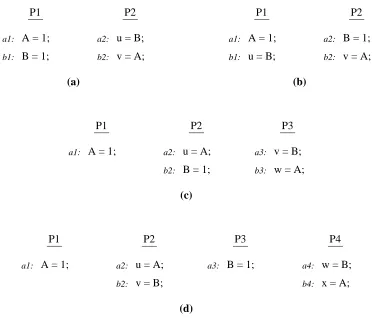
Figure 2.3 provides some canonical sample programs to illustrate the semantics of sequential consistency.
We use the following convention for specifying programs. We use uppercase letters (e.g., A, B, C) to denote
shared memory locations and lowercase letters (e.g., u, v, w) to denote private memory locations. Register
locations are denoted as r1, r2
:::
rn. Each instruction is given a unique label. Instructions from the same processor are sequenced by letters in alphabetical order with the processor number following the letter (e.g.,(a1) is the first instruction on processor 1). We will often use the instruction labels to also identify the memory
operation that results from executing the instruction. Unless specified otherwise, the initial values for all
P1
A = 1;
P2
b1:
a2:
b2: a1:
B = 1;
u = B;
v = A;
(a)
P1
A = 1;
P2
a1:
b1:
a2:
b2:
v = A;
B = 1;
u = B;
(b)
P3
a3:
b3:
P1
P2
a2:
b2:
a1:
A = 1;
u = A;
B = 1;
v = B;
w = A;
(c)
P4
a4:
b4:
P3
a3:
P1
A = 1;
P2
a2:
b2:
a1: