
QUERY MANAGEMENT IN DATA WAREHOUSE USING
VIRTUAL MACHINE FAULT TOLERANT RESOURCE
SCHEDULING ALGORITHM
1S. KRISHNAVENI and 2*M. HEMALATHA
1, 2* Department of Computer Science, Karpagam University, Coimbatore, India
E-mail: [email protected] , 2*[email protected]
ABSTRACT
Multi-stage processing occurred in distributed data warehouse. Many joints and splits are required at the time of submitting queries. Scheduling algorithms are used to resolve these issues. Reducing the processing time and cost are common concerns in scheduling. By this way the available resources are used to accom-plish the task with quick manner. In this paper, we propose Virtual Machine Fault Tolerance Resource Scheduling (VMFTRS) Algorithm for scheduling the resources. Processing time, memory size and Replica-tion Metric are taken as performance metrics and each one calculated depending upon the given query. Per-formance results show that the proposed VMFTRS algorithm gives better result than other existing algo-rithms. It is also adaptable for all distributed data warehouse systems.
Keywords:Data Warehouse, Resource Scheduling (RS), Research On Novel Dynamic Resource
Manage-ment (RNDRM), New Resource Mechanism With Negotiate Solution (NRMNS), Virtual Com-puting Grid Using Resource Pooling (VCGRP), Virtual Machine Fault Tolerant Resource Scheduling (VMFTRS)
1. INTRODUCTION
Data warehouse technology is fruitfully imple-mented in various commercial projects. Stored data are uploaded from the operational systems in the data warehouse, where the data can go through an operational data for supplementary operations be-fore it is used for reporting. It also concentrates the exploitation of the available computing power and catering for the intermittent demands of large com-putational exercises. Main data warehousing appli-cations are
• Personal productivity
• Data query and reporting
• Planning and analysis
Statistical packages, spreadsheets and graphics tools are personal productivity applications that are used in individual computers for manipulating and presenting data. Small amount of warehouse data required to develop a standalone environment. Dis-tributive warehouse data are accessed by data query and reporting applications which are listed-oriented queries and they provide an overview of historical data. The planning analysis applications share a set of user requirements. They cannot be met by apply-ing query tools against the historical data main-tained in the warehouse repository.
Some of the major challenges in a distributed environment are site autonomy, heterogeneous sub-strate, policy extensibility, co-allocation and online control. Modern trends in distributed data ware-house have improved the significance of query se-lecting. In distribution logistics some of the large quantity queries are being exchanged by a number of small queries, which have to be practiced in ex-tremely rigid time gaps. Distributed data warehouse containing more than two local data warehouses at each collection point and coordinator site. If the client gives queries in distributed system, query processing performed at local sites [1]. Skalla sys-tem is designed for distributed data warehouse to evaluate OLAP queries. Skalla translates OLAP queries to reduce the amount of data that needs to be shipped among sites.
Organizing the resources between various tasks is called as scheduling. Scheduling is classified into two types. They are task or job or operation sched-uling and resource schedsched-uling. Task schedsched-uling is the designing of tasks or queries to specific physi-cal resources to reduce the cost function processed by the client. This is an NP-complete problem and different heuristics may be used to reach an optimal or near optimal solution [4].
The resource scheduling is the process of harmo-nizing a query for resources based on required characteristics. The resource scheduling process is critical, when the client or user try to construct in-formation as quickly and reliably [5-9]. In general resource scheduling in large-scale grids can be very challenging because the resources are not centrally controlled as well as they can enter and leave from the system at any time.
This paper is structured as follows. The next sec-tion deals the related works. Secsec-tion 3 gives prob-lem definition. Section 4 presents the proposed Vir-tual Machine Fault Tolerant Resource Scheduling (VMFTRS) algorithm. Section 5 deals about da-taset. Section 6 mention the performance measures mentioned in section 6. Section 7 shows an experi-mental analysis of all algorithms. Finally, in section 8 we conclude our work and also mentioned future work.
2. RELATED WORKS
We survey various scheduling algorithms that fo-cuses resource scheduling (RS), query selecting, time and cost minimizations, etc. Performance has exposed their number of jobs with respect to pro-cessing time, memory size and replication metrics. The simple allocation schemes such as First Fit back fills (FF) are used in practice [10]. In any transactions First In First Out (FIFO) algorithm does not prioritize and transactions are performed based on their arrival time. Some recent algorithms support various resource allocations for a task and run to complete the scheduling. Scheduling proce-dures are based on First-Come-First-Serve (FCFS) algorithm [11] which allocates the resources for tasks based on their arrival time. The benefit of FCFS grants the level of determinism for the wait-ing time of each task [12]. Demerit of FCFS shows, the tasks in the ready queue cannot be scheduled immediately due to lacking of resources but the tasks in the queue would be able to execute given the currently accessible resources. These latter tasks
are blocked from executing while the system re-sources are remaining idle [13].
In distribution logistics few-but-large quantity orders are being replaced by many-but-small or-ders. The optimal routing policy shown in [14] for a warehouse with multiple cross aisles that can be found by using dynamic programming. Roodbergen proposed a model for determining the optimal lay-out for minimizing the throughput time of a data warehouse [15]; here the yields are randomly stored. Construction Management in Decision Sup-port System (CMDSS) can provide exact and time-ly information to support project managers in con-struction decision-making [16].
Gademann et al., [17] think about the issue of grouping queries to reduce the entire travel time for a multiple-aisle selecter-to-part warehouse. They illustrate the problem is still NP-hard in the strong sense when the quantity of orders per batch is better than two. A branch-and-price algorithm is intended to solve instances of modest size to optimality. For larger instances, it is instructed to use an iterated descent approximation algorithm.
An approach for determining the optimal select-ing batch size to order-pickers in a typical 2-block warehouse found by [18]. It is a simple but efficient approach also supports the average waiting time of a random order is a convex perform of the group size. It is difficult to capture the impact of aisle blockage, composite-Poisson arrivals or other stor-age methods and various layouts.
More than 300 papers are surveyed by [19]. They classified the literature on setup time consistent with store environments, group and non-group set-up times, sequence-dependent and independent setup times (costs), and task and group availability models. Also they mentioned the issues of re-source-dependent task and setup constraints, task and set-up corrosion, and task or group transporta-tion. They suggest that future researches have to concentrate a specific solution method.
before they can be shipped but it does not concen-trate the finished time.
Research on Novel Dynamic Resource Manage-ment (RNDRM) scheduling algorithm is a model of agent based dynamic resource management system proposed by [21]. It provides a good paradigm for integrating agent technology with grid computing based applications. RNDRM is Heap Sort Tree (HST) based algorithm. HST is constructed with the use of two layers. They are Autonomy Repre-sentation Agent (ARA) and Node State Monitoring
Agent (NSMA). The combination of bothARA and
NSMA called as Grid Resource Management Agents (GRMA). ARA activated on very high computational availability resource. NSMA de-ployed and activated on all resources. They exam-ined this model by submitting sample tasks and concluded that this algorithm is feasible, rational, dynamic, robust, scalable, efficient, good load bal-ance and high performbal-ance. So we used this algo-rithm in the distributed data warehouse environ-ment for minimizing the processing time and re-duce the cost.
Another agent based resource management sys-tem model is New Resource Mechanism with Ne-gotiate Solution (NRMNS) algorithm innovated by [22]. NRMNS is the combination of Grid Architec-ture for Computational Economy (GRACE) and Resource Pricing Fluctuation Manager (RPFM) within the Agent Based Resource Management with Alternate Solution (ABRMAS). They evaluate the success rate between with negotiation and with-out negotiation. Their final result shows that the negotiation method increases 10% success rate of resource discovery. It gave an alternate solution at the time of a resource discovery malfunction. This algorithm is highly dynamic in grid environment. For this reason we worked with this algorithm to improve the resources success rate.
Virtual Computing Grid using Resource Pooling (VCGRP) is based on the loosely coupled model [23]. The system can select a resource and distrib-ute tasks to it. Virtual Computing Grid Portal (VCGP) and Virtual Computing Grid Monitor (VCGM) are used in this system to minimize the complexity. Major work is to exploit the ideal com-puting power with less effort. So we are using the VCGRP algorithm in the data warehouse for reduc-ing the resource complexity.
The query grouping issue deals with [24]. That is essential for operating manual picker-to-parts query
or task selecting systems in distribution warehouses efficiently. The proposed meta-heuristics are related to the different capacities of selecting devices, anti-thetic routing policies and required scenarios. They suggest the researchers to focus the minimization of overall query or task selecting time for issues in-volving due dates.
3. PROBLEM DEFINITION
When distributed data warehouse has been using, resources are available for data collection. At the time of collecting information, few demerits were occurring such as lack of error information notifica-tion, high processing time and high cost. To address these conflicts we proposed Virtual Machine Fault Tolerant Resource Scheduling (VMFTRS) algo-rithm. The main aim of this algorithm is recycling the virtual machines. i.e., when the primary virtual machine might be failing, the secondary virtual machine is created by the use of Reconfigurable Virtual Machine (RVM) or Physical Resources (PRs).
4. PROPOSED VIRTUAL MACHINE
FAULT TOLERANT RESOURCE
SCHEDULING (VMFTRS) ALGORITHM
Figure 1. Architecture of Proposed VMFTRS Algorithm
4.1 Proposed VMFTRS Algorithm Steps
1.
Initialize the number of VM reconfigurable,number of physical machines
2.
Allocate queries as per VCGRP algorithm3.
If any VM fails, check available virtualma-chines and sort them according to the availa-ble MIPS (MIPS are free after their own al-location) and stored in an array
4.
Available MIPS of the first Virtual machinein the array is greater than the query size the query is allocated to that virtual machine
5.
Check is any other virtual machine failed. Ifany check availability of MIPs from the available VMs in the array. Then allocate VMs if satisfied with query size
6.
If available MIPs from current VMs are notmeeting query requirement, the available MIPS of two virtual machines combined and check the requirement for query processing. If it is not satisfied then combined free MIPS of three Virtual machines and so on
7.
If the MIPS of reconfigurable virtualma-chines is not meeting the requirement and then the MIPS from combination of virtual machines not meeting the requirement then the VMs are created from available physical machines.
8.
The VMs may be created from a singlephys-ical machine alone or from a combination of physical machines which is based on availa-bility of MIPs on physical machines
9.
Repeat step 3 until meets the requirementand for new queries
5. DATASET DESCRIPTION
The dataset for the work contains food mart data of 2010 and 2011. It contains twenty four relevant tables. The table names are Account, Category, Currency, Customer, Days-check, Department, Employee, Expense_fact, Position, Invento-ry_fact_2010, Inventory_fact_2011, Product, Prod-uct_class, Promotion, Region, Reserve_employee, Salary, Sales_fact_2010, Store, Time_by_day, Sales_fact_2010, Sales_fact_dec_2011, Warehouse and Warehouse_class. Total number of records are 3,20,835. In our work, these tables are randomly distributed into different sites.
6. PERFORMANCE MEASURES
For evaluating our proposed VMFTRS algorithm with other existing RS algorithms, we are using three performance measures. They are processing time, memory size and replication metric. Calcula-tion of each metric is given below,
6.1 Processing Time
The difference between query completion time and query initialization time is mentioned as processing time.
Processing Time = Qc - Qi
Qc - Query completion time
Qi - Query initialization time
6.2 Memory Size
The variation between total memory utilization and pre memory utilization at the time of query pro-cessing is mentioned as memory size.
Memory Size = Mt - Mp
Mt – Total memory utilization
Mp– Pre memory utilization
6.3 Replication Metric
Occasionally same queries are repeated in various sites or resources. The count of same query repeti-tion is declared as replicarepeti-tion metric.
Replication Metric = ∑𝑛𝑗=1∑𝑛𝑖=1(Qi∈Ri)∩(Qj∈Rj)
Qi = number of queries given
Ri = number of resources used
7. RESULTS AND DISCUSSION
according to scheduling algorithms. After query processing is completed the results are collected from inter-processors by the server and sent to the corresponding client. This work deals with perfor-mance of four RS algorithms namely Research on Novel Dynamic Resource Management (RNDRM), New Resource Mechanism with Negotiate Solution (NRMNS), Virtual Computing Grid using Resource Pooling (VCGRP) and proposed Virtual Machine Fault Tolerant Resource Scheduling (VMFTRS)
algorithms. Results are compared based on
pro-cessing time, memory size and replication metric.
[image:5.612.322.523.74.209.2]7.1 Results of Proposed VMFTRS Algorithm Table 1. illustrates the processing time, memory size and replication metric values for different number of queries such as 10, 20, 30, 40 and 50 for the proposed VMFTRS algorithm.
Table 1. Performance Values For Proposed VMFTRS Algorithm
Performances of Proposed VMFTRS Algorithm
Number of Queries
Processing Time
(se-conds)
Memory Size (Kb)
Replication Metric
10 1 39.1 0
20 2 78.1 0
30 4 107.4 1
40 6 136.7 1
50 8 175.8 1
7.2 Comparative Analysis of Various Schedul-ing Algorithms with ProcessSchedul-ing Time
Table 2. shows the processing time values for different number of queries such as 10, 20, 30, 40 and 50 for RNDRM, NRMNS, VCGRP and pro-posed VMFTRS resource scheduling algorithms. A unit of the processing time is taken as seconds.
Table 2. Processing Time Of Various RS Algorithms
Number of
Que-ries
Processing Time (seconds)
RNDRM NRMNS VCGRP Proposed
VMFTRS
10 5 3 2 1
20 10 6 4 2
30 13 10 7 4
40 18 14 10 6
50 21 18 12 8
Figure 2. Performance of RS Algorithms with Processing Time
Fig. 2 shows the performance chart of processing time of RNDRM, NRMNS, VCGRP and proposed VMFTRS algorithms. The proposed VMFTRS al-gorithm takes 1 second for 10 queries, 2 seconds for 20 queries, 4 seconds for 30 queries, 6 seconds for 40 queries and 8 seconds for 50 queries. While the total number of queries increases the processing time is less in the proposed VMFTRS algorithm than other existing resource scheduling algorithms. Finally, it concludes that the proposed VMFTRS algorithm outperforms than others.
7.3 Comparative Analysis of Various Schedul-ing Algorithms with Memory Size
[image:5.612.90.296.331.434.2]Table 3. depicts the memory size values for dif-ferent number of queries such as 10, 20, 30, 40 and 50 for RNDRM, NRMNS, VCGRP and proposed VMFTRS resource scheduling algorithms. A unit of the memory size is taken as kilobytes (Kb).
Table 3. Memory Size Of Various RS Algorithms
Number of
Que-ries
Memory Size (Kb)
RNDRM NRMN
S VCGRP
Pro-posed VMFTRS
10 58.6 48.8 39.1 39.1
20 117.2 97.7 87.9 78.1
30 185.5 156.3 127 107.4
40 244.1 205.1 166 136.7
50 302.7 253.9 214.8 175.8
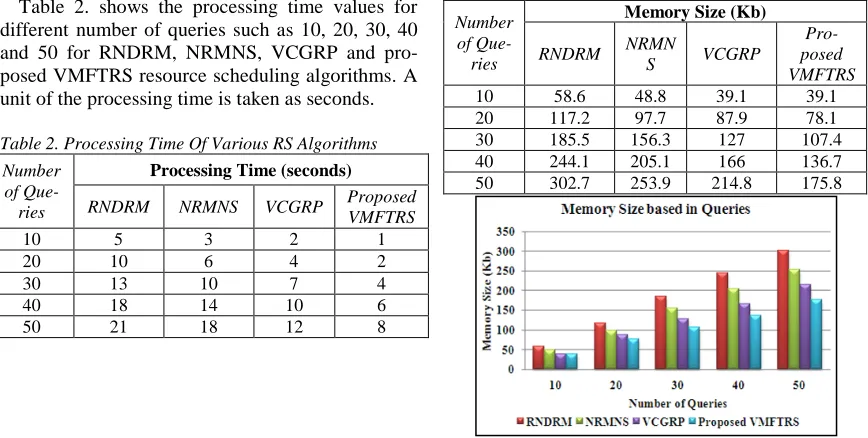
[image:5.612.90.524.481.700.2]Fig. 3 shows the performance chart of memory size for RNDRM, NRMNS, VCGRP and proposed VMFTRS algorithms. The proposed VMFTRS al-gorithm takes 39.1 Kb for 10 queries, 78.1 Kb for 20 queries, 107.4 Kb for 30 queries, 136.7 Kb for 40 queries and 175.8 Kb for 50 queries. While the total number of queries increases the memory size low in the proposed VMFTRS algorithm than other existing resource scheduling algorithms. Finally, it concludes that the proposed VMFTRS algorithm outperforms than others.
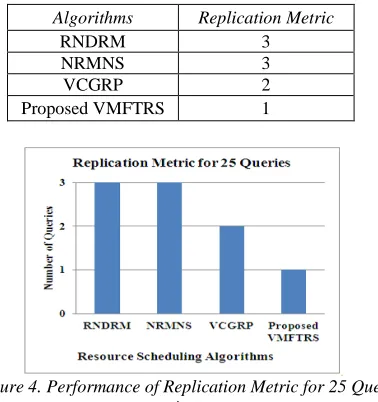
7.4 Comparative Analysis of Various Schedul-ing Algorithms with Replication Metric Table 4. shows the replication metric values for RNDRM, NRMNS, VCGRP and proposed VMFTRS resource scheduling algorithms when we gave 25 queries.
Table 4. Replication Metric of various RS Algorithms
Algorithms Replication Metric
RNDRM 3
NRMNS 3
VCGRP 2
[image:6.612.104.293.332.533.2]Proposed VMFTRS 1
Figure 4. Performance of Replication Metric for 25 Que-ries
Fig. 4 shows the performance chart of replication metric values for RNDRM, NRMNS, VCGRP and proposed VMFTRS algorithms. The proposed VMFTRS algorithm gives 1 query when we are checking with 25 queries. The replication metric is minimized in the proposed VMFTRS algorithm than other existing resource scheduling algorithms. Finally, it concludes that the proposed VMFTRS algorithm outperforms than others.
8. CONCLUSION AND FUTURE WORK
Based on our work, we have concluded that the existing grid based resource scheduling algorithms are working fine in a distributed data warehouse environment. Even though there are few demerits in
existing algorithms such as lack of error infor-mation at the time of job submission, high pro-cessing time, error in resource discovery and high cost. Our proposed Virtual Machine Fault Tolerant Resource Scheduling (VMFTRS) algorithm over-comes these issues and reduce the of query repeti-tion, minimize the processing time and minimize the memory utilization. From the above perfor-mance analysis, we found that the proposed VMFTRS algorithm outperforms than other algo-rithms because of the virtual machine recycling process. Our future work will be based on the inte-gration of resource scheduling algorithm with job scheduling to minimize the cost, increase the scala-bility and success rate.
ACKNOWLEDGEMENT
We thank the Karpagam University for the Moti-vation and Encouragement to make this work as successful one.
REFERENCES:
[1] M.O. Akinde, M.H. Bhlen, T. Johnson, L.V.S.
Lakshmanan and D. Srivastava, “Efficient OLAP Query Processing in Distributed Data
Warehouses”, Information Systems, Vol. 28,
2003, pp. 111-135.
[2] J.A. Tompkins, J.A. White, Y.A. Bozer and
J.M.A.T. Tanchoco, “Warehouse Operations”,
Facilities Planning, 4th Edition, Pub. John
Wiley & Sons, Chapter 7, 2003, pp. 383-448.
[3] C.G. Petersen, “An Evaluation of Order
Pick-ing RoutPick-ing Policies”, International Journal
of Operations and Production Management,
Vol. 17, No. 11, 1997, pp. 1098–1111.
[4] Raksha Sharma, Vishnu Kant Soni, Manoj
Kumar Mishra and Prachet Bhuyan, “A Sur-vey of Job Scheduling and Resource
Man-agement in Grid Computing”, World Academy
of Science, Engineering and Technology, Vol.
64, 2010, pp. 461-466.
[5] K. Ranganathan and I. Foster, “Simulation
studies of computation and data scheduling
algorithms for data grids”, Journal of Grid
Computing, Vol. 1, No. 1, 2003, pp. 53-62.
[6] Ian Foster and Carl Kesselman, “The Grid:
Blueprint for a New Computing Infrastruc-ture”, Elsevier Inc., 2nd Edition, 2003.
[7] M. Caramia, S. Giordani and A. Iovanella,
“Grid Scheduling by on-line Rectangle
Pack-ing”, International Journal of Networks
(Wiley Periodicals), Vol. 44, No. 2, 2004, pp.
[8] Y. Gao, H. Rong and J. Huang, “Adaptive Grid Job Scheduling with Genetic
Algo-rithms”, Future Generation Computer
Sys-tems, Vol. 21, 2005. pp. 151-161.
[9] C. Weng and X. Lu, “Heuristic scheduling for
bag-of-tasks application in combination with
QoS in the computational grid”, Future
Gen-eration Computer Systems, Vol. 21, 2005. pp.
271-280.
[10] Vijay Subramani, Rajkumar Kettimuthu,
Srividya Srinivasan and S. Sadayappan, “Dis-tributed Job Scheduling on Computational Grids using Multiple Simultaneous Requests”,
Proceedings of the 11th IEEE International
Symposium on High Performance Distributed
Computing, IEEE Xplore Press, Nov. 7, 2002,
pp. 359-366.
[11] Claus Bitten, Joern Gehring, Uwe
Schwie-gelshohn and Ramin Yahyapour, “The NRW-Metacomputer-Building Block for a
World-wide Computational Grid”, Proceedings of
the 9th Heterogeneous Computing Workshop,
IEEE Xplore Press, Cancun, Aug. 6, 2000, pp. 31-40.
[12] Carsten Ernemann, Volker Hamscher, Uwe
Schwiegelshohn and Ramin Yahyapour, “On Advantageous of Grid Computing for Parallel
Job Scheduling”, Proceedings of the 2nd
IEEE/ACM International Symposium on
Clus-ter Computing and the Grid, IEEE Xplore
Press, May 21-24, 2002, pp. 39-46.
[13] Hongzhang Shan, Leonid Oliker and Rupak
Biswas, “Job Superscheduler Architecture and Performance in Computational Grid
Envi-ronments”, Proceedings of the ACM/IEEE
Conference on Supercomputing, IEEE Xplore
Press, Nov. 15-21, 2003, pp. 44-58.
[14] K.J. Roodbergen and R. De Koster, “Routing
Methods for Warehouses with Multiple Cross
Aisles”, International Journal of Production
Research, Vol. 39, No. 9, 2001, pp.
1865-1883.
[15] K.J. Roodbergen, “Layout and Routing
Meth-ods for Warehouses”, Ph.D. Thesis. Erasmus
Research Institute of Management (ERIM),
Erasmus University Rotterdam, The Nether-lands, 2001.
[16] K.W. Chau, Ying Cao, M. Anson and
Jianping Zhang, “Application of Data Ware-house and Decision Support System in
Con-struction Management”, Automation in
Con-struction, Vol. 12, No. 2, 2002, pp. 213-224.
[17] N. Gademann and S. Van de Velde, “Order
Batching to Minimize Total Travel Time in a
Parallel-Aisle Warehouse”, IIE Transactions,
Vol. 37, 2005, pp. 63-75.
[18] Tho Le-Duc and Rene M.B.M. de Koster,
“Travel Time Estimation and Order Batching
in a 2-block Warehouse”, European Journal
of Operational Research, Vol. 176, No. 1,
2007. pp. 374–388.
[19] Ali Allahverdi, C.T. Ng, T.C.E. Cheng and
Mikhail Y. Kovalyov, “A Survey of
Schedul-ing Problems with Setup Times or Costs”,
Eu-ropean Journal of Operational Research, Vol.
187, 2008, pp. 985-1032.
[20] Sheng Yuan Hsu and C.H. Liu, “Improving
the Delivery Efficiency of the Customer Or-der Scheduling Problem in a Job Shop”,
Computers and Industrial Engineering, Vol.
57, 2009, pp. 856–866.
[21] Fufang Li, Deyu Qi, Limin Zhang, Xianguang
Zhang and Zhili Zhang, “Research on Novel Dynamic Resource Management and Job
Scheduling in Grid Compuing”, Proceedings
of the 1st International Multi-Symposiums on
Computer and Computational Sciences, IEEE
Xplore Press, Jun. 20-24, Vol. 1, 2006, pp. 709-713.
[22] Junyan Wang, Yuebin Xu, Guanfeng Liu,
Zhenkuan Pan and Yongsheng Hao, “New Resource Discovery Mechanism with Negoti-ate Solution Based on Agent in Grid
Envi-ronments”, Proceedings of the 3rd
Interna-tional Conference on Grid and Pervasive
Computing Workshops, IEEE Xplore Press,
2008, pp. 23-28.
[23] Alpana Rajan, Anil Rawat and Rajesh Kumar
Verma, “Virtual Computing Grid using
Re-source Pooling”, Proceedings of the
Interna-tional Conference on Information
Technolo-gy, IEEE Xplore Press, Bhubaneswar, Dec.
17-20, 2008, pp: 59-64. pp. 59-64.
[24] Sebastian Henn and Gerhard Wascher, “Tabu
Search Heuristics for the Order Batching Problem in Manual Order Picking Systems”,
European Journal of Operational Research,
![Assessment of Physiological Health Status in Relations to Different Anthropometric and Cardio respiratory Measures of Head Supported Load Carrying Male Porters of Sikkim, India [Article Retracted]](data:image/gif;base64,R0lGODlhAQABAIAAAP///wAAACH5BAEAAAAALAAAAAABAAEAAAICRAEAOw==)