Full Length Research Article
NEW ECONOMICAL CONSTRUCTION MATERIAL PANELS FOR REDUCTION OF NOISE
LEVEL IN SMALL INDUSTRIES
*Yogesh Survase and Upendra Saharkar
Department of Civil Engineering, D.Y Patil Institute of Engineering and Technology,
Ambi, Pune Maharashtra-410506, India
ARTICLE INFO ABSTRACT
Today there is large growth in industrialization; therefore industrial noise has become a big environmental Problem. The noise that is generated by machines in industries is termed as industrial noise. This noise interferes with communication between supervisors and staff. Continuous exposure to noise can cause fatigue, which often results in accidents and reduces the pace and quality of work. Noise affects negatively on the day today life of surrounding people, who have faced with many problems mentally and physically. Workers are exposed to continuous noise throughout the workday, might results in some injuries such as hearing loss (temporary or permanent), weakness in nerves, pain in internal tissues, heart problems, and even higher blood pressure in long term. It is seen from the experimentation that a long exposure to noise over 85 dB might be a dangerous factor for high blood pressure (BP), and it may induce major problems amongst the sensitive individuals and hence more focus is required on noise control. Therefore, noise control is one of the major requirements to improve the living environment. Developed countries use sensible techniques to reduce the nuisance barrier walls, soundproof curtains, duct, acoustic panelling, sound enclosures for industrial machinery and different similar noise management treatments that area unit put in close to the supply to effectively cut back the sound level. However, India has not however yielded a lot of into this issue as noise reduction strategies area unit expensive. Therefore, it is necessary to find out cost effective methods to control industrial noise. This study emphasizes the vital role of algae dust, bamboo leaves, Coconut Coir Fiber, saw wood dust etc as natural sound reduction material, to give a solution for the existing industrial noise problems and also aimed to identifying the best practices in industries.
Copyright©2016, Yogesh Survase and Upendra Saharkar. This is an open access article distributed under the Creative Commons Attribution License, which permits unrestricted use, distribution, and reproduction in any medium, provided the original work is properly cited.
INTRODUCTION
Noise is ‘unwanted sound’ emitted from the moving body awareness of that to person is by the physical sensation of hearing. Noise plays a very important role in incidence of annoyance, inconvenience and making nuisance that causes pollution touching the standard of life. Noise pollution has become more prevalent in the present scenario and is still major ignored issue in industrial construction. Pollution is huge environmental drawback facing we have a tendency to everywhere the planet, that has terribly harmful effects on health and lifetime of the employees in industrial sector. Employees are exposed to continuous noise throughout the workday, creates some injuries like hearing disorder (may be temporary or permanent), weakness in nerves, pain in internal
*Corresponding author: Yogesh Survase
Department of Civil Engineering, D.Y Patil Institute of Engineering and Technology, Ambi, Pune Maharashtra-410506, India
tissues, heart issues, and even higher blood pressure in long term. It’s seen from the experimentation that an extended exposure to noise over 85 dB [9] may well be a dangerous issue for high blood pressure (BP), and it should induce major issues amongst the sensitive people and hence a lot of focus is needed on noise control. Effective noise management has become a very important topic due to its numerous direct and indirect impacts of noise on the productivity as well as health of the employee. Ancient noise reduction techniques principally mainly include insulating, absorbing, vibration isolation and damping. But they have their own limitations. Presently, due to the technological advancement lot of recent construction materials are accessible within the market to reduce the matter of noise. With the help of these materials the building can be constructed where noise can be controlled more effectively in economical way. Traditional noise management techniques principally embody insulating, absorbing, vibration-isolating, and damping. The generator, or
ISSN: 2230-9926
International Journal of Development Research
Vol. 06, Issue, 10, pp.9684-9692, October, 2016
International Journal of
DEVELOPMENT RESEARCH
Article History:
Received 27thJuly, 2016 Received in revised form 19thAugust, 2016
Accepted 24thSeptember, 2016 Published online 31stOctober, 2016
Key Words:
noise making set is usually put in an exceedingly sound-attenuated enclosure, that which uses all such kinds of noise reduction techniques. The noise created from the generator is closed the enclosure and prevented from radiating. The most wall panels for noise control of the enclosure are manufactured from the sound boarding. A cooling air water used on one side wall of the enclosure admits the external air into the enclosure, and a cooling air outlet on the wall of the enclosure expel the air from the inside of the enclosure. A multi-pass dissipative silencer is mounted on the air inlet region, a two-stage expansion chamber silencer is applied to control exhaust noise, and a multi-pass silencer is installed on the outlet control region at the end of the enclosure to reduce outlet noise. Effective noise control has become a very important topic due to its numerous direct and indirect impacts of noise on the productivity as well as health of the employee. Traditional noise control techniques mainly include insulating, absorbing, vibration isolation and damping, but they have their own limitations. Presently, owing to the technological advancement lot of recent construction materials are accessible within the market to reduce the problem noise. With the help of these materials the building can be constructed where noise can be controlled more effectively in economical way.
History
Presently, within the industrial construction the matter of undesirable potentially hazardous noise has become more complicated and serious issue, the demands for a better environment and quality life styles are increased. But owners and designers/ architects aren't paying much of the attention to control the noise pollution. Most of the developed countries use advanced techniques to attenuate the nuisance like barrier walls, duct silencers, acoustical wall panel, sound proof curtains, sound enclosures for industrial machinery and other similar noise control treatments that are installed near the source to effectively reduce the sound level. But, India has not yet yielded much into this issue as noise reduction methods are costly.
Therefore, it is necessary to find out cost effective solution to control industrial noise. It is terribly tough to estimate and control the noise at totally different workplaces in industry. But the motivation behind this project is that the accessibility of lot of new sound absorption material with totally different acoustical properties. The noise levels have to be calculated in the working condition and depending upon the working condition suitable type of construction material is to be applied so as to control the noise effectively in industrial sector. Consulting the importance of noise pollution and availability of new materials; in this dissertation it will be attempted to study the techno-economical feasibility of the various new construction materials for the effective noise control in industrial sector.
General
For Reducing bad effects of Industrial Noise pollution on Health of Workers by using Techno-Economically feasible Construction Materials in Industries we can use following various materials. There is an increasing importance of noise pollution in industrial sector because of its direct and indirect impacts on health of the workers and productivity. It is also seen from the literature review of manufacturer’s catalogue that there are so many new construction techniques and materials which are developed in this decade due to the technological advancement. Hence in this dissertation the techno-economical aspects of the various construction techniques and materials for the effective noise pollution control will be studied.
Objectives
To analyze cost effectiveness of new investigated construction materials and their suitability.
[image:2.595.163.433.530.641.2] To study the various material combinations with allied artificial sound insulating material available in market.
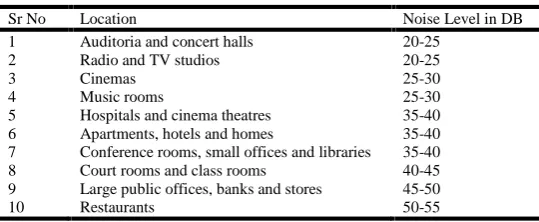
Table 1. Acceptable Indoor Noise Levels for Various Buildings
Sr No Location Noise Level in DB
1 Auditoria and concert halls 20-25
2 Radio and TV studios 20-25
3 Cinemas 25-30
4 Music rooms 25-30
5 Hospitals and cinema theatres 35-40 6 Apartments, hotels and homes 35-40 7 Conference rooms, small offices and libraries 35-40 8 Court rooms and class rooms 40-45 9 Large public offices, banks and stores 45-50
10 Restaurants 50-55
Table 2. Range of Loudness Levels for Various Industrial Operations
Sr. No. Source Loudness level in dB
1 Mills; cotton, silk, woolen (spinning, weaving, carding) 90 to 110
2 Sugar mills (crushing ) 105 to 110
3 Steel rolling 95 to 105
4 Drop forge hammer 130 to 145
5 Steel bar shearing 110 to 125
6 Riveting ( steel plates ) 105 to 110
7 Riveting and chipping ( large steel plates) 120 to 130
8 Circular saw ( wood ) 100 to 110
9 Wood planning 115 to 120
[image:2.595.143.456.671.780.2]Acceptable noise level by sp 7 (2005): national building code of india2005 (group 1 to 5) [ced 46: national building code]: [10].
The desired (acceptable) noise levels and the recommended insulation values for the various areas may be achieved by providing sound insulation treatments by constructional measures. Acceptable Indoor Noise Levels for Various Buildings are given in following table as per National Building Code Of India 2005 (Group 1 To 5) [Ced 46: National Building Code]
Is 3483 (1965): Code of practice for noise reduction in industrial buildings [ced 12: Functional requirements in buildings] appendix a (clause 7.1): [11]
The range of Loudness Levels for Various Industrial Operations as per IS 3483 (1965): Code of practice for noise reduction in industrial buildings [CED 12: Functional Requirements in Buildings] is given in following table. This is general range of the loudness level in industrial buildings. By this way we can know how much noise we need to reduce. This loudness level is needed to reduce up to Acceptable Noise Level by Sp 7 (2005): National Building Code of India2005 (Group 1 To 5) [Ced 46: National Building Code]. Following table clearly show that the nosie level should be reduced from 100-110 dB to 60 dB to reduce their ill effects on workers.
The Decibel Scale: [12]
We need to address here is that the representation of signal amplitude using the dB scale. The dB scale is powerful and vastly flexible scale for representing the amplitude of a wave. The scale typically cause students problem as a result of it differs from most other measurement scales in not only one however in two ways. Most of the measurement scales with which we are familiar are absolute and linear.
The Physics of Sound
Scale, however, is relative rather than absolute, and logarithmic rather than linear. Neither of these characteristics is terribly complicated, but in combination they can make the decibel scale appear far more obscure than it is. We will examine these features one at a time, and then see how they are put together in building the decibel scale. The decibel scale also exploits this relative measurement scheme. The decibel scale does not represent a measured intensity (Im) in absolute terms, but rather, represents the ratio of a measured intensity to reference intensity (Im/Ir). For the decibel scale, many different references can be used. In explaining how the decibel scale works, we will begin with the commonly used intensity reference of 10^12 w/m2 (watts per square meter), which is approximately the intensity that is required for an average normal hearing listener to barely detect a 1,000 Hz pure tone. So, for our initial pass through the decibel scale, 10^12 w/m2
will serve as Ir, Table below lists several sounds that cover a very broad range of intensities. The second column shows the measured intensities of those sounds, and the third column shows the ratio of those intensities to our reference intensity. Whispered speech, for example, measures approximately 10-8 w/m2, which is 10,000 times more intense than the reference intensity (10^8/10^12 = 10^4 = 10,000). The main point to be made about column 3 is that the ratios become very large very soon. Even a moderately intense sound like conversational speech is 1,000,000 times more intense than the reference intensity. The awkwardness of dealing with these very large ratios has a very simple solution. Column 4 shows the ratios written in exponential notation, and column 5 simplifies the situation even further by recording the exponent only. The term exponent and the term logarithm are synonymous, so the measurement scheme that is expressed by the numbers in column 5 can be summarized as follows:
Divide a measured intensity by a reference intensity (in this case, 10^12 w/m2),
Take the logarithm of this ratio (i.e., write the number in exponential notation and keep the exponent only).
This method, in fact, is a completely legitimate way to represent signal intensity. The unit of measure is called the bel, after A.G.
Bell, and the formula is:
Bel = log10 Im/Ir, Decibel =10 log10 Im/Ir
Where: Im = a measured intensity Ir = a reference intensity
Table below shows Sound intensities and intensity ratios showing how the decibel scale is created.
Column 3 shows the measured intensities (Im) of several sounds. Column 4 shows the ratio of these intensities to a reference intensity of 10^-12 w/m2. 5 shows the Log10(Im/Ir). The last column shows the intensity ratio expressed in decibels, which is simply the logarithm of the intensity ratio multiplied by 10.
When intensity Im increased by 100 times decibel increases by About 20 db
When sound reduces from 80 db to 60 db i.e. by 20 db then intensity get reduced by about 100 Watt/ Sq M.
When intensity Im increased by 5 times decibel increases by About 7 dB
Material can be used to reduce noise level
[image:3.595.66.518.509.580.2]The following materials can be used to make panels and are having noise reducing capacity. These materials are available Table 3. Decibel Calculation [12]
Sr. No. Sound Measured Intensity (Im) Ratio (Im/Ir) Exp-onent (log10) Decibel (10X log10)
1 Threshold @ 1 kHz 0.000000000001 1 0 0
2 Whisper 0.00000001 10000 4 40
3 Conversational speech 0.000001 1000000 6 60
4 City Traffic 0.0001 100000000 8 80
5 Rock & Roll 0.01 10000000000 10 100
in nature. And some are available as waste. So they can be used effectively. Also there availability is local.
Coconut Fiber
Coconut fibre is one amongst the natural fibres profusely obtainable in tropical regions, and is extracted from the husk of coconut fruit. Not solely the physical, chemical and mechanical properties of coconut fibres are shown; however conjointly properties of composites (cement pastes, mortar and/or concrete etc), within which coconut fibres are used as reinforcement, are discussed. The analysis applied and also the conclusions drawn by totally different researchers in previous couple of decades also are also briefly presented. Coconut fibres reinforced composites have been now days used as cheap and durable non-structural elements. The aim of this review is to spread awareness of coconut fibres as a construction material in civil engineering. Coconut fibres didn't contribute to bending strength of the tested wall panels. Compressive strength increases the addition of coconut fibres, however the compressive strength reduced with a rise in water content and density was increased. There was no vital modification of water content with coconut fibres. However, water content increases with time. There was conjointly no vital impact to water absorption on increasing coconut fibre content. Test sample is prepared with coconut fiber and glue material and a support of perforated metal plate is given to it to withstand on its own.
Photo Coconut Outer Shell
Photo Sample Prepared From Coconut Coir
Aglae
Filamentous Aglae are usually observed as ‘pond scum’ or ‘pond mosses’ and type green mats upon the water surface. These stringy, fastest-growing algae can cover a pond with slimy, lime-green clumps or mats in a less period of time,
usually starting of their growth along the edges or bottom of the pond and ‘mushrooming’ to the surface. Individual filaments are a series of cells joined end to end which give the Algae. It is having thread-like look. They conjointly type fur-like growths on submerged logs, rocks and even on animals.
Photo Aglae at River Shore
Photo Aglae Collected For Sample Preparation
Saw Wood Dust
Wood dust is created when machines are used, shape, or smooth wood materials. Industries that have a high risk of wood-dust exposure include sawmills, furniture industries, planer mills, dimension mills, cabinet makers, and carpenters. Wood dust is described as any wood particle coming from the processing or handling of wood, such as cutting, sanding, or milling. It does not include dust from pulp or processed cellulose fibers. It also doesn’t include paper or “cellulose” dust, starches, or other types of dusts that may be at a facility. The term “wood dust” also does not apply to large pieces of wood such as wood chips or wood mulch. However, could be smaller wood dust particles that are likely to be mixed in with these larger wood items.
Bamboo Tree Leaves
Bamboo plants have some helpful properties and having lot of beneficiary uses; these are using as pillar, fencing, housing, house hold products, raw materials of crafts, pulp, paper, boards, fabrics industry, fuel, fodder etc. The shoot of young bamboo grass is often processed into numerous delicious healthy foods and typically uses as medicines. This ancient woody grass wide found in tropical, semi tropic and delicate temperate zones of the globe. . It is a tremendously diverse plant, which have the capacity to adapt any extreme climatic and soil conditions. Although it's used for housing, crafts, pulp, paper, panels, boards, veneer, flooring, roofing, materials and vegetable (the bamboo shoot). Products of bamboos are using everywhere and bamboo industries are now thriving in Asia and are quickly expanding across the continents to Africa and America.
Photo Bamboo Leaves
Photo Bamboo Leaves Grinded For Sample Preparation
Photo Drip irrigation plastic
Plastic
Plastic wastes can also used for material as sound absorbent. This will have more life also whether resistant. And they may be made available in the market in large scale. As a short introduction to plastics, it is often same that plastics square measure artificial organic materials made by chemical process. They are usually of high molecular mass, and will contain different substances besides polymers to boost performance and/or reduce prices. These polymers are often shaped or extruded into desired shapes.
Photo Plastic Waste Grinded For Sample Preparation
Waste plastics are one of the most promising resources for fuel production because of its high heat of combustion and due to the increasing availability in local communities. In contrast to paper and wood, plastics don't absorb abundant moisture and therefore the water content of plastics is way not up to the water content of biomass like crops and room wastes. The conversion ways of waste plastics into fuel depend upon the categories of plastics to be targeted and therefore the properties of different wastes which may be employed in the method. In addition the effective conversion needs applicable technologies to be elite per native economic, environmental, social and technical characteristics.
Material Preparation
Material panels are prepared from these materials and are having sound reduction capacity.
Samples
Test Samples are prepared with various proportions and thickness. Samples used are Saw wood dust & cement, Saw wood dust & Glue, algae (Sheval) & cement, algae (Sheval) & glue, Coconut fiber & perforated plate, Bamboo & Glue etc
Samples Are Prepared With Following Proportion
Saw wood dust & cement 1:1
Saw wood dust & cement 1:2
Saw wood dust & Glue
algae (Sheval) & cement 1:1
algae (Sheval) & cement 1:2
algae (Sheval) & glue
Coconut fiber & Perforated plate
Bamboo & Glue
Photo Sawdust & Cement
Photo Aglae & Cement
Photo Samples prepared
Cost Analysis
Cost of Material Panels of About 1m X 1m
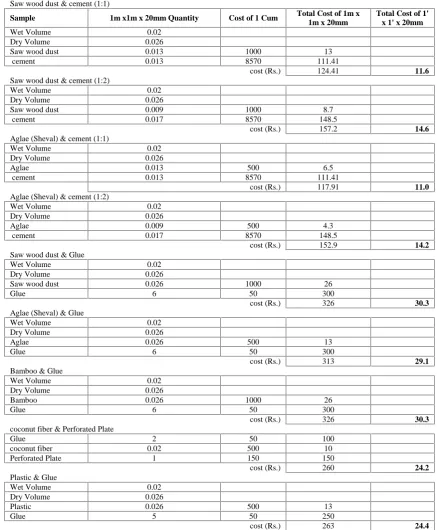
Cost for sample size 1 m x 1 m is drawn; the quantity of each material is multiplied by its unit rate according to schedule of rates, the materials which are not having their rates in schedule of rates the current market rate is taken to find the cost.
Sample Wise Cost of 1m X 1m X 20mm
Sample wise cost of material 1m x 1m x 20mm cost is drawn; the unit quantity is multiplied by Current DSR rates, also the materials which are not in DSR the market rate is taken for same.
Photo 1 X 1 Sample of Plastic and Glue
Calculations
Wet volume = Length x width x height Wet volume = 1 x 1 x 0.020 = 0.020 Cum Dry volume = increase 30 % dry volume Dry volume = wet volume x 1 .30 Total cost = dry volume x unit rate
8X4 FEET PANEL COST
Cost of 8x4 feet panel is drawn including material and labor cost. This includes the Sheet of 1’x1’,Vertical Channel (8 feet), Horizontal angle (4 feet), screw (dozen),Material cost and Labor cost. 8x4 panels are prepared with 1x1feet sheets made from material and horizontal aluminum angle and vertical aluminum channel. The arrangement or fixing is as shown in following photo.
Saw wood dust & cement (1:1)
Sample 1m x1m x 20mm Quantity Cost of 1 Cum Total Cost of 1m x1m x 20mm Total Cost of 1'x 1' x 20mm
Wet Volume 0.02
Dry Volume 0.026
Saw wood dust 0.013 1000 13
cement 0.013 8570 111.41
cost (Rs.) 124.41 11.6
Saw wood dust & cement (1:2)
Wet Volume 0.02
Dry Volume 0.026
Saw wood dust 0.009 1000 8.7
cement 0.017 8570 148.5
cost (Rs.) 157.2 14.6
Aglae (Sheval) & cement (1:1)
Wet Volume 0.02
Dry Volume 0.026
Aglae 0.013 500 6.5
cement 0.013 8570 111.41
cost (Rs.) 117.91 11.0
Aglae (Sheval) & cement (1:2)
Wet Volume 0.02
Dry Volume 0.026
Aglae 0.009 500 4.3
cement 0.017 8570 148.5
cost (Rs.) 152.9 14.2
Saw wood dust & Glue
Wet Volume 0.02
Dry Volume 0.026
Saw wood dust 0.026 1000 26
Glue 6 50 300
cost (Rs.) 326 30.3
Aglae (Sheval) & Glue
Wet Volume 0.02
Dry Volume 0.026
Aglae 0.026 500 13
Glue 6 50 300
cost (Rs.) 313 29.1
Bamboo & Glue
Wet Volume 0.02
Dry Volume 0.026
Bamboo 0.026 1000 26
Glue 6 50 300
cost (Rs.) 326 30.3
coconut fiber & Perforated Plate
Glue 2 50 100
coconut fiber 0.02 500 10
Perforated Plate 1 150 150
cost (Rs.) 260 24.2
Plastic & Glue
Wet Volume 0.02
Dry Volume 0.026
Plastic 0.026 500 13
Glue 5 50 250
[image:7.595.79.517.74.605.2]cost (Rs.) 263 24.4
Table 1.4 summary of all panel per Sqft cost
Sample Sheet of 1x1 Com-mon cost Mater-ial cost Labour cost Total cost Cost / Sqft
Saw wood dust & cement (1:1) 32x11.6=370 329 699 175 874 27
Saw wood dust & cement (1:2) 32x14.6= 467 329 796 199 995 31
Aglae (Sheval) & cement (1:1) 32x11= 351 329 680 170 849 27
Aglae (Sheval) & cement (1:2) 32x14.2= 454 329 783 196 979 31
Saw wood dust & Glue 32x30.3= 969 329 1298 325 1623 51
Aglae (Sheval) & Glue 32x29.1= 931 329 1260 315 1574 49
Bamboo & Glue 32x30.3= 969 329 1298 325 1623 51
coconut fiber & Perforated Plate 32x24.2= 773 329 1102 275 1377 43
Cost of 8’x4’ Panel Prepared
Cost of 8x4 feet panel is drawn including material and labor cost. This includes the Sheet of 1’x1’,Vertical Channel (8 feet), Horizontal angle (4 feet), screw (dozen),Material cost and Labour cost. From above is clearly seen that the per sqft cost of newly invented material is much less than presently available material in market. No doubt the panel available in market having very god strength and less maintenance cost, but are costly and cannot offered by small scale industries, so the new invented panels can be used economically in small scale industries.
Recommendation
It is recommended that following are the plus points of new investigated materials,
New construction materials having less cost as compared to materials available for attenuation of noise.
Due to less cost these material panels can be used in small scale industries where the company cannot offered high cost for noise attenuation.
The Material of panel can be made available easily by local market.
The labor required for Panel making is not much skilled, so can be made by local labor.
The scope for these newly invented material panels is as,
We can update necessary model and revise the model as per site conditions.
It is beneficial in residential as well industrial purpose by making required changes.
By investigating more materials we can achieve more sound attenuation as can create vacuum.
New materials can investigated for sound attenuation which are having their disposing problem and are harmful for environment
Weakness of These Panel Is,
The strength of the new investigated material is less as compared to latest available material so can’t stand for much days and need to replace when get damaged.
The maintenance cost of new investigated panel is much.
Conclusion
For Reducing bad effects of Industrial Noise pollution on Health of Workers by using Techno-Economically feasible Construction Materials in Industries we can use above materials effectively and economically. Now days, in the industrial construction the problem of undesirable and potentially hazardous noise has become big complex and serious; the demands for a better environment and quality life styles are increased. However owners and architects are not paying much of the attention to control the noise pollution because of its implementation cost is high. Developed countries use practical techniques to reduce the nuisance such as acoustical wall panel, barrier walls, duct silencers; sound enclosures for industrial machinery, sound proof curtains, and other similar noise control treatments that are installed near the
source to effectively reduce the sound level. However, India has not yet yielded much into this issue as noise reduction methods are costly. So, it is necessary to find out cost effective solution to control industrial noise. It is very difficult to estimate and control the noise at different workplaces in industry. However the motivation behind this is the availability of lot of new sound absorption material such as Saw wood dust & cement, Saw wood dust & Glue, algae (Sheval) & cement, algae (Sheval) & glue, Coconut fiber & perforated plate, Bamboo & Glue etc with different acoustical properties.
The noise levels have to be estimated in the working condition and depending upon the working condition suitable type of construction material is to be applied so as to control the noise effectively in industrial sector. Consulting the importance of noise pollution and availability of new materials; in this dissertation it will be attempted to study the techno-economical feasibility of the various new construction materials for the effective noise control in industrial sector. From the studies it is seen that the architects and engineers are not providing much of the attention to control the industrial noise which is otherwise very harmful to the health of the workers and directly affects the production. This may be mainly due to the cost of the materials which are commonly used to control the noise. It is also seen from the studies that the conventional materials and methods has their own limitations. From the above study has also indicated that the new construction techniques and materials are available in the market and they can be used more effectively for efficient noise control.
REFERENCES
Kuo-Tsai Chen, 1995. “Study on the Acoustic Transmission Loss of a Rigid Perforated Screen”. Department of Naval Architecture and Ocean Engineering, National Taiwan University, 73 Chow-Shan Road, Taipei, Taiwan. Applied Acoustics, Vol. 47, No. 4, pp. 303-318, 1996.
Zhou Hong, Li Bo, Huang Guangsu, He Jia. “A novel composite sound absorber with recycled rubber particles”.
College of Polymer Science and Engineering, Sichuan University, State Key Lab of Polymer Materials Engineer, Chengdu 610065, China. Journal of Sound and Vibration
304 (2007).pp.400–406.
Nailong ZHANG, Wentong YANG, Renyuan FEI, 2008. “Noise control technology for generator sets in enclosures”
Front. Mech. Eng. China 2008, 3(4): pp.377–384 DOI 10.1007/s11465-008-0051-0.
Rozli Zulkifli, Zulkarnain and Mohd Jailani Mohd Nor. “Noise Control Using Coconut Coir Fiber Sound Absorber with Porous Layer Backing and Perforated Panel”.Department of Mechanical and Materials Engineering, University Kebangsaan Malaysia, 43600 Bangi, Selangor, Malaysia. American Journal of Applied Sciences 7 (2): pp.260-264,
2010 ISSN 1546-9239 © 2010 Science Publications. Jorge, P. Arenas, Malcolm J. Crocker, 2010.“Recent Trends in
Porous Sound-Absorbing Materials” University Austral of
Chile, Auburn University, Auburn, Alabama.
Hemantha Dedigama, K.N., Shyaman Premarathne, S.M.P., Subashi De Silva, G.H.M.J., De Silva, G.S.Y., Jayasundara, N.D. 2012. “Investigation Of Natural Material to Reduce Industrial Noise”University of Ruhuna, Shrilanka.
Materials and Barriers”, International Journal of Engineering and Technology Volume 2 No. 7 pg.
1207-1217, July, 2012.
Lina Karlinasari, Dede Hermawan, Akhiruddin Maddu, Bagus Martianto, Iedo Khrisna Lucky,a Naresworo Nugroho and Yusuf Sudo Hadi, 2012. “Acoustical Properties Of Particleboards Made From Betung Bamboo (Dendrocalamus asper) As Building Construction Material” Contact information: a: Department of Forest Products, Faculty of Forestry, Bogor Agricultural University (IPB), Fakultas Kehutanan Kampus IPB Darmaga, Bogor 1668 INDONESIA; b: Department of Physic, Faculty of Mathematics and Natural Science, FMIPA Kampus IPB Darmaga, Bogor 1668 INDONESIA; Corresponding author: [email protected];
Lamyaa Abd AL-Rahman, Raja Ishak Raja and Roslan Abdul Rahman, “Improvement of Date Palm Fibre Acoustic Properties Using Perforated Plate, Woven Cotton Cloth and Polyester”., University Technology Malaysia, 81310, Skudai, Johor, Malaysia. Research Journal of Applied Sciences, Engineering and Technology 6(22): pp.
4297-4304, 2013.
SP 7, 2005. NATIONAL BUILDING CODE OF INDIA 2005(GROUP 1 TO 5) [CED 46: National Building Code] Acceptable Noise Level by Sp 7 (2005): National Building Code of India2005 (Group 1 To 5 [Ced 46: National Building Code] page 924
a. IS 3483 1965. Code of practice for noise reduction in industrial buildings [CED 12: Functional Requirements in Buildings]
https://law.resource.org/pub/in/bis/S03/is.3483.1965.pdf http://homepages.wmich.edu/~hillenbr/206/ac.pdf
http://homepages.wmich.edu/~stasko/sppa403/unit1/ac.pdf http://www.hse.gov.uk/pubns/top10noise.pdf
http://ebooks.narotama.ac.id/files/Building%20Materials%20i n%20Civil%20Engineering/Chapter%202%20The%20Basi c%20Properties%20of%20Building%20Materials.pdf Text book Building material & construction by Bindra arora
![Table 3. Decibel Calculation [12]](https://thumb-us.123doks.com/thumbv2/123dok_us/8897561.953665/3.595.66.518.509.580/table-decibel-calculation.webp)