Computer-aided identification of the water diffusion coefficient for maize kernels dried
in a thin layer**
Sebastian Kujawa1, Jerzy Weres1*, and Wiesław Olek2 1Faculty of Agriculture and Bioengineering, Institute of Biosystems Engineering, 2Faculty of Wood Technology, Department of Mechanical Engineering and Thermal Techniques,
Poznań University of Life Sciences, Wojska Polskiego 28, 60-637 Poznań, Poland
Received October 10, 2015;accepted July 12, 2016
*Corresponding author e-mail: [email protected]
**This work was financially supported by the National Science Centre of Poland under the research grant No. 2011/01/B/ NZ9/03169.
A b s t r a c t. Uncertainties in mathematical modelling of water transport in cereal grain kernels during drying and storage are mainly due to implementing unreliable values of the water diffusion coefficient and simplifying the geometry of kernels. In the present study an attempt was made to reduce the uncertain-ties by developing a method for computer-aided identification of the water diffusion coefficient and more accurate 3D geometry modelling for individual kernels using original inverse finite ele-ment algorithms. The approach was exemplified by identifying the water diffusion coefficient for maize kernels subjected to dry-ing. On the basis of the developed method, values of the water diffusion coefficient were estimated, 3D geometry of a maize kernel was represented by isoparametric finite elements, and the moisture content inside maize kernels dried in a thin layer was predicted. Validation of the results against experimental data showed significantly lower error values than in the case of results obtained for the water diffusion coefficient values available in the literature.
K e y w o r d s: maize kernels, inverse finite element model-ling, water diffusion coefficient
INTRODUCTION
High moisture content and relatively high temperature of harvested maize kernels increase negative biological pro-cesses deteriorating their quality. Therefore, maize should be properly preserved after harvesting (Suleiman et al., 2013). Computer simulation is helpful in designing such operations – it enables users to quickly assess various op- tions of the drying and storing processes. However, satis-factory simulation results can only be achieved when based on a mathematical model supplemented by appropriate,
adequate and reliable values of physical properties of the investigated system (Erbay and Icier, 2010; Olek et al., 2011). In analysing the maize kernel drying processes the falling-rate period is often assumed as the only period, and the internal diffusion of water plays a dominant role in the drying process. The movement of water inside kernels is complex and it can occur simultaneously in the liquid and gas phases. Therefore, the effective water diffusion coeffi- cient used for mathematical modelling is responsible for representing the rate of total water removal from the inte- rior of the kernel (Kumar et al., 2012). Unfortunately, values of the water diffusion coefficient in maize kernels reported in the literature differ from each other (Chen et
al., 2009; Doymaz and Pala, 2003; Kumar et al., 2012; Muthukumarappan and Gunasekaran, 2009; Pabis et al., 1998). Simplification of the kernel geometry and the diffu-sion model type are the main reasons for such differences (Kumar et al., 2012; Weres et al., 2014a). For example, the value of the water diffusion coefficient obtained for a rectangular shape of the kernel was more than three times greater than for a spherical shape at the same temperature and relative humidity of drying air (Syarief et al., 1984; Pabis et al., 1998).
Many studies have been performed in the area of deve- loping mathematical structural models describing cereal grain drying processes. Most of the models contain distinct
submodels for drying grains in thin layers (Hacihafizoglu
et al., 2011; Kumar et al., 2012; Muthukumarappan and Gunasekaran, 2009; Nemenyi et al., 2000; Pabis et al.,
1998). One of such structural submodels was developed in a numerical operational form (Weres and Jayas, 1994). Although it manifests much lower uncertainty of predic-tions compared to other, more simplified models, it requires further improvement of its predictive capability by more relevant representation of the process parameters. So far, dubious values of the water diffusion coefficient available in the literature have been used in mathematical models. Therefore, a coefficient inverse problem approach was proposed in this work to identify the water diffusion coef-ficient in maize kernels dried in thin layers.
The objectives of this study were:
–to develop a method for computer-aided identification of the water diffusion coefficient in maize kernels dried in a thin layer, based on laboratory measurements, and ori-ginal finite element inverse analysis adequate for water transport in the selected biomaterial;
–to estimate values of the water diffusion coefficient on the basis of the developed method and, next, to use the estimated values to predict more reliable moisture con-tent distributions inside maize kernels during the whole process of thin-layer drying.
MATERIAL AND METHODS
To identify the water diffusion coefficient in individual maize kernels, information was required on the moisture content changes during the thin layer drying of this material. Drying data were collected for maize kernels of the Clarica variety (FAO 280), produced by Pioneer, as the experi-mental material. The maize was grown at the Research and Education Centre Gorzyn of the Poznań University of Life Sciences in Poland. The material was manually cleared, packed in sealed plastic bags and placed in the refrigerator immediately after harvesting.
The method for the identification of the water diffusion coefficient in maize kernels comprised two stages: labo-ratory experiments and computer analysis. Experimental results were obtained and prepared as an input for the com-puter-aided identification of the water diffusion coefficient. During the experiments the drying air temperature was 40ºC and the relative humidity of drying air was 30 and 40%. For each of the relative humidity values three replica-tions of the experimental procedure were performed. The duration of each replication was 24 h. During this period, the sample mass measurements were carried out automati-cally in time intervals of 5 min.
In the computer analysis the three-dimensional irre- gular geometry of maize kernels was implemented, and a possibility to select between kernel non-homogeneity and homogeneity, with respect to the kernel components, was offered in the software. The initial condition was in the form of moisture content uniform distribution inside maize kernels, and it was possible to select between the first kind boundary condition, in which the kernel surface attains the
equilibrium moisture content immediately after the start of drying, and the third kind boundary condition, in which the convective mass transfer coefficient in the boundary layer is taken into consideration. In addition, the computer analy-sis included:
–generalization of experimental data of the moisture con-tent by an empirical formula as a function of drying time (Akpinar et al., 2003; Babalis et al., 2006; Weres and Jayas, 1994):
,
)
exp(
)
(
)
exp(
)
(
τ
A
K
τ
M
0A
K
B
τ
M
=
−
+
−
−
(1)where: τ is time, M0 is the initial moisture content and A, B and K are the empirical formula parameters to be identified.
–influence of the moisture content on the water diffusion coefficient for the temperature of 40ºC expressed by the
following empirical formulas:
variant I (Syarief et al., 1984):
, ) exp( )
(M a0 b0M
Dm = (2)
where: a0 and b0 are the empirical formula parameters to
be identified;
variant II (Jaros et al., 1992):
.) exp( )
(M a1M 1 c1M
D b
m = (3)
where: a1, b1 and c1 are the empirical formula parameters
to be identified.
Before starting the experimental procedures, the ini-tial mass of a sample of maize kernels was determined based on the assumption that experimental results should be characterised by low values of errors resulting from the uncertainty of the measuring instruments. To determine the minimal initial mass of a sample of kernels the relation given by Jaros (1994) was used:
+ + − + + − > ) 1 ( ) 1 ( 1 1 1 0 0 0 M
MM M
M M M M W z
δ
. 1 1 1 ) ( + −+ Wd
M M
W
τ
∆
∆
(4)
where: δz is the maximum permissible relative error of the
moisture content determination, ΔW is the uncertainty of
the measurement of the mass of a sample and ΔWd is uncer-tainty of the measurement of the mass of sample dry matter. The maximum permissible relative error of the
mois-ture content determination δz was assumed at the level of
0.2%. A Radwag WPE 300 electronic balance was used to
,
measure the sample mass during drying; its uncertainty ∆W
was at the level of 0.01 g. The uncertainty of the Sartorius Basic BA 210S balance used to measure the mass of
sam-ple dry matter ∆Wd was 0.0001 g. Before performing the
experiments, the precise value of the initial moisture con-tent for kernels was unknown. On the basis of preliminary measurements shortly after the harvest, it was assumed
that the initial moisture content M0 would be no higher
than 0.429 kgwater kgd.m.-1 at air relative humidity of 30%. It was also assumed that the drying process would be con-ducted to achieve a value of the moisture content not less than the equilibrium moisture content for the lowest value of the relative humidity of drying air (30%). The modified Chung-Pfost sorption isotherm equation with parameters for yellow dent maize was used to determine the
equilib-rium moisture content (ASABE, 2009a; Pabis et al., 1998):
EMC=E – F ln[–(t+C) ln (0.01 RH)], (5)
where: t is the temperature, and values of the parameters C, E, F for the yellow-dent maize are 30.205, 0.339 and 0.059, respectively.
The equilibrium moisture content for drying air temperature of 40ºC and relative humidity of 30% was
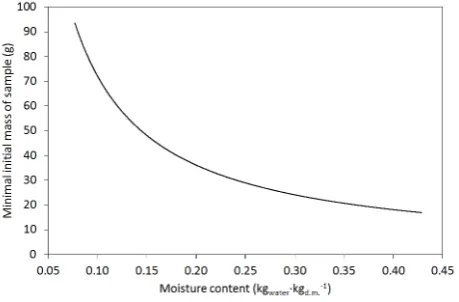
0.077 kgwater kgd.m.-1. On the basis of the findings, the initial mass of a sample was determined using the initial moisture content of 0.429 kgwater kgd.m.-1and the final moisture con-tent of 0.077 kgwater kgd.m.-1. It was calculated from Eq. (4), supplemented by assumed values of its parameters, that the minimal initial mass of a sample of kernels should be high-er than 93.62 g. The relation between the minimal initial mass of a sample and the moisture content of kernels for the assumed value of the maximum permissible relative error of the moisture content determination, known uncertainty of the measuring instruments and the assumed values of
the initial and final moisture content, is presented in Fig. 1.
Finally, taking into account an extra margin, the initial mass of a sample was set to 100±0.25 g.
A test stand was set up to carry out the drying expe- riments. For obtaining and maintaining drying air tempe- rature and relative humidity values at a desired level a com- puter-controlled climate chamber of 239 dm3 was used. A sample of maize kernels was placed inside the climate chamber on a perforated tray connected to the weighing mechanism of a laboratory balance (Radwag WPE 300). The balance was connected to a computer by serial inter-face RS232. Computer software enabled monitoring and controlling the laboratory balance operations, including periodic mass measurement of the product placed on the tray. For each replication of the experimental procedure, the mass of a dried sample was automatically measured and saved to a computer hard drive at the beginning of the pro-cess and after each 5 min interval. After the expiry of the drying time the mass of the sample dry matter was deter-mined by the oven-dry method – a sample was dried in the air temperature of 103ºC for 72 h (ASABE, 2009b) and a laboratory balance (Sartorius Basic BA 210S) was used to determine the mass.
After each replication, when the mass of a sample in each time step and the mass of sample dry matter were known, it was possible to calculate the moisture content in maize kernels.
The results of the experimental procedures were gen-eralised by the empirical formula (Eq. (1)), taking into account averaged values of the initial moisture content M0 of 0.347 and 0.335 kgwater kgd.m.-1, and averaged values of the final moisture content of 0.119 and 0.127 kgwater kgd.m.-1, respectively, for the relative humidity of drying air of 30% and 40%. The generalisation was performed by the Identix/ IPS software developed by the authors (Weres et al., 2009, 2014b).
A structural mathematical model of maize kernel drying in a thin layer is given in the form of quasi-linear differen-tial equations of heat conduction and water transfer with the initial and boundary conditions (Jia et al., 2000; Pabis
et al., 1998; Perré and Turnner, 2007; Ranjan et al., 2001; Weres and Jayas, 1994). In the present study the numeri-cal operational form of this model (Weres and Jayas, 1994) was used as the starting point for improvements with respect to efficiency and accuracy. It was constructed by the finite element approximation with the use of isoparametric, curvilinear, non-homogeneous three-dimensional elements and recurrence schemes in time, with iterative procedures to consider quasi-linearity of the problem. The coupling of the heat conduction and water transport equations was reduced and only the moisture content values were comput-ed. Due to the conditions under which the drying process took place, the effect of the third kind boundary condition was negligible, and it could be assumed that the surface of kernels attained the equilibrium moisture content after the
start of the drying process. The model was supplemented with the modified Chung-Pfost Eq. (5) to determine the equilibrium moisture content.
The maize kernel shape was represented by an irregu-lar geometry of three-dimensional, curvilinear, hexahedral, isoparametric finite elements (Weres and Jayas, 1994;
Weres et al., 2014b). For computations, 480 elements and 693 nodes were automatically generated by the software developed by the authors, and 300 time-stepping inter-vals were used. The parameters used to approximate the problem in space and time can be easily changed from the input window. The effect of the moisture content on the water diffusion coefficient was taken into consideration according to empirical formulas (Eqs (2) and (3)), and the coefficient identification procedure comprised the estima-tion of parameters of these formulas (a0, b0, a1, b1, c1).
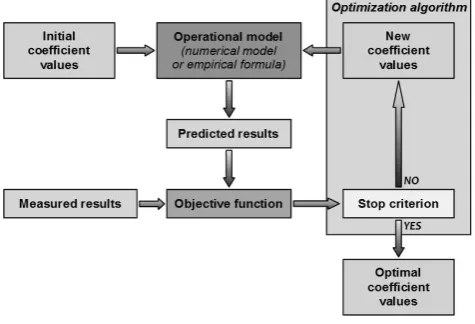
The diagram of the identification algorithm (Fig. 2) was based on the idea of solving inverse problems (Weres and Olek, 2005; Weres et al., 2009, 2014b). The objective function (Eq. (6)) was calculated as the sum of squared deviations between the measured and predicted average values of the moisture content in maize kernels for the investigated time intervals:
. ] ) ( ) ( [
1
2
∑
=
− = NT
i Me i Mp i
S
τ
τ
(6)
The trust region method was used in the identification processes as the local optimisation algorithm with con-straints (Weres et al., 2009). Validation of the numerical model filled with the estimated values of the water diffu-sion coefficient was performed by determining the local and the global relative errors of approximation (Weres and Jayas, 1994; Weres and Olek, 2005).
The computations were performed using the original software for determination and analysis of properties of agri-food and forest products (Weres et al., 2014b). The software comprises the discussed inverse finite element
modelling and identification approach, with a possibility to select among algorithms and performance options appro-priate for a given research.
RESULTS
The parameters of the empirical formula (Eq. (1)) obtained for the generalisation of the experimental data of moisture content changes for the relative humidity (RH)
of 30% and 40% are presented in Table 1. This table also
contains the values of uncertainty of the empirical formula (Eq. (1)) supplemented by obtained parameters, expressed as the global relative error of approximation.
The parameters of the two-parameter empirical for-mula (Eq. (2)) and also of the three-parameter empirical formula (Eq. (3)), which were the results of identifying the water diffusion coefficient, are presented in Tables 2 and 3, respectively.
The relations between the estimated results of the water diffusion coefficient and the moisture content inside maize kernels for drying air temperature of 40ºC and relative humidity of 30 and 40% are presented in Fig. 3. The values
Fig. 2.The diagram of the identification algorithm.
T a b l e 1. Results for the empirical formula (Eq. (1)) for gene- ralization of the experimental data of moisture content changes
RH (%)
Parameters Global relative error of approximation
(%)
A B K
30 0.178 0.057 0.279 1.31
40 0.163 0.052 0.260 1.16
T a b l e 2. Results for the two-parameter empirical formula (Eq. (2)) for presentation of the water diffusion coefficient
RH (%) Parameters Objective function
a0 b0
30 1.193 10-3 -1.060 100 0.042
40 1.654 10-3 -2.152 100 0.033
T a b l e 3. Results for the three-parameter empirical formula (Eq. (3)) for presentation of the water diffusion coefficient
RH (%)
Parameters Objective
function
a1 b1 c1
30 7.976 100 3.778 100 -1.453 101 0.031
of the water diffusion coefficient obtained using the empiri-cal formula (Eq. (2)) are the lowest at the initial moisture content. During the drying process, these values increase with decreasing moisture content to reach a maximum at the final moisture content. Analysing the results obtained using the empirical formula (Eq. (3)) it can be observed that the water diffusion coefficient increases with decrease of the moisture content from its initial value until it reaches a certain value. Further decrease of the moisture content causes a lowering of the value of this coefficient.
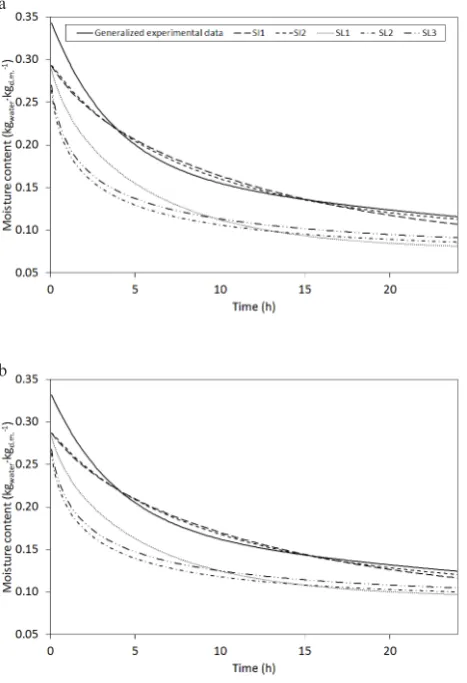
The estimated values of the water diffusion coefficient were used in the numerical structural model to predict the moisture content inside maize kernels dried in a thin layer for 24 h. Additionally, the literature values of the water dif-fusion coefficient were used in the predictions.
In total, five variants of computer simulations were performed. The simulation symbols and their meaning are given:
SI1, SI2 – the water diffusion coefficient values were esti-mated from Eq. (2) and Eq. (3), respectively, and then used for the simulations.
SL1, SL2, SL3 – the water diffusion coefficient values were taken from the literature, and then used for the simulations (Fig. 4). In case of SL1 a constant value of the water diffu-sion coefficient in the temperature of 40°C was taken (Pabis et al., 1998); in case of SL2 a moisture content dependent water diffusion coefficient was used (Chu and Hustrulid, 1968); and in case of SL3 a moisture content dependent water diffusion coefficient, differentiated for the kernel components: germ, floury endosperm, horny endosperm and pericarp was taken for the simulations (Syarief et al., 1984).
The predicted values of the moisture content in dried maize kernels are presented in Fig. 5a, b.
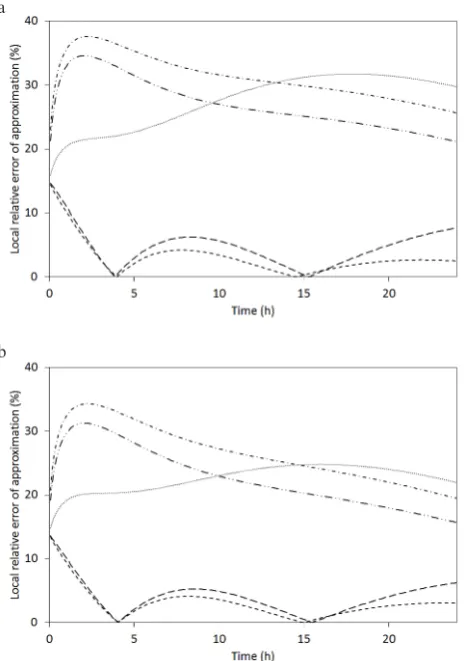
The information about the local relative error of approximation for the numerical structural model for diffe-rent values of the water diffusion coefficient is presented in
Fig. 3. The relation between the water diffusion coefficient and the moisture content inside corn kernels obtained for the drying air temperature of 40°C and the relative humidity of 30 and 40%.
Fig. 4. The relation between the water diffusion coefficient and the moisture content inside corn kernels for the drying air tem-perature of 40°C, simulations based on the literature data for the water diffusion coefficient.
Fig. 5. Generalized experimental data and the predicted values of the moisture content inside corn kernels dried in a thin layer at the drying air temperature of 40°C and the relative humidity of: a – 30 and b – 40%.
a
Fig. 6a, b. The uncertainties of the model measured by the global relative error of approximation for the relative humid-ity of 30% were: 6.82% for SI1, 5.87% for SI2, 25.08% for SL1, 32.72% for SL2 and 29.05% for SL3. For the relative humidity of 40% they were: 5.96% for SI1, 5.32% for SI2, 21.46% for SL1, 28.70% for SL2 and 25.21% for SL3. It can be observed that the simulation results obtained with the use of the water diffusion coefficient estimated in the present study have significantly lower uncertainty when compared to simulation results obtained with the use of the values of this coefficient from the literature.
CONCLUSIONS
1. A method for computer-aided identification of the water diffusion coefficient in maize kernels dried in a thin layer was developed on the basis of laboratory measure-ments and original finite element inverse analysis. The method was exemplified for the drying air temperature of 40°C and relative humidity of 30 and 40%.
2. Experimental data on moisture content changes in dried maize kernels were represented by the empirical
formula and they were an input to the procedure of identi -Fig. 6. The local relative error of approximation for predicting the moisture content inside corn kernels dried in a thin layer at the drying air temperature of 40°C and the relative humidity of: a – 30 and b – 40% for 5 simulation variants. Explanations as on Fig. 5. a
b
fying the water diffusion coefficient. The uncertainty of this empirical formula measured by the global relative error of approximation was 1.31 and 1.16%, respectively, for rela-tive humidity of 30 and 40%.
3. The values of the water diffusion coefficient esti-mated on the basis of the developed method were used to
enhance the numerical structural model and to predict more
reliable moisture content distributions inside maize kernels during the whole process of thin-layer drying. The global relative error of approximation for the predicted moisture content results was between 5.32 and 6.82% for the esti-mated values of the water diffusion coefficient. In the case of the coefficient values taken from the literature this error was between 21.46 and 32.72%.
4. The moisture content predictions corresponding to
the water diffusion coefficient represented by the three-parameter empirical formula were characterized by lower values of the average global relative error of approximation compared to the predictions in which the two-parameter
empirical formula was used, and the difference was ca.
0.8%.
Conflict of interest: The Authors do not declare con
-flict of interest.
REFERENCES
Akpinar E.K., Bicer Y., and Yildiz C., 2003. Thin layer drying of red pepper. J. Food Eng., 59, 99-104.
ASABE Standards, 2009a. D245.6 OCT2007: Moisture relation-ships of plant-based agricultural products. ASABE, St. Joseph, MI, USA.
ASABE Standards, 2009b. S352.2 APR1988 (R2008): Moisture measurement – unground grain and seeds. ASABE, St. Joseph, MI, USA.
Babalis S.J., Papanicolaou E., Kyriakis N., and Belessiotis V.G., 2006. Evaluation of thin-layer drying models for describing drying kinetics of figs (Ficus carica). J. Food Eng., 75, 205-214.
Chen G., Maier D.E., Campanella O.H., and Takhar P.S., 2009. Modeling of moisture diffusivities for components of yellow-dent corn kernels. J. Cereal Sci., 50(1), 82-90. Chu S.-T. and Hustrulid A., 1968. General characteristics of
variable diffusivity process and the dynamic equilibrium moisture content. Trans. ASAE, 11(5), 709-715.
Doymaz I. and Pala M., 2003. The thin-layer drying characteris-tics of corn. J. Food Eng., 60(2), 125-130.
Erbay Z. and Icier F., 2010. A review of thin layer drying of foods: theory, modeling, and experimental results. Critical Reviews in Food Sci. Nutrition, 50(5), 441-464.
Hacihafizoglu O., Kahveci K., Cihan A., and Akyol E., 2011. Finite element simulation of thin layer drying of corn. Proc. 9th WSEAS Int. Conf. Fluid Mechanics and Aerodynamics, WSEAS Press, Athens, Greece.
Jaros M., Cenkowski S., Jayas D.S., and Pabis S., 1992. A method of determination of the diffusion coefficient based on kernel moisture content and its temperature. Drying Technol., 10(1), 213-222.
Jia C.C., Sun D.-W., and Cao C.W., 2000. Mathematical simula-tion of temperature and moisture fields within a grain kernel during drying. Drying Technol., 18(6), 1305-1325. Kumar C., Karim A., Saha S.C., Joardder M.U.H., Brown R.,
and Biswas D., 2012. Multiphysics modelling of convec-tive drying of food materials. Proc. Global Eng., Science and Technology Conference, Global Institute of Science and Technology, December 28-29, Dhaka, Bangladesh. Muthukumarappan K. and Gunasekaran S., 2009. Modeling
moisture diffusion in food grains during adsorption. In: Food Processing Operations Modeling. Design and Analysis (Eds S. Jun and J. Irudayaraj). CRC Press, Boca Raton, FL, USA.
Nemenyi M., Czaba I., Kovacs A., and Jani T., 2000. Investi- gation of simultaneous heat and mass transfer within the maize kernels during drying. Computers and Electronics Agriculture, 26(2), 123-135.
Olek W., Perré P., and Weres J., 2011. Implementation of a re- laxation equilibrium term in the convective boundary con-dition for a better representation of the transient bound water diffusion in wood. Wood Sci. Technol., 45(4), 677-691.
Pabis S., Jayas D.S., and Cenkowski S., 1998. Grain drying. Theory and practice. Wiley Press, New York, NY, USA. Perré P. and Turner I., 2007. Coupled heat and mass transfer.
In: Fundamentals of Wood Drying (Ed. P. Perré), A.R.BO. LOR, Nancy, France.
Ranjan R., Irudayaraj J., and Jun S., 2001. Three-dimensional control volume approach to modeling heat and mass trans-fer in food materials. Trans. ASAE, 44(6), 1975-1982. Suleiman R., Rosentrater K., and Bern C., 2013. Effects of
deterioration parameters on storage of maize: a review. J. Natural Sciences Research, 3(9), 147-165.
Syarief A.M., Gustafson R.J., and Morey R.V., 1984. Moisture diffusion coefficients for yellow-dent corn components. ASAE Paper No. 84-355. ASAE, St. Joseph, MI, USA. Weres J. and Jayas D.S., 1994. Effects of corn kernel properties
on predictions of moisture transport in the thin-layer drying of corn. Trans. ASAE, 37(5), 1695-1705.
Weres J., Kiecana M., and Balcerzak K., 2014a. Two approach-es to reprapproach-esenting agri-food product geometry – an original software for constructing finite element models and the 3ds Max approach. J. Research Applications Agric. Eng., 59(1), 155-158.
Weres J., Olek W., Kujawa S., and Siatkowski M., 2014b. Integration of software components for determination and analysis of properties of agri-food and forest products. J. Research Applications in Agricultural Eng., 59(1), 159-163.
Weres J. and Olek W., 2005. Inverse finite element analysis of technological processes of heat and mass transport in agri-cultural and forest products. Drying Technol., 23(8), 1737-1750.