Full Length Research Article
STOCHASTIC APPROACH - MARKOV CHAIN APPLIED TO THE ANALYSIS AND
PROJECT OF THE INFORMATION SYSTEMS ORIENTED TO OBJECT
1*
Joaquim Rodrigo de Oliveira,
2Antônio Sérgio Coelho,
3Stéfano Frizzo Stefenon and
4Cristina Keiko Yamaguchi
1
Professor at University of Planalto Catarinense
2
Associate professor II of the Federal University of Santa Catarina
3
Coordinator of the Electrical Engineering at University of Planalto Catarinense
4
Professor of University of Extremo Sul Catarinense
ARTICLE INFO ABSTRACT
This research sought an understanding of the implementation of a stochastic approach, as applied to analysis and development of information systems to object-oriented. In order to contribute towards advancing the scope of the area called System Analysis and Development, whose focus is on modeling the view of management, execution and process engineering. From an existing template, the Unified Process, was created the diagram of transition of states graphically that represents the Markov Chain, concerned with the probability of transition between their steps. The application of the stochastic approach will allow better control of the transition from each state in which you encounter the process of creation, validating the possibility of applying the use of Markov Chains in the development any information system, and will obtain results around capacity, time and cost of production; minimizing costs and maximizing profit.
Copyright© 2017, Joaquim Rodrigo de Oliveira et al. This is an open access article distributed under the Creative Commons Attribution License, which permits
unrestricted use, distribution, and reproduction in any medium, provided the original work is properly cited.
INTRODUCTION
The models are simplified representations of reality, it fell to Systems Engineering a significant share of contribution for the process of structuring and systematizing the modeling. Since few applications used in Engineering and Computer Science, suggest the analysis and development of project information systems object-oriented, by applying a stochastic approach (Wazlawick, 2011). According to Clarke & Disney (1979) once a stochastic process involves the behavior of a system over a period of time, this process should start by specifying the set of time T involved, in general terms, it is a phenomenon that varies to some degree, in an unpredictable way, as time goes by. Markov chains are often used for dynamic process model, the behavior of such a system can often be characterized by a stationary analysis of distribution required to obtain analytical results. According to Meyn & Tweedie (2009) it is a particular type of stochastic process that is based on a defined sequence being stationary the probability and transition. In this study it was applied a process model of analysis and development of information systems uses the
*Corresponding author: Joaquim Rodrigo de Oliveira,
Professor at University of Planalto Catarinense.
Unified Process - PU, a process of software engineering which uses the object-oriented approach in its conception (Mclaughlin et al, 2007), it was developed and documented using the Unified Modeling Language – UML notation, which is a unified modeling language, used to illustrate the processes in action. The goal is to present a model of state transition diagram that graphically represents the Markov chain, using the Unified Process - PU applied to analysis and to the development of information systems oriented towards object, thus enabling the understanding in a conscious and effective form about the implementation of the model. The justification comes from observation that there is a vast literature aimed towards the presentation of analysis and development of information system, not worrying about the probability of transition between its states. The application of stochastic approach will enable the control of the transition from each state that the process of creation is encountered, seeking contribution to advances in the scope of the area called System Analysis and development, in which the focus is on the modeling, view of the management, execution and process engineering (Tricoire, 2012). This kind of application can be used to solve many kinds-types of organization problems (Xiao et al, 2016).
ISSN: 2230-9926
International Journal of Development Research
Vol. 07, Issue, 06, pp.13139-13143, June,2017
DEVELOPMENT RESEARCH
Article History:
Received 04th March, 2017
Received in revised form 19th April, 2017
Accepted 27th May, 2017
Published online 20th June, 2017
Key Words:
Stochastic Approach,
INFORMATION SYSTEMS DEVELOPMENT PROCESS ORIENTED TOWARDS OBJECTS
The process, in the context of Software Engineering, refers to the process of development of information systems, i.e. consists of the necessary states to the construction and conclusion of a software, from the beginning, through the steps of approval and then coming to the final training, in regards to the user on the new tool. Its goal is the construction of devices, software, or the improvement of an existing product, through the participation of various types of users (customers, final users, developers, managers, etc.) (Laudon & Laudon, 2010). There are various processes that proposed to be suitable for software construction. This task has already been thought of many times. Even before help of UML, we had an informal process of software construction, which was summarized to gathering requirements (needs), for the definition of an Entity Model and Relationship (MER) and finally the encoding was started (Medeiros, 2004).
A process must define WHO is doing WHAT, WHEN and HOW, for a goal to be reached (Malone, 2005). When an information system oriented towards objects is developed starting from scratch, the development is the process of creation starting from the requirements. However, after it has taken shape (that is, has passed from the initial development cycle), subsequent developments will be the process of adapting to new or changed requirements. This applies throughout the entire life cycle of the information system. From good software practices, much has been sought to develop studies that give subsidies for a good construction of an information system that it has not been designed, and it is detriment with all existing technology. For years, it has tried to project software having as a comparative the Civil Construction, the major problem is the requirements collection that undergo several changes. According to Wazlawick (2011), buying a hammer does not transform you into an architect, it might be necessary, but it is not enough.
Unified Process- UP
It fits in the general definition of a process: a set of activities executed to transform a set of customer requirements in an information system. According to Scott & Prince (2003) the UP makes extensive use of the UML, wherein in its core is the model, which in the context of a development process is a simplification of reality that helps to understand some complex aspects inherent to these systems. Three “gurus” of object orientation have also proposed the UP: Grady Booch, James Rumbaugh and Ivar Jacobson, it being the result of over thirty years of accumulated experience (Wazlawick, 2011).
It is based on three values:
It is directed by cases of usage: development planning is done on the basis of identified-case usage, treating the most complex with priority.
It is focused on architecture: the development process prioritizes the construction of an architectural system that will allow the carry out of the requirements. This architecture is based on the identification of a class structure, produced based of a conceptual model.
It is interactive and incremental: on each work cycle performed, new features are added to the information
system architecture, making it more complete and closer to the final version.
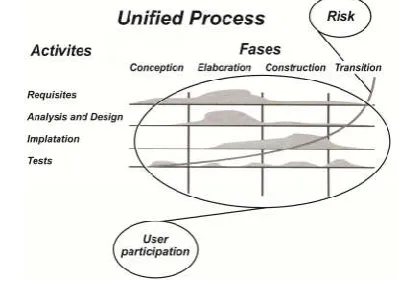
[image:2.595.328.527.233.374.2]It holds in its disciplines the activities of the study of viability, requirements analysis, domain analysis and development. Given that these activities appear associated, with greater or lesser emphasis on the four phases, which are: creation, elaboration, construction and transition. Wazlawick (2011) defines the creation phase and also incorporates the viability study, the requirements gathering is a part of the analysis. The elaboration phase includes the details of the requirement analysis, domain modeling and development. The construction phase corresponds to the programming and testing, and the transition phase consists in the installation of the information system and data migration.
Figure 1. The different emphases of development activities throughout the four phases of the UP (Medeiros, 2004)
The UP defines a set of activities: Well defined; With responsible; With input and output devices; With dependencies and execution order; With a life cycle model; With a systematic description of how to perform them; Using the UML modeling language.
Modeling of an Information System Oriented Towards Objects
The models provide a plan of the project of an information system; it may include detailed plans, as well as more generalized plans with a panoramic view of the considered system (Shitsuka et al, 2005)
0
. Any information system can be described under different aspects, with the use of different models, and each model will be a specific semantic abstraction of the information system. Modeling is a central part of all the activities that lead to the establishment of a good information system. We build models to communicate the structure and the desired behavior of the system, to view and control the architecture, to better understand the system we are developing, often exposing opportunities for simplification and reuse and to manage risks. The choice of models to be created has an influence on how a particular problem is handled and how a solution is defined (Booch, 2012).We build models of complex systems because it is not possible to understand them in their entireties. For Booch (2012) the contemporary view on the development of information systems adopts a paradigm object-oriented, the main building block of all information systems is the object or class. An object is something usually structured from the vocabulary of the problem space and the solution space, a class is a description of a set of common objects. All objects have an identity, you can assign them names or distinguish them from other objects in some way by the states or behavior. The object orientation used for the development of information systems, is a part of the main flow, because its worth has been proven for the construction of systems in all kinds of problem domains, including all degrees of size and complexity. The UML is developed to visualize, specify, construct, and document information object-oriented systems.
STOCHASTIC PROCESSES
The stochastic processes are of interest in describing the behavior of a system operating over some period (França, 2009). A stochastic process is a phenomenon that varies to some degree, unpredictably, as time goes by. The unpredictability in this case implies that an entire time sequence of the process at various different occasions under identical conditions was observed, the resulting sequences under observation would be in general different. Thus, the probability appears, but not in the sense that each output of a random experience determines only a single number (Clarke & Disney, 1979). The random experience determines the behavior of some systems for a sequence or a full-time interval, which is the result of random experience being that a sequence or series of values, a function and not being a unique number. This study considered only one type of discrete T, consisting of a sequence of consecutive integers.
T = {0,1,2,3…} or T = {1,2,3,…} (1)
And a type of continuous T, consisting of all subsequent times to some given origin.
T = {t: 0 ≤ t <∞} (2)
Clarke & Disney (1979) defines that in each point t of the set of time T, it can be observed a measure or random variable Xt, so it is assumed that some random experiment is given and for each one sample point or experimental result, corresponds not only to a single number but to a whole Xt 0If the sample point or experimental result is indicated by s, then the function will be:
X
t(s) for t = T
(3)The random function of t is called a stochastic process or random process. Being a single sequence of observations Xt that corresponds to one sample point s is called a realization of the stochastic process.
Markov Chains: Probability and stationary transition
Markov chain whose transition probabilities are independent of n are said to have stationary transition probabilities or that they are homogeneous in time, and in this case;
P(Xn+1 = j | Xn = i) = P(X1 = j | X0 = i), ∀n ≥ 1 (4)
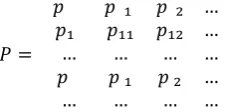
According to Hillier & Lieberman (2006) the Markovian property says that the conditional probability of any "event" in the future, given any past "events" and the present state Xt = i, is independent of past events and depend only on the current event (Hillier & Lieberman, 2006). The transition probabilities in one step can be displayed as a square matrix called transition matrix probabilities, P from the chain, as the following:
=
₁ ₂ …
₁ ₁₁ ₁₂ …
… … … …
₁ ₂ …
… … … …
(5)
In this matrix, the lines correspond to the states of the process, that is, the values that the random variables X0; X1; ... Assume for each fixed t, t = 0; t = 1./ ... therefore it follows that:
≥ 0, ∀ , = 0,1, …
∑∞ = 1, = 0, 1, …
(6) [image:3.595.307.422.188.244.2]
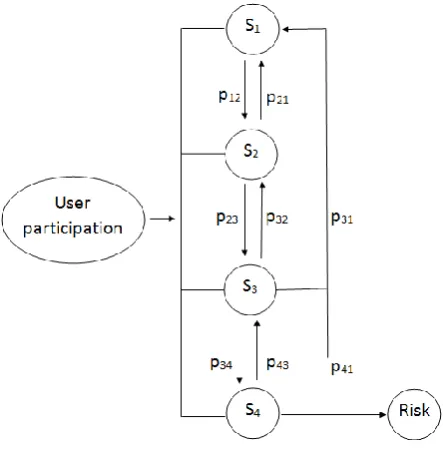
The state transition probabilities in one step can be represented by a diagram called state transition diagram. The transition diagram is a graphical representation of a Markov chain. In this diagram the states are shown (represented by circles), transitions (represented by arcs) and the probabilities of transitions. Generalizing, it can represent the states and transition probabilities, respectively, by Ei and pij where i and j are an index that identifies the various possible states (so pij is the probability of a state transition from Ei to the state of Ej). From this generalization, one can draw a diagram, as in Figure 2:
Figure 2. States Transition Diagram
APPLICATION OF THE STOCHASTIC APPROACH
The study is associated with the fact of the possibility of "forecast" of the impact of changes in the process, in respect to the four states of the UP applied to the analysis of development of information systems oriented towards objects: conception, elaboration, construction and transition, utilizing the states transition diagram in the representation of transitions.
to define the capacity, time and cost of production. In this way seeking to take the adequate decision to maximize profit and minimize cost, so adapting the project to its technical and budget specifications. In the stochastic modeling we will consider the UP as not deterministic, but probabilistic. This way, it is possible to combine the actual data with those interpreted to generate a number of equally likely scenarios. The state Transition Diagram will run a simulation, according to the states of transition in the development of the project.
States transition diagram - Unified Process (UP)
[image:4.595.51.273.392.617.2]The UP foresees four major phases: S1 - Conception, S2 - Elaboration, S3 – Construction and S4 – Transition figure 3 shows the stochastic modeling through the transition diagram, which is a graphical representation of a Markov chain, which aims to control the transition from each state that the process of creation of an object-oriented system development project is encountered. Iterations occur within each state; a state may have one or more iterations. According to Medeiros (2004) the UP foresees five Workflows, which are: Requirements; Analysis; Project; Implantation; Tests. The term workflows has here the meaning of a set of activities with a common goal. These are the activities for which it must go through when it is in a state, each state can predict the five activities. The user has participation in all states with more intensity in the design, in the transition state it is clear the risk, being that in this state the implementation happens.
Figure 3. Model of State Transition diagram for the Unified Process – UP
Expected results
The optimization in the production processes is of great importance for companies, in the creation of development of information system oriented towards objects, it is clear the difficulty of control in the transition between the creation of states, making it difficult to minimize costs and production time. The Research shows the possibility of applying the Stochastic Approach using Markov chains through a transition diagram in any development of information systems, being that results around capacity development, time and costs will be obtained, allowing the full feasibility of the project.
Research methodology
According to Lakatos and Marconi (1996, p 15): "to Search is not just seek the truth; It is to find answers to questions proposed, by using scientific methods.” By this definition we see that the research is not something simple, in this study the descriptive research was used which is a kind of conclusive research and has as a main objective the description of some phenomenon (Lakatos & Marconi, 1996). The development of the research involved two areas of knowledge, systems analysis and Stochastic Processes development, appropriate insights were made gradually. Below are the steps:
Research on Stochastic Processes and their applications;
Research on Systems Analysis and development and its importance today, as well as applications and study suggestions in the area;
Research on Modeling of Information Systems and
Object Orientation and its applications;
Scenario analysis for application of strategies of
stochastic approaches in the solution.
Problem modeling
In the area of analysis and information systems development we question the form of how to measure the time, effort and cost that a project will consume, thus the stochastic approach proposed enables the control of time by applying Markov chain, and for the capacity control of production and costs the state transition diagram is used. During the analysis and information system development oriented towards objects, what is the capacity of production and costs involved using the Unified Process - UP?
CONCLUDING CONSIDIRATIONS
The application of the stochastic approach on information systems development currently is little used, therefore, the goal was to present a model of state transition diagram that represents graphically the Markov chain using the Unified Process - UP applied the analysis and development of information systems object-oriented. The optimization of the production processes is of great importance for businesses, in the creation of an information system project, it is clear the difficulty of control in the transition between the creation of states, making it difficult to minimize costs and production time. Research shows the possibility of applying a Stochastic Approach using Markov chains through a transition diagram in any project, and results around the capacity development, time and costs will be obtained, allowing the full feasibility of the project.
REFERENCES
Booch, G. 2012. UML: User's Guide. 2ª ed. Editora Campus. Rio de Janeiro, Brasil. 472 pp.
Clarke, A.B. & Disney, R. L. 1979. Probability and statistical processes. Technical Books and Scientific Publishing. Rio de Janeiro, Brasil. 1338 pp.
Hillier, F. S. & Lieberman, G. J. 2006. Introduction to
Operations Research. 8ª ed. McGRAW-HILL. São Paulo,
Brasil. 828 pp.
Lakatos, E. M. & Marconi, M. A. 1996. Research techniques: planning and execution of research, sampling and research techniques, preparation, analysis and interpretation of data. 3ª ed. Atlas. São Paulo, Brasil. 277 pp.
Laudon, K. C. & Laudon, J. P. 2010. Systems of management information. 9ª ed. Pearson Education. São Paulo, Brasil. 452 pp.
Malone, D. M. 2005. Deposition Rules: The Essential
Handbook to Who, What, When, Where, Why, and How. National Institute for Trial Advocacy. Chicado, USA. 186 pp.
Mclaughlin, B., Pollice, G. & West, D. 2007. Use your brain: analysis & design object-oriented. Alta Books. Rio de Janeiro, Brasil. 472 pp.
Medeiros, E. 2004. Developing software with UML 2.0:
Definitive. Pearson Education. São Paulo, Brasil. 264 pp. Meyn, S. & Tweedie, R. L. 2009. Markov chains and
stochastic stability. Cambridge. New York, USA. 624 pp.
Scott, K. & Prince, A. M. A. 2003. The unified process explained. Bookman. São Paulo, Brasil. 160 pp.
Shitsuka, R., Shitsuka, C. D. W. M., Shitsuka, R. C. M. & Shitsuka, D. M. 2005. Information systems: a computational approach. Ciência Moderna. São Paulo, Brasil. 328 pp. Tricoire, F., Graf, A. & Gutjahr, W. J. 2012. The bi-objective
stochastic covering tour problem. Computers and Operation
Research. 39: 1582–1592.
Xiao, G., Jaarsveld, W. V., Dong, M. & Klundert, J. V. 2016. Stochastic programming analysis and solutions to schedule
overcrowded operating rooms in China. Computers and
Operation Research. 74: 78–91.
Wazlawick, R. S. 2011. Analysis and design of information systems object to oriented. Campus. Rio de Janeiro, Brasil. 298 pp.