REVIEW
Development of the lymphatic system: new questions and
paradigms
Jonathan Semo*, Julian Nicenboim* and Karina Yaniv‡
ABSTRACT
The lymphatic system is a blind-ended network of vessels that plays important roles in mediating tissue fluid homeostasis, intestinal lipid absorption and the immune response. A profound understanding of the development of lymphatic vessels, as well as of the molecular cues governing their formation and morphogenesis, might prove essential for our ability to treat lymphatic-related diseases. The embryonic origins of lymphatic vessels have been debated for over a century, with a model claiming a venous origin for the lymphatic endothelium being predominant. However, recent studies have provided new insights into the origins of lymphatic vessels. Here, we review the molecular mechanisms controlling lymphatic specification and sprouting, and we discuss exciting findings that shed new light on previously uncharacterized sources of lymphatic endothelial cells.
KEY WORDS: Endothelial, Lymphatic, Embryonic origin, Venous
Introduction
The blood and lymphatic systems are the two major circulatory systems of the body. The lymphatic system is a blind-ended network of vessels that plays several important roles during normal physiology. Lymphatic capillaries help maintain tissue fluid homeostasis by absorbing extravasated fluid and transporting it back to the venous circulation via larger collecting lymphatic vessels. In addition, lymphatic vessels play an important role in immune surveillance in mammals, serving as the main conduit of antigens and antigen-presenting cells from the periphery to lymph nodes, thus allowing the initiation of the immune response (Alitalo and Carmeliet, 2002). Finally, the lymphatic system is crucial for the absorption of dietary fats (Tso and Balint, 1986).
Lymphatic vessel malfunction is associated with the pathogenesis of many diseases, including lymphedema, fibrosis and inflammation. In malignancies, tumor-related lymphangiogenesis is an important mechanism by which metastatic cells disseminate to distant organs and lymph nodes. In addition, lymphangiogenesis is associated with inflammatory diseases such as rheumatoid arthritis and psoriasis (Alitalo and Carmeliet, 2002). A detailed understanding of the development of lymphatic vessels, as well as of the molecular cues governing their formation and morphogenesis, might therefore prove essential for our ability to treat lymphatic-related diseases. In this Review we attempt to integrate recent advances in our understanding of the molecular and cellular mechanisms governing the development of the lymphatic system. We focus mostly on studies carried out in mouse and zebrafish, and highlight the major similarities and differences between these two
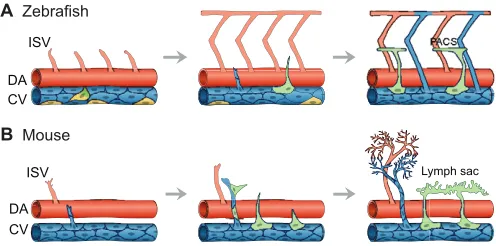
organisms in terms of lymphatic vessel development (Fig. 1, Box 1). We then discuss the embryonic origins of the lymphatic system and provide a thorough historical analysis of the evolution of this field of research, with a special focus on the animal models and experimental approaches utilized. Finally, we discuss exciting findings from the past year highlighting novel potential sources for lymphatic endothelial cells.
Molecular mechanisms underlying early lymphatic development
Despite its importance, research into the development of the lymphatic system has fallen behind that of arteries and veins, mostly because these thin-walled vessels are difficult to visualizein vivo. However, the identification of transcription factors and markers that highlight the lymphatic endothelium (Table 1) has significantly advanced our understanding of lymphatic vessel formation. In addition, recent studies have implicated a number of signaling pathways in the development of the lymphatic system.
Transcriptional control of lymphatic cell fate specification
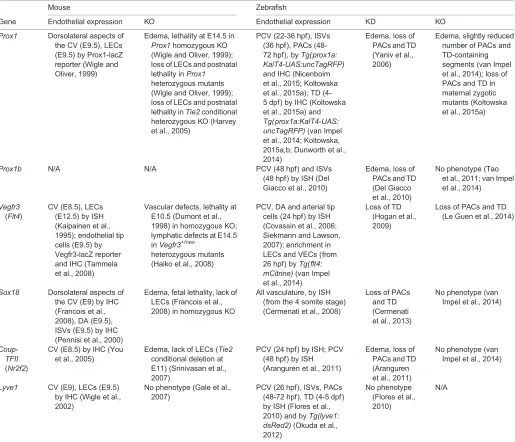
The process of lymphatic cell specification requires the tight spatiotemporal coordination of gene expression (Fig. 2). Indeed, various knockout (KO) and knockdown (KD) studies carried out in mice and zebrafish (Table 1) have identified some of the key transcription factors that play a role in specifying cells towards a lymphatic fate.
Prox1 ( prospero-related homeobox gene 1), which encodes a homeodomain transcription factor, was the first gene demonstrated to be essential for proper lymphatic system development. Prox1 KO mice lack lymph sacs and lymphatic vessels (Wigle and Oliver, 1999) and die early during development due to multiple developmental defects. In addition, the endothelial-specific KO of Prox1 results in lymphatic defects and in postnatal lethality (Harvey et al., 2005). In turn,Prox1overexpression is sufficient to direct endothelial cells (ECs) towards a lymphatic fate both in vitro(Hong et al., 2002) andin vivo(Kim et al., 2010). In mouse embryos, Prox1 expression is initially detected in a restricted population of ECs within the cardinal vein (CV) at embryonic day (E) 9.5 (Srinivasan et al., 2007; Wigle and Oliver, 1999). Although the majority of Prox1-positive ECs bud off the CV to give rise to primitive lymph sacs, a smaller population remains in the vein and forms the lymph-venous valves, which help prevent the backflow of lymphatic fluid into the blood circulation (Srinivasan and Oliver, 2011). In zebrafish, the expression of prox1a(one of two zebrafish orthologs of mammalian Prox1) is detected in the ventral side of the posterior cardinal vein (PCV) at 22-24 h post-fertilization (hpf ) (Nicenboim et al., 2015), and at more dorsal positions within the PCV at ∼30 hpf (Koltowska et al., 2015a). Theprox1a-positive ECs later divide and bud off the PCV to give rise to parachordal cells (PACs), the building blocks of the fish lymphatic system (Hogan et al., 2009; Lim et al., Department of Biological Regulation, Weizmann Institute of Science, Rehovot
76100, Israel.
*These authors contributed equally to this work
‡
Author for correspondence ([email protected])
DEVEL
O
2011; Yaniv et al., 2006). KD of prox1a using ATG antisense morpholino oligonucleotides (MOs) results in reduced numbers of PACs and a defective thoracic duct (Yaniv et al., 2006). By contrast, prox1a homozygous mutants display rather mild lymphatic defects (Koltowska et al., 2015a; van Impel et al., 2014). This discrepancy between phenotypes has recently been shown to result from the presence of maternally contributed transcripts in prox1a−/− embryos, as maternal zygotic mutants carrying a mutation in the same gene were shown to display a severe lymphatic phenotype, including reduced numbers of PACs and absence of the thoracic duct (Koltowska et al., 2015a).
Zebrafish embryos also express prox1b, a second ortholog of mammalianProx1(Deguchi et al., 2009) (Table 1). The expression pattern, as well as the function, of prox1bremains controversial, with one study reporting expression ofprox1bmRNA in the PCV and venous sprouts at 48 hpf, but not in PACs (Del Giacco et al., 2010), and another showing expression of a prox1b transgenic reporter in lymphatic progenitors at comparable developmental stages (Tao et al., 2011). Moreover, whereas the MO-based KD of prox1bresults in defective lymphangiogenesis (Del Giacco et al., 2010), two different prox1b mutant alleles display no apparent lymphatic phenotypes (Tao et al., 2011; van Impel et al., 2014). Additional experiments analyzing the potential maternal contribution of prox1b transcripts might be required in order to ascertain the exact role of this gene during zebrafish lymphatic development.
In addition to Prox1, and prior to its appearance (at E9.5), the transcription factor Sox18 is detected in a dorsolateral subpopulation of ECs within the anterior CV of the developing mouse embryo (François et al., 2008). Sox18, which was shown to be activated by the MAPK/ERK signaling pathway within mouse embryonic veins, induces the expression of Prox1 in the same subpopulation of venous ECs (Deng et al., 2013; Duong et al., 2014). The loss of functional Sox18 results in edema in certain mouse strains, highlighting its important role during lymphatic development (François et al., 2008). In zebrafish,sox18is expressed throughout the entire CV and is also detected in the dorsal aorta (DA) (Cermenati et al., 2008, 2013). As for prox1b, various differences in MO-induced versus mutant phenotypes have been reported forsox18(Cermenati et al., 2013; van Impel et al., 2014)
(Table 1), and again the analysis of mutants lacking maternalsox18 might be required in order to resolve these discrepancies.
An additional transcription factor required during lymphatic specification is COUP transcription factor 2 (Coup-TFII, also known as Nr2f2). Coup-TFII, which is first expressed in the CV of the mouse embryo at E8.5, was shown to promote venous identity by suppressing arterial gene expression (You et al., 2005). Later on (∼E9), Coup-TFII activates Prox1 expression in the mouse embryonic veins by directly binding a conserved DNA domain in the regulatory region of theProx1gene (Srinivasan et al., 2010). In addition, a direct interaction between Coup-TFII and Prox1 was found to be necessary for the maintenance of Prox1 expression during the early stages of lymphatic endothelial cell (LEC) specification and differentiation (Srinivasan et al., 2010; Srinivasan and Oliver, 2011). The role of Coup-TFII during lymphatic development has been analyzed in zebrafish andXenopus embryos. No lymphatic defects were detected in coup-TFII homozygous zebrafish mutants (van Impel et al., 2014), whereas MO-based KD experiments have suggested that coup-TFII is indispensable for lymphatic development in zebrafish andXenopus (Aranguren et al., 2011). Here too, therefore, discrepancies between KD (Aranguren et al., 2011) and KO (Kok et al., 2015; van Impel et al., 2014) phenotypes have presented difficulties in understanding the exact role of this transcription factor during lymphangiogenesis in these animal models (Table 1).
Although certain inconsistencies regarding the role of key transcription factors controlling lymphatic specification have been reported for mice and zebrafish (van Impel et al., 2014) (Table 1), these two animal models do appear to have more in common than previously appreciated. The discovery that, like in mammals, Prox1a is detected in a subpopulation of pre-specified LECs within the PCV of zebrafish embryos, and is required for proper lymphatic development (Koltowska et al., 2015a; Nicenboim et al., 2015), clearly highlights the conservation of this process across vertebrate species. It seems likely that the generation of additional zebrafish maternal-zygotic
Box 1. Development of the lymphatic system: a highly conserved process in vertebrates
The mechanisms underlying the development of both the blood and lymphatic vascular systems in mice and zebrafish are generally conserved. In mice, the first stages of blood vessel development involve the concurrent sprouting of intersomitic arteries and veins from the DA and CV at E8 (Walls et al., 2008). In zebrafish, this process is slightly different, as the formation of ISVs takes place sequentially, with arterial ECs sprouting from the DA at∼20 hpf, followed by venous ECs sprouting at∼30 hpf (Isogai et al., 2003). Early lymphatic development can be divided into two main processes: (1) the specification of cells towards a lymphatic fate; and (2) the sprouting of LEC progenitors to generate lymph sacs. Although the exact developmental stage at which LEC progenitors become specified towards a lymphatic fate was suggested to differ between mice and zebrafish (van Impel et al., 2014), recent reports suggest that the process is in fact similar in both species. At E9.5 in mice and at∼24-36 hpf in zebrafish, the first
Prox1-positive cells are detected in the CV, marking the onset of LEC specification (Koltowska et al., 2015a; Nicenboim et al., 2015; Wigle and Oliver, 1999). In mice, intersomitic veins represent an additional source of LECs (Yang et al., 2012). Following LEC specification in mice, Prox1-positive LECs bud off from the CV to generate primitive lymph sacs. In a similar fashion, zebrafish prespecified lymphatic progenitors sprout from the CV at∼36 hpf and migrate dorsally towards the horizontal myoseptum to give rise to PACs, a chain of superficial longitudinal cells considered to be the equivalent to the mammalian lymph sacs (Isogai et al., 2003; Koltowska et al., 2015a; Yaniv et al., 2006).
A Zebrafish
B Mouse ISV
DA CV
ISV
DA CV
PACS
[image:2.612.50.298.58.181.2]Lymph sac
Fig. 1. An overview of lymphatic system development.Schematic model of early lymphatic development in zebrafish (A) and mouse (B). Arteries and veins are shown in red and blue, respectively. In both zebrafish and mouse, the cardinal vein (CV, blue) acts as a source of cells that become specified towards a lymphatic fate (green), giving rise to parachordal cells (PACs), which are the building blocks of the fish lymphatic system, or lymph sacs in the case of mouse. In mouse, lymphatic endothelial cells (LECs) also bud off from intersomitic veins (B, middle panel). In zebrafish, lymphatic progenitors are derived from a subpopulation of specialized angioblasts (yellow) within the posterior cardinal vein (PCV) through asymmetric cell division.
DEVEL
O
mutants, like those generated forprox1a(Koltowska et al., 2015a), or the identification of putative compensatory mechanisms acting specifically in mutants (Rossi et al., 2015), will be necessary in order to clearly define the similarities and differences in lymphatic vessel formation between these two organisms.
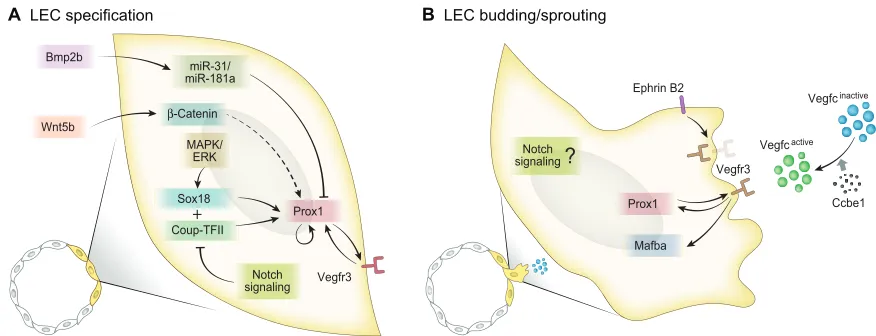
Signaling pathways governing lymphatic cell fate specification While the early cell-autonomous cascade governing LEC specification within a subpopulation of cells in the CV is well established, less is known about exogenous cues inducing lymphatic cell fate specification. Recently, however, a few studies have begun to identify roles for the bone morphogenetic protein (BMP), Wnt, Notch and vascular endothelial growth factor (VEGF) signaling pathways in controlling lymphatic system development (Fig. 2).
As shown for other differentiation processes taking place during embryogenesis (Clevers, 2006; Wang et al., 2014), both BMP and Wnt signaling appear to be involved in the specification of
lymphatic cell fate. Members of the BMP family act as repressors of lymphatic formationin vivo(Dunworth et al., 2014; Levet et al., 2013; Yoshimatsu et al., 2013). In zebrafish, Bmp2b upregulation at 25-26 hpf induces ectopic venous sprouting, whereas forced expression of Noggin 3, which is an endogenous inhibitor of BMP signaling, results in impaired caudal vein plexus formation (Wiley et al., 2011). Interestingly, a recent study has shown that Bmp2b induces venous differentiation through the activation of a novelβ-catenin/Coup-TFII axis (Kashiwada et al., 2015).
[image:3.612.50.565.69.511.2]In addition to its role as a strong inducer of venous cell fate, Bmp2b was shown to negatively modulate lymphatic fate specification in zebrafish by inhibiting the expression of prox1a via miR-31 and miR-181a, in a SMAD-dependent manner (Dunworth et al., 2014). In turn, the upregulation of bmp2b in zebrafish embryos results in decreasedprox1expression in sorted ECs, suggesting a clear negative effect on LEC specification. Nevertheless, because these experiments were carried out at Table 1. Factors involved in lymphatic specification: insights from KO and KD studies
Gene
Mouse Zebrafish
Endothelial expression KO Endothelial expression KD KO
Prox1 Dorsolateral aspects of the CV (E9.5), LECs (E9.5) by Prox1-lacZ reporter (Wigle and Oliver, 1999)
Edema, lethality at E14.5 in
Prox1homozygous KO (Wigle and Oliver, 1999); loss of LECs and postnatal lethality inProx1
heterozygous mutants (Wigle and Oliver, 1999); loss of LECs and postnatal lethality inTie2conditional heterozygous KO (Harvey et al., 2005)
PCV (22-36 hpf), ISVs (36 hpf), PACs (48-72 hpf), byTg(prox1a: KalT4-UAS:uncTagRFP)
and IHC (Nicenboim et al., 2015; Koltowska et al., 2015a); TD (4-5 dpf) by IHC (Koltowska et al., 2015a) and
Tg(prox1a:KalT4-UAS: uncTagRFP)(van Impel et al., 2014; Koltowska, 2015a,b; Dunworth et al., 2014)
Edema, loss of PACs and TD (Yaniv et al., 2006)
Edema, slightly reduced number of PACs and TD-containing segments (van Impel et al., 2014); loss of PACs and TD in maternal zygotic mutants (Koltowska et al., 2015a)
Prox1b N/A N/A PCV (48 hpf) and ISVs
(48 hpf) by ISH (Del Giacco et al., 2010)
Edema, loss of PACs and TD (Del Giacco et al., 2010)
No phenotype (Tao et al., 2011; van Impel et al., 2014)
Vegfr3
(Flt4)
CV (E8.5), LECs (E12.5) by ISH (Kaipainen et al., 1995); endothelial tip cells (E9.5) by Vegfr3-lacZ reporter and IHC (Tammela et al., 2008)
Vascular defects, lethality at E10.5 (Dumont et al., 1998) in homozygous KO; lymphatic defects at E14.5 inVegfr3+/neo
heterozygous mutants (Haiko et al., 2008)
PCV, DA and arterial tip cells (24 hpf) by ISH (Covassin et al., 2006; Siekmann and Lawson, 2007); enrichment in LECs and VECs (from 26 hpf) byTg(flt4: mCitrine)(van Impel et al., 2014)
Loss of TD (Hogan et al., 2009)
Loss of PACs and TD (Le Guen et al., 2014)
Sox18 Dorsolateral aspects of the CV (E9) by IHC (Francois et al., 2008), DA (E9.5), ISVs (E9.5) by IHC (Pennisi et al., 2000)
Edema, fetal lethality, lack of LECs (Francois et al., 2008) in homozygous KO
All vasculature, by ISH (from the 4 somite stage) (Cermenati et al., 2008)
Loss of PACs and TD (Cermenati et al., 2013)
No phenotype (van Impel et al., 2014)
Coup-TFII
(Nr2f2)
CV (E8.5) by IHC (You et al., 2005)
Edema, lack of LECs (Tie2
conditional deletion at E11) (Srinivasan et al., 2007)
PCV (24 hpf) by ISH; PCV (48 hpf) by ISH (Aranguren et al., 2011)
Edema, loss of PACs and TD (Aranguren et al., 2011)
No phenotype (van Impel et al., 2014)
Lyve1 CV (E9), LECs (E9.5) by IHC (Wigle et al., 2002)
No phenotype (Gale et al., 2007)
PCV (26 hpf), ISVs, PACs (48-72 hpf), TD (4-5 dpf) by ISH (Flores et al., 2010) and byTg(lyve1: dsRed2)(Okuda et al., 2012)
No phenotype (Flores et al., 2010)
N/A
CV, cardinal vein; DA, dorsal aorta; dpf, days post-fertilization; IHC, immunohistochemistry; ISH,in situhybridization; ISV, intersomitic vessel; KD, knockdown; KO, knockout; LEC, lymphatic endothelial cell; N/A, not available; PAC, parachordal cell; PCV, posterior cardinal vein; TD, thoracic duct; VEC, vascular endothelial cell.
DEVEL
O
developmental stages that go beyond the established time window for LEC specification (∼22-36 hpf ) (Koltowska et al., 2015a; Nicenboim et al., 2015), these results might suggest a negative role for Bmp2b during LEC fate maintenance, rather than a role in the specification of LEC fate. The molecular mechanisms by which the two proposed functions of Bmp2b (inducer of venous cell fate and repressor of LEC specification) act in a coordinated manner remain unclear. Active Bmp2b signaling promotes the expression of miR-31/miR-181a in ECs, helping them maintain a venous fate. In presumptive LECs, however, the activity of Bmp2b signaling appears to be attenuated by an as yet unknown mechanism, which releases the miRNA-mediated repression ofprox1. Contrary to this model, other studies in zebrafish claim an opposite role for the BMP signaling pathway during lymphatic system development (Kim and Kim, 2014). Using MO-mediated KD, this study showed that downregulation of the BMP type II receptors Bmpr2a and Bmpr2b, the type I receptors Alk3 (Bmpr1aa) and Alk3b (Bmpr1ab), and Smad5–an essential cellular mediator of BMP signaling–leads to diverse lymphatic defects (Kim and Kim, 2014). It remains to be elucidated whether additional ligands from the BMP family (de Vinuesa et al., 2016) are capable of eliciting pro-lymphangiogenic responses through binding of these receptors.
The role of the BMP signaling pathway during lymphatic formation has also been analyzed in mice. In line with the Bmp2b-associated phenotypes observed in zebrafish, Bmp9 was shown to negatively regulate lymphatic formation in mammals (Levet et al., 2013; Yoshimatsu et al., 2013).Bmp9KO results in dilation of the dermal lymphatics at E15.5, suggesting enhanced proliferation of LECs (Yoshimatsu et al., 2013). In addition, Bmp9KO neonates show increased numbers of LECs in the mesentery, causing enlargement of collecting lymphatic vessels (Levet et al., 2013).
Emerging evidence also points to an important role for the Wnt signaling pathway during lymphatic development. Wnt5b has recently been established as both necessary and sufficient to promote lymphatic cell fate specification in zebrafish (Nicenboim et al., 2015). Despite being classed as activator of the ‘ non-canonical’ Wnt pathway, Wnt5 has also been shown to activate canonical downstream components in different contexts (Mikels
and Nusse, 2006; van Amerongen et al., 2012). In the case of LEC specification, downstream activation of theβ-catenin/TCF pathway was shown to be required for the induction ofprox1expression in prospective LEC progenitors. Interestingly, the role of Wnt5b as an inducer of lymphatic cell fate was found to be evolutionarily conserved, as addition of WNT5B to the culture medium of human embryonic stem cell-derived angioblasts was sufficient to induce increased expression ofPROX1 in these cells (Nicenboim et al., 2015). Wnt5a is also involved in lymphatic formation in the mouse, although at later developmental stages. Specifically, Wnt5a KO mice display defects in dermal lymphatic sprouting, which were primarily attributed to activation of the non-canonical pathway (Buttler et al., 2013).
A role for the Notch signaling pathway in lymphatic specification has also recently been identified. The jagged 1/Notch1 pathway was shown to act as negative regulator of lymphangiogenesis in mice by repressing the Coup-TFII/Prox1 signaling axis (Murtomaki et al., 2013), thereby inducing maintenance of a venous cell identity. In addition, in vitro studies demonstrate that Notch overactivation represses the expression of lymphatic markers via downstream effectors of Notch signaling (Kang et al., 2010). Interestingly, the expression of Prox1 and Lyve1 (lymphatic vessel endothelial hyaluronan receptor 1) remains unchanged in mouse embryos lacking Rbpj–the primary mediator of Notch signaling–in ECs, suggesting that the role of Notch in LEC specification is not exerted through this downstream effector, but that it possibly signals via non-canonical mediators (Srinivasan et al., 2010). The LEC-specific KO of alternative downstream effectors of Notch signaling will be required to reveal the full cascade of components underlying the role of Notch in LEC specification.
Molecular mechanisms controlling lymphatic sprouting and migration
Following specification, LECs migrate towards a gradient of Vegfc (Karkkainen et al., 2004). Accordingly, Vegfc-deficient mice and zebrafish fail to establish a proper lymphatic system, developing lymphatic hypoplasia and lymphedema (Jeltsch et al., 1997; Karkkainen et al., 2004; Küchler et al., 2006; Kukk et al., 1996; Bmp2b
Wnt5b
Vegfr3 Prox1 -Catenin
miR-31/ miR-181a
MAPK/ ERK
Coup-TFII
Prox1 Ephrin B2
Ccbe1 Vegfc active
Vegfc inactive
Vegfr3
+
A LEC specification B LEC budding/sprouting
Sox18
Mafba
Notch signaling
[image:4.612.86.524.56.224.2]Notch signaling
?
Fig. 2. Signaling pathways and molecular mechanisms controlling lymphatic specification and sprouting.(A) Prox1 is a key transcription factor that drives lymphatic cell fate specification. Its expression is regulated by the transcription factors Sox18 and Coup-TFII. Secreted factors such as Wnt5b or Bmp2b also induce or inhibit Prox1 expression, respectively, thereby regulating LEC specification. Notch signaling is a negative regulator of LEC specification, while Vegfr3 signaling is important for the maintenance of Prox1 levels and LEC fate specification and/or maintenance. (B) Following their specification, LECs migrate towards a Vegfc gradient in a Vegfr3-dependent manner. Ephrin B2 promotes the migration of LECs by regulating Vegfr3 internalization. Ccbe1 also modulates Vegfc activity by binding to the ECM and enhancing Vegfc processing, transforming inactive, full-length Vegfc into a highly active form. Mafba acts downstream of Vegfc signaling to induce LEC migration in a cell-autonomous manner, while Prox1 induces the expression of Vegfr3 to control LEC budding. The role of Notch signaling in LEC sprouting remains controversial.
DEVEL
O
Yaniv et al., 2006). Vegfr3 (also known as Flt4) (Kaipainen et al., 1995) is the main receptor for Vegfc, and its activation leads to phosphorylation of AKT and ERK, promoting LEC proliferation, migration and survival (Mäkinen et al., 2001). During development, Vegfr3is expressed by blood and lymphatic ECs, both in mouse (Kaipainen et al., 1995; Tammela et al., 2008) and zebrafish (Covassin et al., 2006; Siekmann and Lawson, 2007; van Impel et al., 2014), and is required for remodeling of the vascular network (Dumont et al., 1998). Mice lacking a functional Vegfr3 protein die at E10.5, prior to the emergence of lymphatic vessels (Dumont et al., 1998), whereas Vegfr3 heterozygous mutants suffer from lymphatic defects (Haiko et al., 2008). In zebrafish embryos, mutations in the vegfr3gene lead to defects in the formation of the lymphatic vasculature, without affecting blood vessel sprouting (Le Guen et al., 2014).
Recently, a positive-feedback loop between Prox1 and Vegfr3 has been identified in the mouse as important for establishing the number of LEC progenitors produced in the CV and the number of budding LECs (Srinivasan et al., 2014). In accordance with these findings, Vegfc signaling was shown to control the levels ofprox1a expression in LEC precursors located in the PCV of zebrafish embryos, and to regulate their division (Koltowska et al., 2015a). Nonetheless, the exact mechanism by which Vegfc induces Prox1 expression in zebrafish remains to be determined.
In addition to its established role in promoting LEC sprouting through binding of the Vegfr3 receptor, Vegfc signaling was recently shown to regulate the levels of mafba, which encodes a transcription factor involved in lymphatic development in zebrafish (Koltowska et al., 2015b). Mafba was reported to be important for the initial migration of LECs, following their sprouting from the PCV, in a cell-autonomous manner (Koltowska et al., 2015b). In addition, Mafb has been shown to be important for lymphatic sprouting in mice (Dieterich et al., 2015).
The activity of Vegfc itself is modulated by Ccbe1 (collagen and calcium binding EGF domains 1), a protein required for proper lymphangiogenesis in both zebrafish (Hogan et al., 2009) and mouse (Bos et al., 2011). Interestingly, mutations in the human CCBE1 gene were shown to cause primary generalized lymph vessel dysplasia (Alders et al., 2009), highlighting the high degree of conservation of lymphatic-related pathways throughout evolution. In mouse, Ccbe1 modulates Vegfc activity via binding to the extracellular matrix (ECM) (Bos et al., 2011). ECM-bound Ccbe1 enhances the processing of Vegfc through Adamts3 activity, thereby transforming inactive, full-length Vegfc into its highly active form (Jeltsch et al., 2014). The expression and activity of Vegfr3 are also tightly regulated by a number of factors. For instance, ephrin B2, a transmembrane ligand for Eph receptor tyrosine kinases, promotes the sprouting and motility of blood and lymphatic ECs by regulating Vegfr3 internalization (Wang et al., 2010). It was also shown that defective internalization of Vegfr3 in cultured human LECs and mutant mice results in compromised downstream signaling transduction by the small GTPase Rac1, Akt and ERK (Wang et al., 2010). In addition, Tbx1 was shown to regulateVegfr3expression in ECs, and mouse embryos carrying a conditional deletion ofTbx1in ECs displayed defects in the growth and maintenance of lymphatic vessels, whereas initial LEC differentiation appeared to proceed normally (Chen et al., 2010).
The role of the Notch signaling pathway in lymphatic sprouting has also been studied in recent years, although it remains controversial. On the one hand, suppression of Notch signaling using a soluble form of the Notch ligand delta-like 4 (Dll4-Fc) was shown to induce LEC sproutingin vitroandin vivo(Zheng et al.,
2011). Furthermore, mice carrying an LEC-specific conditional KO of Notch1 display enhanced lymphatic sprouting and enlarged lymphatic vessels (Fatima et al., 2014). On the other hand, inhibition of the Notch1/Dll4 signaling pathway using blocking antibodies during mouse postnatal lymphangiogenesis results in decreased overall lymphatic density (Niessen et al., 2011). Likewise, MO-based KD of dll4or of its receptors notch1band notch6 (notch2) in zebrafish, as well as treatment with Notch pharmacological inhibitors, results in reduced numbers of PACs (Geudens et al., 2010). To conclude, the overall role of the Notch signaling pathway during lymphatic sprouting and development is not entirely clear and appears to be context dependent. Future studies using tissue-specific and/or conditional KOs of different Notch ligands and downstream effectors should help elucidate the exact role of this signaling pathway during lymphangiogenesis.
In addition to the signaling factors described above, Lyve1 (Banerji et al., 1999) has been used extensively for the identification and tracking of venous and lymphatic ECs, both during embryonic development and in pathological conditions. However, it should be noted thatLyve1KO in the mouse (Gale et al., 2007) or its KD in zebrafish (Flores et al., 2010) does not affect lymphatic development, maintenance or functionality. Recently, it has been shown that Lyve1 can cooperate with S1P3 (S1pr3), a lipid-activated G protein-coupled receptor, to promote lymphangiogenesisin vitro (Yu et al., 2015).
The origins of lymphatic vessels
As highlighted above, extensive research over the past decades has shed light on the molecular mechanisms controlling lymphatic vessel development and growth, although important issues, particularly those relating to the embryonic origins of LECs, remain controversial. This controversy began almost 100 years ago when two opposing theories were suggested. Nevertheless, recent lineage-tracing studies in mice and live imaging experiments in zebrafish have shed new light on this process, suggesting that both theories might be reconciled.
A historical perspective: two theories of lymphatic development The embryonic origins of blood and lymphatic vessels have been debated for more than a century. In the absence of molecular and genetic tools, researchers conducted detailed anatomical studies using different animal models such as pigs and cats, as well as non-mammalian organisms such as domestic fowls, turtles, trout and other teleost fish such as erymizon (reviewed by McClure, 1921). Despite the lack of modern technologies, these experiments provided important insights into the embryonic origins of the lymphatic vasculature, giving rise to different hypotheses for the mechanisms underlying these processes (Fig. 3).
In 1902, the anatomist Florence Sabin proposed, based on experiments involving the injection of India ink into pig embryos, that the lymphatic sacs bud from the CV. Later on, LECs sprout from the lymph sacs and gradually invade the body from the center towards the periphery. Based on these observations, this model was designated the‘centrifugal theory’(Sabin, 1902, 1904), which, for simplicity, we hereafter refer to as the‘venous theory’. This model of lymphatic development received further support from experiments using reconstruction of the anterior lymph sacs in rabbit embryos (Lewis, 1905).
At the same time, the anatomists George S. Huntington and Charles F. W. McClure studied the origins of lymphatic vessels using serial histological sections of domestic cat embryos, by the method of reconstruction in wax (Huntington and McClure, 1912).
DEVEL
O
Based on their results, they postulated that lymphatic vessels form via the coalescence of isolated spaces in the mesenchyme, and that mesenchymal cells are then transformed into LECs. Later on, LECs develop a primitive lymphatic network and ultimately connect to the venous system (Huntington and McClure, 1912). In contrast to the model proposed by Sabin, the findings of McClure and Huntington supported a ‘centripetal’ model, in which LECs are derived from mesenchymal clusters that grow from the periphery towards the center; we hereafter refer to this model as the‘ non-venous’theory.
Between 1902 and 1921, nearly 100 studies supporting one view or the other were published (reviewed by McClure, 1921), underscoring the active debate that surrounded the field. Both sides cited bias introduced by the methodology used by the opponent as the main reason for the different conclusions. For example, McClure and Huntington argued that ink injection only labeled channels or spaces that are continuous at the time of administration, but failed to mark isolated spaces in the mesenchyme, even when a connection between them might ultimately form. In turn, Sabin claimed that only ink injections, but not serial sections, could prove that the lymphatic vessels connect with the parent veins throughout every stage of their development (Sabin, 1913).
Reconciling the theories: is there one origin for lymphatic vessels? More recent studies have attempted to uncover the embryonic origins of lymphatic vessels using novel technologies, in particular those utilizing genetic perturbations, molecular tools and live imaging. The discovery thatProx1 is specifically expressed in a subpopulation of ECs located in the dorsolateral part of the anterior CV (Wigle et al., 2002; Wigle and Oliver, 1999) and in the intersomitic vessels (ISVs) (Yang et al., 2012) at E9.5-E9.75, along with the fact thatProx1-positive ECs are those that bud off to give rise to primitive lymph sacs (Wigle et al., 2002), led to the accepted view of a venous origin for LECs, and hence to a venous model for lymphatic development, as postulated by Sabin. This idea received further support from live imaging experiments in zebrafish embryos (Yaniv et al., 2006) and from lineage-tracing analyses in mice (Srinivasan et al., 2007). In the latter work,Tie2-Cre-based lineage tracing (which allows the fate of venous/endothelial cells to be monitored), followed by immunostaining using an anti-Prox1 antibody at E11.5 or E13.5, revealed that the vast majority of Prox1-positive cells were of venous origin. Interestingly, however, not all the Prox1-positive cells were labeled by the transgene. Incomplete Cre-mediated recombination, or lack of expression of the Tie2 (Tek) driver early enough in development to allow labeling of all the Prox1-positive cells, could explain this observation. 1900-1920 1932 2000-2010
2015-V
enous origin (centrifugal)
Dual origin
Non-venous origin
(centripetal)
Ink injections
Live imaging
Lineage tracing, molecular markers
Histology (mesenchyme/
venous)
IHC, transplants (dermatome/
venous)
IHC, ISH (lymphangioblasts/
venous)
Live imaging, molecular
markers (angioblasts/
venous)
Lineage tracing of organ-specific LECs
(hemogenic endothelium/ venous)
Ink injections Histology
Pig Zebrafish Mouse
Turtle Chick Xenopus Zebrafish Mouse
Trout Cat
[image:6.612.119.493.52.357.2]Mesentery Skin Heart
Fig. 3. Exploring the origins of lymphatic vessels: animal models and experimental approaches.Distinct origins–venous, non-venous and potentially dual –of the lymphatic system have been described in different animal models during the past century. Between 1900 and 1920, a venous origin of LECs in pig and rabbit embryos was determined using reconstruction of the anterior lymph sacs and ink injection experiments. By contrast, other early studies described a non-venous origin for LECs in the cat, domestic fowl, trout and other teleost fish such as erymizon (only representative animal models are shown). These results were based mostly on serial histological sections. The first description of a dual origin of lymphatic vessels came from experiments carried out in turtle embryos in 1932, which showed that the lymph sacs are of both mesenchymal and venous origins. Between 2000 and 2010, a number of studies using live imaging experiments in zebrafish embryos and Cre-based lineage-tracing analyses in mice further supported the concept of a venous origin for lymphatic vessels. During this time, however, the rostral lymph sacs of theXenopustadpole and the superficial lymphatics of the chick embryo were shown to be derived from a non-venous source (non-venous lymphangioblasts and dermatome, respectively), while deep lymphatic vessels originated in veins, suggesting a dual origin of lymphatic vessels in these animals. Most recently, lymphatic vessels in the zebrafish embryo, as well as organ-specific (heart, skin and mesenteric) lymphatics of the mouse, were shown to be of dual origin (venous/angioblasts and venous/hemogenic endothelium, respectively). IHC, immunohistochemistry; ISH,in situhybridization.
DEVEL
O
Alternatively, these results could indicate the presence of Prox1-positive cells that are derived from additional, non-venous sources. This latter hypothesis, however, did not receive much attention at the time.
Live imaging in zebrafish embryos, using the pan-endothelial Tg(fli1:EGFP)y1 transgenic reporter (Lawson and Weinstein, 2002) that labels both the blood and lymphatic vasculature, also allowed the process of lymphatic development to be trackedin vivo. Using this approach, LEC progenitors were shown to originate in the PCV (Yaniv et al., 2006) and to migrate dorsally to give rise to PACs (Isogai et al., 2003). Although these results pointed to a venous origin of lymphatic vessels in zebrafish, they could not exclude the contribution of additional cells–those not labeled by thefli1transgene–to PAC formation. Nevertheless, all PAC cells analyzed in this study were tracked back to the PCV.
Can non-venous cells contribute to early lymphatic vessel formation? While the above and other studies (Cermenati et al., 2013; Cha et al., 2012; Flores et al., 2010; François et al., 2008; Hogan et al., 2009; Le Guen et al., 2014; Lim et al., 2011; Srinivasan et al., 2007; Wigle et al., 2002; Wigle and Oliver, 1999) supported Sabin’s venous model of lymphatic system development, a number of other reports suggested alternative origins for the lymphatic endothelium. In fact, early studies by the anatomist Van der Jagt (Van der Jagt, 1932), using sections of turtle embryos, showed that the anterior lymph sacs are derived from both mesenchymal and venous cells (Fig. 3). However, it took more than 80 years until experiments conducted in avian species revived this idea of a dual origin (i.e. both venous and non-venous) for the lymphatic endothelium (Wilting et al., 2006). In these studies, which aimed to identify the origins of superficial (i.e. dermal) versus deep (i.e. jugular) lymphatics, quail paraxial mesoderm or dermatome tissues were transplanted into chick embryos. Analysis of the resulting chimeras demonstrated that deep lymph sacs are formed by angioblasts arising in the paraxial mesoderm, whereas superficial lymphatic vessels are derived from non-venous dermatomes. More recent experiments carried out in the Xenopustadpole also suggested a mixed origin of LECs (Ny et al., 2005). These showed that, whereas some lymphatic progenitors transdifferentiate from venous ECs, others, such as those in the rostral lymph sacs, arise from a population of non-venous lymphangioblasts, which share a common origin with vascular progenitors.
Most recently, emerging evidence has also begun to suggest a dual origin – venous and non-venous – for lymphatic progenitors in zebrafish. For instance, the facial lymphatic network was shown to develop through sprouting from the common cardinal vein (CCV), which is of venous origin, but also from an additional population of lymphangioblasts that connect to this main sprout (Okuda et al., 2012). Interestingly, although these lymphangioblasts were labeled by the venous/lymphatic markerlyve1, the authors were unable to trace their origins back to a venous vessel. Moreover, all of these cells co-expressed the well-established angioblast marker kdrl, leaving open the possibility of alternative, non-venous origins for these lymphangioblasts. In addition, recent studies uncovered a novel pool of specialized angioblasts in the floor of the CV at 22-24 hpf that gives rise to PACs (Nicenboim et al., 2015) as well as to arterial and venous ECs (Hen et al., 2015; Nicenboim et al., 2015). These angioblasts were shown to be molecularly distinct from surrounding venous cells, displaying enriched expression of angioblast and arterial markers, and to arise directly from a restricted angioblast population located in the lateral plate mesoderm. Furthermore, these cells generated LECs through asymmetric cell division, a process that is not commonly observed in fully differentiated venous ECs. This
type of cell division was indeed shown to take place primarily at the floor of the PCV in early stages, further supporting the idea that these cells represent a distinct,‘progenitor-like’cell type. The presence of bipotent precursors located in the dorsal part of the PCV at 32 hpf has recently been reported by Koltowska and colleagues (Koltowska et al., 2015a). These bipotent precursors were also shown to generate LECs through asymmetric cell division, further supporting the idea that undifferentiated progenitors give rise to lymphatic precursors in the zebrafish trunk. Taken together, these findings suggest mixed origins for at least two lymphatic vascular beds in the zebrafish: the facial lymphatics form primarily through sprouting from the CCV with additional contribution from as yet unknown sources, whereas lymphatics of the trunk are derived from angioblasts/bipotent precursors. In the future, additional studies will be required to ascertain whether these angioblasts represent the only source of lymphatic progenitors in the fish trunk, or whether an additional contribution from other cell types is involved. In this regard, recent findings showing that the somites contribute ECs to both the DA and PCV of zebrafish (Nguyen et al., 2014) raise the intriguing possibility that some of the angioblasts found in the PCV are of somitic origin. A provocative question that still remains open is whether a similar heterogeneity applies to the CV of higher vertebrates. Nonetheless, the findings highlighting heterogeneity in the origin of lymphatic vessels certainly raise the possibility that vessel heterogeneity could exist in other contexts. Indeed, recent compelling evidence pointing to heterogeneous origins for the CV and DA has begun to emerge (see Box 2), suggesting that vessel heterogeneity could represent a much broader phenomenon than previously appreciated. In the future, it will be interesting to explore whether lymphatic and blood vessel cells of different origins acquire distinct, specialized functions during late development and adult life.
The origin of organ-specific lymphatic vessels
In contrast to the wealth of data describing the development of early lymphatic vessels, very little is known about the establishment of organ-specific lymphatics at later stages, and important questions
Box 2. Heterogeneity in the origin of blood vessels Two models describing the formation of the great vessels in zebrafish have been proposed. The first postulates that angioblasts in the lateral plate mesoderm are specified towards an arterial or venous fate before they migrate medially to generate the great vessels (Kohli et al., 2013; Zhong et al., 2001, 2000). In this model, a medial population of lateral plate mesoderm angioblasts first migrates to the midline and forms the DA, and a lateral angioblast population later gives rise to the PCV (Kohli et al., 2013). Additional support for this model came from studies analyzing the formation of the zebrafish lateral dorsal aortae and CCV, which also derive from medial and lateral angioblasts, respectively (Helker et al., 2013). A second model postulates that angioblasts first migrate medially and coalesce to form the DA primordium and then, at ∼17.5 hpf, the first signs of arterial/venous differentiation are observed. Later on, a subpopulation of venous-fated angioblasts in the DA sprouts ventrally to give rise to the PCV (Herbert et al., 2009; Jin et al., 2005). Most recently, a study conducted in mice demonstrated that at least ∼15% of the CV cells originate in the DA (Lindskog et al., 2014; reviewed by Potente et al., 2011). In line with the findings of Herbert et al. (2009), this work demonstrated that the DA harbors a heterogeneous population of venous and arterial ECs early during vasculogenesis, with the venous ECs being those that generate the CV (Lindskog et al., 2014). The DA itself can also be considered heterogeneous, as it harbors cells of the hemogenic endothelium, the origins of which also remain controversial (reviewed by Hirschi, 2012).
DEVEL
O
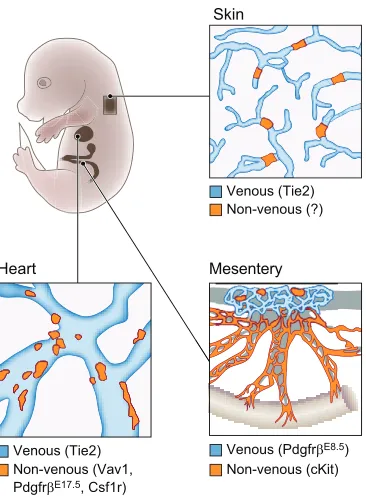
about this process remain unanswered. These include whether the lymphatic vessels of all organs have similar embryonic origins, whether they respond to the same molecular cues, and whether they possess distinct properties and unique gene expression profiles adapted to their specific functions. However, in the past year, research into the origins of organ-specific lymphatic vessels, such as those in the skin, mesentery and heart, has begun to answer some of these questions. In particular, several studies have demonstrated that, as is the case for early lymphatic vessels, cells of a non-venous origin can contribute to the formation of these vessels in mammals (Fig. 4).
Lineage-tracing experiments in mice using the venous/ endothelial cell markerTie2revealed that a significant portion of dermal LECs are not labeled by the transgene, suggesting contribution from alternative, as yet undetermined, sources. These results support a dual origin mechanism in which cells of both venous and non-venous origins give rise to the dermal lymphatic vasculature (Martinez-Corral et al., 2015). It is important to bear in mind that this conclusion is mainly drawn from the lack ofTie2-Cre labeling in a subset of cells that were not‘positively’labeled by alternative markers. This lack ofTie2-Crelabeling could potentially have resulted from a limited efficiency of Cre-mediated recombination rather than from a true absence of marker expression. Additional experiments using alternative Cre lines that positively label the cells will help characterize their identity and confirm the potential dual origin of mouse dermal lymphatics.
Another recent study explored the origins of mesenteric lymphatic vessels in mice and identified a non-venous origin for these vessels too (Stanczuk et al., 2015). It was commonly thought that the mesenteric lymph sacs arise from the mesenteric vein and serve as a source for mesenteric lymphatics (Sabin, 1902; Van Der Putte, 1975). In their new study, however, Stanczuk et al. (2015) used lineage tracing followed by immunostaining for the LEC markers Prox1 and Nrp2 to show that, although the mesenteric vein indeed represents the source for the mesenteric lymph sac, isolated clusters of LECs are found along the mesenteric veins that do not appear to sprout from the vein. These cell clusters were shown to coalesce at∼E14.5 to form the mesenteric lymphatic vessels. Using lineage-tracing analyses, a cKit+ hemogenic endothelium (HE) population was identified as the source of mesenteric LECs, indicating that non-venous lymphatics are derived from a naïve hematopoietic progenitor pool but not from definitive hematopoietic cells. Interestingly, Mahadevan et al. (2014) also proposed that the mesenteric lymphatics arise from two populations of lymphatic progenitors: a venous population that originates in the wall of the subcardinal vein, and a non-venous population that arises in the left dorsal mesentery through an arteriogenesis-dependent process. In this case, paired-like homeodomain 2 (Pitx2) was shown to direct asymmetric arteriogenesis in the left dorsal mesentery only. Consequently, the KO ofPitx2resulted in specific elimination of the non-venous LEC progenitor pool. Nonetheless, the exact lineages of these two subsets of lymphatic progenitors have not yet been determined (Mahadevan et al., 2014).
The heart is also known to possess a well-developed lymphatic vasculature, although its embryonic origins have been unclear. Expanding our knowledge of the cardiac lymphatic system might be of particular interest from a clinical point of view, since impaired lymphatic flow is associated with cardiac pathologies and has been linked to myocardial fibrosis and inflammation (Ullal et al., 1972). A recent study of murine embryos traced the origins of cardiac LECs to two different locations, namely cells from extra-cardiac tissues and LECs sprouting from the CCV (Klotz et al., 2015). Both pools of progenitors appeared to migrate to the sinus venosus and outflow tract before expanding and forming the cardiac lymphatic vasculature. Using a Tie2-Cre lineage-tracing approach, it was shown that only 80% of cardiac lymphatic cells derive from venous ECs. To further explore the source of the non-venous,Tie2-negative cells that contribute to cardiac LECs, a series of lineage-tracing experiments using different transgenes that label a wide variety of cell types was performed (Klotz et al., 2015). The results of these analyses excluded any potential contribution from the epicardium, cardiac mesoderm or cardiac neural crest populations. By contrast, extensive labeling of cells in the cardiac region was achieved when Cre driver lines under the control of Vav1 (which marks hematopoietic cells),Pdgfrb(which is expressed in mesenchymal cells starting at E14) andCsf1r(a marker for myeloid cells) were used. These transgenic drivers did not mark cells in the CCV at E10 or those in the jugular vein at E12.5, but did result in the labeling of yolk sac-derived HE cells, thus highlighting them as the putative source of cardiac lymphatic progenitors. Interestingly, ex vivo explants of yolk sac-derived cells isolated at E8 and treated with Vegfc producedProx1-positive LECs, providing additional support for the lymphatic competence of yolk sac-derived cells (Klotz et al., 2015). Unfortunately, this notion could not be corroboratedin vivo, most probably owing to the lack of expression of the Cre lines used at the relevant developmental stages. Consequently, the possibility of alternative sources expressing similar molecular markers cannot be excluded.
Venous (Tie2) Non-venous (?)
Mesentery Skin
Heart
Venous (Tie2) Non-venous (Vav1,
PdgfrβE17.5, Csf1r)
Venous (PdgfrβE8.5)
Non-venous (cKit)
Fig. 4. The origins of organ-specific lymphatic vessels in the mouse embryo.The embryonic origins of lymphatic vessels associated with the skin, heart and mesentery have recently been studied.Tie2-based lineage-tracing analyses in mice showed that∼20% of skin LECs are not labeled by the transgene, suggesting a contribution from alternative, as yet undetermined, sources. In the mesentery, some LECs are of venous origin (labeled at E8.5 by the early EC marker Pdgfrβ), whereas others are derived from a non-venous source traced to thecKitlineage. Similarly, cardiac lymphatics are of mixed origins: some LECs are derived from venous ECs (Tie2lineage), while an additional contribution from yolk sac-derived hemogenic endothelium cells (Vav1,Pdgfrbat E17.5 andCsf1rlineages) is also observed. Pdgfrβis expressed early on in ECs (∼E8), whereas its expression is detected in
mesenchymal cells at∼E14.
DEVEL
O
Until recently, the brain was believed to be devoid of lymphatic vessels, raising the question of how waste and interstitial fluid are removed from this organ. In the past year, however, two exciting studies (Aspelund et al., 2015; Louveau et al., 2015) have reported the discovery of a new vessel type associated with the central nervous system that runs in parallel to the dural sinuses, which are venous channels found between the layers of the dura mater. This discovery has profound implications for the study of neuropathologies involving an altered immune response, and will undoubtedly put the question of the embryonic origin of the meningeal lymphatics in the spotlight in years to come.
Taken together, these studies reveal a surprising diversity in the origin of lymphatic vessels, implicating both venous- and non-venous-derived cells as potential sources. The finding that organ-specific vessels in mice have mixed origins should, however, be interpreted with caution. Most of these novel findings were obtained through lineage-tracing experiments, which bear several potential drawbacks. First, the tracing is based on the preselection of a limited number of available markers considered to be specific for a certain lineage. For a large number of these lineage markers a comprehensive analysis of their expression throughout embryonic development and adult life is not available, leaving open the possibility that they might highlight additional cell types. Second, the efficiency of labeling varies among different lineage-tracing lines. This poses a particular problem when analyzing the labeling of very low numbers of cells, which could result from inefficient Cre-mediated recombination. In turn, a real biological heterogeneity might potentially be misinterpreted as the consequence of incomplete recombination. An additional problem of lineage-tracing experiments is the potential leakiness of certain lines, which might result in non-specific labeling of undesired cell populations. Lastly, lineage-tracing experiments provide limited information regarding dynamic processes and are, for the most part, limited to certain time points. In this regard, the availability of early markers that can specifically label arterial/venous/hemangioblast lineages is currently limited, posing challenges to our understanding of the origins of the different cell types that comprise the vascular system, including LECs. Future experiments using various tracing markers to highlight a given cell population, in combination with live imaging in suitable animal models, should help uncover the putative contribution of different cell types to lymphatic vessel formation.
Implications for disease and regeneration
Lymphatic vessel malfunction is associated with the pathogenesis of numerous diseases, including lymphedema, fibrosis, inflammatory disease and tumor-related lymphangiogenesis (Alitalo and Carmeliet, 2002). At present, little is known about the cellular and molecular mechanisms underlying neo-lymphangiogenesis in the adult. Moreover, the identity of the cells contributing to the formation of new lymphatic vessels remains unclear. Based on the results obtained from the developmental studies discussed above, it is tempting to speculate that new LECs could arise from pre-existing lymphatic vessels through the process of lymphangiogenesis or, alternatively, they could originate from angioblast niches maintained within veins, or throughout the body, via lymph-vasculogenesis.
An additional possibility is that other cell types transdifferentiate into LECs, as has been shown in the case of tumor-related blood vessels (Kirschmann et al., 2012; Soda et al., 2011) and in tissue regeneration (reviewed by Das et al., 2015). It has also been shown, for example, that bone marrow-derived cells, and myeloid cells in particular, can contribute to lymphatic vessel growth under
pathological conditions (Maruyama et al., 2005). Indeed, in a mouse model of inflamed cornea, bone marrow-derived Cd11b (Itgam)-positive macrophages transdifferentiate and become incorporated into growing lymphatic vessels. In a similar fashion, bone marrow-derived or peripheral blood-derived myeloid cells contribute to tumor-associated lymphatic vessels in a subcutaneous tumor transplantation model (Lee et al., 2010; Religa et al., 2005; Zumsteg et al., 2009). Although myeloid cells do become incorporated into lymphatic vessels in these examples, they do not express Prox1, which might suggest that full differentiation towards the lymphatic lineage does not occur. In addition, some of the markers used to assess lymphatic differentiation are also expressed by myeloid cells (Schledzewski et al., 2006), making it particularly challenging to confirm true differentiation. In contrast to these reports, other studies failed to find a significant contribution of bone marrow-derived cells to growing lymphatic vessels (Gordon et al., 2010; He et al., 2004).
Newly formed lymphatic vessels seem likely to play an important role not only under pathological states but also during the functional recovery of ischemic tissues. Following myocardial infarction, for instance, augmenting the lymphangiogenic response by systemic administration of Vegfc was shown to significantly improve cardiac function (Klotz et al., 2015). Circulating stem cells have also been suggested to play a role in the maintenance of lymphatic vessels, even in the absence of injury (Jiang et al., 2008). In future studies it will be interesting to explore whether LECs of both venous and non-venous origins respond to injury or, alternatively, whether newly formed lymphatic vessels derive predominantly from a single cell type.
From a clinical perspective, there is also increasing interest in technologies that enable the derivation and expansion of LECs from embryonic stem cells (ESCs) or induced pluripotent stem cells (iPSCs) for cell therapy. These cells might potentially be used to augment lymphangiogenesis in patients suffering from impaired lymphatic function, or to replace resected lymphatic vessels after surgeries. Recently, LYVE1+/podoplanin+sorted cells were shown to populate growing lymphatic vessels in an ear wound healing model (Lee et al., 2015), opening up a new area of research that holds great therapeutic potential. Advances in generating LECs or LEC-like cellsin vitrohave also been made. For example, while human iPSC-derived ECs were shown to express low levels of lymphatic markers (Rufaihah et al., 2013), culturing human iPSC-derived embryoid bodies in the presence of EGF, VEGFA and VEGFC leads to a 3- to 15-fold increase in the expression of LEC markers. Most recently, WNT5B has been identified as a potent inducer of LEC specification in cultured human ESCs; the addition of WNT5B to the culture medium induced a marked increase in the fraction of LYVE1-positive cells, as well as in the levels ofPROX1 andFLT4(VEGFR3) mRNAs (Nicenboim et al., 2015).
Overall, translating the data obtained in developmental studies into clinically relevant models might become a major goal in the field of lymphatic research. Further investigation is required in order to identify additional inducers of LEC specification, as well as to optimize protocols that allow human stem cells to be differentiated into cells of potential therapeutic use.
Conclusions
Research over the past decades has begun to reveal the heterogeneous origins of lymphatic vessels. Understanding the mechanisms underlying this heterogeneity holds great promise for developing new ways to treat lymphatic-associated disorders. Although a large body of data has accumulated in recent years
DEVEL
O
that strongly suggests that the origin of lymphatic vessels is not exclusively venous, as previously believed, it is important to bear in mind the technical limitations of the different approaches utilized. The past 100 years of research into the lymphatic endothelium have been guided by the availability of animal models and experimental technologies that enable lymphatic vessels to be visualizedin vivo. Since its early beginning, the question of the origin of lymphatic vessels has remained controversial, in part due to biases in the interpretation of results obtained from different systems. The initial discrepancy between the two key models proposed–the venous/ centrifugal and non-venous/centripetal models – could be easily explained by the limitations imposed by each of the applied methodologies, namely ink injection versus histological sections, which each enable investigation of only certain aspects of the process. Similarly, potential bias inherent to lineage-tracing experiments carried out in mice and zebrafish could lead to conflicting results. Complementary experiments analyzing the distribution of endogenous proteins via immunostaining, as well as live imaging studies analyzing the anatomical location and migration tracks undertaken by LEC progenitors, should lead to more definitive conclusions.
The discovery of multiple origins for the lymphatic endothelium has many implications and raises numerous important questions in the field. For example, whether the classical specification pathways are equally important for the specification of non-venous cells towards the lymphatic fate remains unclear. The anatomical regions from which non-venous cells migrate to their final destination also remain to be determined. One possibility is that non-venous cells reside in the embryonic veins, as is the case in zebrafish (Nicenboim et al., 2015). Alternatively, cells might transdifferentiatein situfrom surrounding mesenchymal cells, as originally postulated by the non-venous theory. Lastly, whether the different embryonic origins of lymphatic progenitors are specifically linked to specialized functions during adult life remains unknown. The origin of the cells responsible for neo-lymphangiogenesis also requires further investigation, and understanding the sources of new lymphatic vessels in the adult might be of great value in the treatment of diseases that involve the lymphatic system, such as lymphedema and cancer.
Acknowledgements
We thank G. Brodsky (Weizmann Institute of Science) for graphic design and N. Konstantin for critical reading of the manuscript. We are grateful to all members of the K.Y. laboratory for many fruitful discussions. We sincerely apologize to colleagues whose important work could not be cited owing to space limitations.
Competing interests
The authors declare no competing or financial interests.
Funding
This work was supported in part by Marie Curie Actions-International Reintegration grants [FP7-PEOPLE-2009-RG 256393 to K.Y.], the European Research Council [335605 to K.Y.] and the Minerva Foundation [711128 to K.Y.]. K.Y. is supported by the Willner Family Center for Vascular Biology; the estate of Paul Ourieff; the Carolito Stiftung; Lois Rosen, Los Angeles, CA, USA; Edith Frumin; the Fondazione Henry Krenter; the Wallach Hanna & Georges Lustgarten Fund; and the Polen Charitable Trust. K.Y. is the incumbent of the Louis and Ida Rich Career Development Chair.
References
Alders, M., Hogan, B. M., Gjini, E., Salehi, F., Al-Gazali, L., Hennekam, E. A., Holmberg, E. E., Mannens, M. M. A. M., Mulder, M. F., Offerhaus, G. J. et al.
(2009). Mutations in CCBE1 cause generalized lymph vessel dysplasia in
humans.Nat. Genet.41, 1272-1274.
Alitalo, K. and Carmeliet, P.(2002). Molecular mechanisms of lymphangiogenesis
in health and disease.Cancer Cell1, 219-227.
Aranguren, X. L., Beerens, M., Vandevelde, W., Dewerchin, M., Carmeliet, P. and Luttun, A. (2011). Transcription factor COUP-TFII is indispensable for
venous and lymphatic development in zebrafish and Xenopus laevis.Biochem.
Biophys. Res. Commun.410, 121-126.
Aspelund, A., Antila, S., Proulx, S. T., Karlsen, T. V., Karaman, S., Detmar, M., Wiig, H. and Alitalo, K.(2015). A dural lymphatic vascular system that drains
brain interstitial fluid and macromolecules.J. Exp. Med.212, 991-999.
Banerji, S., Ni, J., Wang, S. X., Clasper, S., Su, J., Tammi, R., Jones, M. and Jackson, D. G.(1999). LYVE-1, a new homologue of the CD44 glycoprotein, is a
lymph-specific receptor for hyaluronan.J. Cell Biol.144, 789-801.
Bos, F. L., Caunt, M., Peterson-Maduro, J., Planas-Paz, L., Kowalski, J., Karpanen, T., van Impel, A., Tong, R., Ernst, J. A., Korving, J. et al.(2011). CCBE1 is essential for mammalian lymphatic vascular development and enhances the lymphangiogenic effect of vascular endothelial growth factor-C in
vivo.Circ. Res.109, 486-491.
Buttler, K., Becker, J., Pukrop, T. and Wilting, J.(2013). Maldevelopment of
dermal lymphatics in Wnt5a-knockout-mice.Dev. Biol.381, 365-376.
Cermenati, S., Moleri, S., Cimbro, S., Corti, P., Del Giacco, L., Amodeo, R., Dejana, E., Koopman, P., Cotelli, F. and Beltrame, M.(2008). Sox18 and Sox7
play redundant roles in vascular development.Blood111, 2657-2666.
Cermenati, S., Moleri, S., Neyt, C., Bresciani, E., Carra, S., Grassini, D. R., Omini, A., Goi, M., Cotelli, F., Francois, M. et al.(2013). Sox18 genetically
interacts with VegfC to regulate lymphangiogenesis in zebrafish.Arterioscler.
Thromb. Vasc. Biol.33, 1238-1247.
Cha, Y. R., Fujita, M., Butler, M., Isogai, S., Kochhan, E., Siekmann, A. F. and Weinstein, B. M.(2012). Chemokine signaling directs trunk lymphatic network
formation along the preexisting blood vasculature.Dev. Cell22, 824-836.
Chen, L., Mupo, A., Huynh, T., Cioffi, S., Woods, M., Jin, C., McKeehan, W., Thompson-Snipes, L., Baldini, A. and Illingworth, E.(2010). Tbx1 regulates
Vegfr3 and is required for lymphatic vessel development.J. Cell Biol. 189,
417-424.
Clevers, H.(2006). Wnt/beta-catenin signaling in development and disease.Cell
127, 469-480.
Covassin, L. D., Villefranc, J. A., Kacergis, M. C., Weinstein, B. M. and Lawson, N. D.(2006). Distinct genetic interactions between multiple Vegf receptors are
required for development of different blood vessel types in zebrafish.Proc. Natl.
Acad. Sci. USA103, 6554-6559.
Das, A., Sinha, M., Datta, S., Abas, M., Chaffee, S., Sen, C. K. and Roy, S.(2015). Monocyte and macrophage plasticity in tissue repair and regeneration.
Am. J. Pathol.185, 2596-2606.
de Vinuesa, A. G., Abdelilah-Seyfried, S., Knaus, P., Zwijsen, A. and Bailly, S.
(2016). BMP signaling in vascular biology and dysfunction.Cytokine Growth
Factor Rev.27, 65-79.
Deguchi, T., Fujimori, K. E., Kawasaki, T., Ohgushi, H. and Yuba, S.(2009). Molecular cloning and gene expression of the prox1a and prox1b genes in the
medaka, Oryzias latipes.Gene Expr. Patterns9, 341-347.
Del Giacco, L., Pistocchi, A. and Ghilardi, A.(2010). prox1b Activity is essential in
zebrafish lymphangiogenesis.PLoS ONE5, e13170.
Deng, Y., Atri, D., Eichmann, A. and Simons, M.(2013). Endothelial ERK
signaling controls lymphatic fate specification.J. Clin. Invest.123, 1202-1215.
Dieterich, L. C., Klein, S., Mathelier, A., Sliwa-Primorac, A., Ma, Q., Hong, Y.-K., Shin, J. W., Hamada, M., Lizio, M., Itoh, M. et al. (2015). DeepCAGE transcriptomics reveal an important role of the transcription factor MAFB in the
lymphatic endothelium.Cell Rep.13, 1493-1504.
Dumont, D. J., Jussila, L., Taipale, J., Lymboussaki, A., Mustonen, T., Pajusola, K., Breitman, M. and Alitalo, K.(1998). Cardiovascular failure in mouse embryos
deficient in VEGF receptor-3.Science282, 946-949.
Dunworth, W. P., Cardona-Costa, J., Bozkulak, E. C., Kim, J.-D., Meadows, S., Fischer, J. C., Wang, Y., Cleaver, O., Qyang, Y., Ober, E. A. et al.(2014). Bone morphogenetic protein 2 signaling negatively modulates lymphatic development
in vertebrate embryos.Circ. Res.114, 56-66.
Duong, T., Koltowska, K., Pichol-Thievend, C., Le Guen, L., Fontaine, F., Smith, K. A., Truong, V., Skoczylas, R., Stacker, S. A., Achen, M. G. et al.(2014). VEGFD regulates blood vascular development by modulating SOX18 activity.
Blood123, 1102-1112.
Fatima, A., Culver, A., Culver, F., Liu, T., Dietz, W. H., Thomson, B. R., Hadjantonakis, A.-K., Quaggin, S. E. and Kume, T.(2014). Murine Notch1 is
required for lymphatic vascular morphogenesis during development.Dev. Dyn.
243, 957-964.
Flores, M. V., Hall, C. J., Crosier, K. E. and Crosier, P. S.(2010). Visualization of embryonic lymphangiogenesis advances the use of the zebrafish model for
research in cancer and lymphatic pathologies.Dev. Dyn.239, 2128-2135.
François, M., Caprini, A., Hosking, B., Orsenigo, F., Wilhelm, D., Browne, C., Paavonen, K., Karnezis, T., Shayan, R., Downes, M. et al.(2008). Sox18
induces development of the lymphatic vasculature in mice.Nature456, 643-647.
Gale, N. W., Prevo, R., Espinosa, J., Ferguson, D. J., Dominguez, M. G., Yancopoulos, G. D., Thurston, G. and Jackson, D. G.(2007). Normal lymphatic development and function in mice deficient for the lymphatic hyaluronan receptor
LYVE-1.Mol. Cell. Biol.27, 595-604.
Geudens, I., Herpers, R., Hermans, K., Segura, I., Ruiz de Almodovar, C., Bussmann, J., De Smet, F., Vandevelde, W., Hogan, B. M., Siekmann, A. et al.