International Journal of Emerging Technology and Advanced Engineering
Website: www.ijetae.com (ISSN 2250-2459, ISO 9001:2008 Certified Journal, Volume 5, Issue 2, February 2015)
173
A Modified FFT Algorithm using Pruning Technology Based
on OFDM Wireless Communication System
Swati Singh
1, Sanjiv Mishra
21
Department of Electronics and Communication Engg, KIT, Kanpur, India
2Assistant professor, Department of Electronics and Communication Engg, KIT, Kanpur, India
Abstract-- Fast Fourier transforms (FFT) and Inverse Fast Fourier Transform (IFFT) processing is one of the key procedures in popular orthogonal frequency division multiplexing (OFDM) communication systems. This paper presents the study of an efficiency of the fast Fourier transform may be increased by removing operations of input values which are zero, and of output values which are not required; this procedure is known as FFT pruning. FFT pruning algorithm is utilized in NC-OFDM systems to simplify the FFT algorithm complexity in presence of
subcarrier sparseness algorithm. The standard FFT
algorithms assume that the length of the input and output sequences are equal. In practice, this is not always an accurate assumption, and this paper discusses ways of efficiently computing the DFT, when the number of input and output data points differs.
Keywords-- Cognitive radio, OFDM, FFT, Pruning Techniques.
I.
INTRODUCTIONOFDM is a combination of modulation and multiplexing. Multiplexing generally refers to independent signals, those produced by different sources. OFDM is a form of multicarrier modulation. In OFDM the signal itself is first split into independent channels, modulated by data and then re-multiplexed to create the OFDM carrier.
OFDM is a special case of Frequency Division Multiplex (FDM). In an OFDM scheme, a large number of orthogonal, overlapping, narrow band sub-carriers are transmitted in parallel. These carriers divide the available transmission bandwidth. The separation of the sub-carriers is such that there is a very compact spectral utilization. An OFDM signal consists of a number of closely spaced modulated carriers. When modulation of any form - voice, data, etc. is applied to a carrier, then sidebands spread out either side. It is necessary for a receiver to be able to receive the whole signal to be able to successfully demodulate the data. As a result when signals are transmitted close to one another they must be spaced so that the receiver can separate them using a filter and there must be a guard band between them. This is not the case with OFDM.
Although the sidebands from each carrier overlap, they can still be received without the interference that might be expected because they are orthogonal to each another. This is achieved by having the carrier spacing equal to the reciprocal of the symbol period.
OFDM was first proposed by Chang, (1966). Chang proposed the principle of transmitting messages simultaneously over multiple carriers in a linear band-limited channel without ISI and ICI. The initial version of OFDM employed a large number of oscillators and coherent demodulators. In 1971, DFT was applied to the modulation and demodulation process by Weinstein and Ebert, (1971). In the year 1980, Peled & Ruiz introduced the notion of cyclic prefix to maintain frequency orthogonality over the dispersive channel [Andrews et al., 2007]. It is commonly deemed that OFDM is a major technique for beyond-3G wireless multimedia communications other advantage of OFDM is that it achieves robustness against narrowband interference, since narrowband interference only affects a small fraction of the subcarriers. In OFDM, frequency diversity can be exploited by coding and interleaving across subcarriers in the frequency domain [Al-Akaidi & Daoud, 2006] enables bandwidth-on-demand technology and higher spectral efficiency and contiguous bandwidth for operation is not required OFDM splits the bit stream into multiple parallel bit streams of reduced bit rate, modulates them using a Mary modulation, and then transmits each of them on a separate subcarrier.
International Journal of Emerging Technology and Advanced Engineering
Website: www.ijetae.com (ISSN 2250-2459, ISO 9001:2008 Certified Journal, Volume 5, Issue 2, February 2015)
174
Apart from the applications, the system demands high speed of operation, low power consumption, reduced truncation error and reduced chip size. The OFDM based cognitive radio has the capability to nullify individual sub-carriers to avoid interference with the licensed user. So, that there could be a large number of zero valued inputs/outputs compare to non-zero terms. This is the most important thing in the orthogonal frequency division multiplexing (OFDM), which is used as baseband transmission in spectrum pooling technique. Though large bandwidth supports high data rates but practically it is impossible to find contiguous empty bandwidth. So much efficient data rates are achieved by using non-contiguous vacant subcarriers of a targeted spectrum pool. This type of OFDM is known as non-contiguous OFDM or NC-OFDM which helps to avoid the harmful interference by deactivating those subcarriers, which are acquired by different licensed users. That means the input values of the IFFT‟s of those particular subcarriers is zero. As NC-OFDM consists of large number of de-activated or null subcarrier i.e. numbers of zero valued inputs/outputs outnumber non-zero inputs/outputs. So the conventional FFT is no longer efficient in terms of complexity, execution time and hardware architecture.
In this paper we have proposed an input zero traced FFT pruning (IZTFFTP) algorithm, suitable for NC-OFDM based transceiver. It is based on normal Cooley-Tukey radix-4 DIF algorithm using matrix factorizing process. Result shows IZTFFTP is more efficient than ordinary FFT.
II. OFDMSTRUCTURE
In This subsection we will discuss about the OFDM framework and its generation technique using the general schematic in the figure 1-(A, B).Basically in DSA network, it is not practically possible to find a contiguous block of spectrum, which are being utilized fully. So by employing the dynamic spectrum sensing and channel estimation technique, the subcarriers that are accessed by the licensed user are turned off. The OFDM based transceivers those are capable to deactivate the used subcarriers are known as NC-OFDM based transceivers .Using Fig.1 we will discuss about the internal architecture of this complex system step by step.
Fig.1-A: General NC-OFDM transmitter
Let x(n)(x1,x2...xn ) is the modulated version of the input data streamed d(n)(d1,d2...dn).Modulation has been done by using any digital modulation scheme. Then the modulated data stream is divided into N separate data streams by using S-P Converter. Each of the streams is transmitted through those orthogonal subcarriers and after summing them we will get the composite OFDM signal. As we discussed earlier that NC-OFDM transceiver contains many deactivated subcarriers that are used by the licensed users. Those signals are also transmitted to the receiver but have no significant contribution in the IFFT/FFT computation. To reduce the inter symbol interference one cyclic prefix (CP) block is added to the symbol and this CP works as guard interval between two different symbol. Then it is passed through a P-S converter. Finally the signal is up sampled and passed through a D/A converter for converting it into analog signal s(n) and transmitted through the RF link.
International Journal of Emerging Technology and Advanced Engineering
Website: www.ijetae.com (ISSN 2250-2459, ISO 9001:2008 Certified Journal, Volume 5, Issue 2, February 2015)
175
At the receiver s(n) is converted to digital signal r(n) by passing through an A/D converter. Then the signal is passed through an S-P converter to make parallel data stream .After this CP is discarded and fed that signal to the FFT block to transform the time domain data into frequency domain. Finally to obtain the original signal, multiplexing using P-S converter and demodulation has been done.
III. FFTALGORITHM
Fast Fourier Transform, or FFT, is any algorithm for computing the N-point DFT with a computational complexity of O (N log N). A Fast Fourier Transform (FFT) is an efficient algorithm to compute the discrete Fourier transform (DFT) and its inverse. The Discrete Fourier Transform (DFT) is used to produce frequency analysis of discrete non-periodic signals. The FFT is a faster version of the Discrete Fourier Transform (DFT).
The FFT/IFFT is the most critical part of any signal processing system. Here also in OFDM based transceiver those are the most computational intensive blocks of the total system. So an inefficient IFFT/FFT may decrease the overall system response. This paper is based on radix-4 DIF FFT algorithm, which have a divide and conquer approach, where N-points DFT is decomposed into successively small DFTs(with odd and even part separately).The basic formula for DFT is-
X (n) = n=0, 1, 2
...N-1... (1)
N is the order, for example if N= 4.
III.A. Radix-4 FFT Algorithm
The butterfly of a radix-4 algorithm consists of four inputs and four outputs. The FFT length is 4M. Where M is the number of stages. The radix-4 DIF FFT divides an N-point discrete Fourier transform (DFT) into four N/4 -N-point DFTs, then into 16 N/16 -point DFTs, and so on. The radix-4 DIF fast Fourier transform (FFT) expresses the DFT equation as four summations, and then divides it into four equations, each of which computes every fourth output sample. The following equations illustrate radix-4 decimation infrequency.
Thus the four N/4-point DFTs F (l, q) obtained from the above equation are combined to yield the N-point DFT. The expression for combining the N/4-point DFTs defines a radix-4 decimation-in-time butterfly, which can be expressed in matrix form as
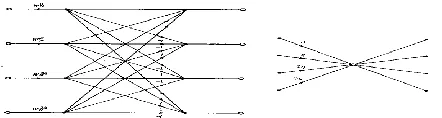
The radix-4 butterfly is depicted in Figure. 2a and in a more compact form in Figure.2b. Note that each butterfly involves three complex multiplications, since WN0 = 1, and
[image:3.612.337.558.485.544.2]12 complex additions:
Figure 2. Basic butterfly computation in a radix-4 FFT algorithm.
International Journal of Emerging Technology and Advanced Engineering
Website: www.ijetae.com (ISSN 2250-2459, ISO 9001:2008 Certified Journal, Volume 5, Issue 2, February 2015)
176
[image:4.612.67.275.174.249.2]A 16-point, radix-4 decimation-in-frequency FFT algorithm is shown in Figure.3 its input is in normal order and its output is in digit-reversed order.
Figure.3 Sixteen-point, radix-4 decimation-in-frequency algorithm with input in normal order and output in digit-reversed order.
For illustrative purposes, let us re-derive the radix-4 decimation-in-frequency algorithm by breaking the N-point DFT formula into four smaller DFTs. We have
From the definition of the twiddle factors, we have
The relation is not an N/4-point DFT because the twiddle factor depends on N and not on N/4. To convert it into an N/4-point DFT we subdivide the DFT sequence into four N/4-point sub sequences, X(4k), X(4k+1), X(4k+2), and X(4k+3), k = 0, 1, ..., N/4. Thus we obtain the radix-4 decimation-in frequency DFT as
Where we have used the property WN4kn = WknN/4. Note that the input to each N/4-point DFT is a linear combination of four signal samples scaled by a twiddle factor. This procedure is repeated v times, where v = log4N.
IV. PROPOSED PRUNINGTECHNIQUES
To increase the efficiency of the FFT technique several pruning and different other techniques have been proposed by many researchers. In this paper, we have implemented a new pruning technique i.e. IZTFFTP by simple modification and some changes in the conventional flowchart of FFT [9] and also includes some tricky mathematical techniques to reduce the total execution time.
A. Zero Tracing
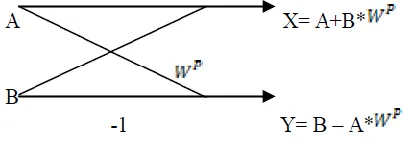
[image:4.612.341.543.475.547.2]As in wide band communication system a large portion of frequency channel may be unoccupied by the licensed user, so no. of zero valued inputs are much greater than the non-zero valued inputs in a FFT/IFFT operation at the transceiver. Then this algorithm will give best response in terms of reduced execution time by reducing the no. of complex computation required for twiddle factor calculation. IZTFFTP have a strong searching condition, which have a 2-D array for storing the input & output values after every iteration of butterfly calculation. In a input searching result whenever it found „zero‟ at any input, simply omit that calculation by considering following two useful condition:
Fig .4: small butterfly unit of a dual node pair
B. Half Butterfly Computation or Partial Pruning
International Journal of Emerging Technology and Advanced Engineering
Website: www.ijetae.com (ISSN 2250-2459, ISO 9001:2008 Certified Journal, Volume 5, Issue 2, February 2015)
177
Fig.5: partial pruning structure
C. Complete Pruning
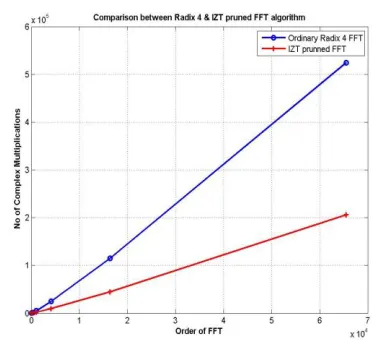
[image:5.612.348.534.135.305.2]Figure shows the part where both the input of the dual node pair is zero. In such cases where number of zero is remarkably very large IZTFFTP works most effectively and program will automatically goes to the next node for required computation omitting these unnecessary complex calculations. In this way the total no of complex multiplications and additions are reduced remarkably as well as the execution time also. In the next result section we will find how the new technique gives better response with respect to general FFT algorithm.
Fig.6: complete pruning structure.
V. RESULTS
To evaluate the performance of the proposed algorithm we utilized the FFT or pruning algorithms with FFT. Some of them are implemented either in MATLAB or in FORTRAN which is able to show the required actual execution time for an FFT operation. Here we have implemented a FFT pruning technique in high level computer language i.e. in C++ and execute it in Linux platform .To check the FFT results, before pruning operation we have simulated the core FFT code based on matrix factorization process. The assumed input data set stored in a 2-D array, considering only real values and as this is only for an NC-OFDM system so the number of possible unlicensed user is less than the total no of subcarriers. The Output shows the significant reduction of computational complexity by reducing the total no. of complex operation in radix-4 i.e. both the multiplications and additions compare to the ordinary FFT operation.
Fig.-7: graphical comparison between two different algorithms.
VI. CONCLUSIONS
We presented the partial pruning algorithm as an efficient implementation of FFT pruning algorithm has presented the analytical evaluation of the proposed and implemented a technique of FFT pruning computation in high level computer program by modifying in place computation technique in the conventional FFT algorithm. Results shows IZTFFTP is much efficient than ordinary FFT algorithm as it takes very less time to compute where number of Zero valued inputs/outputs are greater than the total number of non Zero terms, with maintaining a good trade-off between time and space complexity, and it is also independent to any input data sets and consuming less time to radix 2.
REFERENCES
[1] Qing Zhao and B. M. Sadler, “A Survey of Dynamic Spectrum Access,” IEEE Signal Processing magazine, vol. 24, no. 3, pp. 79– 89, 2007.
[2] Brigham, E. O. (2002). The Fast Fourier Transform. New York: Prentice-Hall
[3] J. Mitola, III, "Cognitive Radio: An Integrated Agent Architecture for Software Defined Radio," Thesis (PhD), Dept. of Teleinformatics, Royal Institute of Technology (KTH), Stockholm Sweden, May 2000.
[4] R. G. Alves, P. L. Osorio, and M. N. S. Swamy, “General FFT Pruning Algorithm,” in Proc.43rd IEEE Midwest Symp.Circuits and Systems, vol. 3, Aug. 2000, pp. 1192 – 1195.
[5] E. Oran. Brigham, "The Fast Fourier Transform and Its Applications" Prentice Hall Publication, 1988, ISBN: 0133075052 [6] T. V. Sreenivas and P. Rao, “FFT algorithm for both input and
output Pruning,” in Proc.IEEE Int. Conf. Acoust., Speech, Signal Process, vol. 27, June 1979, pp. 291 – 292.
[image:5.612.65.270.371.471.2]