1499
MEASURING PROCESS INNOVATION ON
DOUBLE-FLANKED CONCEPTUAL MODEL FOR KNOWLEDGE
SHARING ON ONLINE LEARNING ENVIRONMENT
1
S.M.F.D SYED MUSTAPHA, 2BIJU THERUVIL SAYED, 3ROSHAYU MOHAMAD 1
Computer Science Department, College of Computers and Information Technology Taif University, Saudi Arabia
2
Department of Computer Science, College of Arts and Applied Sciences, Dhofar University, PO Box 2509, PCode 211, Salalah, Sultanate of Oman 3
School of Science and Technology, Asia e University No4, Jalan Sultan Sulaiman, 50000 Kuala Lumpur, Malaysia
E-mail: [email protected], [email protected], [email protected]
ABSTRACT
There are various innovation models that were discussed in the literature and the adoption is based on the organizational needs for their business contexts, vision and applications. These innovation models require effective innovation process framework to be followed. SECI Model has been chosen as knowledge creation model to facilitate innovation through knowledge sharing and creation. While literature has shown that SECI model has been applied in various fields such as management, manufacturing, education and business, very few has considered it as innovation tool for online learning environment. Knowledge creation requires community who has enculturated with knowledge sharing as part of the practices. For this purpose, Community of Practice (CoP) has been chosen as the essentialities for the prospective innovative community and consequently to make implementation of SECI model a success. Community with CoP values are postulated to provide the right organizational setting for innovation. It is suggested that both SECI Model and CoP are integrated as new a conceptual model being regarded as double flank strategy that synergizes to prepare the right community setting and to facilitate innovation through knowledge creation. Subsequently, this paper proposed the methods and approaches in measuring innovativeness in online learning environment based on the double flank conceptual model called DFCMI.
Keywords: Knowledge Management, SECI Model, Community of Practice, Online Learning, Measuring Innovation
1. INTRODUCTION
Innovation models are defined and practically used in various ways by the academics and industrialists. The variants are due to the numerous contexts of what innovations are needed for in order to bring values to the innovators, consumers and organizations. It varies at different business strategies ranging from process innovation, service
innovation, product performance innovation,
branding innovation, organization structure
innovation, design innovation, consumer network innovations, profit model innovation and many more. To achieve the innovation, the fundamental elements should be in place. Some of these involve
community engagement, sharing of vision,
volunteerism, ad hoc idea generation and mutual interaction. These are essentials to form an innovative community prior to building a practical innovative community.
1500
Many theoretical frameworks have been
discussed in the literature, on various types of innovation process [3]. Innovation process is categorized by the factor driving the innovation such as technology [4], market [8], integration between market and R & D [1], interactive [7], network [11] and open [6], to name few. Rothwell [9] described the generation of innovation models based on the industrial technology evolution began from linear model in which the innovation is based on invention through R&D (Research and Development). The subsequent generation of innovation model is market driven that had caused innovation products to be developed as less sustainable due to strong influence of market trend. To overcome the problem, the later generation of innovation model balanced both the market demand and R&D as essential role in innovation, so-called coupled model. Interactive model has similar fashion with network model as described by Manley [7] in her illustration of several more innovation models with similar approaches. Open model is in contrary to the earlier version of innovation model where opportunity for participating innovativeness is non-exclusive and open to public as main character in participating the innovation process.
Innovation model that were described in the literature were adopted at the workplace and industrial environment. Our work is interested to look at implementation of the innovation in the online environment were members are not physically connected. The process of innovation
involves on the knowledge creation,
implementation, reuse and value creation. For this to happen, we adopted SECI model as the innovation model for knowledge creation and to be implemented in the online environment. Even though SECI model was originally developed for the manufacturing environment, the recent work had shown that it has encroached community learning in the web-based environment [2] [5][13][10].
In our work, we postulate that it is required to establish the CoP environment as the pre-requisite to create a community that stimulates innovative environment, demonstrate how knowledge creation can be implemented in the digital environment and finally a proposed computational framework for
measuring innovation. In the subsequent
subsections, we do reflection on SECI model based on the previous effort of applying it in online environment, illustrate the innovation with respect to CoP and finally the measurement of innovation in the online environment.
2. COMMUNITY OF PRACTICE (COP)
Community of Practice can be described as a natural formation of group members who have common interest, free-will membership in a malleable organizational structure, non-tasked based but have shared set of problems to deal with and mutually involved and participated [23]. It was believed that the structure is socially created rather than formally set up like task force or task-oriented committee [24]. Somewhat in a later development, some practitioners have argued that CoP can be cultivated and designed for a specific group which was not initially established as CoP group, to enhance the performance [25][26]. For example, an organized group of specialists who are not acquainted well with each other assigned to solve a complex unprecedented problem could be designed to be in a CoP-based group in order to obtain
promising CoP values. Another important
development which is related to our work is the emergence of CoP in the virtual environment such as in online learning [28][29].
1501
Table 1 CoP Essentials, Values and Supporting Technology
CoP Essentials (described in
[31] as CoP Characteristics) Supporting Technology CoP values Community Structure e-forum, discussion thread, bulletin board Volatile structure, free-will membership Learning through Participation and Reification CSCW (Computer Support Collaborative Work), Web-based Collaborative Software Generating new artefacts from the group participations and engagement; new ideas and solutions Negotiation of Learning Project Management Software, Collaborative Virtual Environment Traceable evolutionary of idea generation and new knowledge as a result of repetitive discussion Learning as Temporal Project Management Software, Collaborative Virtual Environment Incremental development of knowledge resources Boundary Objects Internet forum, threaded discussion Multiple membership to different group discussion and resource sharing across different group Boundary Encounters
Internet forum and multiple channel threaded discussion
Multiple membership and sharing similar thought across different group Mutual Engagement Social Network Analysis In-out relationship demonstrate the level of participation and involvement; analysed the relationship as cordial, animus or collaborative Joint Enterprise Social Network
Analysis
Frequent exchange of ideas between individual, balanced participation on selected issue and playing leading role. Share Repertoire Multimedia objects Individual sharing
resources created or modified from others Identity Social Network
Analysis
Recognizing individual’s character or role in the online group, such as leadership role, knowledge expert
Community of Practice has recently been implemented in the online and virtual environment. This is made possible as the virtual community has been in existence since the internet revolution and it has benefitting in many sectors mainly in
education, manufacturing, financial services and other knowledge-intensive industries. With the modern supporting technology, the essential elements that are required to be in place to fulfil the criteria for CoPs are now feasible if virtual CoP is to be implemented. The essentials of CoP that we believe can be implemented with the supporting technologies to extract some CoP values, as shown in Table 1. We do not deny that there are other CoP values that are not discernible in computational form.
The presence of the CoP in the online environment is to be detected in digital form. Given the list mentioned in Table 1, while the computer technologies are currently available to capture most of the CoP characteristics, but not all CoP values can be sensed in a straightforward manner. For example, in boundary encounters, the membership of individual learner can be detected through its registration, but to monitor who share the knowledge earned from one CoP group across another CoP group can be a challenging task in computational context. Another example is on mutual engagement where relationship between members need to be traced. Relationship of two individuals can be defined objectively through the summation of response value for each interaction that occur, by assigning some values such as +1 for cordial, - 1 for animus and 0 for collaborative. The relationship is labelled based on the highest value of the response. However, the relationship which is based on emotion and subtle relation will be difficult to extract merely from text processing. In the following section, we describe SECI model and its implementation in online learning environment.
3. SECI MODEL
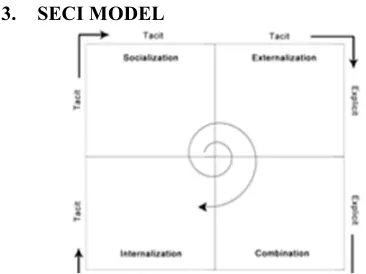
SECI model is a popularly known model for researchers in various disciplines mainly for those looking at implementing knowledge innovation for their organizations. The model describes the Figure 1 Classical View of SECI Model (By Ibmgroup - Using a
image editor, CC BY-SA 3.0,
[image:3.612.314.497.507.644.2]1502 knowledge creation to take place through the conversion of two types of knowledge – tacit knowledge and explicit knowledge. There are four
types of conversion so-called socialization,
combination, externalization and internalization as shown in Figure 1.
In the first quadrant, Socialization is the process where tacit knowledge is transformed within itself where new tacit knowledge is generated. This occurs during conversations, discussions and meetings [19] where one’s tacit knowledge is shared with another person and probably it is received and perceived in the same substance or biased due to “stickiness” [20]. The second quadrant, Externalization is the process where tacit knowledge is transformed into explicit knowledge through actions such as minutes writing, note taking, diagram drawing and reflection writing [17]. Since the source of the knowledge is in a tacit form, some researchers may pose a challenging question on how one would be able to determine whether the explicit knowledge is derived entirely from tacit knowledge or a mixture of another explicit knowledge. In SECI model, tacit knowledge and explicit knowledge is treated as discrete form and hence the shift movement of the knowledge type is assumed to be in a single-type form. The third quadrant is Combination process where new form of explicit knowledge is produced as the result of reorganization, reclassification, compilation or other means of demonstrating of knowledge regeneration explicitly. This may require combination between tacit knowledge and explicit knowledge. For example, in building a prototype requires one’s tacit knowledge for his design skills and explicit knowledge in a form of reference manual for rules and guidelines. These two forms of knowledge thatcould be earned from previous transitions (socialization and externalization). The final quadrant is Internalization where knowledge is converted into one’s tacit knowledge from the
explicit knowledge regenerated from the
combination process. At this stage, the learner established a kind of ownership to the knowledge earned and the degree of control towards the knowledge determined by his effort towards it ([21], pp 8). In the context of a learner, one achieves a high level of internalization once he has mastered a specific knowledge and skills. SECI model suggests the knowledge conversion moves in a spiral manner to induce knowledge creation and knowledge sharing.
3.1. Applying Seci Model In Online Learning Environment
Application of SECI model in the online learning environment had been investigated to gauge relationship between e-learning and SECI model; and LMS (Learning Management System) and SECI Model [32]. The outcome of the experiment indicated that knowledge creation occurred and the knowledge creation process prescribed in SECI model took place in the e-learning environment. SECI model had also been applied as a framework in virtual learning environment [33]. While the attempt was to implement in virtual environment, Hosseini admitted that not all processes in SECI model can be implemented in the virtual environment. For example, in the socialization, the actual meeting where face to face interactions were done instead of using face to face online meeting. Not least to mention, Chatti [34] was among the
earliest to describe the possibilities of
implementing SECI model in web-based
environment and he highlighted few possible technologies that could support such SECI model activities. However, the paper did not mention specifically how it can be done. The recent work illustrated the effort to build an integrated platform for facilitating some selected SECI model activities [10] which specifically mention which activities for each quadrant of SECI model and which technology that would support them. Our emphasis in this paper is that CoP is the precondition to SECI model as knowledge creation will not take place without the effective knowledge sharing process. We believe that CoP prepares a solid platform for knowledge and integration between CoP and SECI model as a double-flanked framework for facilitating and measuring innovation in the online learning environment. The framework will be discussed in the subsequent section.
4. DOUBLE-FLANKED CONCEPTUAL
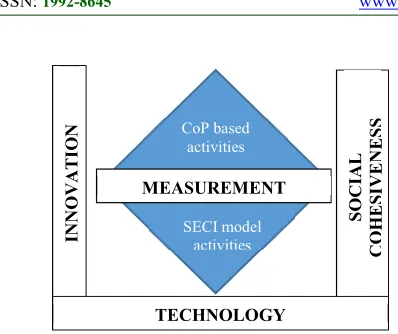
1503 Figure 2 Double-Flank Conceptual Measuring
Innovation (DFCMI)
The problems with knowledge sharing had been discussed elsewhere and the reasons are many. Vajjhala and Hassan [35] reported that in a small and well-structured organization such as small enterprise where employee numbers are rather small, there still exist a resistance for knowledge exchange and the reasons are mainly on cultural and motivational issue. It is not about cultural differences since the workers are locals but rather the intrinsic cultural values that occur within its own culture and this requires changes. Bureš [36] had elaborated well on the factors contributing to cultural issues at both individual and social levels. The factors stated by Bureš in his paper (page 58), were “loss of power”, “fear from revelation”, “uncertainty”, “illusion of reward deprivation”, “single culture elements”, “difference between awareness and knowledge”, “conflict of motives”, “language”, “conflict avoidance”, “bureaucracy and hierarchy”, “incoherent paradigms” and “underestimating of lower levels”. Ahrend et al [37] identified reasons for barriers in knowledge sharing as “trust among colleagues”, “decision structures where lack of autonomy and flexibility”, “poor incentives for sharing” and “improper ICT infrastructure to support knowledge reposition and sharing”. There are many more literature reporting barriers in knowledge sharing [38][39][40]. In our view, the essence of the barriers to knowledge sharing is on the social factors more than technology, while the latter is crucial for facilitating the knowledge sharing process.
Our proposed innovation measuring model
(DFCMI) was based on the two important theories which are CoPs and SECI model where technology is the backbone to support the activities and processes in knowledge sharing since it occurs in the online environment as shown in Figure 2.
DFCMI has placed CoP on top of SECI model as prerequisite for establishing social cohesiveness. Social cohesiveness encompasses the values that are prescribed under CoP discussed (refer to Table 1). It is shown that CoP and SECI are an attached entity which signifies that the community who are participating in the SECI model activities are CoP compliances and group members uphold CoP values. Social cohesiveness overcome the issues raised in the earlier literature describing the barriers for knowledge sharing. CoP value emphasizes on shared repertoire which includes the communication language, common jokes, problems, vision, strategy, solution and even knowledge artefacts. Depending on the organizational setting on CoP, the “wall” between the management and workers maybe permeable if both are involved in the CoP. In many cases, management fails to communicate their vision and goals effectively as that information are presented in a formal presentation through verbal or strategic plan manual and this syndrome is called “single culture elements”. In addition, this overcomes the problems in “underestimating lower levels” and “bad appraisal of co-workers” since the management team members are also part of the CoP teams. CoP requires mutual engagement where every member participates in one way or the other and establish him/herself in a notable manner and not merely as listener or viewer. The common perception of “knowledge is power” is the cause for fear of “loss power” as members deemed each other as “contender”. Joint enterprise counter the “fear from revelation” and “uncertainty” as members who reveal the knowledge will have some useful feedbacks as they are acquainted to each other such that the feeling of embarrassment for not getting appropriate feedback will not occur. “illusion of
reward deprivation” can be addressed by
recognizing one’s identity in the community as identity is an essential characteristic in CoP. One’s continuous contribution to the success of the organizational performance will be noticed and reward is redeemed from this recognition. Resistance to take risk and to avoid “rocking the boat” is common fear among workers who are fear
for being blame. CoP encourages mutual
development of new ideas rather than individual effort, as such, the risk is taken in collective manner. Boundary encounters breaks the “wall” that prevents transparency in the inter-departmental communication. Other aspects that cause the knowledge sharing barriers such as “trust between colleagues or management”, “ill feelings bad
emotions among members” and “pseudo
innovators” will diminish gradually as CoP values
CoP based activities
SECI model activities
MEASUREMENT
S
O
C
IA
L
C
O
H
E
S
IV
E
N
E
S
S
IN
N
O
V
A
T
IO
N
1504 built up within the CoP members. Traditionally, CoP values are monitored and observed through subjective approach by the consulting companies who are presence physically at the premise of the organization. In the online environment, detecting the presence of CoP activities in the online environment would be different from the physical environment and hence, some methods are needed to be considered as alternative to be able to capture activities that are compliances to the CoP characteristics.
At this stage of discussion, based on the literature and the DFCMI illustration, the following assumptions are made:
a. Online-based for CoP activities – it is
possible to perform online activities that leave digital traces as evidences as proof to some selected characteristics of CoP [31].
b. Online-based activities on SECI model –
it is possible to monitor the online activities that are supporting the evidences of the online activities based on SECI model for an individual.
Based on the above assumptions, the measurement of innovativeness is proposed in the following section.
5. MEASUREMENT OF INNOVATION
BASED ON DFCMI
Literature has shown that innovation in online learning subscribes to three categories: innovation in technology, innovation in the pedagogy and academic administration and innovation in the learner’s learning strategy. In the technological perspective, adaptive learning covers aspects on the knowledge representation techniques, strategies for
presenting knowledge based on learner’s
preferences, evaluation mechanism and automated feedbacks to the learners (refer to [41], page 4 – 5). Another example is using technology to analyse the learner’s learning behaviour and learning pattern, so-called learner’s analytics for the consumption of the students and faculty members [42]. In the second category, Twigg has provided few case studies and reviews on various aspects in the online learning innovation with regard pedagogy and academic administration [43]. Some aspects encompass increasing the accessibility to higher education, managing cost in higher learning, developing new strategies to increase interest in
learning, improve success rate in degree
completion, understanding learning styles and
improving learning experiences. Learning strategy had been a field of study by itself independent from the technology for decades. Traditionally, learning strategy focus on the classroom learning, teaching practices, teaching professionalism and cognitive psychology, constructivism and learner’s learning behaviour [44]. With the emerging internet
technology, collaborative learning software
applications and social media, the learning strategy must embrace to these developments.
In our proposal for DFCMI, activities of the learner in the online activities to stimulate innovation is given the primary focus alongside with the technology, learning strategy and pedagogy. Online learning is a broad area and the scope of defining innovation can be indefinite. DFCMI narrow the innovation process to four dimensions: formation of innovative community, evolution of special interest topics, learner’s participation in knowledge development and social recognition. For each of the dimension, there is an element of innovation which should be measurable. Firstly, formation of innovative community is on voluntarily basis such that the members are passionate about the group’s interest such that the interest, vision, objection, mission of the group must be clear, free-flow registration and de-registration on the group to focus on genuinely and potential members, building profile of him/herself with live video (self-introduction) and background information for each member to expedite process of acquaintance and socialization. The profile of the members must be kept active and up-to-date to ensure reliability and validity of the members. The profile may include member’s personal collections (includes articles, images, videos and links) which are relevant to the subjects of group as indication one one’s commitment to the group. Member earns score that contributes to the building the profile of him/herself from each of these activities. We regard this as innovation process which is significant towards attaining than innovation product. The activity is captured using keystroke loggers to capture user’s activity.
1505 the knowledge sources through knowledge sharing (uploading and downloading of multimedia files), participation on crowd-sourcing and collaborative application software (wiki, blogs, forum etc). While these activities need to be translated into some measurable items, some of them pose some challenges to determine the relevancies of the knowledge sources to the special interest topics. This is due to complexity in analysing the content of the multimedia format such as video, audio, images and so forth. For this purpose, collaborative filtering [45] or crowdsourcing would be the appropriate solution towards using group members to assess and evaluate the relevancy of the content posted by other member. The mechanism to collect input from the members and to sum up the total score based on the crowd input need to be established to compute the relevancy of the content. The overall score for the level of process innovation in establishing special interest group will consider the temporal information, knowledge growth [47] and contributing factors of the member based on the relevancy of the posted content. Thirdly, the learner’s participation in knowledge development is an inducement to the innovation
process for knowledge creation. Online
communities are built in different model and among those are for information dissemination
such as Twitter, LinkedIn; work-related
collaboration such as in e-forum, Blackboard or social purposes such as Facebook, FishBrain etc. Two important aspects for the tools for the software is the facilities for knowledge sharing and tools for assessing and analysing each movement and action of the members in the online environment. The computed values for the member activities are used to indicate the process innovation in knowledge development. For example, the number of articles shared with the group, forum participation in terms of quality and involvement across various discussion channels and enriching the knowledge repository for the group are activities that can be traced, translated to numerical values and calculated some values to assign some scoring to them.
Fourthly, the members participating on online activities have rewards in terms of social recognition. Despite in the online environment, one may dispose oneself as the leader among the members from its dominance over the group discussion and possession of knowledge [48]; or as a follower [49]; as well as domain expert [50][51]. The challenges to deal with the online communities in identifying expert would be the dynamic change of the community structure in terms of membership
enrolment, topic of discussions, participatory behaviour of the members such that the roles of the members may change over in temporal manner. The mechanism for measuring the participation of the member and assigning scores to rate the level of expertise and leadership is suggested in [52]. Based on the scores, the innovation process of identifying the social status of the members in the online environment and recognizing them are possible.
The four dimensions recommended for
measuring innovation process are based on some of the CoP essentials (ref Table 1). Another aspect of DFCMI is on innovation product which should occur as the consequences to the successful innovation process. SECI model is a conceptual framework for knowledge creation which includes forming new ideas, generation of new artefacts, improvement to policies, services and procedures, design and modelling and others which lead towards innovation. SECI model has been considered as tightly linked to innovation [53] while others regard it as knowledge creation model. In the perspective of online learning, the knowledge creation through online activities are
the innovation products. For example,
summarization of read articles, solutions to complex problems, critical review of the scientific literature, arguments in intellectual forums are generated from the cycles of knowledge creation. DFCMI stipulates that the innovative community has to experience the four quadrants of the SECI model in a repetitive manner. Some selected SECI model activities that are implementable in online environment that leave traces as evidences of a member who had involved in the four types of knowledge transformation are described in [10]. In order to ensure the group discussion to stay focus on the specialized topic, the relevancy checking and monitoring are performed as background engine [47]. The checking of the relevancy is however, only on the text-based discussion. There is need to explore further on other types of knowledge media such as video, audio, images without going through complex image processing techniques to determine the content and its relevancy to the topic of discussion.
In our view, measuring innovation may receive many criticism as innovation can be defined broadly and it appears in many situations as tangible product which is not presentable in digital format. However, the process innovation is possibly monitored in the online environment albeit with some limitations which will pave way for us to explore more for further research.
1506 6. CONCLUSION AND FUTURE WORK
In this paper, we present the idea of measuring innovation process based on the proposed double-flank model which integrates CoP and SECI Model. The innovation process is a medium platform for a community to embark to innovative community prior to be able to produce various innovative products such as service innovation, technology innovation, marketing innovation and including process innovation (which is not to be mistaken with innovation process). In the context of online learning, measuring the innovation process emphasizes on knowledge sharing and
knowledge creation where knowledge is
represented in the form of text such as articles and other multimedia format. The innovation process activities performed in online environment are traceable as they are captured in digital format. Hence, measuring the innovation process based to determine the compliance to CoP values and to monitor the knowledge transformation to the four quadrants of SECI model is feasible. The doubly flank model is introduced here to emphasize the
importance of establishing the innovative
community as many failures to knowledge creation is due to lacking knowledge sharing within community even in a small enterprise due various factors such as culture, communication skills and job related issues.
The future work for this research is on two aspects: technology and empirical experimentation. The previous work has shown where knowledge flow can be traced computationally for SECI Model [10] but on text-based format. There is also a need to investigate how knowledge that is from other format can also be analyzed to determine its relevancy to the topic of discussion. Another aspect of the technology is on determining the COP values in which some of these values are subtle and hardly to captured merely based on text processing. On the empirical experimentation, SECI model itself is lacking empirical evidences and hence DFCMI ought to be fully experimented in real world situation. It requires some proof that CoP is able to be inculcated in the online environment and hence measuring its presence without using the traditional
method of in situ observation. In similar fashion,
computational platform based SECI model that has been built ought to be experimented to examine the actual output of knowledge creation.
REFERENCES:
[1] Berkhout, A.J., Hartmann, D., van der Duin, P.
and Ortt, R. (2006), Innovating the innovation
process, Int. J. Technology Management, Vol. 34, Nos. 3/4, pp.390–404 - couple
[2] Chatti, M.A., Klamma, R. Jarke, M. & Naeve,
A. (2007). The Web 2.0 Driven SECI Model
Based Learning Process. Seventh IEEE
International Conference on Advanced
Learning Technologies (ICALT 2007),
Niigata, 18 – 20th July, 2007, pp 780 - 782
[3] du Preez, N.D. and Louw, L, (2008). A
Framework for Managing Innovation Process.
Portland International Conference on
Management of Engineering & Technology, PICMET 2008.
[4] Godin, Benoît (2006), The Linear Model of
Innovation: The Historical Construction of an Analytical Framework, Science, Technology, and Human Values, 31 (6): 639-667. - linear
[5] Hosseini, S.M. (2011). The application of
SECI model as a framework of knowledge
creation in virtual learning. Asia Pacific
Education Review, May 2011, Volume 12, Issue 2, pp 263 – 270.
[6] Krause, W. and Schutte, C.S.L. (2016).
Developing Design Propositions for an Open Innovation Approach for SMEs. South African Journal of Industrial Engineering November 2016 Vol 27(3) Special Edition, pp 37-49. - open
[7] Manley, K. (2001). Frameworks for
Understanding Interactive Innovation
Processes, The International Journal of Entrepreneurship and Innovation, 4(1), 25-36.
[8] Mensch, G., Kaash, K., Kleinknecht, A. and
Schnapps, R. (1980), Innovation Trends and
Switching between Full- and
Under-employment Equilibrium, 1950-1978,
International Institute of Management,
Discussion Paper Series, Berlin, January - market
[9] Rothwell, R. (1994), Towards the
Fifth-generation Innovation Process, International Marketing Review, Vol. 11 No. 1, 1994, pp. 7-31.
[10]S.M.F.D Syed Mustapha. (2016). Towards
Building Monolithic Computational Platform for SECI Model. International Journal of Intelligence Science, 2016, 6, 29-41.
[11]Shuman, J., & Twombly, J. (2010).
1507 management. Vikalpa: The Journal for Decision Makers, 35(1), 1-13. - network
[12]Wenger, Etienne and Richard McDermott, and
William Snyder (2002) Cultivating
communities of practice: a guide to managing
knowledge. Cambridge, Mass.: Harvard
Business School Press.
[13]Wenhua, L and Fushu, C. (2011). Evaluation
research based on SECI model in E-Learning.
2011 International Conference on Electrical
and Control Engineering (ICECE), Yichang, pp 6571 – 6573.
[14]Kermally, S. (2002). Effective knowledge man
agement: A best practice blueprint. New York: John Wiley & Son, 2002.
[15]Chia-Ying Li & Chang-Tseh Hsieh. (2009).
The impact of knowledge stickiness on
knowledge transfer implementation,
internalization, and satisfaction for
multinational corporations. International
Journal of Information Management, Vol 29, Issue 6, December 2009, pp 425 – 435.
[16]Murray, A. and Hanlon, P. (2010). An
Investigation into the Stickiness of Tacit Knowledge Transfer. 13th. Annual Conference of the Irish Academy of Management, Cork Institute of Technology, 1-3 September, 2010.
Download: 26th May 2016, from
http://arrow.dit.ie/cgi/viewcontent.cgi?article= 1002&context=buschgracon.
[17]Nonaka, I and Konno, N. (1998). The concept
of Ba. Building foundation for knowledge
creation. California Management Review,
40(3), pp 40 – 54.
[18]Eerola, A & Jorgensen, B.H. (2002).
Technology Foresight in the Nordic Countries.
Risø National Laboratory, Roskilde,
September 2002. From:
http://citeseerx.ist.psu.edu/viewdoc/download? doi=10.1.1.195.2797&rep=rep1&type=pdf
Download: 27th May 2016.
[19]Lee, H.Y & Lee, H.W. (2016). Comparing
Social Network Analysis of Posts with Counting of Posts as a Measurement of
Learners’ Participation in Facebook
Discussions. TOJET: The Turkish Online
Journal of Educational Technology, January 2016, volume 15 issue 1, pp 11 – 19.
[20]Lis, A. (2014). Knowledge Creation and
Conversion in Military Organizations: How the SECI Model is Applied Within Armed
Forces. Journal of Entrepreneurship,
Management and Innovation: Knowledge
Management Special Issue: Connecting
Theory and Practice, pp 57 - 78
[21]Natek, S and Zwilling, M. (2016). Knowledge
Management Systems Support SECI Model of
Knowledge-Creating Process. Joint
International Conference 2016 Technology, Innovation and Industrial Management, 25 – 27 May, 2016, Timisoara, Romania. From:
http://www.toknowpress.net/ISBN/978-961-6914-16-1/papers/ML16-251.pdf Download:
29th May 2016.
[22]Cummings, J. (2003). Knowledge Sharing: A
Review of Literature. The World Bank Operations Evaluation Department, [from http://ieg.worldbank.org/Data/reports/knowled
ge_eval_literature_review.pdf. Download: 26th
May 2016].
[23]Lave, J. and Wenger, E. (1991). Situated
Learning: Legitimate Peripheral Participation. Cambridge: Cambridge University Press. ISBN 0-521-42374-0.
[24]Hutchins, E. (1995), Cognition in the Wild,
Cambridge MA, MIT press
[25]Roberts, J. (2006). Limits to communities of
practice. Journal of Management Studies, 43(3), 623-639.
[26]Saint-Onge, H., & Wallace, D. (2003).
Leveraging communities of practice for strategic advantage. New York: Butterworth Heinemann.
[27]Newman, Laurel Vaughan. “Keeping Up and
Staying Connected: Contributions From a
Community of Practice.” Conference
Proceedings Paper. Distance Learning
Association. 2014.
[28]Murillo, E. (2008). Searching Usenet for
virtual Communities of Practice: using mixed methods to identify the constructs of Wenger's theory. Information Research, 13(4) paper 386.
[29]Kapucu, N. (2012). Classrooms as
Communities of Practice: Designing and
Facilitating Learning in a Networked
Environment. The Journal of Public Affairs Education, JPAE 18(3), pp 585 – 610.
(Available: 24 Jan 2017:
http://www.naspaa.org/JPAEMessenger/Articl e/VOL18-3/11_Kapucu.pdf)
[30]Wenger, E. McDermott, R. and Snyder, W.
1508
managing knowledge. Harvard Business
School Press, 2002.
[31]S.M.F.D Syed Mustapha. CoP Sensing
Framework on Web-based Environment. J.T. Yao (ed), Chapter in Book, Web-based Support Systems, Springer, 2010, Chapter 15, pp 333 - 357.
[32]Kassem, S., Hammami, S. and Alhousaru, T.
(2015). Applying SECI Model to Encourage
Knowledge Creation in e-learning
Environment. International Journal of
Economic Research, 12(4), 2015, 1601 – 1611.
[33]Hosseini, S.M. (2011). The Application of
SECI Model as a Framework of Knowledge Creation in Virtual Learning. Asia Pacific Education Review. 12: 263 – 270.
[34]Chatti, M.A., Klamma, R., Jarke, M. and
Naeve, A. (2007). The Web 2.0 Driven SECI Model Based Learning Process. International
Conference of Advanced Learning
Technology, ICALT 2007, pp 770 – 782.
[35]Vajhalla, N.R. and Hassan, M.H. (2013).
Barriers to Knowledge Sharing in Medium-Sized Enterprises in Transition Economies. International Conference in Management, Knowledge and Learning, 19 – 21 June, Zadar Crotia, pp 809 – 817.
[36]Bureš, V. (2003). Cultural Barriers in
Knowledge Sharing, E+M Ekonomics and Management, Liberec, vol.6, special issue, pp.57-62, ISSN 1212-3609
[37]Ahrend, N., Pittke, F. and Leopold, H. (2014).
Barriers and Strategies of process knowledge
sharing in public sector organizations.
Multikonferenz Wirtschaftsinformatik, pp 1 – 12.
[38]Casimir, G., Lee, K., & Loon, M. (2012).
Knowledge sharing: Influences of trust, commitment and cost. Journal of Knowledge Management, 16(5), 740-753.
[39]Farris, G. F., Senner, E. E., & Butterfield, D. A. (1973). Trust, culture, and organizational behavior. Industrial Relations, 12(2), 144-157.
[40]Hansen, M. (1999): The search-transfer
problem: The role of weak ties in sharing
knowledge across organization subunits.
Administrative Science Quarterly, 44(1): p. 82-111.
[41]Sonwalker, N. (2005). Adaptive Learning
Technologies: From One Size Fits All to Individualization. EDUCAUSE Center for Applied Research: Research Bulletin, Vol 2005, Issue 7, March 29, 2005, pp 1 – 13.
(http://net.educause.edu/ir/library/pdf/erb0507.
pdf Available on 7th Feb 2017)
[42]Atkinson, S.P. (2015). Adaptive Learning and
Learning Analytics: a new learning design paradigm. BPP Working Paper. January 2015, pp 1- 9.
(http://w3.unisa.edu.au/tiu/TEACHING/Learni ng_analytics/Adaptive%20Learning%20and%
20Learning%20Analytics%20-%20a%20new%20learning%20design%20para
digm.pdf Available on 7th Feb 2017)
[43]Twigg, C.A. (2001). Innovations in Online
Learning. The Pew Learning and Technology
Program 2001, pp 1 – 36.
(http://www.thencat.org/Monographs/Mono4.p
df Available on 7th Feb 2017)
[44]Vieluf S., et. al, (2012). Teaching Practices
and Pedagogical Innovation: Evidence from
TALIS, OECD Publishing.
(https://www.oecd.org/edu/school/TalisCeri%2
02012%20(tppi)--Ebook.pdf Available on 7th
February 2017)
[45]Xiaoyuan, Su. and Taghi, M. K. (2009). A
Survey of Collaborative Filtering Techniques. Advances in Artificial Intelligence, Volume 2009, Article ID 421425, pp 1 – 20.
[46]Brabham, D.C. (2013). Crowdsourcing.
Massachusetts Institute of Technology.
[47]S.M.F.D Syed Mustapha. (2012). KFTGA: A
tool for tracing knowledge flow and
knowledge growth in knowledge sharing
environment. Journal of
Information-Knowledge-Systems Management, Vol 11, Issue 3, pp 205 – 224.
[48]Zhang, X and Dhong, D. (2008) Ways of
Identifying Opinion Leaders in Virtual
Communities. International Journal of
Business and Management, Vol 3, No 7, pp 21 – 27.
[49]Emilyn J. and Keerthana, R. (2015).
Community Detection and Identifying Leaders and Followers in Online Social Networks.
International Journal of Scientific and
Engineering Research, Vol 6, Issue 4, April 2015, pp 245 – 251
[50]Pal, A., and Konstan, J. A. (2010, October).
Expert identification in community question answering: exploring question selection bias. In Proceedings of the 19th ACM International Conference on Information and Knowledge Management, pp. 1505-1508.
[51]El-Korany, A. (2013). Integrated Expert
1509 Communities. International Journal of Web & Semantic Technology (IJWesT) Vol.4, No.4, October 2013, pp 19 – 29.
[52]S.M.F.D Syed Mustapha. (2017). Theoretical
Concept on Case-based Reasoning for
Identifying Knowledge Leader within Online
Community. Technical Report. Taif
University. 12 pages.
[53]Easa, N. F.H. (2012). Knowledge Management
and The SECI Model: A Study of Innovation in the Egyptian Banking Sector, PhD Thesis.
University Stirling, Feb 2012.
(http://www.academia.edu/11340484/Knowled ge_Management_and_Innovation_in_Banking