95
ANALYSIS OF TWO DIMENSIONAL WAVELENGTH/TIME
FCC-MDW CODE IN OPTICAL CDMA SYSTEM
1NUI DIN KERAF,2SYED ALWEE ALJUNID,3PHAKLEN EHKAN,4ANUAR MAT SAFAR
1,2,3,4School of Computer and Communication Engineering, Universiti Malaysia Perlis,
02060 Arau, Perlis, Malaysia
E-mail: 1[email protected],2,3,4{syedalwee, phaklen, anuarms}@unimap.edu.my
ABSTRACT
The performance of the incoherent OCDMA system is affected by the multiple access interference (MAI) as well as the phase induced intensity noise (PIIN). A new code structure of the two-dimensional (2-D) code family for OCDMA network system employs the wavelength/time (W/T) coding technique is proposed. By utilizing good cross-correlation properties from both one dimensional (1-D) Flexible Cross Correlation (FCC) and 1-D Modified Double Weight (MDW) codes, this new proposed hybrid code effectively suppresses the PIIN and eliminate MAI. The values of BER have been used to analyze and evaluate the performance of the system based on different data rates (1Gbps and 2.5Gbps). The analysis deliberates the influence of data rates over the number of simultaneous users and effective power. It was found that the increasing of data rates will degrade the quality of the decoded signal due to the rise of the MAI. The numerical results reveal that the performance of the proposed system can be enhanced and support much more simultaneous users compared to 2-D Perfect Difference (PD) and 2-D Diluted Perfect Difference (DPD) codes. In fact, the cardinality of the proposed code indicates the improvements of more than twice as compared to the 2-D PD code. Additionally, the code flexibility of this proposed system also been analyzed. It demonstrates the number of timing chip, N significantly plays a major role in the improvement of performance and the cardinality of the system. The results presented here reveals the importance of data rates and code flexibility in optimizing the system performance.
Keywords:Optical Code Division Multiple Access, Modified Double Weight, Flexible Cross Correlation
1. INTRODUCTION
An optical code division multiple access (OCDMA) is one of the potential multiple access technique that capable to support the multirate services and to satisfy the needs of the current access network. This is due to the ability of the OCDMA system to distinguish the different users, which share both time and frequency by using a unique signature code. In
unipolar two dimensional (2-D)
wavelength/time (W/T) code, the basic process of encoding and decoding starts with the desired wavelength as defined by the code sequence was first encoded using optical filters and then followed by the temporal domain using optical time delay. Once the wavelength and time domain were encoded, the process to retrieve the original signal is done by the
decoder. The decoder filters the same wavelength as the encoder and reversed the time delays for the corresponding wavelengths in order to temporally dispread the signal [1]. The main objective to develop the 2-D code in OCDMA system is to increase the number of simultaneous users. However, the major limiting factor in OCDMA system is the interference from other users transmitting at the same time, which is also known as multiple access interference (MAI).
96 code design, enhancing the performance of optical access networks and increasing potential data throughput [9-11]. Nevertheless, the most importantly of W/T scheme is to increase the number of simultaneous users. H. Yinet. al. [8] reported that 2-D W/T Modified Quadratic Congruence (MQC) code can completely eliminate MAI and suppress PIIN as well as the supported number of simultaneous users. On the other hand, Mendez et. al. [7] described a quasigraphical scheme for generating optical orthogonal matrix codes based on the optimum Golomb ruler. The higher cardinality was obtained from this technique. Likewise, V. Jyoti and Kaler [6] investigated a 2-D W/T constructed based on the folding of Golomb ruler-to-matrix techniques. The investigation revealed that the improvement of cardinality for 2-D code is better than 1-D code.
Previous studies have reported the potential of 2-D Hybrid FCC-MDW code to eliminate MAI and effectively mitigate PIIN as well as the number of simultaneous users can be enhanced [12,13]. In this paper, the aim of our work is to further investigate the performance of new 2-D Hybrid FCC-MDW code which the analysis focuses on different data rates. Moreover, the influence of the code flexibility which reflects the time spreading code length and number of wavelengths also will be discussed. The significant relationship between these two properties is if they are independent, the code then offers a high level of flexibility [14]. The capability of this proposed code to enhance the performance of the system can be shown by comparing the proposed code with the existing 2-D PD and 2-D DPD codes in order to evaluate the performance of the system.
The numerical results show this code structure can effectively eliminate MAI by using MAI cancellation property, and hence enhances the BER. Furthermore, not only the cross correlation property of new proposed code can effectively eliminate MAI and mitigate PIIN but also encouraged by the less complexity of the encoder and decoder design of this new proposed code. The contribution of this study is obvious as the resulting outcomes
can be used as guidelines to optimize the system performance, especially for 2-D W/T OCDMA code family by focusing on data rates and code flexibility.
This paper is organized as follows. The development and correlation property description of newly 2-D Hybrid FCC-MDW code is detailed out in Section 2, the description of this system is discussed in Section 3, performance analysis of 2-D Hybrid FCC-MDW code is provided in Section 4, numerical results are shown and discussed in Section 5 and finally, the conclusion of this paper in Section 6.
2. CODE DESIGN
One of the most significant criteria to design any new code is the code sequence should have a good correlation in order to minimize the MAI and to obtain the high SNR [15]. Accordingly, 2-D Hybrid FCC-MDW is proposed by make use the advantages of these two codes that has a shorter code length, good correlation properties and require lower effective power in the process of decoding such as the work reported on 1-D Flexible Cross Correlation (FCC) [16] and 1-D Modified Double Weight (MDW) [17] codes.
97 analysis. Then, the 2-D Hybrid FCC-MDW can be generated by , = where g ∈
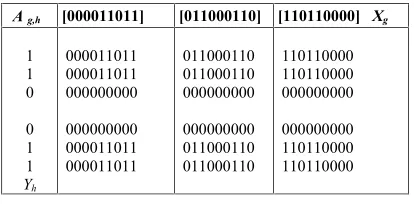
(1,2,3,..., M − 1) and h ∈ (1,2,3,..., N − 1). is the time spreading patterns while is the wavelength encoding patterns. Table 3 shows some examples of 2-D Hybrid FCC-MDW code sequences for k1 = 4 and k2 = 2, wherek1andk2are the code weights for and
[image:3.612.91.298.256.358.2]respectively.
Table 1. 2-D Hybrid FCC-MDW Code for k1=4 and
k2=2 Sequences
As highlighted in previous work by [5], four characteristic matrices ( ), d
∈
(0, 1, 2, 3)has been used to obtain the cross-correlation property. Following the same assumption, ( )
for 2-D Hybrid FCC-MDW code can be defined as
A(0)= YTX, (1)
A(1)= YT , (2)
A(2) = TX, (3)
A(3)= T (4)
Parameters and are the complementary of X and Y respectively. Thus, the cross-correlation of 2-D Hybrid FCC-MDW code A (d)and A
g,h is expressed as
( )( , ℎ) = ∑ ∑ ( )
( )( )
where ( ) is the (i, j) th of A(d ) and
( )( ) is the (i, j) th of Ag,h. Table 4 illustrates the cross-correlation between any two codes A(d) and A
g,h of 2-D Hybrid FCC-MDW code generated from Eq. (5).
Table 2. Cross Correlation of 2-D Hybrid FCC-MDW Code
This property is very important in order to cancel the MAI and suppress the PIIN. Hence, the derivation of new correlation functions can be expressed as
( )( , ℎ) − ( )( , )
( ) +
( )( , )
( ) − ( )( , ℎ) =
, = 0, ℎ = 0
0, ℎ
3. SYSTEM DESCRIPTION
The most important elements in realizing the transmission in OCDMA network are light source and encoder in the transmitter [1,18]. On the other hand, decoder and photodetector are the main elements in the receiver. In general, OCDMA networks composed pairs of transmitters and receivers that use the code sequence and a star coupler. Fig.1depicts the encoder configuration for 2-D Hybrid FCC-MDW OCDMA system.
Every user is allocated with specific codeword from a code set of the new proposed code. The information bits, using on-off keying format is modulated by the modulator MOD). Specifically, an optical pulse is transmitted to the encoder if the incoming data bit is one, while if the data bit is zero there are no optical pulse is sent [8]. After the modulating process, the modulated signals are encoded with the specific codeword in wavelength and time spreading encoding. For time encoding, the modulated pulses are sent to the splitter and enter the optical fiber delay lines (TOFDLs). Then, the combiner reassembles all the delayed optical pulses. Moreover, wavelength encoding is performed by two FBGs (FBG1 and FBG2).
Ag,h [000011011] [011000110] [110110000] Xg
1 1 0 0 1 1 Yh 000011011 000011011 000000000 000000000 000011011 000011011 011000110 011000110 000000000 000000000 011000110 011000110 110110000 110110000 000000000 000000000 110110000 110110000
Xg,h R(0)(g,h) R(1)(g,h) R(2)(g,h) R(3)(g,h)
g= 0,h= 0
g= 0,h≠ 0
g≠ 0,h= 0
g≠ 0,h≠ 0 k1k2
k1
k2
1
0
0
k2(k1−1)
k1−1
0 k1 0 1 0 0 0
k1−1
(10) (6)
(5)
BLS
MOD
Wavelength EncoderXg Time spreading EncoderYh
Sp lit te r m bi ne r TOFDL1 i1τ
i τ
98 In addition, FBG1 and FBG2 have the same number grating, but reversed to each other [19]. Only the matched wavelength will reflected while others are filtered out. However the different round trip delay will occur for those matched wavelengths that reflected by different gratings. As a result, FBG2 is employed to compensate those delay times. Accordingly, all the encoded optical pulses have the same time delay and are sent at the same slot [8]. Thus the full two dimensional encoded optical signal is generated from this point.
The proposed structure of decoder for the 2-D W/T scheme is illustrated in Fig.2. The purpose of decoder structure is to recognize the ability of MAI cancellation as per derivation in Eq.(10). Both combiners (Combiner#1 and Combiners#2) have different tasks.
The incoming signals will be combined by Combiner#1 to produce the time encoding, Yh while Combiner#2 is to produce the complementary time encoding, Yh. Furthermore, the cancellation of MAI from different time spreading codeword can be done by forming the double balanced detector [20]. Thus, in order to accomplish the MAI cancellation in both wavelength and time domains, both branches need one balance detector. The Balance detector#1 is connected accordance with the time spreading codeword while Balance detector#2 is connected to the complementary of the time spreading codeword. Hence, the matched wavelength of FBG1 and FBG2 can be obtained at photodetectors PD0 and PD2 whereas PD1 and PD3 are for unmatched wavelength. The output of photo detector is fed to a threshold detector for data recovery.
[image:4.612.107.494.467.686.2]4. CODE PERFORMANCE ANALYSIS
Figure 2. Structure of 2-D Hybrid FCC-MDW OCDMA Receiver
Output data PD0
PD1 FBG2
FBG1
X1
X2 Delay
Wavelength Decoder, Xg
Sp
lit
te
r
Time spreading Decoder Yh
Time spreading Decoder Yh
Time spreading Decoder Yh
Time spreading Decoder Yh X1
X2
Sp
lit
te
r
1/(k1-1)
PD2
PD3
Sp
lit
te
r
Co
m
bi
ne
r
TOFDL1
TOFDLk2+1 (N-i1)τ
(N-ik2 +1)τ
99 There are certain parameters that highly considered such as correlation function values, BER and cardinality in order to analyze the performance of 2D Hybrid FCC-MDW code. The Gaussian approximation is used to calculate the BER. Subsequently, three types of noises are taken into account for calculating the BER including PIIN, shot noise and thermal noise in the photodiodes. The general form of the photocurrent noise emitted from the photodiodes can be expressed as follows [3-5]
〈 〉 = + 2 + 4
where is the average photocurrent output from the photodiode, is the electrical bandwidth, τcis the coherence time of the light
source, is electron’s charge, is
Boltzmann’s constant, is the absolute receiver noise temperature and is the load resistance. The power spectral densities of the received optical signals can be written as
( ) = ∆ ( ). ( ) ×
− − ∆ – + 2 − − −
∆ – + 2 + 2
where the effective source power at the receiver, ∆f is the source bandwidth, k2 is the code weight of the time spreading code sequence, W is the number of simultaneous active users, ( ) is the data bit of the th user, which can be “1” or “0”, M is the code length of the wavelength encoding code sequence and N is the code length of the time spreading code sequence, ( ) represents an element of the th user’s code word while
( )is the unit step function. In addition, is the code weight of the wavelength encoding code sequence. Hence, the total output photocurrent from the receiver can be obtained as follows
= ℜM
Accordingly, under the circumstances that all of the users transmit bit “1” or worst case
scenario, the power of PIIN that exists in photocurrent of the receiver can be expressed as
〈 〉 = = ∆ (ℜ − 1) 1[ ( − 1)
+ ( − 1)( − 1)]
+ ( − 1)1 [ ( − 1)( − 1)]
Additionally, the power of shot noises from all photodiodes i.e. PD0 – PD3, can be written as [3-5]
〈 〉 = 2 ℜ + 2 ( − 1)( − 1)( − 1)
+ 2 ( − 1)( − 1)( − 1)
+ 4( − 1)( − 1)( − 1)( − 1)
By assuming that the probability of each user sending bit “1” is equal or 1/2, the equation of PIIN and shot noise can be revised as Eqs.(16) and (17) respectively.
〈 〉 = 2 ∆ (ℜ − 1) {[ ( − 1)
+ ( − 1)( − 1)]
+ [ ( − 1)( − 1)] }
〈 〉 = ℜ + 2 ( − 1)( − 1)( − 1)
+ 2 ( − 1)( − 1)( − 1)
+ 4( − 1)( − 1)( − 1)( − 1)
Moreover, the thermal noise can be written as [3-5]
〈 〉 =4
Accordingly, by using the Eqs. (9), (12), (13) and (14) the SNR at the receiver can be obtained as [3-5]
= 〈 〉 + 〈 〉 + 〈 〉
(12)
(13) (7)
(8)
(11) (10)
(14)
(9)
100 Therefore, the BER can then be estimated as [3-5]
=12 8
5. RESULT AND DISCUSSION
The results of numerical analysis can be obtained by using the parameters listed in Table 5. Moreover, there are two different values of bandwidth B and data transmission rate Rb, had been used, i.e. 500MHz and 1.25GHz at 1.0Gbps and 2.5Gbps respectively. The evaluation of the system performance has been carried out by using a mathematical calculation is shown in Fig.3 – Fig.5.
Table 3. Parameters used in the Numerical Calculation
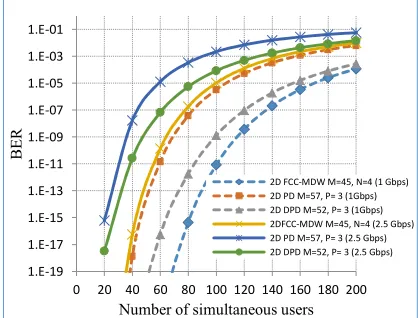
[image:6.612.313.522.437.596.2]The BER against the number of simultaneous users with similar code length are presented in Fig.3. Two types of code i.e. 2-D PD and 2-D DPD codes have been used for comparison purpose. The effective source power, Psr is fixed at 0dBm and two data rates are used, i.e. 1Gbps and 2.5Gbps to determine the BER. For our new proposed 2-D Hybrid FCC-MDW code, we used the codeword with M=45 and N=4 or the code size is 180. Similarly, the code size of 2-D PD code is 171 or the value of M= 57 and N=3. Likewise, the code size of 2-D DPD code is 156 or the value of M= 52 and N=3. In Fig.3 there is a significant difference between these two data rates. There is a clear
trend that the number of simultaneous users’ decreases as the higher data rates was deployed. At the same standard BER error floor i.e 10-9, the number of simultaneous users of our new proposed 2-D Hybrid FCC-MDW code decreased from 120 to 65 users as the data transmission rate increases from 1.0 Gbps to 2.5 Gbps. This finding provides evidence that at a higher data transmission rate, the noise interference at receiver photodiodes is high which will degrade the quality of decoded signal and resulting the power loss in the system. Moreover, our proposed 2-D Hybrid FCC-MDW code can significantly support more simultaneous users than the system using 2-D PD or 2-D DPD codes for both data rates. For instance, at 1Gbps data rate, our proposed system can accommodate 120 users at standard acceptable BER = 10-9while 2-D PD and 2-D DPD codes can only accommodate 70 and 100 users respectively. Apparently, the cardinality of this proposed code improves up to 71% and 20% compared to 2-D PD and 2-D DPD codes respectively. Thus the proposed system provides better performance than the other two codes.
Figure 3. BER Versus Number of Simultaneous Users with Similar Code Length and Effective Received Power
Fixed at 0dbm, Data Rate = 1Gbps and 2.5Gbps
Fig. 4 discusses the BER against effective received power,Psrbetween 2-D Hybrid FCC-MDW code (M=45, N=4), 2-D PD code (M= 57, N=3) and 2-D DPD code (M= 52, N=3) when the number of simultaneous users is fixed at 100 with data rate 1Gbps for each
1.E-19 1.E-17 1.E-15 1.E-13 1.E-11 1.E-09 1.E-07 1.E-05 1.E-03 1.E-01
0 20 40 60 80 100 120 140 160 180 200
BE
R
Number of simultaneous users
2D FCC-MDW M=45, N=4 (1 Gbps) 2D PD M=57, P= 3 (1Gbps) 2D DPD M=52, P= 3 (1Gbps) 2DFCC-MDW M=45, N=4 (2.5 Gbps) 2D PD M=57, P= 3 (2.5 Gbps) 2D DPD M=52, P= 3 (2.5 Gbps)
Parameter description Value
PD quantum efficiency Spectral width of broadband light source
η = 0.75
∆λ= 30nm (∆f = 3.75 THz)
Operating wavelength λo= 1550 μm
Receiver noise
temperature Tn= 300K
Receiver load resistor RL= 1030 Ω Boltzmann’s constant Kb= 1.38 ×10⁻²³
W/K/Hz Electron charge
Light velocity
e= 1.60217646 × 10⁻¹⁹
coulombs C = 3×10⁸m/s
101 user. It can be seen that 2-D DPD code requires 0dBm effective power to meet the standard optical transmission requirements while the proposed 2-D Hybrid FCC-MDW requires only -18 dBm of effective power to meet the same requirement with the same number of simultaneous users. It can be observed that even at high data transmission rate, this proposed code only requiring low power to activate the photodetector in the process of decoding the code.
Figure 4. BER Versus Effective Power, Psr With a Similar Code Length when the Number of Simultaneous
Users is 100 and the Data Rate of Each User is 1Gbps
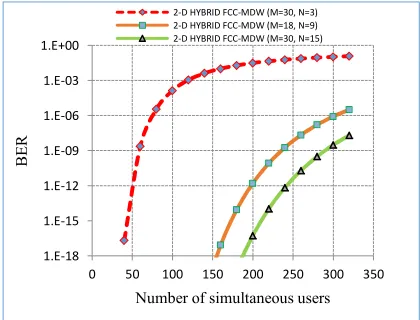
Figure 5. BER Versus Number of Simultaneous Users for 2-D Hybrid FCC-MDW with Varying Combinations of M
and N
Fig.5 exhibits the varied combination of wavelength/time code size for 2-D Hybrid FCC-MDW. Each curve illustrates the difference of combination of M and N where N represents the number of the chip time (time spreading code length) while M is the number of wavelengths. The respective code size is 90
(M =30, N=3), 162 (M =18, N=9) and 450 (M =30, N=15). The plotted curves in Fig.5 clearly show the system performance degrades as the cardinality increases. It is apparent from this graph that higher code size (M =30, N=15) accommodates the highest cardinality as compared to the lower code size (M =30, N=3) and (M =18, N=9). Interestingly, this result revealed that the number of time chip, N contributes significant effect to the cardinality of the system. For instance, the higher cardinality of the system can be achieved when the number of time chip, N =15 comparison with N = 3 at the same number of wavelengths, M = 30. In other words, the cardinality of the system can be enhanced by expanding the number of N. The major findings and the impact of Fig.5 is to prov
e the
hypothesis that 2-D Hybrid FCC-MDW offers a high level of code flexibility. On top of that, if the deployment of number of wavelength increase, it will cause the system complexity as well as the cost for OCDMA network implementation.6. CONCLUSION
This paper presented the performances of a new code in OCDMA system, namely 2-D Hybrid FCC-MDW code generated from two 1-D codes; FCC code and MDW code. The current study contributes to our knowledge by addressing four important issues. First, the proposed 2-D Hybrid FCC-MDW code system can greatly suppress PIIN and eliminate MAI by using the new correlation property. Second, it appears from the numerical results, in which it is proved that this new code is capable to enhance the cardinality of the system although at higher data transmission rates. Consequently, the system performance has also improved. The numerical results demonstrate the number of simultaneous users at BER 10- 9can be maximized up to 71% and 20% in comparison to 2-D PD and 2-D DPD codes respectively. Third, the necessary effective power of the proposed system is lower compared to those two systems when their number of code size is similar. Lastly, the 2-D Hybrid FCC-MDW offers a high level of
1.E-12 1.E-11 1.E-10 1.E-09 1.E-08 1.E-07 1.E-06 1.E-05 1.E-04 1.E-03 1.E-02 1.E-01 1.E+00
-40 -30 -20 -10 0
BE
R
Effective power for each user, Psr (dBm)
2-D HYBRID FCC-MDW M=45, N=4 2-D DPD M=52, N= 3 2-D PD M=57, P= 3
1.E-18 1.E-15 1.E-12 1.E-09 1.E-06 1.E-03 1.E+00
0 50 100 150 200 250 300 350
BE
R
Number of simultaneous users
[image:7.612.90.300.432.592.2]102 code flexibility which the number of the time chip significantly influences the cardinality of the system. Therefore, the findings of this study indicate that this 2-D Hybrid FCC-MDW is suitable for applications in optical CDMA LAN environments.
Acknowledgements – The author would like to
acknowledge the support from the Fundamental Research Grant Scheme (FRGS) under a grant number of 9003-00475 from the Ministry of Higher Education Malaysia.
REFRENCES
[1] Paul R.Prucnal, Optical Code Division Multiple Access: Fundamental and Applications, CRC Press, Taylor & Francis
Group, USA,2006, pp. 203-204.
[2] Tancevski, Ivan Andonovic, Hybrid wavelength hopping/ time spreading schemes for use in massive optical networks with increased security, Journal of Lightwave Technology, 14, 1996, pp. 2636-2647.
[3] Bih-Chyun Yeh, Cheing-Hong Lin, Chun-Liang Yang, Jingshown Wu, Noncoherent spectral/spatial optical cdma system using 2-D diluted perfect difference codes, Journal of Lightwave Technology, Vol.27, 2009, pp. 2420-2432.
[4] Cheing-Hong Lin, Jingshown Wu, Chun-Liang Yang, Nonceherent spatial/spectral optical cdma system with two-dimensional perfect difference codes,Journal of Lightwave Technology, Vol.23, 2005, pp. 3966-3980. [5] A.R Arief, S.A Aljunid, M.S Anuar, M.N
Junita, R.B Ahmad, F. Ghani, Enhanced performance of new family modified double weight codes spectral amplitude coding, optical CDMA system network, Proceedings of IEEE International Conference on Control System, Computing and Engineering, November 25 -27, 2011, Penang, Malaysia, pp. 488-494.
[6] Vishav Jyoti, R.S. Kaler, Design and implementation of 2-Dimensional wavelength/time codes for OCDMA, Optik
Journal, 122,2011, pp. 851-857.
[7] Mendez, Antonio J.,Gagliardi, Robert M.,Hernandez, Vincent J.,Bennett, Corey V.Lennon, William J, Design and performance analysis of wavelength/time (W/T) matrix codes for optical CDMA,
Journal of Lightwave Technology, Vol.21, 2003, pp. 2524-2533.
[8] H. Yin, L. Ma, H. Li. L. Zhu, A new family of 2D wavelength/time codes with large cardinality for incoherent spectral amplitude coding OCDMA networks and analysis of its performance, Photonic Network Communications, 19, 2010, pp. 204–211. [9] Rhys Adams, Julien Faucher, Luay Thomas,
David V. Plant, Lawrence R. Chen, Demonstration of encoding and decoding 2-D wavelength-time bipolar codes for OCDMA systems with differential detection, IEEE Photonics Technology Letters, 17, 2005, pp. 2490-2492.
[10] Ye Zhang, Hongwei Chen, Zhijian Si, Heng Ji, Shizhong Xie, Design of FBG En/Decoders in coherent 2-D time-wavelength OCDMA systems, IEEE Photonics Technology Letters,
Vol.20,2008, pp. 891-893
[11] Lawrence R. Chen, Flexible fiber bragg grating encoder/decoder for hybrid wavelength–time optical CDMA, IEEE
Photonics Technology Letters, 13, 2001, pp.
1233-1235.
[12] N. Din Keraf, S.A.Aljunid, A.R. Arief, M.N Nurol, M.S. Anuar, C.B.M Rashidi, P. Ehkan, Noise mitigation of ocdma system with wavelength/time 2-D hybrid FCC-MDW code,
Proceedings of IEEE International
Conference on Photonics (ICP),September
2-4, 2012-4, Kuala Lumpur, Malaysia, pp. 166-168.
[13] N. Din Keraf, S.A.Aljunid, A.R. Arief, M.S. Anuar, C.B.M Rashidi, P. Ehkan, M.N Nurol, An optimal cardinality of Wavelength/Time incoherent OCDMA system using 2-D Hybrid FCC-MDW Code, Proceedings of the International Conference on Electronic
Design (ICED), August 19-21, 2014, Penang,
Malaysia, pp. 356-361.
[14] Taher M. Bazan, David Harle, Ivan Andonovic, Code Flexibility of 2-D Time-Spreading Wavelength-Hopping In OCDMA Systems, Journal of Selected Topics In
Quantum Electronics,Vol.13, 2007, pp.
1378-1385.
[15] Mengsu Zhang, Design and Performance Analysis of Novel Signature Code in Two-Dimensional Optical CDMA. MPhil Thesis, University of Birmingham, United Kingdom, 2012.
103 (FCC) code for sac-ocdma system by alleviation interference scheme (AIS), Optik International Journal for Light and Electron Optics, 125, 2014, pp. 4889-4894.
[17] S.A Aljunid, M. Ismail, A.R.Ramli, Borhanuddin M. Ali, M. K. Abdullah, A new family of optical code sequences for spectral-amplitude-coding optical CDMA systems, IEEE Photonics Technology Letters,16, 2004, pp. 2383-2385.
[18] Nasaruddin, T.Tsujioka, Design of reconfigurable multiweight wavelength-time optical codes for secure multimedia optical
CDMA networks, Proceedings of IEEE
International Conference on Communications, May 19 -23, 2008, Beijing, China, pp. 5437-5442.
[19] Jen-Fa Huang, Chao-Chin Yang, I-Min Chiu, Hybrid MQC/M-Matrices coding over non-coherent spectral/spatial optical CDMA networks,International Journal of Microwave and Optical Technology, 1, 2006, pp. 592-595. [20] C.Yang, J.Huang, Two-dimensional M-matrices coding in spatial/frequency optical CDMA networks,IEEE Photonics Technology