172
DISASTER RECOVERY PROCESS IMPROVEMENT IN IT
ORGANIZATION : KNOWLEDGE MANAGEMENT AND GAP
ANALYSIS
1HANIZAH HJ. MOHIDEEN, 2MAGISWARY DORASAMY
1Faculty of Management, Multimedia University, Malaysia
2Faculty of Management, Multimedia University, Malaysia
E-mail: 1 [email protected], 2 [email protected]
ABSTRACT
Noteworthy research gap are being perceived on Knowledge Management (KM) in the outlook of Disaster Recovery (DR) in Information Technology (IT) organizations. Preliminary interviews with the organization implied that the organization facing two main challenges in the context of DR, namely (i) DR information hosted in various knowledge repositories, and (ii) lesson learn capturing is being done after the DR test completion and unavailability of centralized lesson learn or best practice document for quick reference. We found that organization can benefit from the inclusion of KM concept within the process improvement to support its Disaster Recovery activities. This research is an action research to improve DR process in a multinational company in Malaysia. Mixed method approach will be used as to obtain some variation in data collection which will lead to greater validity. Our aim is to fill the theoretical gap in KM for DR in IT organizations. This paper presents the result of the first stage in canonical action research which is Problem Diagnosis. The proposition of this research is that an improvised process can successfully support disaster recovery activities in IT organizations.
Keywords: Disaster Recovery, Knowledge Management, Information Technology, Action Research
1. INTRODUCTION
IT Multi-National Companies (MNC) in Malaysia run their IT business by operating around the clock, 365 days a year. The Information Systems (IS) data are hosted at major data center located at different regions. IT operating environments in general have a broad range of various application services and infrastructure components that have frequently developed and stretched over time. This results in a multifaceted network of servers and software applications that can be complex and costly to run the business. It will hold back the agility of the IT structure and limits the efficiency and effectiveness of the IT operations. In the event of IS downtime or disaster strikes, it can bring unwanted visibility by customers, partners, stakeholders, competitors and threaten the credibility of the IT organization.
In light with the online Disaster Recovery Preparedness Survey (2014), most organizations globally are risking their business operations by not being appropriately ready for IT systems recovery due to disaster. The survey outcome demonstrate a
substantial gap in disaster recovery preparedness that does not look good for business that normally rely upon their IT systems to sustain in commercial platform. As indicated by the survey’s outcome, most organizations are still less prepared. As a result, it impacts business with large amount of money in stipulations of lost business, loss of limited resources and tarnished reputations.
173 must include relevant and accurate knowledge. This knowledge can significantly support disaster activities (Davenport and Prusak, 1998). Lesson learned and best practices entries are changes in processes made throughout the organization that have led to improved processes (O’Leary, 1998; Alavi and Leidner, 2001). Infusion of KM elements into a DR process especially in IT organization is still unavailable. Therefore, discovering and experimenting the success factors of KM in DR process is needed.
In this study, the selected client is one of the many other IT Multi-National Companies (MNC) in Malaysia. During the preliminary interview, researcher understood that the DR information in client’s organization are being stored in various repositories (e.g. SharePoint, QBase, Best Guide). Scattered and inconsistent information will lead DR activities to failure due to unavailability of central repository. Mohanty, Panda, Karelia, and Issar (2006) indicate that knowledge on disaster management approaches are materialize to be fragmented and emphasized an apparent gap in information harmonization, which is true in the case of client organization.
The disaster management stakeholders must be innovative for each cycle. (Moe, Gehbauer, Sentz, and Mueller, 2007; Pathirage, Seneviratne, Amaratunga and Haigh, 2015). In client organization, there is no lesson learned database or record to capture all lesson learned from each DR test. However the information are being captured in post-test report separately after each DR test. Two points were observed during the preliminary interview with DR Team, first is some of the lesson learned could not be remembered during post-test report write-up and second is the quick reference on all best practices are not obtainable from one centralized document or database. Hence, this study takes the opportunity to improvise their DR process with intention to serve the customer better and at the same time benefit the organization.
2. METHOD
The research will undergo a mixed-method to obtain variation in data collection which will lead to greater validity. The nature of this research demand for direct researcher’s involvement in the organization studied, for this reason an Action Research (AR) approach will fit the purpose. AR seeks two goals namely to solve problems within an institutional context and contribute to knowledge (Davison, Martisons and Kock, 2004; Davison, Martisons and Ou, 2012; Baskerville and
Wood-Harper, 1998). AR approach is a suitable approach for this research because it require the researcher to deep-dive into the challenges faced by Disaster Recovery Team in the client organization. This approach enabled the researcher to not only explain the phenomena but likewise make things happen, engage in real problems and introduce action or change to test the theory. The eminent problems discussed above warrant AR to solve the immediate IT DR process immaturity at client organization. The changes expected through the improvement of IT DR process that would ease the challenges faced by client organization.
The KMS Success Model of Maier (2002) which is an extension from DeLone and McLean (1992) model is used as the fundamental theoretical framework as a guidance to improve existing DR process. The updated and added dimensions in Maier model is Information, Communication and Knowledge Quality and Knowledge Specific Service, where as all other dimensions are same as DeLone and McLean study. The information system success model of DeLone and McLean (1992; 2003) was used as a structure for model since it was predicted to fit the examined criteria of success and offered an accepted theoretical basis for the suggested model. Maier model are widely utilized for assessing effectiveness and also could be interpreted as being specific to an approach.
Since this research is looking into a specific service within an organization which is DR service, this model is an appropriate model to be applied in this study. At present, the study is in its second stage which is the Action Planning as per CAR diagram by Susman (1983), Baskerville and Wood-Harper (1998) and Davison, Martisons and Kock, (2004). The study’s objective is to expand the theoretical perspective of KM in IT organization’s disaster recovery activities.
174
3. PROBLEM DIAGNOSIS
3.1 Interview
During stage 1: Problem diagnosis, an interview was carried out with Disaster Recovery Team in client organization to acquire a clear understanding of the existing Disaster Recovery process. The diagnosis questions were posted in three subdivisions. In Section 1, the questions were asked about general information of DR Team. Section 2, questions covered specific questions on DR process. The last Section 3, knowledge management in the context of DR questions were clarified. The following are the questions and responses:
Section 1 : General Information on Disaster Recovery Team
a)Could you please introduce yourself and your Team? Nine Employees (1 Team Lead, 4 DR Seniors and 4 DR Juniors) and 1 Project Manager.
b)What are the roles of SGA DR Team during disaster recovery?
DR Team will produce the scope according to situation (which data center impacted). DR Team will communicate to Situation Team. DR Team will perform coordination on which landscape to be recovered first. DR Team will perform disaster recovery coordination with all stakeholders.
Section 2 : Disaster Recovery Process
a)Could you please provide a brief walk-through on DR process?
Onboarding DR Test Process – To validate DR capability before supporting the application landscape. Evergreening Process – To perform test for the new added component / landscape. Annual Test Process – To test all the onboarded DR services to ensure DR capability of the landscape. Reporting Process – To measure and report to customer on monthly basis of the DR plan deliverables.
b)How frequent DR process will be reviewed?
Once in every 12 months, review together with customer and technical (production) engineers. a)Is there any challenges in the current DR process?
Yes many reasons: Customer do not prefer downtime for DR test purpose, production systems enhancement neglect on DR capability and too many processes as a outsourced company and there is less collaboration b)Is your customer happy with the current process?
We provide service support to multiple business units across the global, same goes as DR plan. Hence we do received mixture of feeling on the happiness level on the current DR plan and services provided.
c)How many times will your Team conduct DR test?
Multiple landscapes, at least one DR Test per subscribed landscape. In a year, approximately 200 plus DR tests.
d)Since Jul 2008, is there any unsuccessful test? A lot, no record kept for unsuccessful DR test, the unsuccessful will be re-test again until it is completed as successful. Root cause for the unsuccessful DR test will be done before re-test.
Section 3: Knowledge Management for Disaster Recovery
a)Is there one single DR plan or multiple? If multiple DR plans, could you share the variations?
Multiple DR plan, one landscape will have one DR plan.
b)Is there any challenges in the current DR plan? DR plan owned by customer, there is no clear RACI for the DR plan. Customer will not alert if they made any changes until our DR Team download the DR plan from customer’s repository. This created a lots of confusion and lack of participation of stakeholders during DR plan review.
c)How DR Team stored all the process documents / checklists / DR plans?
In client’s and customer’s repository, which is Microsoft SharePoint document management platform.
d)Is there any lesson learned process for your DR activities?
Yes, lesson learned will be captured as part of DR Post Test Report process. Post Test Report will be performed after completion of each DR Test activities.
e)What are the challenges faced by DR Team in using knowledge management database?
Maintain the knowledge management database to stay relevant on all information, too many parties or stakeholder to contribute and many data can be obsolete or incorrect.
f) Do you think IT / IS can solve some of the challenges? If Yes, what is the critical success factors to consider for better knowledge management blueprint?
Typical SharePoint are not sufficient and smart enough to provide the information in a faster and effective ways, it is the matter of how we store and maintain the knowledge.
3.2 Interview Results
175 report). Knowledge on disaster management approaches, best practices and lessons learned can significantly support mitigation and preparedness stage of disaster management (Pathirage, Seneviratne, Amaratunga, and Haigh, 2015). Although disaster domain is relatively small but there is a growing focus relating knowledge management and motivation hold up for catastrophe activities. Information systems in knowledge management and protection motivation are being discovered for its involvement to support catastrophe activities.
Looking at the problem from macro level perspective, Disaster Recovery Preparedness Survey (2014) analyze that most companies are putting their business operations at risk by not being properly prepared to recover IT systems in the event of a disaster. The survey results indicate a significant gap in disaster recovery preparedness that does not bode well for businesses that typically depend on their IT systems to survive and thrive in today’s marketplace. According to the survey’s results, the vast majority of companies of all sizes are not prepared to recover critical IT systems in the event of a serious outage or disaster. As a result, outages of critical systems are costing business significant amounts of money in terms of lost business, damaged reputations and diversion of resources to remedy and recover from outages or disasters. Staff roles and responsibilities are typically not defined well and the majority simply do not test their DR plans often enough to feel confident they can recover critical information and applications rapidly and reliably. And, it appears even more remarkable that one-third (35%) of companies admit to never fully recovering data lost through an outage.
The same survey concluded three out of four companies are at risk due to failing to prepare for DR. More than 60% do not have a fully documented DR plan and another 40% admitted that the DR plan they currently have did not prove very useful when it was called on to respond to their worst disaster recovery event or scenario. One third of all organizations test their DR plans only once or twice a year and 23% never test their DR plans. Without testing and verification of DR plans, most companies have no idea as to whether they can fully recover their IT systems in the event of a disaster or an extended outage. When companies do test their DR plans, the results are most disturbing because more than 65% do not pass their own test. The survey indicated that more than one third or 36% of organizations have lost one or more critical applications, or critical data files for hours at a time
over the past year, while nearly one in five companies have lost one or more critical applications over a period of days. Even more alarming is that one in four respondents said that they had lost most or all of a datacenter for hours or even days, an indication of a true disaster scenario for companies that rely on IT to conduct business. Reported losses from outages ranged from a few thousand dollars to millions of dollars with nearly 20% indicating losses of more than $50,000 to over $5 million.
3.3 Problem Deep-Dive Analysis
DR Team in client organization is going through two main challenges. First of all, knowledge repositories synchronization challenges between client and their customer’s repositories which resulted in scattered and inconsistent information. The absence of centralized repository will lead DR activities to failures. Mohanty, Panda, Karelia, and Issar (2006) indicate that knowledge on disaster management materialize disconnected and emphasized an apparent gap in information harmonization, which is factual in the case of client organization. Finally, some of the lesson learned could not be remembered because it is being captured after the DR test activities in which client called it as post-test report write-up. Lesson learned information is a valuable information, it is important for stakeholders in the disaster team to gain knowledge from the lesson or experience in order to take up best practices and be innovative during the disaster management (Moe, Gehbauer, Sentz, and Mueller, 2007; Pathirage, Seneviratne, Amaratunga, and Haigh, 2015).
176 As a result, two research questions emerge for the given two problems: How can the Knowledge Management critical success factors improve accuracy, reliability and timeliness of Information Technology Disaster Recovery process? To what extent the inclusion of knowledge and motivational factors can improve Information Technology Disaster Recovery process towards Disaster Recovery effectiveness?
4. BUSINESS PROCESS
4.1 Disaster Recovery Process
Information Technology Infrastructure Library (ITIL) is set of processes which depict best practices for IT organization to provision IT services. At present, ITIL V3 (2011) is the latest process model being used and practice by IT service provider. Looking at history of ITIL, it was developed during 1980's by the Central Computing and Telecommunications Agency (CCTA), a government agency in Great Britain. The objective was to develop effective and efficient methods for the provision of IT Services, in other words a catalogue of best practices for the IT organization. Literature analysis revealed that IT has been viewed and treated as a service (Kettinger & Lee, 1994). Businesses are raising their bar for level of IT services that resulting in the efficiency and effectiveness of IT management being put in the limelight of the top management. IT service management process implementations focus on four areas or 4Ps that stand for process, people, product and partner. This means that implementation of every IT process have to consider the development of process and configuration of toolset around the people and partner or vendor who execute the process steps.
As per ITIL, Disaster Recovery element is situated under Service Design phase, which is named as IT Service Continuity Management. IT Service Continuity Management ensures that appropriate continuity mechanisms are in place. Disaster recovery services in client organization are process driven services that can be ordered to provide disaster protection for a data center catastrophic loss of managed infrastructure or services covered by a DR. Organization must engage in IT disaster recovery planning to have significant impact on their organizational performance. Little research is done in this context as IT disaster recovery planning is under-conceptualized in mainstream IT research (Shropshire and Kadlec, 2009).
DRP consist of detailed procedures to recover critical functions. It usually appears in written form,
outlines standard operating procedures that must be adhered by organizations during a disaster situation. DRP describes how work can be restored after a disaster. The ultimate idea is to develop a plan for an IT department to restore data and system functionality with minimal disruptions to operation. DRP is all about the processes and plans to resume operation rather than about technology. Hence, it should serve as a complete framework and general direction to follow. At the same time, a good disaster plan should allow employees to perform their job in a time-constraint period, under highly stressful situation and perhaps without full organization resources.
4.2 Knowledge Management Process
In ITIL, Knowledge Management element is situated under Service Transition phase with the same abbreviation “Knowledge Management”. ITIL Knowledge Management aims to gather, analyze, store and share knowledge and information within an organization. The primary purpose of Knowledge Management is to improve efficiency by reducing the need to rediscover knowledge which is aligned with Edwards (2011) who declared that knowledge management comprises of three significant elements. They are processes, people and technology. Knowledge Management (KM) in client organization is still in progress to reach the process maturity level. Most of the processes are standalone with KM process, by all means KM is certainly important element however it was not put in practice systematically. The lack of management of technical knowledge in IT services has substantial costs in making the same mistake twice (or more), and inability in finding what the company knows fast enough in problem solving (Gamble and Blackwell, 2001).
177
4.3 Knowledge Management for Disaster
Recovery
KM is an important part of the recovery planning as KM enables system functionality. It facilitates the role of capturing relevant knowledge that are life-saving in nature during a disaster situation. Knowledge base and recovery plan must contain relevant knowledge that must be available all the time, including during disaster. Disaster stakeholders require to be proactive and proficient to learn from past lessons (Pathirage, Seneviratne,
Amaratunga and Haigh, 2015). Kamara,
Augenbroe, Anumba, and Carrillo (2002) asserted that KM strategies can help to reduce repetition of past mistakes and errors. In other words, we posit that KM strategies can avoid unnecessary redundant effort, reduce time needed to recover and save cost.
Maier (2002) proposed a KMS success model that explains the important factors for a successful DRP process. The updated and added dimensions in Maier model is Information, Communication and Knowledge Quality and Knowledge Specific Service, where all other dimensions are same as DeLone and McLean study. Maier model are widely utilized for assessing effectiveness and also could be interpreted as being specific to an approach. This study will employ Maier’s KMS Success framework to steer the process improvement for DR activities. Since this research is looking into a specific service within an organization which is client organization DR service, this model is an appropriate model to be applied in this study. This model will be used to examine if KMS can influence to improvise DR activities.
Previous literature in regards to KMS as a critical factor in disaster context (McManus, Synder, and Wilson, 2003; Lubitz, 2008; Hassan, Hayiyusuh, and Nouri, 2011; Yahya, Ahmad, Mohamad and Rodzi, 2016). Hassan, Hayiyusuh, and Nouri (2011) examined KM system to support humanitarian assistance/disaster relief. KMS are important for response planning, disaster detection and management. Seneviratne, Baldry, and Pathirage (2010) conducted a research to determine the disaster knowledge factors. Benefits of technological disaster knowledge factors are to detect and warn systems to save lives and reduce the impacts. Pathirage, Seneviratne, Amaratunga and Haigh, (2015) carried out an investigation to analyze managing disaster knowledge.
KM play an important role that ensure that the accessibility and availability of reliable and accurate information related to disaster risk when
needed and through adequate lesson learning. McManus, Synder, and Wilson (2003) carried out an investigation to analyze the imperative of knowledge management. Expertise retention of key personnel and enhanced interaction between people, technology and processes continue to drive investment in initiatives of KM. As organizations proceed to be challenged by the competitive global marketplace’s dynamic nature, there is a need to outsource tasks of knowledge and managing rapid key personnel turnover and it is necessary to adopt practices of KM. Lubitz (2008) examined the complexity associated with disaster management. It presents disasters complexity demands knowledge utilization that include outside domain that adopted in disaster management. At the same time to become successful, knowledge has to be extracted, integrated with information that generate the disaster itself and translated into and actionable knowledge.
4.4 Disaster Recovery Process Improvement
The basic goal of a disaster response organization is to minimize effectively the impact of the disaster. Disaster response effectiveness and efficiency occur best through systematic planning which includes components covering costs projections, procurement planning and resource mobilization (Kelly, 1995). Making response efforts cost efficient results in a better matching of available resources to the requirements for effective response. Improving the match between resources and needs requires a positive management of the cost aspects of responding to disasters. The disaster management structure needs to manage the disaster rather than operate reactively. Besides having detailed disaster recovery plan, an organizational ability to update response plans and revise resource needs and costs are critical to a flexible and adaptive operation.
178 According to Alavi and Leidner (2001 ; 2009) the process enhancements engaged curbing the scheme time for developing project management, client engagements, improving staff participation, saving time, developing communication, making the beliefs of plant staff more noticeable, eradicating problem-solving time, offering better accountability and measurement and better serving the clients. Such practice and process developments could be thinking of as either associating to efficiency gains or communication developments. Hence, the apparent advantages of an organization of KMS could be thought of largely as being of a marketing, financial and common nature. Gupta et. al., (2000) quoted in his study, to stay competitive, companies must still be innovative in reducing their costs and expanding their markets. Thus, organizations are streamlining their processes. Organizations are beginning to realize that there is a vast and largely untapped asset diffused around in the organization, which is “knowledge”. KM emerged with not only the need to be cost efficient and managerially effective in problem solving, decision making, innovation and all other elements needed to maintain and develop a competitive edge, but also more specifically to capture, catalogue, preserve, disseminate the expertise and knowledge that are part of the organizational memory.
5. RESEARCH GAP
There have been numerous studies and researches that focus of knowledge management in companies (Martin, 2000; Mistilis and Sheldon, 2006). There are studies that focus on the disaster recovery (Bosher, Dainty, Carrillo, Glass and Price, 2007; Bayrak, 2009). Researchers also focused on the knowledge management during disaster recovery or crisis response (Jennex, 2017). There have been researches that analyze the implementation of system related to knowledge management for the support for disaster management and emergency preparedness (Raman, Ryan and Olfman, 2006; Hassan, Hayiyusuh, and Nouri, 2011; Huang, Chan and Hyder, 2010; Dorasamy, Raman and Kaliannan, 2013). Researchers have studied the managing disaster knowledge that is determined the knowledge factors and challenges (Pathirage, Seneviratne, Amaratunga and Haigh, 2015).
However, study on the IT DR process will be relatively new with contribution respect to Knowledge Management context. This study tries to bridge that gap by investigating the knowledge critical success factors and lesson learned capturing mechanism to improvise IT DR process.
As per the derived literature, this study takes an effort to fill the gap of knowledge in the context of KM for DR in IT organization sector. A query was run in Scopus database using two keywords to search, Knowledge Management and Disaster Recovery. Scopus database was selected to derive the journals data for the reason that it is peer-reviewed literature with a comprehensive overview of worldwide research publication. Total of 256 results were found with publication date from 1975 to 2016. The analysis was analyzed using Microsoft Excel spreadsheet software.
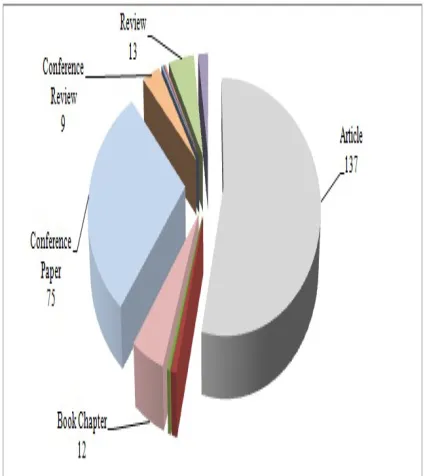
[image:7.612.312.524.369.607.2]Figure 1, a simple pie chart was done to study the document types for those 256 results. Top five document types were noticed namely Article (137), Conference Paper (75), Conference Review (9), Review (13) and Book Chapter (12). Other document types were Article in Press (2), Book (1), Editorial (1), Erratum (1) and Blanks (5). Since more than 50% of the results were published as an article in various journals, this document type was analyzed further.
Figure 1: Document Type Analysis
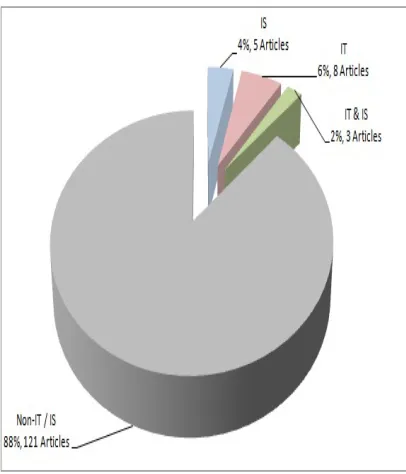
179 articles. Only 12% (16 articles) were on IT and IS or combination of both and this was grouped as IT Sector. The 16 published articles were related to either IT (8 articles), IS (5 articles) and combination of both IT and IS (3 articles). The full details of all 16 articles are presented in Table 1. Hence, these 16 articles were investigated further to identify the research focus area. This will be discussed in the next analysis.
Figure 2: IT/IS Sector and Non-IT/IS Sector Analysis
Table 1, is the further deep-dive analysis was accomplished in order to understand the research focus area. Based on Fig. 2, the 16 articles were reviewed to identify the research focus area. The research focus area has been clearly clustered in Table 1. The table is divided into three categories which are IT, IS and combination of IT and IS. In the domain of IT only, there were 8 articles studied with focusing mainly on decision support, Geographical Information Systems (GIS) and knowledge sharing. For the IS domain, DRP for residential community, medical data, e-learning and knowledge inventory. Study focusing on knowledge base, critical data and critical issues were done using both IT and IS. IT or IS DR is occasionally addressed in information systems textbooks (Hiltz, Van de Walle, and Turoff, 2010) and is generally focused on managerial activity (Kovacs and Spens, 2007; Ramsaran, 2005), but it is rarely approached in mainstream research.
Table 1: Research Focus Area of IT, IS and Combination Analysis
IT
1.Decision Support for Nuclear Disaster 2.Government Software Readiness
during Disaster
3.Disaster Management for Nuclear Disaster
4.Woman Readiness with IT for Disaster
5.GIS for Seismic Hazard 6.Product Development to Protect
Business Critical Data 7.Knowledge Sharing for Risk
Reduction
8.Integrated GIS for Pacific Disaster Center
IS
1.Disaster Recovery Plan for Residential Community
2.Medical Data Post Disaster 3.E-Learning for Disaster 4.E-Health Data Protection
5.Knowledge Inventory for Earthquake
IT and
IS
1.Knowledge Base for Security 2.Critical Data Monitoring 3.Critical Issues Perceived
6. CONCLUSION
[image:8.612.90.293.218.455.2]180 organizations as an asset that must be protected, preserved and evolved.
REFRENCES:
[1] M. Alavi and D.E. Leidner, “Knowledge
Management and Knowledge Management Systems : Conceptual Foundations and Research Issues,” MIS Quarterly, vol. 25, no. 1, 2001, pp. 107 – 136.
[2] R. Baskerville and A. T. Wood-Harper,
“Diversity in Information Systems Action Research Methods,” European Journal of Information Systems, vol. 7, no. 2, 1998, pp. 90 – 10.,
[3] T. Bayrak, “Identifying requirements for a
disaster-monitoring system,” Disaster Prevention and Management, vol. 18, no. 2, 2009, pp. 86 – 99.
[4] L. Bosher, A. Dainty, P. Carrillo, J. Glass and
A. Price, “Integrating disaster risk management into construction: a UK perspective,” Building Research and Information, vol. 35, no. 2, pp. 163 – 177, 2007.
[5] T. H. Davenport and L. Prusak, “Working
Knowledge : How Organizations Manage What They Know,” Boston, Massachusetts : Harvard Business School Press, 1998.
[6] R. M. Davison, M. G. Martinsons and C. X.
Ou, “The Roles of Theory in Canonical Action Research,” MIS Quarterly, vol. 26, no. 3, 2012, pp. 763 – 786.
[7] R. M. Davison, M. G. Martinsons and N.
Kock, “Principles of Canonical Action Research,” Information Systems Journal, vol. 14, no. 1, 2004, pp. 65 – 86.
[8] W. H. DeLone and E. McLean, “The DeLone and McLean Model of Information Systems Success : A Ten-Year Update,” Retrieved from http://www.asiaa.sinica.edu.tw/~ccchiang/GILI S/LIS/p9-Delone.pdf, 2003.
[9] Disaster Recovery Preparedness, “The State of Global Disaster Recovery Preparedness Annual Report 2014,” Disaster Recover. Prep. Benchmark Surv., 2014, p. 21.
[10] M. Dorasamy, M. Raman and M. Kaliannan, “Knowledge management systems in support of disasters management: A two decade review,” Technological Forecasting and Social Change, vol. 80, no. 9, 2013, pp. 1834-1853.
[11] J. Edwards, “A process view of knowledge management: it ain't want you do, it's the way that you do it,” Electronic journal of knowledge management, vol. 9, no. 4, 2011.
[12] B. Herbane, D. Elliott and E. M. Swartz, “Business Continuity Management: time for a strategic role?,” Long Range Planning, vol. 37, no. 5, 2004, pp. 435 – 457.
[13] S. R. Hiltz, B. Van de Walle and M. Turoff,
“Information Systems for Emergency
Management,” Armonk, New York : M.E. Sharpe, 2010.
[14] N. A. Hassan, N. A. Hayiyusuh and R. K.
Nouri, “The Implementation of Knowledge Management System (KMS) for the Support of Humanitarian Assistance / Disaster Relief (HA/DR) in Malaysia,” 2011.
[15] C. M. Huang, E. Chan and A. A. Hyder, “Web 2.0 and internet social networking: A new tool for disaster management? Lessons from taiwan,” BMC medical informatics and decision making, vol. 10, no. 1, 2010, pp. 57.
[16] J. M. Kamara, G. Augenbroe, C.J. Anumba and
P.M. Carrillo, “Knowledge Management in the Architecture, Engineering and Construction Industry,” Construction Innovation, vol. 2, no. 3, 2002, pp. 53 – 67.
[17] G. Kovacs and K. Spens, “Humanitarian
Logistics in Disaster Relief Operations,” International Journal of Physical Distribution and Logistics Management, vol. 37, no. 2, 2007, pp. 99 – 114.
[18] V. Lubitz, “All Hazards Approach To Network-Centric Disaster Management : The
Role of Information and Knowledge
Management, Boyd’s OODA Loop and Network-Centricity,” The Journal of Disaster Studies, vol. 32, no. 4, 2008, pp. 561 – 585.
[19] R. Maier, “State-of-practice of knowledge
management systems: results of an empirical study,” J. Swiss Comput. Soc., 2002.
[20] D. J. McManus, C. A. Synder, and L. T.
Wilson, “The Knowledge Management
Imperative. DSS 2004 Conference
Proceedings,”
Retrieved from : http://www.knowledgeharvest ing.com/documents/KnowledgeManagementIm perative.pdf, 2003.
[21] B. Martin, “Knowledge management within the context of management: An evolving relationship,” Singapore Management Review, vol. 22, no. 2, 2000, pp. 17.
[22] M. E. Jennex, “Re-Examining the Jennex Olfman Knowledge Management Success Model,” Proceedings of the 50th Hawaii
International Conference on System
Sciencesno. 2017.
[23] N. Mistilis and P. Sheldon, “Knowledge
management for tourism crises and disasters,” Tourism Review International, vol. 10, no. 1-2, 2006, pp. 39-46.
[24] S. Mohanty, B. Panda, H. Karelia and R. Issar, “Knowledge Management in Disaster Risk Reduction : The Indian Approach,” 2006.
[25] T. L. Moe, F. Gehbauer, S. Sentz and M. Mueller, “Balanced Scorecard for Natural Disaster Management Projects,” Disaster Prevention and Management, vol. 16, no. 5, 2007, pp. 785 – 806.
[26] D. E. O'Leary, “Enterprise knowledge
management,” Computer, vol. 31, no. 3, 1998, pp. 54 – 61.
[27] C. Pathirage, K. Seneviratne, D. Amaratunga
and R. Haigh, “Knowledge Factors and Associated Challenges for Successful Disaster Knowledge Sharing,” Global Assessment Report on Disaster Risk Reduction 2015.
[28] M. Raman, T. Ryan and L. Olfman,
“Knowledge management system for
181
[29] C. Ramsaran, “Running Ahead of the Pack,” Bank Systems and Technology, vol. 1, no. 4, 2005, pp. 1 – 3.
[30] J. Shropshire and C. Kadlec, “Developing the
IT disaster recovery planning construct,”
Journal of Information Technology
Management, vol. 20, no. 4, 2009, pp. 37.
[31] G. I. Susman, “Action research: a
sociotechnical systems perspective,” Beyond method: Strategies for social research, 1983, pp. 95 – 113,
[32] H. Yahya, M. N. Ahmad, R. Mohamad and M. Z. M. Rodzi, “Essential knowledge transfer process model to support disaster management,” Journal of Theoretical and Applied Information Technology, vol. 87, no. 3, 2016, pp. 404.
[33] Chow, Wing S., and W. Ha. "Determinants of
the critical success factor of disaster recovery planning for information systems." Information Management & Computer Security, vol. 17, no. 3, 2009, pp. 248-275.