4334
ANALYSIS OF HYBRID METAHEURISTIC TECHNIQUES
ON CLASSIFICATION
ANJU BALA1, PRITI2
1Research Scholar, DCSA, M.D.U. Rohtak, Haryana (India)
2Assistant Professor, DCSA, M.D.U. Rohtak, Haryana (India)
ABSTRACT
This paper discusses different hybrid version of Ant Colony Optimization (ACO), Particle Swarm Optimization (PSO), Differential Evaluation (DE) and Genetic Algorithm (GA) and analyzes the performance of different hybrid algorithms in terms of classification accuracy. The hybridization is done to remove the limitations of each individual technique by incorporating the advantages of other techniques resulting in better convergence towards global optima. The paper covers various hybrid meta-heuristic techniques including ACO-PSO, ACO-GA, PSO-GA, GA-DE, and ACO-PSO-GA. The analysis has been done on different datasets downloaded from UCI repository using the parameters classification accuracy, sensitivity and specificity. The analysis clearly shows the impact of the hybridization on the classification in terms of accuracy as well as sensitivity and specificity.
KEYWORDS: ACO, PSO, GA, DE, Hybrid, Classification, Meta-heuristic
1.INTRODUCTION
Classification is one of the basic tasks which is becoming critical with technological advancement [1]. It is a process to categories the entities based on their properties like filtering of e-mails to personal, social or promotions based on the content of the e-mail. A number of authors have worked on different algorithms for classification. The classification accuracy is the key to measure the performance of the algorithm along with the running time especially on the huge datasets available today. The classification accuracy, as well as the running time to classify the data, depends upon the quality of the patterns extracted [2]. The quality of raw patterns can be improved by using feature selection as the pre-processing step to remove the redundant variables. Feature selection methods are of three types i.e. wrapper, filter and hybrid based on their techniques. The wrapper technique uses the classifier to determine the significance of the feature while the filter technique uses statistical measure for the same. The wrapper technique is more accurate as compared to filter technique while filter technique is faster as compared to the wrapper technique. The hybrid techniques combine the feature of both and ensembles the classifier within the technique [3]. This paper focuses on the wrapper techniques due
to their enhanced accuracy. Different authors proposed various techniques for the feature selection and analyzed their performance which shows that meta-heuristic techniques exhibit better performance as compared to the traditional techniques.
4335 hybrid meta-heuristic techniques including ACO-PSO-GA, ACO-PSO, ACO-GA, ACO-PSO-GA, and GA-DE. Then the conclusion section describes the overall conclusion from the analysis.
2.META-HEURISTIC TECHNIQUES
Meta-heuristic techniques mimic the behavior of any natural species or process to solve complex problems efficiently. A number of meta-heuristic techniques have been proposed like Ant Colony Optimization (ACO) which exhibits the foraging behavior of ant, Genetic Algorithm that shows the behavior of chromosomes generation and depletion. Few state of art meta-heuristic techniques has been described in this section.
2.1 Ant Colony Optimization
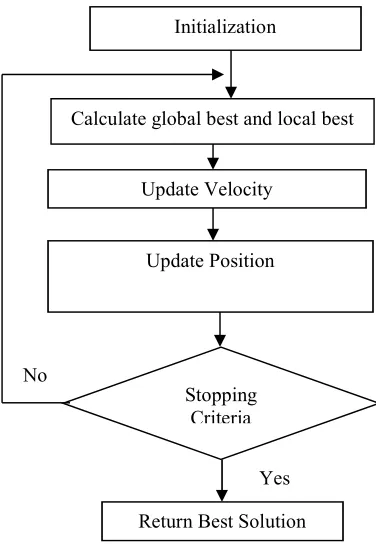
[image:2.612.328.516.266.543.2]This technique mimics the foraging behavior of the ant which includes finding the shortest path to the food source. The ant follows the path which is having maximum pheromone value while the pheromone depends upon the number of ants moved through the path[7]. The complete process of ACO can be described using figure 1.
Figure 1: ACO Process
The complete process of ACO is described through figure 1 which provides the complete solution by updating the pheromone value.
2.2 Particle Swarm Optimization
This technique mimics the swarming and flocking behavior of the birds. This technique has a unique feature to update the solution as per the individual experience (local best) as well as the neighbor’s experience (global best). This is the main reason for better convergence of technique towards global optima[8]. The overall process of PSO is described in figure 2.
Figure 2: PSO Process
Figure 2 shows the complete process of PSO in which the particle updates its velocity and position based on local as well as global best solutions to achieve the global optima.
2.3 Genetic Algorithm
GA represents the natural occurring evolution process. This process represents, the generations of chromosomes that consist of genes which are reproduced as well as depleted through crossover, mutation operations[9]. The complete process is described in figure 3.
Final Solution
No Initialization
Stopping Criteria Achieve
d
Yes
Partial Solution
Update Pheromone
No
Yes
Return Best Solution Calculate global best and local best
Update Velocity
Stopping Criteria Initialization
[image:2.612.98.280.391.678.2]4336 The complete process of GA is described in figure 3 which shows all the operators including selection, crossover, and mutation applied to the population to generate the new population.
2.4 Differential Evolution
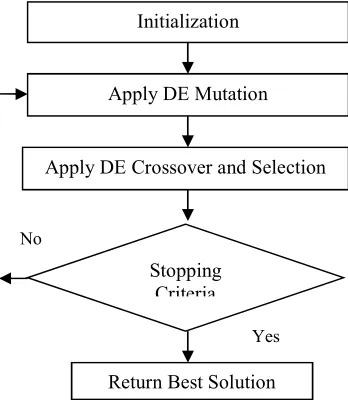
[image:3.612.79.268.88.352.2]It is also a population-based technique like GA and uses the same operators i.e. selection, mutation and crossover.
Figure 4: DE process
But the operation of GA especially mutation differs from the operations of DE[10][11]. It uses the concept of recombination to generate a faster solution. The complete process is shown in figure 4 which shows the flow of the process to generate the best solution.
Each meta-heuristic technique has its pros and cons. These techniques can be hybridized to improve individual performance which is discussed in the next section.
3.HYBRID META-HEURISTIC APPROACH
Different meta-heuristic approach converges towards the global optima but no approach guarantees the global optima. Several new meta-heuristic approaches like Dragonfly algorithm[12], binary gray wolf optimization[13], whale algorithm for optimization[2], ant ion optimization[14] are also proposed that performs better than the existing techniques due to better balancing between the exploration and exploitation phase. Moreover, several authors have hybridized various meta-heuristic techniques to improve the exploration and exploitation search by balancing the features of more than one meta-heuristic technique. This hybridization seems more promising. That’s why this paper discusses and analyzes the different hybrid meta-heuristic techniques as follows.
3.1 Hybrid ACO-PSO Approach
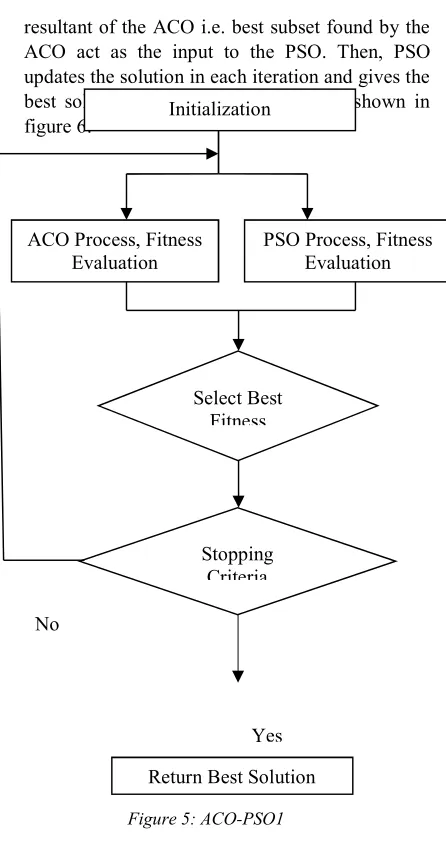
The complete process of running ACO and PSO in parallel and selecting the best value by comparing the best solution of each is shown in figure 5. This algorithm performs better due to the merging of local search advantage of ACO and global perspective of PSO. Different authors have proposed various hybrid versions of ACO-PSO algorithms. This work focuses on one of the latest hybridizations of ACO-PSO which is proven to be effective by the author of [15], [16]. In this hybridization named as ACO-PSO1, the process of ACO and PSO is executed in parallel for each particle. However, the best position in each iteration is selected by comparing the best of ACO and PSO. The process is shown in figure 5.
The author of [15] gives another approach known as ACO-PSO2, which performs an initial search using the ACO. The initial search by ACO remains to continue until the fitness value gets stable. The Yes
No
No
Return Best Solution Apply DE Mutation
Stopping Criteria Initialization
Apply DE Crossover and Selection
[image:3.612.90.264.501.701.2]Yes
Figure 3: GA Process
Return Best Solution Apply GA Selection
Stopping Criteria Initialization
Apply GA Crossover
4337 resultant of the ACO i.e. best subset found by the ACO act as the input to the PSO. Then, PSO updates the solution in each iteration and gives the best solution. The complete process is shown in figure 6:
Figure 5: ACO-PSO1
Figure 6 presents the process of ACO-PSO2 which executes the ACO first to find the best solution which acts as an input to the PSO to find a better solution.
Another approach named as ACO-PSO3 given by the same author [15], hybridize the ACO and PSO by changing pheromone updating phenomena. The pheromone update is tied to the local and global search phenomena of PSO. In this approach, the pheromone update includes the best possible solution along with the local exploration as shown in figure 7.
Figure 7 shows the hybrid ACO-PSO3 process, in which the pheromone update considers the local as well as global results. The analysis of these hybrid algorithm has been done in the result section.
Figure 6: ACO-PSO2
Figure 7: ACO-PSO3
Return Best Solution ACO Process, Fitness
Evaluation
PSO Process, Fitness Evaluation
Fitness Value
Stopping Criteria Initialization
No
Yes
No
Yes
Return Best Solution
No
Yes
Return Best Solution ACO Process
PSO Process
Stopping Criteria Initialization
∇𝜏 = ∇𝜏
⋁+ c ∗ r ∗ ∇τ
+
+c ∗ r ∗ ∇τ
InitializationACO Process, Fitness
Evaluation PSO Process, Fitness Evaluation
Select Best Fitness
[image:4.612.78.301.86.508.2]4338 3.2 Hybrid ACO-GA Algorithm
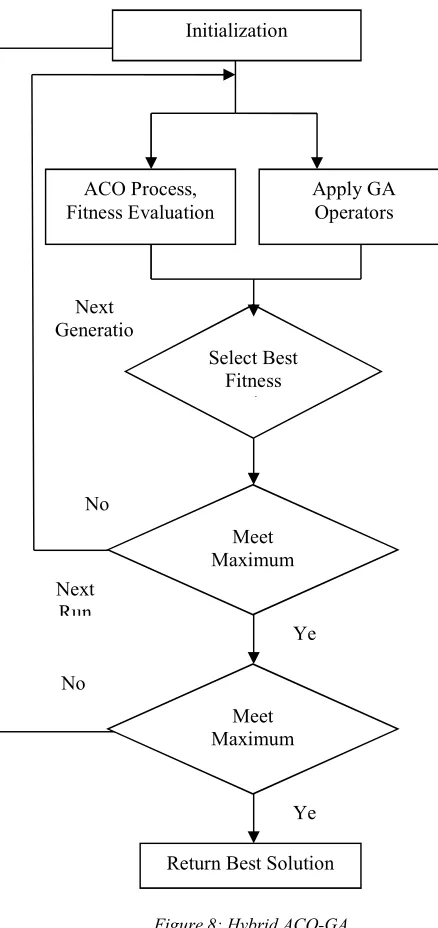
[image:5.612.75.294.180.644.2]The author of [17]gives hybrid ACO-GA algorithm by running in parallel the ACO and the GA on the same population and evaluate both for the best results. The process is executed for the given minimum runs and updated the pheromone in each generation as shown in figure 8.
Figure 8: Hybrid ACO-GA
The figure 8 shows the hybrid process of ACO-GA algorithm, the algorithm iterates for given runs while in each iteration the algorithm executes for given generations. In each generation the process of ACO and GA operators is applied to find the solution. The better solution is saved and the
pheromone value is updated for the next generation. This algorithm processes the better results as compared to the ACO as well as GA algorithm.
3.3 Hybrid PSO-GA Algorithm
[image:5.612.340.525.333.601.2]The author of [18] hybrids the PSO and GA algorithm to avoid the local maxima problem of individual algorithms. The author has modified the weight updating mechanism to improve the global search. This algorithm starts with the random population and updates the position and velocity as per PSO algorithm to get the best value. The GA operator is applied to reproduce the population each step. It avoids premature convergence and improves the probability of convergence towards global optima. The complete process is described in figure 9.
Figure 9: Hybrid PSO-GA algorithm
Figure 9 shows the hybrid PSO-GA algorithm in which the PSO process is applied to the random population to calculate the best values then the population is reproduced using the GA operators to recalculate the best value. The process gives better solution as compared to individual i.e. PSO and GA algorithms.
No
Yes
Return Best Solution PSO Process
Apply GA Operators
Stopping Criteria Initialization
Calculate gbest and pbest Next
Generatio n
No
Ye s
Meet Maximum
Runs
Ye s Next
Run No
Return Best Solution ACO Process,
Fitness Evaluation
Apply GA Operators
Select Best Fitness
Value
4339 3.4 Hybrid GA-DE algorithm
[image:6.612.309.578.181.486.2]GA-DE hybrid algorithm is given by the author of [19]. The author replaces the cross operation of GA with the differential vector perturbations to improve the balance of exploration and exploitation search. The complete process is shown in figure 10.
Figure 10: Hybrid GA-DE algorithm
Figure 10 denotes the process of hybrid GA-DE algorithm. The process clearly shows that the basic structure of the GA algorithm is adopted which includes the fitness function evaluation along with the roulette-wheel selection. Then the crossover step of GA has been replaced by the differential vector perturbation which is followed by the mutation step of GA. This process improves the performance by applying major perturbation in the crossover step and minor perturbation in the mutation step. The performance of the algorithm is better than the existing individual algorithms.
3.5 Hybrid ACO-PSO-GA Algorithm
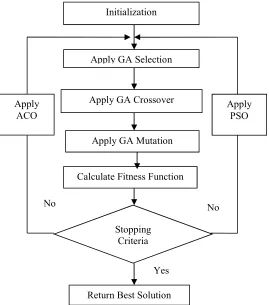
In this, the author[20] hybridize all the three algorithms i.e. ACO, PSO and GA to remove their corresponding weakness. The problem with GA is
the random initiation while the PSO mainly focuses on exploitative search. The ACO algorithm performs better explorative search. So, all the three combined to converge towards the global optima. The process of hybrid ACO-PSO-GA is elaborated in figure 11.
Figure 11: Hybrid ACO-PSO-GA Algorithm
The figure 11 represents the steps of hybrid ACO-PSO-GA algorithm. In this algorithm the random population is given as input to the GA then the ACO and PSO process reproduces the population which is updated by the GA operators. Here, ACO with GA improves the exploratory search and remove the repeated path while the ACO with PSO improves the exploitation search. The process is repeated until the stopping criteria achieved. This process gives better performance as compared to the ACO, PSO and the GA algorithm.
4. RESULT AND DISCUSSION
This work analyzes the hybrid techniques on 7 different datasets. The detail of datasets including dataset name along with its resource, attributes and instances are given in table 1. Moreover, the total
Return Best Solution Apply GA Selection
Apply GA Mutation
Stopping Criteria Initialization
Apply GA Crossover
Calculate Fitness Function
No Apply
ACO
No Apply
PSO
Yes No
Yes
Return Best Solution Fitness Value Calculation
Apply Rouletee-Wheel Selection
Stopping Criteria Initialization
[image:6.612.89.276.215.480.2]4340 number of instances available in the dataset is also given in table 1.
Table 1: Datasets Description
S . N o.
Dataset
Name Attributes Inst anc e Tota l Ele ment s Reso urce
1 AUSTRALIAN 14 690 9660
UCI Repo sitory 2 WDBC 30 569 17070
3 PIMA 8 768 6144 4 ARRHYTHMIA 452 279 126108
5 ADVERTISEMENT 1558 3279 5108682
6 HAR 561 10299 5777739
7 MADELON 500 2000 1000000
Table 1 shows the description of the datasets used in the work to analyze the performance of hybrid meta-heuristic techniques for classification. The SVM classifier is used for classification purposes. Here, the 10 fold cross-validation is used for the training and testing target. The analysis has been done using the accuracy, sensitivity, specificity and selected feature ratio described below:
i) Accuracy
Accuracy represents the number of instances correctly classified by the classifier. It is given as:
𝐴 = ∗ 𝐶𝑜𝑟𝑟𝑒𝑐𝑡𝑙𝑦_𝑐𝑙𝑎𝑠𝑠𝑖𝑓𝑖𝑒𝑑_𝑖𝑛𝑡𝑠𝑛𝑎𝑐𝑒𝑠 (1)
Here, n is the number of instances in the dataset
ii) Sensitivity
It gives the correctly classified true instances. In other words, it is sensitivity to the correct classification. The sensitivity can be represented by (2).
𝑆𝑒𝑛𝑠𝑡𝑖𝑣𝑖𝑡𝑦 = (2)
Here TP, FN shows true positive and false negative respectively.
iii) Specificity
It is the correctly classified negative instances. It can be given by (3).
𝑆𝑝𝑒𝑐𝑖𝑓𝑖𝑐𝑖𝑡𝑦 = (3)
Here TN, FP denotes true negative and false positive respectively.
iv) Selected feature ratio
It is the ratio of the number of features selected to the total number of features. It is given by (4):
𝑆𝐹𝑅 = (4)
Here, n is the number of features in the dataset.
4.1 Performance analysis
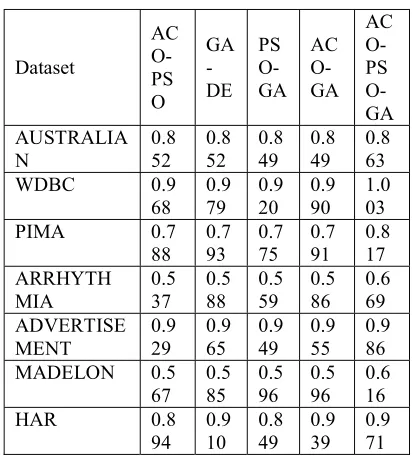
[image:7.612.317.523.464.692.2]The analysis to compare the performance of hybrid meta-heuristic algorithms i.e. PSO, ACO-GA, PSO-ACO-GA, GA-DE and ACO-PSO-GA using the parameters described above on 6 datasets given in table 1 has been done in this section. The results are evaluated by executing the algorithms 20 times and taking the average of results. The initial parameter setting has been done as per the referred paper for each algorithm. The SVM classifier is used with RBF kernel having sigma=15. The accuracy is given in table 2.
Table 2: Comparison of Accuracy on Hybrid Meta-heuristic techniques Dataset AC O-PS O GA -DE PS O-GA AC O-GA AC O-PS O-GA AUSTRALIA
N 0.852 0.852 0.849 0.849 0.863
WDBC 0.9
68 0.979 0.920 0.990 1.003
PIMA 0.7
88 0.793 0.775 0.791 0.817 ARRHYTH MIA 0.5 37 0.5 88 0.5 59 0.5 86 0.6 69 ADVERTISE
MENT 0.929 0.965 0.949 0.955 0.986 MADELON 0.5
67 0.585 0.596 0.596 0.616
HAR 0.8
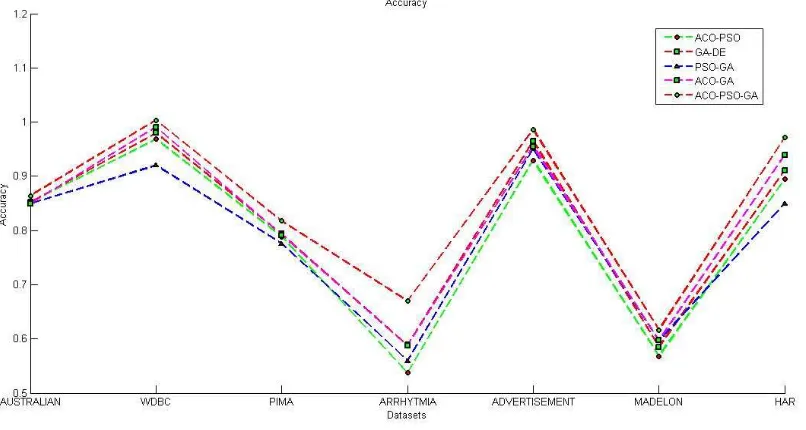
4341 The comparison of accuracy for hybrid meta-heuristic technique can also be shown graphically.
Figure 12: Analysis of Accuracy on Different datasets
[image:8.612.316.543.493.682.2]Figure 12 compares the classification accuracy on different datasets achieved by the hybrid algorithms. The hybrid ACO-PSO-GA algorithm exhibits more accuracy on each dataset as compared to other algorithms. This is due to balancing of exploration phase (due to ACO) and exploitation phase (PSO) by the GA. The comparison of ratio for the number of features selected to the total number of features is given in table3.
Table 3: Comparison of Selection Size Ratio on Hybrid Meta-heuristic techniques
Datase t
ACO-PSO
GA-DE
PSO -GA
AC O-GA
ACO- PSO-GA AUST
RALI
AN 0.868 0.468 0.29 6
0.36
8 0.654 WDB
C 0.744 0.387 0.177 0.277 0.444 PIMA
0.911 0.611 0.386 0.261 0.636 ARRH
YTHM
IA 0.318 0.259 0.185 0.429 0.124 ADVE
RTISE
MENT 0.639 0.644 0.255 0.725 0.543
MADE
LON 0.5162 0.4414 0.4752 0.5216 0.3112 HAR 0.510
8 0.457 0.2785 0.5124 0.4011
The comparison shown in table 3 is also represented graphically in figure 13.
[image:8.612.91.298.536.727.2]4342 Figure 13 compares the selection size ratio of the hybrid algorithm on different datasets. It can be seen that the selection size of the ACO-PSO-GA is high as compared to other few hybrid algorithms. It means higher accuracy of ACO-PSO-GA algorithm costs the number of features.
Table 4: Comparison of Sensitivity on Hybrid Meta-heuristic techniques
Dataset
AC O-PS O
GA-DE
PS O-GA
AC O-GA
AC O-PS O-GA AUSTRALI
AN
0.74 86
0.75 25
0.74 86
0.74 86
0.76 81
WDBC 0.91
62 0.9416 0.9707 0.9707 0.9889
PIMA 0.76
5 0.7795 0.7936 0.840 0.826 ARRHYTH
MIA
0.77 7
0.83 7
0.82 2
0.82 2
0.94 4 ADVERTIS
EMENT 0.921 0.933 0.940 0.965 0.979 MADELON 0.56
7 0.575 0.530 0.597 0.587
HAR 0.60
2 0.973 0.976 0.964 0.983
The comparison of sensitivity on various datasets is done in table 4 is also shown graphically in figure 14.
[image:9.612.89.514.207.664.2]The comparison clearly shows the sensitivity of the hybrid ACO-PSO-GA algorithm is better as compared to other hybrid techniques. However, the exception is shown for the PIMA dataset.
Figure 14: Analysis of Sensitivity on Different datasets
[image:9.612.97.511.475.661.2]4343
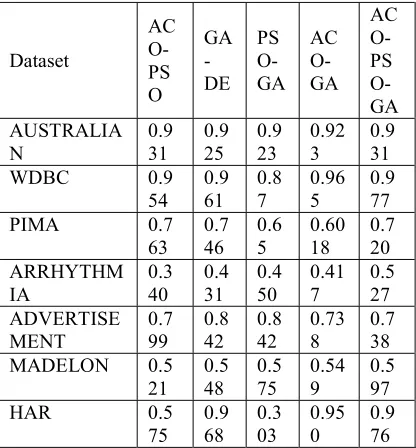
Table 5: Comparison of Specificity on Hybrid Meta-heuristic techniques
Dataset
AC O-PS O
GA -DE
PS O-GA
AC O-GA
AC O-PS O-GA AUSTRALIA
N 0.931 0.925 0.923 0.923 0.931
WDBC 0.9
54 0.961 0.87 0.965 0.977
PIMA 0.7
63 0.7 46
0.6 5
0.60 18
0.7 20 ARRHYTHM
IA 0.340 0.431 0.450 0.417 0.527 ADVERTISE
MENT 0.799 0.842 0.842 0.738 0.738 MADELON 0.5
21 0.548 0.575 0.549 0.597
HAR 0.5
75 0.9 68
0.3 03
0.95 0
[image:10.612.97.507.390.560.2]0.9 76 The comparison is also done graphically shown in figure 15.
Figure 15: Analysis of Specificity on Different datasets
The comparison in figure 15 clearly denotes that the specificity of hybrid ACO-PSO_GA algorithm is better as compared to other hybrid algorithms due to a more balanced exploration and exploitation search.
5. CONCLUSION
This paper analyzes different hybridization of ACO, PSO, GA and DE for the feature selection to improve the classification performance. The analysis has been done on seven different datasets with varying size using accuracy, sensitivity, and specificity and
4344 REFERENCES
[1] P. Lopez-Garcia, A. D. Masegosa, E. Osaba, E. Onieva, and A. Perallos, “Ensemble classification for imbalanced data based on feature space partitioning and hybrid metaheuristics,” Applied Intelligence, vol. 2019, pp. 1–16, 2019.
[2] M. M. Mafarja and S. Mirjalili, “Hybrid Whale Optimization Algorithm with simulated annealing for feature selection,” Neurocomputing, vol. 260, pp. 302–312, 2017.
[3] G. I. Sayed, A. E. Hassanien, and A. T. Azar, “Feature selection via a novel chaotic crow search algorithm,” Neural Computing and Applications, vol. 31, pp. 171–188, 2019. [4] A. M. Anter, A. T. Azar, and K. M. Fouad,
“Intelligent Hybrid Approach for Feature Selection,” Springer Nature, vol. 3, pp. 71– 79, 2019.
[5] M. N. Ab Wahab, S. Nefti-Meziani, and A. Atyabi, “A comprehensive review of swarm optimization algorithms,” PLoS ONE, vol. 10, no. 5, pp. 1–36, 2015.
[6] I. Boussaïd, J. Lepagnot, and P. Siarry, “A survey on optimization metaheuristics,” Information Sciences, vol. 237, no. February, pp. 82–117, 2013.
[7] M. Guntsch and M. Middendorf, “A Population Based Approach for ACO,” pp. 72–81, 2007.
[8] “Empirical study of PSO 1999.pdf.” . [9] A. Dastanpour and R. A. R. Mahmood,
“Feature selection based on genetic algorithm and SupportVector machine for intrusion detection system,” International Conference on Informatics Engineering & Information Science, no. September 2014, pp. 169–181, 2013.
[10] R. Storn and K. Price, “Differential Evolution - A Simple and Efficient Heuristic for Global Optimization over Continuous Spaces,” Journal of Global Optimization, vol. 11, no. 4, pp. 341–359, 1997.
[11] Z. Huang and Y. Chen, “An Improved Differential Evolution Algorithm Based on Adaptive Parameter,” Journal of Control Science and Engineering, vol. 2013, pp. 1– 5, 2013.
[12] M. Mafarja et al., “Binary dragonfly optimization for feature selection using time-varying transfer functions,” Knowledge-Based Systems, vol. 161, pp. 185–204, 2018.
[13] E. Emary, H. M. Zawbaa, and A. E. Hassanien, “Binary grey wolf optimization approaches for feature selection,” Neurocomputing, vol. 172, no. 2016, pp. 371–381, 2016.
[14] M. M. Mafarja and S. Mirjalili, “Hybrid binary ant lion optimizer with rough set and approximate entropy reducts for feature selection,” Soft Computing, vol. 2018, pp. 1– 17, 2018.
[15] K. Menghour and L. Souici-Meslati, “Hybrid ACO-PSO based approaches for feature selection,” International Journal of Intelligent Engineering and Systems, vol. 9, no. 3, pp. 65–79, 2016.
[16] N. P. Holden and A. A. Freitas, “A hybrid PSO/ACO algorithm for classification,” p. 2745, 2007.
[17] S. Nemati, M. E. Basiri, N. Ghasem-Aghaee, and M. H. Aghdam, “A novel ACO-GA hybrid algorithm for feature selection in protein function prediction,” Expert Systems with Applications, vol. 36, no. 10, pp. 12086–12094, 2009.
[18] S. M.Uma, K. Rajiv Gandhi, E. Kirubakaran, and D. E. K. Dr.E.Kirubakaran, “A Hybrid PSO with Dynamic Inertia Weight and GA Approach for Discovering Classification Rule in Data Mining,” International Journal of Computer Applications, vol. 40, no. 17, pp. 32–37, 2012.
[19] W. Y. Lin, “A GA-DE hybrid evolutionary algorithm for path synthesis of four-bar linkage,” Mechanism and Machine Theory, vol. 45, no. 8, pp. 1096–1107, 2010. [20] J. H. Tam, Z. C. Ong, Z. Ismail, B. C. Ang,
and S. Y. Khoo, “A new hybrid GA−ACO−PSO algorithm for solving various engineering design problems,”
International Journal of Computer