A META-ANALYSIS OF WORK DEMAND STRESSORS
AND JOB PERFORMANCE: EXAMINING MAIN
AND MODERATING EFFECTS
SIMONA GILBOA AND ARIE SHIROM Faculty of Management
Tel Aviv University
YITZHAK FRIED Whitman School of Management
Syracuse University
CARY COOPER University of Lancaster
We quantitatively integrated 169 samples (N=35,265 employees) that
have been used to investigate the relationships of the following 7 work-related stressors with job performance: role ambiguity, role conflict, role overload, job insecurity, work–family conflict, environmental uncer-tainty, and situational constraints. Overall, we obtained a negative mean correlation between each job performance measure and each stressor in-cluded in our analyses. As hypothesized, role ambiguity and situational constraints were most strongly negatively related to performance, rela-tive to the other work-related stressors. Analysis of moderators revealed that (a) the negative correlation of role overload and performance was higher among managers relative to nonmanagers; (b) publication year moderated the relation of role ambiguity and role overload with perfor-mance, although in opposite directions; (c) the correlations obtained for published versus unpublished studies were not significantly different; and (d) using the Rizzo et al. scale of role ambiguity and role con-flict decreased the magnitude of the correlations of these stressors with performance, relative to other scales. Theoretical contributions, future research directions, and practical implications are discussed.
Psychosocial stressors at work represent a ubiquitous and multifaceted phenomenon (Lazarus, 1993); several theoretical frameworks predict that they affect employee attitudes and behaviors (Jex & Crossley, 2005). Most past meta-analytical reviews of these relationships focused only on the linkages of role conflict and role ambiguity with job performance, none of
This paper was accepted under the editorship of Ann Marie Ryan.
We gratefully acknowledge the financial support for this study from the Henry Crown Institute of Business Research in Israel, Faculty of Management, Tel Aviv University.
Correspondence and requests for reprints should be addressed to Arie Shirom, Fac-ulty of Management, Tel Aviv University, P.O. Box 39010, Tel Aviv 69978, Israel; [email protected].
COPYRIGHTC2008 BLACKWELL PUBLISHING, INC.
them related to unpublished studies, and each included only a relatively small number of samples, casting doubt on their findings regarding the effect of possible moderators (e.g., Abramis, 1994,n=18 for role ambi-guity only; Fisher & Gitelson, 1983,n=25, 22; Jackson & Schuler, 1985, n=37, 24; Tubre & Collins, 2000,n=74, 54 for the meta correlations of performance with role ambiguity and role conflict, respectively). All previous meta-analytical reviews found that a substantial amount of the variance in the corrected stressor–performance correlations remained un-explained and urged future researchers to identify variables that moderate this relationship (e.g., Tubre & Collins, 2000, p. 166).
We have advanced and refined this knowledge concerning the relation-ships between stressors and job performance in three major ways. First, in addition to role ambiguity and role conflict, we have included role over-load, job insecurity, work–family conflict, and situational constraints, four stressors that have been covered to only a limited extent by prior meta-analytical studies, and environmental uncertainty, which has not been ex-amined in relation to job performance in any previous quantitative review. All seven stressors share a common conceptual denominator in that they reflect stimuli that are perceived by individuals as placing demands upon them and in that they correspond to the notion of chronic stressors as conceptualized by Lazarus (Lazarus, 1999) and by Wheaton (1999). Our comprehensive literature search on demand-based stressors reveals that only the above seven work stressors were those whose associations with job performance were found in at least four samples, which we determined as our minimum threshold to run a meta-analysis, to avoid reporting on chance results. Including these stressors in a meta-analysis is warranted because of the lack of clarity on how they may relate to performance. As we elaborate below, although all seven stressors are associated in one de-gree or another with hindrance at work, which may limit performance (see LePine, LePine, & Jackson, 2004; LePine, Podsakoff, & LePine, 2005), there are some important differences between them that may affect their relationships with performance.
meta-analytically. Following Viswesvaran et al. (1996) we have defined quality of performance as referring to any assessment of how well the job was done and quantity of performance as referring to ratings of quantity or volume of output that an individual has produced, both conceptualized irre-spective of the source of the ratings. Qualitative and quantitative measures of performance were found, in a recent meta-analysis, to be only mod-erately meta-correlated (mean correlation=.34), but the 90% credibility value around this meta-correlation included zero, suggesting that it may be dependent upon situational factors (Viswesvaran, Schmidt, & Ones, 1994). Overall, focusing on multiple measures of performance is impor-tant for the purpose of testing the convergent validity of our meta-analytic findings. Moreover, if the results would suggest consistency across all per-formance measures, it would alleviate concerns about the use of self-rated performance (e.g., self-bias or common method variance) or supervisor-rated performance (e.g., inflated ratings of subordinates who are working in stressful conditions; cf. Westman & Eden, 1991).
Third, we explored several moderators of the stressor–performance relationship, namely, organizational level and publication year, published versus unpublished studies, and types of measure used to assess specific stressors, none of which appear to have been examined in any prior meta-analysis of the stressor–performance relationship.
The Relationship Between a Stressor and Job Performance
Following the theoretical work of Lazarus and his colleagues (e.g., Lazarus & Folkman, 1984), recent studies (for a review, see LePine et al., 2005) suggested that the appraisal of any stressor reflects two basic dimensions: The first dimension, associated with threat or hindrance, is hypothesized to be negatively associated with performance, and the second dimension, reflecting challenge, tends to be positively related to perfor-mance (see also Beehr, Jex, Stacy, & Murray, 2000; Jex, 1998; McGrath, 1976).
and toward coping with the stressors (Jex, 1998). Second, high levels of stressor are invariably associated with involuntary physiological responses that interfere with performance (Lazarus, 1999; Motowidlo, Packard, & Manning, 1986). Third, these high levels of stressor tend to create condi-tions of information overload, which in turn may lead to a narrowing of individuals’ perceptual attention so that they ignore performance-related information and cues, thus deleteriously affecting their job performance (Cohen, 1980). The theoretical model that explains the expected positive relation between challenge-based stressors and performance is the posi-tive linear model, arguing that when a stressor is appraised primarily as a challenge it may lead to internal arousal and higher performance outcomes (LePine et al., 2005; McGrath, 1976).
Differential Relationships of Role Stressors With Performance
The two dimensions, threat or hindrance, and challenge were postu-lated to be reflected to a different extent in each of the stressors included in this study, leading us to expect that they would be differentially related to performance (cf. Drach-Zahavy & Erez, 2002; LePine et al., 2005). This theoretical approach follows the cognitive-relational model of stress appraisal proposed by Lazarus and his colleagues (e.g., Lazarus & Folk-man, 1984; Lazarus, 1999), which posits that, relative to a situational de-mand, threat and challenge appraisals synergistically interact to produce stress appraisals. As pointed out by Folkman (Folkman, 1984), and as empirically verified in her research with Lazarus (cf. Folkman & Lazarus, 1985), threat and challenge appraisals, a distinguished from one another by their cognitive components, are not mutually exclusive and can occur simultaneously with regard to a situational demand. Therefore, we postu-late that, with regard to any type of situational demand under study, the higher the amount of perceived threat and the lower the amount of per-ceived challenge, the higher the resulting negative effect on individuals’ job performance. Moreover, it is important to note that following the above theoretical contributions and accumulated evidence, which indicate that for each of the stressors under consideration one’s overall assessment of its stressfulness combines threat and challenge appraisals, we would still expect its relation with performance to be negative. We base this argument on the well-established finding in social psychology that “bad is stronger than good” (Baumeister, Bratslavsky, Finkenauer, & Vohs, 2001).
component of lack of input from the environment to guide behavior (Rizzo, House, & Lirtzman 1970, pp. 155–156). We argue that relative to the other stressors, role ambiguity is the least likely to have a challenge component because there are fewer coping processes that could possibly counteract its negative effects (King & King, 1990). This argument is consistent with the argument of Kahn et al. (1964) that relative to other types of stressors, role ambiguity is more structurally determined. Therefore, when ambigu-ity is high, the individual faces the difficulty of pursuing job assignments because of an inability to modify them (cf., Lazarus & Folkman, 1984). On the other hand, when role ambiguity is low (role clarity is high), em-ployees’ knowledge of what is expected of them (their job requirements) and how to achieve these expectations (processes and procedures) are high (Griffin, Neal, & Parker, 2007; Murphy & Jackson, 1999). This in turn fa-cilitates a high level of job control, which is associated with higher job performance (Griffin et al., 2007). All previous meta-analytic reviews that covered role ambiguity supported our expectation of a relatively strong negative association between role ambiguity and performance (Fisher & Gitelson, 1983; Jackson & Schuler, 1985; Tubre & Collins, 2000). Analo-gously, we expected situational constraints (a situation in which conditions in an employee’s immediate work environment inhibit or constrain per-formance, like improper machinery or inadequate supplies) to follow role ambiguity as most adversely related to performance at work relative to all other stressors. Situational constraints represent a type of stressor likely to be detrimental to an individual’s ability to function because the individ-ual often has little control over these constraints (e.g., Jex, 1998; Peters & O’Connor, 1980). The only past meta-analytic study (Villanova & Roman, 1993) found only weak relationships between situational constraints and performance (in field studies, the corrected meta-correlation was−.05). Nevertheless, this finding could be due to the research limitations (e.g., only 5 years were covered in the literature search, as compared with 28 years covered by this study).
resources (e.g., time) to overcome them. However, role overload may also occur when high performers take on more tasks and responsibilities and therefore are motivated to perform them well. In this situation, role over-load can be perceived as a challenge positively rather than negatively associated with performance (cf., LePine et al., 2005). Indeed, past stud-ies have reported positive, negative, and no associations between overload and job performance (LePine et al., 2004; Spector & Jex, 1998), possibly an indication that it may represent challenge and/or hindrance to the focal individuals. Similar to role overload, the relation of job insecurity and work–family conflict with performance may be complex. Thus, although job insecurity may lead to a reduction in effort and performance, associ-ated with a reduced commitment to the organization, it can also lead to an increase in effort and performance. This may occur if the individual believes that higher performance will improve the organization’s success and thus also the security of its employees, or if the individual believes that the organization’s decision whom to keep versus whom to let go is contingent upon the contribution of each individual to the performance of the organization. Further, in the case of work–family conflict, it can be expected that this stressor, reflecting incompatible demands at work and home, would be negatively associated with performance (cf. Allen, Herst, Bruck, & Sutton, 2000; Bronneberg, 1995; Yardley, 1995). However, in-dividuals experiencing work–family conflict may feel compelled to keep their performance-related behavior at an acceptable level but may be less willing to engage in any work-related extra-role behavior, as suggested by past empirical research (Allen et al., 2000). Finally, uncertainty regard-ing the environment (environmental uncertainty) is often viewed as one of the defining features of life in organizations (Duncan, 1972; Ellis & Shpielberg, 2003). However, because of its focus on threats in organiza-tional environment, it represents a distal stressor relative to the other, more proximal stressors, and therefore, we expected it to have weaker linkages with performance relative to the other stressors. Our first hypothesis was therefore:
Hypothesis 1: Among the seven stressors studied in this
meta-analysis, role ambiguity and situational constraints will be most strongly negatively related to job performance, relative to the other five stressors.
Potential Moderators
that moderate the stressor–performance relationship could contribute to our understanding of how stressors influence performance. A large number of potential moderators have been suggested in past qualitative and quan-titative reviews of this research area, including age, education, gender, and seniority (e.g., Jex, 1998), but these moderators pose a theoretical chal-lenge in their aggregate form. Several other potentially promising mod-erators, like climate of trust and involvement, have not been empirically addressed in a sufficient number of studies. In this study we examined the following moderators: job level, namely managers versus nonmanagers; year of publication of the study; published versus unpublished studies; and type of measure used to gauge role ambiguity and role conflict. In the following, we present the rationale for each moderator.
Job Level
Publication Year
How does time of publication affect the relationship between work stressors and performance? There are alternative rationales that may lead to opposite predictions about the direction of this effect. On the one hand, studies over the years have become more rigorous methodologically, for example, by reducing common method variance, which could have ar-tificially inflated past stressors–performance linkages. Also, some stres-sors, like role ambiguity, have become more prevalent; therefore, these would suggest a weaker relationship between work stressors and per-formance over time. On the other hand, the social information process-ing theory suggests that formally and informally conveyed information influences individuals’ attitudes and behavior by directing their atten-tion to certain stimuli (Salancik & Pfeffer, 1978). Indeed, Barley and Knight (1992) attributed the rise in stress claims during the late 1980s to the increased coverage of stress-related news items in the media. This suggests that people have become more aware of the adverse effect of stress on their psychological, behavioral, and physiological reactions, and therefore, are also more comfortable in attributing poor performance to work-related stressors. Consequently, one would expect an increase in the negative relationship between role stress and work performance over time. Because of the conflicting alternative rationales for the direction of the effect of publication year, we refrain from providing a formal hypothesis.
Published Versus Unpublished Studies
difficulties we encountered in getting unpublished conference papers from the authors. Therefore we hypothesize:
Hypothesis 2: Published papers will report stronger negative
correla-tions between stressors and job performance than un-published dissertations.
Measurement of Stressor
The Rizzo et al. (1970) role conflict and role ambiguity scales have most often thus far measured these two types of stressors, and thus most past meta-analytical studies of stressor and performance reflect their psycho-metric characteristics. For example, Jackson and Schuler (1985) reported that 85% of the studies that they meta-analyzed had utilized the Rizzo et al. (1970) measures. There has been considerable criticism and debate in the occupational stress literature about the discriminant, convergent, and predictive validity of the Rizzo et al. (1970) measures (for references to the rich literature, see King & King, 1990 and Netemeyer, Johnston, & Burton, 1990). Tracy and Johnson (1981) in an analysis of the factor load-ings of the Rizzo et al. scales found that subjects responded much more clearly to the stressor/comfort dimension than to the conflict/ambiguity dimension of the items. They concluded, therefore, that there is doubt re-garding the meaning of each scale. King and King (1990, p. 62) went as far as to draw the following conclusion: “We firmly believe that partial re-sponsibility for the inconsistencies in research findings about role conflict and ambiguity is due to deficiencies in measurement.” This early work was followed up by Harris and Bladen (1994), who used CFA in analyz-ing a multitrait–multimethod matrix of the two types of stressors usanalyz-ing different wording and examining their correlations with several criteria. They concluded that there is some wording effect on the two role stressor measures, but that even accounting for this source of method variance, at least some significant relationships remain (Harris & Bladen, 1994). In this study, we compared the association of each of the role stressors relat-ing to ambiguity and conflict with all performance variables separately for studies using the Rizzo et al. (1970) scales and studies using other scales to gauge the same role stressor. Based on the above rationale, we expected that:
Hypothesis 3: The effect sizes obtained for each of the two Rizzo et al.
Method
Identification and Selection of Studies
We combined computer-based and manual search methods to locate as many studies as possible for this meta-analysis. The computerized databases we accessed to elicit relevant articles were PsycLIT, SocLIT, MEDLINE, ABI-INFO, Dissertation Abstracts International, and ERIC databases, covering the years 1975–2002. In examining these databases, we used key words identified on the basis of qualitative reviews (Wheaton, 1997, 1999),1 among them stressor, stress, hassles, environmental
con-straints, acute stressor or stress, and job performance. For each category, we searched for all possible types of specific stressors as key words. Al-together, we searched for more than 50 terms in each database. We then reviewed the bibliographies of all previous qualitative and quantitative re-views published on the subject of our research, and to double check for full coverage of all articles, we manually scanned all issues published since 1975 of 14 relevant journals:Academy of Management Journal; Anxiety; Stress and Coping; Human Performance; Human Relations; International Journal of Stress Management; Journal of Applied Psychology; Journal of Occupational Health Psychology; Journal of Organizational Behavior; Journal of Personal Selling and Sales Management; Journal of Vocational Behavior; Organizational Behavior and Human Decision Processes;
Per-sonnel Psychology; Stress Medicine;andWork and Stress.
The relevance of each primary study to our meta-analysis was deter-mined based on how the authors conceptualized and measured the stressor and performance. We defined the population that we wished to generalize a priori as consisting of employed adults. Accordingly, job performance in primary studies needed to occur in a natural job setting and needed to be measured at the individual (as opposed to the group) level. Thus, laboratory studies and studies conducted in learning situations were ex-cluded, as were studies done on students, patients, or other not gainfully employed participants. We included primary studies in which the stressor was assessed as perceived by employees, excluding studies that related to objective stressors like work hours. In addition, we excluded studies that did not report on sample size or that did not include effect sizes or statistics that could be converted to correlation coefficients. In addition,
when the same sample was used in two or more articles, we considered only the one that provided more information. However, if some variables were reported in one article but not in the other, we used the nonoverlap-ping data. Concerning the measurement of work–family conflict, we used the variables called work–family conflict or family–work conflict. When we had both in the same article, we combined them into one variable. In most cases, the studies we included in our meta-analysis assessed only work–family conflict. After applying these exclusion criteria, the analysis included a total of 169 independent samples encompassing 35,265 individ-uals. All in all, there were 374 effect sizes from 104 published studies and 33 unpublished doctoral dissertations. Specifically, there were 145 effect sizes for self-rated performance, 139 for supervisor-rated performance, 31 for objective ratings, 15 for qualitative performance, and 26 for quantita-tive performance, and 18 effect sizes were coded only as part of general performance because their measures or dimensions were not specified.
Coding2
Variables such as sample size, all reliability indicators, effect size es-timates, study source, and characteristics were thoroughly coded. Coding of the moderator variables was straightforward as most of them (e.g., the measure of stressor used, published vs. unpublished papers, publication year, and managers vs. nonmanagers) were clearly indicated in the studies. We coded organizational level as managers only when all study partici-pants held supervisory or managerial positions and nonmanagers when none of the study participants held supervisory or managerial positions, thereby excluding all mixed samples. Moreover, when we coded role am-biguity we included only studies that assessed this construct directly; we did not include studies that reverse-coded positive role-clarity items. In addition, resource inadequacy was coded as a situational constraint (as in Villanova & Roman, 1993).
Although peer ratings are frequently used in performance appraisals (Viswesvaran, Schmidt, & Ones, 2002), we failed to find at least four samples that included correlations between any stressor and peer-rated performance and therefore did not include peer-rated performance in our study. Quality and quantity of performance was defined based on Viswes-varan et al. (1996) as “a measure of how well the job was done” and “ratings of the quantity or volume of work produced,” respectively.
We should note that in many studies the sample size for a specific correlation was different from the overall sample size. Thus, in our meta-analysis we used the sample size that specifically related to the correlation in question. Moreover, in longitudinal studies, we coded the data available for both stressor and performance. If the data were available for several waves of measurement, we used those of the first wave. In field experi-ments, we used the data available for the pretest.
Primary studies often reported performance information from multi-ple sources, including objective assessment, supervisor ratings, and self-ratings. To enable us to compare our findings to those of previous stressor– performance meta-analytical studies (such as Tubre & Collins, 2000), in addition to coding each measure of performance, we also computed a general performance construct using the formula proposed by Rosen-thal and Rubin (1986). If the primary study did not provide the correla-tions between the specific measures of performance employed, we used correlations provided by the most recent job performance meta-analysis (Conway & Huffcutt, 1997). It is well established in the meta-analysis literature that correlations based on composites are more valid than cor-relations based on a single measure (Thoresen, Kaplan, Barsky, Warren, & de Chermont, 2003). In our study the composite measure of general performance takes into account the intercorrelations among the source-specific measures included in it (cf. Hunter & Schmidt, 1990, p. 460). We used the Spearman–Brown prophecy formula (Hunter & Schmidt, 1990, pp. 454–463) to compute the reliability of an equally weighted composite of general performance.
Accurate coding is crucial for a meta-analysis. Therefore, to enhance our confidence in the coding results, after all the 169 samples had been carefully coded, 15% of them were randomly selected and recoded by another coder in order to calculate interrater reliability, which in this study exceeded .90. Note that the interrater reliability coefficients were based on all quantitative information available in the coding sheets. In addition, in order to deal with deficient reporting in primary studies, we corresponded with several of the original investigators to obtain additional information.
Meta-Analytical Procedures
(2004, pp. 173–175). In the first step, individually known artifacts were corrected. This produced a mean correlation corrected for the individually known artifacts and a variance corrected for those artifacts and for sam-pling error. The distributions of the artifacts available from the first step were then used to correct for the remaining artifacts (Hunter & Schmidt, 2004, pp. 174–175). This practice is commonly followed in meta-analytic studies (for some cautions and reservations concerning this practice, see Hall & Brannick, 2002).
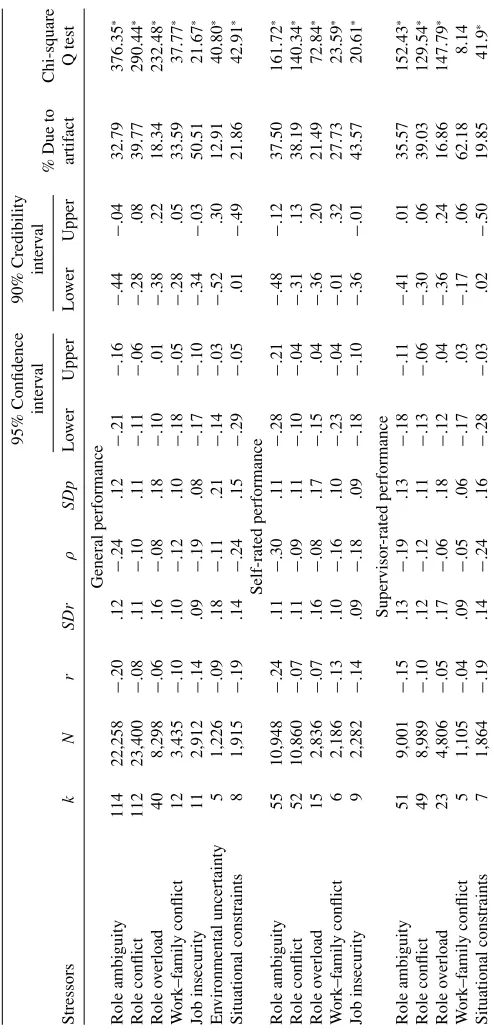
To correct the various types of stressor and job performance measures for unreliability, we used the internal consistency reliabilities. In Table 1 we report the results of all measures and dimensions of performance us-ing internal consistency estimates (when such estimates were reported). However, in the results section, we also report the correction for measure-ment error of performance as was suggested by Viswesvaran et al.(1996). Thus, we used Viswesvaran et al.’s meta-analytical estimates of interrater reliability of supervisor ratings (.52) to correct correlation of supervisor ratings. Because no sample reported the reliability of objective measures of performance, we assumed perfect reliability.
Confidence intervals and credibility intervals aid in providing the best estimate of the true nature of the relationship between two variables (Whitener, 1990) and the variability in the correlation. Accordingly, we report both the 95% confidence intervals and the 90% credibility intervals. Confidence intervals provide an estimate of the variability of the corrected mean correlation (ρ) due to sampling error (Hunter & Schmidt, 2004, p. 205). Credibility intervals provide information on the variability of the individual correlations across the samples examined. Credibility intervals are calculated by using the corrected standard deviation ofρ, referred to asSDp, and they provide information on whether moderators are likely to be present. Whitener (1990, p. 317) recommends that if the credibility interval is small and does not include zero, then the mean corrected effect size is probably the estimate of a single population parameter and modera-tors are not in operation. However, if the credibility interval is sufficiently large or includes zero, thenρprobably represents the aggregate of sev-eral subpopulation means, each representing the operation of a significant moderator.
TA
B
L
E
1(continued) 95%
[image:15.432.126.325.76.584.2]Type I error rates and statistical power (Cortina, 2003). When theQstatistic indicated that moderators were probably present, we examined whether the effect sizes were different across the subgroups within each category: Any nonoverlapping of the confidence intervals of the subgroups can be interpreted as providing support for the moderation hypothesis. Yet another approach, applied in our study, was to examine the between-class effect (Qb): If the categorical moderator fully fits the data, the between-class effect (Qb) is significant.
Meta-Analytical Regression Analyses
For testing the publication year moderating effect, we used meta-analytic regression analyses. We used weighted least squares (WLS; Neter, Wasserman, & Kutner, 1989) to estimate the continuous moderators, fol-lowing Steel and Kammeyer-Mueller (2002), who found it the most accu-rate method, and because the dependent variable in the regression analysis is heteroskedastic. The weights were set equal tonj–3 wherenjis the sam-ple size in samsam-plej.
Results
As already noted, a total of 374 effect sizes from 104 published stud-ies and 33 unpublished doctoral dissertations were available for analysis. The samples ranged from 23 to 1,005 employees and the mean sample size across all the samples was 209 employees (SD=157). Furthermore, the majority of samples reported data from organizations located within English-speaking countries (88%). The response rate, reported in 100 stud-ies, ranged from 15% to 100%, with a mean of 66% (SD= 20.5). The mean age of employees across the 72 samples in which age was reported was 36.5 years (SD=6).
Main Effects
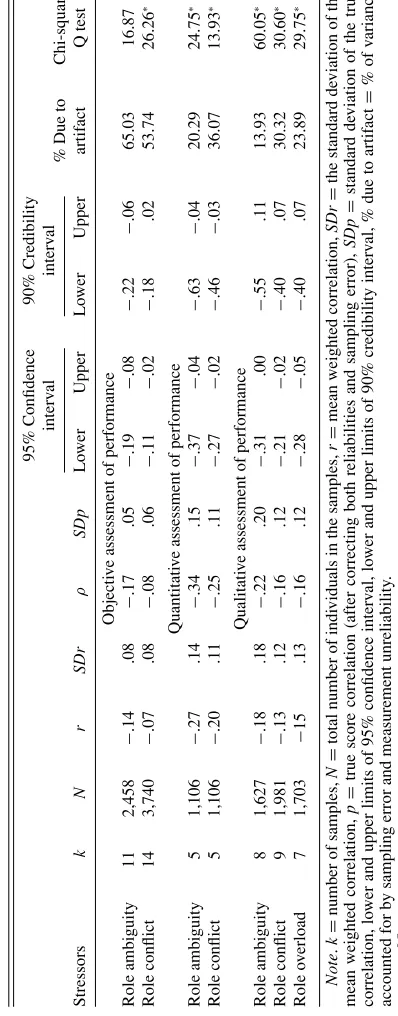
Overall, the results supported Hypothesis 1. Specifically, as hypothe-sized, role ambiguity and situational constraints showed the highest cor-relations with performance. Role ambiguity’s corcor-relations with all the examined measures of performance were close or above−.20, as follows: general performance (ρ = −.24), self-rated performance (ρ = −.30), supervisor-rated performance (ρ= −.19), objective assessment of perfor-mance (ρ= −.17), quantitative assessment of performance (ρ= −.34), and qualitative assessment of performance (ρ = −.22). Similarly, sit-uational constraints, which, because of insufficient data, were only ex-amined in reference to general performance and supervisor-rated perfor-mance, showed a relatively high correlation (ρ = −.24) with both of these performance criteria. As hypothesized, the other examined work stressors showed weaker correlations with the different performance criteria.
correlations of role overload and work–family conflict with supervisor-rated performance wereρ= −.07 (SDρ =.24) andρ = −.07 (SDρ = .08), respectively, and that of situational constraints with supervisor-rated performance wasρ= −.29 (SDρ =.16). In sum, as hypothesized, role ambiguity and situational constraints were most strongly related to work performance, relative to the other work stressors.
Potential Moderators
Table 1 shows that for almost all meta-correlations theQtests of het-erogeneity are significant, that the credibility interval is wide and includes zero even though most effect sizes were significantly different from zero, and that the proportions of variance accounted for by sampling error and measurement unreliability are far below 75%. Thus, all three tests rec-ommended in the literature (Hunter & Schmidt, 2004) are in agreement, indicating that the correlations are not homogenous and suggesting the presence of moderators. There is variability in almost all the stressor– performance relationships examined after the variance attributed to arti-facts is taken into account. In the following section, we report on the results of our tests for the existence of moderators.
Job Level
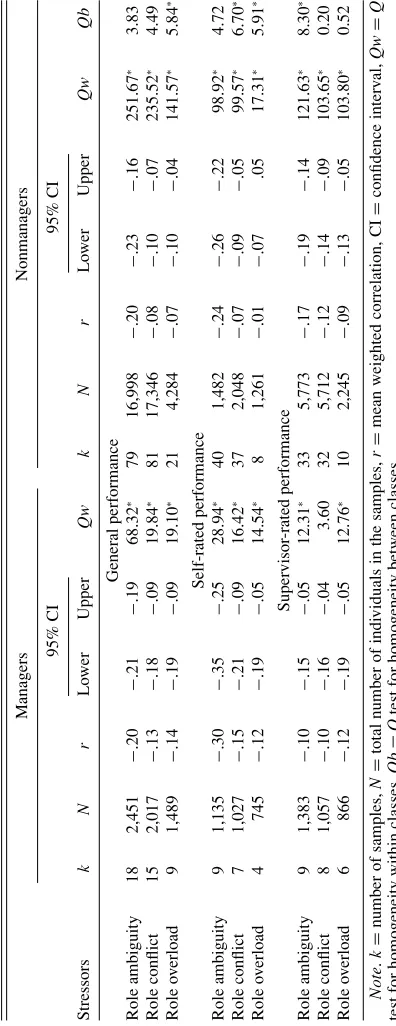
Table 2 depicts the results of the moderator analysis by job level. With the exception of role ambiguity, role conflict, and role overload, none of the other stressors met the requirement of at least four studies per subset. Overall, the results showed significant differences between managers and nonmanagers in four of the nine cases examined. These differences tend to suggest that the relationship of role overload with performance is stronger among managers than among nonmanagers. Specifically, role overload– general performance effect size was significantly stronger among man-agers (r= −.14) than among nonmanagers (r= −.07). This pattern was also demonstrated in the relationship of both role overload (r = −.12 among managers and−.01 among nonmanagers) and role conflict (r = −.15 among managers and −.07 among nonmanagers) with self-rated performance.
Publication Year
In our regression analysis, we found that publication year had a signif-icant negative effect on role ambiguity–general performance correlation (β= −.20,R2=.04,p=.04). However, the same effect in the case of
(β=.40,R2=.15,p=.01). The number of studies for the other stressors
was insufficient to pursue an analysis on the effect of publication years.
Published Versus Unpublished Studies
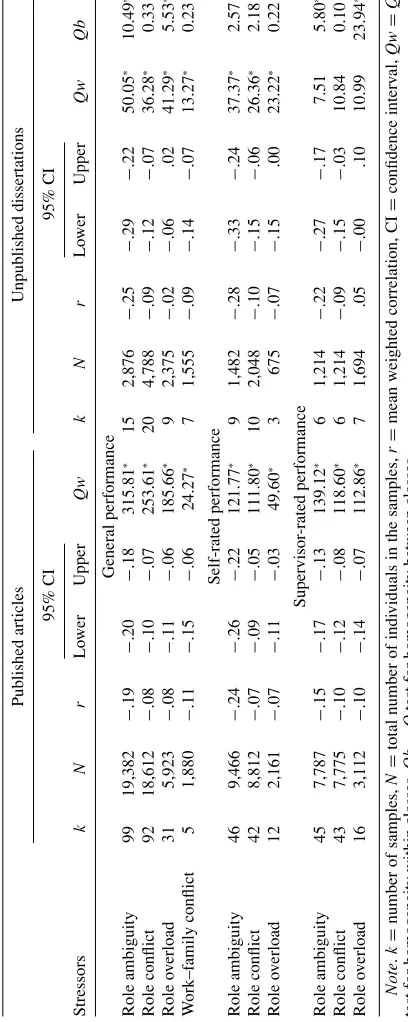
As evident from Table 3, our results failed to support Hypothesis 2, which posited that published papers would report a stronger relationship between stressors and job performance than unpublished papers. In 6 of the 10 comparisons, the differences in the meta correlations between the two groups were not significant from each other. Moreover, the pattern of the observed differences between these correlations was not consistent. Of the remaining four comparisons, the correlations of role overload with general performance and self-rated performance in the published studies were significantly higher than the correlations between these variables in the unpublished dissertations. In contrast, role ambiguity showed signif-icantly higher correlations with these two performance criteria based on the unpublished dissertations relative to the published studies. Therefore, we concluded that our second hypothesis was not supported.
Rizzo et al. Scale Versus Other Scales
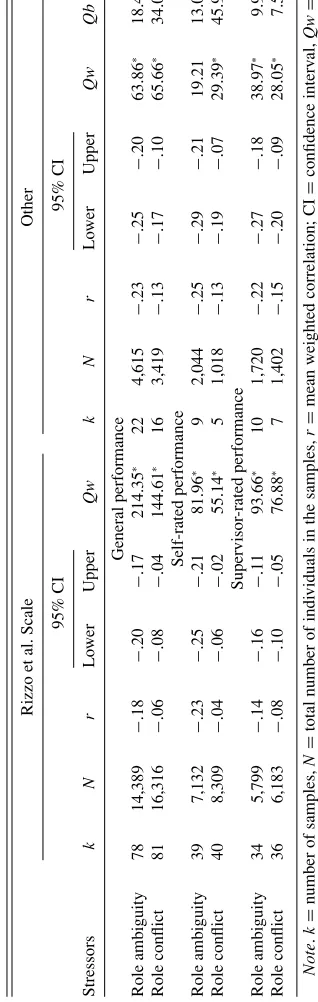
The results described in Table 4 confirm that the type of stressor mea-surement used is a significant moderator. Both role ambiguity and role conflict had significantly lower correlations with performance when mea-sured with the Rizzo et al. (1970) scale compared to all other scales, thus providing consistent support for our hypothesis in this regard. Moreover, these differences were also consistent along the different performance measures. For example, in the relationship between role ambiguity and general performance, studies using the Rizzo et al. scale had a signifi-cantly lower mean correlation (r= −.18) than did those measuring role ambiguity with other scales (r= −.23). Similarly, in the relationship be-tween role conflict and general performance, studies using the Rizzo et al. scale had a significantly lower mean correlation (r= −.06) than did those measuring role conflict with other scales (r= −.17). Thus, it can be concluded that using the Rizzo et al. scale decreased the magnitude of both the role ambiguity and the role conflict correlations with the different performance measures compared to the other scales used.
Explorative Moderator Analyses
analyses, we conducted several explorative investigations of additional moderators, as reported below. We focused on moderators assessed as having the potential to contribute to future studies in this area.
English versus non-English speaking countries. As a general proxy
for potential cross-cultural differences, effects were grouped by sample country origin into two categories: English-speaking countries versus all other countries.3 For role ambiguity, conflict, and overload relationships
with the performance criteria we did not find evidence of a moderating effect of culture. For job insecurity there was a significant difference. Among the English-speaking countries, the relationships of job insecu-rity with both general performance and self-rated performance (r= −.19 andr = −.22, respectively) were double than those of the non-English speaking countries (r= −.10 for both general performance and self-rated performance).
Journal tier. We assessed the possible moderating effect of journal
tier, expecting first-tier journals to show significantly higher effect sizes than second-tier journals. We culled the journals based on available pres-tige and impact ratings, defining as first tier theAcademy of Management Journal, Administrative Science Quarterly, Journal of Applied Psychology, Journal of Health and Social Behavior, Journal of Organizational Behav-ior, Journal of Management, Journal of Personality and Social Psychology, Organizational Behavior and Human Decision Processes, Psychological
Bulletin, andPersonnel Psychologyand as second tier all other journals.
No consistent pattern was found for general performance or self-rated performance. However, the mean correlations of role ambiguity and role overload with supervisory-rated performance were significantly higher in the first-tier journals (r= −.15 and−.16, respectively) than the second-tier journals (r= −.13 and −.01, respectively), thus, providing support for our expectations.
Predictor reliability. We also compared studies that provided
infor-mation on predictor reliability with studies that did not include this in-formation, with the idea that this might be a proxy variable reflecting the methodological rigor of the study (Dudley, Orvis, Lebiecki, & Cortina, 2006). The results suggested that only studies providing information on role overload reliability demonstrated lower correlations as compared to studies that did not provide this information.4We therefore concluded that
our expectation was not confirmed.
3A copy of the table with the full set of results for this moderator is available by e-mail from the first and second authors. Interested readers should specify the name of the moderator.
Controlling for stressor intercorrelations. Knowing of the intercorre-lations among role ambiguity, conflict, and overload, and assuming that the meta-correlations of any one of them with job performance may change relative to those reported in Table 1 when the other two are controlled for, we computed semipartial correlations between all three role stressors and general job performance. That is, we computed the correlation between role ambiguity and job performance, with conflict and overload partialed out; the correlation between role conflict and job performance, with ambi-guity and overload partialed out; and role overload and job performance, with ambiguity and conflict partialed out. We found that the negative cor-relation between role conflict and job performance turned positive but still significant when role ambiguity and role overload were partialed out, in-dicating that this relationship is somewhat influenced by the other role stressors. Role ambiguity, in turn, was significantly and negatively related to job performance even when the effects of role conflict and overload were partialed out. Finally, the relationship between role overload and job performance remained insignificant even when role ambiguity and role conflict were partialed out.4 In sum, these results indicated that the
relationships of role ambiguity and role overload with performance are robust.
Discussion
Summary of the Results
performance-related objectives. The high level of the negative relationship between situational constraints and performance was particularly striking. Jex (1998) postulated that “when organizational or job conditions make it more difficult for people to do their jobs, job performance would suffer” (p. 52). However, Villanova and Roman (1993) reported finding a very weak negative meta correlation of−.05 when they integrated past field research on this linkage. Hence, our study refines and extends their work, setting the record straight with respect to this stressor’s relationships with performance.
Job insecurity, which is a growing threat in the globalized economy, was shown to have a modest negative association with job performance. Nevertheless, we also found some evidence to suggest that the effect of job insecurity may be moderated by context. Thus, in studies from English-speaking countries, the relationships of job insecurity with both general performance and self-rated performance were double that from studies from the non-English speaking countries. It may be that this difference in relationships between job insecurity and performance in English ver-sus non-English speaking countries stems from the fact that non-English speaking countries (e.g., primarily European countries) tend to provide their citizens more safety nets if they lose their jobs compared to En-glish speaking countries. It will be helpful for future research to examine this proposition based on more direct measures of cultural and societal differences.
which contexts work–family conflict is more or less detrimental to work performance.
Of the four nonsignificant negative meta correlations obtained in our study (see Table 1), three concerned the stressor of role overload. As indicated in the introduction, it could be that in certain circumstances employees view role overload as a challenge, in this case it could be positively rather than negatively associated with job performance (LePine et al., 2005). In addition, role overload may consist of several dimensions, such as quantitative and qualitative role overload and job underload, that could be differentially related to performance (see French & Caplan, 1978 and Sutherland & Cooper, 2000).
Performance is a highly complex multidimensional construct, which can be measured in many ways. In this meta-analysis we examined for the first time quantitative and qualitative assessments of performance, which facilitated a more comprehensive understanding of the relationship between stressors and job performance. For example, we examined the relationships of role conflict and role ambiguity with quantitative and qualitative assessments of performance. The findings indicate a noticeably stronger relation between these two stressors and quantitative performance than qualitative performance, thus supporting the suggestion of Fried and Tiegs (1995) that future research on stressor–performance relationships could profit from assessing the relationships between stressors and specific dimensions of job performance.
Moderators
published and unpublished studies in the area of work stress and perfor-mance. Finally, consistent with other studies (MaGee, Ferguson, & Seers, 1989), we found that the use of the Rizzo et al. (1970) scales significantly decreased the magnitude of both the role ambiguity and the role conflict correlations with the different performance measures, as compared to all other alternative scales of these stressors. This finding suggests that re-searchers who continue to use the Rizzo et al. (1970) scales will likely weaken their ability to explain performance.
Reconciling Our Results With Previous Analytical Reviews
on twice as many samples as Tubre and Collins (2000): 14, in comparison to 7.
Sverke et al. (2002) reported a negative relationship between job inse-curity and performance (ρ= −.20) with a 95% confidence interval that included 0, whereas using the same confidence interval, the negative meta correlation ofρ=–.19 found in this study was significant. A possible ex-planation for the relationship being significant in our study is that unlike Sverke et al. (2002) we decided to exclude articles that defined this stressor as satisfaction with job security (e.g., Stepina & Perrewe, 1991; Yousef, 1998), regarding it as a strain or a reaction to the stressor, and therefore our standard error was substantively lower than that reported by Sverke et al. (2002). Our finding concerning situational constraints was not consistent with that of Villanova and Roman (1993), who quantitatively reviewed the relationship between situational constraints and performance in field studies. They found a negative weak relationship with general perfor-mance in field studies (ρ= −.05), whereas in this study, the relationship of situational constraints and general performance was both significant and homogeneous (ρ= −.24). Again, the different criterion for selecting the articles for inclusion is a potential explanation for this inconsistency. For example, Villanova and Roman (1993) included articles where the stressor was not subjectively reported by the study participants but was assessed by informed judges like district managers (Steel & Mento, 1986; Steel, Mento & Hendrix, 1987), but we excluded these studies because we focused on perceived stressors. We do not discuss in details the meta-analysis conducted by Spector and Jex (1998), because they used two or three samples to examine the relationships between job stressors and job performance (Spector & Jex, 1998, p. 363). However, we should note that consistent with our findings, their scales of organizational constraints and interpersonal conflict had negative meta correlations (−.11 and−.10, respectively) with supervisor-rated performance, whereas their scale of quantitative overload had a positive meta correlation with performance (.16).
Theoretical Contributions and Future Research Directions
From a theoretical perspective, these findings provide support for the model postulating that stressors are detrimental to job performance (Lazarus & Folkman, 1984), thus concurring with earlier quantitative and qualitative reviews of the relationships between work stressors and vari-ables often used as proxies of organizational effectiveness and produc-tivity, including absenteeism (Johns, 1997), counterproductive behaviors (Lau, Au, & Ho, 2003), accidents (Taylor & Dorn, 2006), and turnover (Griffeth, Hom, & Gaertner, 2000). However, our meta-analysis also pro-vides evidence indicating that different stressors tend to have differential relationships with performance, and consequently, there is a need to fur-ther theorize and examine the causes for these differential relations. In our study we provided theoretical arguments in support of the differential relationships between different stressors and performance. However, there is a clear need for future research to further examine the circumstances, which contribute to the experience of stress, and the process by which employees combine and integrate threat and challenge appraisals in as-sessing a situational demand. Enhancing our understanding of the process of stress appraisal as combining and integrating challenge and hindrance appraisals would enable a more valid testing and a better understanding of the effect of a stressor on performance. For example, research should explore how the relative weight of perceived challenge versus threat in a given situation affects the individuals’ experience of the situation as an opportunity or a threat. In addition, research would benefit from exploring the circumstances in which a situation is more likely to be perceived as a challenge or a threat. For example, role ambiguity may be perceived as a challenge in organizations that facilitate and reward involvement in new and challenging initiatives. In contrast, role ambiguity is more likely to be perceived as a threat in organizations that emphasize standardized operations and that reward performance based on the pursuit of well estab-lished processes and procedures. Individual differences, such as tolerance for ambiguity or need for clarity (Kahn et al., 1964), may also contribute to the experience of a challenge or a threat. Thus, individuals with high tolerance for ambiguity are more likely to perceive a potentially stressful situation as a challenge rather than a threat, compared to individuals with lower tolerance for ambiguity. Another example refers to role overload. It may be that role overload is perceived as more of a challenge when the organization is in a stage of growth and more of a threat when the organization is in a stage of decline.
relations between the different role stressors and performance. It may be that for some stressors (e.g., role ambiguity) the strongest relation with performance is linear in nature. On the other hand, for other role stressors (e.g., role overload), the strongest relation with performance is curvilinear in nature. In the latter case, it may be that individuals who are motivated to be involved in multiple tasks perform well until the number of tasks or their difficulty exceeds the individuals’ capabilities or resources. In ad-dition, the fact that all statistical indicators (Qtest, credibility intervals, and proportions of variance accounted for by sampling error and mea-surement unreliability) support the presence of moderators should direct future research to systematically examine the effect of theoretically rel-evant moderators including those that we described in the introduction. One direction to follow may be to examine the interaction between and among different role stressors. As Fried, Ben-David, Tiegs, Avital, and Yeverechyahu (1998) proposed, it is possible that individuals are able to accommodate to one stressor at a time but will find it difficult to adjust and perform well in a situation in which two or more stressors are present at the same time. To test the possibility that stressors interact in affecting performance, researchers need to use individual-level data rather than the aggregated sample-level data used in this study.
Yet another direction for future research is to explore the effect of theoretically relevant moderators on the relations between particular role stressors and performance. For example, intolerance of ambiguity is a the-oretically promising moderator of the stressor-performance relationship (Breaugh & Colihan, 1994; Frone, 1990). Societal or organizational poli-cies regarding treatment of unemployed individuals may be also used as moderators on the relationship between job insecurity and performance across different organizations and societies.
In addition, on the basis of available qualitative reviews in the literature (e.g., Bowers, Weaver, & Morgan, 1996; Jex, 1998), future research might examine the moderating role of situational variables not considered in this study (Payne, 1991, provides a list of possible candidates). Specifically, the stressor-performance relationship can be moderated by job control, which was assessed as a moderator by large number of studies (see Spector, 1998). Additional moderators may be social support and organizational commitment, and the personality traits of self-esteem and locus of control (Jex, 1998, pp. 69–90).
time expended by employees to cope with stressors or to deal with their negative affective reactions to stressors that account for the negative re-lationship? Does this mechanism also involve involuntary physiological responses to stressors that take their toll? Do these processes interact and, if so, in what fashion? Concerning motivational mediators, as Jex (1998) suggests, a stressor may affect performance by affecting antecedents of job performance such as the employee’s commitment, motivation to invest ef-fort, and motivation to maintain personal discipline. Emotional responses of employees to stressors such as emotional strain and job dissatisfaction may also serve as mediators (Fisher, 1980; Sullivan & Bhagat, 1992), and so are behavioral responses, which may include absenteeism (Gupta & Beehr, 1979), and involvement in work-related accidents that cause injury (Jones, 1990). Identifying specific variables that mediate the relationship between stressors and job performance could greatly improve our under-standing of how stressors influence job performance.
Methodologically, our results provide evidence that support a cautious use of the stress measures of Rizzo et al. (1970) in primary stress research. Further, our results provide support for the utility of assessing the rela-tionship between stressors and performance, based on self-report data (cf., Boomer, Johnson, Rich, Podaskoff, & Mackenzie, 1995). Unlike any pre-vious meta-analytic inquiry, our study enables a systematic comparison of the relations of several stressors across several performance dimensions. There are widely accepted concerns that individuals’ self-rated perfor-mances may contribute to invalid conclusions on the relationship between role stress and performance. These concerns are based on two alterna-tive arguments. The first argument is that self-report measures of both the independent (stressors) and dependent (self-rated performance) variables may inflate the correlation between the two because of common method variance. The alternative argument is that because self-rated performance is associated with self-enhancing tendencies that lead to overrated perfor-mance and lower variability in perforperfor-mance scores (Dunning, Heath, & Suls, 2004), metacorrelations between self-rated performance and work stressors can be expected to be lower relative to objective or quantitative performance.
However, the results between the different role stressors and self-rated performance (as reported in Table 1) were for the most part similar or in the same direction to the results, which were based on supervisory ratings or objective performance data. This suggests that researchers and practitioners may obtain some useful information from self-report data on stress and performance.
employees working under stressful conditions are likely to perform more poorly than those not exposed to work-related stressors (e.g., Perrewe, Fernandez, & Morton, 1993; Westman & Eden, 1991). Thus, for exam-ple, Westman and Eden (1991, p. 136) argued that only by measuring performance objectively, in a manner that precluded any coloring of per-formance by stressors, could we avoid the threat of implicit stress theory to the validity of other-rated performance. Our analysis failed to support the implicit stress theory: As we have indicated, the meta correlations of quantitative assessments of performance with role ambiguity and con-flict, which are presumably less susceptible to the threat of implicit stress theory, yielded effect sizes almost twice the magnitude of those of the cor-responding meta-correlations of these two stressors with supervisor-rated performance. Therefore, our findings do not undermine the concurrent validity of supervisory ratings of performance.
Practical Implications and Limitations
From a practical perspective, the increasing levels of work-related stressors in advanced market economies have underscored the need for researchers to understand the performance implications of stressors, to predict the effects of novel workplace stressors, and to devise interven-tions designed to reduce the potential negative effects of stressors on job performance. Our meta-analytical review provides initial guidance for responding to these research challenges. The results suggest that organi-zations should give priority to stressors such as role ambiguity and situa-tional constraints. For example, managers can provide adequate employee training that alleviates situational constraints (Jex, 1998). Moreover, role ambiguity can be reduced by leaders’ establishing clearer goals, expec-tations, and evaluation criteria. Similarly, organizations should alleviate organizational constraints by establishing supportive work environments in which employees are given the necessary tools, technology, and infor-mation to function effectively.
effectiveness and individual performance can be improved by endeavor-ing to reduce the stressors that employees perceive. Because the findendeavor-ings reveal relatively strong relationships of stressors with specific dimensions of performance, organizations may consider increasing the effectiveness of their performance appraisal systems by including in them several dimen-sions of performance like its quality and quantity. Constantly surveying the employees and learning which stressors are more prevalent and de-structive to one’s performance would enable organizations, together with their employees, to devise steps on how to minimize the adverse effects of these stressors on performance.
Like other meta-analyses, ours was based mostly on cross-sectional pri-mary studies, which makes it impossible to assess the direction of causality (Deschamps, 1997; Spector, Dwyer & Jex, 1988). Another caveat concerns the number of samples used in each calculation of effect sizes in this study. Caution should be exercised in drawing conclusions from estimates based on small numbers of samples (Oswald & Johnson, 1998). Finally, it should be recognized that we limited our study to stressors, which are part of the category of work demands. Therefore, we did not study the effect of other variables such as job control (e.g., Stone, 1986), which are part of a broader category of work-related social-psychological stressors.
REFERENCES
References with an asterisk (∗) indicate studies included in the meta-analysis.
Abramis DJ. (1994). Work role ambiguity, job satisfaction, and job performance: Meta-analysis and review.Psychological Reports, 75, 1411–1433.
Allen RD, Hitt MA, Greer CR. (1982). Occupational stress and perceived organizational effectiveness in formal groups: An examination of stressor level and stressor type. PERSONNELPSYCHOLOGY,35, 359–370.
Allen TD, Herst DEL, Bruck CS, Sutton M. (2000). Consequences associated with work-to-family conflict: A review and agenda for future research.Journal of Occupational Health Psychology, 5(2), 278–308.
∗Araghi MAK. (1981). The relationship between university faculty job satisfaction, role
conflict, task clarity and productivity.Dissertation Abstracts International, 42(4), 1502A.
∗Armstrong-Stassen M. (1993). Production workers’ reactions to a plant closing: The role of transfer, stress, and support.Anxiety, Stress, and Coping, 6, 201–214
∗Armstrong-Stassen M. (1994). Coping with transition: A study of layoff survivors.Journal
of Organizational Behavior, 15, 597–621.
∗Aryee S. (1992). Antecedents and outcomes of work-family conflict among married
pro-fessional woman: Evidence from Singapore.Human Relations, 45, 813–837. ∗Ashforth BE, Saks AM. (1996). Socialization tactics: Longitudinal effects on newcomer
adjustment.Academy of Management Journal, 39, 149–179.
∗Babakus E, Cravens DW, Johnston M, Moncrief WC. (1996). Examining the role of
∗Babakus E, Cravens DW, Johnston M, Moncrief WC. (1999). The role of emotional
ex-haustion in sales force attitude and behavior relationships.Journal of the Academy of Marketing Science, 27, 58–70.
∗Babin BJ, Boles JS. (1998). Employee behavior in a service environment: A model and test of potential differences between men and women.Journal of Marketing, 62, 77–91. ∗Bagozzi RP. (1978). Sales force performance and satisfaction as a function of individual difference, interpersonal, and situational factors.Journal of Marketing Research, 15, 517–531.
Barley SR, Knight DB. (1992). Toward cultural theory of stress complaints.Research in Organizational Behavior, 14, 1–48.
∗Bateman TS. (1980). A longitudinal investigation of role overload and its relationship with
work behaviors and job satisfaction.Dissertation Abstracts International, 41(7), 3175A.
∗Bauer TN, Green SG. (1994). Effect of newcomer involvement in work-related activities:
A longitudinal study of socialization.Journal of Applied Psychology, 79, 211–223. Baumeister RF, Bratslavsky E, Finkenauer C, Vohs KD. (2001). Bad is stronger than good.
Review of General Psychology, 5(4), 323–370.
Beehr TA, Bhagat RS. (1985). Introduction to human stress and cognition in organizations. In Beehr TA, Bhagat RS (Eds.),Human stress and cognition in organizations(pp. 375–398). New York: John Wiley.
Beehr TA, Drexler JA. (1986). Social support, autonomy, and hierarchical level as mod-erators of the role characteristics-outcome relationships.Journal of Occupational Behaviour, 7, 207–214.
∗Beehr TA, Jex SM, Stacy BA, Murray MA. (2000). Work stressors and coworker support as predictors of individual strain and job performance.Journal of Organizational Behavior, 21, 391–405.
∗Behrman DN, Perreault WD. (1984). A role stress model of the performance and
satisfac-tion of industrial salespersons.Journal of Marketing, 48, 9–21.
∗Behrman DN, Bigoness WJ, Perreault WD. (1981). Sources of job related ambiguity and
their consequences upon salespersons’ job satisfaction and performance. Manage-ment Science, 27, 1246–1260.
∗Bernardin HJ. (1979). The predictability of discrepancy measures of role constructs.
PERSONNELPSYCHOLOGY,32, 139–153.
∗Bertram DA, Hershey CO, Opila DA, Quirin O. (1990). A measure of physician mental
work load in internal medicine ambulatory care clinics.Medical Care, 28, 458– 467.
∗Bhagat RS. (1982). Conditions under which stronger job performance-job satisfaction
rela-tionships may be observed: A closer look at two situational contingencies.Academy of Management Journal, 25, 772–789.
∗Boles JS. (1991). The effect of work and non-work influence upon the relationship be-tween role stresses and selected work outcomes.Dissertation Abstracts Interna-tional, 52(11), 4002A.
Bommer WH, Johnson JL, Rich GA, Podaskoff PM, Mackenzie SB. (1995). On the in-terchangeability of objective and subjective measures of employee performance: A meta-analysis. PERSONNELPSYCHOLOGY,48, 587–605.
Borenstein M, Rothstein H. (1999).Comprehensive meta-analysis. [Computer program]. Englewood, NJ: Biostat.
∗Borucki Z (1987). Perceived organizational stress, emotions, and negative consequences
Bowers CA, Weaver J, Morgan BB, Jr. (1996). Moderating the performance effects of stress. In Driskell JE, Salas E (Eds.),Stress and human performance(pp. 163–195). Mahwah, NJ: Erlbaum.
∗Breaugh JA. (1980). A comparative investigation of three measures of role ambiguity.
Journal of Applied Psychology, 65, 584–589.
Breaugh JA, Colihan JP. (1994). Measuring facets of job ambiguity: Construct validity evidence.Journal of Applied Psychology, 79, 191–202.
∗Brief AP, Aldag RJ. (1976). Correlates of role indices.Journal of Applied Psychology, 61,
468–472.
Bronneberg EA. (1995). The interactive effects of psychological involvement and time spent on work-family conflict and the impact of work-family conflict on job performance.
Dissertation Abstracts International, 56, 4566A.
∗Brown SP, Leigh TW. (1996). A new look at psychological climate and its relationship
to job involvement, effort, and performance.Journal of Applied Psychology, 81, 358–368.
∗Byosiere PHR. (1987). Effects of societal, organizational, and individual factors on job
performance, job satisfaction, and job strain: Multiple structural equations modeling in a three wave longitudinal panel study of new teachers.Dissertation Abstracts International, 48(11), 2831A–2832A.
∗Cagli U. (1985). A study of incongruence of role perceptions in sales forces.Dissertation
Abstracts International, 47(1), 243A.
∗Challagalla GN, Shervani TA. (1996). Dimensions and types of supervisory control: Effects on salesperson performance and satisfaction.Journal of Marketing, 60, 89–105. ∗Chenhall RH, Brownell P. (1988). The effect of participative budgeting on satisfaction and
performance: Role ambiguity as an intervening variable.Accounting Organizations and Society, 13, 225–233.
∗Clayton SH. (1981). Moderators of the relationship between individual task structure
congruencies and job satisfaction and performance.Dissertation Abstracts Interna-tional, 42(3), 1235A.
Cohen S. (1980). After effects of stress on human performance and social behavior: A review of research and theory.Psychological Bulletin, 88, 82–108.
Conway JM, Huffcutt AI. (1997). Psychometric properties of multisource performance ratings: A meta-analysis of subordinates, peer, and self-ratings.Human Performance, 10, 331–360.
Cortina JM. (2003). Apples and oranges (and pears, oh my!): The search for moderators in meta-analysis.Organizational Research Methods, 6, 415–439.
∗Cummings WT, Jackson DW, Ostrom LL. (1989). Examining product managers’ job
sat-isfaction and performance using selected organizational behavior variables.Journal of the Academy of Marketing Science, 17, 147–156.
∗Darden WR, Hampton R, Howell RD. (1989). Career versus organizational commitment: Antecedents and consequences of retail salespeople’s commitment.Journal of Re-tailing, 65, 80–106.
∗Day DV, Bedeian AG. (1995). Personality similarity and work-related outcomes among
African-American nursing personnel: A test of the supplementary model of person-environment congruence.Journal of Vocational Behavior, 46, 55–70.
∗Deluga RJ, Winters JJ. (1990). The impact of role ambiguity and conflict on resident
assistants.Journal of College Student Development, 31, 230–236.
Deschamps JC. (1997). Attribution or explanations in everyday life.European Journal of Work and Organizational Psychology, 6, 7–24.
∗Dougherty TW, Pritchard RD. (1985). The measurement of role variables: Exploratory
examination of a new approach.Organizational Behavior and Human Decision Processes, 35, 141–155.
∗Douthitt EA. (2001). Effects of leader behaviors on service employee role perceptions, fairness perceptions, and performance.Dissertation Abstracts International, 62(11), 3849A.
∗Downey HK, Slocum JW. (1982). Managerial uncertainty and performance.Social Science
Quarterly, 63, 195–207.
Drach-Zahavy A, Erez M. (2002). Challenge versus threat effects on the goal-performance relationship.Organizational Behavior and Human Decision Processes, 88(4), 667– 682.
∗Dubinsky AJ. (1983). Psychological dimensions of the job: The case of customer contact
personnel.Journal of Retail Banking, 5, 30–37.
∗Dubinsky AJ, Hartley SW. (1986). Antecedents of retail salesperson performance: A
path-analytic perspective.Journal of Business Research, 14, 253–268.
∗Dubinsky AJ, Hartley SW, Yammarino FJ. (1985). Boundary spanners and self-monitoring:
An extended view.Psychological Reports, 57, 287–294.
∗Dubinsky AJ, Michaels RE, Kotabe M, Lim CU, Moon H. (1992). Influence of role stress
on industrial salespeople’s work outcomes in the United States, Japan, and Korea.
Journal of International Business Studies, first quarter, 23(1), 77–99.
∗Dubinsky AJ, Mattson BE. (1979). Consequences of role conflict and ambiguity experi-enced by retail salespeople.Journal of Retailing, 55, 70–86.
∗Dubinsky AJ, Yammarino FJ. (1984). Differential impact of role conflict and ambiguity on selected correlates: A two-sample test.Psychological Reports, 55, 699–707. ∗Dubinsky AJ, Yammarino FJ, Jolson MA, Spangler WD. (1995). Transformational
lead-ership: An initial investigation in sales management.Journal of Personal Selling & Sales Management, 15, 17–31.
Dudley NM, Orvis KA, Lebiecki JE, Cortina JM. (2006). A meta-analytic investigation of conscientiousness in the prediction of job performance: Examining the intercorrela-tions and the incremental validity of narrow traits.Journal of Applied Psychology, 91, 40–57.
∗Dunagen KJ, Uhl-bien M, Duchon D. (2002). LMX and subordinates performance the
moderating effects of task characteristics.Journal of Business and Psychology, 17, 275–285.
Duncan RB. (1972). Characteristics of organizational environments and perceived environ-mental uncertainty.Administrative Science Quarterly, 17(3), 313–327.
Dunning D, Heath C, Suls JM. (2004). Flawed self-assessment. Implications for health, education, and the workplace.Psychological Science in the Public Interest, 5(3), 69–106.
∗Edwards GJ. (1985). The relationship between bureaucratic structure, autonomy, role ambi-guity, job performance and job satisfaction for social workers.Dissertation Abstracts International, 46(7), 2072A.
Ellis S, Shpielberg N. (2003). Organizational learning mechanisms and managers’ perceived uncertainty.Human Relations, 56(10), 1233–1254.
Fisher CD. (1980). On the dubious wisdom of expecting job satisfaction to correlate with performance.Academy of Management Review, 5, 607–612.
Fisher CD, Gitelson R. (1983). A meta-analysis of the correlates of role conflict and ambi-guity.Journal of Applied Psychology, 68, 320–333.
∗Flaherty TB, Dahlstrom R, Skinner SJ. (1999). Organizational values and role stress as