Munich Personal RePEc Archive
The Inconsistency Puzzle Resolved: an
Omitted Variable
Arefiev, Nikolay
State University - Higher School of Economics (Moscow),
EUREQua, Paris-1, Université - Sorbonne
2008
Online at
https://mpra.ub.uni-muenchen.de/10244/
AN OMITTED VARIABLE
N. G. AREFIEV MACROTEAM-HSE, MOSCOW
EUREQUA, PARIS-1, UNIVERSIT´E - SORBONNE
Date: August 31, 2008.
E-mail: nicolay [email protected].
Address: kv. 86, d. 12, ul. Marshala Chuykova, Moscow, 109462, Russia.
This research is part of my Ph.D. dissertation written under the supervision of Antoine d’Autume and would not be possible without his assistance. The paper has benefitted from numerous comments of members of EUREQua, Universit´e Paris-1, and SU-HSE in Moscow. I also greatly appreciate the comments of Hippolyte d’Albis, Vadim Khramov, Andrey Malenko, Patrick Toche, and Nikolay Ushakov. I am responsible for any remaining errors. The financial support of the French embassy in Moscow is gratefully acknowledged.
Preliminary results of this research (properties of equilibrium policy) were presented in my paper, titled ”Dynamic Consistency, Property Rights and the Benevolent Government”, at the 58th Econometric Society European Meeting, Stockholm, 2003.
Abstract. The contemporary version of the dynamic Ramsey problem omits expectations of a household’s initial lump-sum wealth taxation due to policy revision; therefore, the attainable resource allocation set in this problem is ill-defined. This omission leads to misleading conclusions about the optimal policy in the short run and, in particular, that the Ramsey policy is dynami-cally inconsistent. The effect of introducing the expectations into the analysis of dynamic inconsistency is similar to that of introducing expected inflation into the Phillips curve: we show that only an unexpected policy surprise af-fects the attainable resource allocation set and the optimal policy. In contrast to Chamley (1986), we show that intensive capital income taxation at the be-ginning of an optimal policy does not imply a lump-sum taxation of household wealth and cannot reduce the excess tax burden. We also demonstrate that the Ramsey policy is dynamically consistent even without commitment. We resolve the Ramsey problem and compare our results to those of Chamley on optimal capital income taxation.
The Ramsey approach to optimal policy remains the simplest way to analyze
the consequences of distortionary taxation in representative agent models, such as
endogenous growth or RBC-style models. Even if the objective of the analysis is
not the Ramsey policy itself, but, for example, the outcome of a game between
government and households (Chari, Kehoe, 1990) or the interactions between fiscal
and monetary authorities (Dixit, Lambertini, 2003), a natural way to analyze the
efficiency of the policy is to compare it with the policy that solves the Ramsey
problem.
However, there is no satisfactory solution to the dynamic Ramsey problem in
contemporary literature. Fisher (1980) notes that the Ramsey policy is
dynam-ically inconsistent; consequently, it is not implementable. Chamley’s (1986)
rec-ommendation to tax capital income at 100% at the beginning of the optimal plan
and then switch to 0% resembles a mathematical artefact rather than a prudent
recommendation to policymakers. A benevolent policymaker has no clear answer
to the question ”What policy should I implement in order to maximize household
welfare?” The objective of this paper is to fill in this gap in the literature.
We show that the inconsistency result, as well as the Chamley “bang-bang”
so-lution to the capital income taxation problem, stems from improper analysis of the
implicit expropriation effect. Policy revisions induce jumps of the shadow price of
household wealth, and, consequently, jumps of the household wealth measured in
the units of the utility function. The latter are what we call the “implicit
expro-priation effect”, or simply “exproexpro-priation”. Previous researchers omit household
expectations of such expropriations, and we explicitly introduce expected
The consequences of the introduction of expected expropriation are similar to
that of introducing expected inflation into the Phillips curve. Previous researchers
implicitly assumed that the attainable resource allocation set and optimal policy
depend only on expropriation at time 0. However, we show that the attainable
resource allocation set and optimal policy depend on the difference between the
actual value and the expected value of expropriation, which we call the
expropri-ation surprise. The omission of the expected expropriexpropri-ation in previous papers led
to incorrect conclusions about the inconsistency of optimal fiscal and monetary
policies.
The central result of this paper is that under rational expectations there is
no reason for the dynamic inconsistency of optimal policy. Indeed, if expected
expropriation equals actual expropriation, then the expropriation surprise is zero.
We show that only a policy surprise affects the attainable resource allocation set and
the optimal policy; consequently, if expropriation is perfectly expected, the optimal
policy and the resource allocation under any value of expropriation will be the same
as under no expropriation. This means that the government has no stimulus for
inconsistency. In the Kydland and Prescott (1977) framework, this means that the
optimum coincides with the equilibrium.
The hypothesis of rational expectations is methodologically attractive, but it is
not necessary for the consistency result. In fact, however expectations are formed,
we can maximize the government’s objective on the set of attainable expropriation
surprises and find the optimal dynamics of expropriation surprise. In this paper we
show that the optimal policy is dynamically consistent regardless of the dynamics
We consider only the case of the Ramsey policy, where the government
maxi-mizes the representative household’s welfare. However, the consistency result holds
regardless of the government’s objective, on the condition that the objective itself is
dynamically consistent. For example, the policy may be inconsistent if we consider
the case of hyperbolic preferences.
Our result is far beyond the scope of the Ramsey problem and is in sharp contrast
to a substantial part of the literature on consistency, reputation, commitment, and
policy interactions. Acceptance of ideas presented in this paper requires a deep
revision of these results. In this paper we focus our attention only on the Chamley
(1986) - Judd (1985) result of short term intensive capital income taxation.
The Chamley-Judd result holds if the government can commit to future policy,
which means in our framework that expected expropriation is zero. Under
com-mitment, the Chamley-Judd policy may achieve a higher value of the objective
function than a policy without commitment, as considered in this paper, because
of a positive expropriation surprise at the beginning of the optimal policy.
However, a few arguments cast doubt on the Chamley-Judd result. The central
argument is that the Chamley-Judd policy is not implementable in a real economy,
where this policy implicitly assumes that the government can expropriate some
part of household wealth without affecting expropriation expectations. In fact,
if expected expropriation for some reason differs from zero (either before or after
the date the optimal policy is first implemented and the actual expropriation takes
place), then the attainable resource allocation set will differ from the one considered
framework, under rational expectations the expropriation surprise is zero.
Conse-quently, the government cannot achieve a lower value of initial household wealth by
means of intensive capital income taxation at the beginning of the optimal policy.
The only effect of intensive capital income taxation is an unnecessary consumption
distortion.
Another argument against the Chamley policy is that for any given value of
expropriation surprise there exists a policy that is better than Chamley’s.
Con-sumption taxation instead of capital income taxation can produce the desired value
of expropriation surprise without producing the side effect of the unnecessary
con-sumption distortion implied by Chamley’s policy; see Chari and Kehoe (1999) and
annex A of this paper for a discussion.
Finally, the value of actual expropriation in Chamley’s framework is given
quasi-exogenously. Chamley assumes that the consumption tax is zero and the capital
income tax is bounded at 100%. If we relax either of these hypotheses, we get a
higher value of expropriation than under the Chamley policy. Thus, the value of
expropriation in Chamley’s framework is determined by somead hoc hypothesis.
The same criticism is applicable to the Judd (1985) approach. These arguments
make us doubt that the policies of Chamley and Judd are in fact the policies
that we are looking for. It is not surprising that these policies have not yet been
implemented in any country.
We find the equilibrium policy, which is defined as the optimal policy without
ex-propriation surprise, and compare it with Chamley’s. Under the equilibrium policy,
the Chamley-Judd result of zero capital income taxation may hold not only in the
solution differs from the solution of Chamley and Judd in two respects. First, our
solution is dynamically consistent. Second, our solution is not just an application of
Chamley-Judd’s long term recommendation to the short term: if a policy revision
is announced, the consumption and labor taxes should be adjusted at some date in
a special way in order to compensate for the redistribution of wealth resulting from
the abolition of capital income taxation.
We show our key result using the primal approach to the optimal fiscal policy
problem developed by Ramsey (1927), Atkinson and Stiglitz (1980), Lucas and
Stockey (1983), Chari and Kehoe (1999) and many others. Chari, Christiano and
Kehoe (1996) apply the primal approach to the optimal monetary policy problem;
their method directly extends our results to the issue of the inconsistency of optimal
monetary policy.
In the context of the optimal monetary policy, our solution may justify
Wood-ford’s (2003) “timeless perspective” approach. Woodford considers a policy which
allows for the expropriation effect only at timet→ −∞. Under some hypothesis, our approach implies the same policy as the timeless perspective approach1.
How-ever, Woodford does not justify this approach and proposes to consider the timeless
perspective as a special type of commitment,iter alia. In contrast to Woodford, we
get our result without assuming any commitment and derive it from the problem
of maximization of household welfare with respect to policy.
Section 1 presents the model and explicitly introduces expropriation and
ex-pected expropriation into the analysis. We consider a continuous-time version of
the neoclassical growth model with endogenous labor similar to the one used by
1We get another solution to the optimal policy problem than Woodford either if the policy
Chamley. In sections 2 and 3 we show that both the attainable allocation set
(sec-tion 2) and the optimal policy (sec(sec-tion 3) depend only on the expropria(sec-tion surprise
but not on the expropriation and the expected expropriation taken separately. In
section 4 we compare the equilibrium policy with that of Chamley. Section 5
con-cludes.
1. Model
The representative household maximizes expected utility, which depends on
con-sumptionCand laborL.
(1) max
[C,L]E0
∞
Z
0
e−ρtU(C, L)dt
We take the producer price of the final good to be equal to one. The consumer
price of the final good is equal to (1 +τC), whereτC is the consumption tax. The
household’s real wealthA consists of capital K and holdings of government debt
B. The budget constraint is given by
˙
A=rA+W L−(1 +τC)C
(2a)
lim
t→∞A(t)e −Rt
0r(z)dz≥0
(2b)
A0−given,
(2c)
whererandW are the real after-tax equilibrium rate of return and the real wage. Policy revisions affect the shadow price of the household wealthγ (the co-state variable for equation (2a)) and, consequently, the household wealth measured in
revisions, the implicit household wealth expropriation effect; see Appendix A for
better intuition of this idea.
We use the Dirac delta function and the Heaviside function to formalize the
household wealth expropriation effect due to policy revision. LetX(t) be the Heav-iside function, which accounts for the accumulated wealth expropriation effect at
datet. We assume thatX is constant during the periods in which the policy is not revised, and if a revision takes place, it discontinuously jumps in order to account
for the new wealth expropriation effect:
(3) dX=
(
0, if there is no policy revision at datet
− lim
dt→0+
at+dt−at−dt
at−dt , if there is a policy revision
Letxbe the derivative ofX with respect to time:
(4) x= ˙X
By definition,x(t) is the Dirac delta function, withx= 0 on the intervals where the policy is not revised, and at the dates of policy revision, the value of xtends to infinity. However, the integral ofxis bounded on any time interval.
The household takes into account the fact that the policy may be revised. It
expects that during dt there will be a revision of the policy with probability pdt. If a revision takes place, there is an implicit expropriation ofφ×a of the wealth,
whereφis a random variable defined on (−∞,1) with a distribution functionξ(φ). Letxe be the expected expropriation rate per time:
(5) xe=p
1
Z
−∞
Similarly tox, the variablexemay tend to infinity at some particular points in
time, but the integral of xe on any time interval remains bounded. In contrast to
x,xe may be positive on some time intervals.
The accumulated expected wealth expropriation effect isXE(t):
(6) XE=
t Z
−∞
xeτdτ
Expropriation surprisexsand accumulated expropriation surpriseXsare
intro-duced as follows:
xs = x−xe
(7a)
Xs = X−Xe
(7b)
The first order conditions of the household problem are (see annex B for details):
uC = (1 +τC)γ
(8a)
uL = −W γ
(8b)
˙
γ = (ρ−r+xs)γ
(8c)
Neither the density function ξ(φ) nor the probability of expropriation p are present in the first order conditions (8); onlyxs is important. Note thatγ jumps
at the dates wherexstends to infinity.
Production is not of any particular importance in problems of optimal taxation;
see Judd (1999) for a discussion. We assume perfectly competitive markets and
constant returns to scale, which implies that there is no profit. The production
(9) Y =F(K, L)
The rate of depreciation isδ.
The capital income and labor taxes areτK andτL. The before-tax interest rate
and wage are ˆrand ˆW: r= (1−τK) ˆrandW = (1−τL) ˆW. The firms’ first-order
conditions are given by
ˆ
r = FK−δ
(10a)
ˆ
W = FL
(10b)
The government collects taxes to supply an exogenous amount of public goods
G. Its budget constraint can be written as
˙
B =rB+G−τCC−τKˆrK−τLW Lˆ
(11a)
lim
t→∞B(t)e −Rt
0r(z)dz≤0
(11b)
B0−given.
(11c)
Market clearing requires
˙
K=Y −C−G−δK
(12a)
K(t)≥0 ∀t
(12b)
K0−given.
(12c)
The representative household cannot solve its optimization problem while fiscal
which may be suboptimal, but which is givenex ante. The household solves its
op-timization problem assuming that this policy may be implemented. However, the
household takes into account that the government can revise the policy.
The government solves a modified Ramsey (1927) problem: it maximizes
house-hold utility (1) with respect to the fiscal policy [τC(t), τK(t), τL(t)]t∈[0,∞), taking
into consideration the wealth expropriation effects that occur if the optimal policy
diverges from the ex ante policy.
2. Expropriation and the attainable allocation set
The set of allocations that are attainable by the social planner (who finds the
first-best allocation) is given by the resource constraint. This constraint may be
found by substitution of the production function (9) into the market clearing
con-dition (12):
˙
K=F(K, L)−C−G−δK
(13a)
K(t)≥0 ∀t
(13b)
K0−given.
(13c)
The implementability constraint ensures that the allocation that resolves the
Ramsey problem can be decentralized without lump-sum taxes. This constraint
requires that for a considered allocation [C(t), L(t)]t∈[0,∞), there exists a vector of
consumer prices that simultaneously satisfies the household budget constraint and
its first-order conditions2. We can derive the resource constraint from equations
(2) and (8). The expropriation-augmented implementability constraint is given by
2In an economy with two goods, the implementability constraint coincides with the
˙
a=ρa−UCC−ULL−xsa
(14a)
lim
t→∞a(t)e −ρt= 0
(14b)
Condition (14b) is derived from inequalities (2b), (11b), (12b), and lim
t→∞K(t)e −Rt
0r(z)dz≤
0, which complete each other and together with (8c) ensure that (14b) is satisfied
with equality.
There are two differences between the conventional implementability constraint
(see, for example, Chari and Kehoe (1999)) and the expropriation-augmented
con-straint (14). First, there is a new termxsain (14a). Second, for a given value of
X0, the value of a0 is also given, while in the conventional constraint, a0 is not
determined.
The government finds the equilibrium under ex-ante policy [eτC(t),eτL(t),eτK(t)]t∈[0,∞)
and arrives atea0. The value of X0 is historically given. Consequently, the initial
conditions for (14a) are given by
a0 = ea0
(14c)
X0 − given
(14d)
Note that a policy revision that produces a wealth expropriation effect at date
0 will change not onlya0 but alsoX0.
The resource and implementability constraints with the initial and transversality
conditions exactly describe the set of allocations that may be implemented in a
decentralized economy without lump-sum taxes. The proof of this fact is well
Proposition 1. The attainable resource allocation set depends on the expropriation
surprisexs but not onxandxe separately.
Proof. The attainable resource allocation set is given by the resource constraint
(13) and the expropriation-augmented implementability constraint (14). We see
that onlyxsenters into these constraints.
Proposition 1 reveals why our conclusions differ from those of Chamley and Judd.
Chamley and Judd implicitly assume that a positive value ofxis possible only at
t= 0 andxe= 0 ∀t ≥0. This is why they arrive at the result that the more the
government expropriates at the beginning, the better the policy outcome.
However, expected expropriation affects the attainable resource allocation set,
and there is no reason to believe that xe is always zero. If we assume rational
expectations andxe=x, thenxs= 0 and the expropriation xdoes not affect the
attainable resource allocation set.
3. Optimal policy for a given expropriation surprise
3.1. The modified Ramsey problem. Assume that the vector [x(t), xe(t)] t∈[0,∞)
max
[C(t),L(t)]
Z ∞
0
e−ρtU(C, L)dt
(15a)
˙
K = F(K, L)−C−G−δK
(15b)
˙
a = ρa−UCC−ULL−xsa
(15c)
lim
t→∞a(t)e
−ρt = 0
(15d)
a0 = ea0
(15e)
K0 − given.
(15f)
The co-state variable is λ(negative) for the implementability constraint and µ
(positive) for the resource constraint. The first-order conditions are:
UC(1−λ(1 +HC)) = µ
(16a)
UL(1−λ(1 +HL)) = −µFL
(16b)
˙
λ = xsλ
(16c)
˙
µ = (ρ−(FK−δ))µ,
(16d)
where the termsHC andHLare given by
HC=
UCC
UC
C+UCL
UC
L
(17a)
HL=
UCL
UL
C+ULL
UL
L
(17b)
The termHiis a measure of the excess tax burden related to a particular form of
taxation. It plays the same role as the inverse elasticity of demand in microeconomic
possible interpretation of (−λ) is the marginal excess burden of taxation measured in terms of utility.
3.2. Optimal policy. Equations (16) and the constraints to the Ramsey problem
(15) give the resource allocation under the optimal policy. In order to determine the
policy itself, it is necessary to combine the first order conditions of the household’s
problem (8) with the first order conditions of the optimal policy problem (16),
taking into consideration the initial condition (15e). For convenience, we introduce
here a determining cumulative tax set that uniquely determines all tax distortions
(see annex A for details). This set consists of the following 3 cumulative taxes:
1 +TC/L =
1 +τC
1−τL
(18a)
1 +TC(t+z)/C(t) =
1 +τC(t+z)
1 +τC(t)
exp
t+z Z
t
τKr(s)ds
(18b)
1 +TC(0)/A(0) = (1 +τC(0))
(18c)
The optimal policy is given by
1 +TC/L =
ΦC
ΦL
(19a)
1 +TC(t+z)/C(t) =
ΦC,t+z
ΦC,t
expXts+z−Xts
(19b)
1 +TC(0)/A(0) = (1 +eτC(0))
UC(C(0), L(0))
UC(Ce(0),Le(0))
,
(19c)
where
ΦC,t = (1−λt(1 +HC,t))
−1
(20a)
ΦL = (1−λ(1 +HL))
−1
Equation (19a) was found from (8a), (8b), (16a) and (16b), equation (19b) was
found from (8a), (8c), (16a) and (16d), and equation (19c) was found from the
definitiona=γA, the constraint (15e), and equation (8a).
There is an infinite number of policies that implement (19) and decentralize
the optimal allocation. In order to get the only policy, we exogenously define the
dynamics of one of the tax rates. Suppose that if xs = 0, then the consumption
tax is constant and its value is chosen to satisfy (19c):
1 +τC = 1 +TC(0)/A(0)
(21a)
In this case, the optimal capital and labor taxes are given by
1−τL =
1 +τC
1 +TC/L
(21b)
τKrˆ =
˙
TC(t)/C(0)
1 +TC(t)/C(0)
(21c)
We assume that expropriation surprises are absorbed by simultanous jumps of
τc andτL.
Proposition 2. For any given dynamics of xs, the solution to the optimal policy
problem (15) is dynamically consistent.
Proof. From (15) it can be immediately seen that ifxandxeare given, the solution
to the problem is dynamically consistent: all state variables are in fact state
vari-ables, which do not include forward-looking terms. If a formal argument is required,
consistency may be shown, for example, by comparing the solutions obtained by
principle maximizes the discounted value of the objective function and may be
dy-namically inconsistent. The Bellman principle recognizes that, in the future, a plan
will be chosen that is optimal for that period and that resolves the consistency
problem. From the fact that these two solutions are equivalent, it follows that the
solution to the optimal policy problem is dynamically consistent.
A special case is xs
t = 0∀t. An application of proposition 4 to this case is that
underxs= 0, the optimal policy is also dynamically consistent.
Proposition 3. Optimal policy depends on the expropriation surprisexs, but not
onxandxe separately.
Proof. See the equations that describe the optimal policy (19).
Proposition 3 supplements proposition 1 and says that not only the attainable
resource allocation set but also the optimal policy depends only on the expropriation
surprise.
Propositions 1 and 3 encourage us to analyze the equilibrium policy, defined as
xst= 0∀t≥0, instead of the policy of Chamley (1986) and Judd (1985).
4. Equilibrium policy
Let us consider the case ofequilibrium policy, xs
t = 0∀t≥0. A special case of
the equilibrium policy ispolicy without expropriation, wherexe
t=xt= 0∀t.
For the case of equilibrium policy, our conclusions are similar to the long term
conclusions of Chamley and Judd. If HC is constant, the optimal cumulative tax
TC(t)/C(0) is zero (see (19b), (20a) and (16c)). Equation (21c) shows that the
cases: if preferences are isoelastic (for example, U(C, L) = C1−θ−1
1−θ +V(L)) or if
the economy is on the balanced growth path3.
There are two differences between the equilibrium policy and the policy of
Cham-ley and Judd. First, the equilibrium policy is dynamically consistent. Second, the
optimal capital income tax under the equilibrium policy may be zero not only in
the long term, but also in the short term.
However, our solution does not replicate the Chamley and Judd long term
rec-ommendations into the short term: in the short term, the optimal consumption and
labor taxes are adjusted in order to avoid any change ina0. For example, a capital
income tax reduction increases the shadow price of household wealth. In order to
compensate for this effect, the government needs to increase the consumption tax
and to decrease the labor tax.
If we neglect certain second-order effects that we discuss in the next paragraph,
then the required changes in consumption and labor taxes may be approximately
calculated in the following manner. Suppose that a decrease in the capital income
tax increases the after-tax interest rate by 10%. Then the capitalists become 10 %
richer, and to compensate this effect, the consumer price of the final good (1 +τC)
should be increased by 10%. The new value of the labor tax should ensure that the
infratemporal government budget constraint is satisfied.
This arithmetic works well in Y=AK - type models, where the decrease of the
capital income tax creates a permanent effect on the real interest rate and when the
excess tax burden of distortionary taxation is not too high. However, in exogenous
growth models, the effect of a decrease inτK on ais temporary; consequently, it
3These two cases are not too different: the balanced growth path is possible only if preferences
requires a smaller increase in the consumption tax. In addition, the capital income
tax reduction produces another effect: this tax should be substituted by others.
This will increase the cumulative tax TC/L, decrease the labor supply, decrease
the before tax interest rate, and reducea0. These effects require a decrease in the
consumption tax. In the general case, it is not clear whether the consumption tax,
as well as the labor tax, should be increased or decreased. Finally, note that on
the balanced growth path, all taxes are constant. Consequently, the optimal debt
to GDP ratio is also constant.
5. Conclusions
Previous papers implicitly assumed that the attainable allocation set and the
optimal policy depend on the expropriation of household wealth due to a policy
revision at the beginning of the optimal policy. However, we show that only an
expropriation surprise affects the attainable resource allocation set and the optimal
policy.
If we knew exactly what affects expected expropriation, we could define the
at-tainable set of expropriation surprises and maximize the government’s objective
on this set. However, expectations of expropriation depend on a large number of
factors, such as credibility, commitment, history, economic and cultural
develop-ment, government debt, sunspots in the sense of Azariadis, and so on. The exact
relationships are unknown, so we cannot solve the maximization problem.
However, a long discussion in the 1970s and 80s on the ways inflationary
ex-pectations are formed induced researchers to use rational exex-pectations by default.
The reason why the rational expectations hypothesis prevails in contemporary
than that of rational expectations. In our framework, under rational expectations,
x=xe, wherebyxs= 0, and the government cannot affect the attainable allocation
set by means of an implicit expropriation of household wealth at the beginning of
the optimal policy.
Underxs= 0, intensive capital income taxation at the beginning of the optimal
policy does not imply a lump-sum taxation of households’ initial wealth and creates
only an unnecessary consumption distortion. Thus, in contrast to the Chamley
result, we show that intensive capital income taxation at the beginning of the
optimal policy is suboptimal.
The only reason for the inconsistency of the Chamley policy is the desire to
produce a positive expropriation surprise. Under rational expectations, xs = 0
and therefore an expropriation surprise is impossible and the policy is dynamically
consistent.
Appendix A. Cumulative taxation and the wealth expropriation
effect
The central conclusions of this appendix are well-known in the literature (see,
for example, Chari and Kehoe (1999)). We review these results in a proper manner
in order to achieve a better intuition of the central conclusions of this paper.
A.1. Some definitions. The only reason why distortionary taxation affects
re-source allocation is because it distorts the ratios of relative consumer prices to
relative producer prices4. Consequently, we can specify all tax distortions using
cumulative tax rates, which determine these ratios:
4In the general case, relative prices may differ not only between consumers and producers but
(22) 1 +Ti/j =
pi/pj
ˆ
pi/pˆj
,
wherepiandpjare the consumer prices of goodsiandj, ˆpiand ˆpjare the respective
producer prices, andTi/j is the cumulative tax rate of goodiwith respect to good
j.
It is easy to verify that two fiscal policies implement different resource allocations
if and only if they implement different cumulative taxes.
By definition,
1 +Ti/j
= 1 +Tj/i −1
(23a)
1 +Ti/k
= 1 +Ti/j
× 1 +Tj/k
(23b)
Consequently, all the cumulative tax rates are not needed in order to specify
all tax distortions, since some cumulative taxes may be derived from others. A
determining cumulative tax set is a set that uniquely determines all tax distortions.
A.2. The determining cumulative tax set. In order to derive a determining
cumulative tax set in the economy, we first write the households’ budget constraint
and the firms’ net present value in integral form:
(1−τA0)A0 =
Z ∞
0
e−Rt
0r(z)dz[(1 +τ
C)C−W L]dt
(24a)
N P V0 =
Z ∞
0
e−Rt
0rˆ(z)dz h
Y −W Lˆ −K˙ −δKidt,
(24b)
whereτA0is the fictitious initial wealth tax. We assume thatτA0= 0 and introduce
Second, from (24), we find the present values of consumer and producer prices.
For example, the present value of the consumer price of the final good is equal to
the term that is multiplied by consumption in the integrand of equation (24a). All
[image:24.612.128.419.549.648.2]present values of prices are given in Table 1.
Table 1. Present values of prices
Consumer Firms
Final good Y(t),C(t) (1 +τC(t))e−
Rt
0r(z)dz e−
Rt
0rˆ(z)dz
LaborL(t) W(t)e−Rt
0r(z)dz Wˆ(t)e−
Rt
0ˆr(z)dz
Initial wealthA0, N P V0 (1−τA0) 1
Finally, we derive a determining cumulative tax set from Table 1 by definition
(22):
1 +TC(t)/L(t) =
(1 +τC(t))
(1−τL(t))
(25a)
1 +TC(t)/A(0) =
(1 +τC(t))
(1−τA0) exp
Z t
0
τKrˆ(z)dz
(25b)
The determining cumulative tax setTC(t)/L(t), TC(t)/A0
t∈[0,∞) uniquely
deter-mines all distortions that arise from distortionary taxation. All cumulative taxes
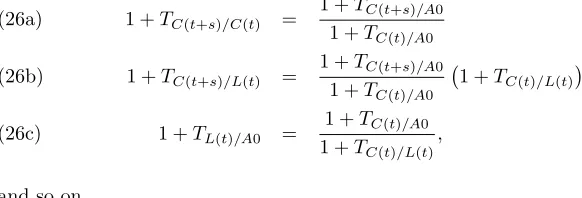
can be derived from the determining cumulative tax set. For example,
1 +TC(t+s)/C(t) =
1 +TC(t+s)/A0
1 +TC(t)/A0
(26a)
1 +TC(t+s)/L(t) =
1 +TC(t+s)/A0
1 +TC(t)/A0
1 +TC(t)/L(t)
(26b)
1 +TL(t)/A0 =
1 +TC(t)/A0
1 +TC(t)/L(t)
,
(26c)
and so on.
In section 4 we compare our policy with the policy of Chamley and Judd. We can
taxation. For this purpose, we will demonstrate how consumption and labor taxes
can substitute capital income taxation.
Assume that the ex ante capital income tax τeK is a positive constant. The
government sets the capital income tax rate to zero, τK = 0. If it desires to keep
the determining cumulative tax set unchanged, it needs to revise the consumption
and labor taxes,τC andτL, in the following manner:
(1 +τC(t)) = (1 +eτC(t)) exp
Z t
0 e
τKˆr(z)dz
(27a)
(1−τL(t)) = (1−eτL(t)) exp
Z t
0 e
τKˆr(z)dz
(27b)
If the revised fiscal policy satisfies (27), then the determining cumulative tax set
remains unchanged, and the revision does not affect the resource allocation.
Accord-ing to (27), capital income taxation at a positive constant rate perfectly substitutes
consumption tax, which tends to infinity as time tends to infinity, and labor tax,
which tends to minus infinity as time tends to infinity. There are two consequences
of this fact. The first consequence follows from the perfect substitutability between
taxes. If the consumption and labor taxes can perfectly substitute the capital tax,
then the capital income tax is unnecessary. For example, if the consumption and
labor taxes are set to their optimal values at the micro level, then the capital income
tax should be set to zero. The second consequence follows from the tax dynamics
when time tends to infinity. A constant capital income tax perfectly substitutes
taxes, which tend in absolute values to infinity. Any tax tending to infinity is
in the long term, even if consumption and labor taxes are not set to their optimal
levels5.
A.3. The wealth expropriation effect. Let us determine the instruments that
allow the initial wealth taxation to be substituted, i.e. the instruments that produce
thewealth expropriation effect.
Proposition 4. The consumption and labor taxes can perfectly substitute eτA0. If
the capital income tax is bounded, it can imperfectly substituteτeA0.
Proof. Assume that the government substitutes the initial wealth taxeτA0, which is
positive ex ante, by other taxes and attempts to keep the determining cumulative
tax set unchanged. The new policy should satisfy the following conditions:
(1 +τC(t)) exp
Z t
0
τKˆr(z)dz
= (1 +τeC(t)) (1−eτA0) exp
Z t
0 e
τKrˆ(z)dz
(28a)
(1−τL(t)) exp
Z t
0
τKˆr(z)dz
= (1−τeL(t)) (1−τeA0)
exp
Z t
0 e
τKrˆ(z)dz
(28b)
Equations (28) show that an increase inτC and a simultaneous decrease in τL
can perfectly substituteτeA0.
If τK is bounded, then the term exp Rt
0τKrˆ(z)dz
is too small to substitute
e
τA0 for small t. For large values of t, the term exp
Rt
0τKrˆ(z)dz
in (28) can
be sufficiently large to substitute eτA0. Thereafter, substitution of τeA0 by τK is
imperfect, because it requires a revision ofTC(t)/A0 for smallt.
Proposition 4 clarifies the short term recommendations of Chamley (1986) and
Judd (1985). Chamley and Judd set the consumption tax and the initial wealth tax
5Equations (27) state that capital income taxation does not violate Diamond-Mirrlees (1971)
to zero, so that the initial wealth in their economies can be taxed only by means
of the capital income tax. However, the capital income tax substitutes the initial
wealth tax imperfectly and creates extra distortions. When the optimal policy is
first implemented, the effect of initial wealth taxation dominates and the capital
income is taxed at its top bound level. At some date the effect of extra distortions
prevails, and the optimal capital income tax switches to another value in order to
compensate for the non-optimality of the taxation at the micro level (if it exists).
In the long term the optimal capital income tax converges to zero.
Thus, consumption and capital income taxes are indirectly levied on the initial
wealth. Note that this appendix confines the analysis to fiscal reforms such that
the cumulative tax rates and the resource allocation remain unchanged, and this
is why we do not consider many other ways to expropriate the initial wealth in
this appendix. For example, a fiscal reform may affect the before-tax interest rate
dynamics and thus influence the market value of household wealth. The approach
used in the body of the paper accounts for all possible ways of wealth expropriations.
Appendix B. First-order conditions to the wealth
expropriation-augmented household problem
LetV(A(t), X(t), t) be the value function
(29) V(A(t), X(t), t) = max
[C,L]Et
∞
Z
t
Taking into account that
(30)
EtV(A(t+dt), X(t+dt), t+dt) = (1−pdt)V(A(t+dt), X(t), t+dt)
+pdt
1
Z
−∞
V(A(t+dt), X(t) +φ, t+dt)ξ(φ)dφ,
the Bellman equation can be written as:
(31)
0 = max
[C,L] e
−ρtU(C, L) +
V(A(t+dt), X(t), t+dt)−V(A(t), X(t), t)
dt +
p
1
Z
−∞
(V(A(t+dt), X(t) +φ, t+dt)−V(A(t+dt), X(t), t+dt))ξ(φ)dφ
We will use a Taylor decomposition for the second term and substitute ˙A from (2). Taking the limit asdt→0+, this gives:
0 = max
[C,L] e
−ρtU(C, L) +
(32)
VA(A(t), X(t), t)(rA+W L−(1 +τC)C) +Vt(A(t), X(t), t) +
p
1
Z
−∞
(V(A(t), X(t) +φ, t)−V(A(t), X(t), t))ξ(φ)dφ
Equation (32) is the Bellman equation for the problem. The first-order conditions
are:
e−ρtU
C = (1 +τC)VA(A(t), s(t), t)
(33a)
e−ρtU
L = −W VA(A(t), s(t), t)
Letγbe the shadow price of the household’s wealth:
(34) γ=VAeρt,
then equations (33) give (8a) and (8b).
Application of the envelope theorem gives:
(35)
0 = VAA(A(t), X(t), t) ˙A+rVA(A(t), X(t), t) +VAt(A(t), X(t), t) +
p
1
Z
−∞
(VA(A(t), X(t) +φ, t)−VA(A(t), X(t), t))ξ(φ)dφ
Differentiate (34) with respect to time:
(36) γ˙ =VAAA˙+VAt
eρt+ργ
From equations (34), (35) and (36), taking into account (3), (4), and (5) we
arrive at the last first-order condition to the expropriation-augmented household
problem (8c).
Appendix C. The attainable allocation set (comments to section 2)
The derivation of the attainable allocation set that we use in section 2 is
well-known in the literature; see, for example, Lucas and Stockey (1983).
We obtain the resource (13) and implementability (14) constraints from
condi-tions that are satisfied for any equilibrium allocation; consequently, they are also
satisfied for any equilibrium allocation.
If an allocation [C(t), L(t)]t∈[0,∞) satisfies equation (14), then for any given
strictly positive dynamics of one of the consumer prices [r(t), τc(t), W(t)]t∈[0,∞),
given allocation. Indeed, the first-order conditions (8) and definitions a=γAand (3) give prices such that these conditions are satisfied, and substitution of these
prices into the implementability constraint gives the household’s budget constraint.
Thus, the household’s budget constraint is also satisfied.
If an allocation [C(t), L(t)]t∈[0,∞)satisfies the resource constraint (13), then we
can find the dynamics of the producer pricesˆr,Wˆunder which firms will choose an input-output vector such that the equilibrium market condition is satisfied.
Indeed, from equation (13) and the initial conditions, we can calculate the dynamics
of K that give the dynamics of the output Y =C+G+ ˙K+δK. Knowing the dynamics ofY, K, and L, we can use the firms’ first-order conditions to find the pricesr,ˆ Wˆunder which the firms choose the considered allocation, ˆr=FK and
ˆ
W =FL.
If both constraints are satisfied, the government budget constraint is also
sat-isfied by Walras’ law. Thus, these constraints guarantee that there exist vectors
of consumer and producer prices such that all equilibrium conditions are satisfied.
The cumulative tax rates (introduced in annex A) that decentralize the considered
allocation may be found from the difference between the consumer and producer
prices. For example,
1 +TC,L= (1 +τC)
W/Wˆ .
References
[1] Atkinson, A.B. and J.E. Stiglitz (1980).Lectures on Public Economics.McGrow-Hill, Maid-enhead, UK.
[2] Chamley, C. (1986). Optimal taxation of capital income in general equilibrium with infinite lives.Econometrica54 (3): 607-622.
[3] Chari, V.V., P. J. Kehoe (1990). Sustainable Plans.The Journal of Political Economy98(4): 783-802
[5] Chari, V. V., L.J. Christiano, P.J. Kehoe (1996) Optimality of the Friedman rule in economies with distorting taxes.Journal of Monetary Economics 37: 203-223.
[6] Diamond, P. A. and J. A. Mirrlees (1971). Optimal taxation and public good production I: production efficiency, and II: Tax rules.American Economic Review61: 8-27 and 261-278. [7] Dixit, A., L. Lambertini (2003). Interaction of commitment and discretion in monetary and
fiscal policies.American Economic Review93(5): 1522-1542.
[8] Fisher, S. (1980). Dynamic Inconsistency, Cooperation, and the Benevolent Dissembling Gov-ernment.Journal of Economic Dynamics and Control 2: 93-107.
[9] Judd, K. (1985). Redistributive taxation in a simple perfect foresight model.Journal of Public Economics28: 59-83.
[10] Judd, K. (1999). Optimal taxation and spending in general competitive growth models. Jour-nal of Public Economics71: 1-26.
[11] Kydland, F. and E. Prescott (1977). Rules Rather than Discretion: The Inconsistency of Optimal Plans.Journal of Political Economy85: 473-491.
[12] Lucas, R.E. and N.L. Stockey (1983). Optimal Fiscal and Monetary Policy in an Economy Without Capital. Jounral of Monetary Economics, 12: 55-93.
[13] Ramsey, F. (1927). A contribution to the theory of taxation.Economic Journal 37: 47-61. [14] Woodford, M. (2003).Interest and Prices: Foundations of a Theory of Monetary Policy.