Munich Personal RePEc Archive
Mean Shift detection under long-range
dependencies with ART
Willert, Juliane
Leibniz Universität Hannover
6 July 2009
Online at
https://mpra.ub.uni-muenchen.de/17874/
Mean Shift detection under long-range dependencies
with ART
Juliane Willert
∗Institute of Statistics, Faculty of Economics and Management
Leibniz Universität Hannover, 30167 Hannover, Germany
Abstract
Atheoretical regression trees (ART) are applied to detect changes in the mean of a sta-tionary long memory time series when location and number are unknown. It is shown that the BIC, which is almost always used as a pruning method, does not operate well in the long memory framework. A new method is developed to determine the number of mean shifts. A Monte Carlo Study and an application is given to show the performance of the method.
Keywords: long memory, mean shift, regression tree, ART, BIC.
JEL-Codes: C14, C22
1
Introduction
It is an ongoing problem to detect changes in the mean. In the long-memory framework it gets
even more difficult to specify number and location correctly because of the high persistence
in the time series. The long cycles and local trends challenge every breakpoint estimator
and make it hard to distinguish between long memory and mean shifts (see e.g. Sibbertsen
(2004)). In addition undetected shifts in the mean bias heavily estimators e.g. for the memory
parameter and create therefore misleading results.
∗
Granger and Hyung (1999) as well as Diebold and Inoue (2001) showed that long memory
behavior can be easily confused with mean shifts and that their properties are very similar.
That’s why standard break detection procedures can be easily confused and are vulnerable to
fail. There are several methods to specify the presence of structural breaks. Chow (1960) was
the first creating a test on structural changes based on the F statistic when the breakpoint was
known. There are Brown, Durbin and Evans (1975) who suggested the CUSUM approach
and Ploberger and Krämer (1992) who based a structural change test on the cumulative sums
of recursive residuals. Bai and Perron (1998) modeled their own break date estimator and
allowed to have multiple breaks in the mean. Their method was a break point estimator based
on OLS regression which works reasonable for short memory time series. Hence it became
the standard procedure for break point estimation.
The methodology of classification and regression trees of Breiman et al. (1993) was applied
to time series analysis by Cappelli and Reale (2005). They showed that atheoretical regression
trees (ART) have reasonable performance in detecting and locating structural breaks in
short-memory time series. In comparison with Bai and Perron (1998) the least squares regression
trees did convincingly. In the long-memory framework the Bai Perron procedure does not
work properly (see Rea (2008)), so ART would be a reasonable alternative.
Regression trees operate in two steps. First the growing step spans a tree which is often
over-fitted (see Rea et al. (2008)) and so the second step, the pruning, is the much more important
part. The regression trees with the BIC as the common pruning technique fail in the long
memory framework. A new pruning method called elbow criteria will be modeled to
over-come this problem and still maintains the good properties of the regression trees to specify the
number of mean shifts.
The rest of the paper is organized as follows. In section 2 the method of atheoretical
regres-sion trees is introduced and different pruning techniques are discussed. The BIC, the most
widespread pruning method, will be replaced by the developed elbow criteria. Section 3
con-tains an extensive Monte Carlo study to analyze the performance of the elbow criteria and its
advantage in comparison to the BIC. In section 4 an application to CPI inflation rates is given.
2
Atheoretical regression trees
ART is a nonparametric procedure that is used to detect and locate structural breaks. It does
not require distributional assumptions about the data or the residuals and hence it is well suited
for a variety of time series. A simple break point model reads
yt = µp+εt
µp =
p
∑
i=1I(ti−1<t<ti)µi
whereyt is the value of the time series at timet, εt is the error term which is assumed to be
stationary and µp is the mean of the time series up to the breakpoint p. It∈R is an indicator
function which is 1 iftis in the regimeiand 0 otherwise.tiwithi=1, ...,pare the breakpoints
with the mean of the regimeµi.
A regression tree fits piecewise constant functions to the data and determines thereby potential
breakpoints. The tree construction uses a greedy algorithm. That means that at each step the
best split is determined and there is no reconsideration of the set split. The time is the only
exogenous predictor variable for the OLS regression but it is not a true predictor, it is more
like a counter.
To determine the best split a measure of node impurity is needed. The sum of squared residuals
(RSS) is used to determine where the node will be set. The least absolute deviation could also
serve as a measure of the deviance of the tree instead of the RSS but that is rather unusual.
The mean squared error is given as a risk function by
R(t) = 1
n(t)x
∑
i∈t(yi−y¯(t))2
where
¯
y(t) = 1
n(t)x
∑
i∈t yi.xiare the predictor variables (time points) which belong to one regime andn(t)is the number
of elements in nodet. The tree construction splits a nodet into a lefttL and a righttR child
node for which the sum of the RSS of the left and right node is minimized.
min
t (R(tL) +R(tR)) =mint
1
n(tL)x
∑
i∈tL(yi−y¯(tL))2+
1
n(tR)x
∑
i∈tR(yi−y¯(tR))2
This can also be written as a maximization of the improvement through the splitting intotL
andtR.
max
t (R(t)
−R(tL)−R(tR))
ART requires at any nodeO(n(t))steps to identify the best split (see Rea (2008)). The
recur-sive partitioning produces a hierarchical structure of nodes and leaves (terminal nodes). Every
terminal node represents a regime with a shifted mean. The tree growth until no improvement
can be made by splitting the time series. So the location and number of breaks in the data are
determined.
An example will be introduced. Considering an ARFIMA(0,d,0) process
(1−L)dXt =εt,
where L is the lag operator, εt are iid random variables with zero mean and the varianceσ2
and the degree of integration is determinded by the long memory parameterd. A stationary
long memory process is characterized by the value ofd in the interval between[0,0.5].
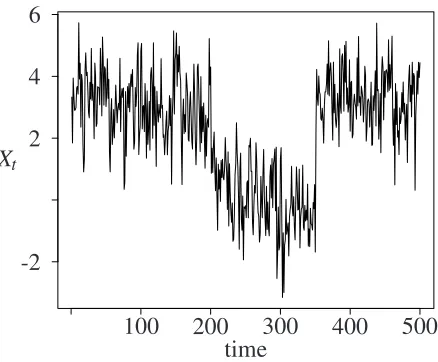
Ford=0.2, a sample size ofT =500 and two breaks from µ1=3 to µ2=0 and µ3=3 at
[image:5.612.188.407.492.673.2]t1=200 andt2=350 an exemplary time series is shown in figure 1.
Figure 1: Exemplary time series with two breaks in the mean
Xt
-2 2 4 6
100 200 300 400 500 time
In figure 2 the spanned regression tree is presented. There are four leaves and each is
att1=200,t2=294 andt3=351. The different estimated mean levels are noted below the
[image:6.612.116.490.166.483.2]encircled numbers.
Figure 2: Regression tree after growing
t <> 351.5
t <> 200.5
3.0897235 200 obs
1 t <> 294.5
0.383134 94 obs
2
−0.5493214 57 obs
3
3.311083 149 obs
4
The growing of the tree is literally driven by the data, so after the growing process a very well
fitted tree is build, because the only stopping rule would be a lack of improvement in the sum
of RSS. In fact the tree gets often quite large and is over fitted (see Rea et al. (2008)). That’s
why pruning techniques are needed to determine which of the nodes are redundant. There is
the possibility of manual pruning which is a quite reasonable way if a priori knowledge can
be used.
A nested hierarchy of regimes was built and can be pruned back by a pruning method. They
work from bottom to top. That means that the first node to cut would be the one which was
grown last, so which gained the weakest node impurity improvement. In our example this
Pruning methods are e.g. the cost-complexity pruning (see Breiman et al. (1993)) or an
information criteria such as the BIC. Rea (2008) showed that the cost-complexity pruning
is difficult to handle because a complexity parameter (penalty parameter) has to be chosen
and that the BIC is the best information criteria over all considered cases. The penalty term
of the BIC depends on the size of the time series T and the number of terminal nodes p.
Kokoszka and Leipus (2002) show that the Bai Perron procedure which is similar to the BIC
information criteria excludes linear sequences with long-range dependence. Regarding to that
it is not astonishing that the BIC does not handle long memory reliable, which can be shown
in section 3.
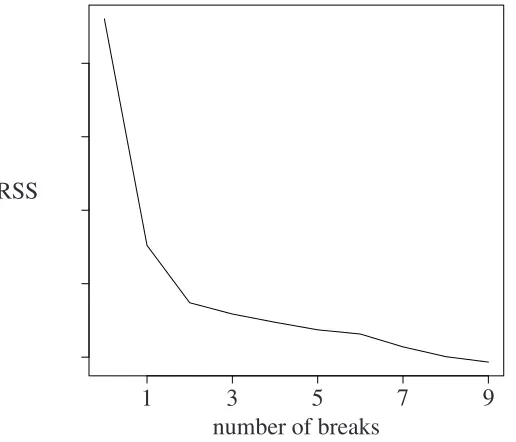
A new pruning method will be suggested to overcome this problem. The idea of the elbow
criteriais that the optimal break number is reached when the improvement of the sum of RSS
is highest. A typical shape of the sum of the squared residuals shows that there is always
a better fit by including more breaks but some splits downsize the risk function more than
[image:7.612.164.422.431.652.2]others.
Figure 3:Typical shape of the sum of squared residuals depending on the break number
RSS
1 3 5 7 9
number of breaks
The largest improvement in the RSS is made where the trend has the biggest bend. To
deter-mine this bend the slope of the piecewise constant functions are considered. The last section
so an improvement of the RSS could only be minimal. Calculating the difference between
two adjacent slopes provides a measure for the improvement benefit through this splitting.
The highest benefit is defined as the optimal number of breaks.
This procedure is independent of the length of the time series and the number of terminal
nodes. It determines the optimal number of breaks where the highest improvement can be
made through splitting at that point. The advantage is that the over fitted tree which was
grown can be counterbalanced because all the small RSS improvements become irrelevant.
In comparison the BIC does depend on the height of its penalty term and though it can be
irritated by the amount of suggested break points.
The elbow criteria considers an absolute deviation between the levels of the RSS function and
can so easily respond to different levels of the RSS function through different time series and
persistences respectively. Returning to the example given before the optimal number of breaks
would be 2. In figure 3 you can see that at two breaks the improvement through splitting the
sample is highest which expresses in the biggest bend of the RSS function.
3
Monte Carlo study
An extensive Monte Carlo study will demonstrate the performance of the new pruning method
for the long-memory framework in comparison to the BIC. All simulations are computed
with the open-source programming language R (2008). The number of replications is set to
M=1000 and we consider a sample size ofT=500 in order to illustrate the good performance
in small samples. All results improve when using larger samples.
The data generating process is an ARFIMA (0,d,0) withd=0.2 andd=0.4 respectively. The
levels of the mean are chosen relatively small on purpose. Small changes e.g. fromµ1=1 to
µ2=3 are harder to determine than large level shifts. Also returning breaks (e.g. µ1=1 to
µ2=3 and back toµ3=1) are challenging, because this small peak can be easily overlooked.
The position of the mean shift when there is only one mean shift is after the 300th observation
and it will be shown that the position does not have a big influence on the results. Considering
Comparing the widespread BIC and the elbow criteria underpin the findings of Kokoszka and
Leipus (2002). The BIC is not able to handle the long-range dependencies because of the
high persistence and dependencies. The tree misspecifies local trends and cycles as additional
break points and the penalty term of the BIC is not strong enough to penalize the high
persis-tence. The BIC leads to choose the maximum number of breakpoints which is spanned by the
[image:9.612.135.473.256.455.2]regression tree, so in most cases no real pruning takes place.
Table 1:Performance of BIC and elbow criteria
when there is one mean shift
elbow criteria BIC
d=0.2 mean s.d. % correct mean s.d. % correct
µ1=1;µ2=3 1.00 0.00 100.00 2.51 1.23 22.80
µ1=3;µ2=1 1.00 0.00 100.00 2.50 1.20 22.40
µ1=1;µ2=2 1.03 0.35 98.60 3.82 1.67 7.40
d=0.4
µ1=1;µ2=3 1.04 0.33 97.50 5.39 1.80 0.50
µ1=3;µ2=1 1.05 0.41 97.60 5.37 1.79 0.60
µ1=1;µ2=2 1.53 1.28 78.10 6.44 1.86 0.40
The BIC has huge problems to find only one mean shift. It overestimates the quantity by
multiple times. The higher the persistence the more mean shifts will be detected and the
lower is the quantity of a correct determination. For the elbow criteria it is not very hard
to determine this one mean shift in a stationary long memory process. The higher the level
of the mean shift and the lower the persistence the more accurate is the criteria. Hence the
mean is very close to the correct number of breaks, a very small standard deviation is obtained
and the percentage of a correct chosen number of breaks is high. The direction of the shift
(from a high level to a lower one or vice versa) influences neither the pruning criteria nor the
tree growing process. The following table 2 shows that the position of the mean shift barely
Table 2:Performance of BIC and elbow criteria
when the position of the break varies and there is one mean shift
break at observation elbow criteria BIC
d=0.2;µ1=1;µ2=3 mean s.d. % correct mean s.d. % correct
50 1.00 0.03 99.90 3.32 1.68 15.40
250 1.00 0.00 100.00 2.45 1.20 24.60
450 1.01 0.07 99.50 3.28 1.64 14.00
d=0.4;µ1=1;µ2=3
50 1.37 0.84 76.60 6.25 1.82 0.50
250 1.04 0.33 98.30 5.42 1.81 0.90
450 1.40 0.99 78.00 6.16 1.84 0.50
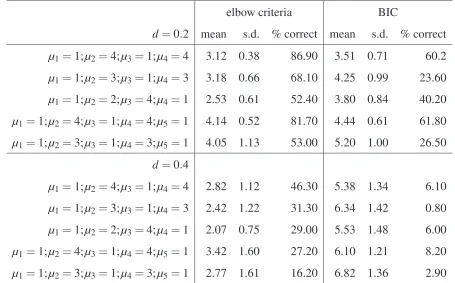
The results for multiple mean shifts are reported in table 3 and 4. The elbow criteria handles
more breaks much more solid than the BIC and gives good results in detecting the mean shifts.
The positions of the break points are spaced equally.
Table 3:Performance of BIC and elbow criteria
when there are two mean shifts
elbow criteria BIC
d=0.2 mean s.d. % correct mean s.d. % correct
µ1=1;µ2=4;µ3=1 2.07 0.26 95.80 2.63 0.76 52.50
µ1=1;µ2=3;µ3=1 2.15 0.39 87.20 3.36 1.13 23.90
µ1=1;µ2=2;µ3=1 2.04 0.64 67.00 4.52 1.48 7.80
d=0.4
µ1=1;µ2=4;µ3=1 2.06 0.54 70.60 4.79 1.44 3.40
µ1=1;µ2=3;µ3=1 1.92 0.75 55.10 5.85 1.58 1.20
[image:10.612.121.492.438.649.2]Table 4:Performance of BIC and elbow criteria for multiple mean shifts
elbow criteria BIC
d=0.2 mean s.d. % correct mean s.d. % correct
µ1=1;µ2=4;µ3=1;µ4=4 3.12 0.38 86.90 3.51 0.71 60.2
µ1=1;µ2=3;µ3=1;µ4=3 3.18 0.66 68.10 4.25 0.99 23.60
µ1=1;µ2=2;µ3=4;µ4=1 2.53 0.61 52.40 3.80 0.84 40.20
µ1=1;µ2=4;µ3=1;µ4=4;µ5=1 4.14 0.52 81.70 4.44 0.61 61.80
µ1=1;µ2=3;µ3=1;µ4=3;µ5=1 4.05 1.13 53.00 5.20 1.00 26.50
d=0.4
µ1=1;µ2=4;µ3=1;µ4=4 2.82 1.12 46.30 5.38 1.34 6.10
µ1=1;µ2=3;µ3=1;µ4=3 2.42 1.22 31.30 6.34 1.42 0.80
µ1=1;µ2=2;µ3=4;µ4=1 2.07 0.75 29.00 5.53 1.48 6.00
µ1=1;µ2=4;µ3=1;µ4=4;µ5=1 3.42 1.60 27.20 6.10 1.21 8.20
µ1=1;µ2=3;µ3=1;µ4=3;µ5=1 2.77 1.61 16.20 6.82 1.36 2.90
The chosen transitions are quite regular which is much more difficult to detect for a break
point estimator than extreme breaks. This almost cyclic behavior (fromµ1=1 toµ2=4 and
back toµ3=1 andµ4=4) simulates the most challenging break pattern with local cycles and
persistences best. Hence the good behavior in this cases are very founded results for more
obvious (easier to be detected) breaks.
Finally you can say that the BIC overestimates the number of breaks with high standard
de-viations. The percentage of correct chosen breaks is so small that even educated guessing
would be more successful. The ability of the elbow criteria on the other hand stays reasonable
even if there is more than one mean shift. When the persistence increases the criteria tends
to underestimate the number of mean shifts. The elbow criteria as a pruning technique of
the atheoretical regression trees shows very good properties even when multiple mean shifts
with small level changes occur in a long memory time series. They will be still detected and
4
Application on inflation rates
To illustrate the good performance of the atheoretical regression trees an application to CPI
inflation rates is given. The time series data starts in January of 1960 (except Australia starts
in 1971) and ends in June 2009. The following table 5 shows the results of some OECD
[image:12.612.208.406.236.441.2]countries when ART with the elbow criteria is applied.
Table 5:Break points in inflation rates
of selected OECD countries
Country 1st break 2nd break
Australia Jan 91
-Canada Aug 72 Dec 91
Germany Sep 70 May 83
Japan Dec 81
-New Zealand Sep 70 Jun 90
Switzerland Oct 93
-UK Sep 73 Nov 82
US Jul 73 Nov 82
The atheoretical regression trees find one or two breaks in the inflation rates. Corvoisier and
Mojon (2005) determined three waves where breaks in inflation rates occur. In their opinion
since 1960 most OECD countries had breaks around 1970, 1982 and 1991. This can be very
well encountered by the estimated break points via ART. Hsu (2005) identifies the break points
under the assumption of two known breaks and finds for Germany the breaks at October 1969
and July 1982 and for the US at January 1973 and September 1981. Under the assumption of
one appearing break he determines for the japanese inflation rate the break point at May 1981.
Hence most of his results are very close to the specified breaks by the elbow criteria, however
Hsu has to know a priori how many breaks will occur.
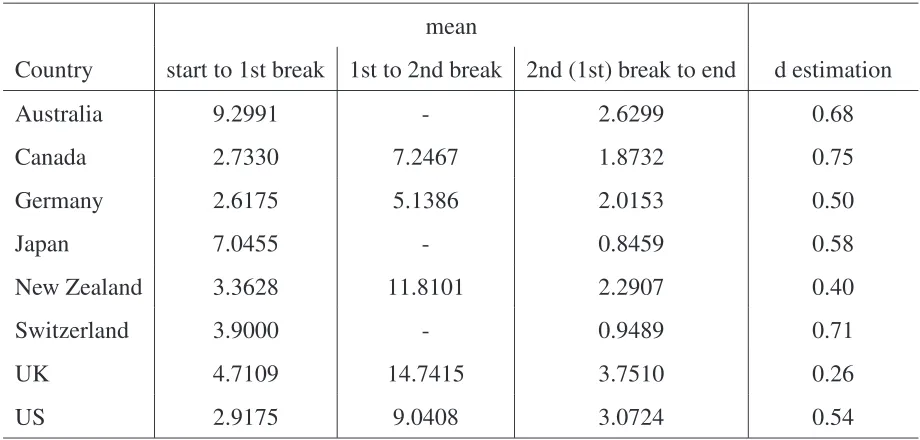
After demeaning the inflation rates using the specified break points the long memory
parame-ter can be computed by the GPH estimator. In the following table 6 the mean of each regime
Table 6:Mean of each break regime and demeaned d estimation of selected OECD countries
mean
Country start to 1st break 1st to 2nd break 2nd (1st) break to end d estimation
Australia 9.2991 - 2.6299 0.68
Canada 2.7330 7.2467 1.8732 0.75
Germany 2.6175 5.1386 2.0153 0.50
Japan 7.0455 - 0.8459 0.58
New Zealand 3.3628 11.8101 2.2907 0.40
Switzerland 3.9000 - 0.9489 0.71
UK 4.7109 14.7415 3.7510 0.26
US 2.9175 9.0408 3.0724 0.54
The detected breaks in the inflation rates have quite high level differences. When there are
two breaks in the inflation rate the mean before the first break and after the second break is
often almost the same and a large peak between the breaks can be detected. In this situation
(when the transitions are quite regular) ART showed good properties (see section 3) and hence
underpin that these break point findings are quite reliable. After demeaning the data
accor-dingly to the estimated break points long-range dependencies are still present in the data. This
implies that an approach which accounts for long memory and mean shifts is very rational.
5
Conclusion
In this paper a new pruning technique for atheoretical regression trees is invented. When the
data generating process is long memory and has shifts in the mean function it performs much
better than common pruning methods like the BIC. In a stationary long memory framework the
elbow criteria accomplishes the detection of the breaks no matter how many shifts appear and
where they are situated, even in small samples. With increasing persistence and decreasing
shift level the determination gets slightly underestimated. As the procedure is well grounded
it can also be extended for smooth transition trees (da Rosa et al. (2008)) and to trend or
References
Breiman, L., Friedman, J.H., Olshen, R.A. and Stone, C.J. (1993): Classification and
Re-gression Trees.Chapman & Hall, New York.
Brown, R.L., Durbin, J. and Evans, J.M. (1975): ”Techniques for testing the constancy of
regression relationships over time.”Journal of the Royal Statistical Society B37, 149 –
163.
Cappelli, C. and Reale, M. (2005): ”Detecting Changes in Mean Levels with Atheoretical
Regression Trees.” Research Report UCMSD2005/2, Department of Mathematics and
Statistics, University of Canterbury.
Chow, G.C. (1960): ”Tests of equality between sets of coefficients in two linear regressions.”
Econometrica28, 591 – 605.
Corvoisier, S. and Mojon, B. (2005): ”Breaks in the Mean of Inflation: How they happen
and what to do with them.” ECB Working Paper No. 451.
da Rosa, J.C., Veiga, A. and Medeiros, M.C. (2008): ”Tree-Structured Smooth Transition
Re-gression Models Based on CART Algorithm.” Journal of Computational Statistics and
Data Analysis52, 2469–2488.
Diebold, F.X., Inoue, A. (2001): ”Long memory and regime switching.” Journal of
Econo-metrics105, 131–159.
Granger, C., Hyung, N. (1999): ”Occasional Structural Breaks and Long Memory.”
Univer-sity of California, San Diego, Discussion Paper99.14.
Hsu, C.-C. (2005): ”Long memory or structural changes: An empirical examination on
in-flation rates.” Economics Letters88, 289 – 294.
Kokoszka, P. and Leipus, R. (2002): ”Detection and estimation of changes in regime” In:
Long-range Dependence: Theory and Applications by P. Doukhan, G. Oppenheim and
Ploberger, W. and Krämer, W. (1992): ”The CUSUM test with OLS residuals.”
Economet-rica60(2),271 – 285.
R Development Core Team (2008): ”R: A language and environment for statistical
comput-ing.” Available at www.r-project.org.
Rea, W.S. (2008): ”The Application of Atheoretical Regression Trees to Problems in Time
Series Analysis.”PhD Thesis.Department of Mathematics and Statistics, University of
Canterbury.
Rea, W.S., Reale, M., Cappelli, C. and Brown, J.A. (2008): ”Identification of Changes in
Mean with Regression Trees: An Application to Market Research.” Econometric
Re-views.forthcoming.
Sibbertsen, P. (2004): ”Long-memory versus structural change: An overview.” Statistical