Munich Personal RePEc Archive
Veto Power and Wealth: Analysis of the
Development of the Swiss Old Age
Security
Zenker, Christina G.
Salem College
August 2009
Online at
https://mpra.ub.uni-muenchen.de/16927/
1
Veto Power and Wealth: Analysis of the Development of the Swiss
Old Age Security
Christina Zenker
Department of Business and Economics, Salem College
Ideas Repec Elon Working Paper
Abstract
Switzerland was one of the last OECD-countries to introduce a program for old age security – the AHV. For many decades, expenditures both in absolute terms and as a portion of GDP remained low in OECD comparison. In the 1970ies however, expenditures exploded – within 10 years, the expenditures as a percentage of GDP doubled. This article explains this astonishing development by applying the veto player theory. Veto player theory is useful to determine changes in the policy stability. The higher the policy stability, the more difficult it is to move away from the political status quo. The lower the policy stability, the more probable it is that reforms and changes in government programs can be achieved. This article shows that the policy stability was particularly high in the constitution phase (from 1890 to 1947) and the consolidation phase (from 1974 to the present) and low in the phase in between (from 1948 to 1973), when the foundation for the expansion was set.
1
Introduction
Switzerland was long known for being a slim welfare state with very low expenditures in
social security. In the classification of Esping-Andersen, Switzerland was closer to countries like the
US or Japan in terms of its welfare spending (Esping-Andersen 1990). Furthermore, Switzerland
introduced its programs of social security in 1948, which was very late. As a comparison, Germany
introduced its program in 1889 and the USA in 1935. In the 1970ies expenditures increased
dramatically – within 10 years, expenditures doubled. Switzerland now has the third highest
expenditures in old age security in comparison to other OECD countries. This article does three things:
First, it gives a short overview of the theory that is used to analyze this development – the veto player
theory. Second, the veto player theory is applied to the history of the first pillar of old age security –
2 who can veto a change of the political status quo. It is shown how the change of the structure and the
preferences of the veto players influenced the willingness to introduce, expand and reform the system
of old age security. The relevant constitutional veto players (both chambers of parliament and the
voting population) have changed their position over time. This has a significant influence on the policy
stability, respectively on the ease by which the political status quo can be changed. Over the past
decades, the number of veto players as well as their ideological congruence and cohesion has changed,
accounting for varying levels of policy stability. Switzerland is typically a country with high policy
stability, which explains why it took a long time for the country to introduce an old age security
program and why reforms of the system are difficult to implement today. In the expansion phase
however, policy stability was exceptionally low: all veto players were consenting about the level of
old age spending. This opened the door to increasing spending significantly. The article ends with a
conclusion.
2
Preliminaries: The veto player theory
The veto player theory is an excellent tool to analyze the position and behavior of political
actors who can trigger policy changes. It is ultimately a tool to measure the policy stability within a
certain policy field. In this paper, the veto player theory is used to analyze the development of the
AHV. A veto player is defined as a political actor who can prevent policy changes. Veto players can
either be individual or collective; constitutional or partisan.
Policy stability is measured through three determinants: The number of veto players, the level of
congruence and the level of cohesion within a collective veto player:
The more veto players there are, the more difficult it is to change the political status quo and
the more stable a policy.
The higher the congruence between the veto players, the more difficult a deviation from the
political status quo and the more stable a policy.
3 In classic veto player theory, the constellation of veto players is typically looked at in a two
axes-scheme. The graph below shows the position of three veto players L1, L2 and L3 according to their
preferences with relation to X1 and X2 with their indifference curves. X1 could for example stand for
the level of benefits and X2 could be the retirement age. The point L1 for instance is the preferred
point of L1. Furthermore, L1 prefers any point within his indifference circle to a point on the circle.
Also, a point outside of the circle will not be accepted by player L1.
The point of intersection of the three players, Q, is the status quo. In the case of the graph below, the
status quo is the only possible outcome, assuming unanimity vote. A point away from Q, say in the
intersection between L1 and L2 would be vetoed by L3. Therefore, it is not possible to move away
from Q. The size of the circle of an individual veto player indicates the political “leeway”, respectively
how broad the ideological position of a political actor is. In the case of the collective veto player, the
size of the circle indicates the policy stability; the smaller the circle, the greater the cohesion (and
therewith the policy stability). The lower part of the graph (b) shows the position of the same veto
players in one political dimension instead of two. L3 shows the centre of the indifference circle of
actor L3. The circle is limited to the right by the status quo (Q) and to the left by the point L3(Q).
Graph (b) reflects the same as graph (a) – there is no point apart from Q which would be accepted by
4 Figure 1: Veto players in one and in two dimensions
L1
L2
L3 Q
0
0 L1 L3(Q) L3 Q L2 X1
X1 X2
(a)
(b)
3
Determining policy stability
3.1 Policy stability in general
In order to apply the veto player theory to a political system, a certain number of questions
have to be asked:
1. How are the veto players being determined?
2. Who are the veto players?
3. Who controls the political agenda (who has the power to introduce political proposals)?
4. How are decisions by collective veto players being made? (Unanimity, simple majorities, qualified
majorities?)
1. The Swiss constitution dictates the number of veto players. On the one hand, the veto players are
5 institution of the constitutional initiative and the referendum creates one or sometimes even two veto
players: the people and the cantons. By calling a federal referendum a group of citizens may challenge
a law that has been passed by Parliament, if they can gather 50,000 signatures against the law within
100 days. If so, a national vote is scheduled where voters decide by a simple majority whether to
accept or reject the law. Eight cantons together can also call a referendum on a federal law. This is
where the additional veto player – the cantons - comes into play. Similarly, the federal constitutional
initiative allows citizens to put a constitutional amendment to a national vote, if they can get 100,000
voters to sign the proposed amendment within 18 months. Parliament can supplement the proposed
amendment with a counter-proposal, with voters having to indicate a preference on the ballot in case
both proposals are accepted. Constitutional amendments, whether introduced by initiative or in
parliament, must be accepted by a double majority of both the national popular vote and a majority of
the cantonal popular votes. Thus there are four constitutional veto players. Due to the concordance
democracy in Switzerland, which forces political parties to a consensus oriented policy, partisan veto
players are less relevant in the Swiss political system.
2. From point 1 follows that the veto players in the Swiss political system are the two chambers of
parliament, the people and – depending on the case – also cantons.
3. The political agenda is being influenced by several political actors. First, the agenda setting happens
through motions and postulates in parliament, second, the federal council can ask the parliament to
prepare political issues. And third, each Swiss citizen has the power to initiate a law through a popular
initiative if a certain amount of people signs the initiative. The constitutional initiative is one of the
options through which interest groups can make themselves heard in the Swiss political system.
Therefore the three most important veto players in Switzerland – the two chambers of parliament
6 4. The decisions in both the National- and Ständerat are being made through simple majority votes.
However, the consent of each of the chambers is required.1 In order to be able to measure the policy
stability in a certain policy field in the past decades, it is necessary to establish the three different
determinants of policy stability: the number of veto players, the congruence between veto players and
the cohesion within a collective veto player. The more veto players there are, the more difficult policy
changes will be. The more congruent the veto players, the easier a policy change can take place. The
higher the cohesion within a collective veto player (e.g. chamber of parliament), the more difficult a
policy change is.
3.2 Policy Stability in the AHV: Case studies
The development of the AHV in Switzerland can be illustrated and explained with the veto
player theory. In the following chapters, the preferences of the different veto players and its
consequence in terms of policy results will be shown. In general, the position of the different veto
players is shown in one dimension. In votes, where two important issues arise, the position of the veto
players is shown on two axes. The application of the veto player theory (see e.g. Tsebelis 2000 and
Moser 1996), as here shown in the case of Switzerland, suggests a certain measurability of the position
of the veto players in the different votes. However, it is not possible to quantify the position of the
veto players – it is only possible to express the strength of the preferences (high – middle – low) as
well as the position of the veto players relative to each other. Despite this restriction, the veto player
theory allows us interesting insights into the development of the AHV.
1
The measure of the so called „Differenzbereinigungsverfahren“ – the process of reaching an agreement –
7
3.2.1 The constitution phase
In the late 19th century, the willingness to introduce a public old age security was very limited.
A few cantons introduced compulsory old age insurance and decided autonomously on its structure
and the level of benefits. Both in parliament and in the population, there was a consensus that old age
insurance should be provided privately and / or on a cantonal level. The situation can be illustrated as
follows:
Figure 2: Position of the veto players People, Stände- and Nationalrat around 1890 (empty winset)
P S N S(Q)
Strong welfare state Individual
provision for old age
Q P(Q)
The graph shows the position of the three relevant veto players people (P), Ständerat (S) and
Nationalrat (N). The further to the right the actors are positioned, the more likely they are to advocate
for a strong welfare state with a publicly provided old age security. The further to the left, the more
likely that the actors prefer a private old age security. Q shows the status quo, which does not provide
for a public old age security. P(Q) shows the outer boundary of the preferences of the people; the
people prefer any point between P(Q) and Q to the status quo. The winset of the status quo is empty –
that is, there are no alternatives to the status quo. A proposition of the parliament to the right of Q
would be prevented by the population with a referendum. According to the preferences of the
parliament, it would choose a point between S and N. Such a proposition would be turned down by the
population. All the bills that would be accepted by the people would have to lie between P(Q) and Q.
As the picture shows, the status quo lies far away from a public regulation of old age security. This
changed however after a few years. The misery in the aftermath of the First World War smoothed the
8 as well as voices from the media led to the installment of a commission of experts to discuss a
constitutional amendment for the introduction of an old age insurance 1919. Because of the crisis of
the post war years and doubts from federalists it took 6 years before the bill created by the commission
could be discussed in parliament. The bill was accepted by both chambers of parliament in June 1925
by a vast majority. A few months earlier, the social democratic party launched a constitutional
initiative to create an invalidity-, old age- and survivor- social security scheme. This was strongly
defeated by the people and cantons. The constitutional article on the AHV had to be voted on by both
people and cantons (C). Therefore, a new veto player came into play. As the illustration shows, the
cantons approved of the new constitutional article by a greater majority than the people. Figure 3
shows the position of the veto players during the vote of 1925. The proposition of the parliament had
to lie between N and P(Q), respectively C(Q). Because the preferences of the people lay much more to
the left than that of the cantons and they wanted less a public old age security than the cantons, P(Q)
forms the border to the right. The new AHV-article lay in the winset of the people, cantons and the
[image:9.595.75.422.512.592.2]parliament: namely between the points of N and P(Q).
Figure 3: Position of the veto players and winset during the vote for the constitutional article in 19252
Q C N C(Q) N(Q) S
Strong welfare state Individual
provision for old age
P P(Q)
The parliament needed to concretize the constitutional article after the positive outcome of the vote.
The law was called “Lex Schulthess” and was voted upon on June 17th 1931. Both National- and
Ständerat voted in favor of the relatively modest law.
2
9 Figure 4: Position of the veto players for the Lex Schulthess (empty winset) 19313
Q P
P(Q) S S(Q) N
Strong welfare state Individual
provision for old age
The figure shows the position of the three relevant veto players at the vote on the “Lex Schulthess”
with which the AHV should have been introduced. Q shows the status quo – no federal old age
insurance. At all points to the right of Q, the median voter prefers the status quo and she would launch
a referendum against a deviation from the status quo. All points to the right of S(Q) would be a
deterioration in the eyes of the Ständerat. Therefore, the parliament agreed on a point between S and
S(Q). Since P is not within the winset (between S and S(Q)) of the parliament, the “Lex Schulthess”
was defeated by the people. Especially the young people were against the law since they thought that
the contribution rate was too high (Binswanger 1986). The congruence between people and parliament
was low – there was no way that a consensus could be reached. However the congruence of the
Stände- and the Nationalrat was high, no process to settle the inconsistencies was needed. Also the
cohesion within the chambers of parliament was astonishingly high – the “Lex Schulthess was
accepted with a high majority in both chambers. During the debate of the AHV-law, which began
1946 in a commission of the Nationalrat, the cohesion in the chamber was very low. It took two
sessions before the Nationalrat reached an agreement and could pass on the bill to the Ständerat. The
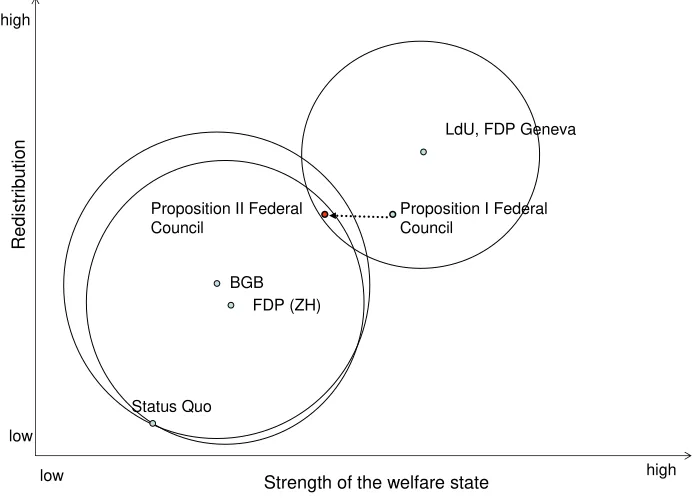
position of the Nationalrat can be shown as follows: In the first meeting in July 1946, the structure of
the AHV was being discussed. While the right of the middle parties FDP (Geneva) and LdU regarded
the proposition as too little redistributive, the BGB was of the opinion, that the AHV redistributed too
much money. The right of the middle FDP of the canton of Zurich on the other hand regarded the
3
10 AHV as too centralistic and wanted to regulate old age security on a cantonal level. Only in a second
meeting the commission deliberated on the financing of the AHV, which was just as controversial.
The federal council planned to use the estate tax raised by the cantons. Here, the federalism-
centralism-trench which divided the commission was visible. Especially the conservative parties were
opposed to interference in the financial autonomy of the cantons. The financing of the AHV through
the estate tax was cancelled in the third meeting of the commission of the Nationalrat, since the costs
of the federal government were smaller than originally thought: The interest of the surplus from the
LVEO4 was enough to cover the costs. This was a wise move in order to prevent a referendum from
being launched. After a few changes, a consensus was reached on the general system of the AHV. The
following picture shows the position of the most important parties of the commission along the axis
redistribution and strength of the welfare state (i.e. in how far the federal government should regulate
old age security). The figure shows the initial proposal that was made by the Federal Council, which
did not stand a chance to win against the status quo. The new proposal on the other hand lay in the
winset of the status quo. After he commission reached an agreement, it forwarded the bill to the
Nationalrat.
4
The LVEO (Lohn- und Verdienstersatzordnung) was introduced to compensate men for missing out on wage
11 Figure 5: Position of the parties in the commission of the Nationalrat 1946
LdU, FDP Geneva
BGB FDP (ZH)
Status Quo
Strength of the welfare state
Redistr
ibu
ti
o
n
low low high
high Proposition I Federal
Council Proposition II Federal
Council
After the commission of the Nationalrat reached an agreement, an extraordinary session of the
Nationalrat was called in August, expressly for the AHV. In the Nationalrat, the interests of the
members of the commission were mirrored. Again, the LdU criticized that the AHV was not
redistributive enough. Furthermore, a long time was devoted to the discussion of the position of
certain groups in the AHV (for instance the rights of the divorced woman after the death of her
ex-husband). Until the end of the extraordinary session, an agreement was reached and the subject of the
financing was discussed in the following fall session. In the centre of the discussions was the financing
of the contributions of the government. After some skirmishing, the Nationalrat agreed on a
proposition of the federal council to finance the AHV with the interests of the LVEO surplus and
changed very little on the bill of the commission of the Nationalrat. With 152 to 8 votes with 7
abstinences, the bill was accepted in the Nationalrat. After the vote in the Nationalrat, the AHV-law
was deliberated by the commission of the Ständerat, before it was sent to the Ständerat in the fall
session in 1946. To sum it up, one can say that the Ständerat argued in a more conservative manner
12 higher than within the commission of the Nationalrat. In December 1946, the bill was sent back to the
Nationalrat to clear out the differences in opinion. With two deviations, the bills went back to the
Ständerat, who terminated the process of clearing the differences in the afternoon of the same day by
agreeing to both deviations. In the final vote, 170 parliamentarians in the Nationalrat voted in favor of
the law, 8 voted against it and 8 refrained from voting. In the Ständerat, 34 were in favor while 2
parliamentarians refrained from voting. Shortly after that, federalists launched a referendum. Also a
left wing group from Geneva was involved in the referendum, however for other reasons than the rest
of the referendum committee. In their eyes, the insurance character of the AHV was not social enough.
The federal government invested a lot in the campaign – even an information service was installed to
answer the questions of the citizens about the AHV. The opponents kept relatively silent and there was
no single party or interest group that was officially opposed against the AHV. With almost 80% votes,
the AHV was accepted by a vast majority of the people. This result can probably be explained with the
good experience one had made with the LVEO on which fundaments the AHV was based. The
[image:13.595.73.425.488.564.2]position of the veto players in the case of the AHV-law can be shown as follows:
Figure 6: Position of the veto players and winset at the vote for the AHV-law in 19475
Q P N P(Q)SN(Q)
Strong welfare state Individual
provision for old age
As can be seen with the approval rates of the different veto players, the Ständerat was the biggest
defender of the AHV-law, however closely followed by the Nationalrat. The people also clearly said
yes to the law with an approval rate of 80%. The new law was within the winset of the people and the
parliament, namely between the points N and P(Q) and was therefore accepted.
5
13
3.2.2 Expansion Phase
Typical for the expansion phase was the magnitude of revisions of the AHV-law with
continuing increases of benefits. During the good economic times, people had the impression that the
AHV system could be expanded infinitely. The policy field of AHV was a welcome possibility to gain
votes. The first eight revisions were introduced without a referendum. Only against the 9th revision, a
referendum was launched. Exemplary for the first eight revisions, the following picture illustrates the
[image:14.595.75.420.374.454.2]situation in the early expansion phase:
Figure 7: Position of the veto players in the early expansion phase
Q S N S(Q)
Strong welfare state Individual
provision for old age
As is shown in the above illustration, there was a consensus regarding the extension of the AHV. This
consensus existed on the one hand because of the surplus in the so called “technical balance” – a
balance that showed the income and the spending across three generations; a cross generational
balance. On the other hand, the many initiatives and motions from the parliament demanded a further
expansion. In the expansion phase, mainly two veto players were active: the National- and the
Ständerat. Since the position of the people lay within the winset of the parliament, there was no
referendum launched in the beginning of the expansion phase. Another interesting case in the
expansion phase was the process that led to an institutionalizing of the three pillar principle.
Exemplary for the Swiss democracy, three initiatives were launched, whereof two were drawn back
because of counterproposals of the parliament. The first initiative was an initiative for a real “people’s
14 The initiative demanded rents of at least 60% of the average annual income of the five best
contribution years. A third of the costs of this should be paid by the government. This comprehensive
old age security should make the private and occupational pension unnecessary – the existing pension
plans would have been integrated into the AHV. In March 1970, an initiative launched by the Social
Democrat Party also demanded the introduction of a people’s pension and questioned – however in a
less radical way – the system of the Swiss occupational pension. This system had a long tradition in
Switzerland – also since the public old age security came so late into existence. The conservative
parties were alarmed by the initiatives. They wanted to hold on the informal Three Pillar System and
wanted to strengthen – not weaken – the system of occupational pension. Therefore, a consortium of
conservative politicians launched an initiative for a timely old age, disability and survivor insurance in
April 1970. The initiative demanded a mandate for the occupational pension system as well as a
promotion for private pension savings through tax incentives. The mandate for the occupational
pension originally went against the philosophy of the FDP. However due to the development in the
expansion phase, this step was considered a necessary evil to save the occupational pension (Ischer
2002). A motion from parliament asked the federal council to work out an 8th revision on the basis of
the conservative initiative. The goal was to be able to offer a good alternative to the PdA-initiative and
to bring the social democrats and conservatives to withdrawing their initiative. A proposal had to be
made that was acceptable to both the left and the right. Concessions were made to the social democrats
by including in the counter proposal that the pensions in the AHV had to cover the minimum
necessary to live. To please the conservative parties, the system of occupational pension as well as the
promotion of private pension saving was mentioned in the counter proposal. This was presented to the
parliament in 1971. In the Nationalrat, the bill was undisputed, both the Three Pillar System as well as
the assurance of the existence as the goal of the AHV. In the final vote in June 1972, the constitutional
amendment was accepted with 132 to 7 votes. Also in the Ständerat the proposal was not questioned
and was accepted unanimously. On December 3rd 1972 both the PdA-initiative and the counter
proposal of the parliament were voted on by people and cantons. The initiative was rejected by 78.6%
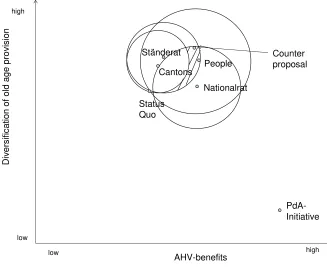
15 100% of the cantons. The bill consisted of two important aspects: the level of spending for the AHV as
[image:16.595.90.417.187.454.2]well as the amount of pillars. Therefore, the issues can be shown along two dimensions:
Figure 8: Position of the veto players at the vote of December 3rd 19726
AHV-benefits D iv e rsifi c at ion o f o ld age pro v is ion Nationalrat Ständerat Cantons People Status Quo PdA-Initiative Counter proposal high high low low
As shown in the above illustration, the PdA-initiative lay far away from the preferences of the veto
players. Both in terms of level of spending and regarding the choice of the kind of pension (one pillar
versus several) the proposal was not acceptable for the people. On the other hand the counter proposal
of the parliament lay in the winset of the veto players and was therefore preferred to the status quo.
However the 8th revision with its big expansion and strengthening of the role of the government would
not have been put into place so fast if the PdA-initiative had not been launched.
6
16
3.2.3 Consolidation Phase
The consolidation phase began with the first economic downturn in the post war era in 1974 /
1975 as a consequence of the oil crisis in 1973. Many of the formerly voluntary insurances were made
mandatory in this phase. The trigger for this was the rising unemployment that broadened the
willingness to install an insurance in this area. Other social insurances were restructured during this
time – the problems could not be covered any longer by increasing the spending – a strategy that had
worked during the prosperous times before the oil crisis. The demographic development led
furthermore to financial problems in certain systems and the need for more equality between genders
demanded reforms also in the system of the AHV. As examples of this phase, the 10th and 11th
revisions of the AHV will be illustrated. The 10th AHV-revision followed as an answer to several
parliamentarian advances to abolish the unequal treatment of men and women as well as a transition to
flexible retirement. After many years of preparation, the federal council launched a message to the 10th
AHV-revision in which he mentioned different provisions for the non-discrimination of women, the
flexible payment of pensions as well as savings. The pension age for women should be left at 62 years
for the time being. The commission of the Nationalrat responded to the draft of the federal council
with their own draft of a law. The model differed significantly from the one of the federal council,
especially because of the system change to the pension claim independent of the marital status – the so
called “splitting”. In order for the married partner without income to receive benefits, he should
receive annual education and home care benefits. Furthermore, 60% instead of 45% of all retired
people should have a claim on the maximal pension. Also, the commission suggested that the
retirement age should be increased to 64 years for women and left unchanged for men at 65 years.
When the bill came to the Nationalrat, the arguments were heated. The issue of the “splitting” was
relatively undisputed; thanks to a social liberal consensus between the social democrats and the
conservative party, a majority could be reached in the Nationalrat. The retirement age of the woman
led to intense discussions between the parties. However, the leftists and the green party were a
minority when it came to defending the status quo. In the final vote in the Nationalrat, the revision was
17 the “splitting” was considered such an achievement. This compensated for the increase in the
retirement age (Häusermann, Mach and Papadopoulos 1994). The commission of the Ständerat
discussed next to the proposal of the Nationalrat also the question of the flat basic pension. This
discussion lasted for over a year and finished with the conclusion that this would be too expensive for
the government. The “splitting” was also undisputed in the Ständerat and was finally accepted
unanimously. Just like in the Nationalrat, the main dispute circled around the question of the
retirement age for women. The argument that the “splitting” compensated for the deterioration of
benefits for women contradicted the opinion that the “splitting” was an overdue act of gender
equalization. The lower retirement age however compensated for the general wage inequality between
men and women. With 31 to 10 votes, the revision was accepted by the Ständerat. A compromise to
cushion the increase in retirement age was rejected with 32 to 5 votes in the Ständerat and 106 to 68
votes in the Nationalrat. The fact that the advantages of the “splitting” could be combined with the
disadvantages of the increase in the retirement age, made the bill safe from a rejection at the ballot.
Also the social democratic party recommended to accept the bill and to reject the referendum that was
launched by the unions. The referendum had no chance to succeed – it was rejected in June 1995 by
60.7% - the 10th AHV-revision came into place.
In the 10th AHV-revision there were two crucial elements along which the position of the veto players
18 Figure 9: Position of the veto players and the winset at the 10th AHV-revision in 19957
Individualization of the pension claim
R
e
tirement
age
o
f w
o
me
n
Nationalrat Ständerat
People Status
Quo
10th AHV-Revision
65
62
_
+
As the above figure shows, the 10th AHV-revision lay in the winset of the veto players – the
referendum had no chance at the ballot. The 11th AHV-revision was presented in February 2000 by the
federal council. Its goal was the assurance of the financial sustainability of the AHV and the
introduction of a flexible retirement age. Among other things, the federal council suggested an
increase of the value added tax which should reinstate a financial balance in the AHV finances. This
should happen in two steps: the first in 2003, the second in the case that the trust fund of the AHV
should fall under 70% of the annual expenditure. The federal government had to receive the authority
for this in the constitution. Furthermore the retirement age of men and women should be at 65 years
and a flexible retirement should be made possible. This could have been realized by receiving a half
pension starting from the age of 59. In addition, the contribution rates of the self employed should
have been raised and the (higher) widow pensions should be adapted to the widower pension. This
proposition of the federal council would have saved the government 1260 million Swiss Francs. In the
Nationalrat, four sessions were devoted to discuss the 11th AHV revision. Many changes were made in
7
19 this chamber of parliament with the effect that the savings of this revision shrank to 500 million Swiss
Francs. Among other things, an increase in the contribution rate of the self employed was cancelled
and the reduction of benefits at early pension was to be made less dramatic than the federal council
had suggested. On the other hand, the majority of the Nationalrat did vote in favor of an increase in the
retirement age to 65 for women, even though the parties on the left requested a lowering of the
retirement age to 62 years for both men and women. The Nationalrat advocated for the introduction of
a new constitutional article that would come into effect if the trust fund of the AHV would fall below
70% of the AHV income. For the case that the people would reject an increase of the value added tax
to help the AHV, the benefits would only be adjusted to the inflation – not the economic growth. efore
the bill was sent to the Ständerat, the Green Party and the Social democratic party voted against it,
while many parliamentarians of the conservative parties abstained from voting. In the Ständerat, some
changes were made to the proposition. Most of the changes led to higher savings. The small chamber
of parliament voted in favor of the bill with 32 to 5 votes. Back to the big chamber of parliament – the
Nationalrat, most of the changes of the Ständerat were rejected – as they were sent back to the
Ständerat, it insisted on the higher cuts of the benefits at an early retirement as well as the reduction of
benefits for widows. The Nationalrat did however agree to let go of the previously planned increase of
the contribution rate of the self employed. Due to the conflict between the two chambers of
parliament, a settlement conference was needed. Compromises were found both for the reduction of
the benefits at an early retirement and the issue of widow benefits. The Nationalrat agreed with the
decisions made in the settlement conference with 109 to 37 votes, however under the protest of the
parties of the left and the green party against the deterioration of benefits in the 11th revision. In the
Ständerat, the bill was finally accepted with 32 to 6 votes. Only shortly afterwards, the referendum
was taken by a committee consisting of parties to the left and different organizations of retired people.
The referendum was voted on in May 2004: the 11th revision was clearly rejected by the people. The
20 Figure 10: Position of the veto players at the 11th AHV-revision in 2004 (empty winset)8
Widows pensions
R
edu
ct
ion
o
f ben
efit
s
a
t
ear
ly
retire
m
ent
Status Quo Ständerat
Nationalrat
People 11th AHV-revision
low high
low high
Since there were two issues that dominated the discussions, the position of the veto players can be
defined along two dimensions: the reduction of benefits at early retirement and the lowering of the
benefits of widows. The Nationalrat was less extreme in his position towards benefit reduction and
lowering of benefits for widows than the Ständerat. The 11th AHV revision lay between the ideal
points of the Ständerat and the Nationalrat. The people had no interest in a reduction of benefits
whatsoever – therefore the winset of the status quo was empty. As a consequence, the 11th revision was
rejected.
8
21
3.2.4 Concluding analysis
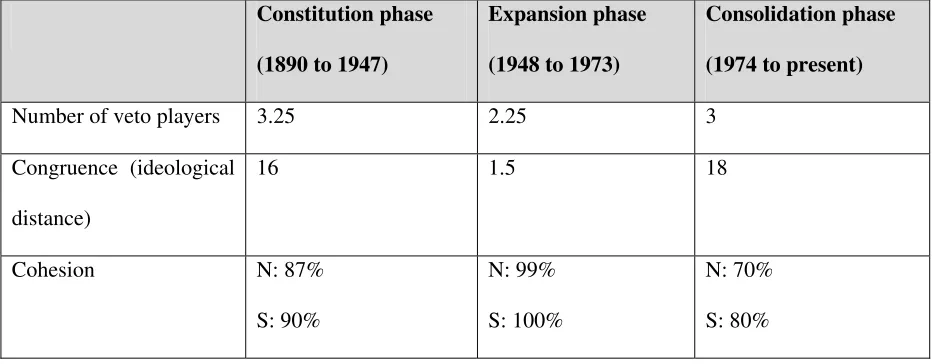
The following table gives an overview of the number of veto players, the congruence and the
[image:22.595.65.531.185.367.2]cohesion throughout the three phases of development of the AHV.
Table 1: Development of the AHV from the point of view of the veto player theory9
Constitution phase
(1890 to 1947)
Expansion phase
(1948 to 1973)
Consolidation phase
(1974 to present)
Number of veto players 3.25 2.25 3
Congruence (ideological
distance)
16 1.5 18
Cohesion N: 87%
S: 90%
N: 99%
S: 100%
N: 70%
S: 80%
The number of veto players is the average of the veto players in the corresponding phase. The
congruence between the veto players is shown with the approval rates per veto player. From that, the
standard deviation is taken, which quantifies the congruence per veto player: the higher the standard
deviation, respectively the ideological distance, the lower the congruence. The cohesion of the
collective veto players National- and Ständerat is being measured through the respective approval rate.
The higher it is, the higher the cohesion within a collective veto player and the more difficult a policy
change according to the veto player theory. The number of veto players varied over the course of
development of the AHV. Both chambers of parliament were always present in the discussions on
revisions of the AHV. In the constitution and consolidation phase the people joined the political
process as a third veto player. For the constitutional initiatives, the approval of the cantons was also
requested. Two of the portrayed cases were constitutional initiatives. As shown in both examples, the
cantons never were the decisive entity – they did not change the outcome of the ballot through their
vote. However the people constituted a crucial actor in the development of the AHV. They influenced
9
22 AHV-policy especially in the first and the last phase of the development. In the expansion phase, all
the revisions and changes were only decided by the parliament – the people never launched a
referendum. Therefore, the conclusion can be made that the revisions lay closer to the ideal point of
the people than the status quo. The congruence changed throughout the development of the AHV.
While the congruence was relatively low during the constitution phase, it increased during the
expansion phase and decreased during the consolidation phase. A deviation of the status quo is thus
the more difficult, the higher the ideological distance between the veto players is. In the constitution
phase, the veto players were ideologically further away from each other. It took several years until the
status quo could be changed and a social security system could be introduced. In the expansion phase,
all the political actors were in favor of an expansion of the AHV – thus a deviation of the status quo –
the congruence was higher during this time compared to previous times. In the consolidation phase,
the congruence sank and the distance between the veto players increased. This in turn makes a
deviation from the status quo, respectively a reform of the AHV more difficult. In the three phases of
the development of the AHV, the cohesion in the two chambers of parliament remained very high,
which also is a result of the settlement process (“Differenzbereinigungsverfahren”), which makes sure
that a compromise that is acceptable for everyone is being made. There are only small variations in the
number for the cohesion (approval rate per chamber of parliament): Both in the Nationalrat as well as
in the Ständerat, the cohesion was the highest during the expansion phase. According to the veto
player theory this would mean that a deviation from the status quo is the most difficult, when the
cohesion is high. In the expansion phase, exactly the opposite was true, for the first and last time in the
history of the AHV, a change of the status quo was especially easy. This can probably be explained by
the harmony of preferences. This was the case in the expansion phase, when a consensus regarding the
expansion of the AHV existed. The congruence of the veto player was high, the at the same time very
high cohesion within the chambers of parliament enforced the realization of these preferences. Had
the preferences of the veto players been similar, the high cohesion would have led to a greater
stability, resp. a higher aversion to change. The question of cohesion is therefore then especially
23
4
Conclusion
After a short introduction into the veto player theory, this article applied the theory onto the
case of old age security – the AHV – in Switzerland. Even though hardly ever used on Switzerland,
the veto player theory is especially suitable to explain the Swiss political system, which has an
unusually high amount of veto players. This fact was also responsible for the late introduction of the
AHV-system: Had Switzerland not had the institution of the referendum, the old age insurance would
have been introduced 17 years earlier. During the expansion phase, thanks to good economic times,
there was no opposition against an extension of the old age security system – the people did not use
their veto. While it is difficult to introduce a new system in a direct democracy, it is equally difficult to
change or abolish that system once it is introduced. This can be seen in the consolidation phase, when
the demographic changes made reforms more urgent. Without a compensation of the losers of a
reform, the veto players are not willing to accept reforms of the AHV. This can be shown nicely with
the example of the 10th revision, where the increase of the retirement age of women was compensated
by a structural improvement of the position of women. The last attempt to revise the AHV – the 11th
revision failed due to its bias towards cutbacks in benefits.
5
Bibliography
Binswanger, Peter (1986). Geschichte der AHV: Schweizerische Alters- und Hinterlassenen
versicherung. Zürich: Pro Senectute Verlag.
Bundeskanzlei der Schweiz (2006). http://www.admin.ch/ch/d/pore/va/vab_2_2_4_1.html /
Esping-Andersen, Gøsta (1990). The three worlds of Welfare Capitalism. Princeton:
Princeton University Press.
24 Partisan Politics: Social Policy Making under Strain in Switzerland. Swiss Political Science
Review (10, 2), p. 33-59.
Ischer, Philipp (2002). „Die AHV-Diskussion in der FDP. Die Genese des Sozialliberalismus
und die Bemühungen des Freisinns um Orientierung in den 1940er Jahren“. In: Gilomen, Hans
Jörg: Von der Barmherzigkeit zur Sozialversicherung. Umbrüche und Kontinuitäten vom
Spätmittelalter bis zum 20. Jahrhundert. Zürich: Chronos Verlag.
Moser, Peter (1996). Why is Swiss Politics so Stable? Swiss Journal of Economics and
Statistics. Vol. 132 (1), p. 31-61
Tsebelis, George (1995). Decision Making in Political Systems: Veto Players in Presidentialism,
Parliamentarism, Multicameralism and Multipartyism. British Journal of Political Science,
Vol. 25, No. 3, p. 289-325
Tsebelis, George (2002). Veto Players. How Politcal Institutions work. Princeton: Princeton