Optimization using Bio-Inspired Algorithm: Intelligent
Waterdrop Algorithm
Manmeen Kaur
Gaganpreet Kaur Dheerendra Singh,
Ph.D. Student Research Scholar ProfessorSGGSW University P.T.U SUSCET, Tangori Fatehgarh Sahib, India Kapurthala, India Mohali, India
ABSTRACT
Nature inspired algorithms are Meta heuristics, these are used for solving the optimization problem. IWD is one of the best algorithms which contain Swarm intelligence is one of the closest field in nature inspired algorithms. IWD is based on behavior of water drops, which has been inspired from natural rivers. The process that happens in nature between the water drops of a river and the soil of the river bed. It is used to find the optimal solutions or paths from source to destination . In this work, offline signature and speech verification is combined which is widely used. For feature extraction in speech MFCC is used and in signature Gabor filters are used which is widely used for image and texture. Then, IWD is applied on the extracted features and fuse the optimized features of both modalities by using the average rule. Here, SVC2004 signature database is used for experimental results. Testing phase consists of 80(signature and speech) sample in which 60 samples are genuine and 20 are forgeries. The accuracy of the noiseless system is 100% with 0% of FAR and FRR and accuracy of the noisy system is 99.87% with FAR 0.025% and FRR 0.1%.
Categories and Subject Descriptors
Optimization and Feature Extraction.
General Terms
Biometrics , Speech and Signature Recognition.
Keywords
Intelligent Waterdrop Algorithm, Gabor Filters, MFCC, Average function.
1. INTRODUCTION
―Biometrics" is for measuring and analysis of physical and behavioral traits. This technology can also be used for individual‘s unique identity, often for security purposes. It is used in computer science as a form of identification and access control under observation[1].
Biometric identifiers are often categorized as physiological versus behavioral characteristics. Physiological characteristics are related to the shape of the body like face, fingerprint etc. Behavioral characteristics are related to the pattern of behavior of a person like voice, gait etc. Biometric systems suffer from several problems like spoof attacks, Non-universality, noisy sensor data, lack of individuality, etc. These problems are increase the error rate and decrease the security of the system [2][3].
Multimodal can overcome these problems. By combining the decisions using fusion rules increase the accuracy of the overall decision making process. In multimodal fusion can be performed at four levels: sensor, feature, score and decision level.
In this work, Signature and speech verification system are integrated because the combination of these traits enhances security and accuracy [4]. Signatures are the one of the oldest biometric trait. There are two categories of signature: Online and Offline. In Online signature signal is captured while writing but in Offline signal is captured while the writing process is done [5]. In Offline signature verification there is no need of person should be present there but for accuracy it needs very care. In Speech, simply a microphone is used to capture the speakers signal, this signal is in the analog form which is converted into digital signal. Speech is categorized into two forms: text-dependent and text independent.
2. LITERATURE SURVEY
From the previous studies, we studied for Multibiometric system like face and speech, signature and fingerprint, palmprint and signature. But one of the most popular multimodal from biometric is signature and speech which is widely used in our daily life. Signature can be copy easily so here we design a system which identify some special properties of a genuine signature and differentiate with forgeries by extracting features and compare those features. Various technologies which are studied and papers are given below in table no.1:
Table no. 1 Literature Survey
Author Paper Name Year of Publication
Techniques used in paper
Shah-Hosseini The intelligent water drops algorithm:
a nature-inspired swarm-based optimization
algorithm
2009 n-queen Puzzle and Travelling salesman problem
Kumar et.al An Efficient Multimodal Biometric Face Recognition Using Speech Signal
2010 MFCC and PCA
Kaur et.al Multimodal Biometric System using Speech and Signature Modalities
2010 VPP-HPP and MFCC
Kekre et.al Gabor Filter Based Feature Vector for Dynamic Signature Recognition
2010 Gabor Filters
Weitao Li et al. Selection of Gabor Filters for Improved Texture Feature Extraction
2010 Gabor Filters, Fisher Ratio and DT-CWT
Mudegaonkar et al.
A Novel Approach to Fingerprint Identification Using Gabor Filter-Bank
2011 Minutiae, Gabor Filters and Euclidean distance
Hanilçi et al. Regularized All-Pole Models for Speaker Verification under Noisy Environments
2012 MFCC,DCT, GMM and SVM
Belhia et al. Feature Level Fusion in Multimodal Biometric Identification
2012 PCA, LDA and Gabor Filters
Nakagawa et al. Speaker Identification and Verification by Combining MFCC and Phase Information
2012 MFCC
Elmir et al. Score Level Fusion Based Multimodal Biometric Identification
2012 MFCC, GMM, SVM and Sum rule
Kumari et al. Effect of Symlet Filter Order on Denoising of Still Images
2012 Wavelet Families
Binitha et al. A Survey of Bio inspired Optimization Algorithms
2012 Overview of optimization algorithms
Zahrani et al. Score-level fusion in biometric verification 2013 GMM and MLP
Pollard et al. Recovering Forensic Signatures from Halftone Images
2013 Gabor Filers and Hamming rule
Soltane et al. Soft Decision Level Fusion Approach to a Combined Behavioral Speech-Signature Biometrics Verification
2013 GMM and MFCC
M.N. et al. Multimodal Biometric Person Authentication using Speech, Signature and Handwriting Features
--- VPP-HPP, GMM , VQ and DCT
3. DESIGN AND IMPLEMENTATION
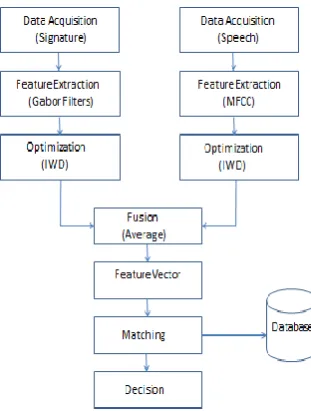
Design and implementation consist of data acquisition, feature extraction, optimization, fusion and matching process. In this one should know the whole process, that how the system works? In the figure 2 shows the process of the system.
3.1 Data Acquisiton
A multimodal biometric is divided into two phases: i) Traning phase, ii) Testing phase. Traning phase consist of 80 samples (signature and speech) from 20 users each users have 3 signatures.Here, SVC2004 signature database is used.Testing phase consist of 60(signature and speech) sample in which 60 samples are genuine and 20 are forgeries
3.2 Signature
Gabor filters are used for edge detection. They are band pass filters which have orientation and frequency and have optimal joint resolution in both spatial and frequency domains. Gabor filters are used to extract the information in the form of time and frequency. They are also used to provide the information against the robustness and brightness of the image [7]. They produce features with large discriminative power but some features produced negligible. In filter bank numbers of filters are combined, which are used to remove the negligible features. These are in different orientation and frequencies . Circular symmetric is working in all orientation . In this 360 ̊ angle is used which is divided into n-sectors. In the figure 3 real and imagenary parts of the samples are shown which are extracted by using gabor filters.
How Gabor Filters Work?
[8][9] In this first Gabor Filter input images are generated initial Gabor Filter Bank and extract the features. After that calculate the sample mean, standard deviation and then calculate the fisher ratio. Then, Pattern classification is performing on the training images using the feature group after observing the little improvement. Gabor Filters produce real and imaginary samples. In the Figure 2 represent the real and imaginary parts of the signature sample.
In this work, by using Gabor filters 448 feature vectors are extracted from signature.
3.3 Speech
[image:3.595.79.235.71.277.2]Speech is a behavioral and physical characteristic of biometric trait. It is divided into categories under the authentication: text independent, text dependent, fixed text. In this present work tracks the text independent approach is used. There are number of equipment‘s are found which are used to store the speech signals but here we use .wav file. MFCC is used for feature extraction; it is used because of the sensitivity of the low order cepstral coefficient. MFCC is produced after the recorded signal is pre-emphasized, framed and hamming windowing [10]. Then the signal is normalized and filtered. Figure 4 contains the input and output of the samples by using MFCC.
Figure 4 Input and Output of speech samples
In the speech feature extraction, by using MFCC 128 feature vectors are extracted.
input image output image
3.4 IWD Optimization
Intelligent water drop algorithm has been proposed to solve this combinatorial optimization problem. It is swarm-based nature inspired optimization, which has been inspired from natural rivers [11]. IWD is created with two main properties:
Velocity Soil
These two properties may change during the lifetime of the IWD. It is used to find the optimal paths from source to destination. It flows in discrete steps from its initial step to next step. In this process velocity of water drop is non-linearly proportional to the inverse of soil. There are two kinds of parameters are used Static parameter and Dynamic parameter. Static parameter are those parameter which remain same during the lifetime of the IWD and Dynamic parameters are those which may change during the lifetime of the IWD, they are reinitialized after each iteration. It is mentioned that water drop has one property is velocity, if a speed of water is high then it gathers a more soil than a slower water drop. A water drop prefers a less soil path then more soil because the velocity of water increases with less soil [2].
[12]In this work symlet wavelet is use because of its closer symmetry with the linear phase.Perfect reconstruction is the important property of wavelet.In this reassembling of decomposed signal or image into its original form without any loss of information [13].The importance of IWD is that it provide the good quality solutions using the average values[4].
Intelligent Waterdrop Algorithm
1) Select Data samples (signature and speech) & saved in variable named as ‗im‘.
2) Static parameter initialization:
Initialize water drop levels, rho=3
Problem representation by adding water drops using following steps:
im = double(im) /256,
Calculate standard deviation: Signatures = std(im(:));
Calculate sigma value: Sigma = sig / rho
Represent it by;
nim = im + sigma * random(size(im));
3) Dynamic parameter initialization:
Soil and Velocity
Soil can be initializing by using: Wth = th * sigma; //where th = threshold value
Initialize velocity = {} empty.
4) Distribution of IWD by decomposes sample using symlet wavelet.
5) Solution construction by IWD along with updating the parameters: C = C.*((abs) > Wth ) ;
6) Local search over each IWD‘s solution.
7) Reconstruct the sample using symlet wavelet.
8) Repeat these steps according to the waterdrop levels.
9) Find out total best solution by obtaining maximum soil content and for each step update the velocity by:
Vel ͥʷͩ (t+1) = Vel ͥʷͩ (t) + av / bv+ cv. soil (i, j).
10) Save the optimized result in mat. File.
3.5 Fusion
Multimodal biometric fusion is the most popular technique due to its better results. The most widely technique which is used feature level, it is also called early fusion. Fusion at the feature level is advantageous in that it can utilize the correlation between multiple features from different modalities at an early stage which helps in better task accomplishment. The features which are extracted to be fused should be represented in the same format before fusion. In this work we use average function forfusion. In this 448 feature vectors of signature are generated by Gabor filters and 128 number of feature vectors are generated by MFCC in speech. Both signature and speech vectors are used first but it is not so easy task because number of feature vectors is not same. Then Normalization is performed on feature vectors by embedded zero‘s on the lower dimension of the vector to make both feature vectors equal. After normalization, average method is used to fuse the features of both modalities and then new vectors are generated. After that average value is calculated from those new vectors to generate a single value. For this:
The sum of feature vectors of signature and speech sample is computed.
The sum of two m × n matrices A and B, denoted by A + B, is again an m × n matrix computed by adding corresponding elements:
Avg. function=
3.6 Matching with Database
After fusing the optimized features of both modalities (Signature & Speech), the values can be stored in the database. For matching extract the features of both the modalities and optimized those features and then fuse these values according to the proposed technique. When fusing is complete then values can be compared with the database and evaluate results.
4.
EXPERIMENTAL RESULTS
4.1 FAR, FRR and Accuracy for Noiseless
Samples
4.4.1 FAR for Speech and Signature:
Total no. of samples=80No. of samples that falsely accepted=0
FAR = 0/ 80= 0
4.4.2 FRR for Speech and Signature:
Total no. of samples=80No. of samples that falsely rejected=0
FRR = 0/ 80= 0
4.4.3 Accuracy of the Noiseless Samples:
Accuracy = 100-(FAR+FRR)Accuracy = 100-(0+0)
Accuracy = 100%
4.4. 4 Results by Adding Noise:
For adding, salt and pepper noise to the image I, where d is the noise density. It has on and off descriptor in black and white pixels while adding noise on the image. With density 0.01 add the noise to both the modalities.
Description for salt and pepper noise: (‗I‘, ‗salt &pepper‘, d);
Where I= image, d= density of noise.
For example. a= imread (‗1.jpg‘);
b=imnoise (a, ‗salt & pepper‘, 0.01);
4.4.5
FRR for Speech and Signature:
Total no. of samples=80No. of samples that falsely rejected=8
FRR = 8/80= 0.1
4.4.6 FAR for Speech and Signature:
Total no. of samples=80
No. of samples that falsely Accepted=2
FAR = 2 / 80= 0.025
Accuracy of Noisy Samples:
Accuracy = 100-(FAR+FRR)
Accuracy = 100-(0.025+0.1)
Accuracy = 99.87%
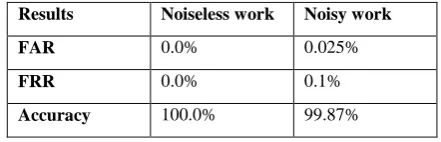
4.4.7 Result Comparison b/w Noisy and Noiseless
Samples:
Table no.2 Noisy and Noiseless samples comparisons
4.4.8 Time Elapsed by Samples:
In this work the datasets collected from 20 users. Each user contributes 3 samples for both signature & speech. In the Table no. 2 shows the time elapsed by system for feature extraction, optimization and fusion for contributed by the users. Time is measured in the form of seconds.
Table no.3 Time Elapsed by Samples
Results Noiseless work Noisy work
FAR 0.0% 0.025%
FRR 0.0% 0.1%
Accuracy 100.0% 99.87%
Sample Signature input
Signature Feature Extraction
IWD
Speech input
Speech feature
extraction IWD Fusion Total
S4 .45 11.56 .59 .31 .45 .40 .31 14.07
S5 .54 10.44 .45 .89 .63 .58 .45 13.98
S6 .36 11.20 .49 .45 .64 .40 .43 13.96
S7 .27 10.26 .67 .27 .31 .27 .54 12.59
S8 .58 10.21 .40 .31 .27 .39 .44 12.6
S12 .31 11.57 .82 .49 .63 .45 .31 14.58
[image:5.595.328.549.358.429.2] [image:5.595.43.551.423.769.2]5. CONCLUSION AND FUTURE SCOPE
In the proposed modal results indicates that IWD is capable to find the optimal solution. In this one of the new techniques is used in IWD is symlet wavelet. Because symlet wavelet has closer symmetry with the linear phase. In this reassembling of decomposed signal or image into its original form without any loss of information. The importance of IWD is that it provides the good quality solutions using the average values. There is number of iterations are computed after each iteration velocity is updated. Most of the time IWD is used for find the optimal way for the Travelling salesman problem, n-queen problem very rare it is used for find the optimal features for speech and signature. In this MFCC and Gabor filters are used to extract the feature of speech and signature. Extracted features are optimized by using IWD algorithm . After the optimization normalization is applied on the optimized features by using zero padding then these features are fused by using the average function. Average function is used to extract the average value from the extracted features. This proposed method using the speech and signature which is widely used in daily life reduced the FAR & FRR and give results as 0% of FAR and FRR. The accuracy of the system is measured as 100%.
For Future work, there is more time spent on cropping the image. So, need any technique which is used to save the time. By using other modalities feature extraction method can be used in future. New techniques like by adding noise
(Salt and pepper, Gaussian, speckle etc) in the system and use the large database for the experimental results. Also, make a system more noise robust.
6. REFERENCES
[1] Shah-Hosseini, Hamed., ―The intelligent water drops algorithm: a nature-inspired swarm-based optimization algorithm‖ published in Int. J. Bio-Inspired Computation, Vol. 1, Nos. 1/2, 2009.
[2] S, Binitha., and Sathya, Siva, S., ―A Survey of Bio inspired Optimization Algorithms‖ published in 2012 by IJSCE Vol. 2.
[3] M.E., Kesavamoorthy, R., M.E., ArunShunmugam, D., and M.E.,ThangaMariappan, L., ―Solving Traveling Salesman Problem by Modified Intelligent Water Drop Algorithm‖ published in International Conference on Emerging Technology Trends (ICETT) 2011 .
[4] Soltane, Mohamed., and Bakhti, Mimen., ―Soft Decision Level Fusion Approach to a Combined Behavioral Speech-Signature Biometrics Verification‖ published in International Journal of Signal Processing, Image Processing and Pattern Recognition Vol.6, No. 1, February, 2013.
[5] Kekre, B, H.,and Bharadi, V A., ―Gabor Filter Based Feature Vector for Dynamic Signature Recognition‖ published in IJCA, Vol. 2 – No.3, May 2010.
[6] Mushtaq,Saba., and Mir,Hussain,Ajaz., ―Signature Verification Based on Texture Features of Image ‖ published in International Journal of Computer Science and Telecommunications Vol. 4, Issue 8, August 2013.
[7] Sharma,Amit., Sharma,Poonam., and Sharma,Ashutosh., ―Rotation Invariant Offline Signature Recognition ‖published in International Journal of Engineering Sciences Research,Vol. 03, Issue 05; September-October 2012.
[8] Li, Weitao., Mao, KeZhi., and Zhang, Hong., ―Selection Of Gabor Filters For Improved Texture Feature Extraction ‖ published by Proceedings of 2010 IEEE 17th International Conference on Image Processing.
[9] M. Mudegaonkar, Prajakta., and P. Adgaonkar, Ramesh., ―A Novel Approach to Fingerprint Identification UsingGabor Filter-Bank ‖ published in ACEEE Int. J. on Network Security , Vol. 02, No. 03, July 2011.
[10]Hasan, Md. Rashidul.,Jamil, Mustafa., Md. Rabbani, Golam., and Md. Rahman, Saifur., (2004). ―Speaker Identification using Mel Frequency Cepstral Coefficients‖, proc. of 3rd International Conference on Electrical & Computer Engineering, pp. 565-568.
[11]M.Alzubaidy,Laheeb., and S.Alhafid, Baraa., ―Proposed Software Testing Using Intelligent techniques (Intelligent Water Drop (IWD) and Ant Colony Optimization Algorithm (ACO))‖ published in International Journal of Computer Science Issues, Vol. 10, Issue 5, No 1, September 2013.
[12]Kumari, S., and Vijay, R., ―Effect of Symlet Filter Order on Denoising of Still Images ‖ published in An International Journal ( ACIJ ), Vol.3, No.1, January 2012.
[13]Kour, Gagandeep., and Singh, Sharad P., ―Image Decomposition Using Wavelet Transform ‖ published in International Journal Of Engineering And Computer Science, Vol. 2 Issue 12 Dec,2013 Page No. 3477-3480.
[14]D,Palanikkumar.,Elangovan,gowsalya., and B, Rithu ―An Intelligent water drops algorithm based service selection and composition in service oriented architecture ‖ published by Journal of Theoretical and Applied Information Technology, 15 May 2012. Vol. 39 No.1.
[15]Sridhar, S., Kumar, Rajesh, P., and Ramanaiah, V. , K.., ―Wavelet Transform Techniques for Image Compression – An Evaluation ‖ published in I.J. Image, Graphics and Signal Proc. 2014, 2, 54-67.
[16]Kaur, Dapinder.,Kaur, Gaganpreet., and Singh, Dr. Dheerendra., ―Efficient & Robust Multimodal Biometric System for Feature Level Fusion (Speech & Signature)‖ )‖ proc. of International Journal of Computer Applications (0975 – 8887) Vol. 75– No.5.
[17]Conti, Vincenzo., and Sorbello, Filippo., ―A Frequency-based Approach for Features Fusion in Fingerprint and Iris Multimodal Biometric Identification Systems ‖ published in IEEE Transactions on systems, man, and cybernetics—part c: applications and reviews, Vol. 40, no. 4, july 2010.
[18]Al-Assam, Hisham., Sellahewa, Harin., and Jassim, Sabah., ―Accuracy and Security Evaluation of Multi-Factor Biometric Authentication ‖ published in International Journal for Information Security Research (IJISR), Vol. 1, Issues 1/2, March/June 2011.
[19]Areekul, Vutipong., and Tantaratana, Saward., ―Separable Gabor Filter Realization for FastFingerprint Enhancement ‖ published in 2005 by IEEE.