Quality of object relations modifies the effectiveness of
short- and long-term psychotherapy on self-concept
Olavi Lindfors1, Paul Knekt1,2, Esa Virtala1
1National Institute for Health and Welfare, Helsinki, Finland 2Biomedicum Helsinki, Helsinki, Finland
Email: [email protected]
Received 26 May 2013; revised 28 June 2013; accepted 4 July 2013
Copyright © 2013 Olavi Lindfors et al. This is an open access article distributed under the Creative Commons Attribution License,
which permits unrestricted use, distribution, and reproduction in any medium, provided the original work is properly cited.
ABSTRACT
The quality of object relations affects interpersonal behaviour, but it is not known whether it modifies effectiveness on personality functioning in psycho- therapies of different mode and length. In this study we estimated the modifying effect of the quality of object relations on the effect of solution-focused therapy (SFT) and short- and long-term psychody- namic psychotherapy (SPP and LPP) on self-concept. A total of 326 patients were assessed at baseline with the Quality of Object Relations Scale (QORS) and 4 times during a 3-year follow-up with the Structural Analysis of Social Behavior self-concept question- naire, comprising altogether 10 scores on different aspects of self-concept pathology. The effectiveness of SFT, but not SPP, was significantly poorer in several domains (5/10) of self-concept for patients with low QORS, i.e. those with less mature relational patterns, than for patients with high QORS, while the reversal occurred in some (3/10) self-concept domains in LPP. The results suggest that the quality of object relations has significance for treatment selection in therapies with different mode and length.
Keywords: Psychodynamic; Psychotherapy; Quality of Object Relations; Self-Concept; Solution-Focused
1. INTRODUCTION
Long-term changes in maladaptive and relatively endur- ing personality characteristics propose specific chal- lenges beyond reduction of psychiatric symptoms for different psychotherapies and are often primary targets of therapy when personality pathology is involved [1]. The development of more benign internal self-representations,
i.e. internalized mental models or schemas which guide
behavior, affects and cognitions, according to the inter-
personal and introject theory [2-4], is considered to rep- resent sustained benefits of psychotherapies for indi- viduals with affective and personality disorders [5]. The changes in the update of the Diagnostic and Statistical Manual of Mental Disorders (DSM-5) further highlight the importance of assessing the modification of personal- ity disturbance on treatment outcome, and the respective treatment focuses on the disturbances of self and inter- personal relations [6].
Based on the Helsinki Psychotherapy Study [7], a ran- domized study on the effectiveness of two different mo- dalities of short-term therapies, brief solution-focused (SFT) and transference-focused psychodynamic (SPP), and long-term psychodynamic psychotherapy (LPP) was conducted, we recently found that during the course and shortly after the end of the short-term therapies SFT and SPP, there was a more beneficial effect on self-concept than LPP [8]. However, at the 3-year follow-up after the start of the therapies, SFT, but not SPP, showed signifi- cantly less improved values than LPP, which in turn showed a more sustained growth in self-acceptance and a decreased tendency to punish and ignore oneself. Some support for greater self-concept changes, linked with somewhat longer therapy duration, has also been found in a study of brief to moderate length cognitive therapy [9], whereas in a study of two modalities of short-term psychodynamic psychotherapies with equal length, dif- ferences on a specific self-concept aspect, self-protect, appeared between therapies with different technique (transference focused vs. non-transference focused), mo- dified by patient’s motivation [10].
of patient’s global personality constellation and therapy length and modality on different types of therapy out- come. One of the most widely used factors in studying the modifying effects of patient’s personality constella- tion, is the quality of object relations, which comprises the intrapsychic, developmental structures of self and object representations [13,14]. A person with a develop- mentally low level of object relations is characterized by a relatively instable self-structure, problematic interper- sonal relations, immature defense mechanisms, and problems in regulating self-esteem and affects [14]. Ac- cordingly, a favourable outcome in personality function- ing has been suggested to benefit from the use of a trans- ference-based technique with these patients, based on an extensive set of studies in SPP [e.g. 13,15-18]. However, there is a lack of knowledge whether the patient’s quality of object relations is also relevant in non-psychodynamic short-term therapies, whether its effect differs in SPP and LPP, and along different self-concept dimensions.
In this study, we studied the possible effect modifica- tion of low vs. high quality of object relations on the outcome of SFT, SPP and LPP on self-concept during a 3-year follow-up.
2. METHODS
2.1. Patients
The patients, altogether 326 persons with mood or anxi- ety disorder were recruited for the Helsinki Psychother- apy Study between 1995 and 2000 [7]. Their age varied from 20 to 45 years, and a quarter of them were male. Most of the patients (82%) had depressive disorder, 44% had anxiety disorder and 18% personality disorder. Pa- tients with comorbid substance abuse disorder, severe somatic or psychiatric disorder, as well as those having received psychotherapy during the previous two years, were excluded. The patients were randomly assigned to either SFT (97 patients), SPP (101 patients) or LPP (128 patients) and monitored up to 3 years after the baseline. Written informed consent was received from all patients and the study was approved by the Helsinki University Hospital’s ethics council
2.2. Treatments and Therapists
SFT is a brief resource-oriented therapeutic approach, based on a technique which helps clients change by con- structing solutions [19]. The number of sessions in SFT was limited to 12, over no more than 8 months. SPP is a transference-based, focal therapeutic approach which helps patients by exploring specific intrapsychic and in- terpersonal conflicts [20,21]. SPP was scheduled for 20 weekly sessions over 5 - 6 months. LPP is an open-ended, intensive, transference-based therapeutic approach which
helps patients by exploring and working through a broad area of intrapsychic and interpersonal conflicts [22]. It was scheduled for 240 sessions, on average, and was provided usually twice a week up to 3 years. The thera- pies were carried out by qualified and experienced psy- chotherapists [23].
2.3. Assessments
Psychiatric diagnoses were assessed by interview, in accordance with the DSM-IV criteria [24]. Quality of object relations was also assessed by interview, using the Quality of Object Relations Scale (QORS) [25]. In scor- ing of the QORS, a total of 100 points was distributed to the five object relational levels (primitive, searching, controlling, triangular, mature), according to the esti- mated correspondence with prototypical descriptions of the scale and of the patient’s object relations. The level scores were weighed (by 1, 3, 5, 7 and 9, respectively), and their sum divided by 100. A dichotomized score (≤5.0; >5.0) was used as an indicator of low and high QORS. Self-concept was measured at baseline and at 7, 12, 24, and 36 months after the baseline with the 36-item Structural Analysis of Social Behavior (SASB) introject questionnaire [26,27]. The primary outcome indicators were the two principal vector scores (ranging from –200 to +200), self-directed affiliation (AF) and self-directed autonomy (AU). In addition, eight cluster scale scores (self-free, self-affirm, self-love, self-protect, self-control, self-blame, self-attack, self-neglect) were calculated as a mean of the 4 to 5 items belonging to the specific cluster, the score values varying from 0 to 100.
2.4. Statistical Analysis
3. RESULTS
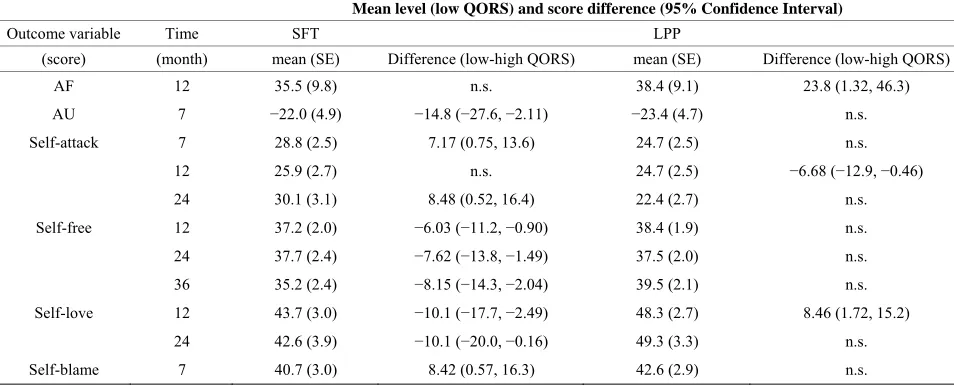
The modifying effect of low vs. high QORS on the ef- fectiveness of SFT, SPP and LPP was determined using the SASB self-concept scores, self-directed affiliation (AF), autonomy (AU), and eight cluster scores as out- come indicators. The QORS statistically significantly modified the outcome indicators in SFT and LPP but not in SPP (Table 1). In SFT, patients with low QORS bene-
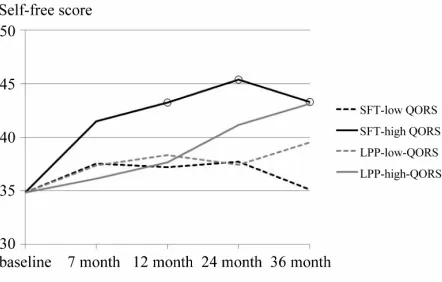
fitted less than patients with high QORS, indicated by poorer values in half (5/10) of the self-concept scores (AU, self-attack, self-free, self-love, self-blame) during the course of the first 12 months of the follow-up. In the self-attack and the self-love scores, the difference be- tween patients with low and high QORS were significant in SFT also at the 24 month follow-up, and in self-free also at the 36 month follow-up, indicated by a score dif- ference of −8.15 (CI = −14.3, −2.04). In LPP a reversed phenomenon was noted in three self-concept scores (AF, self-attack, self-love), indicating better outcomes, e.g. the AF score difference being 23.8 (CI = 1.32, 46.3) at the 12 month follow-up, for patients with low than high QORS, whereas thereafter no effect modification was found in any of the self-concept scores. The statistically significantly different change profiles in low vs. high QORS in SFT are illustrated by the self-free domain, where the modification was most extensive, in compari- son to the respective differences in LPP (Figure 1).
4. DISCUSSION
As far as these authors know, this study is the first to
compare the modifying effect of the quality of object relations on self-concept in psychotherapies with both different modality and length for patients with anxiety or depressive disorders. The study provided further evi- dence on the importance of patient’s personality constel- lation, indicated by high vs. low QORS, when assessing the need for a specific type of short-term (SPP or SFT) or long-term (LPP) psychotherapy. In variance with results from earlier studies on short-term psychotherapies [32] we found a significant difference in the effectiveness of SPP and SFT on specific self-concept domains during a 3-year follow-up in a previous study [8]. In the present study we now demonstrated that QORS modified effec- tiveness only in SFT, being more effective for patients with high than with low QORS. This difference was no- table in several self-concept scores, encompassing both the affiliation and the autonomy dimensions and high- lighted in long-term differences in the domains of self- attack, self-love and self-free. We have also shown LPP to be generally more effective than SFT on self-concept [8]. In this study, it further emerged that LPP patients with low QORS benefitted more than those with high QORS during early phase of therapy in the dimension of affiliation and in the specific self-concept clusters self- attack and self-love.
[image:3.595.58.535.498.691.2]The above findings of the differential modification of QORS may be explained by the SFT being a highly sup- portive, resource-oriented brief therapy [19] which might be more readily useful for patients with more benign developmental history and more balanced and mature internalized concept of oneself and others. For the pa-
Table 1. Baseline-adjusted significanta modification of low versus highb QORS on self-concept change scores in SFT and LPP from baseline to 7, 12, 24 and 36 months of follow-up.
Mean level (low QORS) and score difference (95% Confidence Interval)
Outcome variable Time SFT LPP
(score) (month) mean (SE) Difference (low-high QORS) mean (SE) Difference (low-high QORS) AF 12 35.5 (9.8) n.s. 38.4 (9.1) 23.8 (1.32, 46.3) AU 7 −22.0 (4.9) −14.8 (−27.6, −2.11) −23.4 (4.7) n.s. Self-attack 7 28.8 (2.5) 7.17 (0.75, 13.6) 24.7 (2.5) n.s.
12 25.9 (2.7) n.s. 24.7 (2.5) −6.68 (−12.9, −0.46)
24 30.1 (3.1) 8.48 (0.52, 16.4) 22.4 (2.7) n.s.
Self-free 12 37.2 (2.0) −6.03 (−11.2, −0.90) 38.4 (1.9) n.s. 24 37.7 (2.4) −7.62 (−13.8, −1.49) 37.5 (2.0) n.s.
36 35.2 (2.4) −8.15 (−14.3, −2.04) 39.5 (2.1) n.s. Self-love 12 43.7 (3.0) −10.1 (−17.7, −2.49) 48.3 (2.7) 8.46 (1.72, 15.2)
24 42.6 (3.9) −10.1 (−20.0, −0.16) 49.3 (3.3) n.s. Self-blame 7 40.7 (3.0) 8.42 (0.57, 16.3) 42.6 (2.9) n.s.
Figure 1. Interaction of therapy group and low vs. high QORS in SFT and LPP on changes in the SASB self-free score, base- line adjusted.
tients with high QORS, the approach of SFT could be used like an empowering coaching in facing the need to reconstruct the self in more positive terms [33]. Instead, the patients with low QORS, i.e. those who are more
vulnerable due to lesser trust in oneself and in others, more previous disappointments, ruptures and primitive defenses in relationships, might not be able to modify their more instable sense of self in a brief therapy with a highly supportive technique which does not include ex- ploration of pathological self and object representations within the therapeutic relationship.
The fact that patients with low QORS fared somewhat better than those with high QORS in LPP during the first year of treatment, can be understood as being related to the interplay between the nature of the treatment process and the nature of the patients’ relational problems. Pa- tients with low QORS are expected to be both more prone to repeat openly their problematic internal rela- tionships with the therapist, as well as to be able to bene- fit more from re-experiencing and being sensitively con- fronted by these patterns in the transference than patients with high QORS [13,14]. This may lead to more pro- nounced and faster increase in self-esteem in moderate to long-term therapy, possibly mediated by a stronger alli- ance [11,16], as there are plenty of opportunities to ex- plore maladjusted relational patterns. In contrast, patients with high QORS (and, accordingly, with more benign self-concept), may find that the confronting and explora- tory technique of LPP does not primarily enhance the positive elements of their self-concept. Instead, it offers the possibility to explore more fully potentially conflic- tuous self-experiences, as they manifest in recurring pat- terns in behavior, feelings, and relationships during the treatment. Accordingly, in the long run, patients with high QORS also seem to be able to benefit significantly from LPP.
In variance with the results on SFT and LPP, no modi- fying effect of QORS was found in the short-term, ex-
plorative SPP, unlike in some previous studies where high QORS was related to more favorable outcome in the respective type of SPP [18]. It has also been repeatedly, and mostly consistently [e.g., 13,15-17], shown that pa- tients with low QORS seem to benefit, by decreased symptoms and improved personality functioning, more from explorative SPP with a pronounced transference- focus than without it. However, unlike in all the previous studies focused on transference-interpretations, the thera- pists in this study were not instructed to use primarily or exclusively transference-based interpretations, since the therapies were carried out along the general guidelines presented by Malan [20] and Sifneos [21]. Accordingly, the lack of interaction between QORS and treatment ef- fect on self-concept in SPP may signify therapists’ modi- fication of the technique in relation to patient’s charac- teristics.
The findings of this study have clinical implications concerning pre-treatment assessment of patients’ suit- ability for different types of short-term or long-term psy- chotherapy, as well as for developing more optimally tailored treatments for patients, by acknowledging the level of their object relations. The significance of QORS as a differential modifier of outcome in SFT and LPP suggests that it can provide the clinician important pre- paratory information on the challenges of the planned therapy, as the QORS level tends to activate specific relational patterns with the therapist [34]. Supportive, brief therapies might thus be sufficient for self-concept change when the patient’s object relational patterns are relatively mature, while optimal therapy for patients with low QORS seems to require a modality which encom- passes working with complex issues within the therapeu- tic relationship, like in the different psychotherapies for patients with personality disorder [1,16,35].
potential for generalizing the findings, albeit requires further investigation on the issue.
5. CONCLUSION
In conclusion, the modifying effect of QORS was studied for the first time in both psychodynamic and non-psy- chodynamic brief therapies and in LPP. QORS appeared to modify differently the outcome in LPP and SFT on several aspects of self-concept, but not in SPP. In SFT, smaller long-term treatment effects on self-concept were noted in patients with low QORS than in patients with high QORS, while in LPP especially low QORS patients benefited more at early phases of the treatment. The re- sults suggest that QORS has significance for treatment selection in therapies with different mode and length.
6. ACKNOWLEDGEMENTS
This study was supported financially by the Academy of Finland (grant nr. 138876).
REFERENCES
[1] Bedics, J.A., Atkins, D.C., Comtois, K.A. and Linehan, M.M. (2012) Treatment differences in the therapeutic re- lationship and introject during a 2-year randomized con- trolled trial of dialectic behavior therapy versus nonbe- havioral psychotherapy experts for borderline personality disorder. Journal of Consulting and Clinical Psychology,
80, 66-77. http://dx.doi.org/10.1037/a0026113
[2] Altwood, G.E. and Stolorow, R.D. (1980) Psychoanalytic concepts and the representational world. Psychoanalytic Contemporary Thought, 3, 267-290.
[3] Benjamin, L.S. (1974) Structural analysis of social be- havior. Psychological Review, 81, 392-425.
http://dx.doi.org/10.1037/h0037024
[4] Benjamin, L.S. (1994) SASB: A bridge between person- ality theory and clinical psychology. Psychological In- quiry, 5, 273-316.
http://dx.doi.org/10.1207/s15327965pli0504_1
[5] Blatt, S.J., Zuroff, D.C., Hawley, L.L. and Auerbach, J.S. (2010) Predictors of sustained therapeutic change. Psy- chotherapy Research, 20, 37-54.
http://dx.doi.org/10.1080/10503300903121080
[6] Wright, A.G.C., Pincus, A.L., Hopwood, C.J., Thomas, K.M., Markon, K.E. and Krueger, R.F. (2012). An inter- personal analysis of pathological personality traits in DSM-5. Assessment, 19, 263-275.
http://dx.doi.org/10.1177/1073191112446657
[7] Knekt, P., Lindfors, O., Härkänen, T., Välikoski, M., Virtala, E., Laaksonen, M.A., Marttunen, M., Kaipainen, M., Renlund, C, and the Helsinki Psychotherapy Study Group (2008) Randomized trial on the effectiveness of long- and short-term psychodynamic psychotherapy and solution-focused therapy on psychiatric symptoms during a 3-year follow-up. Psychological Medicine, 38, 689-703.
http://dx.doi.org/10.1017/S003329170700164X
[8] Lindfors, O., Knekt, P., Virtala, E., Laaksonen, M.A. and the Helsinki Psychotherapy Study Group (2012) The ef- fectiveness of solution-focused therapy and short- and long-term psychodynamic psychotherapy on self-concept during a 3-year follow-up. Journal of Nervous and Men- tal Disease, 200, 946-953.
http://dx.doi.org/10.1097/NMD.0b013e3182718c6b [9] Vittengl, J.R., Clark, L.A. and Jarrett, R.B. (2004) Self-
directed affiliation and autonomy across acute and con- tinuation phase cognitive therapy for recurrent depression.
Journal of Personality Assessment, 83, 235-247. http://dx.doi.org/10.1207/s15327752jpa8303_07
[10] Marble, A., Hoglend, P. and Ulberg, R. (2011) Change in self-protection and symptoms after dynamic psychother- apy: The influence of pretreatment motivation. Journal of Clinical Psychology,67, 355-367.
http://dx.doi.org/10.1002/jclp.20771
[11] Hersoug, A.G., Hoglend, P., Gabbard, G.O. and Lor- entzen, S. (2012) The combined predictive effect of pa- tient characteristics and alliance on long-term dynamic and interpersonal functioning after dynamic psychother- apy. Clinical Psychology & Psychotherapy, 20, 297-307. http://dx.doi.org/10.1002/cpp.1770
[12] Laaksonen, M.A., Knekt, P. and Lindfors, O. (2012) Psy- chological predictors of the recovery from mood or anxi- ety disorder in short-term and long-term psychotherapy during a 3-year follow-up. Psychiatry Research, 208, 162- 173. http://dx.doi.org/10.1016/j.psychres.2012.09.053 [13] Hoglend, P., Johansson, P., Marble, A., Bogwald, K.-P.
and Amlo, S. (2007) Moderators of the effects of trans-ference interpretations in brief dynamic psychotherapy.
Psychotherapy Research, 17, 160-171.
http://dx.doi.org/10.1080/10503300701194206
[14] Piper, W.E., Ogrodniczuk, J.S. and Joyce, A.S. (2004) Quality of object relations as a moderator of the relation- ship between pattern of alliance and outcome in short- term individual psychotherapy. Journal of Personality Assessment, 83, 345-356.
http://dx.doi.org/10.1207/s15327752jpa8303_15
[15] Hoglend, P., Hersoug, A.G., Bogwald, K.-P., Amlo, S., Marble, A., Sorbye, O., Rossberg, J.I., Ulberg, R., Gab-bard, G.O. and Crits-Christoph, P. (2011) Effects of tran- sference work in the context of therapeutic alliance and quality of object relations. Journal of Consulting and Clinical Psychology, 79, 697-706.
http://dx.doi.org/10.1037/a0024863
[16] Hoglend, P., Dahl, H.-S., Hersoug, A.G., Lorentzen, S. and Perry, J.C. (2011) Long-term effects of transference interpretation in dynamic psychotherapy of personality disorders. European Psychiatry, 26, 419-424.
http://dx.doi.org/10.1016/j.eurpsy.2010.05.006
[17] Piper, W.E., Azim, H.F., Joyce, A.S. and McCallum, M. (1991) Transference interpretations, therapeutic alliance, and outcome in short-term individual psychotherapy. Ar- chives of General Psychiatry, 48, 946-953.
http://dx.doi.org/10.1001/archpsyc.1991.01810340078010 [18] Piper, W.E., Joyce, A.S., McCallum, M. and Azim, H.A.
ing and Clinical Psychology, 66, 558-567.
http://dx.doi.org/10.1037/0022-006X.66.3.558
[19] de Shazer, S., Berg, I.K., Lipchik, E., Nunnally, E., Molnar, A., Gingerich, W. and Weiner-Davis, M. (1986) Brief therapy: Focused solution development. Family Process,25, 207-221.
http://dx.doi.org/10.1111/j.1545-5300.1986.00207.x [20] Malan, D.H. (1976) The frontier of brief psychotherapy:
An example of the convergence of research and clinical practice. Plenum Medical Book, New York.
http://dx.doi.org/10.1007/978-1-4684-2220-7
[21] Sifneos, P.E. (1978) Short-term anxiety provoking psy- chotherapy. In: Davanloo, H., Ed., Short-Term Dynamic Psychotherapy, Spectrum, New York, 35-42.
[22] Gabbard, G.O. (2004) Long-term psychodynamic psy- chotherapy: A basic text. American Psychiatric Press, Washington DC.
[23] Knekt, P. and Lindfors, O. (2004) A randomized trial of the effect of four forms of psychotherapy on depressive and anxiety disorders: Design, methods, and results on the effectiveness of short-term psychodynamic psycho- therapy and solution-focused therapy during a one-year follow-up. Social Insurance Institution, Helsinki, 15-112. http://www.thl.fi/hps
[24] American Psychiatric Association (1994) Diagnostic and statistical manual of mental disorders: DSM-IV. Ameri- can Psychiatric Association, Washington DC.
[25] Azim, H.F., Piper, W.E., Segal, P.M., Nixon, G.W. and Duncan, S.C. (1991) The quality of object relations scale.
Bulletin of the Menninger Clinic, 55, 323-343.
[26] Benjamin, L.S. (1996) A clinician-friendly version of the interpersonal circumplex: Structural analysis of social behavior (SASB). Journal of Personality Assessment, 66,
248-266. http://dx.doi.org/10.1207/s15327752jpa6602_5 [27] Benjamin, L.S. (2000) SASB user’s manual. University
of Utah, Salt Lake City.
[28] Rubin, D.B. (1987) Multiple imputation for nonresponse in surveys. John Wiley, New York.
http://dx.doi.org/10.1002/9780470316696
[29] Verbeke, G. and Molenberghs, G. (1997) Linear mixed models in practice: An SAS-oriented approach. Springer, New York. http://dx.doi.org/10.1007/978-1-4612-2294-1 [30] Lee, J. (1981) Covariance adjustment of rates based on
the multiple logistic regression model. Journal of Chro- nic Diseases, 34, 415-426.
http://dx.doi.org/10.1016/0021-9681(81)90040-0
[31] SAS Institute Inc. (2007) SAS/STAT 9.1 User’s guide. SAS Institute Inc., Cary.
[32] Abbass, A., Town, J. and Driessen, E. (2011) The effi- cacy of short-term psychodynamic psychotherapy for de- pressive disorders with comorbid personality disorder.
Psychiatry, 74, 58-71.
http://dx.doi.org/10.1521/psyc.2011.74.1.58
[33] Kärkkäinen, H. (2001) Construing the self—Identity pro- cesses in resource-oriented therapy. Rehabilitation Foun- dation, Helsinki, Research Reports 68.
[34] Diguer, L., Gamache, D. and Laverdière, O. (2012) De- velopment and initial validity of the object relations rat- ing scale. Psychotherapy Research, 22, 402-416.
http://dx.doi.org/10.1080/10503307.2012.662606
[35] Critchfield, K.L. (2012) Tailoring common treatment principles to fit individual personalities. Journal of Per- sonality Disorders, 26, 108-125.