ISSN Online: 2332-2004 ISSN Print: 2332-1997
Development of Perfume Bottle Visual Design
Model Using Fuzzy Analytic Hierarchy Process
Hung-Yuan Chen
Department of Visual Communication Design, Southern Taiwan University of Science and Technology, Taiwan
Abstract
With the popularization of internet shopping, visualization of goods package has become an important factor in communicating goods characteristics and plays a critical role in influencing consumers’ purchase decision. This pheno-menon is particularly apparent in the case of mature consumer goods such as perfume products, chocolate, daily commodity, and so on. To construct a de-cision support model for assisting package designers to create a satisfying product package based on consumers’ affective responses, a series of visual experiment evaluation for perfume bottle package is conducted in the current study. The fuzzy analytic hierarchy process-based approach is proposed to construct the decision support model for perfume bottle visual design. In the current study, the feasibility of constructing model based on the fuzzy analytic hierarchy process approach is demonstrated and the resulting model can pro-vide perfume package designers with an understanding of developing a new design alternative in the conceptual design stage.
Keywords
Package Visual Design, Perfume Bottle, Multiple Consumers’ Psychological Perceptions
1. Introduction
A conspicuous or high quality package design is one way that a new product can stand out from familiar packages offered by the competition (Berkowitz, 1987). If the package design of a product communicates high aesthetic quality, con-sumers frequently assume that the product is high quality, and vice versa. Fur-thermore, consumers are likely to generate perceptional response to a product by means of its package, i.e. a product feels, looks, while viewing product pack-age (Underwood et al., 2001). Thus, the consideration of consumers’ psycholog-ical perception (CPP) to package visual design plays a critpsycholog-ical role in purchase
How to cite this paper: Chen, H.-Y. (2017). Development of Perfume Bottle Visual Design Model Using Fuzzy Analytic Hierarchy Process. Art and Design Review, 5, 13-25.
https://doi.org/10.4236/adr.2017.51002
Received: November 9, 2016 Accepted: January 7, 2017 Published: January 10, 2017
Copyright © 2017 by author and Scientific Research Publishing Inc. This work is licensed under the Creative Commons Attribution International License (CC BY 4.0).
decisions since it communicates useful information to consumers at the decision making time. This phenomenon is particularly apparent in the case of mature consumer goods such as perfume products, chocolate, cosmetic, daily commod-ity, and so on. Therefore, it is essential for package designers or companies to comprehend consumers’ psychological perception (CPP) to package design of a product and to develop a consumer-oriented visual design model so as to gener-ate the suitable design alternatives during the conceptual design process.
Many package design studies have conducted systematic approach to con-struct a design model and to obtain a better understanding regarding CPP to package design of a product (Henson et al., 2006; Ares & Deliza, 2010; Gofman et al., 2010; Metcalf et al., 2012; Fernqvist et al., 2015). In general, the effective-ness of the systematic design approach is crucially determined by the choice of analytical techniques. Techniques such as analytic hierarchy process(Lin et al., 2008), conjoint analysis (Ares & Deliza, 2010; Demirtas et al., 2009) and quantit-ative theory type I (Lin & Wei, 2014) are commonly employed. Analytic hie-rarchy process (AHP) is particularly useful to demonstrate the weight/utility of each design element by pairwise comparison method and the unsophisticated calculation process and it has high practicability in the conceptual design evalua-tion. However, the expression of CPP to package design of a product is com-monly multiple and vague. AHP does not take into account the uncertainty of one’s description to a number. To take the multiple CPPs and the imprecision of human linguistic expressions into consideration, the fuzzy set theory is intro-duced (Zadeh, 1994)to strengthen the capability of AHP to construct the visual design model which satisfies the requirements of multiple CPPs in this study.
An integrated approach which combines fuzzy set theory with AHP (desig-nated hereafter as the Fuzzy AHP) is proposed to develop the decision support design model for perfume bottle visual design. The perfume product is chosen for illustration purposes since the consumers’ purchase decision is governed not only by its perfume characteristic for use, but also by the affective response in-duced by its package. The remainder of this study is organized as follows: Sec-tion 2 reviews the background of AHP and fuzzy set theory. SecSec-tion 3 presents the research implementation. Section 4 illustrates the construction of perfume bottle visual design model based on Fuzzy AHP. Section 5 presents a brief con-clusion.
2. Methodological Review
2.1. Analytic Hierarchy Process (AHP)
easiness for use, it does not take into account the uncertainty associated with the mapping of participants’ perception to a number.
2.2. Fuzzy Set Theory
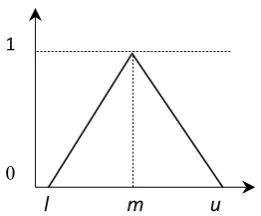
To take the imprecision of human qualitative evaluations into consideration, fuzzy set theory (Zadeh, 1994) is introduced to solve the problems involving the absence of sharply defined criteria. The key idea of fuzzy set theory is that an element has a degree of membership in a fuzzy set (Zimmermann, 1996). A fuzzy set is defined by a membership function. The most commonly used range for expressing the degree of membership is the unit interval [0, 1]. Fuzzy set theory thus is used to solve such kind of problems, and it has been applied in a variety of fields. In this study, the triangular fuzzy number is used to represent subjective pairwise comparisons of selection process in order to capture the va-gueness. As shown in Figure 1, the triangular fuzzy number A=
(
l m u, ,)
, l and u mean the lower and upper bounds of the fuzzy number A, respectively, and m is the median value for A. The membership function is defined as Equation (1). The operational rules of addition and multiplication of A1=(
l m u1, ,1 1)
and(
)
2 2, ,2 2
A = l m u are displayed as following Equations (2) and (3).
( )
(
) (
)
(
) (
)
, , 0, otherwise, 0 A
x l m l l x m u x x u m u m x u
l m u
− − ≤ ≤
= − − ≤ ≤
≤ ≤ ≤
(1)
Addition of the fuzzy number ⊕
(
) (
) (
)
1 2 1, ,1 1 2, ,2 2 1 2, 1 2, 1 2
A ⊕A = l m u ⊕ l m u = l l m m u u+ + + (2)
Multiplication of the fuzzy number ⊗
(
) (
) (
)
1 2 1 1 1 2 2 2 1 2 1 2 1 2
1 2 1 2 1 2
, , , , , ,
for ; 0; ; 0; ; 0
A A l m u l m u l l m m u u
l l m m u u
⊗ = ⊗ =
> > >
(3)
2.3. Fuzzy AHP
[image:3.595.308.439.609.717.2]From the discussions above, this study proposes an integrated scheme, combin-ing fuzzy set theory with AHP (Fuzzy AHP). The triangular fuzzy numbers pa-rameterized by triplet numbers are used to represent the perfume bottle evalua-tion of multiple affective responses as well as to construct the pairwise compari-son matrix. The procedure of Fuzzy AHP is described as follows.
Figure 1.Triangular fuzzy number. 0
l m u
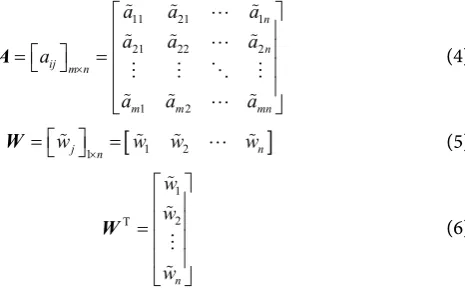
Step 1: Constructing the fuzzy judgment matrix and determining the weight vector: The fuzzy judgment matrix A is the matrix of the combination of m can-didate alternative and n evaluation criteria and the weight vector W based on n evaluation criteria is constructed as following Equations (4) and (5). The ele-ments of the fuzzy judgment matrix A and weight vector W are represented by five triangular fuzzy numbers, i.e. 1 9 − . The five triangular fuzzy numbers are defined with the corresponding membership function and the meaning as shown in Table 1. Then, WT is the transpose of the weight vector W and it can be de-scribed as Equation (6).
11 21 1
21 22 2
1 2
n
n ij m n
m m mn
a a a
a a a
a
a a a
× = = A (4)
[
1 2]
1j n n
w × w w w
= =
W (5)
1 2 T n w w w = W (6)
Step 2: Constructing the weighted fuzzy judgment matrix and calculating the final fuzzy scores of candidate alternatives: The weighted fuzzy judgment matrix can be obtained by means of Equation (7). Based on the result of Equation (7) calculation using the operational rules of Equation (2) and Equation (3), the fuzzy sequencing vector S, show as
[ ]
si m×1, can be obtained. Then, the si of fuzzy sequencing vector is the final fuzzy scores of the candidate alternatives.11 21 1 1 1
21 22 2 2 2
T
1 2
n
n
m m mn n m
a a a w s
a a a w s
A W
a a a w s
= ⊗ = ⊗ = S (7)
[image:4.595.303.536.210.354.2]Step 3: Defuzzifying the fuzzy scores and ranking the candidate alternatives: It is necessary to define a method for building a crisp ordering of si to rank the candidate alternative since the final fuzzy scores of candidate alternatives are the type of fuzzy numbers. In this study, the fuzzy numbers are defuzzified and ranked by the fuzzy mean value (Wu et al., 2004). si is a triangular fuzzy num-ber
(
l m u, ,)
. Its mean x s ( )
i is defined as Equation (8).Table 1. Definition of relative fuzzy number and membership function
Fuzzy number Meaning Membership function
1
Equally important (1, 1, 3)
3
Moderately important (1, 3, 5)
5
Strongly important (3, 5, 7)
7
Very strongly important (5, 7, 9)
9
( )
i(
)
3x s = + +l m u (8)
Then, the fuzzy numbers s s 1, , ,2 sm can be ranked according to the value of the fuzzy mean x s
( )
i to determine the optimum candidate alternative.3. Research Implementation
3.1. Constructing Qualitative Definitions of Perfume Bottle
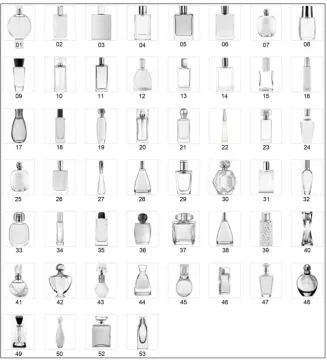
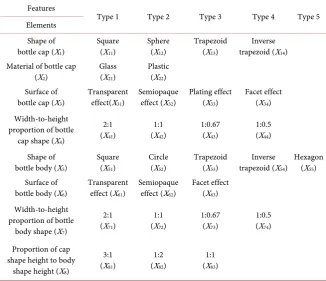
[image:5.595.211.539.354.719.2]To explore the consumers’ psychological perceptions (CPPs) to perfume bottle visual design, approximately one hundred commercially-available perfume bot-tle pictures with similar view-angles are collected in this study. The discussion of focus group (McDonagh et al., 2002) involving 5 package/graphic designers is conducted to classify the perfume bottle pictures based on the similarity of their appearance, and 53 perfume bottle pictures shown as Figure 2 are retained in accordance with the visual dissimilarity of perfume bottle. Then, the morpho-logical analysis is used to define the perfume bottle into several dominant design elements and features based on the experiences of 5 designers by means of a discussion. Table 2 presents the 8 important design elements which are finally determined, and their corresponding features.
Table 2. Definition of perfume bottle visual design.
Features
Type 1 Type 2 Type 3 Type 4 Type 5 Elements
Shape of bottle cap (X1)
Square (X11)
Sphere (X12)
Trapezoid (X13)
Inverse trapezoid (X14) Material of bottle cap
(X2)
Glass (X21)
Plastic (X22) Surface of
bottle cap (X3)
Transparent effect(X31)
Semiopaque effect (X32)
Plating effect (X33)
Facet effect (X34) Width-to-height
proportion of bottle cap shape (X4)
2:1 (X41)
1:1 (X42)
1:0.67 (X43)
1:0.5 (X44)
Shape of bottle body (X5)
Square (X51)
Circle (X52)
Trapezoid (X53)
Inverse trapezoid (X54)
Hexagon (X55) Surface of
bottle body (X6)
Transparent effect (X61)
Semiopaque effect (X62)
Facet effect (X63) Width-to-height
proportion of bottle body shape (X7)
2:1 (X71)
1:1 (X72)
1:0.67 (X73)
1:0.5 (X74)
Proportion of cap shape height to body shape height (X8)
3:1 (X81)
1:2 (X82)
1:1 (X83)
3.2. Creating Evaluation Samples of Perfume Bottle
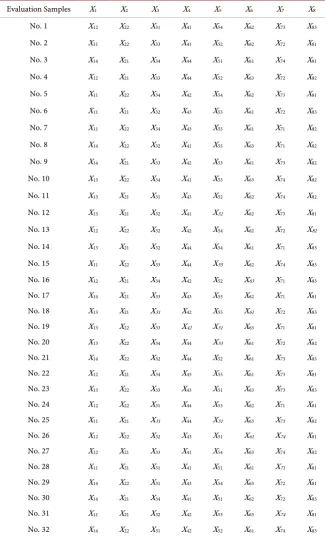
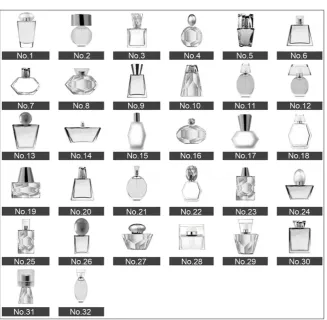
In order to accommodate the 8 design elements and the corresponding features, the orthogonal design is conducted to array the conditions of evaluation samples in this study. The result of orthogonal design is shown in Table 3. Subsequently, three package/graphic designers, each with more than three years’ of design ex-perience are invited to create the perfume bottle evaluation samples based on the qualitative definition scheme shown in Table 2. As shown in Figure 3, a total of 32 samples are created for evaluation of perfume bottle image.
3.3. Selecting Representative Consumers’ Psychological Perceptions
Although many different image words are used when describing commodity package, the image words applicable to perfume bottle are more limited. In this study, 3 package/graphic designers, each with 3 years experience (two males and one female), and 3 white-collar individuals from non-design backgrounds (one male and two females) are invited to participate in a discussion aimed at identi-fying suitable image words with which to describe the possible consumers’ psy-chological perceptions (CPPs) when presented with the perfume bottle samples. The image words are elicited from the participants using the following four-step procedure:
Table 3. Orthogonal design of perfume bottle samples.
Evaluation Samples X1 X2 X3 X4 X5 X6 X7 X8 No. 1 X12 X22 X31 X41 X54 X62 X73 X83 No. 2 X11 X22 X33 X41 X52 X62 X72 X81 No. 3 X14 X21 X34 X44 X51 X61 X74 X81 No. 4 X12 X21 X33 X44 X52 X63 X72 X82 No. 5 X11 X22 X34 X42 X54 X62 X73 X81 No. 6 X11 X21 X32 X43 X53 X61 X72 X83 No. 7 X11 X22 X34 X43 X55 X61 X71 X82 No. 8 X14 X22 X32 X41 X55 X63 X71 X82 No. 9 X14 X21 X33 X42 X53 X61 X73 X82 No. 10 X13 X22 X34 X41 X53 X63 X74 X82 No. 11 X13 X21 X31 X43 X52 X62 X74 X82 No. 12 X13 X21 X32 X41 X52 X62 X73 X81 No. 13 X12 X22 X32 X42 X54 X62 X72 X82 No. 14 X13 X21 X32 X44 X54 X61 X71 X83 No. 15 X11 X22 X33 X44 X55 X62 X74 X83 No. 16 X12 X21 X34 X42 X52 X63 X71 X83 No. 17 X14 X21 X33 X43 X55 X62 X71 X81 No. 18 X13 X21 X31 X42 X55 X61 X72 X83 No. 19 X13 X22 X33 X42 X51 X63 X71 X81 No. 20 X13 X22 X34 X44 X53 X61 X72 X82 No. 21 X14 X22 X32 X44 X52 X61 X73 X83 No. 22 X12 X21 X34 X43 X55 X61 X73 X81 No. 23 X13 X22 X33 X43 X51 X63 X73 X83 No. 24 X12 X22 X31 X44 X53 X62 X71 X81 No. 25 X11 X21 X31 X44 X51 X63 X73 X82 No. 26 X12 X22 X32 X43 X51 X61 X74 X81 No. 27 X12 X21 X33 X41 X54 X63 X74 X82 No. 28 X11 X21 X31 X41 X51 X61 X71 X81 No. 29 X14 X22 X31 X43 X54 X63 X72 X81 No. 30 X14 X21 X34 X41 X51 X62 X72 X83 No. 31 X11 X21 X32 X42 X53 X63 X74 X81 No. 32 X14 X22 X31 X42 X52 X61 X74 X83
Step 2: The Focus Group method is applied to select 25 suitable image words (see Figure 4) for the perfume bottles.
Figure 3. Thirty-two perfume bottle evaluation samples.
Figure 4. Selection and classification of image descriptors.
Step 4: From each group, one image words is chosen to represent the overall characteristics of the group, i.e. Youthful and Vigorous (Y. & V.), Feminine and Graceful (F. & G.), Modern and Novel (M. & N.).
Peculiar Youthful
Cheerful
Sprightly Vigorous
Spirited
Personal
Nimble
Youthful and Vigorous
Gorgeous Feminine
Slender Alluring
Graceful
Delicate Noble
Elegant Sexy
Feminine and Graceful
Modern
Innovative
Prevalent Novel
Concise
Progressive
Succinct
Modern and Novel
3.4. Perfume Bottle Visual Evaluation
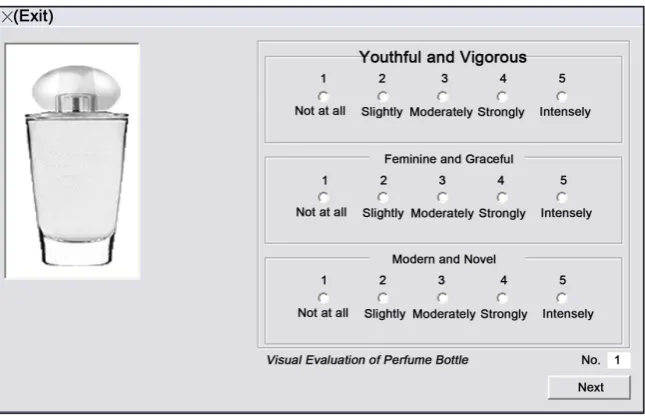
Eighty-four subjects (54 males, 33 females; age from 19 to 34 years old) are in-vited to evaluate the CPPs induced by the perfume bottles. The three representa-tive CPPs are quantified using three 5-point scales. The 32 perfume bottle sam-ples and the three 5-point scales are integrated into an interface constructed by using Visual Basic software, as shown in Figure 5. After each subject had eva-luated all of the samples, the evaluative data are recorded for the usage of estab-lishing the perfume bottle visual design model.
3.5. Modeling the Correlation between Perfume Bottle and Consumers’ Psychological Perceptions
[image:9.595.214.537.342.550.2]To construct a systematic design model respecting CPP to the visual effect of perfume bottle, the evaluation results obtained for the visual evaluation of per-fume bottle are used to establish the correlation between perper-fume bottle and CPP. Since the data of evaluation results are the 5-point scale average values of eighty-four subjects in each of three CPPs, the proper fuzzy numbers are then defined to represent the 5-point scale average values as shown in Table 4. Fur-
[image:9.595.208.541.614.733.2]Figure 5. Perfume bottle evaluation interface.
Table 4. Definition of 5-point scale average values and verbal expression correspond to fuzzy number.
5-point scale average value Verbal expression Fuzzy number Membership function
Below 2.09 Not at all (1) 1 (1, 1, 3)
2.10 - 2.89 Slightly (2) 3 (1, 3, 5)
2.90 - 3.69 Moderately (3) 5 (3, 5, 7)
3.70 - 4.49 Strongly (4) 7 (5, 7, 9)
thermore, this study treats the task of satisfying CPP to perfume bottle as a mul-ti-objective design activity. Therefore, the Fuzzy AHP is introduced to analyze and to determine the optimum perfume bottle alternative which satisfy multiple CPP requirements.
4. Construction of Perfume Bottle Visual Design Model
4.1. Constructing the Fuzzy Judgment Matrix and Determining the Weight Vector for Perfume Bottle Evaluation
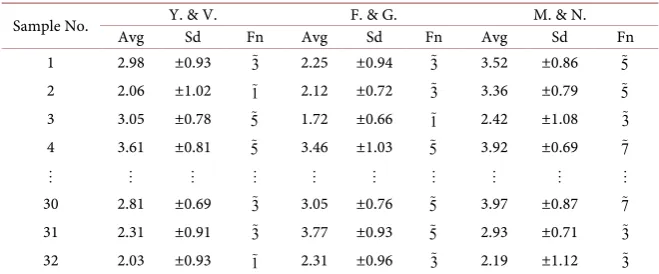
In constructing the perfume bottle visual design model using Fuzzy AHP, the average values (see Table 5) of the three CPPs obtained in the evaluation trials described in Section 3.3 are uniformly convert into the fuzzy number based on the definition of the first column of Table 4. For example, in sample 1, the aver-age values of the three CPPs, i.e. “Y. & V.”, “F. & G.” and “M. & N.”, are 2.98, 2.25 and 3.52, respectively. According to the definition of first column of Table 4 and Equation (4), the average values of the three CPPs in sample 1 can be represented by a fuzzy number, and, respectively. Then, the fuzzy judgment ma-trix A for perfume bottle can be shown below.
perfume bottle
3 3 5 3 3 5 5 1 3 5 5 7
3 5 7 3 5 3 1 3 3
=
A
(9)
[image:10.595.209.539.584.721.2]With respect to the weight decision, a set of specific multiple CPPs to perfume bottle are hypothetically designated by consumer groups or package designers in this study. For example, if a particular consumer group expects a new perfume bottle with “strongly Y. & V.” (4), “slightly F. & G.” (2), and “moderately M. & N.” (3). According to the definition of second column of Table 4, and Equation (5), the fuzzy weight vector W for perfume bottle can be represented below.
Table 5. Average values and the corresponding fuzzy number for 32 perfume bottle sam-ples.
Sample No. Avg Y. & V. Sd Fn Avg F. & G. Sd Fn Avg M. & N. Sd Fn
1 2.98 ±0.93 3 2.25 ±0.94 3 3.52 ±0.86 5
2 2.06 ±1.02 1 2.12 ±0.72 3 3.36 ±0.79 5
3 3.05 ±0.78 5 1.72 ±0.66 1 2.42 ±1.08 3
4 3.61 ±0.81 5 3.46 ±1.03 5 3.92 ±0.69 7
30 2.81 ±0.69 3 3.05 ±0.76 5 3.97 ±0.87 7
31 2.31 ±0.91 3 3.77 ±0.93 5 2.93 ±0.71 3
32 2.03 ±0.93 1 2.31 ±0.96 3 2.19 ±1.12 3
Perfume Bottle = 7 3 5
W (10)
4.2. Constructing the Weighted Fuzzy Judgment Matrix and Calculating the Fuzzy Scores of Perfume Bottle
Subsequently, WT for perfume bottle can be obtained from the transpose of the weight vector W, and the weighted fuzzy judgment matrix can be con-structed based on Equation (7). Then, the fuzzy scores of perfume bottle can be calculated by using the fuzzy sequencing vector Sperfume bottle shown below.
(
)
(
)
(
)
(
)
(
)
(
)
(
)
Perfume Bottle , ,3 3 5 15,55,119
1 3 5 15, 41,101
5 1 3 7 19,53,113 5 5 7 3 33,85,161
5
3 5 7 23,71,143
3 5 3 11,51,115
1 3 3 9,31,87
l m u
= ⊗ = S (11)
4.3. Defuzzifying the Fuzzy Scores and Ranking the Perfume Bottle Alternatives
[image:11.595.209.540.646.736.2]Finally, the defuzzification process is calculated in this step of the current study. Based on Equation (8): x s
( )
i = + +(
l m u)
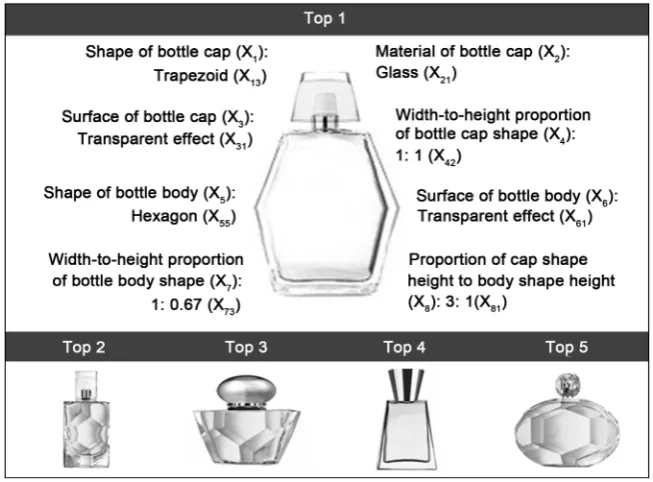
3, the mean values of the triangular fuzzy numbers (l, m, u) for each perfume bottle sample can be obtained by cal-culating the fuzzy number of fuzzy sequencing vector SPerfume Bottle. Accordingly, the 32 perfume bottle samples can be ranked the highest to lowest based on their fuzzy mean values. As an illustration, Table 6 shows the top 5 ranking perfume bottle alternatives, and Figure 6 shows the optimum combination of the deign elements and their corresponding features for top 1 alternative. This result shows that the designers should consider “the trapezoid shape”, “the glass ma-terial”, “the transparent effect” and “approximately 1:1 proportion of width-to- height” for perfume bottle cap design, and “the hexagon shape”, “the transparent effect” and “approximately 1:0.67 proportion of width-to-height” for perfume bottle body, and “approximately 3:1” for the proportion of cap shape height to body shape height when creating perfume bottle prototype designed to satisfy the “strongly Y. & V.”, “slightly F. & G.” and “moderately M. & N.” of multiple CPPs in the conceptual design stage.Table 6. Result of defuzzification and ranking alternatives.
Rank Perfume Bottle No. Fuzzy number ( )si Fuzzy mean ( ) i x s
l m u
1 18 57 117 169 114
2 25 57 107 169 109
3 27 41 101 171 104
4 9 39 95 175 103
Figure 6. Top 5 perfume bottle alternatives.
5. Conclusion
This study has conducted a perfume bottle evaluation to develop the Fuzzy AHP-based design support model based on multiple CPPs. One of contributions of this study consists in proposing an integrated approach based on fuzzy set theory and analytic hierarchy process for modeling the correlation between per-fume bottle and multiple CPPs. Moreover, the integrated approach can be ex-tended to develop a design support model and to present the suitable design elements and design features for perfume bottle visual design. Accordingly, the development of design support model can assist package designers to obtain the prototype of optimum perfume bottle alternatives in the conceptual design stage. Furthermore, the Fuzzy AHP-based design support model in conjunction with the computer aided design system can facilitate the new perfume bottle design process. Overall, this Fuzzy AHP-based approach provides an effective mechan-ism for the package visual design of perfume bottle. In future studies, the gene-rality of the design model constructed by Fuzzy AHP approach could be investi-gated by considering a variety of consumer goods examples.
Acknowledgements
Author gratefully acknowledges the subjects who participated in the evaluation trials and the support provided to this study by the Ministry of Science and Technology of Taiwan under Grant No. MOST 105-2410-H-218-007.
References
Berkowitz, M. (1987). Product Shape as a Design Innovation Strategy. Journal of Product
Innovation Management, 4, 274-283. https://doi.org/10.1016/0737-6782(87)90031-2
At-tentional Effects of Product Imagery. Journal of Product & Brand Management, 10,
403-422. https://doi.org/10.1108/10610420110410531
Henson, B., Barnes, C., Livesey, R., Childs1, T., & Ewart, K. (2006). Affective Require-ments: A Case Study of Moisturizer Packaging. Concurrent Engineering: Research
and Applications, 14, 187-196. https://doi.org/10.1177/1063293X06068358
Ares, G., & Deliza, R. (2010). Studying the Influence of Package Shape and Colour on Consumer Expectations of Milk Desserts Using Word Association and Conjoint Anal-ysis. Food Quality and Preference, 21, 930-937.
https://doi.org/10.1016/j.foodqual.2010.03.006
Gofman, A., Moskowitz, H. R., & Mets, T. (2010). Accelerating Structured Consum-er-Driven Package Design. Journal of Consumer Marketing, 27, 157-168.
https://doi.org/10.1108/07363761011027259
Metcalf, L., Hess, J. S., Danes, J. E., & Singh, J. (2012). A Mixed-Methods Approach for Designing Market-Driven Packaging. Qualitative Market Research: An International
Journal, 15, 268-289. https://doi.org/10.1108/13522751211231987
Fernqvist, F., Olsson, A., & Spendrup, S. (2015). What’s in It for Me? Food Packaging and Consumer Responses, a Focus Group Study. British Food Journal, 117, 1122-1135.
https://doi.org/10.1108/BFJ-08-2013-0224
Lin, M.-C., Wang, C.-C., Chen, M.-S., & Chang, C. A, (2008). Using AHP and TOPSIS Approaches in Customer-Driven Product Design Process. Computers in Industry, 59,
17-31. https://doi.org/10.1016/j.compind.2007.05.013
Demirtas, E. A., Anagun, A. S., & Koksal, G. (2009). Determination of Optimal Product Styles by Ordinal Logistic Regression versus Conjoint Analysis for Kitchen Faucets.
In-ternational Journal of Industrial Ergonomics, 39, 866-875.
https://doi.org/10.1016/j.ergon.2009.06.007
Lin, Y.-C., & Wei, C.-C. (2014). The QTTI-Based TOPSIS Decision Support Model to Fragrance Form Design. 2014 International Symposium on Computer, Consumer and
Control, 10-12 June 2014,1291-1294. https://doi.org/10.1109/IS3C.2014.333
Zadeh, L. A. (1994). Fuzzy Logic, Neural Network, and Soft Computing.
Communica-tions of the ACM, 37, 77-84.https://doi.org/10.1145/175247.175255
Saaty, T. L. (1994). How to Make a Decision: The Analytic Hierarchy Process. Interfaces, 24, 19-43.https://doi.org/10.1287/inte.24.6.19
Zimmermann, H. J. (1996). Fuzzy Set Theory and Its Applications. Waltham, MA: Kluw-er.https://doi.org/10.1007/978-94-015-8702-0
Wu, F.-G., Lee, Y.-J., & Lin, M.-C. (2004). Using the Fuzzy Analytic Hierarchy Process on Optimum Spatial Allocation. International Journal of Industrial Ergonomics, 33, 553- 569.https://doi.org/10.1016/j.ergon.2004.01.002
McDonagh, D., Bruseberg, A., & Haslam, C. (2002). Visual Product Evaluation: Exploring Users’ Emotional Relationships with Products. Applied Ergonomics, 33, 231-240.
https://doi.org/10.1016/S0003-6870(02)00008-X
Submit or recommend next manuscript to SCIRP and we will provide best service for you:
Accepting pre-submission inquiries through Email, Facebook, LinkedIn, Twitter, etc. A wide selection of journals (inclusive of 9 subjects, more than 200 journals)
Providing 24-hour high-quality service User-friendly online submission system Fair and swift peer-review system
Efficient typesetting and proofreading procedure
Display of the result of downloads and visits, as well as the number of cited articles Maximum dissemination of your research work