An Improvement of Power Quality Using
4-Leg (VSC) Based DSTATCOM
Ibrahim Zubairu
PG Student [M.Tech PSE], Dept. of EEE, SRM University, Kattankulathur, Chennai, Tamilnadu, India 1
ABSTRACT: Excessive neutral current, harmonics and reactive power burden and unbalance are usually caused through Large number of single-phase linear and nonlinear loads which may be supplied from three phase ac mains with neutral conductor. A four wire DSTATCOM (distribution static compensator) is used for neutral current compensation along with reactive power compensation, harmonics elimination and load balancing. A four-leg voltage–source converter (VSC) with a dc capacitor is used as a four wire DSTATCOM. The proposed control approach is based on synchronous reference frame (SRF) theory. The switching signals for the voltage–source converter (VSC) of the DSTATCOM are derived from the estimated reference supply currents. The load balancing, harmonics elimination and the neutral current compensation are demonstrated along with unity power factor (UPF) and zero voltage regulation (ZVR) modes of operation. The DSTATCOM is able to maintain the self-supported dc bus under various disturbances. MATLAB Simulink toolbox are used to execute the simulations
.
KEYWORDS:DSTATCOM, Power quality, SRF theory, ZVR, and UPF.
I.INTRODUCTION
Power quality has become one of the most inexhaustible buzzwords in the power industry since 1980s as stated in the textbook of power quality management. Both electric power utilities and end users are becoming so concerned with the quality of electric power. Paying more attention in power quality in a power system is very essential in today‟s scenario because of the increase in wide variety of loads that pollute the power system. Inductive loads like induction generators, induction motors, power transformers and arc furnaces, require reactive power for their magnetization and if the reactive power is consumed from the grid, a voltage dip occurs.
The distribution systems are facing severe power quality problems due to the proliferation of different types of linear and non-linear loads such as solid-state controllers, which draw harmonics and reactive currents from ac mains . Similarly, the single-phase linear and non-linear loads in the three-phase four wire distribution systems may lead to unbalance and excessive neutral current resulting in low power factor and increased loss. Moreover, it may lead to poor power quality at AC source such as sag, swell, notch, flicker, unbalance, etc. Because of such severity of power quality problems, several standards have been developed and are being enforced on consumers and utilities. The last decade has seen a marked increase on the deployment of end-user equipment that is highly sensitive to poor quality controlled electricity supply. Several large industrial users are reported to have experienced large financial losses as a result of even minor lapse in the quality of electricity supply. Efforts have been made to remedy the situation, where solutions based on the use of the latest power electronic technologies prominently. Indeed, custom power technology, the low- voltage counterpart of the more widely known flexible ac transmission system (FACTS) technology, aimed at high -voltage power transmission applications, has emerged as a credible solution to solve manyproblems relating to continuity of supply at the end-user level. Both the FACTS and custom power concepts may be directly credited to EPRI (Electric Power Research Institute).
Specifically, among these customs devices emphasis is mainly on the distribution static compensators (DSTATCOM), dynamic voltage restorer (DVR) and unified power quality conditioner (UPQC).
components, synchronous reference frame (SRF) theory, computation based on per phase basis, and scheme based on neural network. Among these control schemes instantaneous reactive powertheory and synchronous rotating reference frame are most widely used and is also selected on this research work
.
II.LITERATURE SURVEY
Some of the survey literature related to this research reports includes „Leg VSC and a Transformer Based Three-Phase Four-Wire DSTATCOM for Distribution Systems‟ and the research have demonstrated the performance of a new topology of three-phase fourwire DSTATCOM consisting of three-leg VSC with a star/delta transformer for neutral current compensation along with reactive power compensation, harmonic elimination and load balancing and also „Reactive Power Compensation by Controlling the DSTATCOM. Lastly but not the list is „Comparison of Three leg and Four Leg VSC DSTATCOM for Power Quality Assessment„this shows the comparison of the two different topologies in term of their performances for reactive power compensation, harmonic elimination, load balancing and mitigating circulating power flows in interconnected utilities
III.POWER QUALITY ISSUES
Power quality is ultimately a consumer-driven issue, and the end user‟s point reference takes priority. Therefore, the following definition of power quality problem is use:
Any power problem manifested voltage, current, or frequency deviations that result in failure or malfunction of customer equipment.
Power quality and reliability cost the industry large amounts due to mainly sags and short-term interruptions. Here we define the reliability as the continuity of supply. The problem of distribution lines is divided into two major categories i.e. power quality, and power reliability. First group consists of harmonic distortions, impulses and swells. Second group consists of voltage sags and outages. Voltage sags is much more serious and can cause a large amount of damage. If exceeds a few cycle, motors, robots, servo drives and machine tools cannot maintain control of process. voltage swell is defined as a sudden drop in the root mean square (R.M.S) voltage and is usually characterized by the remaining (retained) voltage.
Voltage Swell is defined by IEEE 1159 as the increase in the RMS voltage level to 110% - 180% of nominal, at the power frequency for durations of ½ cycles to one (1) minute. It is classified as a short duration voltage variation phenomena, which is one of the general categories of power quality problems
Fig.1. power quality and reliability
IV.DISTRIBUTED STATIC COMPENSATOR (DSTATCOM)
D-STATCOM is the most important controller for distribution networks. It has been widely used since 1990s to precisely regulate system voltage, improve voltage profile, reduce voltage harmonics, reduce transient voltage disturbances and load compensation. It is a voltage source inverter based static compensator (similar in many respects to the DVR) that is used for the correction of bus voltage sags
.
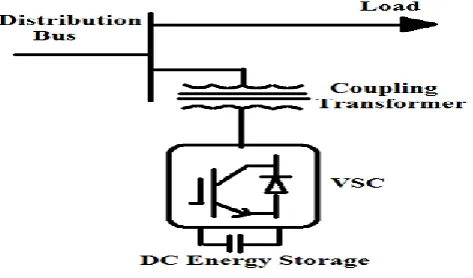
Distribution Static Compensator (D-STATCOM) otherwise known as shunt voltage controller comprises of a two level voltage source converter (VSC), a dc energy storage device, a coupling transformer connected in shunt to the distribution network and associated control circuit as depicted fig below. The VSC converts the dc voltage across the storage device into a set of three phase ac output voltages. These voltages are in phase and coupled with theac system via the reactance of the coupling transformer. Good setting or adjustment of the phase and magnitude of the D-STATCOM output voltages yield effective control of real andreactive power exchangesbetween the D-STATCOM and ac system. Such configuration provides and permit the device to absorb or generate controllable real and reactive power.
Figure 2. Basic Structure of D-STATCOM
Figure 2. shows the VSC connected in shunt with the ac system and this provides a multifunctional topology which can be used for up to three quite distinct purposes.
a) Correction of power factor.
b) Voltage regulation and compensation of reactive power. c) Elimination of current harmonics.
V.CONTROL VSC OF DSTATCOM
0 0 0 0
1
cos
sin
2
1
2 / 3 cos(
120 )
sin(
120 )
2
1
cos(
120 )
sin(
120 )
2
ld la lq lb c loi
i
i
i
i
i
(1)This can further be simplified as
1
cos sin
2
2 2 2 1
cos sin
3 3 3 2
2 2 1
cos sin
3 3 2
ld la lq lb lc lo i i i i i i
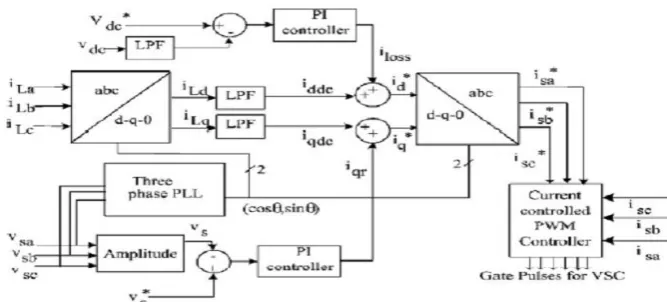
(2)Where cos θ and sin θ are obtained using a three-phase phase-locked loop (PLL). A PLL signal is obtained from terminal voltages for generation of fundamental unit vectors for conversion of sensed currents to the d–q–o reference frame. The SRF controller extracts dc quantities using a low-pass filter, and also, the non-dc quantities (harmonics) are separated from the reference signal. The direct-axis and quadrature-axis currents consist of fundamental and harmonic components as
Ld ddc dac
i
i
i
(3)Lq qdc qac
i
i
l
(4)Figure 3. Control algorithm for the three leg VSC based DSTATCOM in a three phase four –wire system
.
This figure illustrate the control algorithm of synchronous reference frame in respect of the DSTATCOM with four-legs VSC based
.
VI. UNITY POWER FACTOR (UPF) OPERATION OF DSTATCOM
maintaining the dc bus and meeting the losses(iloss) in DSTATCOM. The output of PI controller at the dc bus voltage of DSTATCOM is considered as the current (iloss) for meeting its losses.
1 pd
de n de n1
id de nloss n loss n
i
i
k
v
v
k v
(5)Where
n n
de dc dc
v
v
v
is the error between the reference(
v
dc)
and sense to dc voltage at the nth sampling instant. Kpd and Kid are the proportional and theintegral gains of the dc bus voltage PI controller. The reference source current is therefore as,d dc loss d
i
i
i
(6)Consequently, the reference source current must be in phase with the voltage at the PCC but with no zero-sequence component. It is therefore obtained by the following reverse Park‟s transformation with the id* as in (6) and iq*and i0*as zero
.
VII.ZERO VOLTAGE REGULATION (ZVR) OPERATION OF DSTATCOM
Similarly the compensating strategy for ZVR operation considers that the source must deliver the same direct axis component, id* along with the sum of quadrature axis current (iqdc) and the component obtained from the PI controller (iqr) used for regulating the voltage at PCC. The amplitude of ac terminal voltage (VS) at the PCC is controlled to its reference voltage (VS*) using the PI controller. The output of PI controller is considered as the reactive component of current (iqr) for zero voltage regulation of ac voltage at PCC. The amplitude of AC voltage (VS) at PCC is calculated from the ac voltages (vsa,vsb, vsc) as
,
1/ 2
2 2 2
1/ 22 / 3
s sa sb sc
v
v
v
v
(9)Then, a PI controller is used to regulate this voltage to a reference value as,
n n1
1
qr qr pq te n te n iq te n
i
i
k
v
v
k v
(7)Where, denotes the error between reference
( )
v
s and actual(
v
s n )
terminal voltage amplitude at the nth sampling instant. Kpq and Kiq are the proportional and the integral gains of the dc bus voltage PI controller. The reference supply quadrature axis current is asq qdc qr
i
i
i
(8)The reference source current is obtained by the following reverse Park‟s transformation with the id*as iq* and i0*as
zero
VIII.CURRENT CONTROLLED PWM GENERATOR
IX.SIMULATION RESULTS
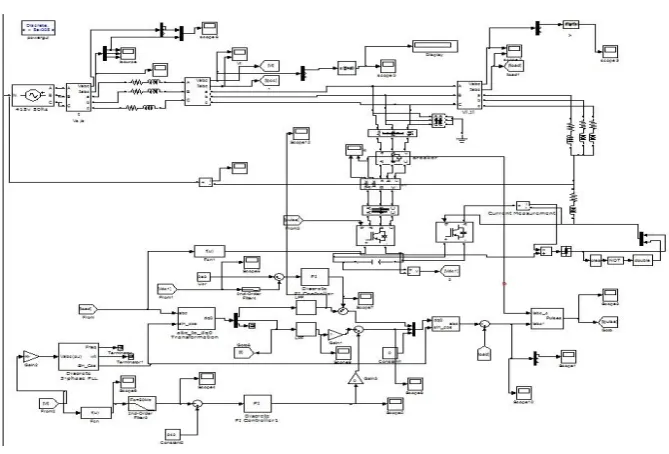
Figure 4 four- leg VSC Based DSTATCOM
Figure 4shows the 4-legs VSC based DSTATCOM for mitigating power quality problems like UPF, ZVR,Load balancing in three phase four wire distribution netwrk.
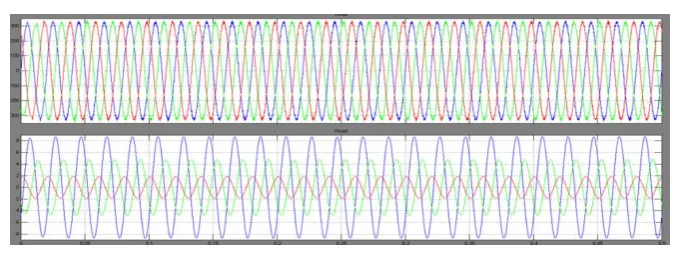
Figure 4.2 source current(amps) vs Time (sec)
This figure illustrate the three source current Ia,Ib,Ic magnitude vs the time in (sec) in the transformation of SRF controller.
This is the terminal voltage and current in the point of common coupling against the Time (sec).
Figure 4.4 Load current vs Time (sec)
This is the wave form behavior of the load connected current or load current versus the time.
Figure 4.5 Loss current vs Time (sec)
This is the loss current before inclusion of the custom power device DSTATCOM against the time or in respect with time.
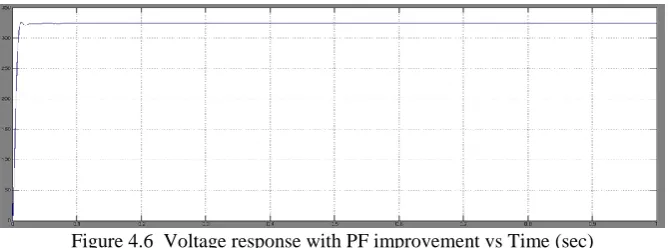
Figure 4.6 Voltage response with PF improvement vs Time (sec)
Figure 4.7 final load voltage vs Time (sec)
After inclusion of the DSATCOM to wipe away all the problems in the system the performance of the SRF controller, the final load voltage wave form becomes so functional as it is shown in the above figure.
VIII.CONCLUSION
The performance of a new topology of four-leg VSC DSTATCOM has been demonstrated for reactive power compensation, harmonic elimination, load balancing and mitigating circulating power flows in interconnected utilities. The voltage regulation and power factor correction modes of operation of the DSTATCOM have been observed as expected ones. The dc bus voltage of the DSTATCOM has been regulated to the reference dc bus voltage under varying loads .
REFERENCES
1. M. C. Benhabib and S. Saadate, “New control approach for four-wire active power filter based on the use of synchronous reference frame,” Electr. Power Syst. Res., vol. 73, no. 3, pp. 353 –362, Mar. 2005.
2. IEEE Recommended Practices and Requirements for Harmonics Control in Electric Power Systems, IEEE Standard 519, 1992.
3. Vuluchala Nirmala devi, M. Venkata Ramana Reddy, A. Raghu Rama Chandra and P. Naga Prasad “Comparison of Three leg and Four Leg VSC DSTATCOM for Power Quality Assessment” IOSR Journal of Electrical and Electronics Engineering (IOSR-JEEE). Volume 6, Issue 5 (Jul. - Aug. 2013), PP 43-49.
4. Bhim Singh, P. Jayaprakash*and D. P. Kothari “Three-Leg VSC and a Transformer Based Three-Phase Four-Wire DSTATCOM for Distribution Systems” Fifteenth National Power Systems Conference (NPSC), IIT Bombay, December 2008.
5. R. Ramanujam „‟power system dynamics (Analysis and simulations)‟‟ ISBN-978-81-203-3525-7 October 2013..
6. Bhim Singh, Sabha Raj Arya “Design and control of a DSTATCOM for power quality improvement using cross correlation function approach” International Journal of Engineering, Science and Technology Vol. 4, No. 1, 2012, pp. 74-86..
7. Prof. P.Venkata Kishore, Dr. S.Rama Reddy “Modeling and simulation of fourteen bus system employing D-STATCOM for power quality improvement”ACEEE Int. J. on Control System and Instrumentation, Vol. 02, No. 03, October 2011.
8. R. H. Salimin, M. S. A. Rahim Simulation Analysis of DVR Performance for Voltage Sag Mitigation The 5th International Power Engineering and Optimization Conference (PEOCO2011), Shah Alam, Selangor, Malaysia : 6-7 June2011.
9. Bhim Singh, A. Adya, A.P.Mittal, J.R.P.Gupta, B.N.Singh Application of DSTATCOM for Mitigation ofVoltage Sag for Motor Loads in Isolated Distribution Systems IEEE ISIE 2006, July 9-12, 2006, Montreal, Quebec, Canada.
10. Pawan jawlkar and (Mrs) .Ritu sharma Power Quality Improvement in transmission lines using D-STATCOM international journal of innovation in engineering research & management issn :2348-4918.
BIOGRAPHY