Political Science Dissertations Department of Political Science
8-11-2015
The Impact of Voter Exit on Party Survival:
Evidence from Zimbabwe's ZANU-PF
Chipo Dendere
Follow this and additional works at:https://scholarworks.gsu.edu/political_science_diss
This Thesis is brought to you for free and open access by the Department of Political Science at ScholarWorks @ Georgia State University. It has been accepted for inclusion in Political Science Dissertations by an authorized administrator of ScholarWorks @ Georgia State University. For more information, please [email protected].
Recommended Citation
Dendere, Chipo, "The Impact of Voter Exit on Party Survival: Evidence from Zimbabwe's ZANU-PF." Thesis, Georgia State University, 2015.
EVIDENCE FROM ZIMBABWE’S ZANU-PF
by
CHIPO DENDERE
Under the Direction of Daniel Young, PhD
ABSTRACT
This dissertation considers the impact of voter exit on the survival of incumbent regimes.
I argue that voters exit the political process as a result of emigration or political violence. Using
the example of Zimbabwe, I argue that ZANU-PF benefited from the exit of nearly four million
Zimbabweans who emigrated outside the country in response to declining economic conditions
and who exited the political system as a result of violence.
EVIDENCE FROM ZIMBABWE’S ZANU-PF
by
CHIPO DENDERE
A Dissertation Submitted in Partial Fulfillment of the Requirements for the Degree of
Doctor of Philosophy
in the College of Arts and Sciences
Georgia State University
Copyright by
Chipo Dendere
EVIDENCE FROM ZIMBABWE’S ZANU-PF
by
CHIPO DENDERE
Committee Chair: Daniel Young
Committee: Carrie Manning
Ryan Carlin
Electronic Version Approved:
Office of Graduate Studies
College of Arts and Sciences
Georgia State University
DEDICATION
ACKNOWLEDGEMENTS
I would like to thank the more than one hundred women and men who shared their life
stories with me. The human cost of migration and politics of transitioning countries is heart
breaking, as an immigrant I recognize the difficulty of opening up about one’s life. Thank you
for trusting me with your life stories. I am also eternally grateful to my advisor Dr. Daniel
Young. As an advisor and friend he spent many hours listening to my broad ideas, challenging
me, and encouraging me. Without his support that went above the call of duty there would be no
dissertation. My mentor Elisabet Rutstrom provided encouragement and financial support that
made this project possible. I am also grateful for my sisters and friends for their support. And
TABLE OF CONTENTS
ACKNOWLEDGEMENTS ... VI
LIST OF TABLES ... IX
LIST OF FIGURES ... X
1 INTRODUCTION... 11
1.1. Background ... 13
1.2 Post independence political parties ... 21
1.3 The Constitutional Referendum ... 23
1.4 The 2000 Parliamentary Elections ... 27
1.5 The Elections 2002-2008 ... 29
2 AN UNCONSIDERED THEORY OF EXIT AND PARTY SURVIVAL ... 32
2.1 Explanations in the literature on party survival ... 34
2.1.1 Electoral Fraud... 34
1.1.1.1 The Voters Roll: Registration challenges, “ghost voters,” and absent voters .. 36
1.1.1.2 Population considerations and access to registration and voting centers ... 42
1.1.1.3 Ghost Voters and Absent Voters ... 48
2.1.2 Historical legacies... 50
2.1.3 Performance theory ... 53
2.1.4 Vote buying, clientelism, neopatromonialism, and patronage in African elections ... 58
2.1.5 Elite unity and superior organization skills ... 69
2.2 My theory of party survival ... 76
2.2.1 Key theoretical concepts ... 78
3 EMIGRATION AND PARTY SURVIVAL ... 85
3.1 Migration patterns in Zimbabwe ... 85
3.2 Mapping out respondents in the United Kingdom, South Africa and United States ... 88
3.2.1.1 The United Kingdom ... 90
3.2.1.2 The Republic of South Africa ... 92
3.2.1.3 The United States ... 93
3.2.1.4 Creating the interview questions and structure, identifying the target group and interviewees ... 95
3.2.1.4.1 Interview Guides ... 96
3.2.1.4.2 Language, setting, and duration ... 96
3.3 The profile of a Zimbabwean migrant ... 97
3.3.1.1 Gender ... 98
3.3.1.2 Age ... 98
3.3.1.3 Tribe ... 99
3.3.1.4 Hometown of Respondents ... 99
3.3.1.5 Education ... 100
3.4 Declining Economy & Middle Class Exit: The case of nurses ... 102
3.4.1.1 Why are they leaving? ... 106
3.5 Middle Class frustration increased opposition support ... 110
3.6 Linking exit to politics ... 112
3.6.1.1 Opposition to ZANU-PF ... 112
3.6.1.2 Migration reduces turnout for the opposition ... 116
3.6.1.3 Voter Exit Prevents Participation, which benefits ZANU-PF ... 117
3.6.1.5 Remittances strengthened ZANU-PF hold to power ... 123
3.7 Concluding thoughts ... 127
4 THE USE OF VIOLENCE AS A SURVIVAL STRATEGY ... 128
4.1 Introduction ... 128
4.2 A new theory of political violence ... 133
4.3 ZANU-PF Historical legacies of violence pre and post-independence ... 135
4.4 Implications for party survival ... 141
4.4.1.1 The relationship between Urbanites and ZANU-PF ... 142
4.4.1.2 The 2000 Citizenship Act and Politics of Identity and forced voter exit ... 144
4.4.2 Post-2000 Land Reform and forced voter exit ... 151
4.4.2.1 Operation Murambatsvina: Violent gerrymandering ... 158
4.4.2.2 Motivation and effects of operation Murambatsvina ... 164
4.4.2.2.1 Operation to Restore Sunshine City Status ... 166
4.4.2.2.2 Operation to punish the urbanites ... 168
4.4.2.2.3 Operation to restore ZANU-PF unity & divert from the economy ... 169
4.4.2.2.4 Operation for forced urban to rural migration ... 170
4.4.2.3 State of fear and violence ... 174
4.5 The electoral implications of violence and state repression: Forced exit and entry sustains ZANU-PF ... 178
4.6 Concluding thoughts on violence and voter Exit ... 184
5 SUMMARY AND CONCLUSION ... 186
5.1 The Impact of Voter Exit on ZANU-PF Survival 1999-2009 ... 186
5.2 A Theory of Voter Exit and Findings ... 187
5.4 Future Research and Conclusion ... 191
LIST OF TABLES
Table 1 Parliamentary Elections 2000 ... 28
Table 2 Time-varying Reasons for Migration to South Africa -Makina study (2007 .... 108
Table 3 Main Reason for Leaving Zimbabwe 2013 study ... 109
Table 4 Opposition Voters Profile ... 115
Table 5 ZANU PF support among urbanites ... 168
Table 6 ZANU-PF Survival and Citizan Intimidation ... 181
LIST OF FIGURES
Figure 1 Referendum Vote 2000... 24
Figure 2 Zimbabwe Population Census 2002 and 2012 ... 43
Figure 3 Mapping Party Survival and Voter Exit ... 81
Figure 4 Geographical spread of Zimbabweans in the U.K... 91
Figure 5 Location of the Zimbabwean Diaspora ... 95
Figure 6 Age of Diaspora Respondents ... 98
Figure 7 Diaspora Identity Groups ... 99
Figure 8 Diaspora Hometown ... 100
Figure 9 Diaspora Education ... 101
Figure 10 Zimbabwe Unemployment 1999-2009 ... 103
Figure 11 Diaspora Professions ... 105
Figure 12 Diaspora Party Identification ... 116
Figure 13 Diaspora Voting Patterns between 2000-2010 ... 117
Figure 14 Diaspora Remitting Behavior 2008-2013 ... 123
Figure 15 Remittances, the Economy and ZANU-PF Survival ... 126
Figure 16 ZANU-PF Support 1999-2009 ... 133
Figure 17 Theory of Voter Violence and Party Survival ... 134
Figure 18 ZANU-PF support and Operation Cleanup ... 170
Figure 19 Impact of Operation Cleanup ... 172
1 INTRODUCTION
In the decade beginning in 2000, Zimbabwe went through one of the worst political and
economic crises in global history. Zimbabwe, once the African breadbasket and the continent’s
beacon for democracy, was at the center of human rights abuses, violence, and a quickly
deteriorating economy. Between 2000 and 2009, the annual rate of inflation rose to 516
quintillion percent – that’s 516 followed by 18 zeros. Zimbabwe’s inflation surpassed the
infamous German economic meltdown of 1923 when inflation reached 29,000 percent. A trip to
the grocery store for a loaf of bread was accompanied by a basket of Zimbabwean dollars. Prices
where changing by the hour. And yet, the Zimbabwe African National Union-Patriotic Front
(ZANU-PF) regime and the man at the head of the government, Mr. Robert Mugabe, remained in
power. The puzzle driving this dissertation is the survival of ZANU-PF under the worst
economic and political crisis in the country’s history.
In response to the crisis, millions of Zimbabweans left. Scholars have referred to this
decade as the Great Zimbabwean Exodus (Crush & Tevera, 2010). Men left their wives and
children. Mothers left children. Young people gave up on their dreams; those who did not quit
school altogether, gave up dreams to become doctors and engineers and instead fought for
positions as gardeners, cleaners, and nurse aids in foreign countries. I met Sarah in 2012, four
years after she had first immigrated to the United Kingdom. Like most immigrants, she was
hesitant to talk about politics. She felt that she had no role in politics and that she was not
political. Instead, she said she would share with me the details of her life:
“I was working as an accountant in Harare before I came here. But in 2002
the economy was becoming really bad and my sister and her husband were here
was that I would come first and sort out our papers and then they would follow.
No, I did not want to get involved in the politics. There was no use so I came
here. I was working in a nursing home here, about 60 hours a week and sending
money home. My husband got a second wife. She wasn’t watching our son as he
was walking from school. He was in first grade; I have his picture from his first
day of Grade one. They said the driver was going too fast. He was hit and died on
the spot. I did not have my papers yet so I did not go to the funeral. I received
asylum two years later. Now I have no reason to return to Zimbabwe. I have
finished nursing school and Scotland doesn’t seem as cold as it was when I first
moved here.”
Female 32 Glasgow, Nov 2012
Sarah’s story is sadly common. Tendai, a 43-year-old lawyer, left a law practice and two
children to work for eight years as a night nurse aid in the United Kingdom. In 2008 Peter, a
promising young scholar at the University of Zimbabwe, left school midway to work cleaning
trains on the Zimbabwe/Botswana route. Each of these immigrants interviewed said that they
were not activists, and yet their exit, and the exit of thousands like them bolstered ZANU-PF by
weakening the base of opposition support.
The cost of movements that usher in democracy is very high. The human cost for the
survival of undemocratic regimes is even higher. Path-breaking work on the survival of similar
parties such as Mexico’s Institutional Revolutionary Party (PRI) by Magaloni (2005) and the
survival of Japan’s Liberal Democratic Party (LDP) by Scheiner (2006) argues that ruling parties
tend to survive when the economy is doing well and the opposition is weak. Conversely, they
weaken their ability to buy votes. ZANU-PF, therefore, presents a major puzzle. It survived
despite the fact that Zimbabwe underwent the worst economic crisis in modern history, with
inflation topping three trillion percent in 2008 and a strong and well-funded opposition led by a
popular presidential candidate, Morgan Tsvangirai. This dissertation engages the conversation on
party survival, arguing that the natural human inclination to exit unfriendly environments
bolsters the survival of incumbent regimes. Using a combination of ethnographic interviews and
statistical analysis of survey data, I argue that ZANU-PF survived its most challenging political
decade because citizens who would have supported the opposition exited the political system.
1.1. Background
At independence from the United Kingdom in 1980, there were high hopes for
Zimbabwe’s political and economic prosperity. Zimbabwe was one of the four most
industrialized countries in Sub-Saharan Africa; it had a more diversified economy compared with
its neighbors, a well-trained and strong human resource base, and the country had earned a
middle-income status. Additionally, Robert Mugabe’s reconciliation speech in 1980 shocked the
world that had in the last decade been inundated by news of a violent liberation struggle between
the black majority and the white minority. Robert Mugabe was often praised as a true democrat
geared for change and development. White Zimbabweans who had packed their bags ready to
flee in anticipation of a black majority win, actually remained (with the exception of those who
had already left in the period leading up to the election; Tevera & Chikanda, 2009). Former
Rhodesian Prime Minister Ian Smith ran for office in the 1986 election and won a seat in
parliament. His party also won in the 1986 election and won the 20 seats reserved for whites in
Parliament. News of the brewing genocide in the southern parts of the country never made it to
remained blissfully unaware of the troubles.
The unification of the two major black parties, Mugabe’s ZANU and Nkomo’s PF ZAPU
to form ZANU-PF, did not raise much national and international suspicion except in
Matabeleland. In the southern region, supporters of Joshua Nkomo found it hard to accept that he
had joined with ZANU, even as reports of killings in Matabeleland by the Fifth Brigade were
still coming out. Joshua Nkomo was brought into the fold after years of having his life
threatened. His decision to allow the merger of the two parties was met with skepticism by some
in Matabeleland who feared he was being bought out by the ruling ZANU-PF. However, there
were others who understood that the cost of peace would be a united government.
“He [Joshua Nkomo] did what he had to, people understood that it had to be
done to bring peace in Matabeleland”
Interview, South Africa, 2013
The fear that white Zimbabweans would isolate themselves fell to the wayside as a significant
number of white Zimbabweans joined forces with the government, both in the private or public
economic sectors. Some even ran for office as ZANU-PF candidates.
“It was a strategic choice (running for office). It was a new day and if
there was a voice of reason in the party I wanted to work with that voice. I was
white but always a Rhodesian- well Zimbabwean at that point-Zimbabwean. I ran
for a seat in Matabeleland, I won.”
Interview with a white Zimbabwean, former MP and farm owner,
now residing in Capetown, 2012
By most standards, Zimbabwe was doing well. Perhaps the praise was inflated and not
entirely deserved, but it was relative. South Africa was riled by apartheid; Mozambique was
mid-1990s, the Zimbabwean economy that had been slowly declining finally plummeted. In
1997, Harare was rife with civil servant strikes and riots headed by then-trade union leader
Morgan Tsvangirai. That same year, ZANU-PF faced its first public outcry against their decision
to send Zimbabwean troops to the Democratic Republic of Congo to shore up Laurent Kabila’s
government against rebels. The two year military intervention cost Zimbabwe an estimated
US$200 million at a time when the Zimbabwean economy was already depressed (UN News
Report, 2000). Zimbabweans argued that their government did not have the money and resources
for the mission. There was also concern with the high number of Zimbabwean casualties in the
war.
In the same year, war veterans made public their demands for remuneration for war
related injuries and demanded compensation in the form of land and money. In November 1997,
the government responded to the demands from war veterans by initiating pension payouts of up
to Z$50,000 (US$4,500 at the time). In addition to the Z$50,000 payouts, the war veterans were
also promised a Z$2,000 monthly income. President Mugabe went on a national tour defending
the release of the funds, even as critics argued that the money had not been budgeted for. The
payouts served as a final nail in the coffin for the Zimbabwean economy. The economy was
struggling to recover from the negative effects of the World Bank’s Economic Structural
Adjustment Program (ESAP), as well as corruption and banking scandals. On the day that the
president made the announcement officiating the payouts, the Zimbabwean dollar fell from
Z$11:US$1 to Z$21:US$1, and the country experienced its first national power blackout, the
infamous “black-Friday”(Meldrum, 2006). By the end of the year, the Zimbabwean dollar had
Prior to the November payouts the war veterans had laid out a series of demands
including hospital and school fees coverage for their families and government redistribution of
land. The payouts did little to ameliorate tensions between war veterans and the ruling party. The
ruling party leaders increasingly became agitated with the War Veterans Association, which was
now openly hostile towards the ruling party. In 1999, the trial of Chenjerai Hunzvi dominated
newspaper headlines and made public tensions between party elites and the war vets. At the same
time, the MDC was gaining public support, and the ruling party could not afford to fight two
battles – one with the rising opposition and another with the war veterans. The government sided
with the war veterans. Comrade Hunzvi was acquitted; his acquittal marked the beginning of his
brutal land reform campaign, which would become the front and center of ZANU-PF campaign
message in the last decade. Hunzvi led the initial farm grabs in 1999, and the government later
took over the process in 2000. The government tried, but largely failed, to formalize the
equitable redistribution of farmlands (Muzondidya, 2007).
The issue of land reform was not new. Land had played a critical role in the 1979
Lancaster House agreements. According to the agreements, the British government would give
financial assistance to the new government to initiate land reform after a ten-year grace period.
The Thatcher government had been primarily interested in protecting the property of the white
minority. At Lancaster, then British Foreign Minister, Lord Carrington, assured liberation
struggle leaders that the British government would enlist the help of its allies to secure the
monies needed for land redistribution. Carrington assured the delegation that the "future
government would be able to appeal to the international community for help in funding
acquisition of land for agricultural settlement.” (McGreal, 2002). This served to calm the fears of
have over the whole land question arising from the great need our people have for land and our
commitment to satisfy that need when in government"(McGreal, 2002). During the first decade
after independence, the new government was limited on what they could do to redistribute land
because of a constitutional mandate that said reform could not be initiated in the first ten years
after independence. By the time the mandate expired, neither the government nor the white
farmers took land reform seriously because the agriculture sector was bringing in a lot of revenue
for the country. It seems that there was an unwritten agreement between the new government and
white farmers – the blacks would run government while the whites would run the economy. This
implicit compromise kept everyone happy until the late 1990s.
Time appeared to have slipped away from both the British and Zimbabwean leaders, and
the promise to give land to millions of poor blacks hung in the air as the economy constricted the
demand for land reared its ugly heard on the unsuspecting government. At independence in 1980,
over 15 million hectares of land were devoted to commercial farming, and the white minority
owned almost all of the land. The first phase of land redistribution was a gradual process starting
in the mid-1990s where a little over three million hectares were portioned. The remaining
white-owned commercial land (est. 12 million hectares) would quickly decline after 2000, when the
government allocated 4,500 to new farmers for a total of up to 7.6 million hectares (Scoones et
al., 2010). The country experienced a dramatic shift from large-scale farming to smaller-scale
farms focused on mixed farming and often with very low levels of capitalization. The decline in
agriculture production led to an increased need for imported foods and a decline in national
exports, which negatively affected the nation’s GDP. Between 2001 and 2010, the national GDP
never made it above 10 percent and was as low as -18 percent in 2003 and 2008 (“Zimbabwe
By the mid-2000s, Zimbabwe could no longer afford to feed its people or import grain.
Zimbabweans were depending on aid for every basic commodity. The once beaming industries
were now closed. Following the land reform initiative, the government in 2000 banned foreign
transactions; it became illegal for businesses to deal with foreign currency without prior approval
from the government. This led to a further decline in operational businesses and industries as
foreign companies fled the nation. Under the doctrine of a “Third Chimurenga,” President
Mugabe’s regime introduced the indigenization policies, which first came into effect in 2008
(Scoones et al., 2010). The Indigenization and Empowerment Act was officially signed into law
on March 7, 2008. The act required all foreign-owned companies to offer at least 51 percent of
their shares to indigenous Zimbabweans (Mugabe, 2001).1 Foreign investors in Zimbabwe spoke
out against the law, and a fair number withdrew their businesses. Market analysts worldwide
expressed their outrage and concern over the policy, arguing that the act would "effectively seal
Zimbabwe's fate as a pariah to international capital" (Id.). Marian Tupy, a Cato Institute policy
analyst, condemned the Act even more strongly as "yet another step on Zimbabwe's road to
economic suicide" that will "expropriate non-black owners, while providing the ZANU-PF
[ruling party] elite with a new source of income. The biggest victims of the Orwellian measure…
will be the black majority"(Zeldin, 2008). In 2001, the government agreed to end land invasions
in exchange of British funds to finance land reform, but the two governments failed to reach an
agreement and the invasions continued.
Between 2001 and 2003, Minister of Information Jonathan Moyo crafted a number of
unpopular media policies that all but killed the Zimbabwean media under the Broadcasting
Services Act (BSA; 2001), the Zimbabwe Broadcasting Corporation (Commercialization) Act
1 The full text of the indigenization act can be found here
(2003), the Access to Information and Protection of Privacy Act (AIPPA; 2002), the Public
Order and Security Act (2002), and the Zimbabwe Broadcasting Corporation
(Commercialization) Act (2003). The efforts to nationalize all media resulted in programming
focused solely on the liberation struggle and the virtues of the ruling party. The Zimbabwe
Broadcasting Corporation (ZBC) lost the viewership of young voters, and over time most
Zimbabweans had purchased satellite televisions to watch South African broadcasting.
The laws were very unpopular both locally and intentionally. ZANU-PF founding father
and later opposition leader, Edson Zvobgo, bemoaned the end of free media in Zimbabwe when
Moyo introduced the bills to parliament. The day Mr. Moyo brought AIPPA,for a vote in
parliament, Dr. Zvobgo said, "I can say without equivocation that this Bill, in its original form,
was the most calculated and determined assault on our liberties guaranteed by the Constitution in
the 20 years I served as Cabinet minister" (Gagare, 2014). Foreign papers and broadcasting
agencies BBC and CNN were the first victims of the new media laws. On July 24, 2001, the
BBC was forcibly banned from broadcasting from Zimbabwe. Minister Moyo accused the BBC
of “reporting lies about the land reform program”(Nkosi, 2007).
The BBC was later relicensed in 2009, but during their ban they were allowed to report
from Zimbabwe on just two occasions, both during cricket games and after intervention from the
International Cricket Council (ICC). In 2003, the government issued a ban on the only
independent newspaper, the Daily News, founded in 1999 by opposition sympathetic journalist
Geofrey Nyarota. The paper, along with a number of independent newspapers, was relicensed in
2009. The period from 2000 to 2009 was rife with reports of harassed journalists that reported
unfavorably about the president, land reform, indigenization, and the ruling ZANU-PF, or
distance itself from the policies of Jonathan Moyo. In the period between 2000 and 2008, only
the state media agencies, Herald and ZBC, were allowed to freely report, and the media became
an extension of ZANU-PF. This caused many in the country to discount anything reported in the
media. The government not only banned political coverage but any programs that were not
Zimbabwean. Popular American and British TV shows were deemed inappropriate, and the radio
was mandated to only play local music. While the move generated an interest in local
production, it reduced viewership and listenership of ZBC.
Zimbabwe’s economic problems reached another tipping point after the controversial and
highly violent 2008 election when a cholera outbreak ravaged the country. The impact of cholera
was felt most in urban slums where hundreds lost their lives, primarily because the health sector
had ceased to function. The majority of state hospitals were non-functional, and in the rare
occasions that they did treat people the cost of treatment was beyond the means of the average
person. Thousands of school children dropped out of school in response to the increase in tuition
fees and the exodus of teachers. At the time, the Organization of Migration estimated that at least
3 million Zimbabweans were living abroad. This is the largest wave of migration in modern
history in a non-conflict zone. The international community, led by Great Britain, Zimbabwe’s
former colonizer and ZANU-PF’s biggest international nemesis, imposed sanctions on
Zimbabwe beginning in 2000 that were meant to restrict the movement and business operations
of political elites with the hope that this would be enough to lead to regime change. Internally
and externally, ZANU-PF faced the biggest and strongest challenge to its dominance in the last
decade. Economic, political and international pressures should have brought an end to the
ZANU-PF rule and bolstered the opposition Movement for Democratic Change (MDC). Even as
notwithstanding the formation of the unity government. In his opening remarks at the annual
ZANU-PF party congress in 2008, Mr. Mugabe told supporters that although ZANU-PF had
been weakened the revolutionary party, they were ready to “fight like a wounded beast” for a
decisive win in the March 2008 elections (Dzirutwe, 2012). He would repeat that statement
throughout the election period. The question at the heart of this dissertation is how ZANU-PF
managed to survive where many parties not unlike itself failed.
1.2 Post independence political parties
When Zimbabwe gained independence in 1980, there were nine active political parties.
However, none of the eight opposition parties had the strength or popularity of ZANU-PF, and
after the 1986 unification of ZAPU and ZANU that guaranteed the Matabeleland vote for
ZANU-PF, the remaining opposition parties were relegated to provincial and tribal parties. Of
the nine parties that contested the 1980 elections, only three won any seats. Mugabe’s ZANU-PF
emerged as the clear winner, with 63 percent of the votes and 57 of the 80 seats allocated to
black Zimbabweans. Nkomo’s PF-ZAPU came second with 24.11 percent of the vote and 20
seats, and Muzorewa’s UANC came third with only 8.28 percent of the vote. The rest of the
parties fared less well. The ZANU-PF wins were in its Shona strongholds of Mashonaland East,
Central, and West Victoria (now Masvingo) and Manicaland, where it won between 71 and 87
percent of the vote in each constituency (Makumbe, 2006). PF-ZAPU won the majority of votes
in its support bases in Matabeleland and Midlands, the southern parts of the country.
Muzorewa’s UANC won three seats scattered in and out of the Harare province. In the second
elections in 1985, ZANU-PF improved on their earlier wins and gained 77 percent of the vote
and 64 seats, and PF-ZAPU lost five seats, winning only 15 seats. Muzorewa won less than two
percent of the vote in Chipinge. ZANU-PF came out of independence as the ruling party, but the
party began to face troubles in the southern parts2 of the country. The ruling party was also aware
of the comeback that Ian Smith’s party had staged in the 1985 election. A combination of
troubles in the South and a fear of a strong white minority forced the ZANU-PF elites to reach
out to the PF-ZAPU elites to form a unified ZANU-PF. The new party guaranteed both Nkomo
and Mugabe political stability and majority wins.
After the unification, ZANU-PF sailed through elections until 1999, facing very little
opposition. In 1999, the Movement for Democratic Change (MDC) was formed. The streets in
both suburbs and townships were filled with very loud murmurs of Chinja, Change,
Gukulaizenzo. The MDC open palm symbol “chinja/change” spread through universities,
factories, and cities all across the country. MDC had great appeal in the urban areas and
especially among the young, the born-frees, or Generation Y who had no experience with the
liberation struggle (Sachikonye, 2002a). Much of the MDC leadership was young, enterprising,
and energetic and presented a clear contrast to the aging ZANU-PF leadership. Tsvangirai at the
head of MDC was young and charismatic, and that more than made up for his lack of liberation
struggle credentials amongst his base, who were more interested in his message centered on the
economy and political change. In ZANU-PF much of the leadership was older, leaving very little
2
to no room for the youth to gain leadership positions in the party. The joke in Harare was that the
youth league in ZANU-PF starts at 60.
1.3 The Constitutional Referendum
In 1999, ZANU-PF began selling the idea of a new constitution, a referendum to the
constitution adopted at the Lancaster agreement. They argued that the new constitution would
usher in an era of independent black-majority rule. It is no coincidence that ZANU-PF decided to
change the constitution just as the newly-formed MDC was gaining support in urban areas. Thus,
the MDC participated in their first election campaign in 2000 when they launched a successful
“No” vote campaign against the constitutional referendum proposed by ZANU-PF. The MDC
and its allies launched an attack on the ZANU-PF proposed constitution, advocating instead that
voters support their “No” vote campaign. The “No” vote took the cities by storm. When people
went to vote, they voted with the new party. The “No” votes handed the president and his party
their first electoral defeat since they came into power at independence in 1980
MDC had done the impossible: they presented a real challenge to the establishment. The
party was not a regional union but had grown roots all across the country with strong leadership
in both Mashonaland and Matabeleland. Previous opposition parties had been unable to bridge
the differences between their own regional interests and those of the larger Zimbabwe. The
constitutional referendum was an expression of frustration with the economy and a direct call for
change.
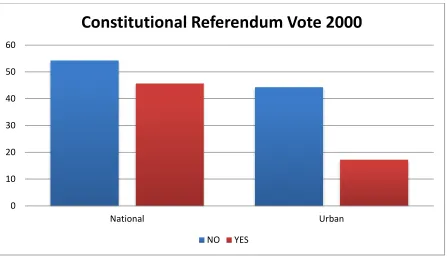
The results of the 2000 constitution referendum are presented in the table above. MDC
managed to win the support of their major bases, the two main urban provinces Harare and
Figure 1 Referendum Vote 2000
key liberation leaders like the late Ndabaningi Sithole and Edgar Tekere. In those three
provinces, “NO” received more than 95 percent of the vote. ZANU-PF retained all other
provinces, predominately located in the rural areas. The referendum failed to pass; this was a
testament to the power of urban mobilization. Over 80 percent of the Zimbabwean population
resides in rural areas, but less than half of that population turned out to vote. In June, the MDC
cut further into ZANU-PF dominance.
Implications of the referendum vote
There are a few lessons that can be drawn from the outcome of the referendum. First, the
successful “No” vote campaign was a test of the newly formed opposition party’s power and
popularity. The MDC was a contrast from past opposition parties because it was both a party of
intellectuals and the masses; the party was also attractive to white farmers who needed a political
outlet. The results revealed that the opposition was strong enough to amass support from a more 0
10 20 30 40 50 60
National Urban
Constitutional Referendum Vote 2000
diverse group of voters and that they had the votes to defeat ZANU-PF. Those results provide an
important starting point for my analysis;: the premise of my dissertation that the exit of the
middle class from the political system had a negative impact on the success of the MDC. The
international community and urbanites celebrated the failure of the constitutional referendum.
International and domestic critics of ZANU-PF argued that that calling for a constitutional
referendum vote just as the opposition was gaining momentum was a sign of weakness on the
part of ZANU-PF. Indeed ZANU-PF was growing weary of the opposition, and the revolutionary
party was also under pressure from war veterans who were eager to go full-scale on the land
reform program.
The MDC and civil society argued that they had advocated for a “No” vote for the
following reasons:
1. The process: In the view of the MDC, the constitution making process had not been
democratic. They argued that direct appointment of the members of the Constitutional
Commission by the President violated the principle of an independent commission. In
addition to appointing the commission, the president also set the timetable for the
commission, and, was thus actively involved in setting the Commission’s agenda. The
president is also said to have had the final say of what went into the Draft Constitution
that was put up for a vote. Unlike the 2013 Constitution Referendum process, the people
of Zimbabwe where not given the opportunity to provide their opinions on major issues
such as land reform and presidential term limits. The Commission was by and large only
beholden to the President and not the people.
2. The Content: The MDC and civil society argued that the content in the constitution was
a. Executive presidency: The draft constitution did not adequately curb the
presidential powers. Indeed the Zimbabwean President has the power to appoint
and dismiss most public figures, he can dissolve parliament without consultation
and he could declare a state of emergency again without consultation.
b. An unworkable system of government: The 2000 constitution made a provision for
a Prime Minister, but, the Prime Minister’s powers where curbed by the President.
For example, the Prime Minister was said to be the head of government and yet
the President was appointed the chair of the cabinet.
c. A weak Senate: The 2000 draft proposed the reinstatement of the Rhodesian
senate, which was weak and had no powers. The senate like the parliament would
provide no checks on the president, instead it would bolster the strength of
ZANU-PF in government.
d. A narrow bill of rights: The constitution had a very narrow provision for the bill
of rights; a particular point of contention was that the constitution did not
recognize past human rights atrocities such as Gukurahundi.
e. Inadequate provisions for free and fair elections: They argued that the Electoral
Commission as it was described in the new constitution was not an independent
body. It relied on funding from the government. Additionally, all the top
leadership of the commission would be appointed by the president and nor other
government body would approve their appointments.
f. No devolution of governmental powers to the people at appropriate levels: The
provisions for devolution of power. They argued that the government should set
up provincial governing bodies.
g. Land reform: The opposition and its supporters, particularly white framers, felt
that the land clause as stated in the 2000 draft gave ZANU-PF too much power in
land redistribution. Also, that ZANU-PF was using the land issue to rewrite
history. ZANU-PF wanted to shift the political narrative from the failing economy
and ZANU-PF’s hegemony to a fight against what the opposition argued was
imagined “neo-colonialism.”
h. The economy: The opposition and their supporters felt that the constitution did not
make any provisions for bolstering the economy or for the poor in the society.
For their part, ZANU-PF argued that the constitution would mark the end of colonial
interference in the country. The new constitution, had it passed, would have transitioned the
country away from the constitution drafted during the independence negotiations at Lancaster
House in 1979. ZANU-PF also argued that the constitution could bring a resolution to the land
issue that had begun to pack some heat in the late 1990s. ZANU-PF was under pressure from the
war veterans who felt that the ruling party had ignored their needs and gone back on their
pre-independence promises. ZANU-PF argued that the new constitution would allow for a better and
more efficient way to distribute land.
1.4 The 2000 Parliamentary Elections
The results of the referendum vote foretold the outcome of the general election later on
that year. In October, Zimbabwe held its first competitive parliamentary elections. The election
in 2000 marked a turning point in Zimbabwe’s history and presents a fitting starting point for
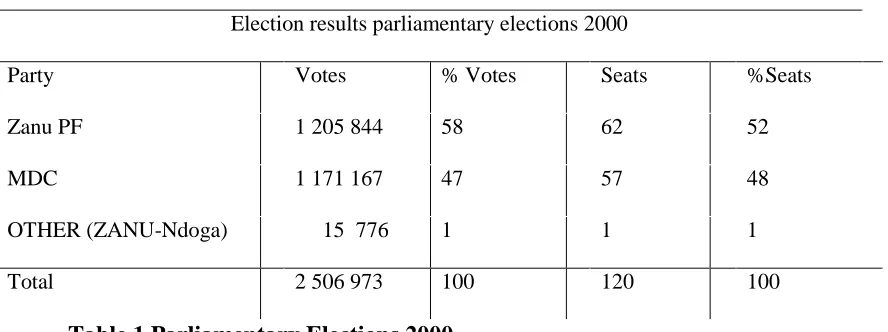
opposition. In the 1995 elections that preceded the 2000 elections, ZANU-PF had won 118 out of
120 seats with 82 percent of the vote. In the 2000 elections, ZANU-PF only won 62 seats with
just 49 percent of the vote to MDC’s 57 seats with 47 percent of the vote.
Election results parliamentary elections 2000
Party Votes % Votes Seats %Seats
Zanu PF 1 205 844 58 62 52
MDC 1 171 167 47 57 48
OTHER (ZANU-Ndoga) 15 776 1 1 1
[image:32.612.74.518.150.316.2]Total 2 506 973 100 120 100
Table 1 Parliamentary Elections 2000
ZANU-PF conceded defeat in the parliamentary elections just as they had done a few
months earlier for the referendum vote. The period before and after the 2000 referendum and the
general election was very safe, with most international and local observers agreeing that the
election had been free and fair (Laakso, 2002). The main political parties accepted the election
results, and although Tsvangirai lost his bid for a seat in his hometown, he announced his
intentions to run for presidency. There was some concern that the environment leading up to the
election had been unfriendly towards the opposition supporters. In an interview with the PBS
after the election, Mr. Wollock of the National Democratic institution (NDI) criticized the
process because of incidents of political violence, an unleveled playing field, and abuse of
electoral institutions by the ruling party. Although observer groups bemoaned the fact that many
of uheir licenses to monitor were withdrawn a few days prior to Election Day, the general
With the benefit of hindsight we can look back to the impact of the elections in 2000,
both the referendum election and the June general election, on the next decade of Zimbabwean
politics and ZANU-PF’s survival. At the time, the elections were seen as a success for the MDC.
Indeed, the MDC had managed the impossible – they reduced the ZANU-PF hegemony. The
MDC made a name for itself by pushing for the “No” vote on the constitutional referendum.
However, the Draft Constitution of 2000 was not fundamentally and substantively different from
the Draft Constitution of 2013 that the MDC later supported and campaigned “yes” for. The
important issues in 2000 are very similar to those presented in 2013; the issues included land
reform, executive term limits, and citizenship. Perhaps ZANU-PF had used the referendum
election as a litmus test for the opposition strength and to draw out opposition supporters.
1.5 The Elections 2002-2008
The peaceful nature of the 2000 elections was short-lived, and the tone of elections
became more violent in subsequent years. Every election since 2000 has been marred by reports
of extreme cases of pre- and post-election intimidation, fraud, and violence. The state became
more militant; voters especially in rural areas in the ZANU-PF base were bullied into attending
political rallies and turnout to vote in the elections (L. M. Sachikonye, 2002b). While the actual
day of the election has always been relatively peaceful; the environment leading up to and after
elections has not allowed for an even playing field.
After the 2005 election, the government initiated the infamous Operation Restore Order,
which resulted in the displacement and deaths of over 700,000 urbanites. The ruling party
adopted strategies of political violence to suppress opposition support. A vocal ZANU-PF critic,
Margaret Dongo, accused the government of implementing the policy to punish urbanites for
teams found it difficult to reach rural areas because of increased roadblocks and military
presence. The opposition leader Morgan Tsvangirai often had his life threatened, including an
unfortunate event when he was beaten to an inch of his life at a police station after going in to
negotiate the release of his supporters.
In 2008, Zimbabwe held its most contentious elections yet. The harmonized elections in
March 2008 had been anticipated to bring the much needed regime change. If the economy had
declined in the early part of the 2000s, by 2008 there was no economy to speak of. The shops
where empty, most children had been pulled out of school, and the hospitals were not
functioning. The remaining Zimbabweans were struggling to leave the country. It was a fight for
survival. One interviewee said this:
“By 2008 I was at the UZ (University of Zimbabwe) and things were bad.
We would illegally jump on trains to go to Botswana to look for piece jobs (part
time work) for the weekend. South Africa was no longer an option, they required
a visa and that cost money. I tried boarder jumping but I saw people dying in the
Limpopo.”
The excerpt above is representative of the struggles facing the majority of Zimbabweans at the
time. There were no economic classes, and,those who remained in Zimbabwe were living a
pre-industrial life of butter trade. Another interviewee added this:
“The situation for us was that we would ask around the neighborhood,
who has a bread-maker, who has a garden and we would exchange. One person
would get the bread or the tomatoes, that is how we survived 200.8”
Despite these conditions, voters turned out in the millions. Voters posted results from
their polling stations on social networks such as WhatsApp, Facebook, and Twitter and via text
messages. The results circulating on the Internet and by word of mouth indicated an outright
MDC win. The initial official results announced for the House of Assembly candidates also
pointed to an MDC landslide win. However, after a few days of the initial parliamentary results
being announced, there was silence: no official results came in until three weeks later ,causing
the world to suspect foul play. The Zimbabwe Electoral Commission (ZEC) employees
interviewed for this project argued that the delay was due to court cases that were brought to the
Supreme Court by the opposition in two districts demanding a recount of local results. They
argued that the national election results could not be announced until all the court cases related to
local elections had been resolved. Additionally, ZEC bemoaned the lack of resources in the
running of the election. They argued that the organization was under equipped to run the election
in a timely fashion.
Meanwhile in Harare, members of civil society who had been camping outside the ZEC
headquarters daily waiting to write post-election reports were asked to go back to their offices
and would be called back when the results were ready. Any and all broadcasting of the election
became an illegal activity. Zimbabweans and the world waited for over one month before the
election results would be announced. The official results indicated that none of the presidential
candidates had an outright win. Robert Mugabe lost the election with only 43 percent of the vote,
the third candidate Simba Makoni managed to get 8 percent of the vote, and Morgan
TsvangiraiTsvangirai’s second bid for the presidency had failed with 49 percent of the vote – just
shy of the two percent for the required 51 percent majority win. Most did not even know of this
front-runners: Robert Mugabe of ZANU-PF and MDC’s Morgan Tsvangirai. The period leading up to
the run-off election was brutal and likened to the days of liberation struggle. Rural dwellers,
especially those suspected of being sympathetic to the opposition, were often the subject of
violent attacks.
In this chapter, I have attempted to set the stage for introducing my theory of party
survival for ZANU-PF in Zimbabwe. I also provide background of the political situation in
Zimbabwe. In the next chapter, I discuss in greater detail the theory of party survival. My theory
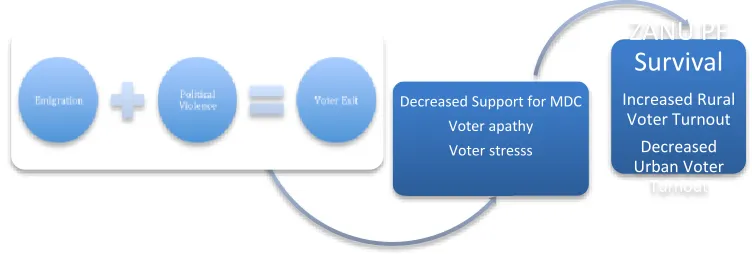
is that the exit of voters due to migration and to violence from the political processes bolstered
the survival of the ZANU-PF regime. In chapter three, I discuss the role of migration in
sustaining the survival of ZANU-PF. I show that the profile of the average Zimbabwean
emigrant – young, urban, and educated – is also the profile of the opposition supporter. Their exit
weakened the opposition base. In chapter four, I discuss the role of violence in Zimbabwean
politics in the last decade. I argue that ZANU-PF employed strategies of intimidation and
violence to suppress opposition turnout all the while mobilizing turnout among their base. In
chapter five, I conclude the project and connect the impact of external and internal exit on the
survival of ZANU-PF in their last decade.
2 AN UNCONSIDERED THEORY OF EXIT AND PARTY SURVIVAL
My theory is that the voluntary and/or involuntary exit of voters from the political
process can serve to bolster ruling parties, weaken opposition support bases, and thus contribute
significantly to ruling party survival. When voters exit their countries in response to unfavorable
conditions, either economic or political, their exit is beneficial to ruling parties that might be
emigrate are more likely to support the opposition over incumbent parties. Large-scale voter
exodus diminished Zimbabweans’ willingness to challenge the regime and lowered support for
the opposition party. I propose that the exit of voters who could not participate in elections
contributed significantly to the survival of ZANU-PF and subsequently to the weakening of
opposition support.
A second part of this argument is that ruling parties also use their monopoly of state
policymaking structures to implement policies that force opposition supporters to exit the
political system. Incumbents make use of intimidation and other forms of electoral fraud to force
opposition supporters to exit the political process, even if they do not emigrate out of the
country. Collier and Vicente (2010) have argued that autocratic parties such as ZANU-PF and
the former ruling People’s Democratic Party (PDP) in Nigeria use violence to mobilize voter
turnout. I add that violence and other fraudulent activities can also be used by incumbents to
suppress the turnout of opposition supporters whilst mobilizing turnout among their own support
base. Intimidation and other acts of election fraud will force opposition voters to withdraw from
politics because the real danger of risking their lives does not outweigh the potential benefits of
the election outcome. Reports of vote fraud and stolen elections can also lead to voter apathy,
especially in situations where the economy is failing and voters are more concerned with
economic survival.
The goal of this chapter is threefold: First, to discuss the existing literature on party
survival and identify significant gaps; second, to identify how each of the previously adopted
theoretical explanations further our understanding of the Zimbabwean situation; and third, to
2.1 Explanations in the literature on party survival
The question of party survival has been explored extensively with works focusing on the
survival and demise of ruling parties such as the Mexican Institutional Revolutionary Party (PRI;
Magaloni, 2006), the Liberal Democratic Party (LDP) in Japan (Scheiner, 2005), and The
Congress Party of India (Riker, 1979). In recent decades, scholars of democratization have
watched with bewilderment in the post-Third Wave era as former advocates for democracy have
turned into autocrats in Africa and much of the developing world. In southern Africa alone, all of
the countries but Zambia and Malawi remain under the rule of the independence party.
2.1.1 Electoral Fraud
The prevailing argument for hegemonic party survival is that the ruling party steals the
election by stuffing the ballot to ensure an electoral win (Huntington, 2006; Levitsky & Way,
2002; S. I. Lindberg, 2006; Magaloni, 2006). Indeed, an explanation of ZANU-PF survival
would be greatly lacking if it did not address the role of electoral fraud in the last decade of
elections. There is a possibility that since 2000 ZANU-PF has engaged in some ballot stuffing to
maintain their electoral wins, but reports from both local and international observers indicate that
ballot counting has been a relatively clean process.3 Low ballot fraud can be explained by the
fact that all the Zimbabwean elections since 2000 have been high-stake elections, drawing the
attention of local political actors and the civil society as well as international observers. The first
critical parliamentary elections were held on June 25, 2000. This was just a few months after the
ruling ZANU-PF had lost the constitutional reform election because of the MDC -ed “Vote-No”
campaign (Staff Writer, 2000). The defeat came as a shock, and although the regime accepted the
results, they accused the opposition of conspiring with foreign forces against Zimbabweans and
of unleashing violence on ZANU-PF supporters. Having faced an earlier defeat during the 2000
constitutional referendum election, the party went into the general elections with a cautious
attitude, but upheld some democratic principles that undermined their ability to steal the election
at the ballot. According to act 161A of the Zimbabwean Electoral Commission, local election
monitors had to be appointed in advance of the election and approved by the Registrar-General.4
The act required that at least four observers be stationed at each of the 535 polling stations and
that all observers receive mandatory training. Both the Commonwealth and EISA reports
indicate that although the accreditation arrangements of local observers took a very long time to
get processed, all the observers were accredited and given training “based on a well prepared
training manual and practical exercises”5 a few weeks before the election. More than twenty
international observer missions applied for permission to participate in the election, and almost
all were given permission and granted access. To be sure, there were major problems of violence
and intimidation before the election, but the days of the election were said to have been peaceful
and presented favorable conditions for an election to take place.
While the ballot counting had been relatively clean, the opposition raised concerns of
ballot-stuffing and the busing of people from rural areas to urban areas. In the most recent
harmonized elections in July 2013, the opposition reported that there had been busing of voters
into former Minister of Finance Tendai Biti’s urban district. Biti presented video evidence of
non-constituency residents at the polls, but the veracity of the video could not be authenticated.
The opposition also reported charges of voter fraud to the Supreme Court, but was unable to
4 The Zimbabwe Electoral Act and related reports were accessed from
http://www.kubatana.net/docs/legisl/zim_elec_comm_act_050114.pdf
5 The Report of the commonwealth observer group
establish with factual evidence that there was ballot stuffing. However, in Zimbabwe, as is the
case in similar countries, it is an open secret that ballot boxes are often tampered with. One local
election observer likened the Zimbabwean election to the infamous Zimmerman trial in the
United States that took place in the same months of the election.
Among the many issues raised prior to the election, one main area of concern was that the
Attorney General, Mr. Mudede, a long time ZANU-PF politburo committee member, refused to
release the electronic version of the voters roll. The opposition and their supporters complained
that the voters roll included “ghost voters” and that some voters had been registered in multiple
constituencies, allowing them to vote twice. These accusations suggest that ZANU-PF is
deliberately tampering with the urban constituencies to shore up their electoral returns in those
areas.
1.1.1.1 The Voters Roll: Registration challenges, “ghost voters,” and absent voters
Critics of the ruling ZANU-PF have in the past decade argued that ZANU-PF uses its
monopoly of state apparatus, in particular the Attorney General’s office – the office responsible
for voter registration – and the voters roll, to rig the elections. Critics claim that ZANU-PF has
rigged the electoral process in almost every election, saying that:
1. Voters, especially urbanites, are turned away from the polling stations because their
names are absent from the voters roll;
2. Voters find out that they are registered to vote when as far as they know they have never
registered to vote; and
3. Voters are not able to register in their voting precinct.
With regard to election fraud complaints related to the voter’s roll, it is important to
are only two official ways in which a voter’s name can end up on the roll. First, those born in or
before 1980 were automatically added onto the voters roll. This was the law under the Smith
regime, and the system was updated just before the independence elections of April 1980 to
ensure that soldiers returning home from the war would be able to register to vote. Second, one
can physically register at the registration center for their ward. As a result, anyone born in 1980
or before that might find their name on the roll even though they never physically registered to
vote. This provision provides clarity on complaints by voters, usually those between the ages of
33 and 45 who have found their names on the voters roll even though they have never
participated in an election or the voter registration process. A person born in 1980 would have
been eligible to vote after 1998, and their first election would have been the 2000 referendum
election. For referendum elections, one does not need to have been registered to vote, and they
would have only learned of their registration a few weeks prior to the presidential election. When
voters were registered at birth, they were automatically registered to vote in their birth precinct.
If they had moved from their original birth home, or if their precinct was redistricted, they would
need to physically update their registration information at the central processing offices in Harare
or Bulawayo. However, in order to process the change of registration voters had to be aware that
they were registered to vote in the first place.
For most urbanites, the first election they voted in was the 2000 election. In Harare and in
the diaspora, I spoke to many urbanites who admitted that prior to the 2000 election they had
largely stayed out of politics, choosing instead to focus on their academics, businesses, or
professional careers. Most discussed their shock at finding their names on the voters roll because
they had not been aware that they were registered at birth, and others bemoaned finding their
for urbanites, rural voters – except those who immigrated to urban areas – did not report facing
the same challenges. This is likely because in most rural villages there tends to be just one voting
precinct. For example, in Victoria Falls where some of the field research was conducted, there is
a rural Victoria Falls and Urban Victoria Falls voting precinct. In the urban area there are about
five voting precincts, and in the rural areas there is just one voting precinct. Let’s say voter A
was registered to vote in Chinotimba for the 2008 election, but relocated to Mkhosana, just two
blocks down the road. Voter A would need to update his registration information to vote in
Mkhoasana on Election Day or return to Chinotimba to cast his vote. Voter B in rural Victoria
Falls does not have the same constraints because all voter registration and voting is done at the
only primary school in Monde Village. Regardless of how many times voter B relocates within
the village, she will remain in the same voting precinct. Unlike urbanites, rural voters tend to live
at the same residency their entire lives. In almost every election there is confusion among urban
voters on their registration status.
In Victoria Falls, when voter registration concerns arise they are typically easily resolved
because the town has a ten kilometer radius, it has a population of less than 30,000, and it is not
difficult to travel between voting centers. However, such administrative problems have grave
implications in larger urban cities, especially in Harare and Bulawayo. During the 2008 and 2013
elections, there were numerous incidents reported of voters turned away from polling stations
because their names were not found on the voters roll. In Harare, people were asked to go to the
central office and verify their original registration precinct. The central office was almost a
two-hour journey for most voters in the furthest parts of Harare, and those who braved public
transportation and the cold weather would have to endure long lines to find out their registration
wards within the same precinct also change more often, while nothing changes in rural areas,
causing more confusion and voter fatigue. The majority of voters interviewed on Election Day
who were among those “turned-away” opted to go home instead of voting. In essence, the
confusing registration laws and inaccessibility of information forced voters to involuntarily exit
the political system.
Let us consider the case of voter C, whom I interviewed on Election Day in Harare. Voter
C travelled from South Africa, where he had been a resident since 2005, two days prior to the
election to vote in the harmonized elections. The last election he had voted in was the 2005
parliamentary election, and since then his family had purchased a home in a different part of
town – about a 30 minute drive from his old home. Prior to the 2008 election, there was a
delimitation (re-districting exercise). With the exception of a single announcement in the Herald
two weeks prior to the election on the new voting precincts, no other information was released,
and the Zimbabwe Electoral Commission (ZEC) announced that the agency was “too broke to
conduct any voter education.” Voter C, having been out of the country when the announcement
was made, was unaware of the precinct changes. Although a resident in Harare full time, voter
C’s spouse was also unaware of the voter precinct changes because, like most urbanites she did
not watch or listen to state media, Herald and ZBC. Therefore, voter C and his wife travelled to
their old voting precinct, only to be informed that their new address had been redistricted and
that the ward authorities at local precincts could not provide them information on their new
voting precinct because local wards did not have access to the computer databases. Only the
central control center in the Central Business District (CBD) could provide that information.
Voter C and his wife, and four other voters to whom they were giving a lift, drove another 30
Fortunately for this voter, he was driving, and because he resided in an affluent, sparsely
populated area, he was able to vote after standing in line for a modest three hours at the correct
precinct. This is not the case for most voters who either reside in densely populated areas or who
do not have a personal vehicle. On average, people would stand in line for over six hours before
they were able to cast their vote. This case study shows that there are major problems with the
registration process, but given that there also major problem in every major administrative office
in Harare, it is difficult to claim that these registration constraints are intentional voter fraud. For
example, it takes at least eight hours to submit an application for a new passport, to obtain birth
certificate for a newborn, or to acquire a driver’s or business license. All these important
documents are also processed at the attorney general’s office, the same office responsible for
voter registration.
The second way in which a person can be added to the voters roll for those born after
1980 is if they physically register to vote. In most developed countries this is a simple enough
exercise, but in Zimbabwe and similar countries this process is often tedious and cumbersome.
Although ZEC lists all-year registration and the availability of the voters roll for inspection on
demand as two of the most important pillars of a democratic electoral process, in reality voter
registration is only open a few weeks before an election and the voters roll is almost always
unavailable for inspection. Between 2000 and 2013, on average, voter registration has been
conducted just a few months before the election. The longest registration period was in 2001
prior to the 2002 elections, when registration was open initially for just ,two months from
October 15 to December 13, 2001. Registration was then extended to January 27, 2002 and
finally to March 2002. Even then, there were complaints, primarily in urban areas, that voter
According to the Norway Observer Mission, the extension to March 3 was only announced in the
Herald morning edition on March 3, 2002 (Norway Observer Mission Election Report). In spite
of these challenges, 5.6 million registered voters appeared on the voters roll. Part of this inflation
can be explained by the conditions of registration discussed above. In 2008, a national mobile
registration exercise was conducted from June 18, 2007, to August 17, 2007. A total of 121,233
new voters were registered for that election, bringing the total of registered voters in the voters
roll to 5,621,464.
In 2013, mobile voter registration was only open initially for 30 days starting on June 10,
2013, in anticipation of the July 31, 2013, elections. As in previous elections the process was
fraught with many problems. Earlier, I discussed the challenges associated with availability of
information and registration centers, In addition to those challenges are challenges related to
access to registration centers for new voters and those voters wanting to update their registration
information. If voters are unable to register, they cannot vote. Once voters are unable to register,
either because of personal choice or registration problems, they are effectively forced to exit the
political system. The claim against ZANU-PF is that they use their control of the registration
processes to discriminate against the urban voter. Hyde et al (2008), in their pioneering work on
election fraud, also identify manipulation of registration laws as one of the chief ways in which
political parties can steal an election to keep themselves in office. I will preempt my analysis by
pointing out there is more work that needs to be done to understand electoral fraud; however,
electoral fraud is only effective if it forces a particular group of voters to exit the political system
or gives an unfair advantage to the supporters of one political party over all others.
In nearly every election since 2000, a recurrent complaint from the opposition, civil
cumbersomeness of the voter registration process. Critics argue that the process is designed to
disadvantage the MDC, whose base is largely resident in urban areas, by making it extremely
difficult for urbanites to register to vote. ZANU-PF elites have been openly hostile towards
urbanites, and it is no surprise that they should be accused of deliberately making voter
registration difficult for urbanites. While these accusations have been accepted as truth, this is
the first work that attempts to provide empirical evidence of the impact of voter registration
difficulties on party survival. I will use data from the 2008 and 2013 elections for this analysis
because data for prior elections has thus far been impossible to acquire.
Voter registration for the July 2013 elections opened on June 10, 2013, and was
scheduled to last for three weeks. In Zimbabwe, once a voter registers to vote, their registration
is valid for the rest of their life unless they change their voting precinct in between elections.
Therefore, voter registration is primarily targeted at new voters, who are usually young, and
voters who need to update their registration information. Ideally, the allocation of registration
centers should be based on not just population size, but also predictions of the population of new
voters and how easy it is for voters to access these centers.
1.1.1.2 Population considerations and access to registration and voting centers
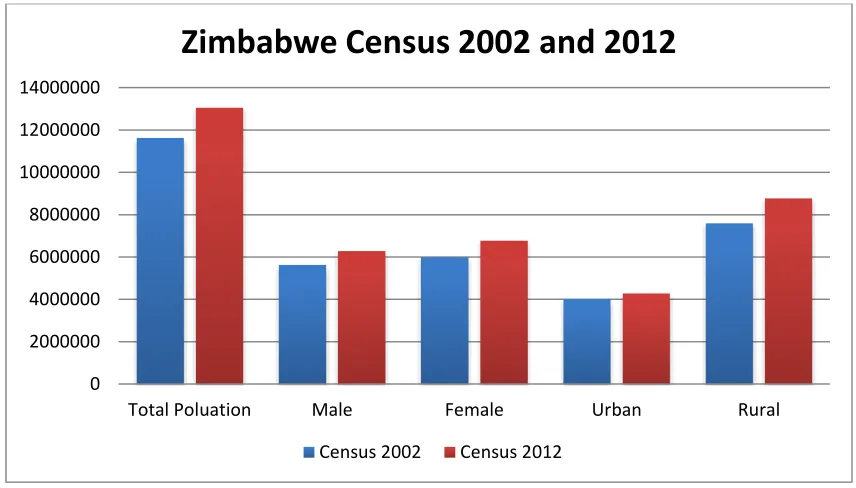
The 2012 census revealed that Zimbabwe’s population had increased from 11,631,657 in
2002 to 13,061,239. The population distribution was equally distributed between males and
females. Of interest and concern with regard to Zimbabwean politics are the different ways in
which ZANU-PF has used their monopoly of state resources to influence the voting behavior of
urban and rural voters. Is what appears to be government bias toward rural voters over urbanites,
an indication of ZANU-PF bias or simply representative of the structure of the Zimbabwean