ScholarWorks @ Georgia State University
ScholarWorks @ Georgia State University
English Dissertations Department of English
Summer 7-15-2011
The Spaces of History: Francis Parkman's Literary Landscapes
The Spaces of History: Francis Parkman's Literary Landscapes
and the Formation of the American Cosmos
and the Formation of the American Cosmos
Florian Schwieger
Georgia State University
Follow this and additional works at: https://scholarworks.gsu.edu/english_diss
Part of the English Language and Literature Commons
Recommended Citation Recommended Citation
Schwieger, Florian, "The Spaces of History: Francis Parkman's Literary Landscapes and the Formation of the American Cosmos." Dissertation, Georgia State University, 2011.
https://scholarworks.gsu.edu/english_diss/74
THE SPACES OF HISTORY: FRANCIS PARKMAN’S LITERARY LANDSCAPES AND
THE FORMATION OF THE AMERICAN COSMOS
by
FLORIAN SCHWIEGER
Under the Direction of Dr. Audrey Goodman and Dr. Robert Sattelmeyer
ABSTRACT
It is the aim of this dissertation to discuss the creation of historiographic space in the works
of Francis Parkman. More specifically, this dissertation intends to analyze Parkman‘s The
Oregon Trail and Montcalm and Wolfe as literary texts that examine geographies of cultural
interaction and transnational empire building. Parkman‘s historical narratives, this dissertation
suggests, not only describe historically significant sites, such as the Oregon Trail and the
Northern Frontier, but further create literary heterotopias.These textual counter geographies, as
for instance his conceptualizations of the trading posts of the far West and the wilderness
fortifications of the far North, allow Parkman to effectively interrogate American history. By
investigating the fruitful juncture between history, geography, and literature this project aims to
establish the importance of historical geographies for Francis Parkman‘s methodology and define
its function for the creation of a national consciousness. In addition to Parkman‘s use of space,
this dissertation further analyzes the historian‘s depiction of historical characters and his
subsequent attempts to define American identity. Thereby, my analysis specifically highlights
trace the impact Parkman‘s historical narratives exert on postmodern authors of American
literature, the concluding chapters interrogate the re-negotiation of Parkman‘s historiographic
spaces in Thomas King‘s Truth and Bright Water and William T. Vollmann‘s Fathers and
Crows.
INDEX WORDS: Francis Parkman, Oregon Trail, Montcalm and Wolfe, Nineteenth-
Century Literature, Literary Criticism, Heterotopias, Historiographic Space,
American History, Geography, Space, French and Indian War, Border
THE SPACES OF HISTORY: FRANCIS PARKMAN’S LITERARY LANDSCAPES AND
THE FORMATION OF THE AMERICAN COSMOS
by
FLORIAN SCHWIEGER
A Thesis Submitted in Partial Fulfillment of the Requirements for the Degree of
Doctor of Philosophy
in the College of Arts and Sciences
Georgia State University
Copyright by
Florian Schwieger
THE SPACES OF HISTORY: FRANCIS PARKMAN’S LITERARY LANDSCAPES AND
THE FORMATION OF THE AMERICAN COSMOS
by
FLORIAN SCHWIEGER
Committee Chairs: Dr. Audrey Goodman and Dr. Robert Sattelmeyer
Committee: Dr. Christopher Kocela
Electronic Version Approved:
Office of Graduate Studies
College of Arts and Sciences
Georgia State University
DEDICATION
ACKNOWLEDGEMENTS
This dissertation is the culmination of a long journey that began over ten years ago in Evessen, Germany and eventually led me to Atlanta, Georgia. Over the course of this journey many people have contributed in one form or another to the eventual completion of this project. First and foremost I would like to thank my family, most importantly my parents Elke and Karl-Heinrich Schwieger for their unwavering love and support. Thank you for believing in me when I picked an exotic field of study and supporting me when I moved to the United States. I will always be grateful for that. I would also like to thank my sister Maren for the many inspirational conversations in person or over the phone and my grandparents, aunts, uncles, and cousins back home for reminding me what is truly important. Special thanks to all of my friends around the globe, but especially to Casey Cater, Malte Gärtner, Stephanie Hass, Grant Kirby, Jan-Fritz Nierste, Jan Saathoff, Martin Schulz, and Volker Soßna (in alphabetical order) for your inspiration and encouragement.
I would also like to express my gratitude to the entire faculty and staff of the English Department at Georgia State University for creating a friendly and encouraging academic environment. In my entire time here I have always felt welcomed and supported, I am very grateful for that. Finally, I would like to thank my advisers Dr. Audrey Goodman, Dr. Robert Sattelmeyer, and Dr. Chris Kocela for their unwavering support and thoughtful guidance. I feel very fortunate that I had the opportunity to work with all of you.
TABLE OF CONTENTS
DEDICATION iv
ACKNOWLEDGEMENTS v
LIST OF FIGURES ix
1 INTRODUCTION 1
1.1 Of New and Other Worlds: American Space 1
1.2 Change of Space 17
1.3 The Interplay of History, Space, and Literature 19
1.4 The Question of Space 25
1.4.1 Leibniz’s Intuitive Intervention 28
1.4.2 Nacheinander and Nebeneinander: The Kantian Order of Space 35
1.5 Historiographic Space 39
1.6 The Question of Temporality in Historical Discourse 47
1.7 The Historical Event: From Erfahrung to Erlebnis 53
1.8 Chapters Outline 58
2 CHAPTER 1: FRANCIS PARKMAN AND THE WRITING OF AMERICA’S PAST
62
2.1 The Invention of the Past: Historiography in America 62
2.2 Biographical Interlude 74
2.3 Francis Parkman’s Historical Method: Romantic Idealism and Humboldtian Crossroads
78
2.4 The Geographic Turn 90
2.5 Sauntering in the Past 97
3 CHAPTER 2: “WESTWARD THE COURSE OF EMPIRE TAKES ITS WAY:” FRANCIS PARKMAN’S THE ORGEON TRAIL
3.1 Prologue: Migrants and Mythmakers 102
3.2 The West as Sensed Space 114
3.2.1 A Space to end all Spaces: the Great American Desert 118
3.2.2 Utopia Unleashed: Fort Leavenworth and Fort Laramie 123
3.2.3 Pastime Paradise and Primordial Prison: The Ogillallah Camp 142
3.3 Trapper, Tourists, and Indian Temptations: People and Place 146
3.3.1 Soulless Savages and Noble Fighters: Native Americans 148
3.3.2 The New American Adam: Guides and Trappers 159
4 CHAPTER 3: AN ATLAS OF FORTS AND FORESTS: FRANCIS PARKMAN’S MONTCLAM AND WOLFE
165
4.1 Prologue: Absolutism Abroad 165
4.2 Montcalm and Wolfe: The Spaces of History 171
4.2.1 Charting Connections: Parkman’s Europe 174
4.2.2 “Et in Arcadia Ego:” New France 176
4.2.3 Castles in the Forest: Canadian Forts 187
4.3 Dystopian Kill Zones: Spaces of War 200
4.3.1 Forest Fighting or Fighting the Forest 202
4.3.2 “In the Shadow of the Season:” Guerilla War 208
4.3.3 “My Land is your Land:” Border War 210
4.3.4 “What went down on the Plains of Abraham:” The Battle of Quebec
215
4.4 Scholar-Soldiers and Man-eating Savages: The Protagonists of Place 220
4.4.1 Sons of the Forest and Friends of the Devil: Native Americans 220
4.4.3 Redcoats: Braddock and Wolfe 232
4.4.4 Rangers, Revolutionaries, and Renaissance Men: American Heroes
235
4.5 Epilogue: Border History 240
5 CHAPTER 4: PARKMAN’S POSTMODERN LEGACY: THOMAS KINGS’S TRUTH AND BRIGHT WATER
242
5.1 Prologue: Crossing the Border Before it’s too late: The U.S.- Canadian Border and Postmodern Literatures
242
5.2 Reservations, Railroad Towns, and a Festival of Consumption: Native American Heterotopias
248
5.3 Simulating Space: Indian Representations 264
5.4 (Un-) Representative Men 271
5.5 Towards a Counter-Geography of the American West: Sacred Spaces
278
6 AFTERWORD 284
6.1 Parkman Redux: William T. Vollmann’s Fathers and Crows 284
6.2 “Et in Arcadia Ego” Ante: De-romanticizing Colonial Geography 290
6.3 Angels of History 296
6.4 Dreaming of Rivers 300
6.5 Unconscious Geographies: Dream Space 304
LIST OF FIGURES
Figure 1.1 Martin Waldseemüller,Universalis Cosmographia Secundum Ptholomaei Traditionem et Americi Vespucii Aliorum Lustrationes (1507).
4
Figure 1.2 Benjamin Wright, Map of New France (1608). 5
Figure 1.3 Gervase Epstorf, The Ebstorf World Map (thirteenth century). 10
Figure 1.4 Virginien; illustration from Olfert Dappert‘s Die Unbekante Neue Welt (1673).
11
Figure 1.5 Friedrich Georg Weitsch, Alexander von Humboldt und Aime Bonpland am Fuß des Vulkans Chimborazo (1810).
16
Figure 2.1 Squaws Guarding Cornfield from Depredations of Blackbirds;carte de visite (circa 1863-1870).
84
Figure 2.2 Tepees of the Sioux Indians, Minnesota; cart de visite (circa 1863).
85
Figure 3.1 Emanuel Gottlieb Leutze, Westward the Course of Empire Takes Its Way (1861).
105
Figure 3.2 Manuscript page of Lansford Hastings‘ The Emigrants’ Guide to Oregon and California (1845).
113
Figure 3.3 Alfred Jacob Miller, Fort Laramie (1858-60).
140
Figure 3.4 Karl Bodmer, Offering of the Mandan Indians (1834).
141
Figure 3.5 Karl Bodmer, Mato-Tope (1834).
157
Figure 3.6 Karl Bodmer, The Interior of the Hut of a Mandan Chief (1834).
158
Figure 4.1 Cartier taking Possession of New France; illustration from John Frost‘s
Pictorial History of America: From the Earliest Times to the Close of the Mexican War (1853).
170
Figure 4.2 Nicolas Poussin, Et in Arcadia Ego (1637-1638).
185
Figure 4.3 Thomas Cole, Evening in Arcadia (1843).
186
Figure 4.4 John Rocque, A Plan of Fort William Henry (1765).
198
Figure 4.5 John Rocque, A Plan of the New Fort at Pittsburgh or Duquesne (1759).
Figure 4.6 Major-General Braddock's Death at the Battle of the Monongahela, 9 July 1755 (nineteenth century).
207
INTRODUCTION
1.1 New and Other Worlds: American Space
―America is therefore the land of the future, where, in the ages that lie before us, the burden of the World's History shall reveal itself.‖ Georg Friedrich Wilhelm Hegel The Philosophy of History
When Rodrigo de Triana aboard the Pinta sighted the coastline of the Bahamas around 2 am
on the morning of October 12 1492 the medieval world ceased to exist. Although neither the
sailor Triana, nor his captain Admiral Christopher Columbus, could possibly foresee the
whirlwind of radical change this event would bring on both the Old World and their inhabitants
and the New World they were about to discover, Columbus had an inclination that his accidental
discovery of America was important. In a journal entry from November 12th Columbus describes
the immense potential of his recent discovery for Spanish colonialism:
Thus your highness should resolve to make them Christians, for I believe
that, the work was begun, in a little time a multitude of nations would be converted to our faith, with the acquisition of great lordships, peoples, and riches for Spain. Without doubt, there is in these lands a vast quantity of gold, and the Indians I have on board do not speak without reason when they say that in these lands there are places where they dig out gold, and wear it on their necks, ears, arms, and legs, the rings being very large. (73)
Although Columbus had failed to achieve his initial goal, the discovery of a seaway to the
Orient, he had succeeded in a far greater task, namely discovering a New World. A world, whose
mythical inhabitants and tales of natural wonders would fascinate the European imagination for
centuries to come while triggering an unparalleled set of political, economic, and geographical
changes. This New World would soon become the physical and imaginary counter-space to a
European world increasingly restricted by intensified urbanization and reckless land use. For its
European explorers and their royal masters, the American continent promised an unprecedented
the arrival of Columbus‘ and Cortez‘ ships marked the beginning of a political, cultural and
spatial conquest that would leave their societies at the brink of extinction.
Before the discovery of the western hemisphere, the world, for the European mind, was a
fairly stable geographical space. It was defined by biblical cartography and organized around
Jerusalem, which was commonly believed to mark the center of God‘s planet. The common
people had little knowledge of distances and abstract notions of space but defined geographical
location in terms of relationship, community, and experience. As a result, Robert Sack explains,
―the Old World viewed territoriality primarily as socially defined‖ (Human Territoriality 131).
Hundreds of years of feudal existence had established a powerful bond between the rural
population and the land they would live and die on. This deep-rooted connection to their fields
and villages was not merely a product of an organically grown sense of belonging, but also the
result of social and geographical immobility and medieval power structures. Bound by divine
law and royal order to their liege lords, medieval serfs had little choice but to develop a deep
connection to the land they could neither escape nor own.
The discovery of America, however, radically changed European notions of space as it
questioned the existing global geography and presented a seemingly untouched and infinite space
that was unbound by the feudal laws that had inflicted a repressive and restrictive model of space
upon the rural population.1 America represented a terra incognita that attracted every form of
European spatial desires while presenting Europeans with a degree of abstract space they were
wholly unfamiliar with. Europeans had never encountered a space so untamed and, from their
1
It is obvious but noteworthy, that the ―discovery‖ of America was not the only event that helped redefine European notions of space during the late fifteenth and sixteenth century. Other contributing factors, such as the rediscovery of the Ptolemaic worldview, the beginning
perspective, empty as the Americas. The new continent thus must be regarded as a condensed
metaphor for the radical changes in the conceptualization of space that occur during the late
fifteenth and early sixteenth century. At the same time, the new world posited an unprecedented
geographical challenge. A simple look at the incomplete and blank maps that show a vast void
beyond the sparsely explored coastal regions reveals the epistemological crisis that resulted from
the exploration of the western hemisphere.
Figure 1.1: Martin Waldseemüller‘s map of America (1507) is believed to be the first work of cartography to use the term ―America‖ to refer to the New World. John R. Hébert labeled described the document as ―the map that named America‖ (―The Map‖) highlighting the
decisive role cartography played in the process of familiarizing Europeans with the recently discovered continent and transforming it from a mysterious landmass known as simply ―the New
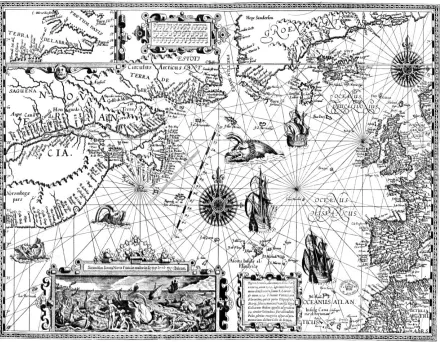
Figure 1.2: Benjamin Wright‘s map of New France (1608) nicely mirrors the inclusion mythological elements into maps of America. In this example, the coast of Nova Scotia is guarded by maritime monsters that are meant to represent both the dangerous waters and the
European concepts of space were simply underequipped to describe the vast American
continent and its wondrous geography. Yet sooner or later the empty spots on the maps of the
New World needed to be filled; to do so European explorers and geographers required a theory
of space that would enable their emperors to develop a firm grip on the continent. What the
triangular trading system, the Encomienda, and the slave trade achieved politically and
economically, the notion of ―blank space‖ accomplished in geographic terms. Within two years
after Columbus‘ maiden voyage to the New World, the first documents that attempt to order
spatial relations in the New World, the Papal Bulls of 1493 and the Treaty of Tordesillas of 1494
were signed. These documents regulated the territorial claims in the Atlantic Ocean, establishing
a distinct sphere of influence for the Portuguese and Spanish crowns in the newly discovered
territories, thereby subjugating the ―blank space‖ of the new continent to the system of
established spatial control that governed the process of colonization. These treatises are
compelling historical witnesses to the imperial implicitness with which the Spanish
conquistadors went to work in the New World and attest to the importance of completing the
military conquest of America on an intellectual level: for the conquest of the New World could
only be completed successfully if this foreign space and the epistemological crisis it had caused
could be controlled with the tools of European cartography.
The method of colonization the European invaders employed differed significantly from
South to North America; and so did the spatial narratives they wrote. The Spanish conquistadors
who followed in the footsteps of Cortez on the Yucatan peninsula and Pizzaro in the Andean
highlands encountered highly developed civilizations such as the Mayans, Aztecs, and Incas that
had erected impressive monuments, temples, and government complexes. These sophisticated
infrastructural support systems reminded the conquistadors of the use of space in their respective
home countries. The North American Indians and their disregard for individual landownership,
on the other hand, posited a spatial enigma for the European settlers. The North American tribes
of the Chesapeake or the Hudson Bay lacked centralized notions of imperial land use and
therefore presented the European arrivers with little recognition value. As a result, as Robert
Sack aptly notes, Native American ―customs and land uses seemed so alien and their political
process so inconspicuous that many Europeans concluded that Indians were sub-human and
could and ought to be removed from the land‖ (133). Immediately, the notion of empty space
that the Europeans superimposed on the North American continent became the foundation for
spatial myths. Early American narratives that evoke America as a ―virgin land‖ and detected a
―manifest destiny‖ in its colonization should thus be understood as the product of the baffling
encounter of European settlers with an understanding and use of space that defied their
geographical imagination. In response to the epistemological challenge of the American space,
thinkers turned, for example, to the ideal space of nature, a rendition of natural space as Edenic
fantasy that liberates the individual from the restrictions of feudal society while returning the self
to a place of heightened spirituality and personal fulfillment. This specifically romantic variation
of ―empty space,‖ which will be discussed in greater detail in my analysis of Parkman‘s The
Oregon Trail and Montcalm and Wolfe, fittingly exemplifies how the discovery and settlement of
the Americas accelerated the development of abstract notions of space that unite physical
concepts of space (void space, absolute space) and ideal notions of space (subjective, intuitive,
transcendental space).
The discovery of America undoubtedly shattered the European mind unlike few other events
Columbus‘ journey, paired with the Copernican revolution of the early sixteenth century, not
only debunked the geocentric worldview but also decentralized the geography of the planet. The
state of epistemological uncertainty that followed the Copernican revelations and their
subsequent validation by Galileo can hardly be imagined by us, but it seems certain that, for
many, human destiny and divine providence had never been less certain. As if the demotion of
the earth to the role of a supporting actor in the great drama of heavenly bodies was not traumatic
enough for the European mind, the discovery of America unmercifully dislocated the geographic
center of the Christian world. Before the discovery of America, Jerusalem was unanimously
perceived as the center of the world from which God‘s grace and with it all human activity
radiated into the far corners of the planet. The Copernican Revolution in conjunction with the
discovery of America eroded that perception beyond repair.
As much as the discovery of the New World in the late fifteenth century sparked a process of
radical astronomical and geographical reordering that would preoccupy European scholars for
centuries, it also produced an increasing desire to depict the newfound geographic realities and
made spatial exploration the main manifestation of empire. Later colonialism and imperialism
continued this trend. Accordingly, printers and book binders in the sixteenth and seventeenth
century responded to the growing appetite for stories from the wondrous continent across the
Atlantic. Travel accounts such as Olfert Dapper‘s Die Unbekante Neue Welt oder Beschreibung
des Welt-teils Amerika, und des Sud-Landes (1673) delighted their readership with ravaging
stories and imaginative illustrations. But not only adventurous travel accounts introduced
Europeans to the far side of the world. Calendars, encyclopedias, and especially geographical
works all contributed in their own way to the vision of America that slowly took shape in the
Ortelius‘ Theatrum oder Schawplatz des Erdbodems: warin die Landttafell der gantzen Weldt,
mit sambt aine der selben kurtze Erklarung zu sehen ist (1572), labor to expand the geographical
imagination of Old World citizens, while others, such as Peter Freytag‘s Grosse
Kalender-Practica/ Auf den von Americanischen Schiffahrten/ Sitten/ Trachten/ Götzendienst/
Grausamkeiten und andern seltzamen Wunder-Begebenheiten handlenden Kalender gerichtet
(1678), familiarize the intrigued reader with the cultures and customs of the oversee colonies.
Some volumes even engage in selective cultural archeology as they anthologize exotic American
tales and rarities, as for example Eberhard Werner Happel‘s Thesaurus Exoticorum. Oder eine
Figure 1.3: Mappa Mundi by Gervase Ebstorf. This world map of the high Middle Ages exemplifies the Judeo-Christian world view and places Jerusalem at the geographical center of
Figure 1.4: Illustration from Olfert Dapper‘s Die Unbekante Neue Welt oder Beschreibung des Welt-teils Amerika, und des Sud-Landes (1673). Dapper‘s resourceful account of America is a colorful example of the literary invention of the New World. The author‘s authoritative account
assures the reader that Native Americans in Virginia adorn their heads with ―snake-tails of rattlesnakes, […] bird-wings […] or the severed hand of a slain enemy‖ (Dapper 158). For clothing, ―they wear wolf and bearskin; sticking their heads through the animal‘s neck, so that the ears of these creatures come to rest on the shoulders, while the muzzles, including the fangs,
Overall, it is safe to say that literary production, in the Old World, in the two hundred years
after Columbus‘ journey to the New World, is characterized by a resourceful process of
intellectual and cartographical occupation from afar. European writers and publishers
spearheaded the literary exploration of America in an attempt to solidify the political and
economic subjugation of the colonies with a narrative of spatial domination. In this process
cartography became an especially productive tool as it not only reflected the ongoing
appropriation of the transatlantic world by European empires, but also announced future claims
for spatial expansion. While the literary and cartographic response to Columbus aimed at
familiarizing its readership with the New World, maps and travel reports were also designed to
validate European control, both politically and intellectually, over the terra incognita. Despite the
immediate attention intellectuals paid to the Americas, it would take a good three hundred years
before another explorer would complete the process with the recently sharpened tools of science.
At 6:30 pm on June 5th 1799, the Pizarro, a Spanish corvette, passed the familiar coal light in
the Tower of Hercules that for centuries had guided sailors safely to the port of La Coruna. This
time, however, the men on board the Pizarro did not look joyfully towards the reassuring flame
for safe guidance home. Instead, their eyes were fixed at the ancient light house in the knowledge
that this dim light would be the last image of their European homeland they would see for a very
long time. Among the men who lined the rails on this foggy June night was the young German
scientist and mining expert Alexander von Humboldt and his friend and colleague
Aime-Jacques-Alexandre Bonpland, a twenty-five year old French Botanist. Humboldt had attempted
to secure funding for his journey to the New World for years and finally succeeded in obtaining
such support from the Spanish court of Charles IV. Humboldt had long dreamed of a scientific
including the threat of British attacks, he must have been elated to finally embark on the journey.
But even Humboldt felt the melancholy of the moment, the uncertainty of the journey‘s outcome,
and the challenge a close encounter with the mysterious continent beyond the horizon presented
for each individual involved: In his account of the Pizarro‘s departure, Humboldt writes:
―Separated from the objects of our dearest affections, and entering into a new life, we are forced
to fall back on ourselves, and we feel more isolated than we have ever felt before‖ (Humboldt
19).
Little did Humboldt, or his men, know that it would indeed be more than five years before
they would return to the French port of Bordeaux. But when he returned, his exploration was
immediately recognized as one of the most daring and significant scientific accomplishments of
recent history. In fact, it was Humboldt‘s scientific exploration of the Americas that ignited a
humanist and scientific passion for the many still unexplained mysteries of the transatlantic
world.
On board the Santa Maria, Pinta, and Nina were a ragtag crew of eighty-seven men, many of
them former soldiers, convicts, and swineherds. Humboldt‘s ship was loaded with the latest
scientific instruments available: sextants, telescopes, hygrometers, barometers, electrometers. All
in all over fifty different tools that would aid him in the meticulous research he had planned. The
difference between the two explorers could not have been any more pronounced. Columbus,
Cortez, Pizarro, and the other protagonists of the American conquista claimed the continent for
the Spanish crown with the bloody sword of colonial subjugation. Humboldt‘s journey, in
contrast, was driven by the desire to understand the alien continent and unlock its secrets for the
sake of all mankind. In the introduction to his Personal Narrative Humboldt explains the
Historique. I wanted to make known the countries I visited, and to collect those facts that helped
to elucidate the new science vaguely named Natural History of the World, Theory of the Earth,
or Physical Geography‖ (5).
The statement validates the assertion that Humboldt‘s unprecedented explorations of the
South American interior continued the century-long struggle of European explorers and
intellectuals to make sense of a world that had remained, despite colonial subjugation, so
different and desirable to the Europeans. However, it also mirrors the fact that this second
discovery of America marks a decisive turn in the geographical imagining of the Americas.
Indeed, Humboldt‘s entire journey must be understood as a grand geographic excursion that
posits geography, the study of the earth and its people, as the key to Humboldt‘s proposed
redefinition of science as an interdisciplinary, interconnect study of the planet.
The observations and sketches Humboldt published after his return to the Old World
presented the Americas as an even greater spatial enigma than previously envisioned. Humboldt
understood that America was much more than a formerly blank slate on a map, inhabited by
primitive societies and wondrous creatures that had to be explained in relation to European
standards. He immediately realized that the Americas inherently negated, even after hundreds of
years of Spanish, Portuguese, Dutch, French, and English colonization, European notions of
space and thereby opened up the possibility of perceiving what Laura Dassow Walls termed ―the
interconnections of all phenomena‖ (13). By doing so, Humboldt perceived the New World as a
metaphor for the cosmos, a space that if studied rather than subdued could reveal much valuable
insights about the human production of space as well as our metaphysical relation to it. The new
appreciation of American space Humboldt advocated urged his readers to understand nature as a
study of the natural geography but also counter the ideology of conquest that had dominated
European spatial discourse.
Unlike the Columbian discovery of America in the late fifteenth century, Humboldt‘s journey
to the Americas also benefited the population of the New World. Humboldt‘s humanist
principles permeate his expedition logs and observations, resulting in a surprisingly respectful
portrayal of any indigenous culture he encounters. For him, the inhabitants of the Amazon basin
and the Andean highlands are not uncivilized savages, but simply different people with their
unique cultures and practices. Humboldt‘s scientific discovery of the Americas thus also played a
decisive role in the conceptualization of American culture in Europe and the Americas
themselves. Humboldt taught Europeans and Americans alike, as Laura Dassow Walls pointedly
observes, to see America ―on its own terms, not as an artifact of Europe‘s making or an
appendage to its power‖ (16). Humboldt ―literally put America on the global map, positioning its
history, nations, and resources in relation to the rest of the world, and drawing the detailed and
extensive maps by which America could find, and know, themselves‖ (Walls 17). Probably
nothing expresses Humboldt‘s significance for the American continent better than the following
excerpt from a poem that Oliver Wendell Homes delivered at the celebration of Humboldt‘s one
hundredth birthday on September 14 1864 in memory of the great scientist and explorer:
Figure 1.5: Friedrich Georg Weitsch‘s painting Alexander von Humboldt und Aime Bonpland am Fuß des Vulkans Chimborazo (1810) shows Humboldt during his South America expedition interacting with the indigenous population. Humboldt‘s expeditions inaugurated
1.2 Change of Space
The discovery of America in the fifteenth century and its scientific rediscovery in the
eighteenth and nineteenth century strikingly show the inherent bond between constant changes in
spatial knowledge and the conceptualization and understanding of space. Every new discovery,
may it have been a continent or a species of plants, challenged the epistemological status quo of
the Early Modern European mind. Map makers and scientists were continuously forced to
rethink the accepted contours of the known world and start over the Sisyphean task of depicting a
world in flux. But the period of colonial expansion is just one example of the unstable ground on
which our perception of space is built. In the last century, for example, smaller, nonetheless
equally radical, caesuras have impacted our understanding of space. The reorganization of
political geographies triggered by events such as the two World Wars, the process of
decolonization, and the fall of the Berlin Wall and the subsequent disintegration of the Soviet
Union forced us to question the durability of spatial realities. In addition to political and social
changes, environmental threats to our living spaces such as flooding, global warming, radical
deforestation, tsunamis, and hurricanes continue to threaten the very existence of entire
geographical regions. Radical transformations of our immediate political and physical geography
naturally remind us of the inextricable link between human existence and space. Contemporary
thinkers, however, have become increasingly aware of the interrelation of time, being, and space
also because the human experience of postmodern reality is marked by the rapid disappearance
of space. In contrast to the period of colonial expansion, in which the colonizing countries
experienced a continual expansion of their spatial horizon (to the detriment of the colonized),
urbanization increasingly mark the postmodern existence as a spatial retreat into imagined or
hyper spaces.
It is of course not true that space actually disappears, but we perceive it as such because the
illusion of temporal simultaneity that had been achieved at the end of the nineteenth century,
now, in the twenty-first century, has been complemented with the simultaneity of space. In fact,
the postmodern individual experiences space either as an artificial simulation or as absence.
Technologies such as computers, webcams, and cell phones create an unparalleled sensation of
spatial simultaneity, enabling individuals to virtually overcome geographical distance. Despite
the illusion of unlimited spatial mobility, the fact remains that the postmodern individual is
increasingly stationary. In actuality, the simulation of space replaces the actual experience of
space, thereby disconnecting the individual from the necessary spatial component of human
experience.2
2
In a sense, postmodern means of communication that produce simulations of spatial
1.3 The Interplay of History, Space and Literature
―Du siehst mein Sohn, zum Raum wird hier die Zeit.‖ Richard Wagner Parsifal
Recently, scholars of historiographic metafiction began to focus on the formation of history
as the encounter between cultures within a specific spatio-temporal setting.3 Often regionally
specialized, authors like Samuel Truett, James R. Giles, Blake Allmendinger, Neil Campbell, or
William R. Handley continued the groundwork of theorists such as Michel Foucault and Hayden
White to challenge both historical and geographical empiricism by replacing monocausationist
national historiography with a paratactic mosaic of human interaction lived out in the cultural
hybrid spaces of postmodernity. James R. Giles‘ The Spaces of Violence, for instance, rewrites
the history of American space as the violent encounter of varying cultural groups and individuals
entering an entropic landscape in search for self-fulfillment. Krista Comer, in Landscapes of the
New West, foregrounds the need for revisiting the spatial historiography of the West and thereby
illuminates the fruitful intersection between the historical and spatial imagination. History,
3
Other important tendencies in the scholarship of postmodern literature‘s relation to history that have influenced this project include the works of Amy Elias, Marianne DeKoven, Hans Kellner, Frank Ankersmit, Peter Nabokov, or Cheryl Walker, to name a few. Amy Elias traces the
postmodern obsession with the past and conceives a notion of the postmodern sublime as historiographic intervention. Elias locates a critical potential within the desire for history that, if unleashed, can recover the fruitful intersection of philosophy, history, and literature. Similarly, Marianne DeKoven, in Utopia Limited: The Sixties and the Emergence of the Postmodern, describes contemporary literature and culture as post-utopian. DeKoven argues that society is permeated with a post-utopian consciousness that creates particularized, single-issue revolutions rather than large scale opposition movements. Embracing an ―utopia limited‖ (DeKoven 21) further means to reinvest individual action with social and historical significance, thereby unsettling the amalgamative tendencies of historical memory. Whereas both Elias and DeKoven interrogate the specific relationship between postmodernity, its various literary and cultural expressions, and historical thinking, Frank Ankersmit, Hans Kellner, Ellen Fitzpatrick, Peter Nabokov, or Cheryl Walker challenge the theoretical foundations of historiography itself. Kellner and Ankersmit advocate a return to a philosophy of history, while Fitzpatrick analyses the varying stages of American historiography. Nabokov and Walker seem particularly
according to Krista Comer, Harold P. Simonson, Roger A. Hall, or José E. Limon, is at all times
the combination of human interaction, geographic location and temporality, and it is only if the
historiographer acknowledges the inseparable union of this triad that historical representation can
be both vibrant and valuable. As diverse as the above outlined tendencies in historiographic
writing are, they do have one thing in common: namely, that they are not entirely new. In fact,
the core assumptions of postmodern theories of history, the acknowledgement of narrativity,
trans-cultural and transnational encounters, and the imagination (among others), were once the
pillars of historical writing.
Romantic historians in the middle of the nineteenth century embraced these seemingly
postmodern assumptions as a genuine form of narrating the past without, of course, claiming that
these myth-histories would describe the past, as Ranke would say, ―wie sie eigentlich gewesen
ist‖ (as it actually happened). Instead, the epic encounters of Montcalm and Wolfe on the Plains
of Abraham, or Cortez and Montezuma on the steps of the great temple of Tenochtitlan, were
progressive fables, intended to explain the course of history according to the gospel of American
exceptionalism. The protagonists of these tragic tales of conquest and conflict were
―representative men‖ (Levin History 52) and idealized literary characters. Chattillon, Pontiac,
Montcalm, Wolfe, or Frontenac all served as supreme historical subjects. They were both models
of civil virtue and individual bravery and consequently romanticized as mythical forefathers of
the American spirit and defendants of the progressive law of history. Montcalm and Wolfe and
The Conspiracy of Pontiac and many other seminal texts of nineteen century American
historicism, such as William H. Prescott‘s History of the Conquest of Mexico or George
Bancroft‘s The History of the United States from the Discovery of the Continent, thus reflect the
to the exploits of identifiable individuals in a social structure peculiarly stratified and peculiarly
dependent on its leaders‖ (Pease 42). However, these historical narratives also exemplify the
conviction of romantic historicism that both history and literature depend on great characters.
Nineteenth century historians realized the importance of characters for the formation of
national history as living, feeling, and sensing witnesses to the emergence of a distinctly
American identity. They allowed the readers to project their own longing for cultural
independence from European traditions while announcing the necessity of a corresponding space
in which this newfound identity could be acted out. For Francis Parkman, the entire history of
America was, in fact, the history of the constant assault on the American forest and its
inhabitants. It was in the vast wilderness of New France that Parkman located the battle between
liberty and absolutism which ultimately generated the revolutionary American spirit.4 Similarly,
Prescott‘s depiction of Mexico inscribed the image of an effeminate Hispanic culture that was
both morally and physically inferior to its conquerors into the American consciousness of the
time, while placing the indigenous population of the Americas on the lowest possible ladder of
civilization. The interplay of a romantic theory of cultural independence thus coincided with the
creation of a mythical geography of conquest.
The ―geographical turn‖ in American historical writing of the nineteenth century is, of
course, closely related to the continuing effort to expand and secure the boundaries of the young
nation. In the course of the nineteenth century territorial accords, such as the Louisiana Purchase,
the incorporation of Texas and California, or even the acquisition of the Alaska territory,
4
significantly altered the geographical make-up of the United States while producing a host of
spatial ideologies that went along with it (manifest destiny, westward expansion, frontier myth
etc.). In this expansionist political climate, questions of space dominated the public discourse of
the time and subsequently permeated the academic disciplines. Interestingly, the increasing
interest in a cross-disciplinary approach to history was not limited to the United States but also
found enthusiastic proponents on the other side of the Atlantic. In fact, a brief look at some of the
prolific historical writers on the continent (for example Michelet, Macaulay, Curtius, Marsh,
Mommsen, Droysen, Humboldt, Stanley, and Ritter) shows that geographical introductions and
detailed maps became the fashionable way to open a historical study. Specifically Michelet‘s
Histoire de France (1833) was a significant moment in the assertion of space into the discipline
of history. His text, as H.C. Darby rightfully notes, almost single-handedly extended the
historical ―vision until it came to include almost every aspect of human endeavour, social and
economic‖ (35). By the late nineteenth century the geographical vogue had changed the
profession so profoundly that the term geography now adorned the title pages of historical texts.
In 1894 George Adam Smith published the Historical Geography of the Holy Land (1894), and
nine years later A.P. Brigham‘s Geographic Influences in American History and E.C. Semple‘s
American History and its Geographic Conditions (1903) announced the inextricable bond
between geography and history. Based on the abundance of cross-disciplinary studies at the turn
of the twentieth century, some scholars, such as Schlögel, even went so far as to identify a
―simultaneous trans-border international discourse on space, territory, borders, location, and
networks around 1900‖ (7). At the very least, however, we can safely assert that geography and
The interest in geography at the turn of the nineteenth century was, however, not limited to
the discipline of history, but permeated the literary discourse as well. Beginning with the
Romantic Movement, writers rediscovered their natural surrounding as a source of artistic
inspiration as well as a worthy subject for creative contemplation. While the Romantics yearned
for a return to an Edenic state of nature, the succeeding generation of realist and naturalist
writers were bend to uncover the depravities of an increasingly industrialized world by analyzing
the space responsible for moral and ethical decay: the city. As the nineteenth century drew to a
close, European authors like Emile Zola, Henrik Ibsen, Nikolai Gogol, and Gerhart Hauptmann
traced the merciless machine of modern capitalism and the impact on its victims.
Simultaneously, in the New World, bleak accounts of the rapidly changing face of American
society replaced the ―Psalm of Life‖ of the American Renaissance. Writers such as Stephen
Crane, Frank Norris, William Dean Howells, and Upton Sinclair, to only name a few, now
focused on an analysis of the urban geography of modern America and often announced the
focus of their inquiry in the titles to their works thereby mirroring the trend in historical writing.
Crane‘s Maggie, A Girl of the Street (1893), Norris‘ McTeague, A Story of San Francisco
(1899), and Sinclair‘s The Jungle (1906) are only three examples of this fashionable practice.
While the later chapters of this dissertation are certainly designed to show the connection of
postmodern writers to their nineteenth century predecessors, thereby uncovering a geographical
tradition within American discourse, this project also proposes a shared conceptualization of
space among the two. Literary figures such as Parkman, similar to his postmodern counterparts
Thomas King and William T. Vollmann, perceived nature as a sensed, relational space. This
perception of space, as we will see in the following, is uniquely individual because it is
individual interpretation of material objects in a time-space relation and consequently can neither
1.4 The Question of Space
―Beyond‘ signifies spatial distance, marks progress, promises the future; but our intimations of exceeding the barrier or boundary- the very act of going beyond- are unknowable, unpresentable, without a return to the ‗present‘ which, in the process of repetition, becomes disjunct and displaced.‖ Homi K. Bhabba The Location of Culture
It is one of the premises of this project that geography and history are inextricably
interwoven disciplines. The claim that the study of history presupposes an acknowledgment of
the spatial dimension and vice versa is, of course, not just the result of the ―spatial turn‖ in
critical theory. Although the works of Henri Lefebvre, Edward Soja, Michel Foucault, and David
Harvey have undoubtedly helped to reintroduce the question of space into postmodern
philosophy, social theory, historiography, and economics alike, the interdisciplinary study of
space had, as we have seen, a much longer tradition in American and European thought. The
return to a geographical discourse had, however, become necessary because the early twentieth
century had previously abandoned the interdisciplinary approach of the late nineteenth century.
Instead of continuing the trend of prominent nineteenth-century historians outlined above, the
acknowledgment of, what Leibniz called, ―sensed space‖ as a fundamental building block for
human existence and its study, spatial thinkers turned to a mathematical understanding of space
that effectively severed the link between history and geography. This post-Einsteinian
understanding of space characteristic of the first half of the twentieth century described space as
a universal signifier, a mere frame of reference, that had little effect on and even less significance
to the individuals inhabiting it. By doing so, the relational quality of space so crucial for the
historical and literary writers of the romantic period had been erased from the theoretical debate.
The accomplishment of postmodern theorists of space such as Foucault, Soja, and Harvey thus
insights for the study of human history, and that nineteenth century writers had something useful
to say about it.
Historically speaking, the first concepts of space were based on the dependency of human
existence on their immediate surroundings. Robert Sack calls this natural space where people are
linked to the land ―a primitive space alive with the spirits and history of the people‖
(Conceptions of Space 22). This concept of space is marked by tribal practices, inhabited by
nomadic hunters and gatherers who dwell in temporary camps. In this archetypal space, which
Deleuze and Guattari described as a ―great ungendered stasis‖ (155) physical space and natural
space are one. In these pre-industrial societies physical space (the world of geographical,
biological and physical phenomena) is relegated to the absolute space of nature. In the discussion
of Parkman‘s The Oregon Trail we will see how the hunting camps of the Dakotas evoke this
concept of ―primitive space‖ (Sack 22).
What is crucial to understand here, however, is the fact that scholars like Sack claim that
humans, from the very beginning, conceived space as a geographical location and a mental
concept. Even the seemingly undifferentiated space of first nature serves, according to Rob
Shields, already as a representation of space because it revolves around the distinction between
nature and wilderness (172). As a mental concept, space is always concerned with ontological
discourse; for a discourse on space is not only concerned with the human element within a spatial
paradigm, it is first of all produced by humans. The study and practice of space is thus an
ontological inquiry in that it investigates the manifestation of being within a particular time and
space, while simultaneously participating in the very object of its inquiry. It is because of this
inextricable relation between being and space, that my analysis of historiographic space in this
texts.5 In particular, this study will show how spatially-aware authors, such as Parkman, King,
and Vollmann use their characters as a means to investigate the interplay between ontology and
space while advancing a theory of sensed space and an understanding of space as the intersection
of geographical location, cultural interaction, and the individual interpretation of material objects
and events in a time-space correlation.
Exactly because spatialization reveals ontological information and vice versa, models of
space underwent significant changes as human existence alienated itself further and further from
its natural habitat. As nomadic tribes were replaced by empires, kingdoms, and later nation
states, spatial concepts became ever increasingly abstracted from any reference to natural space.
Newton‘s revolutionary distinction between absolute and relative space finally completed this
spatialization of denaturalization and laid the foundation of a spatial discourse void of location.
In the early nineteenth century, thinkers such as Georg Riemann in Germany and his colleague
William Clifford in England continued the mathematization of space that Newton had begun,
defining space as a transcendental category. Now, space could be understood as an absolute
category liberated from the human element. By the end of the nineteenth century, this notion of
space as a purely mathematical system of reference could now include such concepts as ―social
space,‖ a term first coined by Emile Durkheim in the eighteen-nineties. Social space, as much as
mental spaces (utopias, dystopias etc.), are almost, if not completely, removed from location.
This continual abstraction of space into a model of dislocation, describes, in fact, the shift from
the experience of place to the discourse of space. Space was no longer perceived as a dwelling
5
place or the site in which human life unfolds, but as mathematical category that existed
independently.
This discourse of space, the attempt to theoretically describe and define the nature and
production of various spaces and its components, of course always existed. From Aristotle to
Zeno, all major philosophical figures of antiquity attempted to describe the constituent parts of
material nature, the existence of absolute spaces (like the universe) and its relationship to and
reception by the human consciousness. It is, however, during the enlightenment that
mathematicians, physicists, and philosophers alike shaped our contemporary understanding of
space. It seems therefore necessary to revisit two turning points in the history of spatial
discourse.
1.4.1 Leibniz’s Intuitive Intervention
―The true criterion regarding the objects of the senses is the connection between phenomena, that is to say the linking up of what occurs in
different places and times, and in the experience of different men, who are themselves very important phenomena to one another.‖
Gottfried Wilhelm Leibniz New Essays
Challenged by the speedy transformation of the natural space surrounding them (through the
rapidly increasing industrialization of the European mainland, the ensuing transportation
revolution, and the rise of the urban landscape, to only name a few factors that altered the
geographical surface of the world), enlightenment thinkers were forced to reevaluate the
philosophical foundations of spatial theories. The ensuing debate that was fought with equal
vigor by proponents of the philosophical and the mathematical camp, focused primarily on
Aristotle‘s twofold theory of nature. Aristotle argued that there are two possible positions on the
subject. The first concept posits that nature includes more than matter, in which case there must
the basic substance that exists in nature besides, or before, matter, while matter itself is examined
by physics. The second concept Aristotle proposes argues that nature only includes matter and
consequently physics becomes first philosophy (Garnett 9).
While Aristotle‘s philosophy had dominated the intellectual inquiry into matters of space and
nature for centuries, a new generation of enlightenment thinkers perceived the classical model as
increasingly unfit to sufficiently explain a world transformed by ground-breaking discoveries
such as the laws of planetary motion (Kepler 1609), the infinitesimal calculus (Leibniz, Newton
1675), and the law of universal gravitation (Newton 1687). These scientific innovations,
especially in the context of the radical social and economic changes outlined above, certainly
challenged established understandings of the physical universe in general and the
conceptualization of human and natural space in particular. This process of the scientification of
early modern society, however, gradually pervaded philosophical discourse and successfully
established the scientific method as a valid metaphysical methodology. Specifically, René
Descartes‘ publication of The Discourse on Method in 1637 announced the discontent with
traditional philosophy among a growing number of scientifically minded scholars. For Descartes,
philosophy and theology, in their present form, had become ineffective because they have ―been
studied for many centuries by the most outstanding minds without having produced anything
which is not in dispute and consequently doubtful and uncertain‖ (8). Subsequently, Descartes
proposed a combination of scientific empiricism and philosophical intuition aiming at
establishing the mathematical rigor and certainty of algebra and geometry at the center of any
philosophical inquiry. Although Descartes‘ work did not trigger a univocal scientific revolution
of philosophy, it most certainly inspired the development of European rationalism and
Descartes for his lack of scientific rigidity, rationalists such as Spinoza and Leibniz further
developed the Cartesian dualism of the mental and physical world.
Among the second generation of rationalists, the German mathematician and philosopher
Gottfried Wilhelm Leibniz (1646-1716), along with his English contemporary Isaac Newton,
stands out as one of the most influential and innovative guardians of Descartes‘ legacy. While
Leibniz‘s philosophy by no means marks a categorical continuation of Descartes‘ Discourse
(many of Leibniz‘s theories, in fact, directly critique Descartes‘ dualistic model), Leibniz is
certainly influenced by Descartes‘ concept of space. Specifically, Leibniz was intrigued by the
principle of Cartesian extension as it laid the foundation for Leibniz concept of sensed space.
In his Meditations Concerning First Philosophy (1641), Descartes discussed how questioning
all things material and immaterial will lead ―our minds to become independent of the senses‖
(71). This step, he believed was essential to clear the scientific mind from false opinion and
uncertain assumptions that had been ―acquired from the senses or by means of the senses‖
(Descartes 76).
Over the course of the Meditations, Descartes develops this initial differentiation between the
mind and the senses into a dualistic system that differentiates two faculties of knowledge: the
intellect and the imagination. The intellect, according to Descartes, is concerned with entirely
abstract entities, such as reason, doubt, or ideas, and rejects assumptions derived from the senses,
as they are mere representations. Further, the intellect considers simple natures, the smallest
building block for knowledge that can only be understood directly and intuitively by the intellect.
The imagination, on the other hand, projects images of the corporeal world, such as ―the shape of
extended things, their quantity, or size and number, and also the place they are, the time that
While Descartes considered the intellect the superior faculty, he also recognized that there is
an inherent interdependence between the two. The intellect is capable to interrogate concepts or
ideas symbolically represented by the imagination, and thereby relate to the concrete
manifestations offered (faulty or not) by the senses. It is, however, incapable of representing the
abstract entities it considers and therefore dependent on the imagination to convert these general,
abstract articles into ―specific magnitudes‖ (110). Therefore, as Stephen Gaukroger nicely
summarized, the intellect depends on the imagination ―because the intellect by itself has no
relation to the world at all. Entities conceived in the intellect are indeterminate. The imagination
is required to render them determinate‖ (Gaukroger 110). In his Rules for the Direction on the
Mind (written in 1628-29, published in 1701), Descartes further explained the relationship
between the intellect and the imagination by highlighting the principle of extension. Descartes
explains:
By ―extension‖ we understand everything which has length, breadth, and depth, without inquiring whether it is really a body or only a space, nor does it seem to need more explanation, since there is nothing more easily perceived by our imagination […] The abstract entities, therefore, such as extension, are never formed in the imagination apart from something which is extended, whatever the intellect believes about the truth of the matter. And because we are to do nothing from this point on without the aid of the imagination, it is useful to distinguish carefully the ideas by which the meaning of the several words are represented to our intellect. For this reason we propose for
consideration these three ways of speaking: ―extension occupies space,‖ ―body has extension,‖ and extension is not body. (Descartes 214-215)
Descartes‘ concept of extension refers to the imaginative perception of an abstract entity through
the senses. Thereby, the intellectually formed, indeterminate idea is rendered determinate as a
specific magnitude and extends into the sensually perceivable realm of the imagination.
Uniquely, Descartes‘ theory of extension bridges the dichotomy between the intellect and the
ideas made manifest in a perceivable reality with the help of intuitive imagination. It is this
notion of Cartesian extension that would inspire Leibniz to formulate his theory of sensed space.
For Leibniz, as for Descartes, there is no universal space. Both thinkers reject the notion of
void space, because it presupposes that bodies are completely at rest or fixed. However, since no
body can ever be absolutely at rest there is no such thing as universal space (Garnett 56). By
rejecting the notion of a universal, or void, space, Leibniz resolutely opposes Aristotle‘s first
concept of nature and thereby effectively excludes philosophy from the discourse of space.
Instead, Leibniz identifies mathematics and physics as the only disciplines to adequately frame
the question of space (as much as the question of philosophy thereby indirectly acknowledging
the philosophical nature of spatial discourse). In his rejection of void space, Leibniz opposes
Newton‘s assertion that space can exist without matter.
Although Leibniz and Newton diverge on the question of void space, it is crucial to point out
the significance of Newton‘s thought because it adds an important methodological observation to
the conceptualization of space. Although space can exist without matter, Newton argues,
material objects require a space in which they are located. Therefore we have to distinguish
between absolute and relative space. Newton writes: ―All things are placed in time as to order of
succession; and in space as to order of situation‖ (qtd. in Northrop 427). Consequently we can
assert that while Leibniz regards space as a subject of mechanical science, Newton acknowledges
the possibility of a philosophical discourse of science by emphasizing the laws of contradiction
and sufficient reason.
Although it seems, after a first glimpse into Leibniz‘s spatial theory, that the German
mathematician had little interest in the ontological qualities of spatial discourse as far as it relates
Communication of Substances, and of the Union of the Soul and Body‖ an anonymously
published article in the Journal des Savants (1695), Leibniz explains, unexpectedly, his
conviction that empirically verifiable matter alone proves insufficient as the foundation for a
theory of space:
I perceived that it is impossible to find the principles of a true unity in matter alone, or in what is only passive, since everything in it is only a collection or aggregation of parts to infinity…I found then that their nature consists in force, and that from this there follows something analogous to sensation and appetite, so that we must conceive of them on the model of the notion we have of souls. (139)
Surprisingly, Leibniz‘s essay evokes inherently intuitive qualities to describe the interplay of
matter and space that echo the principle of Cartesian extension; traits such as ―sensation,‖
―appetite,‖ and even ―the soul.‖ The unity between matter and space that Leibniz proposes in his
transcendental idealism, is thus created through the interplay of empirical data, matter and the
intuition, perceived through the senses of the individual and mediated by reason. Leibniz‘s
―intuitive spatial turn‖ then marks a decisive step in the redefinition of space, for it validates the
importance of identity, intuition and reason for the spatial discourse of the enlightenment.
Introducing the principles of transcendental idealism to the debate is certainly one of the key
achievements of Leibniz‘s spatial thinking. This is, however, not the only innovation Leibniz
contributed to the debate at the end of the seventeenth century. In addition, and important for my
understanding of space employed in this project, Leibniz insisted on a crucial distinction in the
theory of space: the difference between a sensed space, an individually perceived space or nature
(a concept of nature that is uniquely private), and an absolute space, a mathematically and
scientifically perceived and absolute space of matter. This distinction is vital to understand, as it
is the sensed places of history that are analyzed in this dissertation. If nature is perceived as a
subjective interpretation of an appearance. In this regard, sensed space is the individual
interpretation of material objects in a time-space relation. Consequently, sensed space can neither
be scientifically reproduced nor universally generalized. In contrast, the notion of scientifically
verifiable, mathematical space is the subject of science, and should not be confused with the
object of this inquiry, which is solely focused on the investigation of sensed space and its
individualized manifestation in a specific temporal setting. Whereas the distinction between the
two is crucial, the tragic fallacy of the epistemology of space is, as Northrop rightfully notes, to
explain sensed space as merely the appearance of empirically verifiable, absolute space (445). In
a sense, and in contrast to Newton, Leibniz therefore rejects the notion of a mathematically
verifiable absolute space in favor of a concept of space that is reliant upon the human
consciousness as a formative force. For him space is ―the relatedness of phenomenal matter
within the content of consciousness of the individual monad‖ (Northrop 438). This ultimate and
inherent bond between space and consciousness does not, however, simply reproduce the
Cartesian dualism of mental and physical space. Instead, Leibniz‘s assertion that the production
of space is inextricably bound to the human consciousness introduces a new form of space that is
concerned less with actual physical reality (actual space) than with the unlimited amount of
possible spaces produced by the human consciousness (ideal spaces).
Leibniz‘s assertion of ideal space marks a significant intervention in the increasingly
scientific spatial discourse of the enlightenment, for it asserts that knowledge of and about space
is different from the scientific observation of matter. This differentiation between spatial
knowledge and scientific knowledge rests on Leibniz‘s observation that space is observed
assessment.6 In addition to asserting the intuitive component of spatial production, Leibniz
identified another characteristic that is crucial for my understanding of space in this study: the
fact that space, as a result of the interplay between observable matter and intuitive perception,
involves an element of abstraction and is therefore fictitious in nature. Space for Leibniz, Garnett
clarifies, ―is universalized place. Both space and places are metaphysically unreal; both are
abstract, but space, involving a certain presupposition which contradicts the nature of
phenomena, is, in addition, fictitious‖ (Garnett 55).
1.4.2 Nacheinander and Nebeneinander: The Kantian Order of Space
―It is evident that instead of the determination of space following from the positions of the parts of matter relatively to one another, these latter follow from the former.‖
―Space is metaphysically unreal.‖ Immanuel Kant On the First Grounds of the Distinction of Regions in Space
Although this is not a book on the development of theories of space during the
enlightenment, it is necessary to highlight, in detail, the contributions of one more thinker to the
discourse on space: Immanuel Kant. Both Kant and Leibniz believed that space does not merely
exist as an empirical or mathematical category, but is actively created through the interplay of
scientifically observable data (matter) and the senses of the individual subject. Further, Kant and
Leibniz agreed, this interaction of intuition and science was shepherded by the mediating power
of reason. Nonetheless, Kant did depart from Leibniz‘ understanding of space in several
6