ScholarWorks @ Georgia State University
ScholarWorks @ Georgia State University
Educational Policy Studies Dissertations Department of Educational Policy Studies
Summer 8-11-2011
A Phenomenological Case Study of a Principal Leadership: The
A Phenomenological Case Study of a Principal Leadership: The
Influence of Mr. Clark's Leadership on Students, Teachers and
Influence of Mr. Clark's Leadership on Students, Teachers and
Administrators at Eastside High School
Administrators at Eastside High School
Olandha Pinky Miller
Georgia State University
Follow this and additional works at: https://scholarworks.gsu.edu/eps_diss
Recommended Citation Recommended Citation
Miller, Olandha Pinky, "A Phenomenological Case Study of a Principal Leadership: The Influence of Mr. Clark's Leadership on Students, Teachers and Administrators at Eastside High School." Dissertation, Georgia State University, 2011.
https://scholarworks.gsu.edu/eps_diss/85
ACCEPTANCE
This dissertation, A PHENOMENOLOGICAL CASE STUDY OF A PRINCIPAL LEADERSHIP: THE INFLUENCE OF MR. CLARK’S LEADERSHIP ON STUDENTS, TEACHERS, AND ADMINISTRATORS AT EASTSIDE HIGH SCHOOL, by OLANDHA PINKY MILLER, was prepared under the direction of the candidate’s Dissertation Advisory Committee. It is accepted by the committee members in partial fulfillment of the requirements for the degree Doctor of Philosophy in the College of Education, Georgia State University.
The Dissertation Advisory Committee and the student’s Department Chair, as representatives of the faculty, certify that this dissertation has met all standards of excellence and scholarship as determined by the faculty. The Dean of the College of Education concurs.
________________________________ ______________________________ Hayward Richardson, Ed.D. Joyce Elaine King, Ph.D.
Co-Committee Chair Co-Committee Chair
_______________________________ ______________________________
Karen Card, Ph.D. Gwen Benson, Ph.D.
Committee Member Committee Member
_______________________________ Lisa Martin-Hansen, Ph.D.
Committee Member
_______________________________ Date
_______________________________ Sheryl A. Gowen, Ph.D.
Chair, Department of Educational Policy Studies
_______________________________ R. W. Kamphaus, Ph.D.
AUTHOR’S STATEMENT
By presenting this dissertation as a partial fulfillment of the requirements for the
advanced degree from Georgia State University, I agree that the library of Georgia State University shall make it available for inspection and circulation in accordance with its regulations governing materials of this type. I agree that permission to quote, to copy from, or to publish this dissertation may be granted by the professor under whose direction it was written, by the College of Education’s director of graduate studies and research, or by me. Such quoting, copying, or publishing must be solely for scholarly purposes and will not involve potential financial gain. It is understood that any copying from or publication of this dissertation which involves potential financial gain will not be allowed without my written permission.
NOTICE TO BORROWERS
All dissertations deposited in the Georgia State University library must be used in
accordance with the stipulations prescribed by the author in the preceding statement. The author of this dissertation is:
Olandha Pinky Miller 7853 Mohansic Park Lane
Lithonia, GA 30058
The director of this dissertation is:
Dr. Hayward Richardson
Department of Educational Policy Studies College of Education
VITAE
Olandha Pinky Miller
ADDRESS: 7853 Mohansic Park Lane Lithonia, Georgia 30058
EDUCATION:
Ph.D. 2011 Georgia State University Educational Policy Studies M.A. 1995 Montclair State University
Counseling
B.A. 1992 Montclair State University Communication Studies
PROFESSIONAL EXPERIENCE:
2010-2010 Assistant Dean of Students, The University of South Dakota Vermillion, South Dakota
2003-2009 Graduate Research Assistant, College of Education Georgia State University, Atlanta, Georgia
2001-2002 Director of Residence Life & Housing, Clark Atlanta University Atlanta, Georgia
2000-2001 Acting Director of Residence Life, Saint Peter’s College Jersey City, New Jersey
1999-2001 Assistant Director of Residence Life, Saint Peter’s College Jersey City, New Jersey
1997-1999 Area Coordinator of Residence Life, The College of William & Mary Williamsburg, Virginia
1995-1997 First-Year Advisor/Academic Advisor, Miami University Oxford, Ohio
PROFESSIONAL SOCIETIES AND ORGANIZATIONS:
2000-Present National Association of Student Personnel Administrators 2000-Present American College Personnel Association
ABSTRACT
A PHENOMENOLOGICAL CASE STUDY OF A PRINCIPAL LEADERSHIP: THE INFLUENCE OF MR. CLARK’S LEADERSHIP ON STUDENTS,
TEACHERS, AND ADMIINISTRATORS AT EASTSIDE HIGH SCHOOL
by
Olandha P. Miller
Joe Louis Clark was the principal of Eastside High School (EHS) located in
Paterson, New Jersey from 1982 to 1989. The purpose of this phenomenological case
study was to explore Mr. Clark’s leadership style as principal of EHS, and to investigate
from the point of view of Mr. Clark’s former students, teachers, and administrators what,
if any effect, his leadership style had at EHS, as well as on his students, teachers, and
administrators’ lives during and subsequent to their time at EHS. I conducted this
investigation by giving voice to my EHS classmates, teachers, administrators, and
myself, as I graduated from EHS during Mr. Clark’s tenure and I was also a member of
Mr. Clark’s first graduating class in 1986.
When Mr. Clark arrived as principal, EHS was characterized by large numbers of
students living at or below the poverty line, overcrowded classrooms, and outdated
resources. Additionally, there were issues such as: high dropout rates, drugs, prostitution,
teenage pregnancy, violence towards students and teachers, and racial uproars. In an
attempt to raise the students’ Minimum Basic Skills Test scores as well as eliminate the
Through face-to-face and telephone semi-structured, open ended in-depth
interviews with twenty-one participants, I uncovered personal views of Mr. Clark’s
leadership style. Mr. Clark used an approach and leadership style that was characterized
by the informants as autocratic, dogmatic, immoral, directive, intimidating, charismatic
and caring. The voices of his students, teachers, and administrators speak volumes about
the strategies he developed that made an impact on their lives in addition to reforming
EHS.
Much has been written on the topic of effective strategies and leadership styles in
America’s schools. Mr. Clark had a leadership style that, while controversial, some
A PHENOMENOLOGICAL CASE STUDY OF A PRINCIPAL LEADERSHIP: THE INFLUENCE OF MR. CLARK’S LEADERSHIP ON
STUDENTS, TEACHERS, AND ADMINISTRATORS AT EASTSIDE HIGH SCHOOL
by
Olandha P. Miller
A Dissertation
Presented in Partial Fulfillment of Requirements for the Degree of
Doctor of Philosophy in
Educational Policy Studies in
the Department of Educational Policy Studies in
the College of Education Georgia State University
Copyright by Olandha P. Miller
DEDICATIONS
To my supportive, caring and hardworking husband Daryl L. Miller, I love you with all my heart and soul. Thank you for your faith beyond measure and your strength to take care of our family during these past eight years. To my children Dominique Miller, Janay Bazemore, Evonne Bazemore, Darylynn Miller, Olandha Miller, & Kaiya Castillo, (My angel in heaven), you all are the source of my unconditional love, determination and joy. This dissertation is dedicated to you because you were there with me, supported me and told me… “Mommy get your work done!”
To my mother Evonne Seldon-Burroughs, you are my rock, and my inspiration. You are my example of a mother who will take care of her family regardless of what challenges may come her way. You are my Shero! To my mother-in-law Shelby Miller, Thank you for all of your prayers from your lips to God’s heart and ears. Thank you for always having a supportive word for me.
To my sisters and brothers Renee Debnam, Demeshia Seldon, Pam Seldon, Lonnie Seldon and Brent Keys, and brother-in-law Linnie Debnam, because of your prayers, guidance, support, love, challenges, experiences, and fun, I am able to
accomplish this goal. I am forever grateful to you. To my nieces and nephews, Nareab Debnam, Davon Debnam, Charlotte Seldon, Lucaya Featherson, Quevil Austin, Latrece Seldon, Kwame Featherson, Nia Jackson, and Kelonnie Keys. I pray that I have been a good example of not allowing your circumstances dictate where you can go in life. Don’t ever give up! Trust God! Get your EDUCATION! It’s your path toward SUCCESS!
To my cousin James “Pop” Gaines, Yes, this is your Ph.D. too! Thank you for the encouraging words from God that you shared with me. Thank you for supporting me! I love you. Inell Hobbs, thank you for cheering me on and encouraging me to keep pressing forward, no matter what. Yolanda “Yannie” Robinson, this dissertation is dedicated to your daughter Tiffany Robinson; our angel who’s wrapped in Gods loving arms. Aunt Nina Gray, thank you for your prayers and introducing me to Christ when I was eight years old. I know you are smiling down from heaven. I love you.
To my Sorority moms Soror Charlotte B. Cade and Soror Genevieve Hardy, I thank you so much for always being in my corner! You consistently shared a kind word and prayed for me. Mohansic Park Lane Family: Chris & Tracy Dodson, Linnie & Donna Lowe, Lamar & Lechita Evans, Tony & Debbie Mathews, Rhonda Hicks, Jasmine Hicks, and Ben Reynolds, you all encouraged me to keep on keepin’ on. I love you all!
To my Sisters in Christ for life, Prophetess Tapika M. Howard, Jennifer McDowell Selena Robinson, Glenda Crunk, and Dr. Tiffiany Aholou, You all helped God keep me on the journey that He established for my life. Thanks for your infinite wisdom. Ms. Joanne Volpe my kindergarten and first-grade teacher, you were there at the origin of my formal learning, and you are here as I obtain the highest degree in education.
ACKNOWLEDGMENTS
To my dissertation committee chairperson, Dr. Hayward Richardson, I want to thank you for encouraging and supporting me when I needed it most. Thank you for helping me to understand circumstances from another point of view. Thanks for asking me...And what does that have to do with Clark? I will always cherish and honor the support you have provided to me.
Dr. Karen Card, you are a lifesaver! Thank you for all that you have done professionally and personally for me in my time of need. Dr. Benson, thank you for supporting me throughout all of my years as a graduate student; your advice,
encouragement and support allowed me to complete this part of my journey. You are a fine example of an educated Alpha Kappa Sorority Inc. woman. Dr. King, thank you for listening and encouraging me to do my best. Dr. Lisa Martin-Hansen, thank you for your excitement and support.
To my Georgia State Family, Ms. Laurie Gregory, Dr. Susan McClendon, Dr. Wonderful Dzimiri, Ms. Carla Woods, Dr. Philo Hutcheson, Dr. Ben Baez, Dr. Sheryl Gowen, Dr. Jennifer Esposito, Dr. Susan Olgetree, Mr. William Boozer, Mr. Harley Granville, Ms. Cherise Peters, Dr. Tiffany Russell, Dr. Ayanna Swain, Bill Boozer, Shelly K. Caldwell, Jeff Stockwell, and Dr. Tiffany Russell, thanks for helping me make sense of it all. I appreciate your candor and helpful suggestions.
To my South Dakota Family, Jan Grage, Nancy Ward, Kirsten Compary, Jeff Mueller, David Midyette, Daniel Rohmiller, Deborah Dodge, Joni Eden, Dr. James Parker, Tammy Dohn, Tiffany Kashas, Pastor Greg & Melinda Robinson, you supported me when I was far away from my family. Thanks for being my family in South Dakota.
To Troy Gillespie, Shawana Ruth-Bridges, Andrew Cameron, Roger Cameron, Cleve Josephs, Angela Cusack, Sonji Barbour, Keith Williams, Daryl Miller, Aprilynn Harris, Annette Depass, Nadine Depass, Leslie Gist, Cassandra Davis, Kawan Moore, Gregg Scott, Vaughn McKoy, Trene Cornish, Ms. Chanie (Thomas) Peterson, Ms. Theresa Golz, Mr. Mike Osofsky, Ms. Karen Johnson, Mr. Zatiti Moody, Ms. Marylyn DiMartino, Mr. William Zisa, Mr. Barry Rosser, Ms. Vivian Gaines, Mr. George
Featherson, and Mr. Julian Jenkins. May God’s grace forever fall upon you! I will always appreciate all that you have given to support this enlightening endeavor. I truly appreciate how you rose to the occasion when no-one else would. Thank you for your diligence and believing in me.
To everyone listed above, you all have played significant roles during my journey to accomplish this awesome aspiration. You prayed for me, and God heard your prayers! I truly appreciate the lessons I've learned from you and God bless you!
To my Lord and Savior Jesus Christ, I thank you for all the blessings, lessons, trials, tribulations and triumphs throughout this journey. I know that none of this would be possible without your mercy, grace, and most of all your love. Amen!
TABLE OF CONTENTS
Page
List of Tables ...v
Chapter 1 THE PROBLEM ...1
Purpose of the Study ...3
Introduction ...4
Paterson, New Jersey ...5
Eastside High School ...6
Joe Louis Clark ...12
George McKenna III ...21
Comparison of Mr. Joe Clark and George McKenna ...26
Research Questions ...28
Significance of the Study ...28
Limitations of Study ...29
2 REVIEW OF LITERATURE ...30
Leadership Defined ...31
Leadership Theories ...34
Paternalistic Leadership ...39
Leadership and Power ...41
Leadership and Management ...44
Educational Leadership ...44
Impact of African American Principals ...50
Rationale of The Study ...57
3 RESEARCH DESIGN ...59
Methodology: Phenomenological Case Study ...59
Researcher Role and Biases ...62
Participants ...64
Data Collection ...66
Data Management Plan ...68
Data Analysis ...69
Verification ...72
Summary ...73
4 FINDINGS ...74
Statement of Purpose and Research Questions ...74
Demographic Information of Teachers and Administrators ...76
Demographic and Interview Information for Students ...112
Mr. Clark’s Leadership in His Own Words ...143
Strategies Mr. Clark Used to Transform EHS ...154
Emerging Themes from Teacher and Administrator Participant Interviews ...180
Mr. Clark’s Administrator and Teacher Interactions ...199
Impact and Contribution to Student’s Lives ...200
Expressions of Gratitude and Appreciation ...203
5 DISCUSSION, CONCLUSIONS, AND RECOMMENDATIONS ...206
Discussion ...208
Concluding Comments...219
Recommendations for Education Boards...222
Recommendations for Principals ...222
Recommendations for Further Study ...223
Where is Mr. Clark Now? ...224
References ...225
Appendixes ...238
LIST OF TABLES
Table Page
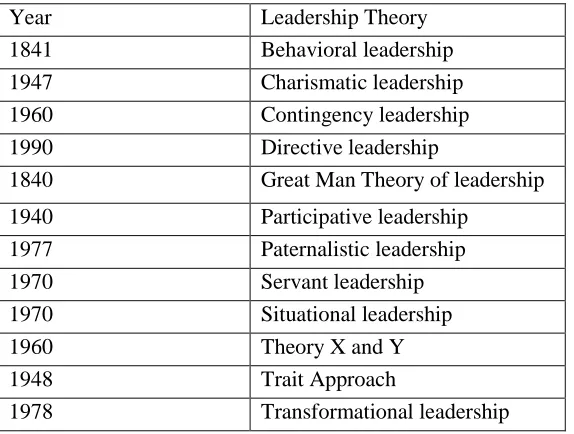
1 Leadership Theory Overview ...56
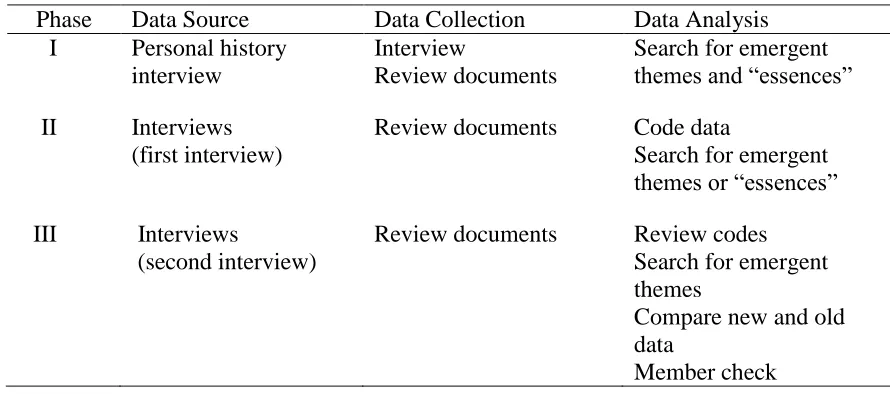
2 Overview of Study ...73
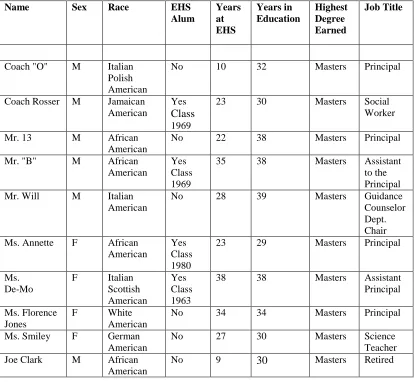
3 Teacher and Administrator Profiles ...75
4 Student Profiles ...112
5 Significant Statements: Support and Availability ...195
6 Significant Statements: A Man of Principles ...196
7 Significant Statements: Leadership Style and Strategies ...198
8 Significant Statements: Mr. Clark’s Administrator and Teacher Interactions ...200
9 Significant Statements: Impact and Contribution to Students’ Lives ...202
10 Significant Statements: Expressions of Gratitude and Appreciation ...205
1 CHAPTER 1 THE PROBLEM
Studies show that urban schools, primarily attended by low-income African
American and Latino students, continue to lag behind middle and high income
predominantly white schools in student attainment (Dittman, 2004). According to
Mickelson (1990) and Smith-Maddox (1999) African American and Latino students are
not advancing in the educational system in America, and their academic performance is
lower than that of their White counterparts when it comes to standardized tests (Jencks &
Phillips, 1998; Miller, 1995). Brown and Evans (2002) argued that academic achievement
is imperative because students devote an inordinate amount of time in school and, thus,
school and school-related activities provide crucial, significant attributes in the
socialization of students and serve as the main social venue for them. Numerous
researchers have argued that academic results are fundamentally influenced by the school
environment (Brooks- Gunn, Klebanov, and Duncan, 1996).
The underlying problems contributing to the urban-suburban achievement gap
―are typically manifestations of larger societal problems related to: (1) social inequality,
(2) racism and (3) the deterioration of urban areas‖ (Noguera, 1999, p.1). It is essential
that the complexity of this triple threat facing urban schools is addressed. According to
Bronfenbrenner (1979) there are several justifications for students' academic achievement
and failure which includes the environment and cultural variances that students bring
connection between individual and social variables as well as the positive and negative
impact on student achievement. Declining urban neighborhoods have negatively
impacted students living in these environments. According to Johnson, Crosnoe, and
Elder (2001) research has revealed that school attachment, which symbolizes students'
feelings about their school, is positively correlated to academic achievement.
There are competing explanations and accounts regarding why these problems
exist and deeper manifestations include but are not limited to: poverty, low-student
achievement, teacher ineffectiveness, deficiency of discipline and safety measures,
shortage of support services for children and families, drugs, poor race relations,
overcrowding, gang activity, violence, insufficiency of adequate education, and lack of
confidence that is seen in many poor minority urban schools (Noguera 1999). Upon Joe
Clark‘s arrival to Eastside High School it was plagued with all of the issues mentioned
above.
During Mr. Clark‘s tenure as principal at Eastside High School (EHS) 1982-1989,
school safety was and continues to be intensely scrutinized in the wake of amplified gang
activity in schools. According to Frymier, Barber and Phi Delta Kappa (1992) more than
3 million criminal acts occur in public schools each year. These crimes are not limited to
urban schools, as is commonly believed to be the case, but occur in suburban and rural
schools as well (Landen, 1992; Rossman & Morley, 1996). Additionally, one in four
students was concerned with being a potential target of criminal activity or threatening
behavior at school as a result of the disturbances caused by hard crimes (Stephens, 1998).
As reported by Huff and Trump (1996) the number of cities in the United States
Gang members commit nearly 600,000 crimes a year in public schools across the U.S. In
1995, organized gang activity in the United States impacted an estimated 2,000 law
enforcement jurisdictions; there were 23,000 recognized gangs, and authorities estimated
that there are a total of 650,000 juveniles participating in gang activities (National Youth
Gang Center, 1997). More than half of gang members surveyed specified that members
of their gang have a history of assaulting teachers.
Nearly 70% described attacking fellow students, and more than 80% confessed to
bringing weapons to school (Huff & Trump, 1996). Specifically, there have been
incidences of children and adolescents being robbed, beaten, or killed because of the
clothing they wore (Alvez, 1994; Pushkar, 1995). Some of these children were victimized
because others sought after the status symbols that went along with their clothing, and
some because of their gang affiliated colors. As mentioned earlier, upon Joe Clark‘s
arrival to Eastside High School, it was plagued with all of the issues mentioned above.
Additionally, some of the reasons Mr. Clark was placed at EHS was to deal with problem
behaviors and lack of achievement.
The Purpose of this Study
Mr. Joe Clark was the principal of EHS in Paterson, New Jersey, from 1982 to
1989. The purpose of this phenomenological case was to: a) describe Mr. Clark‘s
leadership style as principal of EHS from the point of view of a select group of Mr.
Clark‘s former students, teachers, and administrators; and b) determine what, if any,
effect his leadership style had on the conditions at EHS, as well as on the lives of his
conducted this investigation by giving voice to my high school classmates, teachers,
administrators and myself; I attended Eastside High School from 1982-1986.
Introduction
The system abandons them and, far worse, they abandoned their dreams, their real opportunities. I cannot, I thought, change the economy or age old prejudice or the system at large. But what I can, must, and will stop is the way these young people destroy themselves. I will return them their hope. I pledged myself to showing them how to fulfill their better dreams. (Clark & Picard, 1989, p. 18)
According to McGuire and Ikpa (2008), ―urban school districts serve large
numbers of children living at or below the poverty level‖ (p.3); these schools are
overburdened and severely underfunded. ―Many individuals in these distressed districts
characterized by overcrowded classrooms, outdated resources, and limited funding, face
day-to-day challenges that force them to develop and implement creative survival
techniques‖ ( McGuire & Ikpa, 2008, p.3). Moreover, students in these schools ―continue
to be misidentified, misassessed, miscategorized, misplaced, and misinstructed by
ill-prepared, and unprepared educators and service providers‖ (Obiakor & Beachum, 2005,
p. xi).
According to Obiakor and Beachum (2005):
These students are identified as having behavior disorders; they are assessed with instruments that lack validity and reliability; they are
prejudicially categorized and labeled; they are disproportionately placed in special and gifted programs; and that they are mis-instructed with no respect for their learning styles and cultural backgrounds (p. xi).
Obiakor and Beachum (2005) purported that in ―such environments, maintaining a sense
of order has become the major job of the principal. And ―it is readily conceded that the
In 1982, EHS was one of two large high schools located in a poverty-stricken area
of Paterson, New Jersey. Conditions such as: high dropout rates, drugs, gangs, drug
dealers, prostitution, teenage pregnancy, violence towards students and teachers, racial
uproars and fighting, political wars, and complicated educative battles with the board of
education existed at that time. In 1982, an attempt to raise the students‘ minimum basic
skills test scores, and eliminate the violence and other negative conditions at EHS, Joe
Louis Clark was hired as the new principal (Clark, 2009). Mr. Clark had a leadership
style that while controversial, some would argue was successful. Much has been written
on the topic of effective strategies and leadership styles in America‘s schools. By taking a
look at EHS from 1982 to 1989, this phenomenological case study will add to the
literature on the effects of leadership style from the point of view of a select group of
students, teachers and administrators who attended, and worked at EHS during that time.
Paterson, New Jersey
In an effort to further provide the context for the emergence of Joe Clark, I will
provide brief historical information about Paterson, New Jersey. Paterson was established
as a vivacious industrial city that supplied the United States with several manufactured
goods. Paterson is located twenty-five miles west of New York City and situated within
Passaic County. According to American Memory, (2009) Paterson was founded as a
corporation in 1792 by Alexander Hamilton and The Society for the Promotion of Useful
Manufacturers. Alexander Hamilton was an American politician and the first U.S.
Secretary of the Treasury from 1789-1795 (Jost, 1997). Paterson, New Jersey was named
of the Constitution, and the Governor of New Jersey (New Jersey, 2009). The city holds
the ―distinction of being the nation‘s first planned industrial area‖ (American Memory,
2009, p. 1). The power for the industries in Paterson came from the 77-foot high, Great
Falls of the Passaic River. These industries included textiles, firearms (Colt Revolver),
silk and railroad locomotive manufacturing (American Memory, 2009, p. 1).
According to the web site City of Paterson Silk City (2009), Paterson was known
as the ―Silk City‖ during its earlier history for producing silk in the 19th century. By
1870, Paterson was the primary producer of silk in the United States (American Memory,
2009). According to Bookrags Staff (2006), ―Paterson was also the site of historic labor
unrest that focused on anti-child labor legislation. It was also the ‗mecca‘ for immigrant
laborers who worked in the factories‖ (p. 1). The city has changed drastically since those
early years. In the 1970s, there was major deterioration in urban areas and Paterson was
afflicted with homelessness, drug use, gang violence, racial riots, high unemployment
rates and low high school graduation rates. By 1980, Paterson was one of the most
distressed cities in the United States (Bookrags Staff, 2006).
Eastside High School
Eastside High School (EHS) first opened its doors in 1926 as a four-year public
high school that served ninth through twelfth grade students. EHS is located at 150 Park
Avenue, which became a poverty–stricken area of Paterson, New Jersey. The site,
believed to be an old cemetery, gave rise to its mascot, the Ghost. The school colors are
population of the students which from 1982-1990 was 98% African American and
Hispanic and two percent White (Clark, 2009).
EHS is located in what can best be described like the ghetto. From my lived
experience, prior to the arrival of Mr. Clark, the interior and exterior of the school were
dilapidated and filthy. The inside of the school was graffiti covered and garbage strewn.
There seemed to be chaos everywhere, even inside of the classrooms. The student body
ran the gamut, from those who were violent, disruptive drug dealers and gang members,
to those who were non-disruptive and eager to learn. Some teachers were scared and not
able to teach due to fear of the disruptive students. Outside the school, drug addicts,
alcoholics, gang members, drug dealers, and prostitutes circled around the building walls
of the school. This forced students to wade through many potential hazards every day as
they traveled to and from school. It was not a safe campus.
According to Clark & Picard (1989), ―EHS was an open-air, cash and carry drug
market,‖ and his [Clark‘s] aim was to shut down the ―drug business permanently‖ (p.51).
Mr. Clark argued that ―the best way to get drugs out of a school is to keep them from
getting in‖ (Clark & Picard, 1989, p. 51). Mr. Clark also stated that ―ghetto youths have
been murdered because of the hats they were wearing…murdered because the hat
identified the youth as a member of a particular gang‖ (1989, p. 43). As he began to
implement policies and procedures such as increasing security, locking and chaining the
doors, and monitoring incoming and outgoing traffic, Mr. Clark stated that he received
―death threats‖ from the ―doped-up hoods‖ that he began to keep out of the school (Clark
From my personal experience, several students were robbed, beaten, and had their
popular expensive clothing, sneakers and jewelry stolen from them both inside and
outside the school. During that period of time, there was a mixture of street cliques,
gangs, as well as religious-oriented cliques/gangs. Some of the student gangs were
defined by race, African American, Hispanic, Dominican, and Jamaican decent. There
was also a group of students who were known as the Five-Percenters. Five-Percenters
sometimes have been considered an offshoot of the Nation of Islam. According to Allah,
(2007)
The Five Percent nation believed that 10% of the people of the world know the truth of existence and those elites opt to keep 85% of the world ignorant and under their controlling thumb. The remaining five percent are those who know the truth and are determined to enlighten the rest of the world thus they are called the Five Percent nation.
The Five-Percenters have also been perceived as posing a threat or as a gang
because of some criminal and other anti-social acts committed by a few members (Allah,
2007).
In 1984, there were race riots in Paterson, New Jersey, which began at EHS
involving the Five-Percenters, Hispanics, Dominicans, African Americans, and
Jamaicans. According to Clark & Picard (1989), a fight erupted outside the schoolyard
gate between a Black male and a Hispanic male. Racial epithets were shouted and a ―near
mêlée began‖ and ―several students who were fighting received scrapes and bruises‖
(Clark & Picard, 1989, p. 110). There were race riots throughout the night and the next
day in all sections of the city between the Five-Percenters, Hispanics, Dominicans,
African Americans, and Jamaican youths. Some students were hurt and some were
less than half of the 90% that normally attended. Students and parents were frightened
and stayed home as a result of the race riots (Clark & Picard, 1989).
For years, due to the increasing viciousness and gang presence in schools,
administrators have looked for ways to safeguard the protection of students and teachers.
Efforts have included installing security equipment such as metal detectors, alarms,
cameras, and limiting entry to school grounds, increasing police and security presence,
and conducting gang awareness and education programs (Huff & Trump, 1996).
According to (Clark & Picard, 1989) many of these security measures were costly and
were not considered by the Paterson Board of Education because of budget cuts and
increased operating costs (Clark & Picard, 1989).
From my lived experience, Mr. Clark had to focus on order and structure. He
implemented a plan for keeping the drugs and drug dealers out of EHS which ―involved
making the school a fortress that the drug pushers could not penetrate‖ (Clark & Picard,
1989, p. 51). Specifically, Mr. Clark replaced door locks, and old fences and removed
security guards, he deemed ineffective, from the school. He also kept an eye on the kids
he perceived as most likely to open the door and let the drug pushers in the school. Mr.
Clark stationed security guards outside the school near the entrance fences, even though
some teachers were fearful because they felt the school would be ―guard-less‖ inside.
However, Mr. Clark instituted a plan for teachers and administrators to serve as in-school
security. Teachers stood in the corridors before and between class periods. In addition,
the administrators roved along the corridors until students were settled in their
Mr. Clark initiated an Identification Card System that was rigorously enforced.
All students, teachers, and staff members had to wear a color coded, picture ID badge that
was checked by security guards upon entering the building. The ID badge had to be worn
and visible at all times. Those who did not have their ID were not allowed to enter the
school or had to pay a fine to receive another badge. All visitors had to stop at the
principal‘s office to obtain an ID for the day. This ID system was a key step in keeping
people who were not affiliated with EHS out of the school (Clark & Picard, 1989).
My experience with fellow students indicated that the majority of the students
who attended EHS were recipients of free or reduced-price lunch, welfare, food stamps,
and Medicaid, and lived well below the poverty level. In 1982, the poverty level was
defined, for a family of four, as households living on $9,300 per year or less and was
increased to $12,100 in 1989 (U.S. Department of Health and Human Services, 2011).
According to Clark & Picard (1989) the national average for single-parent
households living in poverty in the inner-cities was between 50-60% and ―it‘s the same
for Eastside High School. More than half the kids come from single-parent homes and we
all know that this parent is almost always the woman. The men are gone and the children
have no fathers‖ (Clark & Picard, 1989 p. 73).
There were many students who wanted to learn, who were not violent, and who
were not gang members, or addicted to drugs. Many of those students, including me,
were afraid to attend EHS and prayed for a change. Mr. Clark was an answer to those
prayers when he was assigned to Eastside, and the transformations began.
When asked to describe the outside environment of Eastside High School before,
experiences at EHS. Mr. 13 (who was a teacher prior to, during, and after Clark‘s tenure),
stated that ―it was challenging at times but there are challenges in all school
environments.‖ Mr. Will (who was a guidance counselor prior to, during, and after
Clark‘s tenure), indicated that Eastside ―was totally out of control and dangerous.‖ Ms.
Florence Jones (who was a teacher prior to, during, and after Clark‘s tenure), said that
EHS was ―filled with gangs, drugs, and poverty.‖ Coach ―O‖ (who was a teacher prior to,
during, and after Clark‘s tenure), proclaimed that prior to Mr. Clark; ―it had more
negative qualities than positive. It was pretty safe during the day; it was a different
culture at night…crime was prevalent. Drugs and gangs were in existence all the time.‖
Additionally, Ms. Smiley (who was a teacher prior to, during, and after Clark‘s tenure),
asserted that
The building was normal and hasn't changed, except they took down the 6 foot high wrought iron decorative fencing around the entire school. They had taken that down and recently put up the same type of fence except this time it‘s made of aluminum because wrought iron is cost prohibitive during this day. People don‘t hang out nearly as much as they used to. Especially, because the entire building is wired with cameras; the doors hopefully are locked now. However, they don‘t hang out as nearly as much as they did back then.
Furthermore, Ms. De-Mo (who was a teacher prior to, during, and after Clark‘s tenure),
stressed that Eastside High School was
Mr. Moody (who was a student during Clark‘s tenure and currently is one of four
principals at Eastside High School), discussed the current changes in regard to the
restructuring of Eastside High School. ―This is a major difference. Mr. Clark had about
3000+ students back then [1982-1989]. We only have 1600 students, and we have four
principals‖ that help maintain and manage the students. Eastside is currently fragmented
into three separate academies, (a) the School of Government and Public Administration,
(b) Information Technology, and (c) Culinary Arts, Hospitality and Tourism. Each
academy has its own staff that is comprised of one principal, two vice principals,
secretaries, guidance counselors, and teachers. Moreover, Eastside has an additional
principal position, titled the Principal of Operations, who is responsible for the overall
operations of the building; facilities and maintenance ; athletics; and student management
which includes discipline, suspensions, and different protocols of how students should
enter and be dismissed from the school. Eastside has implemented a mandatory uniform
policy. The students of each of the three academies wear separate colored uniforms so
that the administration is aware of which academy a student belongs.
Joe Louis Clark
The following quoteis what governed Mr. Clark‘s philosophies, actions,
methodologies, strategies, and leadership styles during his seven-year tenure at Eastside
High School.
‗God Dammit, Wake UP!‘ We are not dealing solely with Paterson, we are working within a complex economic, social, political, and cultural
the rest of the country. Dope, crime, taxes, to give you some examples… In the inner-city, youths get killed because of the hats they might be wearing. Black and Hispanic youths cut down by their own kind before getting a chance at life. Maybe one was the next Washington Carver or the next Neruda. And kids have been killed in Paterson too for reasons as horribly absurd as a hat. (Clark & Picard, 1989, p. 43)
My investigation is about Joe Louis Clark, who believed in focusing on order,
structure and firm discipline. Mr. Clark is best known as the bullhorn and baseball bat
carrying principal of EHS in Paterson, New Jersey, from 1982 to 1989. Mr. Clark and the
EHS story gained notoriety from the movie Lean on Me, starring Morgan Freeman, who
portrayed Mr. Clark as the high school principal. One interpretation of Mr. Clark and
EHS follows:
An extraordinary situation calls for an extraordinary leader. At strife-torn Eastside High School, that leader was Mr. Clark. Lean on Me is the rousing, fact-based story of high school principal Mr. Clark, who armed himself with a bullhorn and a Louisville slugger and slammed the door on losers at Eastside High School in Paterson, New Jersey. Brought in as a last hope to save the school, he chained the doors shut to keep the trouble-makers out and the strivers in. Parents fought him. Teachers fought him. Lots of kids loved him. Mr. Clark turned Eastside High School around, becoming a national symbol of tough-love education and appeared on the cover of Time. ―If you students don't succeed in life, says Mr. Clark, ―I want you to blame yourselves.‖ His message is simple: Don't lean on excuses. Don‘t lean on drugs, crime or anger. Lean on me... and learn. (Blockbuster.com Web. (2007) [Avildsen, DVD cover, 1989]
Mr. Clark was born May 7, 1938, in Rochelle, Georgia. He received a Bachelor‘s
of Arts degree from William Paterson College and a Master‘s of Arts degree in
administration and supervision from Seton Hall University located in New Jersey (Clark
& Picard, 1989). ―Mr. Clark is the father of Olympic track athletes Joetta Clark-Diggs
and Hazel Clark, and the father-in-law of Olympic track athlete Jearl Miles‖ (―Clark
Speaks Website,‖ p.1). According to Clark Speaks website (1989), in addition to being
Magazine cover story and profiled on the CBS show ―60 Minutes.‖ He was featured in
many newspapers and journal articles. Mr. Clark appeared on a considerable number of
television news and talk shows. After only two years of his hard-nosed leadership at
Eastside, New Jersey‘s governor acknowledged the former disorderly high-school as a
model school and Mr. Clark was titled one of the nation‘s 10 ―Principals of Leadership‖
in 1986 (―Clark Speaks Website,‖ p.1). Mr. Clark gained national applause for his
accomplishments which resulted in President Ronald Reagan naming him a model
educator. Mr. Clark was offered a White House position as a policy adviser by Reagan,
which Mr. Clark declined (Clark & Picard, 1989).
Throughout his book, Laying Down the Law, Clark & Picard (1989), Joe Louis
Clark shared his beliefs, strategies, leadership, and success stories about his experiences
at Eastside High School. His primary message was: ―Every day, pride in self and school
must be reinforced. Every day, the value of academics must be demonstrated‖ (Clark
Speaks Website, p.1). Mr. Clark was a former army drill instructor who saw education as
a mission and was an elementary school teacher for over ten years in New Jersey (Clark
& Picard, 1989). Mr. Clark held enormous expectations for his teachers, administrators,
and students to inspire most of them to develop lifestyles for success, and he challenged
them when they did not improve (Clark & Picard, 1989). From my lived experience, Mr.
Clark was not only a caring, father-like, unwavering supporter for students who wanted
to learn, but also a charismatic role model and steadfast ally for parents, teachers,
administrators and community leaders who believed in his efforts to save EHS from the
Despite his popularity in some circles, Mr. Clark‘s tactics were not always
praised. For example, he came under attack during his first couple of weeks at EHS
because he expelled 300 students for fighting, vandalism, drug possession, abusing
teachers, or for being fifth year seniors who were not showing what Clark considered
sufficient academic promise. In response, Clark explained that ―kids desire discipline,
because order is necessary for learning to take place‖ (Clark & Picard, 1989, p. 193).
When there is a lack of discipline, there is disorder. Good citizenship demands attention
to responsibilities as well as rights (Clark & Picard, 1989). During an interview with
Rafael Pi Roman, (Courtesy of Thirteen, 1994, Video). Mr. Clark provided the following
answer to a question from Mr. Pi Roman,
Mr. Pi Roman - But, isn‘t throwing 300 students out and periodically you threw more out. Isn‘t that more like treating them like animals? But, not inside the school, but outside of the school, more like garbage that you can discard?
Mr. Clark - No, just the opposite. What I was saying is that the school should be a citadel of learning and that you cannot permit a handful of individuals to cause chaos and pandemonium. The ambience and the environment must be conducive for learning, a safe place for students and for teachers. Not all young people can function in a traditional setting. Thus, it should be the responsibility of the bureaucracy to make sure that alternative methods of education exist for those individuals who cannot function… No, I am convinced that you cannot force 16, 17 and 18 year old young people to go to school. If they don‘t want to go to school, then I think that it is incumbent upon us to make sure that they go and get a job somewhere, and learn how important an education is. And thus whenever they make up their minds that they need an education, make sure that the doors of opportunity are open for them. I guess in short, what I am saying is that we cannot permit the majority to be imbrued, and stained by a minority of individuals who are not concerned about education.
Information about Mr. Clark was published in numerous national and local
newspapers and magazines including but not limited to the New York Times, The
Ebony Magazine. Additionally, Mr. Clark appeared on various television talk shows and
local news in the tri-state area (New Jersey, New York and Philadelphia).
Some of the most notable headlines were recorded as Lean, Mean Principal Gets
Call From Reagan; this article talked about how Mr. Clark received a phone call from
United States President Ronald Reagan, who applauded Mr. Clark for his tough approach
to discipline (―Lean, Mean' Principal Gets Call,‖ 1983). An article entitled 2 Schools
With 2 Remedies For Drugs And Violence: Discipline Stressed In Paterson School,
explained how some of the older faculty members remember the scary violent days of the
past that included chaos in the hallways of 3,200 students, assaults on teachers and
administrators, gang violence in the cafeteria with knives, and blatant drug sales during
the school day. However, it was a new day at EHS because students ―walked to the right‖
circumventing fights in the corridors, teachers were boasting about student performance
and the clean appearance of the potted plants, couches and paintings unscathed by
vandalism (―Schools (2) With 2 Remedies for Drugs,‖ 1986).
Although in the eyes of many, Mr. Clark had much success yet, his success came
with many controversies. An article entitled Clark's Get-Tough View Airs Nationwide
(1986), described how Mr. Clark was profiled on NBC news. The television show opened
by introducing ―Crazy Joe,‖ a man admonishing students, yet berating administrators
with a bullhorn in hand and referring to suspended students as ―deviants,‖ A newspaper
article entitled Principal Clark Drops Dukes, Gets Big Gift for School (1988), described
Mr. Clark‘s resolution to cease and desist struggling with the Paterson Board of
Education to accept a $1 million generous contribution to EHS (―Principal Clark drops
Expelled Students (1987), described how Mr. Clark was ordered to reinstate 50 students
that he expelled out of school for being disciplinary problems and not being productive
students (―Principal in Paterson is directed,‖ 1987).The newspaper article, Principal
Says He’ll Relock School Doors If Necessary (1986), described how Mr. Clark
unwillingly removed padlocks from the doors of EHS and stated that he would ―take the
consequences‖ because he felt the students were in danger from criminals outside of the
school and that he would rather be safe than sorry. The newspaper article, 400 Students
Walk Out, Back Clark (1987), provided information about the 400 EHS students who left
school and marched downtown to the Paterson Board of Education office in
demonstration of support for Mr. Clark who was suspended. Students acquired control of
the meeting in the Paterson Board of Education building. The Paterson Police escorted
the students back to school later on that day as requested by Mayor Frank Graves
(Students (400) walk out, back Clark, 1989).
According to Clark Speaks (Clark Speaks Website, 2010, p.1), after seven years
as principal at EHS, Mr. Clark resigned and became a noted speaker on the country's
lecture circuit. He was eventually nominated in 1996 for the National Association of
Campus Activities, Speaker of the Year Award. Mr. Clark ―began his latest crusade on
behalf of America's youth in August 1995 when he was appointed Director of the Essex
County Youth House, a juvenile detention center in Newark, New Jersey‖ (Clark Speaks
Website, 2010, p.1). Through his book Laying Down the Law, his work as an educational
consultant, his speeches, and his activities as Director of the Essex County Youth House,
Mr. Clark shared ―his strategies and success stories with teachers, school boards, parents,
observation as a student at EHS High, Mr. Clark seemed to be dogmatic, demanding,
arduous, unbending and very flamboyant in his approach in the public view; yet showed
love and compassion to the students while holding them accountable for their actions.
In the final chapter of his book, Laying Down the Law, Mr. Clark speaks about
leadership and management. He stated that ―current management theory, as taught in
colleges of business administration, denotes five key, interrelated facets, or functions, of
proper management. These facets include preparation, organizing, staffing, guiding, and
controlling; every quality manager should perform each of these functions well‖ (Clark &
Picard, 1989, p. 185). Moreover, Mr. Clark (1989) stated that,
I feel that I have performed all five of those functions well at Eastside High School High. The old Eastside High School produced drug addicts and criminals, unwed mothers and welfare cases. Thousands of
underdeveloped youths lacking direction and skills were poured out upon the bleak streets of Paterson and upon the nation. The new EHS turns out responsible, drug-free young citizens ready to work to achieve their goals and make worthy contributions to society. My management accomplished this. (p. 185)
Clark & Picard (1989) also offered that ―current theory lists two prerequisites for
the successful manager: clear-headedness and the ability to work through people‖ (p.
185). Mr. Clark added the requirement of instinct and placed it at the top of the list. He
argued that without this attribute, the other two cannot carry the day. Mr. Clark described
the instinct for leadership, as ―the desire and the drive to be a leader‖ (p. 186). Unlike
theorists who imply that this quality is necessary, Mr. Clark indicated that it should be the
most emphasized. Mr. Clark stated that leadership is a quality that must rank high
amongst the superintendent‘s and the board of education‘s employment search committee
standards or they will be in jeopardy of ending up with a principal who executes the
186). Mr. Clark was apprehensive that new principals may manage the staff despite the
necessity of accurately knowing how to lead the administrators and teachers. Mr. Clark
was concerned because he believed that the consequences are more detrimental if the
school is in dire need of substantial restructuring because it is in a distressed state of
being (Clark & Picard, 1989).
I have become a great champion of and for teachers. Because I realized that by in large teachers are dedicated and committed. They are just manipulated by a bureaucracy that has them fettered. I don‘t blame the woes and the vexations of this educational system on teachers…No, I took back a school that was out of control. I took it back from a multiplicity of individuals, a large number of individuals. And concentrated it at the doorsteps of the individual who is ultimately responsible and that was and is the principal. If there is anything wrong with education today it‘s due to pusillanimous, cowardly principals who are afraid to assume the responsibility of their job and make schools orderly and safe for students and for dedicated and committed teachers. (―Courtesy of Thirteen,‖ 1994, Video)
Mr. Clark stated that he received firm support from two levels of American
political structure, the grass roots support of parents, students, and, residents, and the
support of the White House. Clark & Picard (1989) stated that
Minority students, poor youths - I gave them a needed role model, a Black man born in poverty, who rose in a good cause and through his own efforts to national prominence. I showed them, and I told them, that the media would surely have exposed me for a knave had I been one. I was not an imitation or fanciful commercial image of a real man. I was and am! - Through rightful purpose and years of hard work, through building on a strong foundation - a real man. I pointed the way for them, as an educator should. (1989, p. 206)
According to Mr. Clark, the problems in education, in this country are excessive.
―We all must confront them, or live with the dire consequences‖ (Clark & Picard, 1989,
p. 206). Many people looked to where they might find solutions and Mr. Clark gave
I have shown you what one man, a Black man born into abject poverty, can accomplish against the odds. Now it is your turn to act and effect change. Help save our schools, our children, in the future over our
civilization. Yes, there is that much at stake. But together we can make the crucial difference. I have seen how righteous actions transcend ethnicity and economic class. Such actions evoke a deep, rushing river of support, which is nothing less than the flow and the spirit of humanity. We are the solution to the present crisis in education. We can, we must, and together we will triumph. (1989, p. 207)
In Clark & Picard (1989), Mr. Clark related the students‘ lives to a baseball game
and explained to the students that they had strikes held against them in life. The first
strike was that they were Black and member of a minority group, and the second strike
was that they were poor. Mr. Clark explained they had one more chance at bat and their
education was the way to hit a homerun. Mr. Clark argued that dropping out of school
would count as strike three, ―you‘re out of the batter‘s box, out of the ballgame, and off
the team, you‘re finished‖ (1989, p. 92).
Mr. Clark believed in communicating real-life examples of what his students had
to deal with as a minority in these Unites States. Delpit (2006) expounded that there is a
culture of power, which includes linguistic forms, presentation of self and communicative
stratagems. If people are not already participants in the culture of power, then being told
unequivocally the rules of the culture make acquiring power easier. Mr. Clark
demonstrated culture of power as one of several strategies to connect with his students.
Sharing his personal experiences and life stories about his childhood, growing up poor
and not allowing his circumstances to dictate his future was a way to bond with his
students. Mr. Clark used his proficiencies as an illustration to be a role model for his
students. Mr. Clark allowed his students to see an African American man who
progressed, acquired higher education, and used power to help his students succeed in
Delpit (2006) maintains that teachers should make minority students aware of the
―culture of power‖ so that they can succeed, while at the same time respecting their
individual cultural backgrounds. Delpit described five aspects of this power:
(1) Issues of power are enacted in classrooms; (2) There are codes or rules for participating in power; that is, there is a ―culture of power‖; (3) The rules of the culture of power are a reflection of the rules of the culture of those who have power; (4) If you are not already a participant in the culture of power, being told explicitly the rules of that culture makes acquiring power easier; and (5) Those with power are frequently least aware of or least willing to acknowledge its existence. Those with less power are often most aware of its existence. (Delpit 2006, p. 282)
Delpit (2006) suggested that in order to change the status quo, students must be educated
about the culture of power and taught the codes and discourses necessary in order for
them to acquire power themselves.
Dr. George McKenna III
As mentioned earlier, Mr. Clark‘s strategies were not without controversy. By
way of contrast, I researched another African American principal, Dr. George McKenna
III, who was classified by many as being successful. His leadership style and strategies
were quite different from Mr. Clark‘s. Dr. McKenna was born in New Orleans,
Louisiana, receiving a Bachelor of Arts, a Master of Arts from Loyola University, and a
Ph.D. from Xavier University (History Makers, 2011). Dr. McKenna was principal at
George Washington Preparatory High School (GWPHS) in Los Angeles California and
was credited with making a serious transformation in a school that had been categorized
by crime, drugs and gang violence (HistoryMakers, 2011).
In 1979, when Dr. McKenna became principal at the age of thirty seven, the
students were in gangs. The Crips and the Bloods were the most noticeable gangs in the
school‖ (Kirp, 2001, p.1). When Dr. McKenna was assigned as principal, the death of a
student further cemented this environment as a combat zone (History Makers, 2011). The
school was inundated with gang violence, graffiti, drugs, student truancy, and an
ill-mannered student body, that would bully and physically assault teachers. In fact, many of
the conditions that existed at GWPHS were very similar to the conditions at EHS upon
Clark‘s arrival.
Dr. McKenna‘s personality and demeanor stood in direct contrast to George
Washington Preparatory High School. He was characterized as an idealist who assumed
that all young people are essentially decent and have a desire to acquire knowledge. In
this regard, he requested that his faculty make an effort to connect with students who
were disengaged and at risk of failing or who had already displayed destructive
behaviors. However, many of the teachers resisted this mandate and quit their jobs or
requested to be transferred to another school. Even though Dr. McKenna‘s approach was
different from Mr. Clark‘s, he received some of the same types of criticism. According to
Dr. McKenna,
But I had to aggravate the system a bit, I had to even aggravate some of the teachers and some of them took not kindly to that, so many of them left and I hired new teachers. ‗Cause I demanded that they give
homework, I demanded that we do lesson plans, I started getting the wrong publicity first. I started getting attacked by the teacher unions because I was demanding and they were leaving and calling me names.‘ He‘s a dictator, he‘s… but the community loved it. So it became the struggle…. I was having a love affair with the community and this love-hate affair with some of these other folks. …They started leaving on their own. I never drove anybody out of the school [George Washington
school started growing, and growing and people started getting off the buses and coming back. (History Makers, 2011, Video)
According to HistoryMakers (2011, Video) Dr. McKenna worked long hours
combating nonattendance, violent behavior and defacement of school property. Those
students who were in violation of school rules had to assist in campus clean up and later
came to know that if they did something wrong, they would be held accountable by
picking up trash around the school and painting the defaced walls. Dr. McKenna‘s
approach engaged students and taught them that their actions had consequences. Parents
supported Dr. McKenna‘s strategies, as they would rather see their children doing work
and atoning for their wrong-doing than being kicked out of school altogether.
According to the History Makers, Video (2011), Dr. McKenna worked with
students who had their share of adversities, particularly those who were gang members,
where society and even some parents had given up on them. Dr. McKenna stated that he
held all-male and all-female assemblies to connect with the students. These assemblies
would last at least an hour and a half, and Dr. McKenna would listen and discuss student
concerns especially when there was a death in the neighborhood (HistoryMakers, 2011,
Video). He spoke about manhood with the males and for the females; he offered fatherly
advice, encouraging them to respect themselves. According to Dr. McKenna, these
passionate conversations would be difficult at times. He did not focus on violence, but his
focus was on love and strength, not violence, and creating a family of students who
supported each other. (HistoryMakers, 2011, Video)
to value life so that they didn't become indifferent to death and become accustomed to it and just say, "Oh, Mookie's dead" well, he had a name and you need to celebrate his real name, you know. So those kinds of things kind of humanized the environment, is what I call it, and I used what I call the love agenda. (HistoryMakers, 2011, Video)
Dr. McKenna is credited with making a positive difference in this troubled
school. He salvaged a wrecked high school and preached love for students. Rather than
lashing out against them, Dr. McKenna believed, ―We want to fix education, but you
don‘t do that by seeing kids as the enemy.‖ News reporter Ted Koppel asked ―When do
you give up on students who are not performing? ― Dr. McKenna answered, ―Never‖
(Kirp, 2001, p.1) and in this way, Dr. McKenna‘s approach was very different from Mr.
Clark‘s, as Mr. Clark believed that debauched students needed to be dismissed in order
for a school to succeed.
Dr. McKenna‘s agenda was ―change.‖ He believed in empowering young people
so that they could see a future of possibilities. He changed the school‘s name from
George Washington High School by adding the word ―preparatory,‖ to be more college
oriented. Dr. McKenna also added college prep courses, extended library hours, and
provided parent education workshops to empower parents to become involved in their
children‘s educational and social lives (History Makers, 2011).
Additionally, he had promoted his philosophy of nonviolence and love because he
wanted the school to be recognized as a family, not a gang. He created ―We are Family‖
buttons in Crips and Bloods colors as a way of redirecting the youth‘s previous notions of
family and providing them with love and a caring atmosphere (History Makers, 2011).
According to Kirp (2001), ―People who Care‖ was the name of a 700 member volunteer
Dr. McKenna shared with the volunteers that they were doing ―God‘s work.‖ His agenda
for his teachers was to ―do more!‖ and ―rescue these kids‖, thus requiring his teachers to
have lesson plans prepared every week (p.1). He wanted his teachers to extend the
learning environment beyond the classrooms to volunteer and tutor students after school
and on Saturdays. Teachers were also required to call absent students to ensure the
parents knew of their child‘s whereabouts. In this regard, Dr. McKenna believed in
holding his teachers accountable for their students‘ successes and/or failures, telling his
staff: ―You can‘t be great if your kids fail. Teachers were dissatisfied and voiced their
concerns to the teachers‘ union and as a result, during his first 3 years of being principal
100 of 117 teachers quit‖ (Kirp, 2001, p.1).
Kirp (2001) stated that some of Dr. McKenna‘s accomplishments were achieved
by requiring homework every night. Dr. McKenna also added eighteen sections of
chemistry and Advanced Placement classes. As reported by Kirp (2001), ―Unexcused
absences dropped below 10%, which were the lowest in the Los Angeles area during Dr.
McKenna‘s tenure and the dropout rate was down 14%‖ (p.1). Dr. McKenna‘s reform
―strategies transformed the school with approximately 80 percent of its graduates
attending college instead of continuing in a downward spiral‖ (History Makers, 2011,
p1).
In September 1988, Dr. McKenna left the high school to become the Assistant
Superintendent Officer in the Los Angeles School District. His former assistant principal
became principal of the high school and unfortunately, without Dr. McKenna, his vision
could not be sustained in his absence (Kirp, 2001, p.1). Dr. McKenna appeared in several
received a gleaming report from President Ronald Reagan for his achievements at George
Washington Preparatory High School (History Makers, 2011, p1).
Comparison of Mr. Joe Clark and Dr. George McKenna
Both Mr. Clark and Dr. McKenna have been thought of as heroes in their own
right. They both were faced with the challenge of working with a large high school
demographic of primarily minority students who were from poverty-stricken, drug, and
gang infested areas. Despite Mr. Clark being on the east coast and Dr. McKenna on the
west, they experienced very similar situations and occurrences within their respective
schools including violence, drugs, and lack of education, defiant students, criticism and
praise from parents, teachers, and community leaders. They both worked extremely hard
to increase educational attainment for their students, and wanted the best for their
students. They had a great desire for their students to obtain a high-quality education,
prosper, and go to college. One could argue that Dr. McKenna wanted the best for all
students, while Mr. Clark focused on those who demonstrated the willingness to learn
and stay out of trouble. Both viewed higher education as a way out of the ghetto and
believed in order, discipline, sacrifice, and working hard to fulfill their dreams of
changing the futures of the students who attended their particular high schools. They both
were admired by much of the media and they both were featured in newspapers,
magazines, and appeared on television, news, and talk shows.
President Ronald Reagan praised both for their awe-inspiring efforts to defy the
odds at these poor, dysfunctional, rundown high schools. Celebrating their successes,
theaters while Dr. McKenna‘s Hard Lessons: The George McKenna Story was made for
television.
Dr. McKenna began working at George Washington Preparatory High School in
1979 while Mr. Clark began his tenure in 1982 at EHS. As I observed both movies, I
noticed a significant difference in the leadership style of the two principals, who appeared
to have similar challenges, but was very different in their approaches on how to handle
the issues they were facing.
I know from my lived experience that Mr. Clark was very dogmatic and autocratic
in his approach and leadership style, while Dr. McKenna, from my viewing of the movie,
appeared to be transformational in his style of leadership and not as boisterous as Mr.
Clark. Mr. Clark seemed to be vilified in the media for his tirades and throwing at least
300 students out of school, (although a large number of the students were allowed to
return based on a mandate from the school board), locking the doors, and not backing
down from critics (teachers, students, staff, fire marshal, board of education or
administrators who did not agree with his methods and strategies). Dr. McKenna, on the
other hand, appeared to get along with most of the critics/supporters, students, teachers,
and administrators, and did not appear to have as many controversies as Mr. Clark, even
though many of his teachers quit or transferred to other schools. However, watching the
video of Dr. McKenna sharing his views of his legacy, there were several teacher and
administrative controversies during his tenure as principal. Dr. McKenna progressed to
be the superintendent of schools in Los Angeles California, whereas Mr. Clark, after
open-heart surgery in May of 1989, resigned from his position as principal two months
management, leadership, drug control measures for inner cities, and his experiences at
EHS.
Research Questions
1. How do Mr. Clark‘s former students, teachers and administrators perceive his leadership style as principal at EHS?
2. What impact, if any, did former students, teachers and administrators perceive that Mr. Clark‘s leadership style as principal of EHS have on their lives?
Significance of the Study
The goal of this study is to provide insight for educational leaders and policy
makers in urban areas related to the way educational leaders and principals who work in
poverty-stricken areas might take steps to diminish high school violence, drugs, and gang
activity and increase academic achievement in an effort to assist low-income students. It
is my aim that the information gained from this study will help educational leaders move
students toward a better and more successful life. In addition, through an analysis of the
results, I will present recommendations for education boards, and principals working in
urban high schools, higher education, and the public sector.
This investigation will allow educators at all levels, the opportunity to view and
understand Mr. Clark‘s leadership style and strategies, and to see what, if any, impact Mr.
Clark had on his former students, teachers and administrators at EHS. This information
could be useful to school principals and assistant principals as they work with students in
school board members as they assess the leadership styles, values and beliefs of principal
candidates.
Limitations of the study
The limitations of my study consist of a) not including the views of those students
who were expelled from East High School and were not allowed to return. b) The
information collected is retrospective data of past events, and is therefore subject to the
CHAPTER 2
REVIEW OF LITERATURE
Mr. Joe Clark was the principal of Eastside High School in Paterson, New Jersey,
from 1982 to 1989. The purpose of this phenomenological case study was to: a) describe
Mr. Clark‘s leadership style as principal of EHS from the point of view of a select group
of Mr. Clark‘s former students, teachers, and administrators; and b) determine what, if
any, affect his leadership style had on the conditions at EHS; as well as on the lives of his
students, teachers, and administrators, during and subsequent to their time at EHS. I
conducted this investigation by giving voice to my high school, classmates, teachers,
administrators, and myself; I attended Eastside High School from 1982-1986.
From my experience, Mr. Clark was a no-nonsense, dogmatic, controlling,
uncompromising, and demanding principal to anyone including students, parents,
teachers, administrators, board of education leaders, community leaders, political
incumbents, fire marshals, or anyone who did not follow along with his strategy to
reconstruct EHS into what he envisioned as a model institution for learning. I am
investigating issues regarding his strategies, philosophies, leadership style, successes,
controversies, and challenges, as well his approach and the tactics he used at EHS. There
is a need to engage this phenomenon in a review of the literature that places this
investigation of Mr. Clark into the context of what has been learned about leadership. In
Chapter 1, I attempted to set the stage for the dissertation by providing a snapshot of
Paterson, New Jersey, at its inception and at the time Joe Clark was principal at EHS. I