RESEARCH ARTICLE
▲
Joseph A. Grant Walt Bentley Carolyn Pickel Jeannine Groh-Lowrimore
▼
As concerns increase over changes in pesticide regulations, farmworker safety, surface and groundwater contamination and escalating costs and uncertainties associated with chemical controls, walnut growers need effective and cost-efficient ways to produce walnuts with minimal use of pesticides. This study compared the effectiveness of Bio-logically Integrated Orchard Systems (BIOS) with conventionally managed walnut orchards in the northern San Joaquin Valley from 1999 to 2001. We found no significant differences between BIOS and conventional blocks in nut quality or yields. Cod-ling moth was effectively controlled by pheromone disruption and alter-native pest-control methods. Mating disruption, by itself, appears to pro-vide good control of codling moth in many orchards. However, it is still more expensive for growers than conventional pest-control methods.
T
he Community Alliance with Fam-ily Farmers (CAFF), through its innovative Biologically Integrated Or-chard Systems (BIOS) project in Yolo and Solano counties, demonstrated from 1996 to 1999 that it is possible to reduce pesticide use and still produce good yields of high-quality walnuts with low levels of pest damage (CAFF 1999). BIOS emphasizes intensive monitoring, biological control and ben-eficial insect habitat enhancement to control pests; cover crops, animal ma-nures and composts to build soil; and measured use of fertilizers based on nutrient budgeting and leaf tissueanal-ysis to optimize fertilizer use (Swezey and Broome 2000).
From 1999 to 2001, we conducted a project aimed at adapting the BIOS model to fit the biological, economic and infrastructure conditions of the walnut farming industry in the northern San Joaquin Valley. Our primary focus was pest management, including con-trol of three key walnut pests: codling moth, aphids and mites. BIOS, conventional blocks compared
Ten growers participated in the proj-ect in 1999, and 12 in 2000 and 2001. Each grower designated a block of ma-ture walnuts for BIOS implementation. BIOS blocks were chosen based on vari-ety, previous crop and pest history and the growers’ preferences. These blocks
included a variety of walnut cultivars and orchard designs in eastern San Joa-quin and northern Stanislaus counties (table 1). Nine of the 12 growers in 2000 and 2001 designated an adjacent por-tion of the same block or a nearby block — of the same variety and similar size, age and cultural characteristics — to serve as a conventionally managed com-parison block. At our request, most of the growers retained a pest control advi-sor (PCA) experienced in BIOS or other alternative farming methods to provide management advice in BIOS blocks. Independent consultants or PCAs from agricultural supply dealers provided consulting in conventional blocks.
[image:1.612.236.583.42.267.2]A customized plan for managing codling moth and other pests was de-veloped for each BIOS block by a team
TABLE 1. Participating BIOS and conventional walnut blocks in northern San Joaquin Valley, 1999–2001
Varietal codling Block size (acres) BIOS/conv. Site Variety moth susceptibility BIOS Conv. configuration A Vina Moderate 16 47 Single block, split B Chandler Low 20 20 Single block, split C Vina Moderate 10 10 Single block, split D Serr & Sunland High 20 20 Single block, split
E Hartley Low 20 54 Adjacent blocks
F Vina Moderate 13 9 Adjacent blocks (1999 only)* G Vina Moderate 10 10 Separated by small
‘Waterloo’ block
H Vina Moderate 11 None N/A
I Vina & Serr Moderate/high 23 None N/A
J Hartley Low 20 None N/A
K Serr High 15 39 Single block, split
L Hartley Low 10 10 Adjacent blocks
* Site F had paired BIOS and conventional blocks in 1999, and no conventional block in 2000 or 2001.
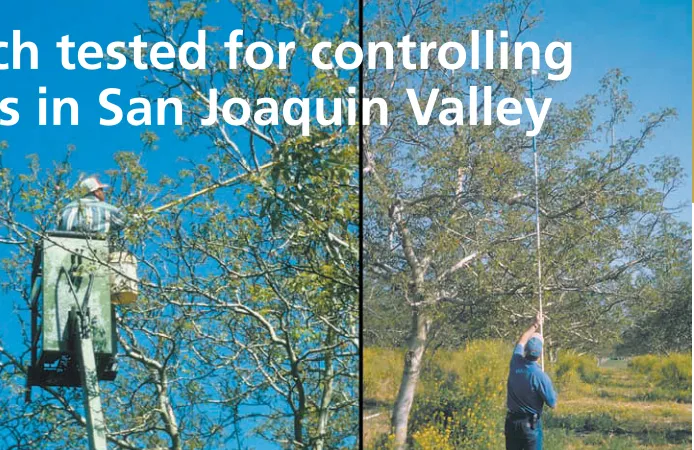
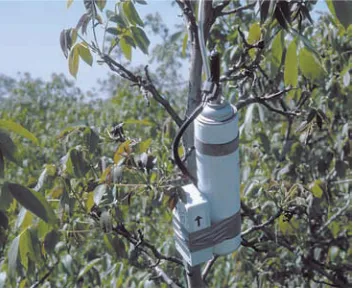
To test the effectiveness of mating disruption in controlling codling moth, pheromone dispensers were applied to walnut trees in the northern San Joaquin Valley. The dispensers must be hung by hand either from a pruning tower, left, or the ground, right.
of technical experts, consisting of the local UC Cooperative Extension farm advisor, two UC integrated pest man-agement advisors, two walnut growers with BIOS or organic walnut farm-ing experience, four individuals with BIOS-related expertise (cover crops, soil building, pest management), two PCAs and a representative of a major California walnut processor. Growers agreed to follow the management plan as closely as possible in BIOS blocks. Growers and their consultants and PCAs determined pest management practices in the conventionally man-aged comparison blocks.
We developed a comprehensive monitoring program, which included weekly monitoring of BIOS and con-ventionally managed blocks by a project field scout from April through October for key pests, using established sam-pling methods (UC IPM 1987, 2000). Monitoring results were summarized and delivered to growers and their PCAs each week.
We used data from growers’ har-vest delivery and grading reports to compare yield and quality in BIOS and conventionally managed blocks. We also evaluated nut quality using harvest samples we collected when trees were shaken for commercial harvest. We in-spected 60 randomly selected nuts col-lected from each of 10 presecol-lected trees per block for quality defects and pest damage (total of 600 nuts per block). These trees were located at regular intervals along a middle row in each block. We also obtained yield informa-tion from quesinforma-tionnaires completed by growers each year.
Managing codling moth
Codling moth is the key insect pest of walnuts, and it was the major focus of our efforts. Codling moth has three generations per year in the northern San Joaquin Valley. Feeding by first-genera -tion larvae causes damaged nuts to drop from trees. Second and third generation larvae bore into nuts and damage the kernel. Most of these nuts remain on the tree until harvest but are unmarketable. In BIOS blocks, we proposed a careful combination of intensive monitoring of pests and beneficial insects with thoughtful deployment of one or more alternatives to conventional insecticides.
These included pheromone mating dis-ruption, releases of the codling moth parasitoid Trichogramma platneri, and insecticides that would not disrupt bio-logical control of other pests.
Pheromone mating disruption. We
tested several hand-applied phero-mone mating-disruption products in BIOS blocks. Two companies currently produce hand-applied pheromone dis-pensers for use in walnuts. Each manu-facturer has developed small, specially designed plastic dispensers containing small amounts of codling moth phero-mone. Most growers used motorized pruning towers to reach the upper parts of tree canopies, and attached the dis-pensers — directly by hand or with the aid of a specially configured pole — to branches near the tops of trees.
We used Isomate C+, a currently available mating-disruption product (Pacific Biocontrol), in one BIOS block (C) in 1999; five blocks (C, D, F, I and K) in 2000; and four blocks (C, E, F and H) in 2001. A single application at a rate of 400 dispensers per acre was made at biofix (the start of egg laying by the first flight) of the overwintered generation in each block. Isomate CTT (Pacific Biocon -trol), another hand-
applied product with the same phero-mone blend as the C+ formulation but twice as much pheromone per dispens-er, was used in two BIOS blocks (K and L) in 2001. This product was applied at a rate of 200 dispensers per acre at bio-fix, affording some savings in applica -tion cost over the C+ product.
Three growers (A, E and J) used CheckMate CM-XL1000 (Suterra), an-other commercially available mating- disruption product, in their BIOS blocks in 2000 at a rate of 225 dispensers per acre, applied once per season at biofix.
A recently developed experimental wax emulsion containing codling moth pheromone (Atterholt et al. 1999; Grant et al. 2001) was made available to our project by the manufacturer (Gowan). We used the product in four BIOS blocks (B, E, F and G) in 1999 and three (B, H and L) in 2000. The pheromone emulsion was applied using a pressur-ized handgun applicator that projected a precisely metered stream of emulsion onto branches or leaves near the tops of trees. The application rate and concen-tration were designed to provide
40 grams of codling moth pheromone per acre per application in 2000. A first application was made at biofix in early April, and subsequent applications at 4- to 6-week intervals.
Two manufacturers produce bulk pheromone dispensers, known generi-cally as puffers, for disrupting codling moth mating. Puffers consist of a pres-surized disposable can filled with pheromone and propellant, fitted with a valve and nozzle assembly and a battery-operated controller. The control-ler is programmed to release precise doses of pheromone at timed intervals. The dispensers, hung near the tops of trees at rates of one per 1 to 2 acres, of-fer considerable potential savings in application labor over dispensers such as Isomate C+ and CTT. We deployed experimental puffers manufactured by Pure Green Solutions at a rate of one per acre in three BIOS blocks (A, D and G) in 2001.
Two manufacturers have developed sprayable pheromone formulations. In these products, codling moth phero-mone is contained in very small (10- to 200-micron diameter) spherical poly-mer capsules suspended in a liquid carrier. When sprayed in the orchard, these capsules adhere to leaves and other tree surfaces and slowly release pheromones into the air. An advantage A variety of pheromone mating-disruption products were tested in BIOS and
of these formulations is that they are applied with conventional orchard sprayers. The principal limitation is that the pheromones are subject to degrada-tion by ultraviolet light, which limits their longevity to 30 to 45 days (Welter et al. 2002). As such, they must be ap-plied three to five times for full-season control. Manufacturers are working to improve the stability and longevity of these products. We used a spray-able formulation (Suterra) in two BIOS blocks (B and I) in 2001.
Parasitoids, growth regulators.
T. platneri was released during the
sec-ond and third codling moth generations in five BIOS blocks (A, D, F, I and J) in 1999 (Mills et al. 2000). Four weekly re-leases of 200,000 Trichogramma-infested eggs of a stored-product moth pest were made during each generation by fixed-wing aircraft. At four of these five sites (all but F), growers also applied the insect growth regulator tebufenozide to control first-generation codling moth larvae. This material is selective and nondisruptive to T. platneri and other orchard beneficial insects. T. platneri re-leases were not made in 2000 or 2001.
Codling moth assessment.To
as-sess the effectiveness of codling-moth control strategies in each block, we used pheromone trap captures (Pherocon 1C in 1999 and Scenturion LPD in 2000 and 2001; traps were baited with Suterra BioLure lures). Three traps were placed at midcanopy in each block and moni-tored weekly. It is generally accepted that if male moths can locate phero-mone traps in mating-
disrupted orchards, the mating suppres-sion is not working. Low trap captures are generally assumed to indicate
ef-fective disruption, though instances of unacceptably high damage levels sometimes occur in mating-disrupted orchards with low seasonal trap cap-tures. We used pheromone traps (with the same designs and lures as in the BIOS blocks) to monitor codling moth development and populations in con-ventional blocks.
To evaluate first-generation activity and damage, we counted dropped nuts weekly under 10 preselected trees in each block. These were the same 10 trees sampled at harvest for quality and dam-age evaluations. The number
of dropped nuts damaged by first-generation larvae is an accepted indica-tor of possible damage by the second and third generations. Damage was also assessed at the end of the first and second codling moth generations by vi-sually inspecting 100 randomly selected nuts in the middle (50 nuts) and upper (50 nuts) canopies of these trees for external signs of feeding or entry. Data from harvest sample evaluations and growers’ grade results was also used to assess damage at harvest.
Mites and aphids
Aphid and mite feeding can reduce tree growth, and nut quality and yield. Aphids also excrete honeydew, which serves as a substrate for sooty mold growth on the surface of nuts, turning the husk surface black. This increases the likelihood that nuts will become sunburned and have darkened or shriv-eled kernels.BIOS relies on intensive population monitoring to assess the need for chemical control of mites and aphids, and on limiting the use of cod-ling moth insecticides to enhance
control of these pests by natural en-emies. Web-spinning mites (primarily two-spotted mites in the northern San Joaquin Valley), mite predators (six-spotted thrips and western predatory mite) and aphids (walnut and dusky-veined aphids) were monitored from May through harvest. Each week, 50 to 60 terminal leaflets were collected from lower and midcanopy branches of random trees in the orchard, and leaves were examined for the presence or absence of mites and dusky-veined aphids. Walnut aphids (live as well as aphid “mummies” killed by the para-sitoid Trioxys pallidus) were monitored using this presence-absence method in 1999. In 2000 and 2001, we counted the number of live and parasitized walnut aphids present on leaflets.
Natural enemies. Enhancement of
natural enemies is an integral com-ponent of BIOS. The field scout made notations on the presence or absence of generalist predators (lady beetles, as-sassin bugs, lacewings and syrphid fly larvae) on leaflets collected for mite and aphid monitoring during weekly visits. If any number of particular predator species was observed among sampled leaflets, it was scored as present for that sample date.
Pesticide use
Growers and their PCAs collaborated with project personnel in selecting and deploying alternative codling-
moth management approaches in their BIOS blocks. When chemical control of codling moth was indicated in BIOS blocks, growers were asked to use tebufenozide as their first choice. This insect growth regulator is selective and TABLE 2. Yields and nut quality were comparable in paired BIOS and conventional blocks*†
Processor grading evaluation‡ Orchard harvest samples
No. Yield % % large % % % codling % % % %
Year sites Block (tons/ac) insect§ sound offgrade¶ edible RLI# moth mold shrivel oilless** dark
1999 7 BIOS 2.2 0.7 76.1 5.7 45.2 53.1 0.3 5.8 4.5 2.0 10.4
Conv. 2.5 0.3 71.4 4.6 45.6 53.1 0.3 3.1 3.3 2.6 6.1
ns ns ns ns ns ns ns ns ns ns s
2000 8 BIOS 1.6 2.0 81.5 5.4 43.8 49.9 1.5 4.1 4.8 3.3 8.4
Conv. 1.6 1.0 77.3 4.4 44.1 50.2 1.1 3.9 3.8 3.8 8.1
ns ns ns ns ns ns ns ns ns ns ns
2001 8 BIOS 2.0 0.5 86.2 1.7 50.9 50.9 0.6 1.0 1.6 4.3 14.7
Conv. 1.9 0.3 83.7 1.9 48.7 51.6 0.6 0.8 1.6 3.4 16.1
ns ns ns ns ns ns ns ns ns ns ns
* ns = Difference between BIOS and conventional blocks not significant.
s = Significant at P < 0.05.
† Only sites with paired BIOS and conventional blocks were used for comparison (excludes sites F in 2000 and 2001, and sites H, I and J in 1999–2001).
‡ Grading performed by Diamond Walnut Growers, Stockton.
§ Includes damage to in-shell nuts by codling moth and navel orangeworm.
¶ Includes kernel damage identified as mold, insect and shrivel.
# Relative Light Index, a measure of kernel color; higher numbers mean lighter color.
nondisruptive to beneficial insects in the orchard. Phosmet was recommended as an alternative to tebufen-ozide in BIOS blocks with severe codling moth pressure or where first-generation treat -ment was necessary. The growers and their PCAs made decisions to treat BIOS blocks for other pests — and conven-tional blocks for all pests — based on their individual experiences and objec-tives.
Growers treated conventional blocks with standard pesticides at registered rates, including chlorpyrifos (Lorsban), esfenvalerate (Asana), phosmet (Imi-dan) or methyl parathion (Penncap-M) for codling moth; propargite (Omite) or clofentezine (Apollo) for mites; and chlorpyrifos or naled (Dibrom) for aphids. Though growers were informed of and asked to adhere to recognized treatment thresholds for particular pests, they were generally allowed to treat BIOS and conventional blocks as they deemed necessary to ensure ac-ceptable yields and quality. Growers reported pesticide applications for cod-ling moth and other pests in year-end questionnaires.
BIOS effectiveness evaluated
Yields and quality. Nut yields were similar in BIOS and conventional blocks in all three years of the project (table 2). Nut quality, as measured by processor grading evaluations, was also compara-ble. Kernel damage by insects was never great enough to trigger processor pay-ment penalties, though mold damage resulted in off-grade penalties in both BIOS and conventional blocks in some years. Nuts sampled at harvest showed no significant differences between BIOS and conventional blocks in nut damage or kernel quality, except for a slight in-crease in darkened kernels in one year.
[image:4.612.24.199.73.300.2]In general, our harvest samples showed more damage than processors’ grading reports, especially non-insect-related defects such as moldy, shriveled and darkened kernels. This occurred because some damaged nuts (e.g., shriv-eled and oilless) are removed by harvest and hulling equipment prior to proces-sor delivery and because our harvest evaluations included defects such as dark kernels that processors do not nec-essarily consider rejectable. As such, our harvest samples were a more sensitive TABLE 4. Average number codling-moth-damaged
dropped nuts under trees during first generation, and percent nuts with codling moth damage during first
and second canopy damage assessments, in paired BIOS and conventional blocks*
% %
No. No. drop damage, damage, Year sites Block nuts/tree June August 1999 7 BIOS 0.2 0.14 0.06
Conv. 0.5 0.03 0.69
ns ns ns
2000 8 BIOS 1.5 0.43 0.66 Conv. 1.7 0.23 0.48
ns ns ns
2001 8 BIOS 3.9 0.21 0.45 Conv. 4.7 0.06 0.48
ns s ns
* ns = Difference between BIOS and conventional blocks not significant.
s = Significant at P < 0.05.
TABLE 3. Total seasonal average 1X pheromone trap captures in BIOS (after deployment of mating
disruption*) and conventional blocks
1999 2000 2001
A BIOS 490 67 4
Conv. 525 562 492
B BIOS 0 1 0
Conv. 80 75 200
C BIOS 4 7 10
Conv. 688 677 295
D BIOS 245 0 < 1
Conv. 240 332 208
E BIOS 14 20 < 1
Conv. 331 326 85
F BIOS 31 5 < 1
Conv. 993 N/A N/A
G BIOS 2 50 < 1
Conv. 196 98 32
H BIOS 175 24 1
I BIOS 764 16 2
J BIOS 1224 695 168
K BIOS N/A 4 < 1
Conv. N/A 382 250 L BIOS N/A 12 < 1 Conv. N/A 276 101
* Use of mating disruption is indicated by colored numerals.
and comprehensive indicator of qual-ity differences than processor grading results, though the latter determine the actual price paid for nuts by the proces-sor.
Codling moth. Codling moth
pres-sure, as measured by pheromone trap captures, varied greatly among the orchards (table 3). Trap catches were generally lower in pheromone-mating- disruption BIOS blocks, though the vari-ous technologies differed in longevity of suppression and in the amount of occa-sional captures of male moths.
Results of first-generation dropped-nut counts showed low levels of early-season codling moth damage in most blocks (table 4). There were no sig-nificant differences between BIOS and conventional blocks in the number of dropped nuts. The numbers of codling moth–damaged nuts in midseason can-opy damage assessments were accept-ably low at all sites in all years. Except for the first canopy damage assessment in 2001, when BIOS blocks had slightly greater average damage than conven-tional blocks, there were no significant differences between BIOS and conven-tional blocks.
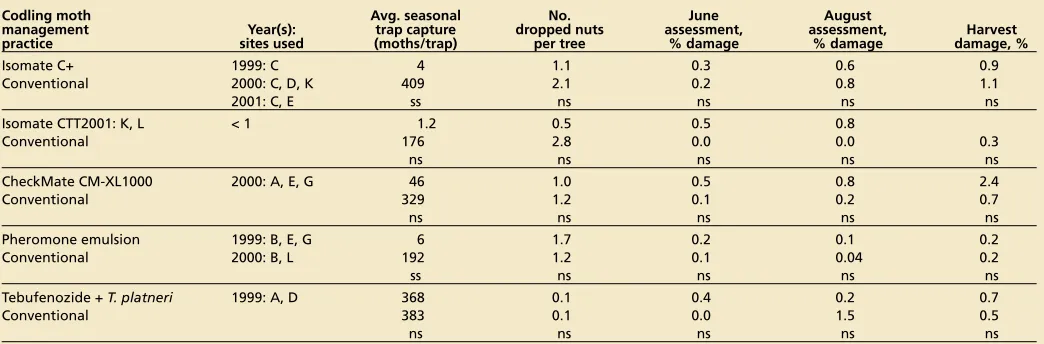
A single application of Isomate C+ or CTT suppressed trap captures for the entire season at all sites where these products were used (table 5). Nut dam-age in these sites, as measured by can-opy damage assessments and harvest evaluations, was also low and compa-rable to that in conventional blocks.
A single application of CheckMate CM-XL1000 suppressed trap captures at the three sites where it was used in 2000 until mid-July, when a resumption of low-level trap captures indicated that the product was depleted of phero-mone. The average weekly trap capture in these blocks was only 0.3 moths per trap before July 16; it was 5.3 moths per trap thereafter. This late-season activity was great enough to warrant chemi-cal treatment at one of the sites. Two of the three blocks where this product was used had the greatest codling moth damage at harvest (4.3% and 2.2%) of all the mating-disrupted blocks.
The pheromone wax emulsion sup-pressed pheromone trap captures for at least 30 days after application (Grant et al. 2001). Under the relatively low codling-moth pressure conditions that Pheromones can be applied in aerosol form,
[image:4.612.24.202.334.479.2]malfunctioning ones at BIOS block D, where they provided good suppression of trap captures (total seasonal capture of 0.3 moths per trap) and nut damage (0.3% at harvest).
The Suterra sprayable formulation used in BIOS blocks B and I in 2001 pro-vided good suppression of pheromone trap captures throughout the season (to-tal seasonal trap captures were
0 and 2.0 moths per trap, respectively). However, both these sites had relatively high dropped-nut counts (19 and 10 per tree, respectively), and the tall Serr trees at site I had relatively high damage levels in canopy assessments (1.5% and 4.2% in the June and August assessments, re-spectively) and at harvest (4.5%).
Orchards treated with a combination of tebufenozide and T. platneri releases had acceptably low levels of nut dam-age during the season and at harvest. Good codling moth control
Our results lead us to the provisional conclusion that mating disruption, by it-self, can provide good control of codling moth in many orchards. It is least likely to be successful as a sole treatment in orchards with susceptible varieties, tall canopies and historically large codling moth populations. Ongoing research with sprayable and puffer formulations will address whether this limitation can be overcome using more frequent or higher doses.
[image:5.612.58.580.65.237.2]Walnut growers and PCAs with con-ventional orchards currently base their codling moth management decisions on prior damage and in-season assess-ments of pheromone trap captures and nut damage. Because pheromone trap captures are greatly reduced in mating-disrupted orchards, they are not consid-ered useful for assessing moth activity. Statistical comparisons of trap captures and harvest damage in our project’s mating-disruption blocks showed that pheromone trap captures were poor in-dicators of potential damage within the range of relatively low damage levels observed in the mating-disrupted block (linear regression is significant at P < 0.01, r2 = 0.24). Work is currently under way to evaluate a new codling moth lure based on a pear fruit volatile that attracts both male and female moths and may allow more accurate tracking TABLE 5. Performance of alternative approaches used to control codling moth in paired BIOS and conventional blocks*
Codling moth Avg. seasonal No. June August
management Year(s): trap capture dropped nuts assessment, assessment, Harvest practice sites used (moths/trap) per tree % damage % damage damage, %
Isomate C+ 1999: C 4 1.1 0.3 0.6 0.9
Conventional 2000: C, D, K 409 2.1 0.2 0.8 1.1
2001: C, E ss ns ns ns ns
Isomate CTT 2001: K, L < 1 1.2 0.5 0.5 0.8
Conventional 176 2.8 0.0 0.0 0.3
ns ns ns ns ns
CheckMate CM-XL1000 2000: A, E, G 46 1.0 0.5 0.8 2.4
Conventional 329 1.2 0.1 0.2 0.7
ns ns ns ns ns
Pheromone emulsion 1999: B, E, G 6 1.7 0.2 0.1 0.2
Conventional 2000: B, L 192 1.2 0.1 0.04 0.2
ss ns ns ns ns
Tebufenozide + T. platneri 1999: A, D 368 0.1 0.4 0.2 0.7
Conventional 383 0.1 0.0 1.5 0.5
ns ns ns ns ns
* ns = Difference between BIOS and conventional blocks not significant. ss = Significant at P < 0.01.
prevailed in orchards where this mate-rial was used in 1999, the longevity of the emulsion was such that two appli-cations were sufficient for the season. Three applications were needed in 2000. This material provided good con-trol of nut damage during the season and at harvest.
Early in the 2001 season, we found that some puffers deployed at BIOS blocks A, B and G were malfunction-ing and releasmalfunction-ing variable amounts of pheromone. Because of this, the units were removed from BIOS blocks A and G in early June and Isomate C+ dis-pensers were hung to disrupt mating for the balance of the season. We used properly operating puffers to replace
of activity in mating-disrupted walnut orchards (Light et al. 2001, 2002).
Although early-season counts of codling-moth-damaged dropped nuts are used as an indicator of damage in conventionally managed orchards, we found no relationship between dropped-nut counts and codling moth damage at harvest in mating-disrupted blocks (linear regression is not significant at P < 0.05). Midseason canopy damage assessments proved a somewhat better predictor of eventual harvest damage in mating-disrupted blocks, though all but 0.5% and 0.3% of harvest damage was already present by the time assessments were made at the end of the first and second codling moth flights, respectively. (Linear regression for first canopy assessment is not signif -icant at P < 0.05; regression is significant for second assessment at
P < 0.001, r2 = 0.56.) If codling moth had not been controlled as effectively by mating disruption in these blocks, can-opy damage assessments may not have provided adequate advance warning of a codling moth problem.
Pheromone product costs
Although we demonstrated that many of the pheromone-dispensing technologies can control codling moth effectively in walnuts, they must also be cost-competitive with pesticides for growers to use them. Of the various mating-disruption products we tested, only the hand-applied dispensers were registered for use and commercially available in California. Approximate 2001 retail prices were $110 per acre per application for Isomate C+ and CTT and $140 for CheckMate CM-XL1000. Appli-cation costs were $50 to $90 for Isomate C+, $25 to $50 for Isomate CTT, and $15 to $26 for CheckMate CM-XL1000. Proj-ect growers’ annual average
codling-moth management costs in conventional blocks, as provided by growers in year-end surveys, ranged from $76 to $112 per acre. Therefore, growers consider hand-applied products prohibitively expensive compared with conventional pesticides. The cost of the pheromone emulsion product could not be esti-mated because it was experimental and is not currently commercially available. The cost of applying the emulsion aver-aged $7 per acre per application in our tests — around $14 to $21 per acre de-pending on the number of applications needed for
season-long control. If they are shown to be effective in ongoing tests, phero-mone puffers (now available for cod-ling moth from Suterra) and sprayable formulations (now available from Suter-ra and 3M) offer the prospect of achiev-ing good control at lower costs than the hand-applied products. Costs per acre for these products are unknown because the amounts of product needed per acre are still under investigation.
Control of mites and aphids During the 3 years of the project, web-spinning mite infestations were similar in BIOS and conventional blocks (table 6). Mite predators (six-spotted
thrips and western predatory mites), on the other hand, were significantly more abundant in BIOS blocks, though the difference was small. These findings contradict the broadly held assertion that mites can be reduced by eliminating or reducing broad-spectrum insecticides (UC IPM 1987, 2000). In some cases, late-season changes in mite and predator populations indicated that mites were effectively controlled in BIOS blocks by their natural predators. Overall, however, our results suggest that biological control of two-spotted mites was not strongly enhanced by reducing disruptive insecti-cide treatments for codling moth, at least not to a degree where the need for miti-cide applications was reduced. BIOS and conventional blocks needed chemical treatment for mites with roughly equal frequency over the 3-year project.
Averaged over 3 years, the dura-tion and intensity of walnut aphid and walnut aphid parasitoid activity were similar in BIOS and conventional blocks (table 7). Apparently, walnut aphids were controlled as well by parasitoids in BIOS blocks as by late-season insecticide ap-plications in conventional blocks. The dusky-veined aphid was present at some sites and reached greater average infesta-tion levels in BIOS than in conveninfesta-tional blocks. Only one BIOS block (H) was treated each year for this pest.
Natural enemies. Seasonal
compila-tion of general predator observacompila-tions made by the project field scout showed that lady beetles and syrphid fly larvae — both aphid predators — and lace-wings — effective general predators of mites and aphids — were significantly more abundant in BIOS than in conven-tional blocks (table 8).
TABLE 6. Duration and intensity of web-spinning mite infestations and mite predators, in paired BIOS and conventional blocks (n = 23), 1999–2001*
Web-spinning mites Mite predators†
Avg. % Max. % Avg. % Max. %
No. weeks leaflets leaflets No. weeks leaflets leaflets detected mites w/mites detected w/predators w/predators
BIOS 6.3 14.3 29.0 8.6 14.7 37.1
Conv. 6.0 11.3 26.8 6.5 11.3 24.2
ns ns ns s s s
* ns = Difference between BIOS and conventional blocks not significant. s = Significant at P < 0.05.
† Includes six-spotted thrips and western orchard predator mites.
TABLE 7. Duration and intensity of aphids and their parasites in BIOS and conventional blocks, 1999–2001*†
Live walnut aphids‡ Parasitized walnut aphid mummies Dusky-veined aphids No. No. Avg. no. Max. no. No. Avg. % Max. % weeks Avg. no. Max. no. weeks mummies/ mummies/ weeks leaflets leaflets detected leaflet per leaflet detected leaflet leaflet detected with DVA with DVA BIOS 9.6 1.0 4.2 10.8 0.8 2.2 4.9 7.1 14.5 Conv. 8.4 1.0 3.6 9.6 0.7 1.7 2.4 2.6 10.1
ns ns ns ns ns ns ns s ns
* ns = Difference between BIOS and conventional blocks not significant. s = Significant at P < 0.05.
† Only paired BIOS and conventional sites where walnut aphids (n = 16), aphid mummies (n = 16) or dusky-veined aphids (n = 8) present were used for comparison.
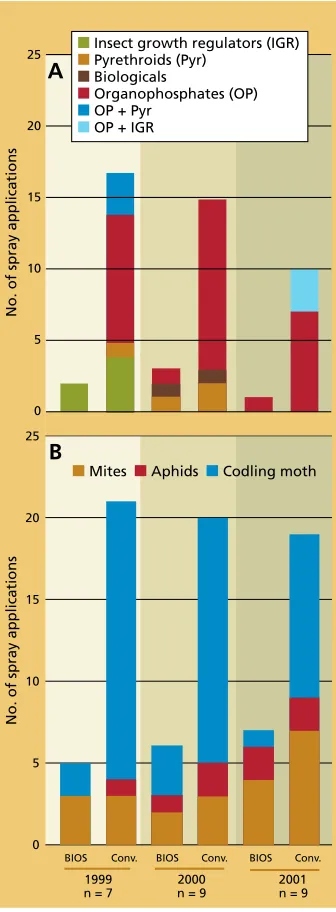
Fewer pesticide applications Though the number and type of treatments used each year differed de-pending on pest abundance, growers’ pesticide use records show that our suc-cesses in managing key walnut pests in BIOS blocks were achieved while using substantially fewer conventional pesti-cide applications (fig. 1). The reductions achieved were mainly the result of re-placing codling moth sprays with mat-ing disruption and other alternatives. We observed that growers’ pesticide use patterns in conventional blocks were similar to other conventional blocks they farmed and to blocks of similar varieties and pest pressure in the area. We do not believe that project growers made more pesticide applications in conventional blocks because of moni-toring data made available to them by project personnel.
Effective alternatives
This project demonstrated that alter-native approaches can be used to ef-fectively manage key pests in walnuts. These tactics must be deployed with thoughtful consideration of individual pest and orchard factors, and intensive monitoring is critical for evaluating ef-fectiveness and assessing the need for supplemental pesticide applications. Most of the currently available mat-ing-disruption technologies we tested were effective and helped reduce total pesticide use, but were more costly than conventional pesticide-based programs. Biological control of mites and aphids was enhanced when disruptive insecti-cides were reduced, but may not be adequate to eliminate pesticide applica-tions for these pests. Ongoing research
may help address the costs and uncer-tainties of the BIOS approach, and help identify better methods of assessing pest pressure and potential damage in orchards where they are used.
J.A. Grant is Farm Advisor, UC Cooperative Extension (UCCE), Stockton;
W. Bentley is IPM Entomologist , UC Kear-ney Agricultural Center, Parlier;
C. Pickel is Area IPM Advisor, UCCE, Yuba City; and J. Groh-Lowrimore is Staff Research Associate, UCCE, Stockton. The UC Sustainable Agriculture Research and Education Program funded this project. The authors wish to thank project growers for their vision and cooperation and CAFF for inspiring it.
References
Atterholt CA, Delwiche MJ, Rice RE, Kro-chta JM. 1999. Controlled release of insect sex pheromones from paraffin wax and emul-sions. J Controlled Release 57:233–47.
[CAFF] Community Alliance with Family Farmers. 1999. Biologically Integrated Or-chard Systems (BIOS) 1998 Year-End Report. Davis, CA. 18 p.
Grant JA, Giles DK, Brazzle J, Groh J. 2001. New codling moth management tool: Phero-mone emulsion shows promise in walnuts. Nut Grower 21(4):8–11.
Light D, Knight AL, Henrick CA, et al. 2001. A pear-derived kairomone with phero-monal potency that attracts male and female codling moth, Cydia pomonella (L.). Naturwis-senschaften 88:333–8.
Light D, Reynolds K, Grant JA, et al. 2002. Validation and development of a monitoring and management system for codling moth based on a novel female and male attractant kairomone. In: Walnut Research Reports 2001. Sacramento: California Walnut Market-ing Board. p 259–304.
Mills NJ, Pickel C, Mansfield S, et al. 2000. Trichogramma inundation: Integrating para-sitism into management of codling moth. Cal Ag 54(6):22–5.
[image:7.612.57.225.96.552.2]Swezey SL, Broome JC. 2000. Growth pre-dicted in biologically integrated and organic farming. Cal Ag 54(4):26–35.
[UC IPM]UC Statewide Integrated Pest Management Program. 1987. Integrated Pest Management for Walnuts, 2nd ed. ANR Pub 3270. 96 p.
UC IPM.2000. UC Pest Management Guidelines: Walnuts. ANR Pub 3471. 48 p.
Welter SC, Cave F, Singleton M. 2002. Development of alternative pheromone dispensing technologies for management of codling moth. In: Walnut Research Reports 2001. Sacramento: California Walnut Marketing Board. p 225–7.
Fig. 1. Number and type of annual pesticide treatments applied for (A) codling moth and (B) all pests in paired BIOS and conventional blocks.
TABLE 8. Generalist predators observed in paired BIOS and conventional blocks (n = 23)*
Chrysopidae/
Coccinellidae Reduviidae Hemerobiidae Syrphidae
(lady beetles) (assassin bugs) (lacewings) (syrphid flies) Total
BIOS 5.2 2.0 17.6 5.7 30.6
Conv. 3.3 1.1 13.4 2.8 20.6
s ns sss ss sss
* ns = Difference between BIOS and conventional blocks not significant.
s = Significant at P ≤ 0.05. ss = Significant at P ≤ 0.01. sss = Significant at P ≤ 0.001.