R E V I E W
Open Access
Poststernotomy mediastinitis: a classification to
initiate and evaluate reconstructive management
based on evidence from a structured review
Jan J van Wingerden
1*, Dirk T Ubbink
2, Chantal MAM van der Horst
1and Bas AJM de Mol
3Abstract
Early recognition and, where possible, avoidance of risk factors that contribute to the development of poststernotomy mediastinitis (PSM) form the basis for successful prevention. Once the presence of PSM is diagnosed, the known risk factors have been shown to have limited influence on management decisions. Evidence-based knowledge on treatment decisions, which include the extent and type of surgical intervention (other than debridement), timing and others is available but has not yet been incorporated into a classification on management decisions regarding PSM. Ours is a first attempt at developing a classification system for management of PSM, taking the various evidence-based reconstructive options into consideration. The classification is simple to introduce (there are four Types) and relies on the careful establishment of two variables (sternal stability and sternal bone viability and stock) prior to deciding on the best available reconstructive option. It should allow better insight into why treatment decisions fail or have to be altered and will allow better comparison of treatment outcomes between various institutions.
Keywords:Classification, Infection, Mediastinitis, Mediastinal infection, Outcomes, Poststernotomy, Postoperative, Sternal infection, Wound infection
Introduction
Poststernotomy mediastinitis (PSM) is still one of the most complex and costly infectious processes to treat. Changes in cardiac surgical patient population and con-tributing pathogens, amongst others, have ensured that the incidence of PSM, despite many advances in preven-tion, remains significant.
Data recently presented by the Netherlands Associ-ation for Cardio-Thoracic Surgery, which includes all 16 cardiac surgical centers, showed an increase in open car-diac procedures between 2007 and 2011 from 15 500 to 16 500 per year [1]. Data procured from 8 of the 16 cen-ters from 2002 to 2007 revealed a cumulative incidence for surgical site sternal wound infection of 2.4% (95% con-fidence interval [CI], 1.9 to 3.1) following coronary ar-tery bypass grafting (CABG) [2]. This figure rose to 3.2% (95% CI, 2.0 to 5.1) where CABG was combined
with concomitant valve surgery. This roughly translates to 396 to 530 new cases a year. Between hospitals, the adjusted rates varied from 0.0% to 9.7% [2]. By compari-son, in the United States approximately 700,000 median sternotomies are performed each year, leading to nearly 8,300 cases of deep sternal wound infections [3].
The acute mortality rates in some large centers still approach 40% internationally [4]. Even if the patient sur-vives, the long-term mortality rate is significantly higher. In a 10-year follow-up study after CABG [5], the ad-justed survival rate was 39% for patients who had suf-fered from PSM compared with 70% who did not. The adjusted hazard ratio for mortality during that period was 2.12 (95% CI, 1.80 to 2.49; P < 0.001). The study by Graf and colleagues [4] confirmed the findings of an earlier study from Uppsala, Sweden [6], with a similar length of follow-up.
PSM has a significant impact on both healthcare and hospital budgets. In a recent case-control study performed by Graf and colleagues [4] from Hannover, Germany, the * Correspondence:[email protected]
1Department of Plastic and Reconstructive Surgery, Academic Medical
Center, University of Amsterdam, P.O. Box 22660, 1100 DD Amsterdam, the Netherlands
Full list of author information is available at the end of the article
median costs for treatment were almost three times higher (P < 0.0001) and the median length of stay more than dou-bled (P = 0.0006). Ennker and colleagues [7] demon-strated an opportunity cost, or turnover increase, in excess of 10 600 euro through reducing the average hospitalization of their PSM patients from 48,43 to 36,73 days by improving treatment efficiency.
The enormous amount of intellectual investment re-quired from a multidisciplinary team including, among others, microbiologists, intensivists, radiologists, cardi-ologists, cardiothoracic and plastic surgeons in effect-ively dealing with these cases has yet to be calculated.
Recent developments such as the introduction of top-ical negative pressure therapy (TNP), new insights into the timing of flap surgery and flap choice, design and methods of harvesting have all become significant in re-cent years. Further improvement in the treatment and research of PSM requires a targeted approach. A new, evidence-based classification may allow for better com-parison between different treatment protocols and may further both research and refinement in the manage-ment of PSM.
The aim of this paper is to categorize and assess the effectiveness of a range of primary and secondary recon-structive management options for PSM, based on cur-rently available evidence and present an evidence-based classification. See the“Clinical definition of PSM”.
Clinical definition of poststernotomy mediastinitis (van Wingerden JJ, de Mol BAJM, van der Horst CMAM: Poststernotomy mediastinitis: definition and
terminology, Submitted)
Poststernotomy mediastinitis (in adults) must meet the following criteria:
Infection occurs within 1 year, regardless of whether an implant is in place or not
AND infection appears related to the operative procedure
AND, at least 1 of the following criteria:
1. Patient has organisms cultured from mediastinal tissue or fluid obtained during a surgical operation or needle aspiration.
2. Patient has evidence of mediastinitis seen during a surgical operation or histopathologic examination. 3. Patient has at least 1 of the following signs or
symptoms with no other recognized cause: fever (>38 0C), chest pain, or sternal instability AND at least 1 of the following:
a. Purulent discharge from mediastinal area b. Organisms cultured from blood or spontaneous
discharge from mediastinal area
c. Radiological evidence of an infective process in the mediastinum.
Methods
Literature search strategy
A search of the literature from 1990 to March 2014 was conducted without language restrictions using the Cochrane Central Register of Controlled Trials, Ovid Medline, and PubMed and Web of Science databases. Key words and MeSH terms were used to identify and a manual search of the reference lists was done regarding all possible factors (excluding pre-, or intra-operative risk factors) that could influence the current treatment decisions of PSM. Only procedures for which either usefulness or efficacy was claimed were considered. The quality and strength of the evidence was weighed according to the Rating Scheme used by the Society of Thoracic Surgeons (STS) Workforce on Evidence-based Medicine (EBM) for Classification of Recommendation (see below) [8]. Two hundred thirty three records were identified. Two members (JJvW & DU) reviewed titles and abstracts to exclude records that were of interest. In addition, a manual search of the reference lists was done.
STS workforce on EBM rating scheme to assess the quality and strength of the evidence
Rating Scheme for the Strength of the Evidence Levels of Evidence
Level A. Data derived from multiple randomized clinical trials.
Level B. Data derived from a single randomized trial or from nonrandomized trials.
Level C. Consensus expert opinion. Rating Scheme for the Strength of the Recommendations
Classification of Recommendations
Class I. Conditions for which there is evidence or general agreement, or both, that a given procedure is useful and effective.
Class II. Conditions for which there is conflicting evidence or a divergence of opinion, or both, about the usefulness/efficacy of a procedure.
Class IIa. Weight of evidence favors usefulness/ efficacy.
Class IIb. Usefulness/efficacy is less well established by evidence.
Class III. Conditions for which there is evidence or general agreement, or both, that the procedure is not useful/effective.
Results
Search results
From two hundred thirty three records, the search strat-egy rendered 78 studies, of which 4 were case reports (Table 1) that complied with the selection criteria set out above. Our literature search did not yield any man-agement choices for which multiple randomized clinical trials existed.
Classification of the studies found
As a result most studies were categorized as class II (where evidence about the usefulness/efficacy of a proced-ure is conflicting or opinion diverged, or both)per proced-ure,while procedures for which no evidence existed were discarded.
The type of study determined the level of evidence for a specific procedure. Systematic reviews of observational studies, controlled clinical trials, or comparable cohort studies were considered to be Level B1 and case series and regression analyses as B2. The Level of Evidence for Case Reports was considered to represent Level C.
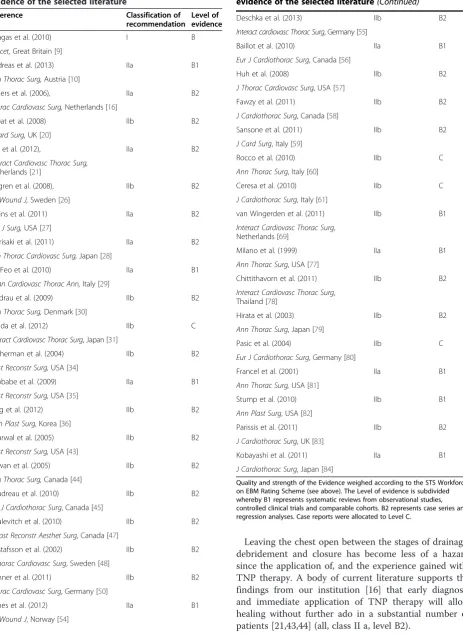
The outcome of the categorization of the supporting literature is summarized in the Table 1. This shows that the majority of studies with a Level B1 evidence led to a Class IIa categorization and the majority of Level B2 studies resulted in a Class IIb categorization.
Harmonization
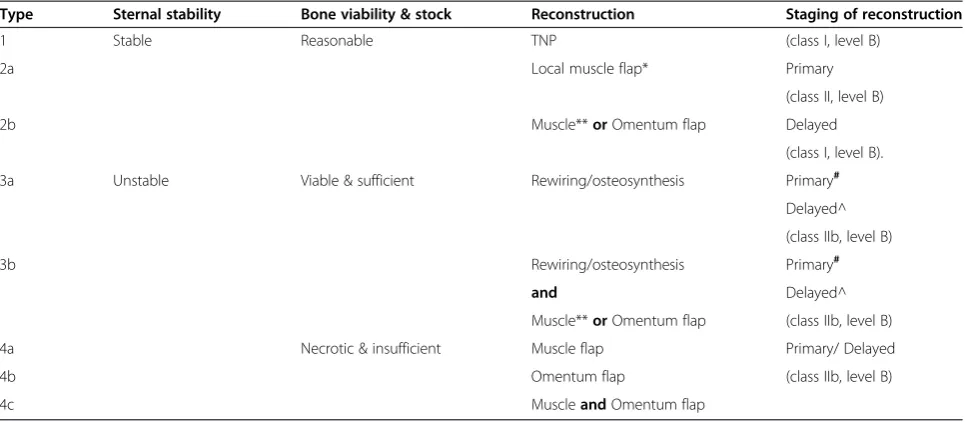
The new classification was based on the Level of Evi-dence for the usefulness or effectiveness of a specific management procedure as well as sternal stability, viabil-ity, and available bone stock, together with timing of re-construction. This resulted in a classification presented in Table 2, describing the major types of management strategies for four different clinical circumstances.
Review
Evidence found for the four major types of management strategies
Type I
When minimal bone loss and a relatively stable sternum are found at debridement, available evidence favors wound management through the application of TNP. Microbial identification and antibiotic susceptibility should be estab-lished early. In addition, the dosing of antimicrobial agents should be adjusted in obese patients to ensure adequate tissue levels [9] (class I, level B) Evidence also suggests the need for dosing adjustment following skeletonized IMA harvesting as this significantly diminishes antimicrobial penetration into the presternal tissue following IMA har-vesting [10] (class IIa, level B1).
Evidence-based support for TNP therapy has been provided by systematic reviews [11,12] and two meta-analyses [13,14]. Prospective and retrospective clinical
studies from our institution [15,16] and many others [17-22], paralleled by meticulous in vitro studies de-signed to determine the effect of TNP on the intratho-racic organs [23-25], lend convincing evidence to claims of efficacy and safety. Early diagnosis [26] and early ap-plication of TNP therapy [27] seem to predict a greater likelihood of survival (class IIa, level B2).
According to two recent studies [28,29], methicillin-resistant Staphylococcus aureus (MRSA), as the primary causative pathogen, is not a contraindication for TNP ther-apy. (class IIa, level B) Negative-pressure therapy was also successfully applied as a temporizing measure prior to sec-ondary closure in candidal mediastinitis [30,31] (class IIb, level B2 & C).
Severe bleeding, one of the most serious complications during TNP therapy, fortunately occurs seldom [32,33]. As neither the frequency nor severity of bleeding ex-ceeds that of the other conservative treatment modal-ities, the same precautions should be taken to prevent it during TNP therapy [33].
The current evidence supports the use of TNP, either as a destination or as a bridge prior to final surgical clos-ure (class I, level B).
Type 2
In Type 2 there is sufficient bone stock and the sternum is relatively stable. Direct closure, usually accompanied by advancement of the pectoralis muscle, is done either primarily (without a conservative management bridge such as TNP) (Type 2a) or delayed (Type 2b).
A single-stage procedure (Type 2a), combining drainage and debridement with immediate flap reconstruction, was favored by early workers in the field. Although never speci-fied, two possible reasons justified this approach at that time: first, the introduction of flap reconstruction which dramatically decreased mortality related to PSM; and sec-ondly, the high failure rate related to conservative manage-ment such as packing and or antibiotic irrigation. This was prior to the introduction of TNP therapy. In the advent of very early diagnosis and referral, in the hemodynamically stable patient or where TNP therapy is not available, im-mediate flap closure may still be justified, as some have pointed out [34-36] (all, class II, level B).
Alternatively, delayed closure (Type 2b) has gained strong advocates in recent years for the following reasons:
➣improved accuracy in assessing the extent of the sternal infection [37]
➣improved outcome if flap closure is delayed until the patient is hemodynamically stable [38,39]
➣less risk of sepsis in high-risk patients [40,41]
Leaving the chest open between the stages of drainage, debridement and closure has become less of a hazard since the application of, and the experience gained with, TNP therapy. A body of current literature supports the findings from our institution [16] that early diagnosis and immediate application of TNP therapy will allow healing without further ado in a substantial number of patients [21,43,44] (all, class II a, level B2).
Table 1 Classification of recommendation and level of evidence of the selected literature
Reference Classification of recommendation
Level of evidence
Falagas et al. (2010) I B
Lancet,Great Britain [9]
Andreas et al. (2013) IIa B1
Ann Thorac Surg,Austria [10]
Segers et al. (2006), IIa B2
Thorac Cardiovasc Surg,Netherlands [16]
Bapat et al. (2008) IIb B2
J Card Surg,UK [20]
Vos et al. (2012), IIa B2
Interact Cardiovasc Thorac Surg, Netherlands [21]
Sjögren et al. (2008), IIb B2
Int Wound J,Sweden [26]
Atkins et al. (2011) IIa B2
Am J Surg,USA [27]
Morisaki et al. (2011) IIa B2
Gen Thorac Cardiovasc Surg,Japan [28]
De Feo et al. (2010) IIa B1
Asian Cardiovasc Thorac Ann,Italy [29]
Modrau et al. (2009) IIb B2
Ann Thorac Surg,Denmark [30]
Osada et al. (2012) IIb C
Interact Cardiovasc Thorac Surg, Japan [31]
Ascherman et al. (2004) IIb B2
Plast Reconstr Surg,USA [34]
Cabbabe et al. (2009) IIa B1
Plast Reconstr Surg,USA [35]
Jang et al. (2012) IIb B2
Arch Plast Surg,Korea [36]
Agarwal et al. (2005) IIb B2
Plast Reconstr Surg,USA [43]
Cowan et al. (2005) IIb B2
Ann Thorac Surg,Canada [44]
Gaudreau et al. (2010) IIb B2
Eur J Cardiothorac Surg, Canada [45]
Gdalevitch et al. (2010) IIb B2
J Plast Reconstr Aesthet Surg, Canada [47]
Gustafsson et al. (2002) IIb B2
J Thorac Cardiovasc Surg, Sweden [48]
Danner et al. (2011) IIb B2
Thorac Cardiovasc Surg, Germany [50]
Risnes et al. (2012) IIa B1
Int Wound J, Norway [54]
Table 1 Classification of recommendation and level of evidence of the selected literature(Continued)
Deschka et al. (2013) IIb B2
Interact cardiovasc Thorac Surg, Germany [55]
Baillot et al. (2010) IIa B1
Eur J Cardiothorac Surg, Canada [56]
Huh et al. (2008) IIb B2
J Thorac Cardiovasc Surg, USA [57]
Fawzy et al. (2011) IIb B2
J Cardiothorac Surg, Canada [58]
Sansone et al. (2011) IIb B2
J Card Surg, Italy [59]
Rocco et al. (2010) IIb C
Ann Thorac Surg, Italy [60]
Ceresa et al. (2010) IIb C
J Cardiothorac Surg, Italy [61]
van Wingerden et al. (2011) IIb B1
Interact Cardiovasc Thorac Surg, Netherlands [69]
Milano et al. (1999) IIa B1
Ann Thorac Surg, USA [77]
Chittithavorn et al. (2011) IIb B2
Interact Cardiovasc Thorac Surg, Thailand [78]
Hirata et al. (2003) IIb B2
Ann Thorac Surg, Japan [79]
Pasic et al. (2004) IIb C
Eur J Cardiothorac Surg, Germany [80]
Francel et al. (2001) IIa B1
Ann Thorac Surg,USA [81]
Stump et al. (2010) IIb B1
Ann Plast Surg, USA [82]
Parissis et al. (2011) IIb B2
J Cardiothorac Surg, UK [83]
Kobayashi et al. (2011) IIa B1
J Cardiothorac Surg, Japan [84]
In our institution, about two-thirds of patients (median 64.9%) required some sort of direct secondary closure, with or without the aid of a flap [15] (class IIa, level B2). Whereas early diagnosis [26] (class IIb, level B2) and the application of TNP therapy [27] (class IIa, level B2) pre-dicts a greater likelihood of survival (class II, level B), pro-longed TNP therapy was shown to be a significant independent predictor of late mortality [26] (OR, 1.13; 95% CI, 1.05 to 1.21; P = 0.001) (class IIb, level B2). Fur-thermore, two studies [20,45] suggest that prolonged ap-plication of TNP therapy can result in recurrent problems due to chronic infection (class IIb, level B2). This could perhaps be explained, to some extent, that TNP therapy is known to be accompanied by a significant shift in bacterial species–even increased growth of some, such asS. aur-eus–instead of a reduction in bacterial load [46].
The real challenges related to the treatment of PSM with TNP therapy thus lie first in timely diagnosis and application, and secondly in deciding when to stop TNP therapy altogether and continue with further surgical re-construction. Some insight may be gained by looking at a retrospective cohort study by Gdalevitch and col-leagues [47]. Defining TNP therapy failure as death from sepsis, a need for surgical closure or recurrence of infection within 1 year, they found bacteremia to be the most sensitive predictor (sens. = 87.5) and a wound depth of >4cm (spec. =89.9) followed by the degree of sternal exposure and instability (spec. =85.7) to be the most specific predictors of failure. (class IIb, level B2) Gustafsson [48] and others [49] have been guided by plasma C-reactive protein levels (<30–70 mg/L), while
others have suggested that three consecutive negative wound and tissue cultures are more reliable predictors [45] (all class IIb, level B2). The necessity for obtaining negative cultures has been questioned by two very recent studies [50,51], which found that the presence of positive tissue cultures at the time of closure does not influence the rate of readmissions for recurrent infection.
In the Type 2b and all other types where definite closure is delayed, early commencement and limiting duration of TNP may offer a better outcome (class I, level B). There are inconclusive data regarding determining optimal tim-ing of closure (class IIa, level B).
Type 3
In Type 3 and Type 4, the sternum is unstable. The via-bility and amount of remaining sternal bone following debridement(s) distinguish them. With sufficient bone stock left, the sternal stability is aided by rigid fixation with wires, plates or clips–without flap coverage [52,53] (Type 3a) or with it (Type 3b). Two studies have recently com-pared rewiring and suction–irrigation with other modal-ities of treatment. Less frequent sternal wound healing failure or re-infection has been reported in a cohort treated by TNP and rewiring (6%), when compared with the rewiring and suction–irrigation drained cohort (21%; RR, 0.29; 95% CI, 0.06 to 0.88; P = 0.01) [54]. In approxi-mately 14–15% of patients an additional muscle flap re-construction was done. The other study compared the outcome following rewiring and suction–irrigation drain-age with rewiring only [55]: in 74% of patients rewiring with suction–irrigation sufficed, vs. 59% of the rewiring-Table 2 AMSTERDAM classification (Assiduous Mediastinal Sternal Debridement & Aimed Management)
Type Sternal stability Bone viability & stock Reconstruction Staging of reconstruction
1 Stable Reasonable TNP (class I, level B)
2a Local muscle flap* Primary
(class II, level B)
2b Muscle**orOmentum flap Delayed
(class I, level B).
3a Unstable Viable & sufficient Rewiring/osteosynthesis Primary#
Delayed^
(class IIb, level B)
3b Rewiring/osteosynthesis Primary#
Delayed^
and
Muscle**orOmentum flap (class IIb, level B)
4a Necrotic & insufficient Muscle flap Primary/ Delayed
4b Omentum flap (class IIb, level B)
4c MuscleandOmentum flap
*Always, unilateral or bilateral pectoralis muscle advancement. **Frequently, unilateral or bilateral pectoralis muscle advancement.
#
Rewiring.
^Osteosynthesis (plates, clips, etc.).
only patients (P = 0.056). Although insufficient, the evi-dence suggests that the outcome following rewiring-only could be worse when compared to rewiring and suction-irrigation drainage (combined), whereas the latter may be less advisable than combining TNP with rewiring. (class IIb, level B2) Flap coverage may be effective following wir-ing (Type 3b) but the data are inconclusive. It is recom-mended where the surgeon considers this necessary (class IIb, level B).
Following plating, flap coverage with either bilateral pec-toral muscle advancement flaps [45,56-58] or omentum [59-61] is recommended (class IIb, level B2). Despite this precaution, recurrence of infection, necessitating plate re-moval, has been reported in 5–10% of cases [45,58]. In all patients the sternum remained stable following plate re-moval because of a recurrent infection.
More recently, the successful use of clips, either of ther-moreactive nickel-titanium [62] or titanium only [63], in-stead of plates, has been reported. Titanium alone, contrary to the impression given by some [58] may not be sufficiently bacteriostatic [64]. Attractive future prospects include coatings for the titanium either with anti-adhesive properties to prevent adhesion-mediated bacterial (par-ticularly Staphylococcal) anchorage and biofilm produc-tion [64], or for controlled release of antimicrobials such as antibiotics [65], antimicrobial peptides [66] or their syn-thetic analogues [67].
Type 4
Type 4 is recognized by loss of sternal stability and vi-able bone. Soft-tissue (flap) reconstruction following de-bridement of all necrotic and fractured bone improves local vascularity, can obliterate dead space and, on its own (without additional fixation), may ensure sufficient chest stability [68] in these cases. Type 4a represents muscle flap closure, the commonest being pectoralis, rectus abdominis and the two combined, or latissimus major muscle. Bilateral pectoralis muscle flaps, as either advancement or turnover flaps, remain the most popular “single type” muscle flaps [69]. Favoring a muscle flap above an omental flap has two lesser-known disadvan-tages: a slight survival disadvantage (overall RR 1.29; 95% CI, 0.58 to 2.88) [70] (class IIb, level B1) and pos-sible association with more, and more frequent, compli-cations when compared with omental flaps [27,69].
As a better understanding regarding angiogenesis [70,71], antimicrobial activity [72] and tissue-generation promotion [73] by the omentum emerges, so does the popularity of a single omental flap (Type 4b) in the treatment of PSM rise. Harvested either laparoscopically [49,74], by laparotomy or manually, transdiaphragmatically [3], it is particularly pferred following significant sternal loss, where bulk is re-quired to fill the dead space. Contrary to the fear of postfilling atrophy expressed [75], the omentum has been
shown to hypertrophy when a Burgundian lifestyle is em-braced following successful transfer for PSM [76].
A clear preference has been expressed for the use of omentum (instead of muscle) in cases where the primary causative organism is particularly resistant, such as MRSA [50,77-80] (class IIb, level B2) or Candida [31,81] (class IIb, level C & class IIa, level B1, resp.) or where the patient suffers from diabetes mellitus [82] (class IIb, level B1). The omental flap is transposed either delayed or, less frequently, as part of the primary procedure.
In Type 4c both the omentum and pectoralis major muscle advancement are transferred [83,84] (class IIb, level B2 & class IIa, level B1, resp.).
Discussion
At the other end of the spectrum, the surgical team is left with few options when the sternum is very necrotic and found to be insufficient for closure following de-bridement. But then, which flap would be preferable and at which stage (primary or delayed) should it be applied? The most difficult cases to decide on (and to compare) are the scenarios in between the two Types I and 4, be-cause of the relatively small number of cases per institu-tion. Comparison could be made easier if some of the variables are standardized. Eventually it would also open a way for meta-analysis, which is necessary in small case series of each institution. The proposed Classification could be a first step in this direction. What this Classifi-cation is not primarily intended for is to encourage insti-tutions to alter their approach to each case of PSM. The preferred approach to the further management of PSM is decided on during the first, vigorous debridement that follows immediately upon diagnosing PSM. Patient-related factors (hemodynamic stability, sternal bone viability, etc.) and local circumstances (e.g. availability of material and expertise) will influence this first decision and determine the type of management is planned accordingly. It is this first decision that determines the type of management to which the patient is allocated. Further treatment may change according to altering circumstances (e.g. a flap may be required where initially it was thought unneces-sary) but the Type will not change – regardless of what treatment was ultimately given. In this way a prognostic balance generated from the original treatment allocation is ensured. Management approach (type) allocation allows for outcome analysis, which in turn reflects the real-world clinical scenario because it admits treatment-decision al-terations and deviations. Insight into the reasons for, and timing of, these decisions will become clearer. A poten-tial weakness of the proposed Classification, some may argue, could be that it is over simplified. This will have to be weighed against a Classification that is so cumber-some that it becomes impractical. Time will tell – at least it is a start.
Conclusion
The development of further, evidence-based guidelines and research would benefit from universally adopted classification of the severe infectious process in the wound that may follow a sternotomy.
In this paper a classification system is introduced based on Evidence-based principles with the aim of providing the highest level of evidence currently avail-able. This system, due to its simplicity, could easily be adopted provided that there is an early, collaborative approach between cardiothoracic-, and reconstructive plastic surgeons. As more evidence becomes available, undoubtedly the classification proposed here will be refined. For more evidence, larger numbers, from
numerous centers internationally, are required and for this, a classification as presented here, may serve as a starting as a starting point.
Abbreviations
CI:Confidence interval; CoNS: Coagulase negativeStaphylococcus; EBM: Evidence-based medicine; IMA: Internal mammary artery;
MRSA: Methicillin-resistantStaphylococcus; PSM: Poststernotomy mediastinitis; RR: Relative risk; STS: Society of thoracic surgeons; TNP: Topical negative pressure (synonym for V.A.C.®); V.A.C.®: Vacuum assisted closure.
Competing interests
The authors declare that they have no competing interests.
Authors’contributions
JJvW: Literature search, preparation of the manuscript, revising the manuscript, submission, corresponding author; DU: Literature search, preparation of the manuscript; CvdH: Literature assessment, preparation of the manuscript, revising the manuscript; BdM: Literature evaluation, preparation of the manuscript, revising the manuscript. All authors read and approved the final manuscript.
Author details 1
Department of Plastic and Reconstructive Surgery, Academic Medical Center, University of Amsterdam, P.O. Box 22660, 1100 DD Amsterdam, the Netherlands.2Department of Quality Assurance and Process Innovation, Academic Medical Center, Amsterdam, the Netherlands.3Department of
Cardiothoracic Surgery, Academic Medical Center, University of Amsterdam, Amsterdam, the Netherlands.
Received: 24 July 2014 Accepted: 30 October 2014
References
1. Versteegh MH:De Nederlandse Dataregistratie Hartchirurgie. Resultaten van samenwerking tussen 16 Nederlandse hartchirurgische centra. Available at: http://www.nvtnet.nl/?page_id=113. Accessed July19, 2014. 2. Manniën J, Wille JC, Kloek JJ, van Benthem BH:Surveillance and
epidemiology of surgical site infections after cardiothoracic surgery in The Netherlands, 2002-2007.J Thorac Cardiovasc Surg2011,141:899–904. 3. Vyas RM, Prsic A, Orgill DP:Transdiaphragmatic omental harvest: a simple,
efficient method for sternal wound coverage.Plast Reconstr Surg2013, 131:544–552.
4. Graf K, Ott E, Vonberg RP, Kuehn C, Haverich A, Chaberny IF:Economic aspects of deep sternal wound infections.Eur J Cardiothorac Surg2010, 37:893–896.
5. Braxton JH, Marrin CA, McGrath PD, Morton JR, Norotsky M, Charlesworth DC, Lahey SJ, Clough R, Ross CS, Olmstead EM, O'Connor GT:10-year follow-up of patients with and without mediastinitis.Semin Thorac Cardiovasc Surg2004,16:70–76.
6. Ståhle E, Tammelin A, Bergström R, Hambreus A, Nyström SO, Hansson HE: Sternal wound complications–incidence, microbiology and risk factors.
Eur J Cardiothorac Surg1997,11:1146–1153.
7. Ennker IC, Kojcici B, Ennker J, Vogt P, Melichercik J:[Examination of the opportunity costs and turnover situation in patients with deep sternal infections].Zentralbl Chir2012,137:257–261. German.
8. Engelman R, Shahian D, Shemin R, Guy TS, Bratzler D, Edwards F, Jacobs M, Fernando H, Bridges C, Workforce on Evidence-Based Medicine, Society of Thoracic Surgeons:The Society of Thoracic Surgeons practice guideline series: Antibiotic prophylaxis in cardiac surgery, part II: Antibiotic choice.
Ann Thorac Surg2007,83:1569–1576. Review.
9. Falagas ME, Karageorgopoulos DE:Adjustment of dosing of antimicrobial agents for bodyweight in adults.Lancet2010,375:248–251.
10. Andreas M, Zeitlinger M, Hoeferl M, Jaeger W, Zimpfer D, Hiesmayr JM, Laufer G, Hutschala D:Internal mammary artery harvesting influences antibiotic penetration into presternal tissue.Ann Thorac Surg2013, 95:1323–1329.
12. Bush LD:Negative pressure wound therapy versus conventional therapy for the treatment of poststernotomy mediastinitis: a systematic review. Available at http://commons.pacificu.edu/pa/215/. Accessed April 28, 2012. 13. Damiani G, Pinnarelli L, Sommella L, Tocco MP, Marvulli M, Magrini P,
Ricciardi W:Vacuum assisted closure therapy for patients with infected sternal wounds: a meta-analysis of current evidence.J Plast Reconstr Aesthet Surg2011,64:1119–1123.
14. Falagas ME, Tansarli GS, Kapaskelis A, Vardakas KZ:Impact of vacuum-assisted closure (VAC) therapy on clinical outcomes of patients with sternal wound infections: a meta-analysis of non-randomized studies.
PLoS One2013,8:e64741.
15. Segers P, de Jong AP, Kloek JJ, de Mol BA:Poststernotomy mediastinitis: comparison of two treatment modalities.Interact Cardiovasc Thorac Surg
2005,4:555–560.
16. Segers P, de Jong AP, Kloek JJ, van der Horst CM, Spanjaard L, de Mol BA: Topical negative pressure therapy in wounds after cardiothoracic surgery: successful experience supported by literature.Thorac Cardiovasc Surg2006,54:289–294.
17. Ennker IC, Malkoc A, Pietrowski D, Vogt PM, Ennker J, Albert A:The concept of negative pressure wound therapy (NPWT) after poststernotomy mediastinitis—a single center experience with 54 patients.J Cardiothorac Surg2009,4:5.
18. Sjögren J, Malmsjö M, Gustafsson R, Ingemansson R:Poststernotomy mediastinitis: a review of conventional surgical treatments, vacuum-assisted closure therapy and presentation of the Lund University Hospital mediastinitis algorithm.Eur J Cardiothorac Surg2006,30:898–905. Review. 19. Fuchs U, Zittermann A, Stuettgen B, Groening A, Minami K, Koerfer R:
Clinical outcome of patients with deep sternal wound infection managed by vacuum-assisted closure compared to conventional therapy with open packing: a retrospective analysis.Ann Thorac Surg2005, 79:526–531.
20. Bapat V, El-Muttardi N, Young C, Venn G, Roxburgh J:Experience with Vacuum-assisted closure of sternal wound infections following cardiac surgery and evaluation of chronic complications associated with its use.
J Card Surg2008,23:227–233.
21. Vos RJ, Yilmaz A, Sonker U, Kelder JC, Kloppenburg GT:Vacuum-assisted closure of post-sternotomy mediastinitis as compared to open packing.
Interact Cardiovasc Thorac Surg2012,14:17–21.
22. Deniz H, Gokaslan G, Arslanoglu Y, Ozcaliskan O, Guzel G, Yasim A, Ustunsoy H:Treatment outcomes of postoperative mediastinitis in cardiac surgery; negative pressure wound therapy versus conventional treatment.
J Cardiothorac Surg2012,7:67.
23. Lindstedt S, Malmsjö M, Sjögren J, Gustafsson R, Ingemansson R:Impact of different topical negative pressure levels on myocardial microvascular blood flow.Cardiovasc Revasc Med2008,9:29–35.
24. Sjögren J, Gustafsson R, Wackenfors A, Malmsjö M, Algotsson L, Ingemansson R:Effects of vacuum-assisted closure on central
hemodynamics in a sternotomy wound model.Interact Cardiovasc Thorac Surg2004,3:666–671.
25. Gustafsson R, Sjögren J, Malmsjö M, Wackenfors A, Algotsson L, Ingemansson R:Vacuum assisted closure of the sternotomy wound: respiratory mechanics and ventilation.Plast Reconstr Surg2006,117:1167–1176. 26. Sjögren J, Mokhtari A, Gustafsson R, Malmsjö M, Nilsson J, Ingemansson R:
Vacuum-assisted closure therapy for deep sternal wound infections: the impact of learning curve on survival and predictors for late mortality.
Int Wound J2008,5:216–223.
27. Atkins BZ, Onaitis MW, Hutcheson KA, Kaye K, Petersen RP, Wolfe WG:Does method of sternal repair influence long-term outcome of postoperative mediastinitis?Am J Surg2011,202:565–567.
28. Morisaki A, Hosono M, Sasaki Y, Hirai H, Sakaguchi M, Nakahira A, Seo H, Suehiro S, Shibata T:Evaluation of risk factors for hospital mortality and current treatment for poststernotomy mediastinitis.Gen Thorac Cardiovasc Surg2011,59:261–267.
29. De Feo M, Vicchio M, Nappi G, Cotrufo M:Role of vacuum in methicillin-resistant deep sternal wound infection.Asian Cardiovasc Thorac Ann2010, 18:360–363.
30. Modrau IS, Ejlertsen T, Rasmussen BS:Emerging role of Candida in deep sternal wound infection.Ann Thorac Surg2009,88:1905–1909. 31. Osada H, Nakajima H, Morishima M, Su T:Candidal mediastinitis
successfully treated using vacuum-assisted closure following open-heart surgery.Interact Cardiovasc Thorac Surg2012,14:872–874.
32. Sjögren J, Gustafsson R, Nilsson J, Lindstedt S, Nozohoor S, Ingemansson R: Negative-pressure wound therapy following cardiac surgery: bleeding complications and 30-day mortality in 176 patients with deep sternal wound infection.Interact Cardiovasc Thorac Surg2011,12:117–120. 33. van Wingerden JJ, Segers P, Jekel L:Major bleeding during negative
pressure wound/ V.A.C.® - therapy for postsurgical deep sternal wound infection–a critical appraisal.J Cardiothorac Surg2011,6:121. 34. Ascherman JA, Patel SM, Malhotra SM, Smith CR:Management of sternal
wounds with bilateral pectoralis major myocutaneous advancement flaps in 114 consecutively treated patients: refinements in technique and outcomes analysis.Plast Reconstr Surg2004,114:676–683. 35. Cabbabe EB, Cabbabe SW:Immediate versus delayed one-stage sternal
debridement and pectoralis muscle flap reconstruction of deep sternal wound infections.Plast Reconstr Surg2009,123:1490–1494.
36. Jang YJ, Park MC, Park DH, Lim H, Kim JH, Lee IJ:Immediate debridement and reconstruction with a pectoralis major muscle flap for
poststernotomy mediastinitis.Arch Plast Surg2012,39:36–41.
37. Wong CH, Senewiratne S, Garlick B, Mullany D:Two-stage management of sternal wound infection using bilateral pectoralis major advancement flap.Eur J Cardiothorac Surg2006,30:148–152.
38. Jones G, Jurkiewicz MJ, Bostwick J, Wood R, Bried JT, Culbertson J, Howell R, Eaves F, Carlson G, Nahai F:Management of the infected median sternotomy wound with muscle flaps. The Emory 20-year experience.
Ann Surg1997,225:766–776.
39. Schroeyers P, Wellens F, Degrieck I, De Geest R, Van Praet F, Vermeulen Y, Vanermen H:Aggressive primary treatment for poststernotomy acute mediastinitis: our experience with omental- and muscle flaps surgery.
Eur J Cardiothorac Surg2001,20:743–746.
40. Fleck TM, Koller R, Giovanoli P, Moidl R, Czerny M, Fleck M, Wolner E, Grabenwoger M:Primary or delayed closure for the treatment of poststernotomy wound infections?Ann Plast Surg2004,52:310–314. 41. Izaddoost S, Withers EH:Sternal reconstruction with omental and
pectoralis flaps: a review of 415 consecutive cases.Ann Plast Surg2012, 69:296–300.
42. Lindsey JT:A retrospective analysis of 48 infected sternal wound closures: delayed closure decreases wound complications.Plast Reconstr Surg2002,109:1882–1885.
43. Agarwal JP, Ogilvie M, Wu LC, Lohman RF, Gottlieb LJ, Franczyk M, Song DH:Vacuum-assisted closure for sternal wounds: a first-line therapeutic management approach.Plast Reconstr Surg2005,116:1035–1040. 44. Cowan KN, Teague L, Sue SC, Mahoney JL:Vacuum-assisted wound
closure of deep sternal infections in high-risk patients after cardiac surgery.Ann Thorac Surg2005,80:2205–2212.
45. Gaudreau G, Costache V, Houde C, Cloutier D, Montalin L, Voisine P, Baillot R:Recurrent sternal infection following treatment with negative pressure wound therapy and titanium transverse plate fixation.Eur J Cardiothorac Surg2010,37:888–892.
46. Mouës CM, Heule F, Hovius SE:A review of topical negative pressure therapy in wound healing: sufficient evidence?Am J Surg2011,201:544–556. 47. Gdalevitch P, Afilalo J, Lee C:Predictors of vacuum-assisted closure failure
of sternotomy wounds.J Plast Reconstr Aesthet Surg2010,63:180–183. 48. Gustafsson R, Johnsson P, Algotsson L, Blomquist S, Ingemansson R:
Vacuum-assisted closure therapy guided by C-reactive protein level in patients with deep sternal wound infection.J Thorac Cardiovasc Surg2002,123:895–900. 49. van Wingerden JJ, Coret ME, van Nieuwenhoven CA, Totté ER:The
laparoscopically harvested omental flap for deep sternal wound infection.Eur J Cardiothorac Surg2010,37:87–92.
50. Danner BC, Zenker D, Didilis VN, Grossmann M, Stojanovic T, Seipelt R, Tirilomis T, Schöndube FA:Transposition of greater omentum in deep sternal wound infection caused by methicillin-resistant Staphylococci, with differing clinical course for MRSA and MRSE.Thorac Cardiovasc Surg2011,59:21–24. 51. Rodriguez Cetina Biefer H, Sündermann SH, Emmert MY, Rancic Z, Salzberg
SP, Grünenfelder J, Falk V, Plass AR:Negative microbiological results are not mandatory in deep sternal wound infections before wound closure.
Eur J Cardiothorac Surg2012,42:306–310.
52. Schimmer C, Sommer SP, Bensch M, Elert O, Leyh R:Management of poststernotomy mediastinitis: experience and results of different therapy modalities.Thorac Cardiovasc Surg2008,56:200–204. Review.
53. Molina JE, Nelson EC, Smith RR:Treatment of postoperative sternal dehiscence with mediastinitis: twenty-four-year use of a single method.
54. Risnes I, Abdelnoor M, Veel T, Svennevig JL, Lundblad R, Rynning SE: Mediastinitis after coronary artery bypass grafting: the effect of vacuum-assisted closure versus traditional closed drainage on survival and reinfection rate.Int Wound J2014,11:177–182.
55. Deschka H, Erler S, El-Ayoubi L, Vogel C, Vöhringer L, Wimmer-Greinecker G: Suction-irrigation drainage: an underestimated therapeutic option for surgical treatment of deep sternal wound infections.Interact Cardiovasc Thorac Surg2013,17:85–89.
56. Baillot R, Cloutier D, Montalin L, Côté L, Lellouche F, Houde C, Gaudreau G, Voisine P:Impact of deep sternal wound infection management with vacuum-assisted closure therapy followed by sternal osteosynthesis: a 15-year review of 23,499 sternotomies.Eur J Cardiothorac Surg2010, 37:880–887.
57. Huh J, Bakaeen F, Chu D, Wall MJ Jr:Transverse sternal plating in secondary sternal reconstruction.J Thorac Cardiovasc Surg2008, 136:1476–1480.
58. Fawzy H, Osei-Tutu K, Errett L, Latter D, Bonneau D, Musgrave M, Mahoney J:Sternal plate fixation for sternal wound reconstruction: initial experience (retrospective study).J Cardiothorac Surg2011,6:63. 59. Sansone F, Mossetti C, Bruna MC, Oliaro A, Zingarelli E, Flocco R, Del Ponte
S, Casabona R:Transomental titanium plates for sternal osteomyelitis in cardiac surgery.J Card Surg2011,26:600–603.
60. Rocco G, Fazioli F, La Manna C, La Rocca A, Mori S, Palaia R, Martucci N, Salvi R:Omental flap and titanium plates provide structural stability and protection of the mediastinum after extensive sternocostal resection.
Ann Thorac Surg2010,90:e14–e16.
61. Ceresa F, Casablanca G, Patanè F:Complicated sternal dehiscence treated with the Strasbourg thoracic osteosyntheses system (STRATOS) and the transposition of greater omentum: a case report.J Cardiothorac Surg
2010,5:53.
62. Tocco MP, Costantino A, Ballardini M, D'Andrea C, Masala M, Merico E, Mosillo L, Sordini P:Improved results of the vacuum assisted closure and Nitinol clips sternal closure after postoperative deep sternal wound infection.Eur J Cardiothorac Surg2009,35:833–838.
63. Levin LS, Miller AS, Gajjar AH, Bremer KD, Spann J, Milano CA, Erdmann D: An innovative approach for sternal closure.Ann Thorac Surg2010, 89:1995–1999.
64. Zhao L, Chu PK, Zhang Y, Wu Z:Antibacterial coatings on titanium implants.J Biomed Mater Res B Appl Biomater2009,91:470–480. Review. 65. Gilchrist SE, Lange D, Letchford K, Bach H, Fazli L, Burt HM:Fusidic acid and
rifampicin co-loaded PLGA nanofibers for the prevention of orthopedic implant associated infections.J Control Release2013,170:64–73. 66. Kazemzadeh-Narbat M, Lai BF, Ding C, Kizhakkedathu JN, Hancock RE, Wang
R:Multilayered coating on titanium for controlled release of antimicrobial peptides for the prevention of implant-associated infections.Biomaterials2013,34:5969–5977.
67. Williams DL, Sinclair KD, Jeyapalina S, Bloebaum RD:Characterization of a novel active release coating to prevent biofilm implant-related infections.J Biomed Mater Res B Appl Biomater2013,101:1078–1089. 68. Zeitani J, Pompeo E, Nardi P, Sergiacomi G, Scognamiglio M, Chiariello G, Del
Giudice C, Arganini C, Simonetti G, Chiariello L:Early and long-term results of pectoralis muscle flap reconstruction versus sternal rewiring following failed sternal closure.Eur J Cardiothorac Surg2013,43:e144–e150. 69. van Wingerden JJ, Lapid O, Boonstra PW, de Mol BA:Muscle flaps or
omental flap in the management of deep sternal wound infection.
Interact Cardiovasc Thorac Surg2011,13:179–187.
70. Litbarg NO, Gudehithlu KP, Sethupathi P, Arruda JA, Dunea G, Singh AK: Activated omentum becomes rich in factors that promote healing and tissue regeneration.Cell Tissue Res2007,328:487–497.
71. Singh AK, Patel J, Litbarg NO, Gudehithlu KP, Sethupathi P, Arruda JA, Dunea G:Stromal cells cultured from omentum express pluripotent markers, produce high amounts of VEGF, and engraft to injured sites.
Cell Tissue Res2008,332:81–88.
72. Paslakis G, Keuneke C, Groene HJ, Schroppel B, Schmid H, Schloendorff D: The putative role of human peritoneal adipocytes in the fight against bacteria: synthesis of the antimicrobial active peptide DEFA1-3.
Nephron Exp Nephrol2010,115:e96–e100.
73. Shah S, Lowery E, Braun RK, Martin A, Huang N, Medina M, Sethupathi P, Seki Y, Takami M, Byrne K, Wigfield C, Love RB, Iwashima M:Cellular basis of tissue regeneration by omentum.PLoS One2012,7:e38368.
74. De Brabandere K, Jacobs-Tulleneers-Thevissen D, Czapla J, La Meir M, Delvaux G, Wellens F:Negative-pressure wound therapy and laparoscopic omentoplasty for deep sternal wound infections after median sternotomy.
Tex Heart Inst J2012,39:367–371.
75. Fujii T, Watanabe Y, Shiono N, Ozawa T, Hamada S, Masuhara H, Teramoto C, Hara M, Katayanagi T, Sasaki Y, Koyama N:An aortic root
pseudoaneurysm that developed after implantation of a rectus abdominis muscle flap to treat an MRSA mediastinitis: a case report.
Ann Thorac Cardiovasc Surg2010,16:63–66.
76. Lengelé B, Poncelet A, Meunier D, Elias B, El Fouly PE, Willemart G, Noirhomme P:[About the rational use of intrathoracic transfers. Anatomical and surgical bases for the selection of twelve different muscular and omental flaps].Ann Chir Plast Esthet2003,48:99–114. French. 77. Milano CA, Georgiade G, Muhlbaier LH, Smith PK, Wolfe WG:Comparison of
omental and pectoralis flaps for poststernotomy mediastinitis.
Ann Thorac Surg1999,67:377–380.
78. Chittithavorn V, Rergkliang C, Chetpaophan A, Simapattanapong T: Single-stage omental flap transposition: modality of an effective treatment for deep sternal wound infection.Interact Cardiovasc Thorac Surg2011, 12:982–986.
79. Hirata N, Hatsuoka S, Amemiya A, Ueno T, Kosakai Y:New strategy for treatment of MRSA mediastinitis: one-stage procedure for omental transposition and closed irrigation.Ann Thorac Surg2003,76:2104–2106. 80. Pasic M, Schaffarczyk R, Hetzer R:Successful treatment of
methicillin-resistant Staphylococcus aureus (MRSA) mediastinitis in a heart transplant recipient.Eur J Cardiothorac Surg2004,25:1127–1128. 81. Francel TJ, Kouchoukos NT:A rational approach to wound difficulties after
sternotomy: reconstruction and long-term results.Ann Thorac Surg2001, 72:1419–1429.
82. Stump A, Bedri M, Goldberg NH, Slezak S, Silverman RP:Omental transposition flap for sternal wound reconstruction in diabetic patients.
Ann Plast Surg2010,65:206–210.
83. Parissis H, Al-Alao B, Soo A, Orr D, Young V:Risk analysis and outcome of mediastinal wound and deep mediastinal wound infections with specific emphasis to omental transposition.J Cardiothorac Surg2011,6:111. 84. Kobayashi T, Mikamo A, Kurazumi H, Suzuki R, Shirasawa B, Hamano K:
Secondary omental and pectoralis major double flap reconstruction following aggressive sternectomy for deep sternal wound infections after cardiac surgery.J Cardiothorac Surg2011,6:56.
doi:10.1186/s13019-014-0179-4
Cite this article as:van Wingerdenet al.:Poststernotomy mediastinitis: a classification to initiate and evaluate reconstructive management based on evidence from a structured review.Journal of Cardiothoracic Surgery 201419:179.
Submit your next manuscript to BioMed Central and take full advantage of:
• Convenient online submission
• Thorough peer review
• No space constraints or color figure charges
• Immediate publication on acceptance
• Inclusion in PubMed, CAS, Scopus and Google Scholar
• Research which is freely available for redistribution