65:4 (2013) 59–63 | www.jurnalteknologi.utm.my | eISSN 2180–3722 |
Full paper
Jurnal
Teknologi
Performance of PSf Ultrafiltration Membrane: Effect of Different
Nonsolvent on Coagulation Medium
Muhamad Fikri Shohura,b*, Zawati Haruna,b, W. J. Lauc, Muhamad Zaini Yunosa,b, Mohd Riduan Jamalludina,b
aDepartment of Materials and Design Engineering, Faculty of Mechanical and Manufacturing Engineering, Universiti Tun Hussein Onn Malaysia, 86400
Parit Raja, Johor, Malaysia
bAdvanced Materials and Manufacturing Centre (AMMC), Faculty of Mechanical and Manufacturing Engineering, Universiti Tun Hussein Onn Malaysia,
86400 Parit Raja, Johor, Malaysia
cAdvanced Membrane Technology Research Centre (AMTEC), Universiti Teknologi Malaysia, 81310 UTM Johor Bahru, Johor, Malaysia
*Corresponding author: [email protected]
Article history
Received :21 August 2013 Received in revised form : 30 October 2013
Accepted :15 November 2013
Graphical abstract
Abstract
One of the big challenges in developing a good asymmetric membrane is macrovoid formation that leads to reduction of rejection value. The most common method to reduce or suppress macrovoid formation is by addition of controlled solvent to the coagulation bath. Therefore, the effect of difference coagulants based on dissolved KCl (monovalent) and dissolved Na2SO4(divalent) with different concentration onto
asymmetric Polysulfone (PSf) ultrafiltration membrane was investigated in this work. The PSf ultrafiltration membranes were prepared by using phase inversion method using these two immerse aqueous solutions. The performances of membranes were evaluated via pure water flux (distilled water) and solute rejection (humic acid). Results on the cross section revealed that the structure of membrane show a straight pattern of bigger finger-like pore structure from top to bottom layer tend to reduce with at the same time the diameter of finger-like pore structure also increased, as salt medium of coagulant increases. These obviously shown by permeation values for both salt mediums were higher compared to without salt coagulant. This reduction of finger-like structure at bottom layer occurred along together with the formation of sponge shape structure. The growth of thick sponge shape is strongly influence by kinetic phase inversion of salt coagulant that also creates resistance to permeation mechanism. However the intense salt coagulant medium can cause the bigger sponge structure that will slightly reduce rejection and increase the permeation. This was proved by the rejection of KCl medium started to increase at 1-3% but slightly reduced at 4%. Based on the result analysis demonstrated that the ideal membrane with highest rejection and good permeation values was membrane immersed into 1% Na2SO4 coagulation
medium.
Keywords: Polysulfone (PSf); polyethelene glycols (PEG); sodium sulphate (Na2SO4); potassium chloride
(KCl)
© 2013 Penerbit UTM Press. All rights reserved.
1.0 INTRODUCTION
Phase inversion that also known as “phase separation process” is one of the most established method that used by numerous researchers to produce asymmetric membrane structure. This technique that used Non-solvent Induced Phase Separation (NIPS) to prepare assymetric of microfiltration and ultrafiltration polymeric1-8 and ceramic membranes9-11. In this technique, a thin film of polymer homogenous dope solution is casted with gadner film knife on a suitable substrate such as glass, polyester or polyethylene non-woven fabric, metal, Teflon directly immersed in a non-solvent coagulation bath where exchange polymer precipitation between solvent and non-solvent will take places. The removal of non-solvent and the entering of water as coagulation medium into membrane substrate produce anisotropic membrane with a dense top layer and porous sub-layer which is related to thermodynamics and kinetic equilibrium during phase inversion process5,12.
macrovoid formation16-18. This was agreed with other work reported by Yves Termonia that shows a salt poorly soluble in polymer solvent and acting as the most proficient method in preventing macrovoid formation19. Theoretically, this mechanism occur due to the presence of inorganics salts will form complexes with carbonyl groups in polar, aprotic solvents such as N-methy-2-pyrrolidone (NMP) via an ion-dipole interaction20. This entanglaments formation nature can be analyzed by many methods, such as infrared, H1- and C13- NMR spectroscopies20. The existence of inorganic salt additive in coagulation bath possibly interact strongly to form complexes with solvent utilized for membrane preparation. This behavior slightly attributes to the change of membrane morphology and properties.
Thus, in this experiment, the modification of PSf ultrafiltration membranes were prepared by using phase separation method commonly called “phase inversion” with different concentration of KCl and Na2SO4 as additive in non-solvent (distilled water) coagulation mediums. The macromolecular additives PEG which is known as pore forming agent to rise the membrane pore size distribution, suppress macrovoid and create hydrophilic property18-21. These additives absolutely provide positive influence of membrane performance notably in flux and rejections. The membrane performance testing was evaluated via crossflow filtration method.
2.0 EXPERIMENTAL
2.1 Materials
Polysulfone (PSf) pellets (UDEL P1700) was used as a matrix polymeric material in membrane fabrication. N-methyl-2-pyrrolidone (NMP) from MERCK was used as solvent and polyethylene glycol (PEG 400 MW) was used as copolymer addive in casting formulation. Distilled water and aqueous solution of potassium chloride (KCl) and sodium sulphate (Na2SO4) were used as non-solvent coagulation bath. Humic acids was used as solute rejection evaluation
2.2 Membrane Fabrication
The Polysulfone (PSf) was dried with a control temperature 40˚C in an oven for 1hour before used.Then, the casting formulations were prepared by dissolving the ratio between, PSf and PEG into NMP. firstly, The NMP was stirred by using a mechanical stirrer at temperature 60˚C with a range speed of 400- 500 RPM. Then, The PSf pallet was added into NMP solutions during the stirring process . The stirring process was continued up to 4 hour to get homogenous solution.Next, the PEG 400MW was poured carefully into solutions and the stirring process continued approximately 10 minutes.The solutions were transferred into a dry clean bottle that controlled by an electrostatic machine for release bubbles. Later on, the casting solution was casted using gadner film knife with range thickness 100-120µm and directly immersed into a coagulation bath containing distilled water. Then, the flat sheet membranes were dried for 24 h before testing 1,2,3,6,11. In this study, the coagulation mediums consist of KCl and Na2SO4 at different concentrations with in the range of 1-4 %.
2.3 Characterizations
The cross sectional morphologies of membrane were analyses with a model JEOL JSM6380LA SEM. The membrane were cut into a small area rectangular shape and immersed into liquid
nitrogen before immediately broken it. Then, membranes were coated with gold via sputtering to avoid charging effect.
2.4 Membrane Evaluation
The performance of filtration PSf/PEG ultrafiltration membrane was evaluated based on pure water permeation flux (PWP) and solute rejection rates (SR) by UF crossflow filtration method. All the experiment were performed at ambient temperature. The flat sheet membrane was cut into a circle geometry form before it was installed in membrane permeation testing unit .The tested area for membrane permeation test was around 2.0 x 10⁻³ cm² 1-4. The membrane initially prepressurized at 4 bar with distilled water around 10 minutes before the actual test was performed.The best three membranes with similar thickness and fine surface areas were prepared for each testing to ensure consistent average value. The pure water flux evaluation was calculated as formula (1).
PWF = Q/(A x ∆t) (1)
where is a permeation flux for distilled water and wastewater
(Lm-2h-1) , is volumetric flow rate of permeation solution and
is the permeation time (h). The solute rejection membranes were evaluated by using 200mg/L humic acid. The absorbance was measured by using the spectrophotometer (Shimadzu UV-160) at wavelength of 254 nm against a reagent blank. The calculation of solute rejection is defined as:
SR = x 100 (2)
where and are humic acid concentration in the feed and permeate solution, respectively.
3.0 RESULTS AND DISCUSSION
3.1 Membrane Morphology
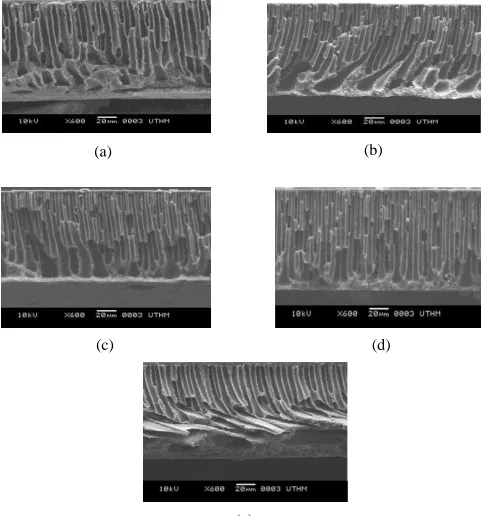
result is agree well with others previous studies that used different salt coagulation mediums16-18. Besides that, this transformation also strongly influence the membrane morphology that resulted from interactions of components in the casting solution and phase inversion kinetics 16-18. Basically, the addition of inorganic salts decrease the chemical potential (µ) of water and result in delayed of phase transition due to restrained
[image:3.612.189.430.459.717.2]of water inflow and solvent outflow mechanisms16. On the other hand the addition of inorganic salt also reduce temperature of water in phase inversion that also produce better membrane performance and properties as shown in the following section figures. Therefore the effect Na2SO4 (divalent ion) as show better structure membrane in terms of suppression macrovoids compared to monovalent ion (KCl).
Figure 1 SEM pictures of the cross-sections of membrane prepared different concentration of KCl, (a) control, (b) 1% of KCl, (c) 2% of KCl, (d) 3% of KCl and (e) 4% of KCl
Figure 2 SEM pictures of the cross-sections of membrane prepared different concentration of Na2SO4, (a) control, (b) 1% of Na2SO4, (c) 2% of Na2SO4, (d)
3% of Na2SO4 and (e) 4% of Na2SO4
(b)
(c) (d)
(e) (a)
(a) (b)
(c) (d)
3.2 Permeation Properties
The effect of aqueous solution KCl and Na2SO4 as a non-solvent coagulation bath on the membrane performance was studied. The concentration of KCl and Na2SO2 varies from 1%-4% and the dope solution composition was keep constant.
Figure 3 illustrates the performance of PSf/PEG ultrafiltration membrane in Pure water flux permeation upon immersion into different aqueous solution of KCl and Na2SO4.Result from the graph demonstrated that the PSf/PEG membrane immersed into aqueous solution of KCl and Na2SO4 shows an increase of pure water flux compared to pristine membrane that immersed in distilled water. In fact, the plot shows the increase of pure water flux when concentration of KCl was added from 1% to 4%. However, the results shows reverse tendency with addition of Na2SO4. The highest pure water flux is given by the membrane at 4% KCl with 281.14 LMH and the lowest flux from pristine membrane with 102.69 LMH.
According to the Figure 4, the graph demonstrates the percentage of rejection humic acid by membrane immersed into distilled water, aqueous solution of KCl and aqueous solution of Na2SO4 as non-solvent coagulation bath. As clearly shown in the graph, membrane immersed into aqueous solution of Na2SO4 shows the highest humic acid percentage rejection approximately 99% compared to membrane immersed into aqueous solution of KCl and distilled water. The highest rejection value is given by membrane immersed in 1wt%
Na2SO4, whilst the lowest rejection produce is shown by membrane immersed in distilled water. This revealed that the influence of Na2SO4 and KCl as additives in non-solvent coagulation bath not only improve permeation flux but also enhance solute rejection. It was observed that in co-operation Na2SO4 and KCl as additive in coagulation bath enhance hydrophilicity membrane nature. This was demonstrate by several previous studies6,16,17 that showed membrane with more hydrophilic property tend to reduce the interaction between the hydrophobic contaminants and inherently increasing the rejection property.
Theoritically, the existence inorganic salts into coagulant bath will minimize the chemical potential that attributes to the reduction of driving force for film precipitation. This phenomena indirectly slightly reduced the flux permeation and rejection of membrane. In general, the higher salt concentration is, the more reduction of permeability is17. However this works reflect reverse tendency and have coincidence with M. Wang et al.16 that clearly shown that the increase of flux permeation in the present study has attributed to the interaction between PSf/PEG/NMP in dope formulation and salt coagulation medium. The existence of PEG as pore forming agent give better perfomance of membrane with the increase of flux permeation. The similar result was prefered by M. Wang et al. where the interaction occur between aqueous solution of inorganic salts as coagulation bath with additive in polymer dope solution ameliorated the membrane permeability.
[image:4.612.54.286.359.512.2]
Figure 3 The pure water flux permeation KCl and Na2SO4 Figure 4 The effect of Humic acid concentration
4.0 CONCLUSION
The PSf/PEG anisotropic flat sheet membrane was fabricated via non-induced phase separation method with direct immersion of preciptation technique utilizing distilled water, aqueous solution of KCl and aqueous solution of Na2SO4 as non-solvent coagulation medium. The performance of membranes were analyzed in term of pure water permeation and solute rejection.The cross sectional area morphology were characterized by using Scanning Electron Microscope (SEM). Results obviously show that KCl and Na2SO4 as nonsolvent coagulation medium PSf dope formulation in phase inversion method enhanced the performance of membrane permeation and solute rejection rate compared to pristine membrane.The membrane morphology having assymmeric structure with dense top layer and porous sub-layer. The structure also shows suppression macrovoid at the membrane drain out layer when increasing concentration of aqueous solution of KCl and
Na2SO4. According to the observation,the ideal membrane was membrane immersed in 1% aqueous solution of Na2SO4 with forn rejection of humic acid until 99%.
Acknowledgement
References
[1] Z. Harun, M. F. Shohur, M. Z. Yunos, M. R. Jamalludin, and A. F. Ismail. 2013 . Advance Material Research. 328:798–801.
[2] Z. Harun, M. R. Jamalludin, M. Z. Yunos, M. F. Shohur, and A. F. Ismail. 2013. Advance. Material. Research. 701: 319–322.
[3] M. Z. Yunos, Z. Harun, H. Basri. and A. F. Ismail. 2012. Advance .
Material. Research. 488–489: 46–50.
[4] A. Idris, I. Ahmed, and M. A. Limin, 2010. Desalination. 25: 805–809. [5] A. Rahimpour, S. S. Madaeni, and Y. Mansourpanah. 2010.
Desalination. 258: 79–86.
[6] M. F. Shohur, Z. Harun, Z. Yunos, S. Hasan, and R. Jamalludin. 2013.
Applied. Mechanic and. Materials. 372: 3–7.
[7] M. R. Jamalludin, Z. Harun, H. Basri, M. Z. Yunos, and M. F. Shohur. 2013. Applied Mechanic and Materials. 372: 8–12.
[8] S. H. Mohamad, M. I. Idris, H. Z. Abdullah, and A. F. Ismail. 2013.
Advance Materials Research. 795: 318–323.
[9] Kang Li. 2007. Ceramic Membrane for Separation and Reaction. John Wiley and Sons, West Sussex,
[10] N. F. Ismail, Z. Harun, N. A. Badarulzaman. 2012 International. Journal. of Integrated Eng. 4: 16–21.
[11] Z. Harun, N. F. Ismail, N. A. Badarulzaman. 2012 Advance Materials
Research. 488–489: 335–33.
[12] T. Mohammadi and E. Saljoughi. 2009. Desalination. 243: 1–7. [13] Drioli, E. and L. 2009. Membrane Operations. Wiley.
[14] D. B. Mosqueda-Jimenez, R. M. Narbaitz, T. Matsuura, G. Chowdhury, G. Pleizier, and J. P. Santerre. 2004 J. Membr. Sci. 231: 209–224.
[15] J. Bumsuk, Y.J. Ki, K. Bokyung, R. Hee-Woo.2005. J. Membr. Sci. 246: 67–76.
[16] M. Wang, L. Wu, and C. Gao.2006. J. Membr. Sci. 270: 154–161. [17] S. Yang and Z. Liu. 2003. J. Membr. Sci. 222: 87–98.
[18] J. F. Hester and A. M. Mayes. 2002. J. Membr. Sci 202:119–135. [19] Y. Termonia. 2002. Polymer. 50: 1062–1066.
[20] H. Jai, J. Won, H. Lee, and Y. Soo. 2002. J. Membr. Sci. 196: 267–277. [18] G. Arthanareeswaran, D. Mohan, and M. Raajenthiren. 2007. App. Sur.
Sci. 253: 8705–8712.
[19] J.-H. Kim and K.-H. Lee. 1998. J. Membr. Sci. 138: 153–163. [20] B. Chakrabarty, A. K. Ghoshal, and M. K. Purkait. 2008. J. Membr.
Sci. 309: 209–221.
[21] Y. Ma, F. Shi, J. Ma, M. Wu, J. Zhang, and C. Gao. 2011.
Desalination. 272: 51–58.