FABRICATION
OF TITANITJMFOAM
BY USINGCOMPACTION
METHOI)
Mohamad Azizi Abu Kassimr
& Sufzar
Ahmadi1.
Faculty of Mechanical and Manufacturing Engineering, universiti Tun Hussein onn Malaysi4 Batu Pahat, Johor, Malaysia.sufizor@ uthm.edu.mv
ABSTRACT
Metal foam is a new material that
is
less used in engineering. Metal foam is widely usedin
bio-medical fieldsto
produceartificial
human bones.Metal
foam madeof
a
porous structure that provides the physical and mechanical propertiesof
both aslow
specific weight and high thermalfluidity. In
this
study, the selected metalto
be foamedis
a titanium metal powder.In
general, titanium is very light weight compared to other metals. Special propertiesofthe
titanium encourage more study implemented on titanium foam. Preferred methods for producing titanium foam is via powder metallurgy or Fraunhofer process. Foaming agent used is urea or carbamide which is widely used ascrop fertilizer,
Powder metallurgy process needsto
go
through themiing,
pressing, sintering and analysis. The compositionof
titanium was fixed at 75o/o' 80yo and 85%while
the remaining percentage is the compositionofthe
urea. The selected sintering tempemture is 1200 " C, 1250"
C
and 1300 0c.
sintering proc€ss was conductedin
the tube furnacein
the argon gas atmosphere. After sintering process carriedou!
analysisofthe
density and porosity was carried out on all samples. Density test shows the increasing densityofthe
particles of titanium when added up to 85% forall
sintering temperatures. For porosity tests,it
is found that the p€rcentage of porosity decrcases when the titanium particles inqeas€d up to 8570.KEYWORDS; Porous structure; powder metallurgy; sintering; porosity; density'
INTRODUCTION
Metal foam is a new material that could be said is a stranger in the world of engineering. To date' studies
of
metal foam are continuingto
searchfor
the best methodfor
producing metal foam features that are required. Dueto
imperfectionsin
the classification and control parameters are involved, and then there is varietyof
foaming propertiesof
different metals (Ashby et. al, 2000). Introduction to the metal foam provides greater benefitsto
humanlife
today. This is because the metal foam is widely used in thefield of
energy absorption and noise, the automotive sector and also in other fields (Ashby et. al, 2000). tn this study, the production oftitanium foam is expeoted to provide favorable resultsof
the discoveryof
the physical characteristicsof
mechanical or better than metal foams that available.(open cell foam). Figure 1 shows the open cell foam and closed cell foam for aluminum. For Figure
1 (a) and Figure
I
(b) shows the closed cell foam to aluminum occur as a result of gas bubbles from aluminum metal. FigureI
(c) or foam is open cell, such as name, too, has an open cell walls. This typeof
foam has wrinkles, leavingthe
ligaments strong.This is
a
solid metal ligament, which consist of structural foam. Difference in size of the foam is determined by the parameters set as the quantity of foaming agent used and sint€ring temp€rature during the sintering process carried out.Therefore. in this research it is determined to achieve:
a)
The fabrication oftitanium foam with 20-30% ofporosity [image:2.590.81.509.233.381.2]b)
To perform tests of porosity and density on sample after sintering processFigure
l:
Foam structur€: (a) a large closed cell foam (b) small-sized closed cell foam (c) the is open cell (Shinko Wire Company, 2005)MATERIALS
AIID METHOI)
The
methodologyfor
this
researchis
basedon the
powder metalturgy method.The
most fundamental step begins with the mixture of the metal powder together with foaming agent. Then, the mixture is compacted adequately; so thatit
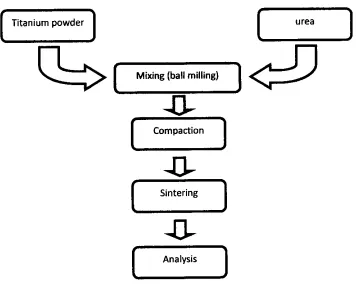
is strong enough to be hold. Next, the ready sample is sintered in tube firrnace. After that, the sample is tested by three kinds of testing. The more clear view of this research is represented by the flow chart in Figure2'
The target composition for titanium arc 75To,80% and 85% while the rernaining perc€ntage
filled
bytheii
foaming agent (urea). The mixing process is done by ball milling machine. Carver Hand piess machine is appliea to perrorm compaction, Pressure applied is 8 tons which according to Azar (2003) who 111unag"d to fabiicate aluminum foam by using this pressure. Via comp-action, a sampleis obtained and that
it
can be hold for the next stage.At
this stage, sample is sinteredin
a tube furnace in three sintering temperatures which are 1200'C, 1250"C and 1300"C. The argon gas is used during the sintering in order to avoidoidation
from occur onto the sample. After the sintering process,thi
sample is tested by using three kinds of tests which are porosity test, density and also Scanning Electron Microscopy (SEM)'(c) (b)
Titanium powder urea
Sintering
[image:3.590.110.466.49.334.2]Analysis
Figure
2:
The flow chart for the sample preparation oftitanium foamRESTJLTS AND
ANALYS$
Figure 3 shows the microstructure of the sample after sintering at 1250'C in the tube fumace. This figure has shown the pores and strut
of
the
sample.After
the testing,the
resultsof
porosity percentage, densityand
shrinkageare
obtained.The
Graphfor
porosityand
density verses compositionof
titanium shownin
Figure4
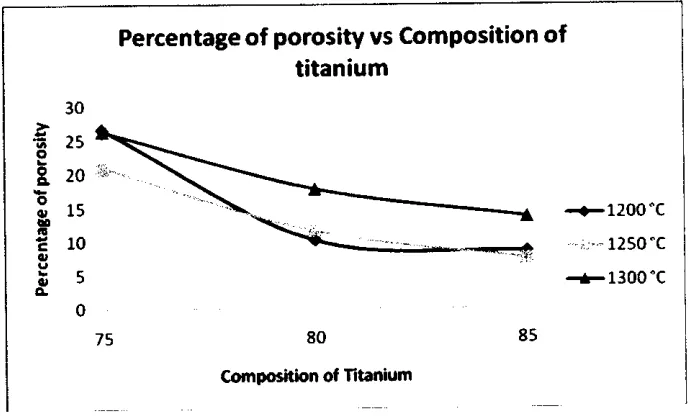
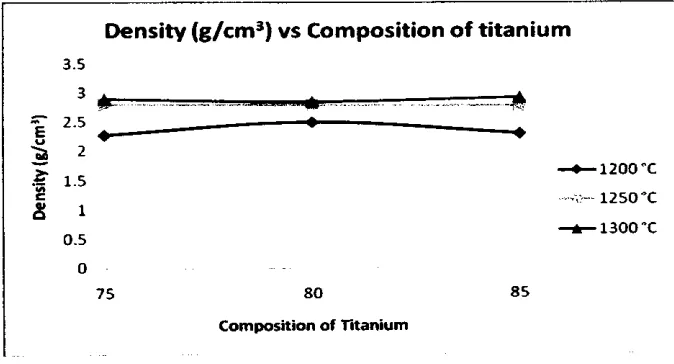
and Figure 5. From Figure 4, when titanium particle addeduntil
upto
85%, the potosityfor all
sintering temp€ratures was decrease.It
because more particle was replace the pore in this sample (sufizar ahmad 2010). When the sint€ring temperature increases so the perc€ntage of porosity was decrease. This because during the sintering process, the neckgpw
at the particle contact (German 1996). This causes the elimination of pores and increaseFigure
3:
SEM micrographs of pure Titanium foam sintered in the tube fumace. The magnification for the sample is 30XPercentage
of porosity
vsComposition
of
titanium
30
25
20
15
10
o
75 80
Compositbn of Titanium
Figure 4: The effeot of pure titanium foam content and sintering temPerature on the percentage
of
porosity lor the titanium foamsa A o
c
4
i
'q.'a '"
6r
0.5 o
?
''t.
t
.
n2
ao
[image:5.590.132.469.53.235.2]Compoaition ot T.itanium
Figure 5: The effect of pure tilanium content and sintering temperature on the density
ofthe
titanium foamsCONCLUSION
Pure titanium foam was successfrrlly produced by compaction method. From the results gained, not
all
samples achieved the porosityof
20-30%o exceptfor
the composition titaniumof
75o/oin all
sintering temperatures. The result for density test also did not follow the research before but
it
still acceptable becausethis
is
primarily
testfor
this
method.The
sintering palameter also plays acritical
factorto
produce the best puretitanium
foams.For
further research,the
compressive strength ofthese sampleswill
be investigated.REFf,,RENCES
Ashby,
M.
F., Evans,A.
G., Hutchinson, J. W. and Fleck,N. A.,
Metal Foams:A
Design Guide' United States: Butterworth-Heinemann, (2000).C.F-Li.Z.G.
Zhu, and T. Liu, Microhardness of pore walls in porous titanium prepared with novel powder metallurgy , Journal Powder Metallurgt, Vol. 48(3) (2005) ' 237 -240German, R.M., Sintering Theory and Practice, New York: John Wiley
&
Sons (1996)'Li
Yan, Guo Zhimeng, Hao Junjie and Ren Shubin, Porosity and mechanioal propeltiesof
porous titanium fabricated by gelcasting, Rare metals, Yol. 27(3) (2008) 282-286'S. Azar, Kajian terhadap busa alumunium melalui kaedah metalurgi
serbu\
Kolej Universiti Teknologi Tun Hussein Onn (2003)S. Ahmad, N. Muhama4 A. Muchtar, J. Sahari, M.H.I. Ibrahim, K.R. Jamaludin &
N'H'M'
Nor' Development And Characterization of Titanium Alloy Foams. Intemational Joumal of Mechanical and Materials Engineering (IJMME), Vol. 5 (2010)Density (g/cm3)
vsComposition of
titanium
+1200"c
-i--1250'C
S. Ahmad, N. Muhamad, A. Muchtar, J. Sahari, K. R. Jamaludin, M. H. I. Ibrahim, N. H.