Munich Personal RePEc Archive
An exploration of money interest in the
theory of value
Desai, Milinf
Gokhale Institute of Politics and Economics (Deemed University),
B.M.C.C. Road, Deccan Gymkhana, Pune - 411004 (Maharashtra),
India
8 August 2010
Online at
https://mpra.ub.uni-muenchen.de/37315/
An Exploration of Money & Interest in the
Theory of Value
Milind Desai
Dissertation to be submitted to the
Gokhale Institute of Politics and Economics, Pune in partial fulfillment
of the requirements for the degree of
Doctor of Philosophy Economics March: 2011
©2011 Milind Desai
Research Guide:
Declaration by the Research Scholar
This is to certify that the thesis entitled“An Exploration of Money and Interest in the Theory of Value”, submitted by me to the Gokhale Institute of Politics & Economics, Pune for the award of the degree of Ph. D is a bonafide record of research work carried
out by me under the supervision of Dr. Rajas Parchure. The contents of this thesis, in full or in parts, have not been submitted to any other Institute or University for the award
of any degree or diploma.
Pune 411001
Thesis Certificate
This is to certify that the thesis entitled“An Exploration of Money and Interest in the Theory of Value”, submitted by Milind Desai to the Gokhale Institute of Politics & Economics, Pune for the award of the degree of Ph. D is a bonafide record of research
work carried out by him under my supervision. The contents of this thesis, in full or in
parts, have not been submitted to any other Institute or University for the award of any
degree or diploma.
Acknowledgements
This work has grown out of a series of dialogues with my research guide Dr. Rajas
Parchure during the summer of 2005. These dialogues culminated first into a master
thesis submitted to this institute in 2006 and finally into this thesis. I am very grateful to
Dr. Parchure for his support, mentoring and an ever-friendly attitude which gave me the
motivation to complete this work.
I am thankful to the Gokhale Institute of Politics & Economics for providing me ample
scope and infrastructure to carry this work. The support provided by Mrs. Anjali
Nilangekar in this regard needs a special mention and I am thankful to her for the same.
This work would not have seen the light of the day without the support from Ms. Anjali
Shitole whose skills in mathematical programming made the insurmountable task of
solving complex polynomial equations seamless.
I would like to place on record the support and help provided by Prof. Pradeep Apte
during the numerous discussions had with him over the dinners.
Lastly, I would like to thank my family & my wife who constantly encouraged and
supported me to write this thesis and achieve completion.
In the 51st year of the publication of his book, Piero Sraffa and his works stand as an
epoch making event in the history of economic thought. These works have constantly
inspired me to take his line of thought and incorporate the same in this work. I would like
to dedicate this work to this great man and a scholar- Piero Sraffa.
Table of Contents
Chapter Title Page Number
Acknowledgements Iv
Index Vi
List of Tables Vii
List of Abbreviations X
Abstract Abstract Xii
Chapter I Literature Survey 1
Chapter II Closed Sraffa Stock-flow system 17
Chapter III A Theory of Currency Money 27
Chapter IV A Theory on Interest Rates 39
Chapter V A Theory of Currency & bank Money 46
Chapter VI Fiscal & Monetary Policy 100
Chapter VII Conclusions 127
Annexure 137
Chapter Summary & Outline Chapter I: Literature Survey
1. Introduction & Hicks‟ ISLM framework and attack on Keynes 2. Pigou‟s and of Real-Balance effect
3. Choice theoretic approach and monetary theory
4. Patinkin‟s integration of money & value 5. Clower & Hahn critique of Patinkin
Chapter II: Closed Sraffa stock-flow system 6. Equations of the System
7. A numerical example
Chapter III: A theory of Currency Money 8. Equations of the System
9. A numerical example
Chapter IV: A theory of Interest Rates 10. Functions of Banks
11. Risks
12. Equations
13. Numerical example
14. Remarks on the theory of interest rates
Chapter V: A theory of Currency & Bank Money 15. Equations of the System
16. A numerical example
17. Fiscal policy- Public god, taxation and borrowings
18. Monetary Policy- CRR and OMO
19. Interplay of Fiscal and Monetary Policies
Chapter VII: Conclusions
20. Section I: Comparisons with Keynesian & Patinkinisque Syntheses
21. Section II: Monetary and Value Theory
Chapter-wise Annexures
i. Annexure to Chapter 1- Survey of Classical, Keynesian & Neoclassical Monetary
Theory
ii. Annexure to Chapter 2- Sraffa‟s Economics iii. Annexure to Chapter 3
a. A Model of Commodity Money
b. A Model of Currency Money with deficit financing
iv. Annexure to Chapter 5- Failure of Quantity Theory of Money as a closing
equation
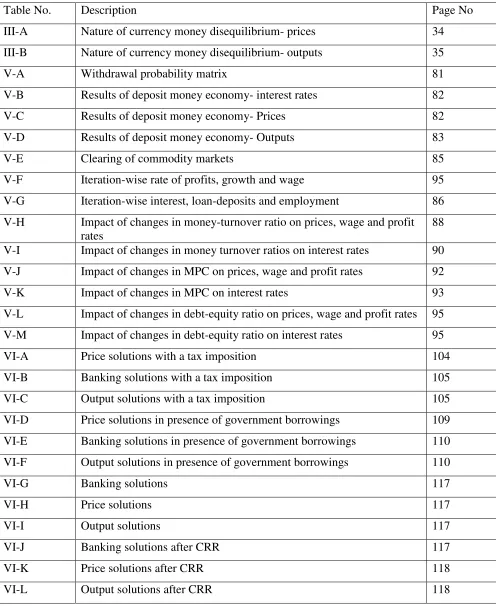
List of Tables- Chapter-wise solutions of the hypothetical numerical examples
Table No. Description Page No
III-A Nature of currency money disequilibrium- prices 34
III-B Nature of currency money disequilibrium- outputs 35
V-A Withdrawal probability matrix 81
V-B Results of deposit money economy- interest rates 82
V-C Results of deposit money economy- Prices 82
V-D Results of deposit money economy- Outputs 83
V-E Clearing of commodity markets 85
V-F Iteration-wise rate of profits, growth and wage 95
V-G Iteration-wise interest, loan-deposits and employment 86
V-H Impact of changes in money-turnover ratio on prices, wage and profit rates
88
V-I Impact of changes in money turnover ratios on interest rates 90
V-J Impact of changes in MPC on prices, wage and profit rates 92
V-K Impact of changes in MPC on interest rates 93
V-L Impact of changes in debt-equity ratio on prices, wage and profit rates 95
V-M Impact of changes in debt-equity ratio on interest rates 95
VI-A Price solutions with a tax imposition 104
VI-B Banking solutions with a tax imposition 105
VI-C Output solutions with a tax imposition 105
VI-D Price solutions in presence of government borrowings 109
VI-E Banking solutions in presence of government borrowings 110
VI-F Output solutions in presence of government borrowings 110
VI-G Banking solutions 117
VI-H Price solutions 117
VI-I Output solutions 117
VI-J Banking solutions after CRR 117
VI-K Price solutions after CRR 118
VI-M Banking solutions after new CRR 119
VI-N Price solutions after new CRR 119
VI-O Output solutions after new CRR 119
VI-P Banking solutions with OMO Case I 120
VI-Q Price solutions with OMO Case I 121
VI-R Output solutions with OMO Case I 121
VI-S Banking solutions with OMO Case II 122
VI-T Price solutions with OMO Case II 122
VI-U Output solutions with OMO Case II 123
VI-V Deficit financing & interplay- I 124
VI-W Deficit financing & interplay- II 125
List of Abbreviations
ij
S - ith Stock coefficient in the jth industry
ij
A - ith flow coefficient in the jth industry
j
L - Labour used in the jth industry
w- Uniform wage rate across industries r- Uniform rate of profit across industries
j
P - Price in the jth industry
t
i - Interest rate in the tth period, t=1 to n
t
l - Loan/ Debt in the tth period, t=1 to n
t
D - Deposit in the tth period, t=0 to n
j
B - Output for the jth industry g- Growth rate of the economy
α- Marginal propensity to consume of the capitalists β- Marginal propensity to consume of the workers
ij
k - ith money turnover ratio in the jth industry
p c
k - Capitalists share in the currency out of their incomes
p e
k - Capitalists share in the equity out of their incomes
p
k0 - Capitalists share in the demand deposits out of their incomes
p
k1 - Capitalists share in the fixed deposits period 1 out of their incomes
p
k2 - Capitalists share in the fixed deposits period 2 out of their incomes
p
k3 - Capitalists share in the fixed deposits period 3 out of their incomes
w c
k - Workers share in the currency out of their incomes
w e
k - Workers share in the equity out of their incomes
w
k0 - Workers share in the demand deposits out of their incomes
w
w
k2 - Workers share in the fixed deposits period 2 out of their incomes
w
k3 - Workers share in the fixed deposits period 3 out of their incomes
Abstract
The most serious challenge the existence of money poses to the theorist is this- even the best developed models of the economy cannot find room for it.
On one more thought, another great economist had posed this:
How to make money appear without making standard theory disappear?
Yet another in the theory has to offer:
Recent work on the existence of an equilibrium has been concerned with a world without money while all work in monetary theory has ignored the ‗existence‘ question.
Do all of these have something in common? Yes indeed- these are thoughts as well on “An exploration of money and interest in the theory of value”. When Ostroy has to question us on how to make money appear without making standard
theory disappear- to him the standard theory is the theory of value. Also, Hahn‟s best developed models are not different than the standard mainstream neoclassical
models of the time. He also questions Arrow- Debreau reasoning in proving the
existence of a monetary equilibrium. These similarities are indeed good enough
motivations to begin this thesis. In what is to follow, we would be exploring the
possibility of synthesizing a monetary and value theory. In the process, since
precedents have shown that the monetary economy cannot be integrated with the
mainstream theory, we deviate from the standard mainstream theory itself.
Instead, we find that the model proposed by Sraffa in his 1960 book comes to our
rescue. The Sraffa system of production of commodities by means of
commodities becomes an ideal system for us to describe the real activity in the
economy. On the monetary front, mainstream theories before us cannot be
adapted to suit the requirements of the real system described and hence, we
develop a pure theory of banking during the course. Unifying the two doctrines of
economy using hypothetical (numerical) examples of economic situations. In the
end, we get over all the three questions above (and more questions as well that are
posed in the theory but not listed above) and provide for the role of money
through this integration of the monetary and value theory. In so doing, we would
come across the conclusion that though this integration may be possible in the
non-standard theory, a natural monetary equilibrium is not possible. More so, and
importantly, it would be discovered that money is not neutral in theory as well.
Money affects prices, outputs, interest, employment and fiscal activities equally.
Chapter I: Literature Survey
1. Exchange, value, money and price (ratios) have played an important role in the
production of commodities and distribution of incomes across various societies
and cultures. However, there does not exist a single theory unifying all of these
under one doctrine. While exchange and value are regarded at the firm level,
money and distribution are regarded at the national level; while price ratios are considered under “real” analysis; absolute prices are lumped under “monetary analysis”. To quote Grandmont (Grandmont, 1985) in this sense, One of the major theoretical issues that underlies, implicitly or explicitly, quite a few recurrent controversies in macroeconomics is whether a competitive monetary economy has built in mechanisms that are strong enough to remove excess demands and
supplies on all markets, through an automatic adjustment of the price system1. Moving into the strands of literature available before us, a clear delineation exists
between classical, neoclassical and Keynesian schools of thought. In neoclassical
economics, the value of an object or service is often seen as the price it would
command in an open and competitive market. This is determined primarily by the
demand for the object relative to its supply. Many neoclassical economic theories
equate the value of a commodity with its price, whether the market is competitive
or not. As such, everything is seen as a commodity and if there is no market to set
a price then there is no economic value. In classical economics, the value of an
object or condition is the amount of discomfort/labor saved through the
consumption or use of an object or condition (Labor Theory of Value). Though
exchange value is recognized, economic value is not dependent on the existence
of a market and price and value are not seen as equal. In this tradition, to Steve
Keen (Keen, 2001) "value" refers to the innate worth of a commodity, which determines the normal ('equilibrium') ratio at which two commodities exchange2. To Keen and the tradition of David Ricardo, this corresponds to the classical
1
Grandmont, J M (1985): Money and Value: A Reconsideration of Classical and Neoclassical Monetary Economics (Econometric Society Monographs)
2
concept of long-run cost-determined prices, what has been referred to in the
Wealth of Nations (Smith, 1776) called "natural prices" and Das Kapital (Marx,
1872) referred to as the "prices of production." It is part of a cost-of-production
theory of value and price. Ricardo, but not Keen, used a "labor theory of price" in
which a commodity's "innate worth" was the amount of labor needed to produce
it. In another classical tradition, Marx distinguished between the "value in use"
(use-value, what a commodity provides to its buyer), "value" (the
socially-necessary labour time it embodies), and "exchange value" (how much labor-time
the sale of the commodity can claim, Smith's "labor commanded" value). By most
interpretations of his labor theory of value, Marx, like Ricardo, developed a "labor
theory of price" where the point of analyzing value was to allow the calculation of
relative prices. Others see values as part of his sociopolitical interpretation and
critique of capitalism and other societies, and deny that it was intended to serve as
a category of economics. According to a third interpretation, Marx aimed for a
theory of the dynamics of price formation, but did not complete it3. Roy Harrod
(Harrod, 1937),4 James Meade (Meade, 1937)5 and Oskar Lange (Lange, 1938)6
had attempted to express the main relationships of Keynes's (Keynes, 1936)
theory as equations in order to elucidate the interrelationships between the theory
of effective demand and the theory of liquidity preference. The 1937 (Hicks,
1937)7 Econometrica article, "Mr Keynes and the Classics: A suggested
interpretation", suggested two curves, "SI-LL" to illustrate these relationships.
These curves have since become famously known as the IS-LM model and were
popularized by a now-converted Alvin Hansen8 (Hansen: 1949, 1953). The IS-LM
model has remained one of the most formidable pieces of pedagogic machinery
and, as far as back-of-the-envelope diagrammatic reasoning is concerned, one of
3
Refer Annexure for a detailed discussion of Classical, Keynesian & Neoclassical Monetary theories. This chapter would focus primarily on the works of Hicks, Patinkin, Clower & Hahn
4Harrod, R, “Mr. Keynes and the traditional theory‖,
Econometrica, Vol 5, 1937
5
Meade, J, ―A simplified model of Mr Keynes‘ System‖, Review of Economic Studies, 1937
6
Lange, O, ―The rate of interest and the optimum propensity to consume‖, Economica, Vol 5, 1938, pp 12-32
7
Hicks, J, ―Mr Keynes and the classics; A suggested reinterpretation‖, Econometrica, Vol 5 No 2, 1937, pp 147
the most efficient ever devised in economics. It is not, however, without
substantial problems, both as an internally consistent model or as a representation
of Keynes's theory. The crucial feature of the Keynesian system Hicks and
Hansen concentrated on when formulating the simple IS-LM is the interaction
between the real and monetary markets. From the real market, one extracts the
level of income (Y) and from the money market, one obtains the interest rate (r).
These variables, in turn, affect elements in the other market - in the simplest
version, income affects money demand and interest affects investment. This
interaction clearly violates the "classical dichotomy" and, as we shall see, it also
does not support the neutrality of money. Financial-real interaction is the core of
the IS-LM version of Keynes's theory - therefore, Hicks (Hicks, 1937)9 concluded
with perfect Walrasian instincts, it is necessary to solve for the money and real
markets simultaneously. However, many Keynesians, such as Pasinetti (Pasinetti,
1974)10, have argued that Keynes's system should be thought of "block
recursively" or "sequentially" and thus should not be solved simultaneously.
Specifically, it can be argued that the Keynesian system ought to be seen as a
sequence of alternating "asset market" and "goods market" decisions - the interest
rate being first determined by a portfolio decision in the financial markets and
only thereafter determining investment, output and employment in the real market
which then feeds back into another portfolio decision, etc. This criticism is
noteworthy because the portfolio (LM) decision is made in the context of a stock
constraint whereas the real market decisions (IS) are made in a flow constraint.
Furthermore, as Richard Kahn (Kahn, 1984)11 and Joan Robinson (Robinson:
1973, 1978, 1979) emphasized later, the simultaneous equation method of the
IS-LM, by eliminating sequential time, also eliminates the time-dependent concepts
which they saw as fundamental to Keynes's theory - such as uncertainty,
expectations, speculation and animal spirits. As John Hicks (Hicks: 1980, 1988)
himself notes in his recantation, these different time references for IS and LM
9Hicks, J, (1937), “
Mr Keynes and the classics; A suggested reinterpretation”, Econometrica, Vol 5 No 2,
pp 147.
10
Pasinetti, L., Growth & income distribution: essays in economic theory, 1974
makes the simultaneous IS-LM model incongruous (see also Leijonhufvud12,
1968, 1983; Davidson, 1992). Keynesian General Theory is a glorified version of
the solution to the age old problem: determining the value of money, achieving a
truly integrated theory unifying exchange and money. After General Theory,
Hicks, Allen and Hansen attempted a version of the Keynesian model and titled it
the IS-LM model. It must be understood that Keynes was able to demonstrate
with significant levels of acceptability that a system that involves money in any of
its forms, consoles or bonds, credit or paper is never able to achieve its fullest
potential. As a result, any model involving money should not attempt to explain
equilibrium but should aim at attempting explanations towards the frictions that a
monetary model presents. In terms of the General Theory, wage rigidity, liquidity
trap, principle of effective demand and involuntary employment, all tying back to
only one thing, frictions in the monetary system are offered as explanations to the
theory of money and production economy. However, the unification of monetary
and value theory is attained ingeniously through the multiplier-accelerator
principle and hence, through a series of business cycles. Interest rates adjustment
is a pivotal element in Keynesian analysis while wages have to remain rigid. The equilibrating factor in Keynesian synthesis was output thorough the
saving-multiplier-accelerator principle. However, the General theory spurred an all
important economic phenomena- the Hicksian IS-LM framework. Hicks
constructed his suggested interpretation of the Keynes‟ General Theory in 1937, a year after the publication of the theory. Hicks immediately recognized some
similarities between his model and the General Theory. The theory of effective
demand forms an essential part of the IS-LM model. Effective demand manifests
itself in the spending of income, and for income to increase, employment should
increase, and thus consumption increases at a rate lesser than income. Despite
similarities, there are two fundamental differences between the General Theory
and the IS-LM model. The IS-LM model is a perfect competition model in which
the all the prices is flexible (flexprice model). Keynes however made use of price
12
rigidity in his model. Keynes assumptions of money wage and price rigidity led to
the Neo-classical Synthesis. Another feature of the General Theory concerns the
length of the period. Keynes used a short-term period, assumed to be a year,
whilst Hicks used an ultra short period called a week. Victoria Chick13 (Chick,
1982) used a quarter as a suitable period in her analysis of the IS-LM model. She
pointed out that investment component is fixed at the beginning of the quarter
through interest rate as determined by the liquidity preference and long-term
expectations. The IS-LM model is constructed from an Investment Savings
schedule and the demand for money (L) and supply of money (M) schedules.
Hicks made use of two parameters to derive his schedule called the IS schedule.
He determined the price of the one parameter in terms of another. For instance the
price of A in terms of C and B in terms of C. If A and B are equilibrates, the third
(A and B) equilibrates. Keynes also used two parameters. He used income (Y) in
terms of wage units and the rate of interest (r). He made investment to be
dependent on the interest rate and savings to be dependent on income. For each
rate of interest there is a corresponding level of income at which savings equals
investment. Therefore there is no excess demand in the goods market. Hicks
expressed this relation between income and interest rates as the IS curve. Unlike
the Classical model, Keynes viewed a positive relationship between savings and
income. According to the General Theory, the level of income also depends on
the desire to consume. If consumption rises with income, but the marginal
propensity to consume is less than unity, the savings must rise with income.
Another feature of Keynes‟ theory is that of savings being equal to investment. An increase in income results in increased savings, which results in a decrease in
the interest rate. Savings and investment are equal and the locus of these
equilibrium points represents the downward sloping IS curve. Another
characteristic of the General Theory is the liquidity preference theory or demand
for money. The money market equilibrium requires the demand for money and
the supply of money to be equal. It therefore also depends on the relationship
13Chick, Victoria, “A comment on „
between interest rates and the level of income. The demand for money can be
analysed on the motives for people to hold money. Keynes identified three
motives namely the transaction, precautionary and speculative motive. The
transaction motive depends positively on the level of income. An increase in the
level of income thus will increase the demand for active balances (transaction and
precautionary motive). The demand for idle balances (speculative motive) is
based on the function of interest rates based on expectations of future interest rate.
The Neo-classical Synthesis differ from the IS-LM model in the sense that
consumption is not determined by income alone, but also through wealth effects
as introduced by Pigou14 (Pigou, 1943). Like the IS-LM curve, a fall in price will
shift both the LM and IS curve rightwards as it is presented in the wealth effects
of Pigou. The increase in the real value of money leads to an increase in wealth,
thus increasing consumption that is equal to investment. Monetary policy,
together with price and wage flexibility can restore the economy to full
employment, but the adjustment process might be to slow, and can only be
speeded through fiscal policy. The acceptance of this view forms the basis of the
Neo-classical Synthesis. An essential part of the General Theory is the effective
demand theory, in terms of which aggregate supply is equal to aggregate demand. Say‟s Law also postulates that “supply creates its own demand.” In terms of a monetary economy it will mean that the value of things sold is equal to the value
of things bought. The introduction of money as a medium of exchange however does not necessarily agree with this notion, because income won‟t be necessarily entirely been spent on purchases, and even if so, it will only cover recovery costs
and not large profits. This notion strengthens the IS-LM model in the sense that
the part of the money not been spent will either be invested or saved. More so,
what Hicks did to Keynes, Patinkin did to Hicks. Hicksian analysis stated that the
General Theory was a special theory and not General at all. This, he stated
because he was able to demonstrate that the rigidities that the Keynesian synthesis
talked about with respect to the wage-price rigidity or the liquidity trap added
nothing new, but only made (Hicks‟) LM curve flatter, a special case of the classic money supply curve
2. Techniques of varying nature had been proposed even since Keynes announced
the concepts from General theory. Samuelson15 (Samuelson, 1939) came with his
accelerators, Hicks with the full blooded mathematical version of the Keynesian
model whilst Robinson and company still debating over problems of aggregation
in the Hicksian or the Keynesian cases. In two articles which appeared in
Econometrica, Patinkin examined classical monetary theory. The main conclusion
of this was that the classical attempt to dichotomize the economic processes of a
monetary economy into a real sector, dependent upon and determining relative
prices, and a money sector, dependent upon and determining absolute prices,
cannot possibly succeed. These propositions were attacked by W. B. Hickman
(Hickman, 1950)16, W. Leontief (Leontief, 1950)17, C. G. Phipps (Phipps, 1950)18
in criticisms. These criticisms led to developing what later became the most
important classic in economic literature, second only to General Theory19. Patinkin‟s decision to resume his book project was made while working in 1952 -1953 on a paper on “Keynesian Economics and the Quantity Theory”, following an invitation (in October 1951) by Kenneth Kurihara to contribute to a book
(Kurihara,1954)20 on Keynesian economics after Keynes. However, instead of his
original plan for a text on employment theory, Patinkin decided to write a book on
monetary theory, moving the discussion of the integration between monetary and value theory through the real balance effect to the first part (“microeconomics”) of the book and the chapters on the theory of employment to the second part (“macroeconomics”), which is close to the organization of his 1947 dissertation. Chapters 13 and 14 on unemployment - partly based, respectively, on Patinkin -
were preceded by a full employment aggregative model (chapters 9 to 12), first
advanced in his 1954 contribution to the Kurihara volume. As recalled by
15
Samuelson, Paul, “Dynamics, Statics & the stationary state”, The Review of Economics & Statistics, 1943
16
Hickman, W.B., ―The determinacy of absolute prices in classical economic theory‖, Econometrica, 1950
17Leontief, W., “The consistency of the classical theory of money & prices‖,
Econometrica, 1950
18Phipps, C.G., “A note on Patinkin‘s ―Relative Prices‖‖,
Econometrica, 1950
19
Patinkin, Don (1954): Money, Interest & Prices: An integration of Monetary & Value theory (MIT Press)
Patinkin, “it was in the process of writing this article that I decided to write my 1956 book”. Patinkin argued that the propositions of the quantity theory of money - such as the long-run neutrality of money - are based only on the assumption of
an absence of money illusion, and hold under any form of the aggregate demand
function, a claim that he carried to MIP as the general theoretical conclusion of
the book. An important point to note is Patinkin aimed the formal synthesis of
monetary and value theories through two approaches: in part one of his book
through the microanalysis and in part two through the macroanalysis. These two
analyses have their formal basis in what Patinkin developed as the real balance
effect. Patinkin picked up this trend from his predecessors in Scitovszky, Haberler
and Pigou. Nonetheless, all was not well for long. Specifically, Haberler
(Haberler, 1937)21, Scitovsky (Scitovsky, 1941)22 and Pigou (Pigou, 1943)23
postulated that the consumption decision is based not only on current income but
on "real net wealth". Initially, "real net wealth" referred to the real supply of
money (M/p) and the real supply of bonds (B/p). The conventional Keynesian
consumption function makes consumption, at best, a function of real disposable
income and interest rates, but Haberler-Pigou proposed the inclusion of real net
wealth as well, thus C = C(Y, r, V) where V = M/p + B/p. The implication of this
new consumption function should be clear. In situations of unemployment, as
money wages and price levels decline, then the real money supply rises (the
Keynes effect) which, as we saw, shifts the LM curve to the right. However, the
"Pigou Effect" (or "Real Balance" effect) implies that as M/p rises, so does V and
consequently consumption rises as well - shifting the IS curve to the right. Thus,
Pigou proposed, even the "special cases" of a liquidity trap or interest-insensitive
investment are not sufficient to maintain unemployment equilibrium as the
rightward shifts of the IS curve via the "Pigou Effect" will ensure we are taken to
full employment equilibrium. Thus, the only possible way to have unemployment
equilibrium in a Keynesian model is if there are sticky wages and prices, period.
While many neoclassicals cheered this development, there was a sense of unease
21
Haberler, G., Prosperity & Depression, League of Nations, 1937
22
Scitovsky, T., ―A note of welfare propositions in economics‖, Review of Economic Studies, 1941, pp. 69
about these wealth effects for the implications they had for their own
macroeconomic theory. Specifically, as Metzler (Metzler, 1951)24 noted In salvaging one feature of classical economics - the automatic tendency of the system to approach a state of full employment - Pigou and Haberler have destroyed another feature, namely, the real theory of the interest rate. In other words, the "dichotomy" between real and monetary sectors, so popularized by
neoclassical economists, was broken by the Pigou Effect; as increases in the
money supply could now affect real items like consumption, interest and output.
In a careful and elaborate disquisition and elucidation, Don Patinkin arrayed
various arguments in defense of this "wealth effect". Specifically, he noted, the
neoclassical theory was contradictory anyway - it is impossible to reconcile the
Quantity Theory of Money with the assumption of dichotomy. In fact, as he went
on to argue, the "neutrality hypothesis" and the Quantity Theory itself requires a
real balance effect that violates dichotomy. Furthermore, it helps solve the old
problem of negative interest rates that the neoclassical loanable funds theory
could not really rule out.
3. Patinkin‟s real balance effect for the micro economics and Chapters 13 and 14 for the macro economy gave a distinctive character to Money, Interest and Prices.
Whilst the former was incorporated into many analyses of deflation and price
theory, the later was used and made one of the foundations of disequilibrium
macroeconomics. To quote an unpublished chapter from Patinkin, when I wrote chapter 13 of my book in 1956... I felt at the time, and still feel, that that was the most novel and important contribution of the book25. Although Patinkin did not organize his discussion of the concept of involuntary unemployment around Keynes‟s definition, he mentioned on several occasions that (contrary to Lange‟s interpretation) Keynes‟s notion of “unemployment equilibrium” did not mean that the labor market is in equilibrium without any tendency for money-wages to
change. An important point worthy of noting is the fact that through his book and
24Metzler, L, “Wealth, saving & the rate of interest‖,
Review of Political Economy, vol59, 1951, pp. 93
25
his econometrica articles, Patinkin aimed at proving, amongst other things, that
the neoclassical dichotomy between real and monetary sectors cannot be
maintained. Patinkin aimed at removing this dichotomy out of the monetary and
value analyses. To this end, in his micro analysis, he had used the standard utility
analysis with a modification for real money balances as an argument in the utility
functions. With these, he used the Walras‟ law and tried to identify an equilibrium in the system. In the macro analysis, he aggregated all of these individual demand
curves, of course assuming all individuals to be homogenous, and in effect
therefore assuming all Engel curves to be parallel to one another. In so doing,
Patinkin had also introduced a fresh market, the market for bonds following
Keynes and thus his variables were price, interest and the level of real balances,
operating at conditions of full employment where money balances where assumed
to be a given. Thus, his analysis is more concentrated towards explaining
disequilibrium economics rather than identifying an economic equilibrium. As we
shall see, Patinkin failed on two counts: one in terms of the analytical framework
he had suggested and second in terms of the mathematical stability and existence of the solutions of his system. In effect, due to the fact that in Patinkin‟s model, money appears from nowhere and the model does not maintain the link between
real and monetary analysis, the model appears to be a glorified version of barter.
The main reason for this being the element of time in his system. Trading is
synchronized amongst weeks and every week individuals receive their
endowments and they trade starting Monday thorough Saturday when the system
attains equilibrium. There is no explanation as to how the system moves to a new
level or an explanation to provide for the additions to existing stocks is missing.
In this model, in which time is divided into discrete contracting periods called
weeks, it is important to distinguish between equilibrium at a point of time and
equilibrium over time. As Hicks has put it, a stationary economy " . . . is in full
equilibrium, not merely when demands equal supplies at the currently established
prices, but also when the same prices continue to rule at all dates. The level of
doing, Patinkin employed certain concepts and analytical devices of his own.
Patinkin has in his system, what he calls, a demand curve of individuals for money and what he defines as corresponding “market equilibrium curve”. The point remains and the question still remains open: can all this not be done without:
a. Maintaining false separations between real and nominal balances in
Patinkinisque world?
b. Do we need to adhere to the Walras‟ law in this system because sticking to Walras‟ law, we are getting into the same debate that wither the excess demand in commodity markets will be cleared by excess supply in money
markets, bond markets held constant or some similar feature
c. Labour market in Patinkin operates at full employment and still Patinkin
manages to demonstrate disequilibrium.
All said, this question of whether a monetary theory can co-exist with a value
theory, or to be more on the bulls-eye, are these two doctrines: real and monetary
in reality separable? In order to understand how Patinkin‘s model works, it is
necessary to analyze: (1) the individual's weekly equilibrium; (2) how he reaches full equilibrium; (3) how this full equilibrium is altered by a changed desire for balances; (4) how it is altered by a change in the price level (5) how the market reaches full equilibrium; (6) how full equilibrium in the market is altered by a change in the money stock; (7) how weekly market equilibrium is altered by a change in the money stock which takes place when full equilibrium does not obtain; (8) the effects on the market of a non-proportional change in individuals' stocks of money; (9) the bearing of the above on the demand for money; and (10) the part played in the above by the real-balance effect. Since Patinkin neglects the conditions for full equilibrium, his analysis is devoted mainly to (1), (7), (8) and (9) 26.Patinkin‟s contribution to the field of monetary theory is important primarily due to two reasons- one that Patinkin intended to provide the
micro-foundations of monetary theory. Choice theoretic frameworks to explain the
monetary theory were not available in the Patinkin era. Patinkin began his quest
26G.C. Archibald and R.G. Lipsey (1958): “
for these. Along with such a process, Patinkin also aimed at developing a theory
that would retain the assumptions of the theory and as well find a place for
money! In so doing, Patinkin discovered two results- one that in the short-run,
money is neutral; however, in the long run the effects like the real balance effect
begin to operate and money looses its neutrality- money in the long run is
non-neutral
4. Clower (Clower, 1965)27 had discovered that there was a flaw with the analytical
construct Patinkin had devised to employ. This had to do with the Patinkinisque
budget constraint, which Clower suggested to dichotomize. If the real-balance
was so critical to Patinkin in establishing a link between real and monetary forces,
Clower found that the right place to attack was where the real balances resided. Also, with respect to Patinkin‟s real balance, Archibald and Lipsey (Archibald & Lipsey, 1958) quote this is necessary because Patinkin's analysis is incomplete and leaves many important points obscure. We find that, while the price level is of course determined by the desire to hold balances together with the stock of
money, the role of the real-balance effect is only to provide an explanation of how the system behaves in disequilibrium. Thus the real-balance effect is irrelevant to those famous propositions of the quantity theory which are the result of
comparative static analysis28. Clower (Clower, 1967) pointed out that in the Patinkinisque world, the budget constraints need not always constitute an
appropriate definition of choice alternatives in a monetary economy. It can be shown, indeed, that an increase in unsold stocks of any commodity the price of which is fixed, in a Patinkinisque world, generate an increase in the general price level and so, indirectly rise in the sales of the goods whose price is fixed. Again, therefore, we arrive at a conclusion that is offensive to our intuitive conception of the working of a money economy, a conclusion that indicates that money plays no distinctive role in economic activity29. What Clower therefore attacked in Patinkin was the model itself, and with comfortable ease was able to demonstrate that
27
Clower, R W (1965): “The Keynesian Counterrevolution: A theoretical appraisal” in F. H. Hahn and F. Brechling (eds.), The Theory of Interest Rates
28 Ibid 29
Patinkin‟s monetary economy was no better that a perfect barter. For Clower, the peculiar feature of a money economy is that some commodities are denied the
role as potential or as actual means of payment. To use his terms, Money buys goods, good buy money but goods do not buy goods. Clower suggested that one could get over this issue through dichotomization of the budget constraint; one as
a constraint on expenditure and another as a constraint on income. Clower himself
does not suggest that this method is fool-proof but according to him, it at lease
guarantees the existence of the required solutions.
5. An important problem was highlighted by Grandmont and Younes (Grandmont &
Younes, 1972). Monetary theorists have been criticized for having neglected the "existence problem‖ that is the problem of the existence of an equilibrium where money has positive value in exchange. On the other hand, we are reminded by R. W. Clower that one of the weaknesses of contemporary monetary theory is that it primarily considers money as a store of value but does not pay enough attention to its function as an exchange intermediary. One can reasonably expect that the two problems are closely related30. People of this school predict that the monetary economy has an economic equilibrium and when it comes to existence of the
economy, the problem has to be dealt more mathematically and rigorously rather
than philosophically. First, the evolution of the economy is presented by the
authors as a succession of temporary or short run equilibria. The model is
augmented to provide for an exchange economy where only spot transactions are
allowed and where (fiat) money is the only store of value, which is similar to the
economy studied by Friedman (Friedman, 1969)31 or Patinkin (Patinkin,1965)32.
What is proved that a short run monetary equilibrium always exists in that type of
model when, among other conditions, the elasticity of the traders' price
expectations with respect to current prices is " small ". The theorem is valid even
when money has no role to perform as a medium of exchange. We now examine
the validity of the classical dichotomy. Indeed, if we look back to ….. we see that
30
Jean-Michel Grandmont and Yves Younes (1972), “On the Role of Money and the Existence of a Monetary Equilibrium”, Review of Economic Studies
31
Friedman, M (1969): The Optimum Quantity of Money (New Brunswick, New Jersey)
there exists some kind of dichotomy between "real " and " monetary " quantities. For, if we "solve‖ equations …. with the additional requirement p = 1, it is possible to compute (stationary) relative equilibrium prices, equilibrium
consumption and " real " equilibrium money holdings. Then, using the Quantity Theory, we can determine the monetary equilibrium price level and nominal money holdings from equation. This is what P. A. Samuelson (Samuelson, 1968)33 claimed to be the classical dichotomy. It must be however emphasized that it is conceptually equivalent to the Quantity Theory.This dichotomy does not permit the separate determination of stationary relative prices and equilibrium
consumption ignoring monetary phenomena. However, those who have managed to grab a copy of Arrow‟s34
article, conclusions and quotes presented above seem
confusing, misleading or wrong. Arrow has found that in the premises of the
standard monetary theory, mathematical solutions do not exist in the
Patinkinisque world. Recent work on the existence of an equilibrium has been concerned with a world without money while all work in monetary theory has ignored the ‗existence‘ question35. In the context of monetary theory, the role of money has either been undermined by theorists or proved futile by mathematical
analysts. The point however remains where it was as faced by Marx or Keynes or
a Patinkin or a Friedman of late: How to make money appear without making the standard theory disappear? This remains the motivation for the rest of this work where we would aim to deviate from the standard theory. It may be the case that in the ambit of the proposed standard theories, the role of money had been forced
from the outside and hence the conclusions had to be the way they are today. It is
in here that we would like to stress that a standard theory would be abandoned in
the light of the problems and issues highlighted above. We would aim to develop
an economic model so as to capture and explaining the workings of the monetary
economy. In Patinkin, microanalysis through real balance and macroanalysis
33
Samuelson, P. A. (1968), “What Classical and Neo-Classical Monetary Theory Really Was ", Canadian Journal of Economics, (1), pp. 1-15.
34
Hahn, F.H, 1971: Trading out of Equilibrium, a Pure Exchange Economy, Chapter 13
35Hahn, F.H (1965): “On some problems of proving the ex
through the theory of unemployment fail to produce a unique role for money, the crux of Patinkin‟s work. Keynesian analysis came close to this, but Keynes failed to provide a modeling framework and argued philosophically that money is a
friction to economic activity. Arrow, Hahn and the other took immense trouble of
crafting mathematical edifices to these theories only to find some problems on
proving the existence of solutions of such models. After all the discussions, it
appears that the standard theory has been incapable of finding a place for money.
In the current work, we therefore aim to change this course of thought. We aim to
propose an alternative theory and discover whether such a theory would be
capable of finding a place for money while keeping the standard assumptions
relatively constant. Ultimately, the results of all these debates can be summed up
simply as follows
a. Money cannot appear in a model of economic theory where standard
assumptions and frameworks are followed
b. Where such a force-fitting is done, as seen in Patinkin or Clower,
equilibrium and the existence of solutions becomes impossible as
demonstrated by Arrow, Hahn, Debreu
c. Hahn went to the extent of concluding that even if money is made to
appear in the choice theoretic frameworks, the solution would only be
trivial where the price of money would be zero. With zero exchange
prices, what would be the role of money in such an economy? Therefore,
one need to leave the ambit of standard theory if one needs to construct the
synthesis of monetary and value theory.
d. Do wages have to remain rigid and should the interest rate be caught in a
trap, is money a veil to economic activity
e. Does a quantity theory equation to explicitly provide for a relationship
between money and prices have reasonable requirement?
f. And finally, can there be an underemployment equilibrium in case where a
different view on approaching the problem is proposed?
theory disappear. In what shall follow, we would aim to do exactly the same. We begin
with exploring an alternative theory of value and then only when the footings are firmly
Chapter II: Closed Sraffa System with Stock-Flow Variables
6. If money cannot appear without making standard assumptions disappear, it would
only be plausible by making money appear with making standard theory
disappear and modifying the standard assumptions to make a new theory appear. This is the aim of the following chapter- to provide an alternative to the standard
mainstream neoclassical theory. The basic system described here can be extended
in various logical manners depending on the purpose the reader aims to take it. In
a true sense, we would aim to extend the agrarian Sraffa system36 to non-agrarian
industries as well in the first place. The production system in its natural form
seems to be an agrarian system where production of commodities is happening by
means of production. However, in actual industrial set-ups, the production has
several important components as stocks or inventories of commodities, fixed
capital and circulating capital. However, the aim of this synthesis is to provide for
the role of money in the economy. This role can only be provided for by
foregoing the standard theory since as discussed, attempts to make money appear
without making standard theory disappear have turned futile. Hence, we take the course of Sraffa‟s economics in order to demonstrate the synthesis. Money, it should be noted, is a balance sheet item. Money is normally and, at most times, is
a stock concept which facilitates the flow in the economy. Therefore, the Sraffa model needs to be adequately expanded and made accommodative so as to
incorporate money. We can, in this chapter, clearly see that the basic Sraffa model
can be extended to incorporate such concepts of stock and flow variables. Stock
variables would be regarded as the fixed capital in the economy and the regular
activities of the enterprise would be the flow variables in such an economy. The
stocks primarily could be conceived to consist of machinery, factory shed, stock
of raw materials and the like. The regular payments to like the provision of seeds
for production, uniforms for labour, administrative expenses, rent, rates and
electricity et al would ideally form the flow variables in the economy. The flow
36Refer annexure to this chapter for a detailed discussion on the theory and development of Sraffa‟s
variables are required over the entire production period in the sense that since
these are regular payments, they need to be made often. The stocks form the
capital in the system and as such, like every other form of capital, command a rate
of profits. We would, for simplicity sake, assume the rates of profits across all
industries to be uniform- preserving the Sraffian tradition. This model of
continuous industrial production carries over all the essential properties of the
Sraffa system. When the production process is properly primed, the flow of
purchases of inputs is exactly matched to the flow of output and its sale so that
capital is needed only to finance the holding of stocks. A model that contains
stocks and flows can be represented as under:
n m n m n m t
n m n m n m t
n m n m n m t t t t B p wL B Ak p A p A r B Sk p S p S B p wL B Ak p A p A r B Sk p S p S B p wL B Ak p A p A r B Sk p S p S ... ... ... ... ... ... ... ... ... ... ... ... ... ... ... ... ... ... ... 2 2 1 1 2 2 1 1 2 2 2 2 2 22 1 12 2 2 22 1 12 1 1 1 1 2 21 1 11 1 2 21 1 11In the above model, the stocks are represented by the matrix S and the flows are represented by the matrix A. We represent outputs using the standard B matrix and the usual variables prices (p), rate of profits (r) and the wage rate, w remain the same from the standard Sraffa model. We aim to use the same notation throughout
the course of this thesis. It would be prudent to note the major changes in the
model incorporating the stock-flow model over the standard Sraffa model. There
are no changes in the parsimony of the model; however, the interpretation of
standard variables changes. Every industry in particular would have its own rate
of profit, though in equilibrium, these rates converge to a uniform rate through
flight of capital (stocks) from one industry to another. This equality of rate of
profits still remains the same in the current set-up as well. However, in terms of a
standard Sraffa model, the own rate of growth of individual commodities was
defined as
m n
i n m j ij i n m i n m j ij i i
iB p A p A
p
1 _
1 1 1
. However, this definition of own rate
n m i n m j ij i n m i n m j ij i iiB p A pS
p
1 _
1 1 1
. It is important enough to understand that
the profits only on a stock component form a part of the valuation of the
commodities. The production relations do not allow for the sales revenue to cover
up the capital or the stock parts. In fact, the stocks are perennially present. This
system has n equations in n+2 unknowns- the n prices and the 2 distributive variables. Either one of the prices can be fixed as numeraire so that there would be n+1 unknowns. The uniform rate of profits that prevails across industries is
j j ji j i j ji i i p S wL p A B p rThis rate is assumed to prevail across all industries. However, the system still moves with Sraffa‟s one degree of freedom. In order to eliminate this degree of freedom so as to enable us determine the unknowns of the system, we would
require an additional equation. In the discussion so far, the discussion on demand
is missing. We would resort to the demand equations in order to appropriately
close the system. We would use the Engel-Stone-Geary type of functions37 to do
37
Stone-Geary Function
The Stone-Geary function is often used to model problems involving subsistence levels of consumption. In these cases, a certain minimal level of some good has to be consumed, irrespective of its price or the consumer‟s income.
The Stone-Geary uses the natural log function to model utility. The sum of all the proportions of the goods consumed must equal 1. In the problem below, the subsistence levels of A and B are α and β. The term I is income, and pk {k=a,b} are the prices of A and B.
The Lagrangean and the First-Order conditions are:
so. The functions would be suitably adjusted with respect to the form and the ) ( 1 ) ( 1 ) 1 ( ) ( ) ( ) )( 1 ( 1 ) ( ) 1 ( ) ( A p p B B p p A p B p A B p A p p p A B p p B A b a a b a b b a b a b a
Substitute into the third, FO condition.
A p A p p A p A p p I p A p A p p I A p A p p I p A p p p A p I A p p p A p I a a a a a b a a a b a a b b a b b a b a b a ) 1 ( ) ( 1 ) ( 1 ) ( 1
Multiply the last equation above through by γ/pa.
b a b b a a b a a p p I p B p p I p A A p p I p 1 * * Notes1. Each of the functions of A* and B* are the Marshallian demand functions for the Stone-Geary utility. 2. The first term on the right-hand-side of the equality, is the subsistence consumption. A consumer will always consume this amount irrespective of their budgets or the price.
3. The term I - paα - pbβ is the income the consumer has left over, after the subsistence levels are met. It is in effect, the residual income.
nature; however, the essential properties of reflexivity, transitivity and
importantly symmetry and substitutability of the Slutksy matrix would be intact.
The required missing degree of freedom between the equations and the variables
can be also filled in by considering the composition of commodities which the
individual agents desire to purchase; the demand equations for the n commodities.
Walras‟ law dictates that only n-1 of these will be independent, and that we shall use the empirical demand functions that designed are designed by Stone as
where is the capital stock, L is the annual labour and the constants alpha and beta
are propensities of capitalists and wage earners to consume or spend. This would
take the following form
wL rk B
pi i
The following points need to be noted. 1) The demand equations of the above
type are introduced only for non-basic Sraffa commodities. Such commodities
would be referred to as consumption goods in the economy. 2) The marginal propensities α and β would always be given; α being the MPC of capital owners (capitalists/ industrialists/entrepreneurs) and β being the MPC of wage earners (workers/ households)38. With this equation, assuming we have a two commodity
system as follows, we can determine the prices by assuming the suitable demand
equation for commodity 2.
1 1 2 2 2 2 2 22 1 12 2 2 22 1 12 1 1 1 1 2 21 1 11 1 2 21 1 11 ... ... ... ... B p wL rk B p wL B Ak p A p A r B Sk p S p S B p wL B Ak p A p A r B Sk p S p S t t t t Therefore, the prices of both the goods in this system are determinate and all the
standard properties of Sraffa system are preserved in the continuous production
economy39.
It is the flows that have to be replaced period on period as the system gravitates to
equilibrium. The dual system that would be used to determine the outputs in the
system is similar but for the fact that the growth rate is attributed to the stock
coefficients and the flow coefficients are determined simultaneously along with
38
The terms in the parenthesis have been used interchangeably in the entire document
the stock coefficients. More so, the dual or the q-system would take the following form: L x L x L x L x B A x A x A x A g S x S x S x S x B A x A x A x A g S x S x S x S x B A x A x A x A g S x S x S x S n n n n m j nj n nn n n m j nj n nn n n m j j n n m j j n n m j j n n m j j n n
... .... .... . ... ... ... ... ... ... ... ... ... ... ... ... ... .... .... .... .... 2 2 1 1 1 2 2 1 1 1 2 2 1 1 2 2 1 2 2 2 22 1 21 1 2 2 2 22 1 21 1 1 1 1 1 2 12 1 11 1 1 1 2 12 1 11More so, the properties in terms of the relation between the rate of profits and the
rate of growth would not change much and instances where it changes
dramatically would be pointed out; not for the reason of drawing comparisons, but
for the cause that this relation would be the important relation between two
important variables- rate of profit and rate of growth. The standard system of the
dual is being used here. We would aim to close this chapter on the following note:
a basic Sraffa model can be extended to incorporate the stock-flow concepts40 in
the economy and we would aim to use such an extended Sraffa model in the
following work.
7. Let us take up a numerical example to study the workings of this system. Let us
assume the following hypothetical economic system with stocks, flows, labour
and output. The model has two capital (basic) and one consumption (non-basic)
goods industries
1 2
1 2
32 2 1 2 1 1 2 1 2 1 30 10 2 3 3 2 30 5 3 1 2 3 20 5 2 1 2 1 p w p p r p p p w p p r p p p w p p r p p
For the last industry, since it is a non-basic good, we would have a demand
equation specifying its consumption pattern. Let us assume that the workers
consume with a propensity of 0.2 out of their wage incomes only (to be precise,
40
let us assume that workers do not have a share in profits). Thus, we have the
demand equation
20
30 32 .
0 w p
It is important to mention the dual of this system which specifies the output
requirements of the individual industries
10 5 5 30 2 3 2 3 2 2 20 3 1 1 2 3 1 2 1 2 2 1 2 1 1 2 1 2 1 q q q q q g q q q q q g q qFinally, we have the growth profit equation of the following type
1 2
2 1 7 6 20 8 . 0 7 6 p p w p p g r
Therefore, we have 8 equations in 9 unknowns (3 prices, profit rate, wage rate,
growth rate, and the three outputs). We would begin by assuming an arbitrary rate
of profits; say 0.20 and let us assume the wage-rate as the numeraire.
Accordingly, we obtain p10.29,p2 0.20,p3 0.38 with r=0.20 and w=1. From this, we can immediately determine B3 10.40using the demand equation
and hence, we would adjust the equation of the third industry to this effect
0.69p11.04p2
r 1.04p10.69p2
3.46w10.40p3 and hence, the dualchanges as well to
10 5 5 30 69 . 0 3 2 04 . 1 2 2 20 04 . 1 1 1 69 . 0 3 1 2 1 2 2 1 2 1 1 2 1 2 1 q q q q q g q q q q q g q qUsing the growth profit relation, we have g=6.01. and thus, the output multipliers are 1.67 and 0.44. With these, we obtain the new production equations for
industry 1 and 2 respectively as under.
1 2
1 2
3And so on, the process would continue until all demand for commodity 3 equates
the supply at the going prices. Thus, we obtain the solutions in the augmented
Sraffa model to incorporate stock-flows using the following algorithm
Start with an arbitrary rate of profits and a numeraire, in this case the wages
Determine the prices and demand for consumption goods at the going prices
Adjust the price equations for the consumption goods to reflect the new demand by multiplying the entire equations by the ratio
old i new i
B B
Determine the growth rate using the growth-profit relationship and formulate the dual of the problem
Determine the output multipliers and create new set of basic price equations for capital industries
Repeat the process until Binew-Biold=0
In the following chapter, we would adapt this base model of Sraffa stock-flows to