■*t:-fi*?--HíSi -i.: Α Ί Α
m:ÆMrnm*uii'.is,»tiiik
asÆmmml
«8 JSnR&iiixnN
mme
Ζ kamuu w.Ww, m
tals
"* «Hfl
EUROPEAN ATOMIC ENERGY COMMUNITY EURATOM
iütim
Fj53l.(ij·?w ÎSSçl»(!»! »fTH'(iR* !!ISiKl"Sl
ll||ÄliÄ»IIlfeiefe^
S'il" Uñ'í |$|fBrΙΜΐΙί
| FEASIBILITY OF USING A URANIUM HOLLOW
JiHCATHODE LAMP AS PRIMARY SOURCE IN
r«*Í "TOMIC ABSORPTION SPECTROSCOPY
ΐ·:Α«»ρ,
ÆEbBBBM
MP«»™.*».
■ ■ mPLbvfe.Ola-v^Ai«i2«lBiiiïlîlS § ^ r * τ « S" i <* wFÄ*. Ï täat-J*TAHUÎUÎ & Ø Æ V .
G. ROSSI and Ν. ΟΜΕΝΕ
■ Ι i l h
?Äi
;?$
Ana
i i i l l É S
mm
This document was préparée under the sponsorship of the
Commission of t h e European Atomic Energy Community
(EURATOM).
Neither the EURATOM Commission, its contractors nor any
person acting on their behalf :
pill
|i
Make any warranty or representation, express or implied, with
respect to the accuracy, completeness, or usefulness of the
information contained in this document, or that the use of any
information, apparatus, method, or process disclosed in this
document may not infringe privately owned rights ; or
Assume any liability with respect to the use of, or for damages
resulting from the use of any information, apparatus, method
or process disclosed in this document.
This report is on sale at the addresses listed on cover page
at the price of F F 2.50
FB 25
DM 2.—
Lit. 310
Fl. 1.80
When ordering, pleas» quote the EUR number
and
the title,
which are indicated on the cover of each report.
BllSm
|f|JÄ
Printed by Vanmelle
Brussels, August 1967
:
fi* «S'a
■ElßftjÄ
ér-™ *—
™^ * „ · , , κ
i l l Ρ Ρ Ι
This- document w a s reproduced OB¡ t h e b a s i s of t h e best available copy.
twiiJwiRIHlBi'
Kilta' . JEci«'78Vj(n«nifiÍM'i<>kAi .Β'αΚίίΓ,ΐί;*!»«*
EUR 3558 e
FEASIBILITY OF USING A URANIUM HOLLOW CATHODE LAMP AS PRIMARY SOURCE IN ATOMIC ABSORPTION SPEC TROSCOPY by G. ROSSI and N. OMENETTO
European Atomic Energy Community ·— EURATOM
Joint Nuclear Research Center —■ Ispra Establishment (Italy) Chemistry Department — Analytical and Inorganic Chemistry Brussels, August 1967 — 12 Pages — 1 Figure — FB 25
The feasibility of a Uranium hollow cathode lamp, working a t high discharge current, as primary source in atomic absorption spectroscopy is presented.
The extreme complexity of the Uranium spectrum makes possible the coincidence of its lines with the analytical resonance lines of the most of the elements. Uranium is excited in a Ni hollow cathode at 500 mA discharge current. The advantages to have at a disposal this multiline source are stressed. First results are then presented for the elements Cu, Mg, Mn, Fe, Ni, Cr and In.
EUR 3558 e
FEASIBILITY OF USING A URANIUM HOLLOW CATHODE LAMP AS PRIMARY SOURCE IN ATOMIC ABSORPTION SPEC TROSCOPY by G. ROSSI and N. OMENETTO
European Atomic Energy Community — EURATOM
Joint Nuclear Research Center — Ispra Establishment (Italy) Chemistry Department — Analytical and Inorganic Chemistry Brussels, August 1967 — 12 Pages — 1 Figure — FB 25
The feasibility of a Uranium hollow cathode lamp, working at high discharge current, as primary source in atomic absorption spectroscopy is presented.
EUR 3558 e
EUROPEAN ATOMIC ENERGY COMMUNITY - EURATOM
FEASIBILITY OF USING A URANIUM HOLLOW
CATHODE LAMP AS PRIMARY SOURCE IN
ATOMIC ABSORPTION SPECTROSCOPY
by
G. ROSSI and N. OMENETTO
1967
Joint Nuclear Research Center
Ispra Establishment - Italy
Chemistry Department
SUMMARY
The feasibility of a Uranium hollow cathode lamp, working at high discharge current, as primary source in atomic absorption spectroscopy is presented.
FEASIBILITY OF USING A URANIUM HOLLOW CATHODE LAMP,AS PRIMARY SOURCE IN ATOMIC ABSORPTION SPECTROSCOPY1"^
INTRODUCTION
Among the different instrumental parameters involved in atomic absorption analysis, the emission source together with the means of sample atomisation, were the most widely investigated
(1,2,3,4,5,6,7,8,9).
The use of the popular hollow cathode lamps is mainly limited by a noticeahle investement in a multiplicity of lamps required for the analysis of the various elements and hy the unfavorable ratio between the time required for interchanging the sources and
warming-up (/s>25 minutes) and the effective time of measurement (/%• 30 seconds). Multi-element hollow cathode lamps — lamps with cathodes containing up to 6 elements now commercially available — offer partial solutions to this problem· On-ttie other hand, the use of demountable lamps (3,4,5,6) in which cathodes can be rapidly replaced, represents a more economical approach to the problem» but the inconvenience oonnected to the time loss still exists· Moreover, difficulties in the preparation of oathodes for some
of the elements, must be taken into account. Walsh's conclusions (ï) on the feasibility of using a continuum as primary source shoved
that a high resolution monoohromator would be required in order to isolate the spectral profile of the absorption line (0,01 - 0,03 A°) and that low energy would be available in that narrow frequency interval»
However, Faseei et al (8) and subsequently ¥· MoGee and
J,D, Winefordner (9) have demonstrated that a continuum of high stability oonnected with a medium resolution monoohromator can give results either comparable to or exceeding those obtained with sharp-line sources. As reported by L, De Qalan et al (10) only at low atomic concentration does a linear relationship existe between either absórbanos or absorption values versus concentration. However, the high stability of the oontinuu» source allows for an appropriate scale expansion to be used in order to measure the low absorption values«
- 4
Obviously, the "ideal source" for atomic absorption would be such a lamp whose spectrum includes all the analytical lines of the elements. A good approach to this source, practically unrealizable, would be represented by a lamp containing an element which emits as many lines to make of analytical use the coincidences with the resonance lines of the other elements. In this sense, C.W. Frank et al (il) have reported analytical results for Mg, Mn, Ni and Cu, by using as primary source a Westinghouse Iron hollow cathode lamp. In this connection, some other factors must be taken into accounti the frequency difference between the absorption lines in the flame and the emission lines, the energy of the latter, and the instability of this source, greater than that of the continuum, which limits the usefulness of the scale expansion when unfavorable
signal to noise ratios are concerned.
These factors suggested to us the opportunity to consider a
Uranium hollow cathode lamp as a possible primary source. As well known, the Uranium spectrum is by far the most complicated among the spectra of all natural elements. D.W. Steinhaus (12)
estimated 30 lines per Angstrom as a mean value for the Uranium spectrum. In other words, the spectrum will appear like a
continuum with a medium resolution monoohromator. In these conditions, a very large number of coincidences between U lines and analytical lines of the other elements should exist. Table I shows the resonance wavelengths for a large number of elements and the corresponding wavelengths of Uranium lines, taken from M.I.Τ Wavelengths Tables (13). The extreme complexity of the Uranium
spectrum is not accompanied by a corresponding remarkable emission intensity. However, previous works (14,15) on Uranium isotopie
5
-in the cathode led to a more stable discharge together with a much higher emission intensity.and a longer life-time of the lamp. For each particular wavelength, a discharge current rate and an entrance slit width can be choosen in order to bring the output energy to a level of analytical value. However, a good coincidence will not always mean that an absorption will take place. Some factors like the intensity, the spectral band width and the possibility of self-reversal of the emission line can make the coincidence
ineffective for the absorption. For these reasons Frank et al. (il) were not able to achieve the expected results for the Mg whose line is exactly coincident with an Iron line at 2852,13·
PRELIMINARY RESULTS AND DISCUSSION
This report describes the preliminary results obtained by using a Uranium hollow cathode lamp as emission source. Fig. 1-shows a block diagram of the apparatus. Incident radiation from the
Uranium lamp is reflected by a plane mirror in the optical path of an atomic absorption spectrometer. This arrangement allows for a fast conversion of the apparatus to operate with conventional hollow cathode tubes by simple tilting of the mirror.
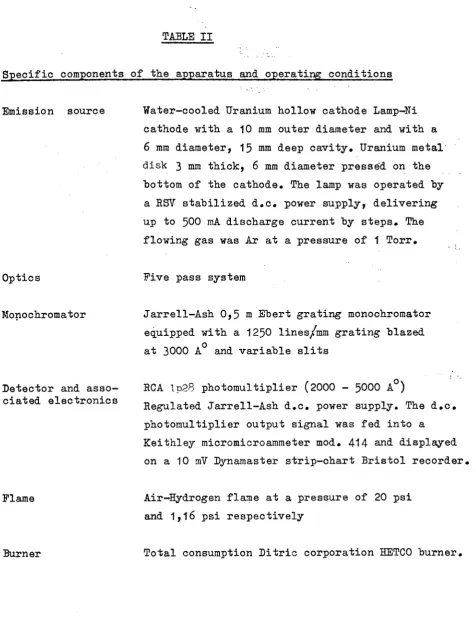
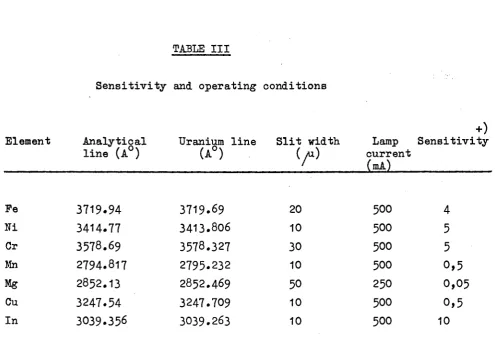
Table II summarizes the specific components of the experimental set-up and the operating conditions. Table III lists a first series of elements and the results obtained. It must be pointed out that the experimental conditions were in no case optimized because the aim of this work was to demonstrate the feasibility of using the Uranium hollow cathode lamp as primary source rather than a critical
evaluation in terms of sensitivity.
6
-CONCLUSIONS
The results obtained look undoubtly promising and seem to confirm the broad analytical applicableness of a very complex line souroe in atomic absorption. Noticeable improvements should be expeoted by the use of a more sophisticated detection and recording system as well as that of a nitrous-oxyde acetylene flame for the
refractory materials.
Tests for other elements and a critical evaluation of the different parameters (lamp current, spectral band width of the monoohromator and flame conditions) are now in progress. The results will be presented in a future paper.
ACKNOWLEDGEMENTS
7
-LITERATURE CITED
1. W.G. JONES and A. WALSHi Spectrochim. Acta 16, 249 (i960)
2. J.C. BURGER» Westinghouse Electric Corp., EDT-6603, April 1966
3. A. STRASHEIM and L.R.P. BUTLER« Applied Spectroscopy 16 no.3, IO9 (1962)
4. L.R.P. BUTLER and A. STRASHEIM» Spectrochim. Acta 21, 120) (1965)
5. G. ROSSI and N. OMENETTO» in press on Applied Spectroscopy
6. A.N. ZAIDEL, N.I. KALITEEVSKII, L.V. LIPIS, M.P. CHAIKAt
"Emission Spectrum analysis of atomic materials" Book 1,
Translation Series AEC-tr-5745
7. A. WALSH» Spectrochim. Acta, 7, IO87 (1955)
8. V.A. FASSEL, V.O. MOSSOTTI, W.E.L. GROSSMANN and R.N, KNISELEY»
Spectrochim. Acta 22, 347 (1966)
9. W.W. McGEE and J.D. WINEFORDNER» Anal.Chim. Acta 37, 429 0967)
10. L. DE GALAN, W.W. McGEE and J.D. WINEFORDNERt ibid. 37, 436 (1967)
11. C.W. FRANK. W.G. SCHRENK and C.E. MELOAN» Anal. Chem. 38, no.8
IOO5 (1966)
12. D.W. STEINHAUS! Atomic Spectro Symp. - Argonne I96I
13. M.I.T. Wavelength Tablest The Technology Press, Massachusetts
Institute of Technology
14. G. ROSSI, Z. HAINSKI, N. OMENETTO» Atti del XIII Simposio
Spettrochimico AIM - Montecatini - Ottobre I966 - in press on
"La Metallurgia Italiana"
15. G. ROSSI, Ζ. HAINSKI, Ν. OMENETTO» p
aper to be presented at
the XIV
8
-TABLE I
Eleraer Ag Al Au Β Ba Be Bi Ca Cá Ce Co Cr Cu Dy Er Eu Pe Ga Gd Ge Hi' Hg Ho Y Yb In
it λ(Α°)
3230.683 ;,3&?.o9 3092.71 2427.95 2497.733 5535.551 2348.61 3O67.716 4226.728 2280.OI8 2761.415 2407.254 3578.69 3247.54 4211.719 4OO7.67 4594.02 2483.27 3719.94 2874.244 3684.124 2651.575 3072.877 2536.519 4053.92 4102.376 3987.994 3039.356 2502.983
Analytical lines of Uran
D λ (A°)
328O.6O8 3382.67 3093.O12 2427.622 2498.267 5535.796 2348.91 3067.758 4226.60 2287.80 2761.449 2406.435 3578.327 3247.709 4211.68 4007.934 4594.294 2484.008 3719.69 2874.083 3684.617 2651.844 3072.783 2536.6 4054.313 4102.21 3988.029 3039.263 2502.407
i larri l i n e s
U int. arc. 1 4 20 12 3 6 2 8 1 -5 10 8 4 10 8 6 15 1 15 5 3 20 3 12 1 8 15 2 which spark. 2 4 20 2 8 2 2 6 2 2 2 10 1 5 10 3 8 4 8 10 5 15 h 20 2 15 4 12 12 10
9 -TABLE II
Specific components of the apparatus and operating conditions Emission source Water-cooled Uranium hollow cathode Lamp-Ni
cathode with a 10 mm outer diameter and with a 6 mm diameter, 15 mm deep cavity. Uranium metal disk 3 mm thick, 6 mm diameter presse'd on the bottom of the cathode. The lamp was operated by
a RSY stabilized d.c. power supply, delivering up to 500 roA discharge current by steps. The flowing gas was Ar at a pressure of 1 Torr. Optics Five pass system
Monochromator Jarrell-Ash 0,5 m Ebert grating monochromator equipped with a 1250 lines/mm grating blazed at 3OOO A and variable slits
Detector and asso-ciated electronics
RCA lp28 photomultiplier (2000 - 5OOO A°)
Regulated Jarrell-Ash d.c. power supply. The d.c. photomultiplier output signal was fed into a Keithley micromicroammeter mod» 414 and displayed
on a 10 mV Dynamaster strip-chart Bristol recorder. Flame Air-Hydrogen flame at a pressure of 20 psi
and 1,16 psi respectively
[image:13.595.67.544.61.679.2]10
TABLE III
Sensitivity and operating conditions
+)
Element
Fe
Ni
Cr
Mn
Mg
Cu
In
Analytical
line (A°)
3719.94
3414.77
3578.69
2794.817
2852.13
3247.54
3039.356
Uranium line
(A°)
3719.69
3413.806
3578.327
2795.232
2852.469
3247.709
3039.263
Slit width
(/O
20
10
30
10
50
10
10
Lamp Sensitivity
current
(mA)
5OO 4
500 5
500 5
500 0,5
250 0,05
500 0,5
500 10
recorder
multipass system
d. c.
amplifier
U]f^"z
monochromator
T
HET CO
water
'"'V^·
lliiii#yilililliiËSiiiie
ffSÄl I lïii β ü l !-§f
;
* f ¡ I A
Wm
m
w
Έ*ΪΕ*3Γ
H K
m
N O T I C E T O T H E READERAll Euratom reports are announced, as and when they are issued, in the monthly periodical E U R A T O M I N F O R M A T I O N , edited by the Centre for Information and Documentation (CID). For subscription (1 year : US$ 15, £ 5.7) or free specimen copies please write to :
Handelsblatt G m b H "Euratom Information' Postfach 1102
D - 4 Düsseldorf (Germany)
SlliipPiiSI
or
Office central de vente des publications des C o m m u n a u t é s européennes
2, Place de Metz L u x e m b o u r g
. . general prosperity and not individual riches — and with prosperity ^llHIlIllíinilllininiMílllIUÍill disappears the greater part of the evil which is our heritage from
1 darker times.
I
i
mmwãmiw.
äPliStsALES OFHCsJ|ÌMH^Se»m^
All Euratom reports are on sale at the offices listed below, at the prices given on the back of the
f , χ, A J — — — / _ _ _ ! _ «. _ ^ ^ . - u . J « -^ * - u . ^fl ^ » « . w» - , 1 £~ . ~ 1A * ^ « . 1 « 4 - 1 * « Λ Τ " ï A * « 4 ~-«~~« T * *-* «-« <-^ ■»-. x-I +■ V » Í-* 4 - . + 1 Λ Í~\ f 4 - 1 * j - \ * * 4 - ν * - ν * * τ *■* -Í- u r t i t n i l .-» »-* Í »
shown
B E L G I Q U E - B E L G I Ë
M O N I T E U R B E L G E
An ΛΙ> _..„ Α~ τ „„,,-,;„ _
u,-,,^..ii...-BäiBÜft
4042, r u e de Louvain Bruxelles
B E L G I S C H S T A A T S B L A D
Leuvenseweg 4042 Brussel
mm
D E U T S C H L A N D
B U N D E S A N Z E I G E R Postfach Köln 1
! ■•rt<JXJj|R,.'ir|ta'
F R A N C E
S E R V I C E D E V E N T !
D E S P U B L I C A T I O N S D E S
C O M M U N A U T E S E U R O P E E N N E S
26, rue Desaix Paris 15e
L U X E M B O U R G
O F F I C E C E N T R A L D E V E N T E
m
D E S P U B L I C A T I O N S D E S
C O M M U N A U T E S E U R O P E E N N E S
;îi!
!$ρξ· ijr '
I T E E N F R A N C E
i«
jííSi
N E D E R L A N D
S T A A T S D R U K K E R I J
Christoffel Pianti] η s t r a a t Den H a a g
ilvtflf·;···!