http://dx.doi.org/10.4236/jbbs.2013.38064
Qualitative Differences in Pup-Retrieval Strategies in a
Maternal Separation Paradigm
*
Loudin Daoura, Ingrid Nylander, Erika Roman#
Department of Pharmaceutical Biosciences, Neuropharmacology, Addiction & Behaviour, Uppsala University, Uppsala, Sweden Email: #[email protected]
Received October 30, 2013; revised November 28, 2013; accepted December 12,2013
Copyright © 2013 Loudin Daoura et al. This is an open access article distributed under the Creative Commons Attribution License,
which permits unrestricted use, distribution, and reproduction in any medium, provided the original work is properly cited.
ABSTRACT
The rodent maternal separation (MS) paradigm is frequently used to investigate the impact of early-life conditions in the offspring. One critical issue is whether the effects seen in the offspring are a result of maternal contact deprivation and/or altered pup-directed maternal behavior. To address this question we used an innovative approach with a qualita-tive analysis of pup-retrieval strategies in a test situation related to risk for the pups. The dams were separated from their litters for 0 (MS0) or 360 (MS360) min, respectively. The pups were placed in a risk area in the multivariate con-centric square field™ test at two test occasions and the pup-retrieval strategies were recorded. No significant evident differences between MS0 and MS360 dams were found. However, there were clearly two different strategies, either removing the pups out of potential danger or into safety, and these strategies were represented in both MS groups. As compared to the MS0 dams, the MS360 dams did not change their strategies and left more pups in the risk area in both pup-retrieval tests. This implies different pup-retrieval strategies depending on early-life conditions.
Keywords: Pregnancy; Gestation; Virgin; Handling; Maternal Deprivation; Multivariate Concentric Square Field;
Behavior; Wistar Rats; Stress; Maternal Behavior; Ultrasonic Vocalization
1. Introduction
Environmental influences during childhood and adoles-cence are known to have a pronounced impact on behav-ior later in life [1,2]. Neuronal networks continue to un-dergo vital development after birth and the developmen-tal reorganization and maturation processes continue all through adolescence [3,4]. The brain is therefore highly sensitive to environmental input early in life and the abil-ity to change and adapt to environmental stimuli is im-portant in processes shaping the brain [3,5]. Such ear-ly-life adaptive alterations may be favorable for the indi-vidual [6,7] but may also result in impaired ability to adapt to new situations and in altered sensitivity to chal-lenges later in life and thereby contribute to the individ-ual vulnerability for later disease [2,8-10]. The primary caregiver has not only a vital role in nursing and
protec-tion but also for attachment and social contacts that are essential for normal development of the infant [11]. Dis-ruption of these interactions between caregiver and off-spring can therefore have major impacts on the infant. The occurrence of early adverse experiences such as childhood abuse, severe neglect or other stressful events can for example contribute to later psychopathology[12], including alcohol use disorders [13,14]. The mechanisms underlying these long-term effects are poorly understood. To examine the impact of environmental factors dur-ing sensitive developmental time windows, animal ex-perimental models are required. In exex-perimental studies the influence of environmental stimuli can be minimized and the causal relationship between different early-life factors and adult phenotype can be investigated. The ro-dent maternal separation (MS) model is frequently used to investigate the impact of early-life conditions on neu-robiology, endocrine function and behavior in the off-spring [15-17]. In this model the environmental condi-tions are manipulated by short (<15 min) or prolonged (180 - 360 min) separations of the litter from the dam. The consequences of MS on offspring at different ages later in life have been extensively studied and prolonged
*Note: Parts of this work were included as a preliminary manuscript in the PhD thesis by Dr. Loudin Daoura entitled “Early environment and adolescent alcohol consumption: Effects on endogenous opioids and behaviour in rats”, Acta Universitatis Upsaliensis, Uppsala 2013, Digi-tal Comprehensive Summaries of Uppsala Dissertations from the Fac-ulty of Pharmacy 171, ISBN 978-91-554-8678-5, urn:nbn:se:uu:diva-198670.
MS is, in general, related to negative consequences and therefore regarded as a risk environment as compared to shorter periods of MS [16,18-20]. One critical issue fre-quently discussed in MS studies is whether the effects seen in the offspring are a result of maternal contact dep-rivation or altered maternal behavior caused by absence of the pups, or a combination of both [21-23]. Behavioral and/or physiological stress responses may emerge in the dam as a result of interference with the mother-pup in-teractions and may be transferred to the offspring [22,24]. It has also been suggested that MS alters the quality of maternal care and thereby elicit effects in the offspring [23].
This study was designed to further investigate mater-nal-pup interactions and address the question whether dams experiencing daily and lengthy loss of contact with the litter during the first week after birth will exhibit al-tered behavior towards the pups. The study includes be- havioral profiling before parturition, assessment of ma-ternal pup-retrieval strategies after parturition and meas-urement of the ultrasonic vocalizations (USVs) emitted by the pups. The first week was chosen for pup retrieval tests since it is part of the stress hypo-responsive period [25] and the pups are dependent on the mother for ther-moregulation, nursing and protection [26].
The multivariate concentric square field™ (MCSF) test was used for the behavioral assessments. For behav-ioral profiling, the rat is placed in an arena consisting of several areas including areas associated with risk and shelter for the animal to freely explore [27,28]. The MCSF test enables extensive behavioral profiling in one test situation and has, for example, been used for charac-terization of behavioral profiles in rats subjected to MS15 and MS360 [29], and post-weaning behavior in dams after MS [30]. The rationale for using the MCSF test for the investigation of pup-retrieval strategies was that the behavioral validation of areas associated with potential risk versus sheltered areas in the MCSF showed that lactating dams retrieve their pups from a potential risk area into a sheltered area without further repositions [27].
The study involves two parts; behavior profiling of the dam before parturition (gestational day, GD, 20), and two repeated pup retrieval tests in the same dams exposed to daily 0 or 360 min separations from their litter (MS0 and MS360, respectively). In addition, it was examined whether MS altered the USVs emitted by the pups.
2. Material and Methods
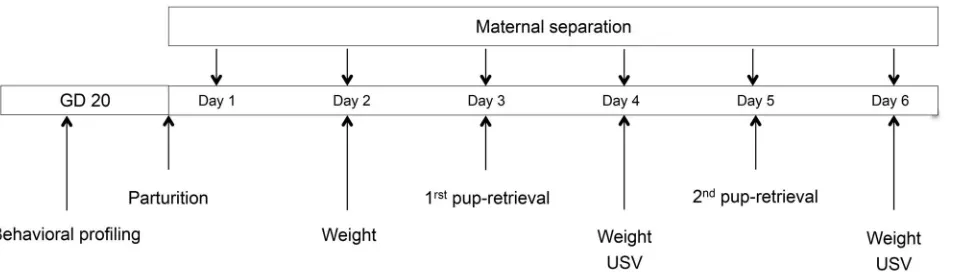
The experimental outline is shown in Figure 1.
2.1. Animals
Twenty-eight outbred Wistar rats (Sca:WI; Scanbur BK
AB, Sollentuna, Sweden) out of which 15 were pregnant on gestational days (GDs) 12 - 14, arrived to the animal facility. On arrival, the dams were housed singly in cages (59 × 38 × 20 cm) with wood chip bedding and 40 × 60 cm paper sheets (Cellstoff, Papyrus) as nesting material. Cages were changed once a week, and a small part of the old bedding material was always transferred to the bed-ding material in the new cage. The rats had ad libitum
access to pellet food (R36; Lantmännen, Kimstad, Swe-den) and water. All animals were housed in temperature (21˚C ± 1˚C) and humidity controlled (49% ± 5%) ani-mal cabinets in a room on a 12-h light-dark cycle with lights on at 07:00 am. All animal experiments were per-formed following a protocol approved by the local Upp-sala Animal Ethical Committee and in accordance with the guidelines of the Swedish Legislation on Animal Ex-perimentation (Animal Welfare Act SFS1998:56) and the European Communities Council Directive (86/609/EEC).
2.2. Maternal Separation
Figure 1. Experimental outline. Two experimental groups were used in the maternal separation paradigm: MS0, handling of the pups and less than 1 min separation from the dam, and MS360, handling of the pups and 360 min separation from the dam. GD: Gesta- tional day, USV: Ultrasonic vocalization.
cedure took around 15 seconds to perform.
2.3. The MCSF Test
All assessments were performed using the MCSF test in a room separate from the housing room, with a masking background noise. The animals were monitored while the observer watched remotely from an adjacent room. Each trial lasted for 10 minutes. After each animal, the arena was wiped with 10% ethanol solution and sufficient time was allowed for the arena to dry before the next ani-mal/group of dam and litter was tested.
The MCSF arena (100 × 100 cm) has been described in detail elsewhere [27,28]. The entire arena is divided into zones, which forms the basis of the description and the variables of the animals’ performance in this test. The defined zones are: center, open area (the center field of
the arena); central circle, risk area (the circular zone in
the middle of the center); corridors, transit areas (the
corridors surrounding the center field); dark corner room (DCR), area for shelter seeking (the covered room); hur-dle, exploratory incentive (the high passage to a hole
board with a photocell device); slope, risk assessment
area (the slope leading up to the bridge); bridge, risk area
(the elevated and illuminated bridge construction). Dimmed light was used during the testing, except for the bridge area. The approximate light conditions (lx) in the MCSF arena were as follows: DCR: < 1; center, corri- dors and hurdle: 10 - 15; bridge: 600 - 650.
2.4. The Ultrasonic Vocalization Test
The USV test was modified from the protocol used by Ploj et al. [31]. The individual USVs emitted by MS0
and MS360 pups were measured at the end of the MS0 and MS360 procedures, respectively, on PNDs 4 and 6. Each pup was individually placed in an insulated box connected to a microphone bat detector device, inter- faced with a USV counter and the number of USVs in the 40-60 kHz range were recorded. The pups were allowed
to adapt to the novel environment for one minute before the number of vocalizations were counted for another mi- nute. Meanwhile, the rest of the littermates were kept warm in a cage placed on a heating pad. After each pup the equipment was cleaned with 10% ethanol solution and sufficient time was allowed for the area to dry. When all littermates were tested, the litter was returned to the maternity cage.
2.5. Behavioral Profiling before Parturition On GD 20, the pregnant (n = 15) rats were tested in the MCSF test to obtain individual behavioral profiles. Vir- gin rats (n = 13) were also tested as controls. Each ani- mal was transferred in a bucket from the home cage to the MCSF apparatus and released in the center facing the wall without openings, between the center and bridge.
generated from the MCSF with regard to function (i.e.
general activity, exploratory activity, risk assessment, risk taking and shelter seeking) was used in the interpre-tation of results, for details see [28,32].
2.6. Pup-Retrieval Strategies
The pup-retrieval tests were performed on PNDs 3 and 5. The litter to be tested (MS0 brought from the maternity cage; MS360 brought from the heating cabinet) was placed on cellulose cotton at the end of the bridge. The dam was placed in the center facing the wall without openings, between the center and bridge.
Pup-retrieval related behaviors, i.e. latencies in first
visiting the bridge, in first contact with the pups, in re-trieval of each pup from the bridge and the number of pups placed in the DCR (complete retrieval), or some-where else in the arena or left on the bridge, were re-corded. A latency of 600 s was given for any parameter in the pup-retrieval test that was not initiated or com-pleted within the 10-min observation period.
2.7. Statistical Analyses
Statistica 10.0 (StatSoft Inc., Tulsa, OK) was used for the statistical analyses. Differences were considered statisti-cally significant at p≤ 0.05. Body weight data was
ana-lyzed using parametric one-way analysis of variance (ANOVA). The data from the behavioral tests was not normally distributed according to the Shapiro-Wilks’ W test and therefore nonparametric statistics were used.
Possible differences in the behavioral parameters be-tween pregnant and virgin rats were analyzed using the Mann-Whitney U-test. The Wilcoxon signed-rank test
was used when comparing the total activity, distance, and velocity during the first and last 5-min periods of the 10-min trial. Correlations were calculated using the Spearman rank correlation test. Besides analyzing each MCSF parameter, a trend analysis was used, explained in detail elsewhere [30,32]. The performance of the MS0 and MS360 dams in the pup-retrieval tests and of MS0 and MS360 pups in the USV test were analyzed using the Mann-Whitney U-test. In addition, a trend analysis [32]
was used for evaluation of pup-retrieval activity. The individual rank values for the parameters included in the pup-retrieval activity (LAT bridge, LAT to first contact and LAT to retrieval of first pup) were summed. The Wilcoxon signed-rank test was used when comparing behavioral parameters from the first and second pup- retrieval and USV tests, respectively. Correlations were calculated using the Spearman rank correlation test.
A principal component analysis (PCA) was used for investigation of associations between the behavior of the pregnant dams (GD20) and their later pup-retrieval strategies. For the multivariate data analysis, SIMCA-P+
12.0 (Umetrics AB, Umeå, Sweden) was used.
3. Results
3.1. Body Weights
The mean ± SEM body weight was 356.8 ± 7.6 g in pregnant rats and 289.7 ± 8.2 g in virgin rats [F(1,26) = 35.96; p < 0.001]. The litters were weighed on PNDs 2, 4,
and 6, and the mean pup weight (± SEM) per litter was calculated. The one-way ANOVA analysis showed a statistically significant lower mean body weight in MS360 litters on PND 4 [F(1,12) = 9.25; p < 0.01] and
PND 6 [F(1,12) = 13.61; p < 0.01] compared to the MS0
litters. This finding is in agreement with previous results collected from our group [31,33].
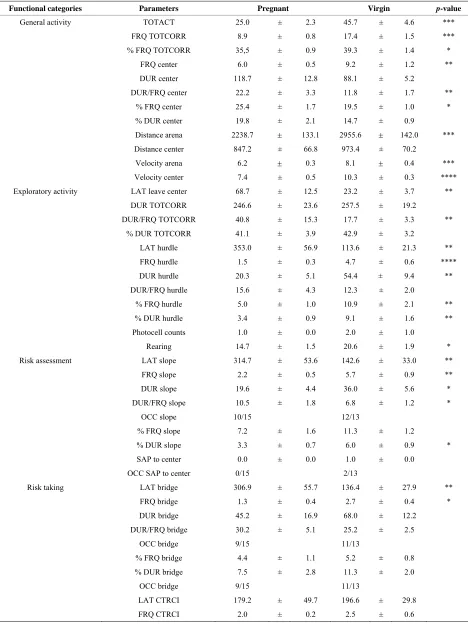
3.2. Behavioral Profiling before Parturition The descriptive parameters from the 10-min trial in the MCSF test within the functional categories (general ac-tivity, exploratory acac-tivity, risk assessment, risk taking, shelter seeking), interpreted mental states (anxiety-like behavior, impulsive-like behavior) and information about SAP, boli, urine and grooming behavior are shown in
Table 1. Significant differences between the pregnant
and virgin rats were found for parameters of relevance to general activity, exploration and risk assessment, while minor differences were revealed for parameters of rele-vance for risk-taking and shelter-seeking behavior. For statistics, see Table 1.
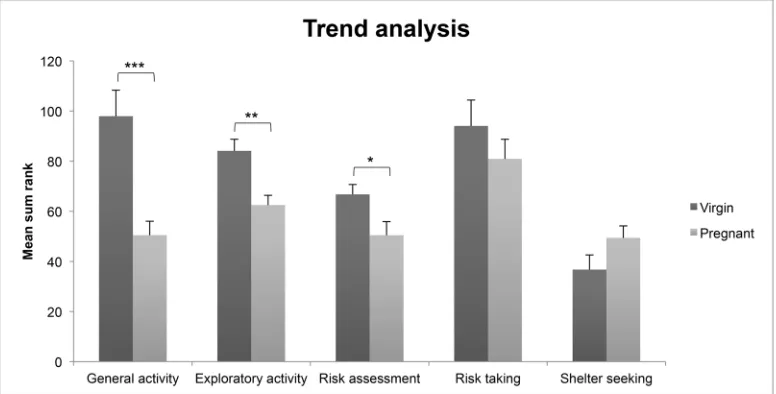
The trend analysis of MCSF performance (Figure 2)
shows that the pregnant rats had significantly lower gen-eral [U = 28.0, Z = −3.2, p = 0.001] and exploratory
ac-tivity [U = 34.0, Z = −2.9, p < 0.01], and lower
risk-assessment [U = 53.0, Z = −2.0, p < 0.05] behavior
compared to the virgin rats.
Differences in total activity, distance, and velocity over time during the 10-min session within the respective group were analyzed. Pregnant rats had significantly higher total activity [Z = 2.7, p < 0.01] and velocity [Z =
3.0, p < 0.01] during the last 5-min period compared to
the first 5-min period of the 10-min trial, while no dif-ference in distance was observed (data not shown). No differences over time were detected in the virgin rats.
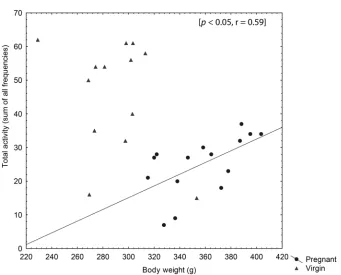
A significant positive correlation between body weight and total activity was found for the pregnant rats [r = 0.59, p < 0.05] (Figure 3). No significant correlation was
found for the virgin rats. No significant correlation was found for any group between either body weight and total distance moved or between body weight and velocity in the MCSF arena.
3.3. The First Pup-Retrieval Test
Table 1. Behavioral parameters recorded during the 10-min trial of the MCSF test in pregnant (n = 15) and virgin (n = 13) rats.
Functional categories Parameters Pregnant Virgin p-value
General activity TOTACT 25.0 ± 2.3 45.7 ± 4.6 ***
FRQ TOTCORR 8.9 ± 0.8 17.4 ± 1.5 ***
% FRQ TOTCORR 35,5 ± 0.9 39.3 ± 1.4 *
FRQ center 6.0 ± 0.5 9.2 ± 1.2 **
DUR center 118.7 ± 12.8 88.1 ± 5.2
DUR/FRQ center 22.2 ± 3.3 11.8 ± 1.7 **
% FRQ center 25.4 ± 1.7 19.5 ± 1.0 *
% DUR center 19.8 ± 2.1 14.7 ± 0.9
Distance arena 2238.7 133.1 2955.6 142.0 ***
Distance center 847.2 ± 66.8 973.4 ± 70.2
Velocity arena 6.2 0.3 8.1 0.4 ***
Velocity center 7.4 ± 0.5 10.3 ± 0.3 ****
Exploratory activity LAT leave center 68.7 ± 12.5 23.2 ± 3.7 **
DUR TOTCORR 246.6 ± 23.6 257.5 ± 19.2
DUR/FRQ TOTCORR 40.8 ± 15.3 17.7 ± 3.3 **
% DUR TOTCORR 41.1 ± 3.9 42.9 ± 3.2
LAT hurdle 353.0 ± 56.9 113.6 ± 21.3 **
FRQ hurdle 1.5 ± 0.3 4.7 ± 0.6 ****
DUR hurdle 20.3 ± 5.1 54.4 ± 9.4 **
DUR/FRQ hurdle 15.6 ± 4.3 12.3 ± 2.0
% FRQ hurdle 5.0 ± 1.0 10.9 ± 2.1 **
% DUR hurdle 3.4 ± 0.9 9.1 ± 1.6 **
Photocell counts 1.0 ± 0.0 2.0 ± 1.0
Rearing 14.7 ± 1.5 20.6 ± 1.9 *
Risk assessment LAT slope 314.7 ± 53.6 142.6 ± 33.0 **
FRQ slope 2.2 ± 0.5 5.7 ± 0.9 **
DUR slope 19.6 ± 4.4 36.0 ± 5.6 *
DUR/FRQ slope 10.5 ± 1.8 6.8 ± 1.2 *
OCC slope 10/15 12/13
% FRQ slope 7.2 ± 1.6 11.3 ± 1.2
% DUR slope 3.3 ± 0.7 6.0 ± 0.9 *
SAP to center 0.0 ± 0.0 1.0 ± 0.0
OCC SAP to center 0/15 2/13
Risk taking LAT bridge 306.9 ± 55.7 136.4 ± 27.9 **
FRQ bridge 1.3 ± 0.4 2.7 ± 0.4 *
DUR bridge 45.2 ± 16.9 68.0 ± 12.2
DUR/FRQ bridge 30.2 ± 5.1 25.2 ± 2.5
OCC bridge 9/15 11/13
% FRQ bridge 4.4 ± 1.1 5.2 ± 0.8
% DUR bridge 7.5 ± 2.8 11.3 ± 2.0
OCC bridge 9/15 11/13
LAT CTRCI 179.2 ± 49.7 196.6 ± 29.8
Continued
DUR CTRCI 3.0 ± 0.5 3.6 ± 0.9
DUR/FRQ CTRCI 1.6 ± 0.2 1.6 ± 0.1
OCC CTRCI 15/15 11/13
% FRQ CTRCI 8.6 ± 0.9 4.7 ± 1.0 **
% DUR CTRCI 0.5 ± 0.1 0.6 ± 0.2
OCC CTRCI 15/15 11/15
Velocity CTRCI 12.3 ± 1.5 17.0 ± 2.5
Distance CTRCI 56.9 ± 7.5 90.2 ± 19.4
Shelter seeking LAT DCR 221.7 ± 45.7 218.9 ± 50.4
FRQ DCR 3.1 ± 0.3 3.9 ± 0.5
DUR DCR 146.7 ± 24.1 100.0 ± 26.1
DUR/FRQ DCR 46.4 ± 6.8 23.0 ± 4.9 **
% FRQ DCR 13.9 ± 1.8 9.1 ± 2.3 *
% DUR DCR 24.5 ± 4.0 15.4 ± 4.2
Anxiety-like behavior FRQ risk/shelter index −0.5 ± 0.1 −0.2 ± 0.1
DUR risk/shelter index −0.6 ± 0.1 −0.1 ± 0.2 *
Impulsive-like behavior Slope/bridge interval 0.0 ± 0.1 −0.1 ± 0.1
Miscellaneous Boli 0.1 ± 0.1 0.1 ± 0.1
Urine 1.2 ± 0.2 1.8 ± 0.3
Grooming 0.9 ± 0.3 0.3 ± 0.1
[image:6.595.105.493.425.622.2]When an animal did not visit a zone the latency measure was considered a missing value and therefore occurrence is shown. The Pearson Chi-square test re-vealed no differences in occurrence between groups. Values represent mean ± SEM.*p < 0.05, **p < 0.01, ***p < 0.001, ****p < 0.0001 when comparing pregnant and virgin rats (Mann-Whitney U-test). CTRCI, central circle; DCR, dark corner room; DUR, duration (s); DUR/FRQ, duration per visit (s); FRQ, frequency; LAT, latency (s); TOTACT, total activity, i.e., the sum of all frequencies; TOTCORR; total corridor, i.e., the sum of all corridors (2 - 4); PC counts, photocell counts; OCC, occurrence, i.e., indicates the zones with latencies = 0, or the behaviors that were not performed by all animals in each group; SAP, stretched attend posture.
Figure 2. The trend analysis in virgin and pregnant rats. The individual rank values for MCSF parameters included in the functional categories general activity, exploratory activity, shelter seeking, risk assessment and risk taking are summed into single composite dependent variables. Values represent mean ± SEM.*p < 0.05, **p < 0.01, ***p < 0.001 (Mann-Whitney U-test). ure 4. The results from the first pup-retrieval test at PND
3 show that the MS360 dams had a shorter latency in first visiting the bridge [U = 4.0, Z = 2.6, p = 0.01] compared to
MS0 dams (Figures 4(a) and (b)). There was no difference
between MS0 and MS360 dams in latency to first contac-
tor latency in retrieval of first pup (Figures 4(a) and (b)).
Figure 3. The correlation between body weight and total activity in virgin and pregnant rats during the 10-min session in the MCSF test. A significant Spearman rank correlation was found in the group of pregnant rats (p < 0.05).
ent outcome between the MS0 and MS360 dams was found, with an improved pup-retrieval activity in the MS360 dams (Figure 5).
Large differences were observed in the individual re- trieval strategies, both within the MS0 (Figure 4(a)) and
the MS360 (Figure 4(b)) group. Three dams within each
group had a retrieval pattern characterized by a system-atic retrieval of the pups into the DCR. Two dams in each group retrieved none of the pups into the DCR within the observation period of 600 s (Figures 4(a) and (b)). Furthermore, it was of interest to score if the dams
had the same strategies in transposing the pups in the arena. The number of pups in different areas in the arena was counted at the end of the tests and is shown in Fig-ure 6. The MS0 dams retrieved 16 out of 28 pups (57%)
into the DCR while the corresponding number for MS360 dams was 18 out of 28 pups (64%). The MS0 dams left 8 pups (29%) on the bridge, retrieved 3 pups (11%) to the slope and retrieved 1 pup (3%) to the corri-dors (Figure 6(a)). The MS360 dams left all the
remain-ing 10 pups (36%) on the bridge (Figure 6(b)).
3.4. The Second Pup-Retrieval Test
In the second retrieval test at PND 5, no differences be-tween MS0 and MS360 dams in latency to first visit of the bridge or in latency to first contact were found ( Fig-ures 4(c) and (d)). In MS0 dams a positive correlation
between latency in first visiting the bridge and latency in first contact [r = 0.94, p < 0.01] was found, while no
such association was revealed in the MS360 dams. The lack of differences between MS0 and MS360 dams was further supported by the trend analysis (Figure 5).
The individual retrieval strategies in the MS0 group were either all pups retrieved to the DCR (three dams (43%)) or some or none pups retrieved to the DCR (Fig- ure 4(c)). A similar pattern was observed in the MS360
Figure 5. The trend analysis of pup-retrieval related per-formance in the MS0 and MS360 dams. The individual rank values for the latencies in first visiting the bridge, first contact and retrieval of the first pup were summed into a single composite dependent variable. Values represent mean ± SEM.
group (Figure 4(d)). The MS0 dams retrieved 17 out of
28 pups (61%) into the DCR while the corresponding number for MS360 dams were 15 pups (54%). The MS0 dams left 7 pups (25%) on the bridge and retrieved 4 pups (14%) to the slope (Figure 6(c)). The MS360 dams
left all the remaining 13 pups (46%) on the bridge ( Fig-ure 6(d)).
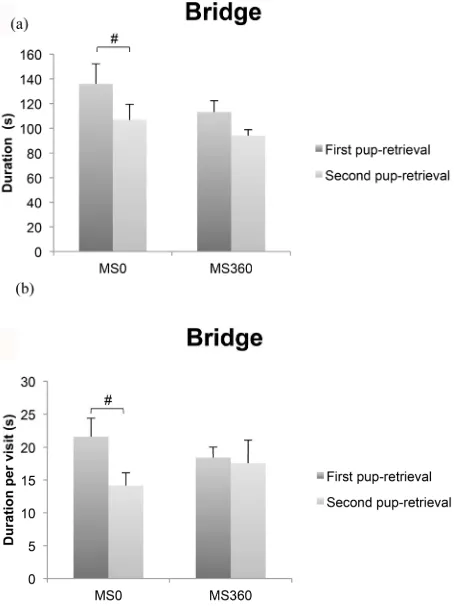
When comparing the behavior performed by the MS0 and the MS360 dams from the first and second pup-retrieval trials, it was found that there were differ-ences over time in parameters of relevance for retrieval behavior (Figure 7). This was observed only in the MS0
group and showed that the MS0 dams spent significantly shorter time [Z = 2.2, p < 0.05] and shorter time per visit
[Z = 2.4, p < 0.05] on the bridge in the second relative to
the first pup-retrieval test. It was also found that in the second retrieval test, the MS0 dams had a significantly shorter latency to the bridge [Z = 2.4, p < 0.05] and to
the first contact [Z = 2.4, p < 0.05] compared to first
re-trieval test (Figures 4(a) and (c)). In the trend analysis,
no difference in performance over time was noted for either group.
The MS0 dams that systematically retrieved the pups into the DCR had shorter retrieval latencies in the second test while the dams that retrieved no pups in the first trial expressed the same behavior in the second trial. In addi-tion, the total amount of MS0 pups retrieved from bridge was almost equally (16 and 17 pups) in both retrieval trials. On the other hand, the MS360 dams (Figures 4(b)
and (d)) had a somewhat different pattern in the second
trial; the systematic retrieval into the DCR was slower in two dams and more pups (n = 13 (46%)) were left on bridge compared to first trial (n = 10 (36%)).
3.5. The Behavior of Pregnant Dams a Predictor of Retrieval Strategies
Since the dams were profiled prior to parturition it was of interest to see if the behavior in the MCSF on GD20 could be used for prediction of later retrieval strategies. A PCA was used for investigation of associations be-tween the behavior of the dams before parturition and their later pup-retrieval strategies during PNDs 3 and 5, respectively. No correlation in the MCSF performance of relevance for pup-retrieval behavior was found.
Since similar retrieval strategies were observed inde-pendent of MS group, two new subgroups were formed based on retrieval of all pups into the DCR or not. These subgroups were used for the investigation of possible differences in behavioral profiles before parturition, i.e.
GD20, on later retrieval strategies. No such differences were observed.
3.6. Ultrasonic Vocalization (USV) Test
Figure 6. The pie charts illustrate the location of the pups placed in the MCSF arena after 600 s in the first (a)-(b) and second (c)-(d) pup-retrieval tests during (PND 3 and PND 5, respectively). Two experimental groups were used: MS0 (a) and (c), respectively), and MS360 (b) and (d), respectively). The total number of pups was 28 (4 pups/dam).
Figure 7. The duration (s) and the duration per visit (s) spent on the bridge in the MCSF test in the MS0 and MS360 dams. Values represent the mean ± SEM. #p < 0.05 compared to second pup-retrieval test (Wilcoxon signed rank test).
PND 6 are presented in Figure 8. No difference between
[image:9.595.56.284.85.258.2]MS0 and MS360 pups was found on PND 4. On PND 6,
Figure 8. The number of ultrasonic vocalizations (USVs) in MS0 and MS360 pups. PND = postnatal day. Values repre-sent the mean ± SEM. *p < 0.05 comparing MS360 and MS0 litters (Mann-Whitney U-test). #p < 0.05 compared to PND 6 (Wilcoxon signed rank test).
the MS360 pups made fewer vocalizations [U = 4.0, Z =
2.6, p < 0.01] compared to MS0 pups. A time-dependent
increase in USVs was observed within the MS0 pups [Z=
2.2, p < 0.05] while no difference was found for the
MS360 pups.
4. Discussion
In this study, we addressed the hypothesis that interfer-ence with the mother-pup interactions through daily ma-ternal separations during the first postnatal week will affect goal-directed behavior towards the pups. We used the MCSF test and provided novel data regarding pup- retrieval strategies in an arena with areas associated with risk and shelter, respectively. During the pup-retrieval tests, the litters were placed all together at the end of the bridge in the MCSF arena. This forces the dam to take a risk by crossing the illuminated bridge area in order to reach the pups. It was explored whether the dams re-trieved the pups from the potential risk area and if so, it was examined where they placed the pups.
In the first retrieval test, the MS360 dams had a shorter latency in the first visit to the bridge compared to the MS0 dams, while no difference in latency to the first contactor retrieval of the first pup was observed. That is, the MS360 dams were faster to enter the risk area but not faster to reach the litters. When the pup-retrieval per-formance, i.e. latencies in the first visit to the bridge, the
[image:9.595.60.287.340.643.2]ses-sion, the MS360 pups emitted more calls than the MS15 pups on PND 5 [31]. In the present study the USVs were instead measured at the same time point as the pup-retrieval tests were performed, i.e. immediately
be-fore the end of the MS sessions. In view of the MS dura-tion in the MS0 group, i.e. to avoid a too long MS, the
USV measurements and the retrieval tests were not per-formed on the same day. The observations from the USV test on PND 4 show no difference in number of USVs emitted by MS0 and MS360 pups, which may explain the similar behavior in MS0 and MS360 dams in reaching the pups. The literature gives a complex picture as a number of investigations regarding pup-retrieval behav-ior during MS have been reported using various proce-dures [35-38] and experiments investigating the effect of MS on maternal behavior are far from conclusive [23,39,40]. Marmendal et al. [36] studied pup-retrieval
behavior in the maternity cage in a MS paradigm with 240 min and 5 min separations, respectively, and repor- ted similar results as herein, i.e. no differences in time for
retrieval of the first pup or for retrieval of the whole litter and MS240 dams spent more time with their pups after retrieval, as compared to briefly separated dams [36]. However, more recent studies performing pup-retrieval in the maternity cage [37,38] showed that MS180 dams took longer time to collect their litter as compared to MS15 dams [38], and MS270 dams took longer time for retrieval of the entire litter as compared to AFR dams [37]. Both moderately and more severely disruptive pos- tnatal manipulations have been reported to result in in-creased, rather than dein-creased, levels of active maternal care compared to completely undisturbed conditions [41]. This is in line with the improved pup-retrieval perform-ance in the MS360 dams herein as evidenced by the first trial in the trend analysis.
There were differences between dams with regard to placement of the pups after retrieval from the risk area (bridge). Two different strategies were observed; either removing the pups away from potential danger (away from bridge) or into safety (into the DCR). The MS0 dams to a larger extent retrieved the pups away from bridge and placed them in different areas in the MCSF while the MS360 dams left more pups on the bridge but those pups that were retrieved from bridge were also further retrieved to the DCR and nowhere else in the arena. The retrieval strategies seen by the MS0 and MS360 dams contrast the pattern seen in a previous re-trieval test where all dams retrieved all pups into the DCR and no pups were left on the bridge [27]. There are several factors that may have affected the outcome in the present investigation. In the previous study [27], a smaller MCSF arena was used that today is used for test-ing mice [42], the pup-retrieval test was performed dur-ing the active phase, the pups were older (PNDs 6 to 8) and it was performed in Sprague-Dawley dams that were
not handled daily or separated from the litter. Moreover, in the previous study the retrieval test took place in a novel arena and the test lasted for 20 min. In the present investigation a 10 min retrieval test was used in order to shorten the separation time in the MS0 group. To com-pensate for the shorter testing time and with considera-tion to previous studies showing that repeated testing in the MCSF results in recognition of areas associated with risk and shelter, respectively [27,43], the pregnant dams were habituated to the MCSF arena on GD20 in order to facilitate recognition of the risk area (bridge) and the sheltered area (DCR) before the first pup-retrieval test. In addition, this enabled behavioral profiling in late preg-nancy that hypothetically could be used for prediction of later pup-retrieval strategies.
An advantage of this study is the assessment of re-trieval strategies over time. In the second rere-trieval test the MS0 dams were faster in reaching the bridge. Thus, the difference in latency to the first visit to the bridge that was observed between the groups in the first test was abolished. In addition, the MS0 dams had shorter laten-cies to the first contact and their latenlaten-cies to the bridge and to the first contact were positively correlated. As shown in the trend analysis, the MS0 dams improved with time. This behavior together with the shorter dura-tion and duradura-tion per visit spent on the bridge during the second relative to the first retrieval test points to a higher motivation over time in MS0 dams to reach the pups and to remove them from the risk area. A possible explana-tion for this could be the higher USVs emitted by the MS0 pups on PND 6 compared to PND 4. Likewise, the unchanged latency to the first contact by the MS360 dams in the second trial may relate to the unchanged USVs by the MS360 pups. Another explanation for the MS360 dams not being faster to enter the bridge in the second retrieval test is their already short latencies to the bridge in the first retrieval test. However, although the MS0 pups emitted significantly more USVs than the MS360 pups during PND 6, and this may have contrib-uted to the shorter latencies in the MS0 dams, the higher number of calls did not affect any other retrieval pa-rameters. This is in agreement with the notion that a suc-cessful retrieval by the dam is not only dependent on USVs, that give the direction to the pups, but also by the presence of the olfactory cues that are important in initi-ating the searching behavior [44].
rats suggests that the daily 360-min interruption of mo- ther-pup interactions may interfere with pup-directed be- haviors implying different strategies depending on early- life rearing conditions.
The design of this study, that is, to profile the pregnant rats on GD20 and investigate possible associations to later retrieval strategies, gave no support for the use of the behavioral profile during late pregnancy as a predic-tor of later retrieval behavior. Instead, the findings herein point at innate strategies rather than strategies being af-fected by early-life rearing conditions. Approximately half of the number of the dams within each experimental group had a fast systematic retrieval into the DCR. This may relate to a natural variation in maternal care such as the presence of high/low licking and grooming mothers [40,45] within both groups. One interesting approach would be to examine the relationship between the varia-tions in frequency of licking and grooming, and the dif-ferent pup-retrieval strategies seen herein. However, since the frequency of licking and grooming varies lar- gely (fourfold) during the first postpartum week [45], such an experiment would require much larger groups to analyze possible correlations between high and low lick-ing and groomlick-ing behavior, respectively, and pup-re-trieval strategies.
The MCSF test has not previously been used for be-havioral profiling of pregnant rats and therefore virgin rats were included as controls in the present study. The findings reveal a lower general and exploratory activity and lower risk-assessment behavior in pregnant rats compared to virgin rats during the late stage of gestation. Risk-assessment behavior is influenced by exploratory drive [46] and the present results give support for altered approach/avoidance behavior during late pregnancy. Moreover, a tendency for lower risk-taking and higher shelter-seeking behavior in pregnant rats was found, whi- ch was further supported by the trend analysis. The per-formance on the bridge relative to the DCR (Table 1) is
commonly used in interpretations of anxiety-like behav-ior [28,32] and together with the results in the trend analysis, it indicates a higher anxiety-like behavior in later stage of pregnancy compared to virgin rats, which is in agreement with previous findings [47,48]. The activity and velocity in the arena increased over time in the preg-nant rats, as opposed to the virgin rats. Previous studies show both increased and decreased activity in male rats over time [27,43,49] and it is presumed that this relates to the mental state of the animals. Notably, there was a positive correlation between the total activity and the body weight in the pregnant rats, showing that the higher body weight, the more zones visited. This confirms that the lower general and exploratory activity seen by the pregnant rats in the trend analysis is not due to their higher body weight and support findings from a previous
study using groups of male rats from 5 different suppliers (body weight ranging from 260 - 420 g), in which body weight was independent of the total activity in the arena [49].
Taken together, the results provide new knowledge about mother-pup interactions and also about effects of repeated MS during the first week after parturition. The use of the MCSF arena for observing pup-retrieval strate- gies in an environment associated with potential risk represents an innovative approach that reveals qualitative differences between MS0 and MS360 dams. However, it was not possible to use the maternal behavior in late pregnancy as a predictor of later retrieval strategies. It would be of interest in future studies to test the hypothe-sis that the individual variations in maternal behavior within each group could be used for prediction of later retrieval behavior in the MCSF arena.
5. Acknowledgements
The authors are grateful for the excellent technical assis-tance provided by Ms. Marita Berg. Funding from the Facias Foundation (LD and ER), Swedish Medical Re-search Council (K2012-61X-22090-01-3; IN), the Euro-pean Foundation for Alcohol Research (EA 11 30; IN and ER) and the Alcohol Research Council of the Swed-ish Alcohol Retailing Monopoly (IN and ER) supported this study.
6. Conflict of Interest Statement
The authors declare that the research was conducted in the absence of any commercial or financial relationships that could be construed as a potential conflict of interest.
REFERENCES
[1] P. D. Gluckman, M. A. Hanson and A. S. Beedle, “Early Life Events and Their Consequences for Later Disease: A Life History and Evolutionary Perspective,” American Journal of Human Biology,Vol. 19, No. 1, 2007, pp. 1-19. http://dx.doi.org/10.1002/ajhb.20590
[2] E. McCrory, S. A. De Brito and E. Viding, “The Impact of Childhood Maltreatment: A Review of Neurobiologi-cal and Genetic Factors,” Front Psychiatry, Vol. 2, 2011,
pp. 1-14. http://dx.doi.org/10.3389/fpsyt.2011.00048 [3] F. Crews, J. He and C. Hodge, “Adolescent Cortical
De-velopment: A Critical Period of Vulnerability for Addic-tion,” Pharmacology Biochemistry and Behavior, Vol. 86, No. 2, 2007, pp. 189-199.
http://dx.doi.org/10.1016/j.pbb.2006.12.001
[5] R. D. Romeo and B. S. McEwen, “Stress and the Adoles-cent Brain,” Annals of the New York Academy of Sciences, Vol. 1094, 2006, pp. 202-214.
http://dx.doi.org/10.1196/annals.1376.022
[6] A. Feder, E. J. Nestler and D. S. Charney, “Psychobiol-ogy and Molecular Genetics of Resilience,” Nature Re-views Neuroscience, Vol. 10, No. 6, 2009, pp. 446-457. http://dx.doi.org/10.1038/nrn2649
[7] J. Kim-Cohen, “Resilience and Developmental Psycho-pathology,” Child & Adolescent Psychiatric Clinics of North America, Vol. 16, No. 2, 2007, pp. 271-283. http://dx.doi.org/10.1016/j.chc.2006.11.003
[8] C. B. Nemeroff, “Neurobiological Consequences of Childhood Trauma,”Journal of Clinical Psychiatry, Vol.
65, Suppl. 1, 2004, pp. 18-28.
[9] R. Sinha, “Chronic Stress, Drug Use, and Vulnerability to Addiction,”Annals of the New York Academy of Sciences, Vol. 1141, 2008, pp. 105-130.
http://dx.doi.org/10.1196/annals.1441.030
[10] U. Ehlert, “Enduring Psychobiological Effects of Child-hood Adversity,” Psychoneuroendocrinology, Vol. 38, No. 9, 2013, pp. 1850-1857.
http://dx.doi.org/10.1016/j.psyneuen.2013.06.007 [11] J. Murray and L. Murray, “Parental Incarceration,
At-tachment and Child Psychopathology,” Attachment & Human Development, Vol. 12, No. 4, 2010, pp. 289-309. http://dx.doi.org/10.1080/14751790903416889
[12] C. Heim, M. Shugart, W. E. Craighead and C. B. Nemer- off, “Neurobiological and Psychiatric Consequences of Child Abuse and Neglect,” Developmental Psychobiology,
Vol. 52, No. 7, 2010, pp. 671-690. http://dx.doi.org/10.1002/dev.20494
[13] M. D. De Bellis, “Developmental Traumatology: A Con-tributory Mechanism for Alcohol and Substance Use Dis- orders,” Psychoneuroendocrinology, Vol. 27, No. 1-2,
2002, pp. 155-170.
http://dx.doi.org/10.1016/S0306-4530(01)00042-7 [14] W. Langeland, N. Draijer and W. van den Brink,
“Psy-chiatric Comorbidity in Treatment-Seeking Alcoholics: The Role of Childhood Trauma and Perceived Parental Dysfunction,” Alcoholism: Clinical and Experimental Re- search, Vol. 28, No. 3, 2004, pp. 441-447.
http://dx.doi.org/10.1097/01.ALC.0000117831.17383.72 [15] E. R. de Kloet, R. M. Sibug, F. M. Helmerhorst and M. V.
Schmidt, “Stress, Genes and the Mechanism of Program-ming the Brain for Later Life,” Neuroscience & Biobeha- vioral Reviews, Vol. 29, No. 2, 2005, pp. 271-281. http://dx.doi.org/10.1016/j.neubiorev.2004.10.008 [16] C. R. Pryce, D. Ruedi-Bettschen, A. C. Dettling, A.
Wes-ton, H. Russig, B. Ferger and J. Feldon, “Long-Term Ef-fects of Early-Life Environmental Manipulations in Ro-dents and Primates: Potential Animal Models in Depres-sion Research,”Neuroscience & Biobehavioral Reviews,
Vol. 29, No. 4-5, 2005, pp. 649-674.
http://dx.doi.org/10.1016/j.neubiorev.2005.03.011 [17] I. Nylander and E. Roman, “Neuropeptides as Mediators
of the Early-Life Impact on the Brain; Implications for alcohol Use Disorders,” Frontiers in Molecular
Neuro-science, Vol. 5, 2012, pp. 1-19.
http://dx.doi.org/10.3389/fnmol.2012.00077
[18] A. Holmes, A. M. le Guisquet, E. Vogel, R. A. Millstein, S. Leman and C. Belzung, “Early Life Genetic, Epige-netic and Environmental Factors Shaping Emotionality in Rodents,” Neuroscience & Biobehavioral Reviews, Vol.
29, No. 8, 2005, pp. 1335-1346.
http://dx.doi.org/10.1016/j.neubiorev.2005.04.012 [19] I. Nylander and E. Roman, “Is the Rodent Maternal
Sep-aration Model a Valid and Effective Model for Studies on the Early-Life Impact on Ethanol Consumption?” Psy-chopharmacology (Berl), Vol. 229, No. 4, 2013, pp. 555-
569. http://dx.doi.org/10.1007/s00213-013-3217-3 [20] H. C. Becker, M. F. Lopez and T. L. Doremus-Fitzwater,
“Effects of Stress on Alcohol Drinking: A Review of Animal Studies,” Psychopharmacology (Berl), Vol. 218,
No. 1, 2011, pp. 131-156.
http://dx.doi.org/10.1007/s00213-011-2443-9
[21] C. O. Ladd, R. L. Huot, K. V. Thrivikraman, C. B. Ne- meroff, M. J. Meaney and P. M. Plotsky, “Long-Term Behavioral and Neuroendocrine Adaptations to Adverse Early Experience,”Progress in Brain Research, Vol. 122,
2000, pp. 81-103.
http://dx.doi.org/10.1016/S0079-6123(08)62132-9 [22] S. Macri and H. Wurbel, “Developmental Plasticity of
HPA and Fear Responses in Rats: A Critical Review of the Maternal Mediation Hypothesis,” Hormones and Be-havior, Vol. 50, No. 5, 2006, pp. 667-680.
http://dx.doi.org/10.1016/j.yhbeh.2006.06.015
[23] C. R. Pryce, D. Bettschen and J. Feldon, “Comparison of the Effects of Early Handling and Early Deprivation on Maternal Care in the Rat,” Developmental Psychobiology, Vol. 38, No. 4, 2001, pp. 239-251.
http://dx.doi.org/10.1002/dev.1018
[24] M. L. Boccia, M. Razzoli, S. P. Vadlamudi, W. Trumbull, C. Caleffie and C. A. Pedersen, “Repeated Long Separa-tions from Pups Produce Depression-Like Behavior in Rat Mothers,” Psychoneuroendocrinology, Vol. 32, No. 1,
2007, pp. 65-71.
http://dx.doi.org/10.1016/j.psyneuen.2006.10.004
[25] R. M. Sapolsky and M. J. Meaney, “Maturation of the Adrenocortical Stress Response: Neuroendocrine Control Mechanisms and the Stress Hyporesponsive Period,”
Brain Research, Vol. 396, No. 1, 1986, pp. 64-76. http://dx.doi.org/10.1016/0165-0173(86)90010-X [26] A. S. Fleming, D. H. O’Day and G. W. Kraemer,
“Neu-robiology of Mother-Infant Interactions: Experience and Central Nervous System Plasticity Across Development and Generations,” Neuroscience & Biobehavioral Re-views, Vol. 23, No. 5, 1999, pp. 673-685.
http://dx.doi.org/10.1016/S0149-7634(99)00011-1 [27] B. J. Meyerson, H. Augustsson, M. Berg and E. Roman,
“The Concentric Square Field: A Multivariate Test Arena for Analysis of Explorative Strategies,”Behavioural Brain Research, Vol. 168, No. 1, 2006, pp. 100-113.
http://dx.doi.org/10.1016/j.bbr.2005.10.020
Concentric Square Field (MCSF) Test,” Behavioural Brain Research, Vol. 205, No. 1, 2009, pp. 249-258. http://dx.doi.org/10.1016/j.bbr.2009.08.020
[29] E. Roman, L. Gustafsson, M. Berg and I. Nylander, “Be-havioral Profiles and Stress-Induced Corticosteroid Se-cretion in Male Wistar Rats Subjected to Short and Pro-longed Periods of Maternal Separation,” Hormones and Behavior, Vol. 50, No. 5, 2006, pp. 736-747.
http://dx.doi.org/10.1016/j.yhbeh.2006.06.016
[30] L. Daoura, M. Hjalmarsson, S. Oreland, I. Nylander and E. Roman, “Postpartum Behavioral Profiles in Wistar Rats Following Maternal Separation—Altered Explora-tion and Risk-Assessment Behavior in MS15 Dams,”
Frontiers in Behavioral Neuroscience, Vol. 4, 2010, pp. 1-7.
[31] K. Ploj, E. Roman and I. Nylander, “Long-Term Effects of Short and Long Periods of Maternal Separation on Brain Opioid Peptide Levels in Male Wistar Rats,” Neu-ropeptides, Vol. 37, No. 3, 2003, pp. 149-156.
http://dx.doi.org/10.1016/S0143-4179(03)00043-X [32] B. J. Meyerson, B. Jurek and E. Roman, “A Rank-Order
Procedure Applied to an Ethoexperimental Behavior Model—The Multivariate Concentric Square FieldTM (MCSF) Test,” Journal of Behavioral and Brain Science, Vol. 3, No. 4, 2013, pp. 350-361.
http://dx.doi.org/10.4236/jbbs.2013.34035
[33] L. Daoura, J. Haaker and I. Nylander, “Early Environ-mental Factors Differentially Affect Voluntary Ethanol Consumption in Adolescent and Adult Male Rats,” Alco-holism: Clinical and Experimental Research, Vol. 35, No.
3, 2010.
[34] J. T. Allin and E. M. Banks, “Functional Aspects of Ul-trasound Production by Infant Albino Rats (Rattus norve- gicus),” Animal Behaviour, Vol. 20, No. 1, 1972, pp. 175-
185. http://dx.doi.org/10.1016/S0003-3472(72)80189-1 [35] R. L. Huot, C. O. Ladd and P. M. Plotsky, “Maternal
Deprivation,” Elsevier Inc., Amsterdam , 2000.
[36] M. Marmendal, E. Roman, C. J. Eriksson, I. Nylander and C. Fahlke, “Maternal Separation Alters Maternal Care, But Has Minor Effects on Behavior and Brain Opioid Peptides in Adult Offspring,” Developmental Psychobi-ology, Vol. 45, No. 3, 2004, pp. 140-152.
http://dx.doi.org/10.1002/dev.20027
[37] J. P. Aguggia, M. M. Suarez and M. A. Rivarola, “Early Maternal Separation: Neurobehavioral Consequences in Mother Rats,” Behavioural Brain Research, Vol. 248,
2013, pp. 25-31.
http://dx.doi.org/10.1016/j.bbr.2013.03.040
[38] J. Maniam and M. J. Morris, “Long-Term Postpartum Anxiety and Depression-Like Behavior in Mother Rats Subjected to Maternal Separation are Ameliorated by Palatable High Fat Diet,” Behavioural Brain Research, Vol. 208, No. 1, 2010, pp. 72-79.
http://dx.doi.org/10.1016/j.bbr.2009.11.005
[39] N. P. Daskalakis, S. E. Claessens, J. J. Laboyrie, L. En-thoven, M. S. Oitzl, D. L. Champagne and E. R. de Kloet, “The Newborn Rat’s Stress System Readily Habituates to Repeated and Prolonged Maternal Separation, While Continuing to Respond to Stressors in Context Dependent
Fashion,” Horm Behav, Vol. 60, No. 2, 2011, pp. 165-176. http://dx.doi.org/10.1016/j.yhbeh.2011.04.003
[40] D. Liu, J. Diorio, B. Tannenbaum, C. Caldji, D. Francis, A. Freedman, S. Sharma, D. Pearson, P. M. Plotsky and M. J. Meaney, “Maternal Care, Hippocampal Glucocorti-coid Receptors, and Hypothalamic-Pituitary-Adrenal Re-sponses to Stress,” Science, Vol. 277, No. 5332, 1997, pp.
1659-1662.
http://dx.doi.org/10.1126/science.277.5332.1659
[41] S. Macri, G. J. Mason and H. Wurbel, “Dissociation in the Effects of Neonatal Maternal Separations on Maternal Care and the Offspring’S HPA and Fear Responses in Rats,” European Journal of Neuroscience, Vol. 20, No. 4,
2004, pp. 1017-1024.
http://dx.doi.org/10.1111/j.1460-9568.2004.03541.x [42] A. Wallen-Mackenzie, K. Nordenankar, K. Fejgin, M. C.
Lagerstrom, L. Emilsson, R. Fredriksson, C. Wass, D. Andersson, E. Egecioglu, M. Andersson, J. Strandberg, O. Lindhe, H. B. Schioth, K. Chergui, E. Hanse, B. Lang-strom, A. Fredriksson, L. Svensson, E. Roman and K. Kullander, “Restricted Cortical and Amygdaloid Removal of Vesicular Glutamate Transporter 2 in Preadolescent Mice Impacts Dopaminergic Activity and Neuronal Cir-cuitry of Higher Brain Function,” The Journal of Neuro-science, Vol. 29, No. 7, 2009, pp. 2238-2251.
http://dx.doi.org/10.1523/JNEUROSCI.5851-08.2009 [43] E. Roman, B. J. Meyerson, P. Hyytia and I. Nylander,
“The Multivariate Concentric Square Field Test Reveals Different Behavioural Profiles in Male AA and ANA Rats with Regard to Risk Taking and Environmental Reactiv-ity,” Behavioural Brain Research, Vol. 183, No. 2, 2007,
pp. 195-205. http://dx.doi.org/10.1016/j.bbr.2007.06.009 [44] W. P. Smotherman, R. W. Bell, J. Starzec, J. Elias and T.
A. Zachman, “Maternal Responses to Infant Vocaliza-tions and Olfactory Cues in Rats and Mice,” Behavioral Biology, Vol. 12, No. 1, 1974, pp. 55-66.
http://dx.doi.org/10.1016/S0091-6773(74)91026-8 [45] F. A. Champagne, D. D. Francis, A. Mar and M. J. Mea-
ney, “Variations in Maternal Care in the rat as a Mediat-ing Influence for the Effects of Environment on Devel-opment,” Physiology & Behavior, Vol. 79, No. 3, 2003,
pp. 359-371.
http://dx.doi.org/10.1016/S0031-9384(03)00149-5 [46] D. C. Blanchard and R. J. Blanchard, “Ethoexperimental
Approaches to the Biology of Emotion,” Annual Review of Psychology,Vol. 39, 1988, pp. 43-68.
http://dx.doi.org/10.1146/annurev.ps.39.020188.000355 [47] A. H. Macbeth, C. Gautreaux and V. N. Luine, “Pregnant
Rats Show Enhanced Spatial Memory, Decreased Anxi- ety, and Altered Levels of Monoaminergic Neurotrans- mitters,” Brain Research,Vol. 1241, 2008, pp. 136- 147. http://dx.doi.org/10.1016/j.brainres.2008.09.006 [48] I. D. Neumann, “Alterations in Behavioral and Neuroen-
docrine Stress Coping Strategies in Pregnant, Parturient and Lactating Rats,” Progress in Brain Research, Vol.
133, 2001, pp. 143-152.
http://dx.doi.org/10.1016/S0079-6123(01)33011-X [49] S. Palm, E. Roman and I. Nylander, “Differences in Vol-
untary Ethanol Consumption in Wistar Rats from Five Different Suppliers,” Alcohol, Vol. 45, No. 6, 2011, pp.
Abbreviations
AFR: animal facility reared; CTRCI: central circle; DCR: dark corner room; DUR: duration (s);
DUR/FRQ: duration per visit (s); FRQ: frequency;
GD: gestational day; LAT: latency (s);
MCSF: multivariate concentric square field™;
MS: maternal separation, followed by a number indicates
the duration of separation; PND: postnatal day;
TOTACT: total activity, i.e., the sum of all frequencies;
TOTCORR: total corridor, i.e., the sum of all corridors;
PC counts: photocell counts;
OCC: occurrence, i.e., indicates the zones with latencies
= 0, or the behaviors that were not performed by all ani-mals in each group;