Modeling and Solution of Economic Dispatch Problem
for GTCC Units
Yongmei Wang1*, Hua Xiao2* 1
College of Information Engineering, Zhengzhou University, Zhengzhou, China 2
College of Electric Power, South China University of Technology, Guangzhou, China Email: [email protected], [email protected]
Received February, 2013
ABSTRACT
Economic dispatch problem lies at the kernel among different issues in GTCC units’ operation, which is about mini-mizing the fuel consumption for a period of operation so as to accomplish optimal load dispatch among units. This pa-per has analyzed the load dispatch model of gas turbine combined-cycle (GTCC) units and utilizes a quantum genetic algorithm to optimize the solution of the model. The performance of gas turbine combined-cycle units varies with many factors and this directly leads to variation of model parameters. To solve the dispatch problem, variable constraints are adopted to correct the parameters influenced by ambient conditions. In the simulation, comparison of dispatch models for GTCC units considering and not considering the influence of ambient conditions indicates that it is necessary to adopt variable constraints for the dispatch model of GTCC units. To optimize the solution of the model, a Quantum Genetic Algorithm is used considering its advantages in searching performance. QGA combines the quantum theory with evolutionary theory of genetic algorithm. It is a new kind of intelligence algorithm which has been successfully employed in optimization problems. Utilizing quantum code, quantum gate and so on, QGA shows flexibility, high convergent rate, and global optimal capacity and so on. Simulations were performed by building up models and opti-mizing the solutions of the models by QGA. QGA shows better effect than equal micro incremental method used in the previous literature. The operational economy is proved by the results obtained by QGA. It can be concluded that QGA is quite effective in optimizing economic dispatch problem of GTCC units.
Keywords: GTCC Units; Economic Dispatch; Variable Constraints; Quantum Genetic Algorithm
1. Introduction
Due to the availability of natural gas and the advantages [1,2] of GTCC units, GTCC plants continue to gain strength in power industry. In this situation, economic operation of the GTCC units becomes much important. Economic dispatch problem lies at the kernel among different issues in GTCC units’ operation [3, 4].
The economic dispatch problem is about minimizing the fuel cost for a period of operation so as to accomplish optimal load dispatch among units and in return satisfy-ing the total load demand and operation constraints. Modeling of the load dispatch problem is necessary for the calculation of the problem. In practical, performance of a GTCC unit varies with many factors [5-7]. And this will lead to variation of load dispatch model. Environ-mental factors are uncontrollable and always changing with time and location. So the influence of environmental conditions on establishing the economic dispatch model is analyzed.
Mathematically, the problem of economic dispatch is a complex nonlinear problem containing integer and con-tinuous variables. Many efforts [8-10] have been made to solve the problem, through various mathematical pro-gramming and optimization techniques. But these meth-ods all have certain limitations such as requiring the formulation in continuous differentiable form, high computation time, failing to provide global optimal solu-tion and so on.
been approved. Therefore QGA is adopted to solve the economic dispatch problem for GTCC units. Simulations were performed by building up models using data from previous literature [16] and optimizing the solutions of the models by QGA. The results show that QGA is quite effective in solving the optimization of economic dis-patch problem of GTCC units.
2. Economic Dispatch Model of GTCC Units
2.1. Basic Model of Economic Dispatch Problem
The economic dispatch problem of GTCC units is to find the optimum combination of units that minimizes the total gas consumption while satisfying the total load de-mand and operation constraints. In order to analyze the problem through a mathematical model, the total gas consumption of all the GTCC units is described as a function of units’ power outputs. And to optimize the solution of the load dispatch problem is to get the value of each unit’s power output while the total gas consump-tion funcconsump-tion achieves a minimum. Thus the formulaconsump-tion of a GTCC units load dispatch problem with operation constraints can be described as follows.
1
1
min max
max 1
min ( )
. .
n
i i i
i n
i i D
i
i i i
n
i i D
i
F U f P
s t U P P P P P
U P P R
(1)where F is the objective function corresponding to the total gas consumption (in ); n is the total number of GTCC units.
3 m / h ( )
i i f P
h P
is the gas consumption for the ith unit (in ); i is the power output of unit i (in
MW); n is the number of units in the system; i repre-sents ith unit’s running state and it can only be 0 or 1 which represents stop or running.
3 m / U D P P
is the system’s total demand (in MW); imin and imax are the lower and upper bounds of power outputs for the ith unit (in MW); R is the spinning reserve and generally
P
R 0.07PD is adopted.
For gas consumption function f Pi( )i , binomial
ex-pression is usually adopted to fit its characteristic curve as follow.
2 ( )
i i i i i i i
f P a P b Pc (2)
where are the gas consumption characteristic coefficients of ith unit.
, , i i i a b c
There are some simplified hypotheses of the model: All the n units can be arranged to start and stop; fuel consumption for start or stop is not considered; line losses are not considered; the fuel property of natural gas
is constant; and the total load demand keeps constant within a certain interval.
2.2. Economic Dispatch Model of GTCC Units Adopting Variable Constraints
In the model above, min max are influenced by the performance of a GTCC unit. And the performance of a unit varies with many factors, such as environmental conditions, condenser pressure, inlet and exhaust losses, fuel properties, and so on. Considering environmental factors are always changing with time and location, the influence of environmental conditions is mainly studied to show how the performance of GTCC units varies with environmental conditions.
,
i i
P P
According to Ref [17,18], for the influence of ambient temperature, generally speaking, every 1℃depression in inlet air temperature results in about 0.45% power in-crease of GTCC and very slight variation in heat con-sumption rate [19]. For the influence of barometric pres-sure, the output and the barometric pressure generally decrease proportionately, but the heat rate and other cy-cle parameters are not affected. However, for the plant already installed, the variation of this variable is so subtle that can be neglected. For the influence of humid air, the variation is to be too small to be considered.
To calculate the value of imin and imax, correction for ambient temperature needs to be known. The tem-perature correction factor can be defined as follow.
P P
0
t P
P
(3)
where t is the output power of a GTCC unit under full
load operation when the ambient temperature is t. 0 is the output power of a GTCC unit under ISO condition (15℃). Thus, when the ambient temperature is t, the up-per bound for power output of the ith unit can be calculated as follow.
P P max i P max 0 i
P P (4)
Considering the stability and economy of GTCC units,
min 60% max
i
P Pi is usually adopted.
3. Optimization of Economic Dispatch
Problem for GTCC Units Based on
Quantum Genetic Algorithm
3.1. Quantum Genetic Algorithm
updating of quantum gates. QCA has the advantages of small population size, strong ability of globally optimiza-tion, fast convergent speed and so on.
3.2. Quantum Code
QGA uses vector representation to express quantum state, of which the smallest unit of information for representing individuals is quantum bit. Using probability amplitude of quantum bit to represent the codes of chromosome, quantum bit coded chromosome probabilistically repre-sents several states in the search space. The state of a quantum bit can be represented by a superposition of two quantum states as follow [20].
| | 0 | 1 (5)
where | ,|0> and |1> represent respectively the states of a quantum bit; and are two complex numbers represent the probability amplitudes of the corresponding quantum state. They should satisfy the following equa-tion.
2 2
1
(6)
where 2 is the probability to have the value 0 and 2
is the probability to have the value 1.
The quantum bit can contain information of 0 and 1 simultaneously. Therefore a chromosome containing m quantum bits can represent 2m states.
3.3. Quantum Gate
Quantum gate is the actuator of evolution operation. Quantum rotation gate strategy is adopted to achieve population evolution as follow.
cos sin
'
' sin cos
(7)
where
,
and
', '
are the probability ampli-tudes before and after quantum rotation updating. is the rotation angle and its value adopts the methods in paper [21].3.4. The Procedure of the Optimization by QGA
1) Initialize a population Q(t) of n chromosomes ran-domly and each chromosome contains m quantum bits. Each pair of quantum bit probability amplitudes i and
i
, i = 1,2, ..., m, are initialized with 1/ 2, which means the same probability to emerge at the beginning of the algorithm.
2) Observe each chromosome in Q(t) so that a set of binary solutions 1 2 3 n are obtained.
Each bit of
( ) { t, t, t... t}
P t p p p p
j
t
p , j=1,2, ..., n, is formed as follow. Gener-ate a number r randomly with uniform distribution in range [0, 1]. If r > 2 or 2, the result of the
obser-vation will be 1, otherwise, it will 0.
3) Measure the fitness of all the solutions observed above. For the load dispatch problem in this paper, the objective function can be described as follow.
2
1 1
[ ( )] (
n n
i i i i i D
i i
)
g U f P C U P P
(8)where C is a penalty factor which usually takes a large value. In the function above, it can lead to small value of the function if a solution does not satisfy the constraints, so the solution will be deleted. Record the best solution and its fitness.
4) Judge whether the convergence condition is satis-fied. If not, the algorithm will use the quantum rotation gate to update the population Q(t) so that a new popula-tion Q(t+1) is obtained.
5) The algorithm will go back to step (2) and the proc-ess will be repeated iteratively until the convergence condition is satisfied.
4. Simulation
In paper [16] the author uses equal micro incremental method to optimize the load dispatch of 3×390 MW gas turbine generation units. In this paper, the gas consump-tion characteristic equaconsump-tions from paper [16] are used for the calculation of optimal load dispatch by QGA.
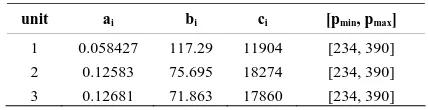
According to paper [16] the characteristic coefficient of gas consumption function and bound constraints are shown in Table 1.
Take total load demand =491 MW on July 25, 2007 as an example. The food consistence function is described as follow.
3 3
2
1 1
[ i i( )i ( i i D
i i
g U f P C U P P
) ] (9)The units in operation are just 1# and 3#, so
1 3
U U 1, U2 0. Take 100 for the penalty factor C. 2
1 1 1 1
2
3 3 3 3
( ) 0.058427 117.29 11904
( ) 0.12681 75.695 17860
f P P P
f P P P
(10)
[image:3.595.315.529.684.739.2]In this QGA, the size of the population is set to 40; the maximum iteration number is 200. Through the optimi-zation of QGA, when the load of 1# unit is 234.34 MW and 2# unit is 255.94 MW, the maximum value of fitness function reaches-87229.83. The total gas consumption is 85605.81m3N/h.
Table 1. Gas consumption character coefficients and limit of load.
unit ai bi ci [pmin, pmax]
1 2 3
0.058427 0.12583 0.12681
117.29 75.695 71.863
11904 18274 17860
5. Results and Discussions
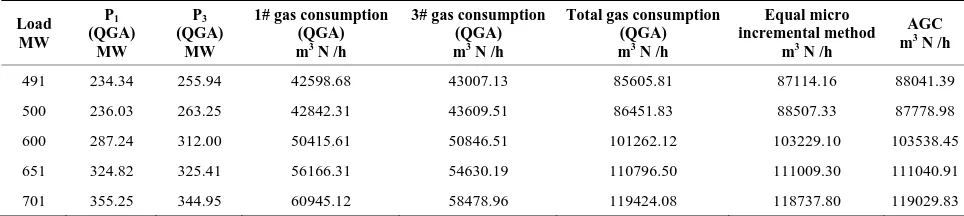
[image:4.595.312.535.273.452.2]Using the foregoing QGA method to optimize the eco-nomic load dispatch problem of GTCC units, the load dispatch results obtained by QGA on October 26, 2007 are compared with those by other methods, as shown in Table 2.
According to the results above, QGA could achieve savings of total gas consumption compared to the equal micro incremental method and AGC instruction. For in-stance, on October 26, 2007, when the total load demand is 500 MW, the load dispatch results of unit 1# and 3# are 236.03 MW and 263.25 MW. The gas consumption is 42842.31 m3N/h and 43609.51 m3N/h respectively. The total gas consumption is 86451.83 m3N/h, which has a reduction of 2055.50 m3N/h compared to equal micro incremental method and 1327.151 m3N/h compared to AGC instruction. It indicates that using QGA to optimize the load dispatch problem of gas turbine units can im-prove the economic efficiency of the units.
When considering the influence of ambient conditions, according to related literature, it can be assumed that
. If the ambient temperature is 25℃, then the maximum limit of unit i is Pimax 372.45MW i1, 3, and the minimum limit of unit i is Pimin 60%Pimax
223.47MW
. Then the load dispatch results are shown in Table 3.
1, 3
i
In Tables 2 and 3 the results of load dispatch optimi-zation are compared. It has shown that there are big dif-ferences in the results considering the influence of am-bient condition or not. For example, when the total load demand is 491 MW, the load dispatch results of the
model with variable constraints are 223.50 MW and 266.80 MW while the results not considering the influ-ence of ambient temperature are 234.34 MW and 255.94 MW. In fact, considering the influence of ambient condi-tions can help to make full use of GTCC units’ output performance in this situation. The process for QGA to optimize the solution of load dispatch model is shown in Figure 1.
6. Conclusions
In this paper, the economic dispatch problem of gas tur-bine comtur-bined-cycle units is proposed and the quantum genetic algorithm is employed on the optimization of the problem.
0 50 100 150 200
-1.15 -1.1 -1.05 -1 -0.95 -0.9 -0.85x 10
5
Number of iteration
B
e
st
f
it
n
ess of
e
a
ch
gen
er
at
io
n
[image:4.595.56.538.491.599.2]Figure 1. Iterative process of QGA.
Table 2. Load dispatch results of 1#,3# by different methods On October 26,2007.
Load MW
P1
(QGA) MW
P3
(QGA) MW
1# gas consumption (QGA) m3 N /h
3# gas consumption (QGA) m3 N /h
Total gas consumption (QGA) m3 N /h
Equal micro incremental method
m3 N /h
AGC m3 N /h
491 234.34 255.94 42598.68 43007.13 85605.81 87114.16 88041.39
500 236.03 263.25 42842.31 43609.51 86451.83 88507.33 87778.98
600 287.24 312.00 50415.61 50846.51 101262.12 103229.10 103538.45
651 324.82 325.41 56166.31 54630.19 110796.50 111009.30 111040.91
[image:4.595.58.536.629.736.2]701 355.25 344.95 60945.12 58478.96 119424.08 118737.80 119029.83
Table 3. Load dispatch results of 1#,3# considering the influence of ambient temperature.
Load MW
P1
(QGA) MW
P3
(QGA) MW
1# gas consumption (QGA) m3 N /h
3# gas consumption (QGA) m3 N /h
Total gas consumption (QGA) m3 N /h
Equal micro incremental method
m3 N /h
AGC m3 N /h
491 223.50 266.80 41412.29 47426.59 83985.02 87114.16 88041.39
500 224.56 274.72 41558.06 48565.27 84757.70 88507.33 87778.98
600 287.97 311.28 50730.95 54028.17 101366.38 103229.10 103538.45
651 326.05 324.18 56697.07 56036.98 110974.87 111009.30 111040.91
On the basis of analyzing the influence of the ambient conditions on the performance of GTCC units, tempera-ture correction factor is used to improve the economic dispatch model.
The optimization results by QGA are compared with those by equal micro incremental method. Almost all the results obtained by QGA in the simulations are better than other methods used in the literature. With QGA method the gas consumptions are significantly reduced. The searching processes show that QGA has good char-acteristics of globally optimization, fast convergent speed robustness for initial values and so on.
The comparison of dispatch models for GTCC units considering and not considering the influence of ambient conditions indicates that it is so necessary to adopt vari-able constraints for the dispatch model of GTCC units.
REFERENCES
[1] T. S. Kim and S. H. Hwang, “Part Load Performance Analysis of Recuperated Gas Turbines Considering En-gine Configuration and Operation Strategy,” Energy, Vol. 31, No. 2-3, 2006, pp. 260-277.
doi:10.1016/j.energy.2005.01.014
[2] S. H. Yousef and Najjar, “Comparison of Performance for Cogeneration Systems Using Single- or Twin-shaft Gas Turbine Engines,” Applied Thermal Engineering, Vol. 17, No. 2, 1997, pp. 113-124.
doi:10.1016/S1359-4311(96)00028-2
[3] B. K. Panigrahi, S. R. Yadav, S. Agrawal and M. K. Ti-wari, “A Clonal Algorithm to Solve Economic Load Dis-patch,” Electric Power Systems Research, Vol. 77, No. 10, 2007, pp. 1381-1389. doi:10.1016/j.epsr.2006.10.007
[4] W.-M. Lin, F.-S. Cheng, M.-T. Tsay, “An Improved Tabu Search for Economic Dispatch with Multiple Minima,” IEEE Transactions on Power System, Vol. 17, No. 1, 2002, pp. 108-112.
doi:10.1109/59.982200
[5] C. Yang, Z. L. Yang and R. X. Cai, “Analytical Method For Evaluation of Gas Turbine Inlet Air Cooling in Com-bined Cycle Power Plant,” Applied Energy, Vol. 86, No. 6, 2009, pp. 848-856.
doi:10.1016/j.apenergy.2008.08.019
[6] C. C. Chuang and D. C. Sue, “Performance Effects of Combined Cycle Power Plant with Variable Condenser Pressure and Loading,” Energy, Vol. 30, 2005, pp.1793-1801. doi:10.1016/j.energy.2004.10.003
[7] D. Sanchez, R. Chacartegui, J. M. Munoz, A. Munoz and T. Sanchez, “Performance Analysis of a Heavy Duty Combined Cycle Power Plant Burning Various Syngas Fuels,” International Journal of Hydrogen Energy, Vol. 35, 2010, pp. 337-345.
doi:10.1016/j.ijhydene.2009.10.080
[8] C. L. Chen and S. C. Wang, “Branch and Bound Sched-uling for Thermal Generating Units,” IEEE Transactions on Energy Conversion, Vol. 8, No. 2, 1993, pp.184-189.
[9] B. H. Chowdhury and S. Rabman, “A Review of Recent 4dvances in Economic Dispatch,” IEEE Transactions on Power Systems, Vol. PWRS-5, No. 4, 1990, pp. 1248-1257. doi:10.1109/59.99376
[10] M. Huneault and F. D. Galiana, “Survey of the Optimal Power Flow Literature,” IEEE Transactions on Power Systems, Vol. PWRS-6, No. 2, 1991, pp. 762-770.
doi:10.1109/59.76723
[11] K. Y. Le, A. Sode-Yome and J. Ho, “Park Adaptive Hop-field Neural Networks for Economic Load Dispatch,” IEEE Transactions on Power Systems, Vol. 13, No. 2, 1998.
[12] R. Naresh, J. Dubey, J. Sharma, “Two Phase Neural Network Based Modeling Framework of Constrained Economic Load Dispatch,” IEE Proceedings-Generation Transmission and Distribution, Vol. 151, No. 3, 2004, pp. 373-378.
[13] C. K. Panigrahi, P. K. Chattopadhyay, R. N. Chakrabarti and M. Basu, “Simulated Annealing Technique for Dy-namic Economic Dispatch,” Electric Power Components and Systems, Vol. 34, No. 5, 2006, pp. 577-586.
doi:10.1080/15325000500360843
[14] J. E. Lansbeny and L. Wozniak, “Adaptive Hydrogenera-tor Governor Tuning with a Genetic Algorithm,” IEEE Paper 93 WM 136-2 EC, presented at the IEEERES 1993 Winter Meeting.
[15] L. S. Coelho, R. C. T. De Souza and V. C. Mariani, “Im-proved Differential Evolution Approach Based on Cul-tural Algorithm and Diversity Measure Applied to Solve Economic Load Dispatch Problems,” Mathematics and Computers Simulation, Vol. 79, No. 10, 2009, pp. 3136-3147. doi:10.1016/j.matcom.2009.03.005
[16] X. G. Peng, C. H. Zhang and X. H. Wang, “Application Research of Optimal Load Dispatch on LNG Power Plant,” Power System Protection and Control, Vol. 38, No. 14, 2010, pp. 84-87.
[17] F. R. P. Arrieta and E. E. S. Lora, “Influence of Ambient Temperature on Combined-cycle Power-plant Perform-ance,” Applied Energy, Vol. 80, No. 3, 2005, pp. 261-272.
doi:10.1016/j.apenergy.2004.04.007
[18] R. Hosseini, A. Beshkani and M. Soltani, “Performance Improvement of Gas Turbines of Fars (Iran) Combined Cycle Power Plant by Intake Air Cooling Using a Media Evaporative Cooler,” Energy Conversion and Manage-ment, Vol. 48, No. 4, 2007, pp. 1055-1064.
doi:10.1016/j.enconman.2006.10.015
[19] C. Yang, Z. L. Yang and R. X. Cai, “Analytical Method For Evaluation of Gas Turbine Inlet air Cooling in Com-bined Cycle Power Plant,” Applied Energy, Vol. 86, No. 6, 2009, pp. 848-856.
doi:10.1016/j.apenergy.2008.08.019
[21] K.-H. Han and J.-H. Kim, “Quantum-inspired Evo-lutionary Algorithm for a Class of Combinatorial Optimization,” IEEE Transactions on Evolutionary
Computation, Vol. 6, No. 6, 2002, pp. 580-593.