Robust Low-Power Algorithm for Random Sensing Matrix
for Wireless ECG Systems Based on Low Sampling-Rate
Approach
Mohammadreza Balouchestani
*, Kaamran Raahemifar, Sridhar krishnan
Electrical and Computer Engineering Department, Ryerson University, Toronto, Canada. Email: [email protected], [email protected], [email protected]
Received April, 2013.
ABSTRACT
The main drawback of current ECG systems is the location-specific nature of the systems due to the use of fixed/wired applications. That is why there is a critical need to improve the current ECG systems to achieve extended patient’s mo-bility and to cover security handling. With this in mind, Compressed Sensing (CS) procedure and the collaboration of Sensing Matrix Selection (SMS) approach are used to provide a robust ultra-low-power approach for normal and ab-normal ECG signals. Our simulation results based on two proposed algorithms illustrate 25% decrease in sampling-rate and a good level of quality for the degree of incoherence between the random measurement and sparsity matrices. The simulation results also confirm that the Binary Toeplitz Matrix (BTM) provides the best compression performance with the highest energy efficiency for random sensing matrix.
Keywords: Sensing Matrix; Power Consumption; Normal and Abnormal ECG Signal; Compressed Sensing; Block Sparse Bayesian learning
1. Introduction
WBANs as a special purpose of Wireless Sensor Net-works (WSNs) consist of tiny Biomedical Wireless Sen-sors (BWSs) and a Gate Way (GW) to connect to the external databases in the hospital and medical centers [1]. The WBANs are expected to be a breakthrough in healthcare areas such as hospital and home care, Mobile Health (MH), Electronic Health (EH), and physical reha-bilitation. The GW could connect the BWSs, to a range of wireless telecommunication networks. These wireless telecommunication networks could be either mobile phone networks, standard telephone networks, dedicated medical center or using public Wireless Local Area Networks (WLANs) nodes also known a Wi-Fi system [2]. The compressed sensing is a revolutionary idea for the acquisition and recovery of sparse signals that enables sampling-rate significantly below the classical Nyquist-rate (NR). The electrocardiogram (ECG) signals are widely used in health care systems because they are noninvasive mechanisms to establish medical diagnosis of heart diseases. The current ECG systems suffer from important limitations: limited patient’s mobility, limited energy, limited on wireless applications. In order to fully exploit the benefits of WBANs such as EH, MH, and Ambulatory Health Monitoring Systems (AHMS) the
be well reconstructed using ℓ1 norm minimization, while
satisfying the Restricted Isomerty Property (RIP) condi-tion for random measurement matrix Φ and orthogonal
Ψ in any domain [6]. Our simulation results based on two proposed algorithms illustrate 25% decrease in sam-pling- rate and a good level of quality for the degree of incoherence between the random measurement and spar-sity matrices. The simulation results also confirm that the Binary Toeplitz Matrix (BTM) provides the best com-pression performance with the highest energy efficiency for random sensing matrix. The structure of this paper is organized as follows: Section 2 gives an overview about CS theory in general and specifically for WBANs. Sec-tion 3 proposes the new algorithm based on combinaSec-tion of CS theory, and SMS approach. The reminder of the paper is categorized in the following way: the simulation results are presented in Section 4. The conclusion is drawn in Section 5.
2. Overview of Compressed Sensing
The conventional sampling approaches have traditionally relied on the Shannon sampling theorem. This theory says a signal must be sampled at least twice its band-width in order to be represented without error. The tradi-tional approaches have two important drawbacks. First, they generate huge samples for many applications with large bandwidth that is not tolerated. Second, even for low signal bandwidths such as ECG signals, they pro-duced a large amount of redundant digital samples. That is why it is desirable to reduce the number of acquired ECG samples by using advantages of the sparsity. The CS theory replaces the conventional sampling and reconstruction operation with a general random linear measurement process and an optimization scheme in order to recover original signal from a small number of random measurements.
2.1. Basic Theorem
The goal in the digital-CS theory as a new sampling scheme is to reduce the load of sampling-rate by de-creasing the number of samples after the Analog to Digi-tal Convertor (ADC) required to completely describe a signal by exploiting its compressibility[7]. An important aspect of CS theory is that the measurements are not point samples but more general linear functions of the signals. Any compressible or sparse signal 𝔻𝔻in ℝNcan be expressed as:
1 N
i i i
D C
=
=
∑
Ψ . (1)The compresses signal
can also be found as:1 1
[ ]
M×= Φ
[ ]
M N×[ ]
D
N× . (2)Thus, the compressed signal is found as:
1 1 1
[ ]M× = Φ[ ]M N× [ ]Ψ N N× [ ]C N× = Θ[ ]M N× [ ]C N× . (3) Fortunately,
[ ]
Φ
and[ ]
Θ
have two interesting and useful properties. First, they are incoherent with the basis[ ]
Ψ
. Second, they have the RIP with high probability where is suitable condition to recover the original signal in the receiver side [8]. Thus, CS scenario has two important steps. First step in CS offers a stable measurement matrix[ ]
ΦM N× to ensure that the salient information in anycompressible signal is not damaged by the dimensionality reduction from D ∈ℝN down toℂ∈ℝM. In the second step, the CS theory offers a reconstruction algorithm under certain condition and enough accuracy to recover original signal D from the compressed signal. Therefore, we can exactly reconstruct the original signal D with high prob-ability via 1 norm by solving the following convex op-
timization problem (
1 n n
s =
∑
s ):
1
min N
s
s∈
subject to = ΦΨS. (4)
There are two important conditions, which guarantee the correctness of this recovery. Firstly, the number of random linear measurements, the number of coefficients, and the number of non-zero coefficients must satisfy the following equation [9]:
/
(log
)
M
≤
K C
N
. (5)Secondly, for any vector
a
of the original signal[ ]
D
matrix[ ]
Φ
must satisfy the following condition for someε
0
:2 2
1
− ≤ Φ
ε
a
/
a
≤ +
1
ε
(6)where satisfies RIP property for the random dictionary matrix. In order to recover K-sparsity of the original sig-nal, now we have
M
×
K
system of linear equations, with M equations and K unknowns. It is possible to find out the K-sparsity of the original signal, because ofM
≥
K
.2.2. Compressed Sensing in WBANs
The CS theory says sparse or compressible signals such as ECG; signals can be well recovered using to minimize
ℓ1 norm optimization, while satisfying the RIP condition
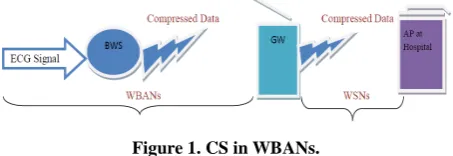
such as K≤ M<<N. As the result, the small number of non-zero coefficients is small; the CS theory can be ap-plied to reduce the load of sampling. Figure 1 illustrates CS theory in WBANs.
Figure 1. CS in WBANs.
As it can be seen the biomedical signals are com-pressed by wireless sensors. The collected comcom-pressed biomedical data are then transmitted wirelessly to Access Points (APs) at hospital, ambulance, and helicopter [10, 11]. The APs recover compressed biomedical data for diagnostic and therapeutic purposes. Furthermore, the D
data vector in WBANs is a sparse vector, because the GW needs to collect only M bits instead of N bits of data
(M≈K– sparse) through the network. In the WBANs with
N wireless sensor, sensor
i
is acquiring a sampled
i of the human body [9]. The final goal in WBANs for medical applications is to collect Data's vector D of N wireless sensors in a suitable basis Ψ= [Ψ1][Ψ2]…[ΨN] like:1
N i i i
D
d
=
=
∑
Ψ
. (7)CS suggests that, under certain conditions, instead of collecting data vector D, we can collect compressed vec-tor
[ ]
= Φ
[ ][ ]
D
where Φ is (K×N) sensing matrix whose entries are i.i.d random variables. In non-CS sce-nario a node is receiving N-1 packets and sends out Npackets ((N-1) received packets plus its data) each packet corresponding to data sample from a node. In WBANs with CS theory the GW needs only to receive M (M≈K-sparse) packets [9]. In order to use CS, each node needs to know the value of Compressed Ratio (CR=N/K) that is constant and value of N [16]. The node i compute
K=N/CR and generate K values Φji (1≤ j ≤k) and creates a
vector Di [Φ1 i, Φ2 i…Φk i], where Di is its own data.
Typ-ically, node i would wait to receive from all its down-stream neighbors. Each received packet carries its index
from 1 to K, so that it can be added to the data already waiting in i with the same index(either locally produced or received from a neighbor). Then node i would send exactly K-Packets corresponding to the aggregated col-umn vectors. Now the difference between CS and non-CS operation becomes clear [10]: CS operation requires each node to send exactly M packets irrespective of what it has received, and each node needs to know CR and N and then computes the value of (M≈K). The received vector in GW
can be written as:
1 1
[ ]
M×= Φ
[ ]
M N×[ ]
D
N× . (8)Consequently, the received vector in GW is a con-densed representation of the sparse events and can be expressed like:
1 11 1 1
1
N
M M MN N
D
D
Φ
Φ
=
Φ
Φ
. (9)
Our simulation results show that by employing the CS the WBANs can achieve a higher transmission, a lower time delay and higher probability of success of data transmission. Therefore, a combination of CS theory to WBANs is an optimal solution for achieving robust WBAN with low sampling rate and power consumption. As it can be seen the biomedical signals are compressed by wireless sensors. The collected compressed biomedical data are then transmitted wirelessly to Access Points (APs) at hospital, ambulance, and helicopter [10, 11]. The APs recover compressed biomedical data for diagnostic and therapeutic purposes.
3. Proposed Approach
To validate the performance of the considered compres-sion schemes three performance measurements are de-fined in this section first. Then, the proposed algorithm for selecting the best fit for random sensing matrix is proposed.
3.1. Performance Measure
The Compression Ratio (CR), the Structural Similarity Index (SSI), and Percentage Root-mean-square Differ-ence (PRD) are employed as performance measures in our approach. The CR is found as follows [12]:
/
100
CR
=
N M
×
, (10)where M and N are the number of random linear mea-surements and number of samples in ECG signals re-spectively. Further, our simulation results indicate that satisfying quality of SR can be achieved when CR does not exceed of 35%. The SSI metric is defined as [13]:
(
/
) 100
SSI
=
D
×
, (11)2 2
(
/
) 100
PRD
=
D
−
D
×
. (12)The value of PRD shows the quality of reconstruction approach. The relationship between the measured PRD
[image:4.595.63.287.252.315.2]and diagnostic distortion is recognized on the weighted diagnostic data for ECG signals, which classifies the dif-ferent values of PRD based on the signal quality obtained by a specialist. Table 1 illustrates the resulting different quality classes and corresponding PRD values. As de-picted in Table 1, lower PRD means better recovery quality.
Table 1. Different Quality Classes.
PRD
Quality of recovery0
1%
Excellent1
2%
Very good2
0.85%
Good0.85%
≥
Poor3.2. Proposed SMS Algorithm
The random measurement matrix
[ ]
Φ
is a key compo-nent of CS theory. Two key features are needed for a successful implementation of CS approach: Sparsity of the biomedical signal and incoherence between the ran-dom sensing matrix and the sparsity basis [15]. That is why; the random sensing matrix must exhibit a high de-gree of incoherence with the sparsity basis[ ]
Ψ
. In this part, the new SMS procedure is presented to select the best fit for the random sensing matrix[ ]
Φ
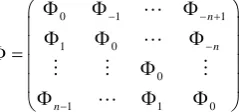
. Herein, Bernoulli Toeplitz, Gaussian Circulant, and Binary Toeplitz ma-trices are examined to find out the best fit for random sensing matrix [16]. The Toeplitz matrix is a matrix in which each descending diagonal from left to right is con-stant. The random sensing matrix in Binary form is ex-pressed as:0 1 1
1 0
0
1 1 0
n
n
n
− − + −
−
Φ Φ Φ
Φ Φ Φ
Φ =
Φ
Φ Φ Φ
(13)
The Circulant matrix is a special kind of Toepliz ma-trix where each row vector is rotated on element to the right relative to the preceding row vector [17]. The ran-dom sensing matrix in Circulant form is illustrated as:
0 1 1
1 0 2
0
1 1 0
n
n
−
−
Φ Φ Φ
Φ Φ Φ
Φ =
Φ
Φ Φ Φ
(14)
In the simulation part, CS approach is applied on the ECG data obtained from MIT-BIH database for three
sensing matrix possibilities: (1) Bernoulli Toeplitz matrix, (2) Gaussion Circulant matrix, and (3) Binary Toeplitz matrix. Our simulation results will further confirm that the Binary Toeplitz matrix shows the best performance for the random sensing matrix
Φ
. Table 2 illustrates our new algorithm to select the best fit for random sensing ma-trixΦ
.Table 2. The best fit for sensing matrix.
Algorithm: The Best Fit for Random Sensing Matrix
Φ
Enter: Raw ECG data
1: Apply Dynamic Thresholding Approach to Raw ECG data
2: Select Initial Square Matrix
3: Apply Row Selection Scheme (select the first M rows as the initial sensing matrix
Φ
)4: Compare with Binary Toeplitz Matrix
5: If
Φ
is Binary Toeplitz Matrix Stop, the Algorithm is completed6: M=M+1
7: Go to Step 4
In the step 1 of the proposed algorithm, the DTA pro-cedure is applied to the raw ECG data. The principal ob-jective of the DTA is to vary the sparsity level of a raw ECG signal to convenient level [18]. In the simulation part, the convenient level is defined 98%. In the step 2, the initial square matrix is used for each of the sensing matrices in the experiments [19]. In the step 3, a Row Selection Scheme (RSS) is applied to reduce the number of rows from N to M [20]. Two RSSs approaches are compared: (1) select first M rows from the initial
N
×
N
matrix, and (2) randomly select M rows from the initialN
×
N
matrix. The first RSS approach de-monstrates better performance than the second RSS ap-proach. So only the first RSS approach is utilized in the proposed algorithm.4. Simulation Results
The following assumptions were made for simulation:
► Experiments are carried out over a 10-minutes ECG signal from MIT-BIH database [21].
► One hundred repletion’s are averaged for our sim u-lation results. To validate the simuu-lation results ECG signals from records 100,107,115 and 117 of MIT-BIH are investigated.
►The mean of ECG blocks is rounded in the sliding
window to the nearest multiple of
2
L, whereL
is the BSBL level [22].►To simulate SNR for ECG signals the following eq-uation is used [23].
10
20 log (0.01 )
SNR= − PRD . (15)
►Three sensing matrix possibilities are examined for
[image:4.595.117.237.531.587.2]matrix [24].
►TheSPARCO toolbox is used for testing sparse re-construction algorithm.
►The SPGL1 (Spectral Projected Gradient for
1mi-nimization) toolbox is used to determine Large-scale one-norm regularized least squares in the following equ-ation:
min 1 N
c
c∈
subject to = ΦD. (16)
►To validate the simulation results, the BPBQ (Basis
Pursuit DeQuantizer) toolbox is used for recovery of sparse signals from quantized random measurements to solve [25]:
arg min 1 N
c
c∈
subject to − ΦDpforp≥2. (17)
►The simulation results were obtained for an input
signal of N=512 samples and a 12-bits resolution for the input signal and the measurement signal
.►To simulate the SMS approach, the DTA framework
[image:5.595.310.535.99.262.2]is used to vary the sparsity level [26].
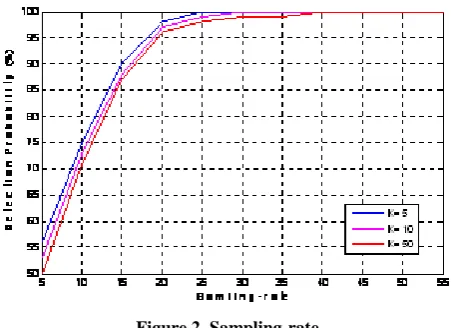
[image:5.595.309.537.296.362.2]Figure 2 illustrates the sampling-rate for random bi-nary matrix with CS theory for different values of non-zero entries
K
for specific records of ECG signals.Figure 2. Sampling-rate.
Based on the results of Figure 2 and suitability of the random binary matrix, the sampling rate can be reduced by 75% of NR without sacrificing the performance. Fig-ure 3 shows simulation results on power consumption for random binary matrix with CS theory in terms of Compressed Ratio (CR) for specific records of ECG sig-nals.
As depicted in the Fig. 3, the power consumption can be reduced by 65% by employing CS theory. Table 3
compares the simulation results on sampling rate and power consumption for random binary matrix with CS theory.
Figure 3. The power consumption.
Table 3. Comparing SR and PC.
N in ECG CR SR PC
1024 10.24 25%*(NR) 30%*(PC in non-CS)
2048 20.48 28%*(NR) 35%*(PC in non-CS)
3074 30.74 32%*(NR) 40%*(PC in non-CS)
Table 2 indicates that satisfying quality on sampling rate and power consumption can be achieved when CR does not exceed of 30.
5. Future Work
We have simulated the benefit of CS to wireless ECG systems for some recodes of ECG signals. Our future work involves developing the CS theory to other records of ECG signal, including abnormal records for wireless ECG systems.
6. Conclusions
[image:5.595.57.283.412.576.2]systems based on CS will be able to deliver healthcare not only to patients in hospital; but also in their homes.
REFERENCES
[1] M. Balouchestani, K. Raahemifar and S. Krishnan, “Low Power Wireless Body Area Networks with Compressed
Sensing Theory,” in Circuits and Systems (MWSCAS), 55th IEEE International Midwest Symposium on, 2012, pp. 916-919.
[2] A. S. Alvarado, C. Lakshminarayan and J. C. Principe, “Time-Based Compression and Classification of Heart-beats,” Biomedical Engineering, IEEE Transactions on, Vol. 59, 2012, pp. 1641-1648.
[3] A. M. R. Dixon, E. G. Allstot, D. Gangopadhyay and D. J. Allstot, “Compressed Sensing System Considerations for ECG and EMG Wireless Biosensors,” Biomedical Cir-cuits and Systems, IEEE Transactions on, Vol. 6, pp.
156-166, 2012
[4] B. H. Tracey and E. L. Miller, “Nonlocal Means Denois-ing of ECG Signals,” Biomedical Engineering, IEEE Transactions on, Vol. 59, No. 9, 2012, pp.
2383-2386
[5] H. Sjoland, J. B. Anderson, C. Bryant, R. Chandra, O. Edfors, A. J. Johansson, N. S. Mazloum, R. Meraji, P. Nilsson, D. Radjen, J. N. Rodrigues, S. M. Y. Sherazi and V. Owall, “A Receiver Architecture for Devices in Wire-less Body Area Networks,” Emerging and Selected Top-ics in Circuits and Systems, IEEE Journal on, Vol. 2,
2012, pp. 82-95
[6] Y. Hamada, K. Takizawa and T. Ikegami, “Highly Relia-ble Wireless Body Area Network Using Error Correcting Codes,” in Radio and Wireless Symposium (RWS),2012, pp. 231-234.
[7] C. A. Chin, G. V. Crosby, T. Ghosh and R. Murimi, “Advances and Challenges of Wireless Body Area Net-works for Healthcare Applications,” in Computing, Net-working and Communications (ICNC), International Conference on,2012, pp. 99-103.
[8] C.-H. Kang, S.-J. Wu and J.-H. Tarng, “A Novel Folded UWB Antenna for Wireless Body Area Network,” An-tennas and Propagation, IEEE Transactions on, Vol. 60,
2012, pp. 1139-1142
[9] T. Bonnici, C. Orphanidou, D. Vallance, A. Darrell and L. Tarassenko, “Testing of Wearable Monitors in a Real-world Hospital Environment: What Lessons can be Learnt?” in Wearable and Implantable Body Sensor Net-works (BSN), Ninth International Conference on, 2012, pp. 79-84.
[10] W. B. Xu, D. H. Wang, K. Niu, Z. Q. He and J. R. Lin, “A Channel Estimation Method Based on Distributed Compressed Sensing and Time-domain Kalman Filtering in OFDM Systems,” in Broadband Network and Multi-media Technology (IC-BNMT), 4th IEEE International Conference on, 2011, pp. 157-161.
[11] S. Atapattu, C. Tellambura and H. Jiang, “Performance of
an Energy Detector over Channels with Both Multipath Fading and Shadowing,” Wireless Communications, IEEE Transactions on, Vol. 9, No. 12, 2010, pp.
3662-3670
[12] H. Su and X. Zhang, “Battery-dynamics Driven Tdma mac Protocols for Wireless Body-area Monitoring Net-works in Healthcare Applications,” Selected Areas in Communications, IEEE Journal on, Vol. 27, No. 4, 2009,
pp. 424-434
[13] M. Balouchestani, K. Raahemifar and S. Krishnan, “Ro-bust Wireless Sensors with Comoressed Sensing Theory,” Communication in Computer and Information Science Journal of Springer, Vol. 293, 2012, pp.
608-619
[14] P. K. Baheti and H. Garudadri, “An Ultra Low Power Pulse Oximeter Sensor Based on Compressed Sensing,” in Wearable and Implantable Body Sensor Networks, BSN 2009. Sixth International Workshop on, 2009, pp. 144-148.
[15] M. Balouchestani, K. Raahemifar and S. Krishnan, “Wireless Body Area Networks with Compressed Sens-ing Theory,” in Complex Medical Engineering (CME), ICME International Conference on,2012, pp. 364-369.
[16] H. Kim, R. F. Yazicioglu, P. Merken, C. Van Hoof and Hoi-Jun Yoo, “ECG Signal Compression and Classifica-tion Algorithm With Quad Level Vector for ECG Holter System,” Information Technology in Biomedicine, IEEE Transactions on,Vol. 14, 2010, pp. 93-100.
[17] S. M. Jadhav, S. L. Nalbalwar and A. Ghatol, “Artificial Neural Network Based Cardiac Arrhythmia Classification Using ECG Signal Data,” Electronics and Information Engineering (ICEIE), International Conference on,2010, pp. V1-228-V1-231.
[18] H. Mamaghanian, N. Khaled, D. Atienza and P. Van-dergheynst, “Compressed Sensing for Real-Time Ener-gy-Efficient ECG Compression on Wireless Body Sensor Nodes,” Biomedical Engineering, IEEE Transactions on, Vol. 58, No. 9, 2011, pp. 2456-2466.
[19] L. F. Polania, R. E. Carrillo, M. Blanco-Velasco and K. E. Barner, “Compressed Sensing Based Method for ECG Compression,” in Acoustics, Speech and Signal Processing (ICASSP), IEEE International Conference on, 2011, pp. 761-764.
[20] W. Dullaert, H. Rogier, L. De Camillis and T. Dhaene, "Improving Link Quality of UWB Communication Links by Means of PSWF-basis Persuit Denoising,” in Antennas and Propagation in Wireless Communications (APWC), IEEE-APS Topical Conference on, 2011, pp. 126-129.
[21] K. Kanoun, H. Mamaghanian, N. Khaled and D. Atienza, “A Real-time Compressed Sensing-based Personal Elec-trocardiogram Monitoring System,” in Design, Automa-tion & Test in Europe Conference & ExhibiAutoma-tion (DATE), 2011, pp. 1-6.
[23] A. M. R. Dixon, E. G. Allstot, A. Y. Chen, D. Gango-padhyay and D. J. Allstot, “Compressed Sensing Recon-struction: Comparative Study with Applications to ECG Bio-signals,” in Circuits and Systems (ISCAS), 2011 IEEE International Symposium on, 2011, pp. 805-808.
[24] L. F. Polania, R. E. Carrillo, M. Blanco-Velasco and K. E. Barner, “Compressive Sensing for ECG Signals in the Presence of Electromyographic Noise,” in Bioengineering Conference (NEBEC), 38th Annual Northeast, 2012, pp. 295-296.
[25] H. Mamaghanian, N. Khaled, D. Atienza and P. Van-dergheynst, “Compressed Sensing for Real-Time Ener-gy-Efficient ECG Compression on Wireless Body Sensor Nodes,” Biomedical Engineering, IEEE Transactions on,
Vol. 58, 2011, pp. 2456-2466.
[26] P. Karthikeyan, M. Murugappan and S. Yaacob, “ECG Signals Based Mental Stress Assessment Using Wavelet Transform,” in Control System, Computing and Engi-neering (ICCSCE), IEEE International Conference on, 2011, pp. 258-262.
[27] A. Chacko and S. Ari, “Denoising of ECG Signals Using Empirical Mode Decomposition Based Technique,” in Advances in Engineering, Science and Management (ICAESM), International Conference on,2012, pp. 6-9.