International Journal of Emerging Technology and Advanced Engineering
Website: www.ijetae.com (ISSN 2250-2459, ISO 9001:2008 Certified Journal, Volume 5, Issue 5, May 2015)
65
MDS-WLAN: Maximal Data Security in WLAN for Resisting
Potential Threats
Latha P.H
1, Vasantha R
21
Asst. Prof: Dept. of Information Science & Engg. Atria Institute of Technology Bangalore, India 2Prof.: Dept. of Information Science & Engg. Sambhram Institute of Technology, Bangalore, India
Abstract— Providing the utmost security standards over
Wireless Local Area Network (WLAN) is still an unsolved answer in research community as well as among the commercial users. There are various prior attempts in proposing security of WLAN, however, the solution lacks focus on access point and is found to be quite complex implementation of cryptography. Such inclusion of techniques results in impractical solutions with least focus on the performance. Hence, the proposed paper presents a novel, simple, and yet robust technique called as MDS-WLAN i.e. maximal data security in WLAN. The system is evaluated over laboratory prototype and mitigation measures are drawn for resisting wormhole attack, Sybil attack, and rogue access point issue in WLAN. The outcome of the MDS is compared with conventional AES and SHA to find optimal communication performance and highest data security.
Keywords—Data security, Cryptography,Key management,
Security protocol, Wireless Local Area Network
I. INTRODUCTION
A WLAN is a distribution process for two or more devices that utilize high frequency radio waves and frequently incorporate a right to gain access point to the Internet. Current implementations of WLANS reach from small in home systems to extensive, campus sized ones to totally mobile networks on planes and trains. Users can get to the Internet from WLAN hotspots inside restaurants, lodgings, along with at the present with compact access that associate with 3G or 4G systems. The increase in accessibility have shaped security holes for hackers and cheats to mishandle, that is at long last being tended to by stronger security protocols and these security protocols incorporate WEP Wired Equivalent Privacy, WPA Wi-Fi Protected Access and 802.11i (WPA2). WEP is a weak security standard [1]. The secret key it uses can frequently be split shortly with a fundamental Smart phone generally from available software tools. Wired Equivalent Privacy is an old IEEE 802.11 standard which is outdated through Wi-Fi Protected Access or WPA. WPA was a speedy option to enhance security over WEP. Wireless networks are more defenseless to attacks due to their imparted physical medium, open transmission of radio frequencies.
International Journal of Emerging Technology and Advanced Engineering
Website: www.ijetae.com (ISSN 2250-2459, ISO 9001:2008 Certified Journal, Volume 5, Issue 5, May 2015)
66
However, still the solution towards optimal security in WLAN is unsolved till date. Hence, the proposed system introduces a multilayered security technique to secure data communication in WLAN. Section 2 discusses about the security aspects of WLAN followed by Section 3 that discusses about the prior research technique. Section 4 discusses about the problems that have been identified to be addressed in proposed study. Section 5 discusses about proposed system followed by design principle in Section 6. Implementation of algorithms is discussed in Section 7, while results are discussed in Section 8. Finally section 9 discusses about conclusion of this paper.II. SECURITY IN WLAN
Security is an important attention when arranging, outlining, actualizing, and dealing with any system network This is mainly valid for WLANS, which exhibit a remarkable set of difficulties to IT and security experts. In spite of the run of the mill issues in a new system by implementing the innovations and motivating the incompatibilities and continuous assist issues, non-secure remote LANS can uncover an association's system traffic and assets to an unapproved outsider. Security Key is a component which can be either numeric or non-numeric, which when connected to a given message brings about an encoded message. Key can be certainly or clearly taken from plaintext. Verifiable key induction is otherwise called auto keying, where the inferred key is a piece of the plaintext. Express key or individual key is a key that is not a piece of the plaintext. The step in key includes the distribution, cancellation, initialization, agreement. There numerous security key methodology and conventions are acquainted for the lack of security in WLAN, some of them are
Secret Key Approach: In secret key verification
techniques, the AS Authentication Server and the customer have the same secrecy and create trust by demonstrating to one another the information of the imparted to the secret key. This preference is particularly paramount in WLANS on the grounds that numerous wireless devices, for example, PDAs and portable VOIP telephones, have minimal computational power the primary disadvantage in secret key validation conventions get the imparted secret from the client's secret word, and in light of the fact that most clients pick awful passwords, it is simple for the attacker to assemble enough scrambled messages separate the secret key from them, utilizing dictionary attacks.
Lightweight Extensible Authentication Protocol (LEAP):
Leap's verification convention likewise incorporates shared confirmation and makeshift session keys, two of numerous missing features of WEP validation EAP presentation message trades, and the customer and the AS perform MSCHAP challenge-reaction convention, initially created for validating modem clients, to fulfill common confirmation the steps back .LEAP does not secure the customer's identity in light of the fact that the EAP character messages are sent in plaintext
EAP-Transport Layer Security (EAP-TLS): It is focused around a certificate approach, and requires trusted CAS Certification Authorities. TLS is an identical modification of the Secure Socket Layer (SSL) protocol, which was created by Netscape. EAP-TLS stretches out EAP to give corticated-based verification for WLANS. EAPTLS helps common verification between the customer and the AS if the customer likewise has a declaration marked by a CA that the AS trusts. EAP-TLS opposes most attacks, including replay and man-in the- center attacks. EAP-TLS additionally infers an every session key between the AP and the customer after effective TLS confirmation. There are a few impediments of TLS, EAP TLS does not give an approach to verify customers who don't have an authentication that are marked by the CAs that the AS trusts.
Id-Based (ID-Based) Cryptography: ID-based
cryptography exploits open key verification without the difficulty of declarations. ID-based cryptography is a type of open key encryption for which the general population key can be one's email address or any self-assertive string the person who holds the related private key ID-based cryptography can facilitate the disavowal of open keys by utilizing these open key strings that incorporate close date. Additionally, incorporating genuine appointed rights in the general population key strings can unscramble the designation process.
International Journal of Emerging Technology and Advanced Engineering
Website: www.ijetae.com (ISSN 2250-2459, ISO 9001:2008 Certified Journal, Volume 5, Issue 5, May 2015)
67
The Beller-Yacobi protocol: adds a test to address the replay issue in the past protocols. The reason behind why this calculation is favored is that the digital signature is utilized on the test at the mobile and mark can generally be executed before picking the message to be marked, i.e., the mobile can do the greater part of the work when unmoving. Aziz and
Diffie's Protocol: The Aziz and Diffie convention utilizes both open key and secret key cryptography procedures. General society key cryptography gives the intends to session key setup and confirmation. Secret key cryptography is utilized to give security to mass information transmission.
Yacobi and Shmuely (YS) Protocol: :it is intended for WLAN in 1989 this convention gives security for link Confirmation is not escrowed on any gathering framework. Shortcomings of this convention are Martin and Mitchell's old key reuse attack, Boyd and Park's no signature impact attack and disguising attack of mobile or base to speak with different parts
Park's Protocol: Compared with the Yacobi Shmuely Protocol in which both the mobile host and the base station need to do two exponentiation operations, this Protocol require the portable M to perform one and only exponentiation operation, which makes it more suitable for key foundation in remote situations .[6]
III. RELATED WORK
The paper was conducted by Georgios Kambourakis et al.[7] the author concentrate on quality declarations, which are of real vitality for client authorization They stress on the vital public key framework joining which obliges least changes in 3G center system components and signaling and give a rundown of the potential threats , which can be recognized in an apparent sending. Their trial assessment of the execution of two option test bed scenarios, demonstrates that computerized authentications technology is not just possible to actualize in present and future heterogeneous mobile systems. The work was introduced by Anand Balachandran et al. [8]observed that the mobile computing scene has changed both regarding number and kind of hotspot venues, there are a few innovative and arrangement difficulties staying before hotspots can turn into an universal framework. These difficulties incorporate as verification, security, scope, administration, area administrations, charging, and interoperability. They talk about existing research, the work of principles bodies, and the knowledge of hot spot suppliers in these territories, and afterward portray convincing open research addresses that remain.
The paper was demonstrated by S. Mohanty et al .[9] they proposed a novel 3g/WLAN coordinated building design utilizing the outsider, Network Inter-working Agent (NIA), to coordinate 3G and WLANS of diverse suppliers. The proposed building design does not necessitate the presence of immediate SLAS among the system suppliers. Subsequently it is adaptable. They created a novel algorithm by utilizing the idea dynamic boundary area to backing consistent ISHO between the 3G and WLAN. Execution assessment demonstrates that the proposed limit territory based ISHO algorithm beats the current WLAN ISHO and 3G algorithm.
International Journal of Emerging Technology and Advanced Engineering
Website: www.ijetae.com (ISSN 2250-2459, ISO 9001:2008 Certified Journal, Volume 5, Issue 5, May 2015)
68
They introduced an attack next to the Michael message respectability code. permits an attacker in the direction of rearrange the interior MIC condition in addition to expanding on top of that, connecting a known message by means of an obscure communication maintenance the obscure MIC substantial for the new complete packet focused around ,and they portrayed the decode all activity towards the customer. The paper was led by Nidal Tura Bet al. [15] they present a suggestions guide for remote LAN security. Security of the remote system is a vital issue, on the grounds that the transmission media is open. They created aide for the security purposes, security protocols begins by choosing the system size relying upon the number of the computers of on the system; each one system size (little, medium and substantial) has diverse arrangements for security. The work was reconsidered by I. P. Mavridis et al .[16] they concentrating on three principle security conventions WEP, and WPA2, WPA .They talked about and displayed in detail an analytical method towards WEP and WPA2 cracking from genuine circumstances. They study delineated that any remote system may be experiencing effective hacking endeavors, in the event that it is not deliberately setup and secured. The paper was given by Tsubasa TSUKAUNE et al. [17] they proposed a protected WEP operation next to key recuperation attacks. Furthermore they proposed strategy require intended for attackers no less than 100,000 packets to recuperate the WEP key. Moreover the hypothetically evaluate technique to work a protected WEP correspondence. The work was conducted by Vipin Poddar et al. [18] they directed an investigation of WEP, and WPA2, WPA. They have attempted in the direction of carry out and make sure validation of each of the protocols by inferring the legendary attack vector script by Air break set of apparatuses. The examination is directed on Back Track working framework which is considered as devoted pretesting working framework. In the test outcome, they discovered that WEP is the weakest, to which WPA was a makeshift arrangement and WPA2 is an exceptionally strong and long team arrangement. The paper was discussed by Ajah Ifeyinwa et al. [19] they comprehensively assessed different improved protocols proposed to comprehend WEP connected confirmation, secrecy and respectability issues. The author discovered that quality of every arrangement relies on upon how fit the encryption, confirmation and respectability strategies work. The work proposed is by utilizing a Defense in Depth Strategy and joining of biometric in 802.11i.Exhaustive inside and out relative investigation of every of the security instruments are determined by survey of related work in WLAN security arrangements.
IV. PROBLEM IDENTIFICATION
The identified problems of the proposed study are as follows:
Security protocols: The resiliencies of the existing security protocols are highly questionable in area of WLAN. Still there is a prevalence of using WPA and WEP as the core security technique in access point. It is already known that both of them are potential vulnerable for various lethal attacks particularly wormhole attack and Sybil attack, where identities and routes are easy to be compromised.
Role of Access Point: Majority of the existing protocols discussed in prior section (Section III) discusses about security techniques on the client’s machine. The role of access point is not that much emphasized. It is noticed that access point is considered as mere a router to help in communication of the nodes present in WLAN. It should be known that access point in WLAN is the most vulnerable point as all the data transact through it and it is also responsible for authenticating and authorizing other nodes. Hence, existing studies focuses only on physical level security and not on application or network layer security. Hence, there is an emergent need of multilayered security technique to secure data in WLAN. Selection of Encryption Standard:It was seen that SHA
is the most frequently used cryptographic technique in WLAN, which is followed by AES. There is no doubt that SHA as well as AES has potential merit factor as an encryption standards in WLAN, but there are certain pitfalls too. SHA is computationally slow and yield larger hash size, where AES design is quite complex. However, AES supports faster processing in hardware and hence a slight modification in AES could solve the issues of encryption.
International Journal of Emerging Technology and Advanced Engineering
Website: www.ijetae.com (ISSN 2250-2459, ISO 9001:2008 Certified Journal, Volume 5, Issue 5, May 2015)
69
V. PROPOSED MODEL
The prime aim of the proposed study is to incorporate maximum level of security to the data that are being transacted through various WLAN routers. The proposed model is an extension of our prior model SAKGP (Secured Authentication of Key Generation Protocol) in WLAN [20]. SAKGP have introduced a unique technique for ensuring the authentication of bidirectional nature with an aid of mathematical model. SAKGP also adopts the latest version of cryptographic hash function (SHA-3), that was never tried before. The prime reasons for choosing to incorporate further security measures on SAKGP are as below:
SAKGP ensure robust authentication between the WLAN router and client. It is also required to incorporate further security measures to improve data security.
SAKGP is more inclined for accomplishing confidentiality; however there is also a need to ensure privacy, integrity, and non-repudiation towards data security.
SAKGP was more inclined to mitigate problems of rogue access point; however, there are various types of lethal attacks e.g. wormhole attack, Sybil attack etc. which tampers the identities of node and illegitimately access the user’s peripherals of WLAN.
Hence, owing to above reasons, it is deliberately felt that SAKGP should be further revised to incorporate the optimal data security after the authentication being performed in WLAN environment. The proposed system is coined as MDS-WLAN which stands for Maximal Data Security in WLAN to introduce a most robust, simple, as well as cost effective security techniques to ensure privacy, integrity, and confidentiality against wormhole attack and Sybil attack. The schematic architecture of the proposed system is highlighted in Fig.1
Sender node
Destination Node
Router
Initiation Stage
1 2
Generate 128 bit AES secret key(ki)
3 5
R
e
q
(s
p
lit
-K
e
y
s
)
4
6
M
e
rg
e
k
i+
S
p
li
t
K
e
y
Perform Encryption
7
8
Transmit data
9
Req(Ki) Res(ki)
10
11
R
e
q
(S
p
lit
-k
e
y
s
) Me
rg
e
k
i+
S
p
lit
k
e
y
s
12
Perform Decryption
[image:5.612.328.558.139.325.2]13
Figure 1 Schematic Architecture of MDS
The proposed system targets to accomplish the maximal standards of security with privacy, confidentiality, and non-repudiation using lightweight AES encryption standards. The next section discusses about the design principle of MDS.
VI. DESIGN PRINCIPLE
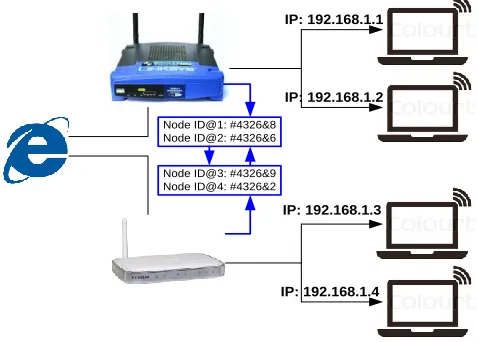
The proposed MDS is designed considered the real-time scenario where WLAN is used like institution, campus, cafeteria etc. Considering multiple access point as well as multiple terminals with some of the latest configurations. The primary components of proposed system are i) Sender node, ii) Receiver node, and iii) access points. The layout of the evaluation of MDS is highlighted in Fig.2
IP: 192.168.1.1
IP: 192.168.1.2
IP: 192.168.1.3
IP: 192.168.1.4
Node ID@1: #4326&8 Node ID@2: #4326&6 Node ID@3: #4326&9 Node ID@4: #4326&2
[image:5.612.324.563.515.686.2]International Journal of Emerging Technology and Advanced Engineering
Website: www.ijetae.com (ISSN 2250-2459, ISO 9001:2008 Certified Journal, Volume 5, Issue 5, May 2015)
70
The primary role of access point is to manage the node identities. Usually, in real-time the node creates its ID in WLAN configuration, but in proposed system, the access point will create a significant node ID that are maintained privately by them and common terminals doesn’t have any sorts of access to such private information. This formulation plays a significant role in data security as well as key management uniquely. For an example, consider about an environment where there are 16 keys being randomly distributed among 16 users, where none of the 16 users knows any information about their neighbor keys. This principle plays a significant role in mitigating wormhole and Sybil attack as the identities of the nodes cannot be compromised. The attacker will have to guess with some complex algorithms to find the location of keys. The common cryptographic technique stores keys in storage, but proposed MDS stores keys in network. Every time the sender node will like to communicate with destination node, access point plays a critical role. Without the access point, no one will able to retrieve the keys from the network. For giving an access to the sender, the access point will require to merge the secret key of sender and response of split keys. Even by default, if the access point is also compromised, the intruder will never be able to guess the location of secret keys or can generate split keys. Hence, the proposed system is also resilient against problem of rogue access point. For incorporating effective design principles, we have designed it in java environment with enrich APIs of networking and cryptography to carry out the proposed study. The proposed study also offers higher level of communication performance due to adoption of AES based encryption. The next section discusses about algorithm implementation.VII. ALGORITHM IMPLEMENTATION
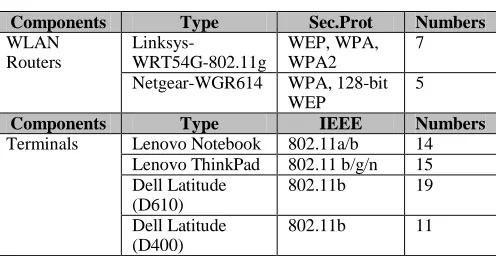
[image:6.612.321.569.154.282.2]The implementation of the proposed MDS-WLAN system is done on real-time test bed. Table 1 highlights the specific configurations of the access points (WLAN routers) as well as terminals used for the testing the proposed protocol. The tabulated information also pertains to the security protocols supported by access points as well as IEEE standards supported by the terminals. The experimentation of the proposed system was done considering all G-based wireless routers.
Table 1
Components used for Experiments
Components Type Sec.Prot Numbers
WLAN Routers
Linksys-WRT54G-802.11g
WEP, WPA, WPA2
7
Netgear-WGR614 WPA, 128-bit WEP
5
Components Type IEEE Numbers
Terminals Lenovo Notebook 802.11a/b 14 Lenovo ThinkPad 802.11 b/g/n 15 Dell Latitude
(D610)
802.11b 19
Dell Latitude (D400)
802.11b 11
International Journal of Emerging Technology and Advanced Engineering
Website: www.ijetae.com (ISSN 2250-2459, ISO 9001:2008 Certified Journal, Volume 5, Issue 5, May 2015)
71
Another unique point to be noted in the design principle of Algorithm-1 is that the secret key can be splitted in only 2 or 16 parts as the minimum size of one block of message occupies around 8 bit to support 128 bit of encryption using AES (so, 8x16=128) (Line-13). We choose to work on AES as this is frequently adopted cryptographic hash function in normal Wi-Fi environment like office, campus, cafeteria etc. After receiving the secret key, the requester node is allowed an access to the network. It is critically important for us to incorporate algorithm-1 to avoid rogue access point as well as for proper identification of legitimate nodes in WLAN environment.Algorithm-1 for Node Activation
Input: request message for authentication (ireq), requester node (i), Access point (router)
Output: Authorization for requester node.
Start
1. Node i request ireq to join the network 2. ireqrouter.
3. Perform authentication 4. If i=1,
5. No authentication 6. Return;
7. If i⩾2,
8. routerhash(sk) //AES secret key 9. u=hash(sk); //sk=Secret key 10. Break;
11. Distribute u to in. //n=total number of nodes 12. Generate Priv(ID)in.
13. Split u to Rand(in) (2<i<16) 14. Activate the node i
End
The proposed system ensures optimal security by adopting a simple and yet cryptographic mechanism considering only three entities source node (is), destination node (id) and access point (router). After the requester nodes (is) obtained activation state the Algorithm-1, it can perform communicated with the destination node (id) using Algorithm-2. According to Algorithm-2, any nodes in the network can initialize a message as a source node to the access point, where the source node will be required to select the IP address of the destination node and this information has to be forwarded to the access point. The prime reason behind this is that access point is a node considered in the network that has secured information about the source and destination nodes. The source node will generate their own 128-bit AES secret key (Line-3 of Algorithm-2) and will send a request message to the access point about the splitted key (Line-4 of Algorithm-2).
The source node will be authenticated by the access point, which upon successful authentication, the access point will retrieve the splitted key from the network (Line-5 of Algorithm-2). Hence, it can be seen that secret keys resides in network and access point can only generate it whenever the request is made by sender node (is).
Algorithm-2 for Maximal Data Security (MDS)
Input: IP address of id,
Output: Successful and Secure data transmission
Start
1. Initialize source node is and destination node id. 2. isString Capture(IP of id) to router
3. is generates ki (size of i=128) 4. isReq(msgsplitkey) to router
5. router validate Req(msgsplitkey) and retrieves Res(msgsplitkey)
6. routervs = cat(ki|| Res(msgsplitkey)) 7. Send vs to is
8. Initiate dual encryption by is 9. is: (ES1=encrypt(ki)) 10. is: (Es2=encrypt(vs)) 11. is transmit data to id.
12. id received encrypted data from is. 13. idReq(ki) to is
14. isRes(ki) to id 15. idReq(vs) to router
16. router authenticated id and retrieve vs from network 17. routervd= cat(vs|| Res(msgsplitkey)) to id
18. Initiate dual encryption by id 19. id: (ES4=encrypt(vd)) 20. id: (ES3=encrypt(ki)) End
International Journal of Emerging Technology and Advanced Engineering
Website: www.ijetae.com (ISSN 2250-2459, ISO 9001:2008 Certified Journal, Volume 5, Issue 5, May 2015)
72
The destination node then request the access point for splitted key (vs) of the source node as it will be always in possession of access point. Upon receiving the request, the access point will perform authentication of the destination node and retrieve source node splitted key from the network. Finally, the access point merges the splitted key (vs) and response and the concatenated outcome (vd) is forwarded as a new splitted key to the destination node from the access point (Line-17 of Algorithm-2). Upon receiving of the splitted key, the destination node also performs dual step decryption process. The first level of decryption process is mechanized by splitted key of source node (Line-19 of Algorithm-2) and the second level of the decryption process is mechanized by secret key of source node (Line-20 of Algorithm-2).VIII. RESULT ANALYSIS
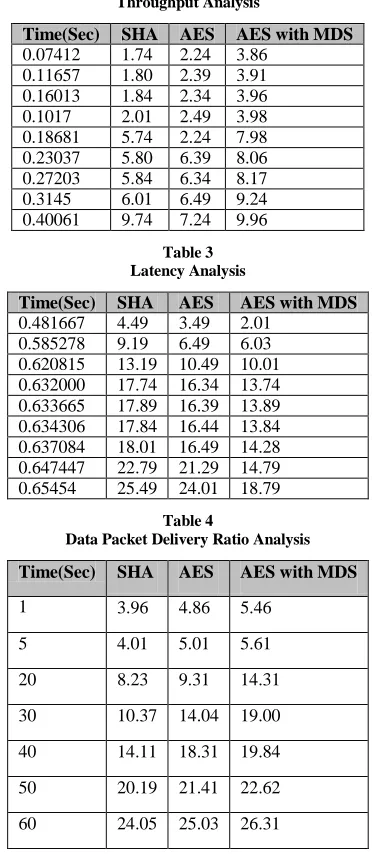
The prime objective of the algorithms discussed in proposed system is to incorporate multilayer security protocol for WLAN under most challenging environment. For the purpose of result analysis, the proposed system has considered to compare with the most frequently adopted cryptographic protocols in WLAN i.e. SHA and AES. Majority of the commercial routers adopts SHA and AES based encryption mechanism and hence, it was a better idea to compare the proposed system that has significant revision for existing AES algorithm too. As seen from the discussion of the prior section on design principles of the algorithm, the proposed system offers a simple and yet a robust protocol for performing encryption as well as decryption. It is known that a typical cryptographic algorithm has various iterative steps and hence it is possible that it can ensure highest level of security. However, ensuring the communication and service relay is another performance factor that also required to be evaluated while framing up cryptographic protocol. Hence, we perform the analysis first by discussion the impact of proposed MDS technique on communication performance to be measured with respect to throughput, latency, and packet delivery ratio. Throughput is evaluated by considering the amount of the data packet being transmitted from the sender to the receiver. Hence, we calculate the throughout by estimating the rate of generation of the keys for validating the user that enables them to forward the data packets with respect to the request being made by the 59 users involved in the experiments. As the proposed system is also focused on integrity of the data packet, packet delivery ratio is computed by amount of the test file that are already received by the destination node to the amount of total files that has been already send by the sender node.
Finally, we evaluate the time required to transmit the data packet by dividing number of bits by rate of data transmission. For better precision in analysis, we have used WireShark [21] that can monitor the real-time data transaction on the experimental test-bed of MDS. All the information is tabulated in Table 2, Table 3, and Table 4.
Table 2 Throughput Analysis
Time(Sec) SHA AES AES with MDS
[image:8.612.350.536.223.650.2]0.07412 1.74 2.24 3.86 0.11657 1.80 2.39 3.91 0.16013 1.84 2.34 3.96 0.1017 2.01 2.49 3.98 0.18681 5.74 2.24 7.98 0.23037 5.80 6.39 8.06 0.27203 5.84 6.34 8.17 0.3145 6.01 6.49 9.24 0.40061 9.74 7.24 9.96
Table 3 Latency Analysis
Time(Sec) SHA AES AES with MDS
0.481667 4.49 3.49 2.01 0.585278 9.19 6.49 6.03 0.620815 13.19 10.49 10.01 0.632000 17.74 16.34 13.74 0.633665 17.89 16.39 13.89 0.634306 17.84 16.44 13.84 0.637084 18.01 16.49 14.28 0.647447 22.79 21.29 14.79 0.65454 25.49 24.01 18.79
Table 4
Data Packet Delivery Ratio Analysis
Time(Sec) SHA AES AES with MDS
1 3.96 4.86 5.46
5 4.01 5.01 5.61
20 8.23 9.31 14.31
30 10.37 14.04 19.00
40 14.11 18.31 19.84
50 20.19 21.41 22.62
60 24.05 25.03 26.31
International Journal of Emerging Technology and Advanced Engineering
Website: www.ijetae.com (ISSN 2250-2459, ISO 9001:2008 Certified Journal, Volume 5, Issue 5, May 2015)
73
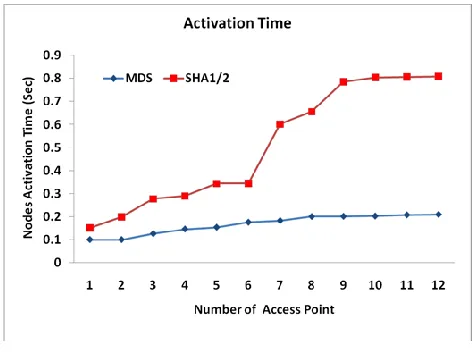
SHA algorithm on the other hand was found to be better alternative for security for AES as it produces long hash value, something which AES cannot produce. Although SHA supports higher security protocols, but it doesn’t support enhance performance in large scale WLAN system in real-time. Table 2 shows that overall throughout perform of AES is found to be always better compared to SHA versions. Moreover, the proposed system revises the structure of AES to generate the split keys in such a way that it has bi-directional nature, it is light weight (128 bit), and supports optimal security on real-time terminals included in our experiment. Hence, better non-repudiation policy can be ensured by the proposed system along with data packet integrity. Table 3 highlights the latency analysis of the proposed system, where the proposed system MDS with AES was found to have reduced latency factor compared to conventional AES and SHA algorithm in cryptography. Hence, the outcome highly encourages the system to be used in more large scales without any fear of compromization by intruder. Table 4 shows the outcome of the packet delivery ratio, where it can be seen that performance of AES with proposed MDS is much better compared to conventional SHA and AES. The above discussed outcomes show the justification of using modified AES to support security in WLAN.Usually the conventional research outcomes on network security is tested for processing time that gives the scale of computational time complexity. However, we choose to perform much extensive analysis by observing the computational time complexity of each phases of algorithm implementation. We choose to study the computational time complexity of the proposed MDS algorithm with respect to
[image:9.612.325.562.135.311.2]i) activation time, ii) validation time, and iii) time required to perform encryption.
Figure 2 Analysis of Activation Time
International Journal of Emerging Technology and Advanced Engineering
Website: www.ijetae.com (ISSN 2250-2459, ISO 9001:2008 Certified Journal, Volume 5, Issue 5, May 2015)
[image:10.612.62.278.189.371.2]74
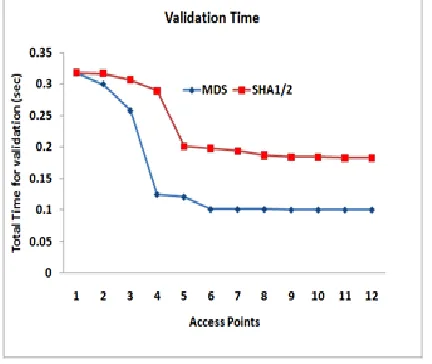
Fig.3 highlights the outcome of the validation time which pertains to operation time of Algorithm-2. Basically, the operation time of Algorithm-2 has two types of steps, one for sender node and other for decryption node.Figure 3 Analysis of Validation Time
In the entire operation of Algorithm-2, the router has to retrieve the secret keys as a response against the request from both sender as well as destination node. This typical case of key management doesn’t require to store the key in any physical device as the key has to be retrieved from the network itself. Therefore, a much reduced storage or memory is required in the entire process of proposed MDS technique. Hence, the validation time significant reduces even compared to SHA1/2 protocol. The outcome significant showcase the evidence of non-repudiation of the proposed system, which is significantly better compared to SHA1/2. Fig.4 shows the time required to perform only encryption of the data packet particularly in Algorithm-2. A closer look into the Algorithm-2 design principle will show that the access point performs concatenation of the key of the sender as well as response message. The similar operation is also carried out in decryption stage, but with reduced dependency of secret key from sender node owing to Algorithm-1. Hence, the encryption time doesn’t have much time consumption for encrypting data with increasing numbers of the user inputs of 16 bits. Hence, on every encryption, the operational steps speeds up by using AES algorithm that runs quite faster compared to SHA1/2 on hardware. Although SHA version supports 160 bits of message, but AES is also scalable to more than 168 bits of message.
[image:10.612.322.576.211.373.2]The 128 bit block size of AES in the proposed system renders the faster encryption mechanism as compared to frequently used SHA versions in cryptographic hash function. Hence, the proposed algorithm not only supports potential security standards but also supports higher communication performance.
Figure 4 Analysis of Encryption Time
IX. CONCLUSION
International Journal of Emerging Technology and Advanced Engineering
Website: www.ijetae.com (ISSN 2250-2459, ISO 9001:2008 Certified Journal, Volume 5, Issue 5, May 2015)
75
REFERENCES[1] Zhang.Y, Zheng.H, Miao Ma IGI “Handbook of Research on
Wireless Security” V.1 Technology & Engineering - 860 pages
[2] Prasad.R, Sudhir Dixit, Van Nee.R, Ojanpera.A Artificial
intelligence “Globalization of Mobile and Wireless
Communications” 2010
[3] Finneran.M Jonathan Fox.D, Finneran .T- Computers” The Privacy
Engineer's Manifesto “2014
[4] Baek, Hyun.k, Sean Smith.W, and Kotz.D "A Survey of WPA and
802.11 i RSN Authentication Protocols." Dartmouth Computer Science Technical Report 2004.
[5] Mukesh .S, Bai.R, Lin.Y, Wang.Y, Yang.W, and Zhang .Q "Key
management protocols for Wireless Networks." Lab for Advanced Networking, Dept of Computer Science, University of Kentucky, Technical Report 2004.
[6] Adarsh.K, and Aggarwa.A. "Survey And Taxonomy Of Key
Management Protocols For Wired And Wireless Networks." International Journal of Network Security & Its Applications Vol. 4, 2012
[7] Georgios .K, Rouskas .A, Gritzalis.S, and Geneiatakis.D. "Support
of subscribers’ certificates in a hybrid WLAN-3G environment." Computer Networks, Vol.11, pp.1843-1859, 2006
[8] 8 Anand.B,Voelker.GM, and Bahl.P. "Wireless hotspots: current
challenges and future directions." Mobile Networks and Applications 10, Vol. 3, pp.265-274, 2005
[9] Mohanty S, "A new architecture for 3G and WLAN integration and
inter-system handover management." Wireless Networks 12, Vol. 6, pp. 733-745.2006
[10] Andrea.B, Handley.M, and Lackey.J. "The final nail in WEP's
coffin." In Security and Privacy,IEEE Symposium on, pp.15,2006.
[11] Changhua .M, John C. "Security Analysis and Improvements for
IEEE 802.11 i." In The 12th Annual Network and Distributed System Security Symposium (NDSS'05) Stanford University, Stanford, pp. 90-110. 2005.
[12] Ondiwa .O, Nashon E. Biermann, and G. Noel. "An integrated
security model for WLAN." In AFRICON, pp. 1-6. IEEE, 2009.
[13] Omar.Y, Youssef.M, and El Gamal..H "ARQ secrecy: From theory
to practice." In Information Theory Workshop, pp. 6-10. IEEE 2009.
[14] Martin.B "Enhanced TKIP michael attacks." 2010.
[15] Scarfone, Karen, and John Padgette. "Guide to Bluetooth security."
NIST Special Publication pp.121,2008
[16] Mavridis, I. P., Androulakis.H, Halkias.B, and Mylonas.ph.
"Real-life paradigms of wireless network security attacks." In Informatics 15th Panhellenic Conference on, pp. 112-116. IEEE, 2011.
[17] Tsubasa .T, Todo.Y, and Morii.M. "Proposal of a Secure WEP
Operation against Existing Key Recovery Attacks and its Evaluation." In Information Security (Asia JCIS), 2012 Seventh Asia Joint Conference on, pp. 25-30. IEEE, 2012.
[18] Vipin.P, and Choudhary.H. "A Comparative Analysis Of Wireless
Security Protocols (Wep And Wpa2)."2014
[19] Ajah .A Ifeyinwa. "Evaluation of Enhanced Security Solutions in
802.11-Based Networks." International Journal of Network Security & Its Applications Vol .4,2014
[20] Latha P.H, Vasantha R, SAKGP: Secure Authentication Key
Generation Protocol in WLAN, International Journal of Computer Applications, Volume 96– No.7, June 2014
[21] https://www.wireshark.org/
[22] Jochen Eisinger, Peter Winterer, Bernd Becker, Securing Wireless
Networks in a University Environment, IEEE, 2005
[23] G. Epiphaniou, Iterative Block Cipher’s effects on Quality of