International Journal of Emerging Technology and Advanced Engineering
Website: www.ijetae.com (ISSN 2250-2459,ISO 9001:2008 Certified Journal, Volume 5, Issue 5, May 2015)
136
To Experimentally Examine the Green Density and Plastic
Deformation of the Fe-Gr-Cr Prepared by Compaction Process
Sunil Kumar Katheria
1, Manvandra Kumar Singh
2 1Research Scholar (M.Tech), Department of Mechanical Engineering, Mewar University, Gangrar, Chittorgarh, Rajasthan-312901(India)
2Department of Mechanical Engineering, IIT (BHU)-Varanasi, Uttar Pradesh-221005(India) Abstract— The aim of the present experiment is to
investigate the green density and plastic deformation of the medium carbon steel alloy (MCSA) of composition Fe-1%Gr-5%Cr. In this study the sample is compacted at 618.935MPa, 663.146MPa, 707.355MPa, 751.565MPa.The compaction process is very critical step in the PM technique because compacted product’s final shape and mechanical properties are highly depends on uniformity of the compacts and green density. The green density was estimated based on the weight and measured dimensions of the pressed parts. The plastic deformation behaviour was examined by the compaction equation proposed by Panelli and AmbrosioFilho.
Keywords-- Green Density, MCSA, Plastic Deformation, Powder Metallurgy
I. INTRODUCTION
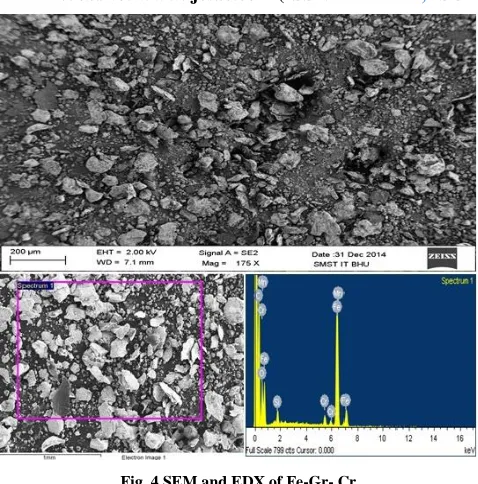
During compaction process different stages have been identified (i) fully elastic behaviour, (ii) Particle sliding, (iii) Particle irreversible deformation [1]. Initial stage of compaction leads to rearrangement of the powder from loose array to close packing. By applying pressure the contact area between the grains increases and particle undergo extensive plastic deformation [2]. Since the compaction process important step in PM technique as it decides the mechanical properties of the specimen due to variation in density with respect to full density. The term green means un-sintered specimen prepared by after compaction process and the density of the specimen prepared after compaction process is called green density. At this stage, the compacts maintain their shape by cold welding and interlocking between the particles [4]. The irregular shape (shown in fig.4) of the powder particles gives efficient cold welding and interlocking between the particles. Compressibility is a measure to which a powder will compress or densify upon application of external pressure.
The compressibility behaviour of pallets can be analysis by using Panelli and Ambrosio Filho equation [3, 6]
Where D= relative density of the compacted material (gm/cm3)
P= applied pressure or Compaction pressure (MPa)
A= plastic deformation or deformation capacity of the powder during compaction process.
B=fitting constant
The parameter A, inclination or slope from the linear plot, provides the plastic deformation capacity of the powder in compaction. Thus as the parameter A increases the powder will undergo more plastic deformation during compaction.
II. EXPERIMENTAL
II.A Alloy Powder preparation:
International Journal of Emerging Technology and Advanced Engineering
Website: www.ijetae.com (ISSN 2250-2459,ISO 9001:2008 Certified Journal, Volume 5, Issue 5, May 2015)
[image:2.612.96.238.134.295.2]137
Fig.1. Low Energy Ball Mill
II. B-Compaction process:
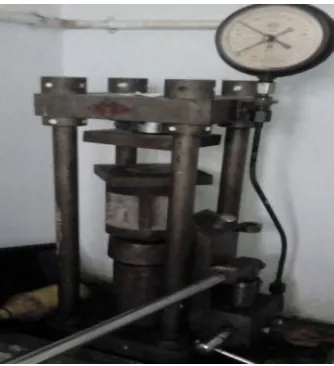
After preparation of alloy composition, next step is the compaction process which is done on compaction machine as shown in Fig. 2 these alloy powders are cold compacted at different pressure of 618.935MPa, 663.146MPa, 707.355MPa, 751.565MPa in a stainless steel closed die having diameter of 12mm without any hindrance. A definite amount of alloy powder taken and poured into the die with its butt inserted at the bottom and then the punch was introduced from top of the die. At this stage, due to cold welding between powder grains, the compacts maintained their shape and finally we get a green compact product.
Fig. 2. Compaction Machine
II. C-Sintering process:
Sintering is one of the major steps of the powder metallurgy it comes after the cold compaction process, the green compact is undergoes for the sintering process, in the sintering process the compact product is kept in a special electric furnace which is continuously circulated with N2/H2 medium at a temperature of 11500 C for 30 minutes.
During sintering process volatile materials evaporates and due to diffusion process the densification of the product start and finally we get highly dense sintered product. The sintered product is shown in Fig.3.
[image:2.612.380.522.274.375.2]
Fig. 3. Fe-Gr- Cr sintered sample
III. RESULT AND DISCUSSION
III. A-Powder morphology analysis:
[image:2.612.85.252.461.644.2]International Journal of Emerging Technology and Advanced Engineering
Website: www.ijetae.com (ISSN 2250-2459,ISO 9001:2008 Certified Journal, Volume 5, Issue 5, May 2015)
[image:3.612.315.574.127.564.2]138
Fig. 4 SEM and EDX of Fe-Gr- Cr
Energy dispersive spectroscopy (EDX) is used to know the how many elements are added in the alloy composition, which justifies our compositions. It is very clear shown in fig-4 in the EDX image the selected area is observed for elements added, the peaks of the added elements is clearly seen which is justifying our composition. The peak of the iron, carbon and chromium are shown very clearly in the Fig.4
III.B-Green density and dimension calculations:
Table 1. Shows the various dimensions like- height of the green compact sample, diameter of the green compact sample of the mild carbon steel alloy of the same composition at different pressures and weight are also calculated. These dimensions help to calculate the volume of the green compact and the green density of the green compact.Table 2. Shows the green densities with respect to the applied pressures since as the weight of the each sample after compaction is not same because of the amount of powder taken was not same so the green density of samples is not in a definite pattern otherwise as the pressure increases the green density increases of the green compact in a pattern. Green density is calculated by the mathematical method like density is equal to mass per unit volume, mass and volume is calculated from table 1 data
Table 1.
Dimensions of Fe-Gr-Cr Sample
Table 2.
Calculated Green Density of MCSA –Fe-Gr-C
Table 3
calculation of Panelli- Ambrosio Equation
Sr. No.
MCSA Sample
Applied Pressure (MPa)
Weight (gm)
Dia. (mm)
Height (mm)
1.
Fe-Gr-Cr
618.935 5.4015 13.11 8.16
2. 618.935 6.2493 13.10 9.41
3. 707.355 5.5011 13.14 8.39
4. 751.565 5.0495 12.56 6.89
Sr. No.
MCSA sample Applied pressure (MPa)
Green density (gm /cm3)
1.
Fe-Gr-Cr
618.935 4.906
2. 663.146 4.929
3. 707.355 4.838
4. 751.565 5.918
Sr. No
.
Applied Pressure (MPa)
Relative Density
Panelli and AmbrosioFilho Equation
1. 618.935 0.625 0.981=A(618.935)1/2+B
2. 663.146 0.627 0.986=A(663.146)
1/2 +B
3. 707.355 0.615 0.988=A(707.355)
1/2 +B
[image:3.612.49.288.128.370.2]International Journal of Emerging Technology and Advanced Engineering
Website: www.ijetae.com (ISSN 2250-2459,ISO 9001:2008 Certified Journal, Volume 5, Issue 5, May 2015)
[image:4.612.52.288.136.308.2]139
Fig. 5-Plot obtained for Panelli-AmbrosioFilho Equation
III. C-Analysis of Plastic deformation (A) parameter:
Panelli and AmbrosioFilho Equation is shown by equation (1) in which all the abbreviation is elaborated. In this equation the deformation parameter (A) is the deformation capacity of the powder during compacting process. The higher value of A shows that material is soft, ductile and tough. From the Fig.5 shows that the graph is almost linearly at 618.935MPa, 663.146MPa, and slightly graph is down at 707.355 (assumed it is linearly) compaction pressure. Initially it is assumed that negligible plastic deformation and energy is dissipated by interparticle friction. But at 751.565MPa compaction pressure the graph is steeply rises due particles interlocking generates plastic deformation, which is first localized at the contact areas between particles[1, 5].
This means that the deformation of the powder particles is not much higher at the pressures less than the 751.565 MPa but at this pressure the plastic deformation of powder particles started at very high rate. And due to this plastic deformation of powder particles there is higher possibility of strain hardening or work hardening at this pressure than the rest of compacted pressure.
III. D-Green density, relative density vs applied pressure analysis:
Green Density of MCSA Samples:
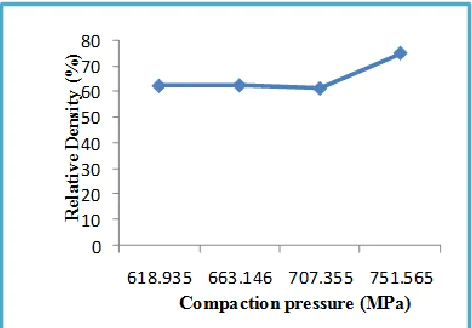
The compaction process important step in PM technique as it decides the mechanical properties of the specimen due to variation in density with respect to full density. The green density was estimated based on the weight and measured dimensions of the pressed parts. From the Fig.6 shows that as the compaction pressure increases the green density also increases due to atoms comes closer and closer and particles size is more effective at filling voids between the particles become less hence green density increases with decrease in volume. Green density is higher at 751.565 MPa compaction pressure than the rest of compaction but there is a little contradiction that as pressure increases the density increases but at 707.355 MPa the green density decreases this is only possible when the proper mixing and blending are not done due to which the powder particles try to resist the relative motion between them as the pressure applied on them, this is the main reason to increase in volume due to the presence of more voids and improper compaction. Fig. 7 shows the plot between relative density and compaction pressure. This figure shows that the rapid increase in relative density at pressure of 751.565MPa is largely due to particle re-arrangement rather than plastic deformation.
Fig. 7-Plot between Relative Density and compaction pressure
[image:4.612.326.562.449.613.2]
International Journal of Emerging Technology and Advanced Engineering
Website: www.ijetae.com (ISSN 2250-2459,ISO 9001:2008 Certified Journal, Volume 5, Issue 5, May 2015)
140
Fig.6. Graph between Applied Pressure and Green Density
IV. CONCLUSIONS
Chromium containing medium carbon steel has been developed using the powder metallurgy (P/M) technique. The following conclusions can be drawn from the present investigation.
1.At compaction pressure, 751.565 MPa the green density is 5.918 gm/cm3. It shows that with increase of compaction pressure the green density increases and hence mechanical properties may be improved. 2.From fig. 5 shows that the at various compaction
pressure the deformation parameter (A) or slope is almost linear or constant but at 751.565MPa the slope is 30˚ (appx.). It shows that the material is not soft ductile in nature but may be brittle in nature.
3.The shape and size of powder particle of alloy is inhomogeneous or irregular due to this the mechanical and other property of the sintered alloy or P/M product is affected like- strength and hardness etc. 4.Relative density of the medium carbon steel alloy is
also affected by the compaction pressure, the relative density is almost same at the pressures less than 751.565 MPa but it increases suddenly when pressure reaches to this value.
5. The deformation parameter (A) effect the mechanical properties of the chromium alloys as plastic deformation increases to a definite limit the mechanical properties like-hardness and strength improves due to the strain hardening or work hardening.
REFERENCES
[1] J.A Lund, Origin of green strength in iron P/M compacts, international journal of powder metallurgy and powder technology 18 (2) (1982) 117-127
[2] I. M moon, J.S Choi, Dependence of green strength on contact area between powder particles for spherical copper powder compacts, Powder Metallurgy 28 (1) (1985) 21-28
[3] Enneti k. Ravi et al. Effect of lubricant on green strength, compressibility, and ejection of parts in die compaction process, powder technology 233 (2013) 22-29, 2012
[4] Dowson Gordan, Whittaker David, introduction to Powder Metallurgy – the process and its product, EPMA, 1992, 2008, page no. 10
[5] H.Lippmann, V.Mannl, R.Iankov, Numerical simulation of density distribution during compaction iron powders, archive of applied mechanics 67 (1991) 191-199
0
1
2
3
4
5
6
7
618.935
663.146
707.355
751.565
G
re
en
D
en
si
ty
(
g
m
/c
m
3
)