
Determination of Λ Cyhalothrin in palm and palm kernel oils using tandem solid phase extraction cartridges
7
0
0
Full text
(2) Journal of Oil Palm Research 24 (April 2012). analytes. In addition, some of the pesticides used are lipid-soluble non-polar compounds which tend to concentrate and remain in the fat or oil despite the various oil processing steps. The matrix also stabilises and protects these pesticides from degradation or oxidation, thus aiding in the persistence of these compounds even at low concentrations for long periods of time. Thus, there is a great need to develop more rigorous extraction and clean-up procedures in order to minimise or, if possible, to completely remove co-extraction of fatty material from the oil sample. In an earlier work by Lentza-Rizos et al. (2001a), a simple low-cost method was developed using low-temperature lipid precipitation for the rapid analysis of virgin olive oil for organophosphorus insecticides and triazine herbicides commonly used in olive groves. The method had a good clean-up step prior to gas chromatography (GC) analysis with nitrogen-phosphorus detection, and the recovery was between 77% and 104% with relative standard deviation (RSD) values of 7%-16%. Later, the same extraction method was used but with the addition of a solid-phase extraction (SPE) clean-up step for the determination of endosulfan and pyrethroid (cypermethrin, deltamethrin, fenvalerate, λ-cyhalothrin, and permethrin) insecticides in virgin olive oil using GC with electron-capture detection (ECD) (LentzaRizos et al., 2001b). Li et al. (2007) proposed an almost similar method of extraction for multiresidue determination of 14 organophosphorus pesticides in soyabean oil, peanut oil and sesame oil by GC with flame photometric detector (FPD). Previous studies in the development of pesticide detection methods in palm oil matrices dealt with organochlorine, organophosphorus compounds, paraquat, glyphosate, deltamethrin, glufosinate ammonium and fluroxypyr. Ainie et al. (1999; 2005) evaluated the feasibility of a method developed by the Imperial Chemical Industry (ICI) for determining paraquat residues in palm oil and palm oil products using an ion exchange column chromatography and a spectrophotometer set at a wavelength of 396 nm. The same authors studied the application of gel permeation chromatography to separate monocrotophos from refined bleached deodorised (RBD) palm olein without preliminary liquid-liquid extraction (Ainie et al., 2000). To date, λ-cyhalothrin has not been investigated. In another study, Yeoh et al. (2006) proposed a method for the determination of acephate, methamidophos and monocrotophos in crude palm oil (CPO) using low-temperature precipitation followed by a SPE clean-up step. In their study, pesticide residues in CPO were extracted with acetonitrile, and a clean-up process was performed by cooling the entire extract below 10ºC, followed by a decolouring process using a carbon black. SPE cartridge. Halimah et al. (1999) worked with chlorpyrifos in refined palm olein using the method adapted from Cloborn et al. (1968) which was developed for the determination of chlorpyrifos in milk and body tissues of cattle. They investigated the suitability of the GC method for the determination of chlorpyrifos in oil samples using both the ECD and FPD detectors. Later, the same authors proposed a comprehensive study on the optimisation of the extraction and clean-up procedures for chlorpyrifos residue in refined bleached deodorised palm olein (RBDPO) using GC with ECD. An improved method for the extraction and clean-up techniques for chlorpyrifos residue from an oil matrix was established after a series of trials (Halimah et al., 2002). A recently published paper dealt with the determination of the herbicide fluroxypyr in CPO and CPKO by high performance liquid chromatography (HPLC) with a diode array detector (Halimah et al., 2008). In this study, the herbicide residue was extracted from palm oil matrices using liquid-liquid extraction, followed by low-temperature precipitation to separate the analyte from the bulk oil matrix. The purpose of this study was to develop a simple, cheap and efficient method of extraction and analysis of λ-cyhalothrin residue in CPO and CPKO based on low-temperature extraction with acetonitrile followed by SPE as a cleanup procedure to obtain the optimal recovery of λ-cyhalothrin in the oil. MATERIALS AND METHODS Chemicals and Materials HPLC-grade acetone and acetonitrile were obtained from Merck. The λ-cyhalothrin standard (>99% purity) was purchased from Dr Ehrenstorfer (Augsburg, Germany). A standard stock solution of λ-cyhalothrin (100 µg ml-1) was prepared by dissolving appropriate amounts of the pesticide standard in acetone, and the solution was then stored in a freezer at -20ºC. Working standard solutions for calibration were prepared by appropriate dilution of the standard stock solution in acetone, and then stored in a refrigerator at 4ºC. Microlitre pipettes, adjustable between 100 and 1000 µl, and pipette tips (Eppendorf, Hamburg, Germany); a SPE vacuum manifold (Supelco Inc., Bellefonte, PA, USA), microvials (Agilent, Palo Alto, CA, USA), a vortex mixer (Barnstead/Thermolyne Inc., Dubuque, IA, USA), graphitised carbon black (GCB) cartridges with a configuration of 500 mg/6 ml (Alltech Inc., Deerfield, IL, USA), and primary secondary amine (PSA) cartridges with a 500 mg/2 ml configuration (International Sorbent Technology, Hengoed, UK) were used in this study. 1304.
(3) DETERMINATION OF -CYHALOTHRIN IN PALM AND PALM KERNEL OILS USING TANDEM SOLID-PHASE EXTRACTION CARTRIDGES. Oil Samples. Recovery Study. CPO and CPKO were obtained from local palm oil mills and palm kernel crushing plants, respectively.. Six replicates were analysed for each of five fortification levels (0.05, 0.08, 0.1, 0.5, and 1 µg g-1) for accuracy and precision assessment. The sensitivity and linearity of the detector response to the analyte were assessed by the calibration curve constructed from a series of six λ-cyhalothrin standards ranging from 0.01 µg ml-1 to 1 µg ml-1.. Extraction and Clean-up Low-temperature precipitation. Samples of 5.0 g homogenous oil (CPO or CPKO) were placed in 50 ml screw cap test tubes. Each sample was spiked with a suitable volume of the working standard solution for the recovery experiment. The spiked samples were mixed using a vortex mixer, and allowed to stand for 30 min to reach equilibration. Acetonitrile (10, 15, and 20 ml) was added to the spiked samples in each tube and the mixtures were shaken for 5 min using a vortex mixer. The oil precipitated to the bottom of the test tubes, and the acetonitrile extract rose to the top. Each tube was stored either horizontally or vertically in a freezer (-20ºC) for 1, 2 or 24 hr for oil precipitation before undergoing the clean-up procedure.. CPO Monitoring CPO samples were obtained from 30 different CPO mills from various parts of Malaysia. Each sample was analysed in triplicate for the presence of λ-cyhalothrin. RESULTS AND DISCUSSION Solvent Extraction and Low-temperature Precipitation As mentioned earlier, the extraction method used in this study is a modification of the method for multi-residue analysis as outlined by LentzaRizos et al. (2001a). The procedure is based on liquid partitioning of the oil with acetonitrile, without the involvement of hexane. In the extraction step, acetonitrile was chosen as the extraction solvent because it is one among a few solvents, including methanol, that is immiscible with oil. To date, acetonitrile is probably the most extensively used solvent for sample extraction of pyrethroids from vegetable oils. Initial experiments showed that variations in the extraction techniques and parameters, e.g. extraction volume, position of the test tube in the freezer, decanting the liquid phase immediately after freezing, and freezing time, generally had little effect on the mean recovery of λ-cyhalothrin. This showed that the method is sufficiently robust for use by inexperienced analysts. Nonetheless, it is very important to optimise the extraction procedure in order to save time and the amount of solvent used. Tables 1 to 3 show the effect on recovery by: (i) the acetonitrile volume, (ii) the freezing time, and (iii) decanting the liquid phase from the precipitated oil after low-temperature precipitation. In the first experiment, different volumes of acetonitrile were used to optimise the extraction procedure. Volume ratios of sample to solvent of 1:2, 1:3 and 1:4 were employed, for which 10, 15 and 20 ml of acetonitrile, respectively, were used for each 5 g oil sample. Recovery for each volume was then calculated to obtain the optimum volume of acetonitrile needed. In this study, fortified CPO samples (0.1 µg g-1) were extracted four times by. Solid-phase extraction clean-up. SPE cartridges were first conditioned with 5 ml acetonitrile. An aliquot (equal to 20% of the original volume) from the upper layer of the acetonitrile extract from the low-temperature extraction step was transferred into the cartridge. The extract was initially allowed to flow under gravity before gentle pressure was applied to achieve a flow of approximately one drop per second. Collection of the eluate into a 10 ml graduated vial was started at this point. The column was then eluted with an additional volume of acetonitrile, and the volume collected was adjusted to 5 ml. The eluate was then ready for GC analysis. Gas Chromatography Extracts were analysed on an Agilent Model 6890 series GC equipped with a 7683 autosampler and ECD set at 280ºC (Agilent Technologies, Palo Alto, CA, USA). A DB-608 column (30 m × 0.25 mm I.D. x 0.25 µm film thickness, Agilent Technologies) was used. Nitrogen was used as both a carrier and the makeup gas, with the carrier gas flow rate set at 1.2 ml min-1. The injection mode was in the splitless mode at 250ºC, and the injection volume was 2.0 µl. The oven was initially set at 100ºC. It was then heated up to 250ºC at 10ºC min-1, followed by an increase to 280ºC at a heating rate of 3ºC min-1, and held at 280ºC for 15 min. Chemstation software was used for instrument control and data analysis. A calibration curve was constructed using six external standards of λ-cyhalothrin in acetone at concentrations of 0.01, 0.05, 0.08, 0.10, 0.50, and 1.00 µg ml-1. 1305.
(4) Journal of Oil Palm Research 24 (April 2012) TABLE 1. RECOVERY OF -CYHALOTHRIN FROM CRUDE PALM OIL OBTAINED BY LOW-TEMPERATURE PRECIPITATION (24 hr, -20°C) AND SOLID-PHASE EXTRACTION (GCB/PSA) CLEAN-UP WITH VARIOUS VOLUMES OF ACETONITRILE (n=4) 0.1 µg g-1 Compound. λ-cyhalothrin. 10 ml. 15 ml. 20 ml. Recovery (%). Relative standard deviation (%). Recovery (%). Relative standard deviation (%). Recovery (%). Relative standard deviation (%). 92.49. 1.62. 89.98. 4.68. 94.63. 3.34. TABLE 2. RECOVERY OF -CYHALOTHRIN FROM CRUDE PALM OIL OBTAINED BY LOW-TEMPERATURE PRECIPITATION (10 ml ACN*, 24 hr, -20°C) AND SOLID-PHASE EXTRACTION (GCB/PSA) CLEAN-UP AT VARIOUS FREEZING TIMES (n=4) 0.1 µg g-1 Compound. λ-cyhalothrin. 1 hr. 2 hr. 24 hr. Recovery (%). Relative standard deviation (%). Recovery (%). Relative standard deviation (%). Recovery (%). Relative standard deviation (%). 95.39. 3.59. 96.68. 1.04. 95.32. 2.61. Note: *acetonitrile.. solvent extraction for 5 min each time with 10, 15 and 20 ml of acetonitrile, followed by lowtemperature precipitation at -20°C for 24 hr. Then, SPE (GCB/PSA) was applied as the clean-up step. Statistical analysis showed no significant differences among the mean recoveries for the CPO samples, and that using different extraction volumes gave almost similar results (Table 1). Consequently, 10 ml was chosen as the minimum volume of the solvent required to extract the analyte from the oil sample. The minimum time needed for the sample to be left in the freezer at -20ºC for fat precipitation was studied. From the recovery table shown in Table 2, all the durations of freezing time that were studied gave acceptable recoveries (70%-120%) for the extraction of λ-cyhalothrin from fortified CPO samples (0.1 µg g-1). The minimum time for satisfactory fat removal during low-temperature precipitation was found to be 2 hr. The third preliminary investigation was on the positioning of the test tubes in the freezer. Initially, test tubes for both CPO and CPKO extraction were placed vertically in a separate beaker during the freezing step, so that the frozen oil precipitated at the bottom of test tubes. However, it was then found that it was better and easier to remove an aliquot of extract from the frozen oil if the test tubes were stored horizontally in the freezer. On removal from the freezer, the test tubes were immediately stood vertically, thus leaving the frozen oil adhering to the test tube wall. Finally, the effect of decanting the liquid phase after the freezing step was investigated. To do this, two different ways of separating the oil from the acetonitrile layer containing λ-cyhalothrin were conducted. The first technique involved the. immediate removal of the acetonitrile layer after the freezing step, while in the second technique, the acetonitrile layer was first decanted into an empty beaker before an aliquot was taken. Table 3 shows that the recovery by both techniques was acceptable (70%-120%). From the statistical data analysis and on the basis of the preliminary test results shown in Tables 1 to 3, the optimised solvent extraction and low-temperature precipitation conditions were identified as follows: 5 g of oil sample (CPO, CPKO) is weighed into a 50-ml screw cap test tube. Then, 10 ml of acetonitrile is added and the mixture is agitated and homogenised using a vortex mixer for 5 min. After homogenisation, the mixture is left to stand for a while to allow phase separation between the lipid and acetonitrile layer. A good separation normally takes about 1-2 min for CPO while a slightly shorter time is needed for CPKO. The test tube is then transferred into the freezer and stored horizontally for a minimum of 2 hr for fat precipitation. After 2 hr of storage, the test tube is carefully removed from the freezer so as not to disturb the precipitated solids. Following this, the tube is stood vertically leaving the frozen oil adhering to the test tube wall. The supernatant is transferred immediately into a small beaker using a Pasteur pipette, leaving the frozen fat in the test tube. The transferred supernatant is left for a while before an aliquot is taken from it for the clean-up step. Solid-phase Extraction Clean-up SPE was selected for the clean-up step because this technique which uses various types of sorbents has been increasingly applied to food analysis as 1306.
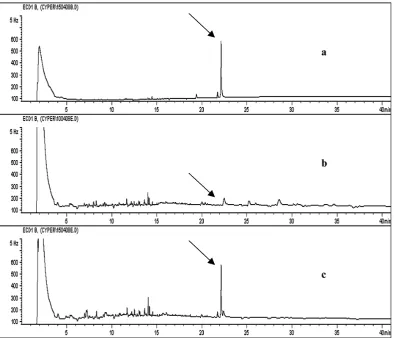
(5) DETERMINATION OF -CYHALOTHRIN IN PALM AND PALM KERNEL OILS USING TANDEM SOLID-PHASE EXTRACTION CARTRIDGES TABLE 3. EFFECT ON RECOVERY OF DECANTING THE LIQUID PHASE AFTER FREEZING OF -CYHALOTHRIN FROM CRUDE PALM OIL (2 hr, -20°C, 10 ml ACN*), n=4 0.1 µg g-1 Decanted. Compound λ-cyhalothrin. In contact with solid. Recovery (%). Relative standard deviation (%). Recovery (%). Relative standard deviation (%). 92.36. 1.33. 93.2. 2.76. Note: *acetonitrile.. TABLE 4. PERCENTAGE RECOVERY OF -CYHALOTHRIN FROM CRUDE PALM OIL (CPO) AND CRUDE PALM KERNEL OIL (CPKO) (n=6) Concentration of -cyhalothrin (µg g-1). CPO. CPKO. Recovery (%). Relative standard deviation (%). Recovery (%). Relative standard deviation (%). 0.05. 97.6. 3.9. 91.1. 4.8. 0.08. 84.8. 6.2. 90.7. 6.8. 0.1. 81.8. 7.6. 94.1. 9.5. 0.5. 92.1. 7.8. 93.7. 4.6. 1. 81.8. 5.2. 86.4. 4.6. an alternative to classical methods. The clean-up efficiency of the optimised method was assessed by determining the amount of oil co-extracted from the samples into the extract. This was done gravimetrically after clean-up using GCB/PSA SPE cartridges. The optimised acetonitrile extraction together with low-temperature precipitation and GCB/PSA SPE clean-up was applied to blank CPO and CPKO samples, i.e. unspiked oil. The vial of the final solution was weighed before addition of the extract. The sample extract obtained after the cleanup step was dried using a N-evaporator to obtain the fat residue. Finally, the fat residues together with the vial were re-weighed for fat residue determination. From the results obtained, the amount of oil co-extracted from the CPO and CPKO samples after the clean-up procedure was found to be 1.7 ± 0.6 mg g-1 (n=6) and 2.7 ± 1.2 mg g-1 (n=6), respectively. These values represented 0.2% and 0.3%, respectively, of the sample mass. The results show that the clean-up step was able to eliminate 99.75% of the lipid, and this is sufficient for the chromatographic system to maintain its separation efficiency for more than 100 sample injections.. 1.0 µg g-1), and six replicates were analysed for each level. Figures 1a, 1b, and 1c show the chromatograms of the standard λ-cyhalothrin solution, the blank sample of CPO and the spiked sample of CPO at a fortification level of 0.1 µg g-1. Figures 2a, 2b and 2c show the chromatograms of standard λ-cyhalothrin, the blank sample of CPKO and the spiked sample of CPKO at a fortification level of 0.1 µg g-1. The retention time for λ-cyhalothrin was 22.1 min. Overall recovery was between 82% and 98% with RSD values of 4%-8% for CPO, and 86%-94% with RSD values of 3%-10% for CPKO. As RSD of λ-cyhalothrin found in both CPO and CPKO were <10%, this indicated the good precision and accuracy of the method. Monitoring Results The developed method was applied to the analysis of λ-cyhalothrin in CPO samples randomly collected from various parts of Malaysia. A total of 30 CPO samples from different mills were analysed using the proposed method, and each sample was analysed in triplicate. Results show that none of these CPO samples contained λ-cyhalothrin.. Method Validation A good linearity was obtained for the six levels of λ-cyhalothrin (0.01 – 1 µg ml-1) spiked into the oil samples. A correlation coefficient of 0.9999 was obtained. The limit of detection (LOD) value of the proposed method was determined at a signal-tonoise ratio (S/N) of 3:1, and was found to be 0.05 µg g-1 for both CPO and CPKO. The results of the recovery studies are given in Table 4 for CPO and CPKO. Samples were fortified at five levels of λ-cyhalothrin (0.05, 0.08, 0.1, 0.5,. CONCLUSION In this study, the applicability of a new method developed by modification of the method proposed by Lentza-Rizos et al. (2001a) using low-temperature precipitation at -20°C and dual SPE (GCB/PSA) cartridges was determined. The method used for extraction of λ-cyhalothrin gave satisfactory recovery with good precision having RSD values of < 10%. As reported in our previous study 1307.
(6) Journal of Oil Palm Research 24 (April 2012). Figure 1. Chromatograms obtained for (a) λ-cyhalothrin standard solution, (b) blank crude palm oil (CPO) sample and (c) spiked CPO sample (0.1 µg g-1).. Figure 2. Chromatograms obtained for (a) λ-cyhalothrin standard solution, (b) blank crude palm kernel oil (CPKO) sample and (c) spiked CPKO sample (0.1 µg g-1).. 1308.
(7) DETERMINATION OF -CYHALOTHRIN IN PALM AND PALM KERNEL OILS USING TANDEM SOLID-PHASE EXTRACTION CARTRIDGES. (Badrul et al., 2009), the method is very robust because variations in the extraction techniques and conditions have little effect on the recovery of λ-cyhalothrin from CPO and CPKO samples. The method was subsequently used for the analysis of CPO samples from various parts of Malaysia, and the results show an absence of λ-cyhalothrin residue in all the samples tested.. HALIMAH, M; OSMAN, H; AINIE, K; TAN, Y A and MD PAUZI, A (1999). Determination of chlorpyrifos in refined palm olein by GC-FPD and GC-ECD. J. Oil Palm Research Vol. 11 No. 2: 89-97. HALIMAH, M; OSMAN, H; MD PAUZI, A; TAN, Y A and AINIE, K (2002). Optimization of extraction and clean-up procedures for chlorpyrifos residue determination in oil matrix. Malaysian Journal of Chemistry, 4: 21-26.. REFERENCES. HALIMAH, M; TAN, Y A and ISMAIL, S (2008). Determination of the herbicide fluroxypyr in oil matrices. J. Environ. Sci. Health, 43: 134-140.. AINIE, K; HAMIRIN KIFLI and TAN YEW AI (2005). Determination of paraquat in edible oil. MPOB Information Series No. 293.. LENTZA-RIZOS, C H; AVRAMIDES, E J and CHERASCO, F (2001a). Low-temperature clean-up method for the determination of organophosphorus insecticides in olive oil. J. Chromatogr. A., 912: 135142.. AINIE, K; KIFLI, H and TAN, Y A (1999). Method for the determination of paraquat residue in oil matrix. J. Oil Palm Research Vol. 11 No. 2: 57-62. AINIE, K; KIFLI, H and TAN, Y A (2000). Gel permeation chromatographic clean-up of organophosphorus pesticide in oil matrix. J. Oil Palm Research Vol. 12 No. 1: 95-101.. LENTZA-RIZOS, C H; AVRAMIDES, E J and VISI, E (2001b). Determination of residues of endosulfan and five pyrethroid insecticides in virgin olive oil using gas chromatography with electron capture detection. J. Chromatogr. A., 921: 297-304.. AINIE, K; TAN, Y A; NORMAN, K and YEOH, C B (2007). Pesticide application in the oil palm plantation. Oil Palm Bulletin No. 54: 52-67.. LI, L; ZHOU, Z; PAN, C; QIAN, C; JIANG, S and LI, F (2007). Determination of organophosphorus pesticides in soybean oil, peanut oil, and sesame seed oil by low-temperature extraction and GCFPD. Chromatographia, 66: 625-629.. BADRUL, H Z; NOR KARTINI, A B and HALIMAH, M (2009). Determination of cypermethrin in palm oil matrices. Eur. J. Lipid Sci. Technol., 111: 10141019.. YEOH, C B; AINIE, K; SELVARAJAN, D; MOHD RIZAL, O; MUHD YUSOF, M N and MOHD RAZALI, M N (2006). Determination of acephate, methamidophos, and monocrotophos in crude palm oil. Eur. J. Lipid Sci. Technol., 108: 960-964.. CLOBORN, H V; BRAZA, M and LEUCK, D B (1968). Dursban determination in milk and tissues of cattle. J. AOAC Int., 52: 1243-1245.. 1309.
(8)
Figure


Related documents
Jesslé, D, Novotný, A: Existence of renormalized weak solutions to the steady equations describing compressible fluids in barotropic regime. Jiang, S, Zhou, CH: Existence of
The construction of ethnic boundaries between majority Sunnis and Syria’s various Arab minorities has given rise to the main source of conflict in the Syrian Civil War.. The
These four methods, comprising three modified silica based commercial kits (Modified Blood, Modified Tissue, Modified Dx kits) and an in-house developed magnetic beads based
Figure 7 Total microbial biomass carbon in irrigation water at 1 and 40 meters from the inflow point at flow rates of 7.5, 15.5, and 21.5 liters per minute; mean inflow value for
Conclusion: There is need for sustained capacity building for the FBOs in order to provide them with knowledge on the pandemic and help them act out the role
Moreover, anxiety rate among hearing- impaired children was significantly reduced after CBT intervention compared to children in control group, suggesting the
An understanding of what nurses actually believe is important to job satisfaction and ultimately to job persistence compared to what hospitals may believe will retain nurses
To measure intracellular fluorescence intensity caused by DOX uptake, the cells were treated with DOX solution or DOX-PEC-NPs for 4 (MDA-MB-231 cells and NCI- H1299 cells) or 20
