International Journal of Emerging Technology and Advanced Engineering
Website: www.ijetae.com (ISSN 2250-2459, ISO 9001:2008 Certified Journal, Volume 4, Issue 9, September 2014)
752
Review on Automatic Number Plate Recognition System
Using Improved Segmentation Method
Bhavin A Patel1, Ashish Singhadia2 1M.Tech (DC) VIT Bhopal, India 2Professor ECE Department, VIT Bhopal, India Abstract- Automatic license plate recognition (ANPR)
system has been intensively studied in many countries. Due to the different types of number plates being used, the requirements of an automatic license plate recognition system are different for each country. In this paper, a number plate localization and recognition system for Indian vehicles. This system is developed based on digital images and can be easily applied to car park systems for the use of documenting access of parking services, secure usage of parking houses and also to prevent car theft issues. Automatic license plate recognition system is to extract vehicle license plate from a digital image. The paper based on a combination of thresolding, labeling, filling up the holes approach method and region props method with area criteria test for the number plate localization. Segmentation of the plate characters was achieved by horizontal and vertical scanning method. The character recognition was accomplished with the aid of optical characters by the process of Template matching. We mainly concrete on three steps: one is to locate the number plate, second is to segment all the number and to identify each number separately, third is recognize each character.
Keywords- Vehicle number plate recognition, Digital image labeling, edge detectors, Region props, character segmentation, optical character recognition
I. INTRODUCTION
Automatic license plate recognition system plays important role in real life applications such as automatic toll collections ,traffic law enforcement, parking lot access control, and road traffic monitoring [1].ANPR recognizes a vehicle‟s plate number from an image by digital camera. It is fulfilled by the combination of a lot of techniques such as image acquisition i.e. capturing the image of real image of plate localizing the license plate character segmentation i.e. locating and identify individual character on the plate, optical character recognition. The recognition problem is generally sub-divided into four parts are Image acquisition i.e. capturing the image of the license plate, Pre-processing the image i.e. localizing the license plate, Character segmentation i.e. locating and identifying the individual symbol image on the plate, Optical character recognition. A guiding parameter in this regard is country-specific traffic norms and structure. This helps to fine tune the system i.e. number of characters in the license plate, text luminance level (relative index i.e. dark text on light background or light text on dark background) etc.
For example, in India the norm is printing the license plate number in black colour on white background for private vehicles and on a yellow background for commercial vehicles. Number plate is a pattern with very high variations of contrast. If the number plates is very similar to the background it‟s difficult to identify the location, Brightness and contrast is changes to it. The morphological operation reused to extract the contrast feature within in the plate [2]. The work is divided into several parts:
1. Input image
2. Input Gray scale/binirazation
3. Reduce the noise using median filtering Method 4. Plate localization
[image:1.595.317.554.429.608.2]5. Character segmentation 6. Character recognition
Figure 1: Block diagram of prposed approach.
1. Input image:
Input image is captured by digital camera.
2. Input Gray scale/binirazation:
Input image has to be converted to 8-bit gray scale value is calculated. And after that Gray scale is converted into binary image by thresolding method.
3. Noise reduction:
We have used median filtering technique to reduce the noise. We have used 3 x 3 masks to get eight neighbors of a pixel and their corresponding gray value.
Input Image Gray Scale
Image
Binary Image
Segmentation of Characters in the
Extracting plate
Character Recognition
License Plate Detection
Displayed of Recognized
Characters
Noise Reduction
International Journal of Emerging Technology and Advanced Engineering
Website: www.ijetae.com (ISSN 2250-2459, ISO 9001:2008 Certified Journal, Volume 4, Issue 9, September 2014)
753
4. Plate Localization:
The basic step in recognition of vehicle number plate is to detect the plate size. In general number plates are rectangular in shape. Hence we have to detect the edges of the rectangular plate [3]. Matlab toolbox function provides a function called region props. It measures a set of properties for each labeled region in the matrix. We used bounding box to measure the properties of the image region. After labeling the connected components, the region will be extracting from the input image.
5. Character Segmentation:
We get individual character and number image by using, vertical and horizontal scanning method,
6. Character Recognition:
Template matching method is used for Character recognition and the resulting data is then used to compare with the records on a database, so as to come up with the specific information [4].
II.SYSTEM MODEL
Image processing is a moving horizon. Walking towards a horizon is open ended. The horizon never gets any closer to you, but recedes from you. It has been with the growth of Image processing, as a technical discipline. Constant progress is being made but the potential is far from exhausted. In the early years of image processing the concern was of basic phenomena, for example, making models for image data compression, image restoration and image enhancement. Currently there is a great in test in moving beyond physical phenomena and into the realms that are wrapped with psychology, perception and cognition. The research in this branch of image processing is called as „Image Understanding‟ [5].
The field of digital-image processing has experienced dramatic growth and increasingly widespread applicability in recent years. Fortunately, advances in computer technology have kept pace with the rapid growth in volume of image data in these and other applications. Fortunately, advances in computer technology have kept pace with the rapid growth in volume of image data in these and other applications. Digital image processing has become economical in many fields of research and in industrial and military applications. Each application has requirement unique from the others, all are concern with faster, cheaper, more accurate and more extensive computation. The trend is toward real-time and interactive operations, where the user of the system obtains preliminary results within a short enough time that the next decision can be made by the human processor without loss of concentration on the task at hand. An example of this is the obtaining of two dimensional computer-aided to morphology images.
The ability to place earth oriented sensor into orbit because of its large economic. Potential has received considerable research emphasis and many operations systems have been evolved. Land and remote sensing has been evolving since 1960s and its various applications in urban land utilization, forestry and food commodity production forecasting has been producing remarkable results. An off shoot sensing by satellites has been the use of this data for military purpose.
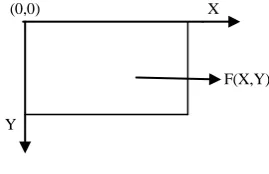
The processing of two-dimensional data, or images, using a digital computer or other special digital hardware typically involves several steps. First, the image to be processed must be put in a format appropriate for digital computing. This image acquisition step cab ne accomplished in number of ways, depending on the application. Then the processing must be performed in order to extract the information of interest from the image. Finally the imagery must be reformatted for human or machine viewing, storage, or hardcopy documentation. FFF extract the information of interest processing must be performed in order to extract the information the image. Finally the image must be reformatted for human or machine viewing, storage or hardcopy documentation. An Image is a 2D array of values representing light intensity. For the purpose of image processing, the term image refers to a digital image. An image is a function of the light intensity.
(0,0) X
F(X,Y)
[image:2.595.361.496.452.539.2]Y
Figure 2: Image Representation
International Journal of Emerging Technology and Advanced Engineering
Website: www.ijetae.com (ISSN 2250-2459, ISO 9001:2008 Certified Journal, Volume 4, Issue 9, September 2014)
754
Pattern Recognition deals with methods for producing either a description of the input picture or an assignment of the picture to a particular class. In a sense, it is the inverse problem of computer graphics. It starts with a picture and transforms it into an abstract description, a set of numbers, string of symbols, etc. Further processing of these forms results in assigning the original picture to one of several classes. An automatic mail sorter that examines the postal code written on an envelope and identifies the digits is a typical example of the application. However, the term „Image Processing‟ should be used as a catch all these activities and in a much broader context with the implicit understanding that the fundamental underlying activity is that of „Information Processing‟.
It is clearly evident that in coming days, much information is going to be represented, and subsequently processed, as digital images, be it X-rays scans, satellite images, video films or whatever. This is no more than a reflection of the fact that our information processing channel with the highest band width, by a long way is the visual one. It is this primary of images in information representations that renders a digression into the possible social impact of information processing.
Image processing is convenient to subdivide different image processing algorithms into broad subclass, there are different for different tasks and problems. Aspects of image processing are image enhancement, image restoration and image segmentation.
Image Enhancement: It is among the simplest and most appealing areas of digital image processing. Basically, the idea behind enhancement techniques is to bring out detail that is obscured, or simply to highlight certain features of interest in an image. A familiar example of enhancement is when we increase the contrast of an image because “it looks better‟‟. It is important to keep in mind that enhancement is a subjective area of image processing.
Image Restoration: It is an area that also deals with improving the appearance of an image. However, unlike enhancement, which is subjective, image restoration is objective, in the sense that restoration techniques tend to be based on mathematical or probabilistic model of image degradation. Enhancement on the other hand, is based on human subjective preferences regarding what constitutes a “good” enhancement result.
Image Segmentation: Segmentation procedures partition an image into its constituent parts or objects. In general, autonomous segmentation is one of the most difficult tasks in digital image processing. A rugged segmentation procedure brings the process a long way toward successful solution of imaging problems that requires objects to be identified individually. On the other hand, weak or erratic segmentation algorithms almost always guarantee eventual failure.
In general, the more accurate the segmentation, the more likely recognition is to succeed.
III. LITERATURE REVIEW
Tran Duc Duan, Tran Le Hong Du, Tran Vinh Phuoc, Nguyen Viet Hoang [6], in this paper, automatic VLP Recognition system, ISee car recognizer, to read Vietnamese VLP‟s registration number at traffic tolls, our system consist of three main modules: VLP detection, plate number segmentation, and plate recognition. In VLP detection module, we propose an efficient boundary line–based method combining the Hough transform and contour algorithm.This method optimizes speed and accuracy in processing images taken from various positions and use horizontal and vertical projection to separate plate numbers in VLP segmentation module. Finally each plate number will be recognized by OCR module implemented by Hidden Markov Model.
Zhen-Xue Chen, Cheng-Yun Liu, Fa-Liang Chang and Guo-You Wang [7], License plate recognition plays an important role in numerous applications, and a number of techniques have been proposed. In this paper, a novel method to recognize license plates is presented. First, the license plates are located using salient features. Then each of the seven characters in license plates is segmented and finally, the character recognizer extracts some salient features of the characters and uses a feature salience classifier to achieve robust recognizer result.
Pramukh Kulkarni, Ashish Khatri, Prateek Banga, Kushal Shah [8] this paper shows that recognizing number plate for Indian condition is considered. Feature-based number plate localization for locating the number plate, Image scissoring for character segmentation and statistical feature extraction for character recognition method used which specially designed for Indian number plates.
Kumar Parasuraman, [9], In this paper, a smart, simple and efficient algorithm which is mainly designed for Indian license plate recognition is presented for vehicle‟s plate recognition system. The proposed algorithm consists of three major parts: Extraction of plate region, segmentation of characters and recognition of plate characters. For extracting the plate region, edge detection algorithm and vertical projection method are used. In segmentation part, filtering, thinning and vertical and horizontal projection are used. And finally, chain code concept with different parameters is used for recognition of the characters.
International Journal of Emerging Technology and Advanced Engineering
Website: www.ijetae.com (ISSN 2250-2459, ISO 9001:2008 Certified Journal, Volume 4, Issue 9, September 2014)
755
The system consists of digital camera, software to interface the camera with software module. Digital camera captures the image and passes it to the software module. The software module analyzes the input image, identifies the location of the license plate, segment the character on it and recognize the character.
The plate region is extracted by using the concept of connected component in the image. The algorithm was implemented in MATLAB and the result obtained agreed with theoretical predictions.
Table: 1
Summary of Literature Review
Year Author Title Approach
Result
Extraction Segmentation Recognition
2010 Rajesh Kannan
Megalingam, Prasanth Krishna, Pratheesh
Somarajan, Vishnu A Pillai, Reswan Ul Hakkim
Extraction of License Plate Region in Automatic License Plate Recognition
Mathematical Morphology, Digital image labeling, Template Matching
%91
2010 Kumar Parasuramn An efficient method
for Indian Vehicle License Plate Extraction and Character Segmentation
Edge detection algorithm, Vertical
Projection, Horizontal Projection, Chain Code Concept
% 98
2009 Prathamesh
Kulkani, Ashish Khatri, Prateek Banga, Kushal Shah
Automatic License-Plate Recognition System for Indian Conditions
Feature-based number plate Localization, Image Scissoring,
Statistical Feature Extraction
%87 %95 %85
2009 Zhen-Xue
Chen-Yun Liu, Fa Liang Chang, and Guo- You Wang
Automatic License-Plate Location and Recognition Based on Feature Salience
Salient Feature and
Feature Salient Classifier %97.3 - %95.7
2005 Tran Duc
Duan,Tran Le Hong Du, Tran Vinh Phuoc, Nguyen Viet Hoang
Building Automatic Vehicle License-Plate Recognition System
Hough transform and Contour algorithm, Vertical and Horizontal Projection, Hidden Morkov Model
%98.2 %97.13 %97.19
IV. CONCULSION
From review of various paper, we conclude that there are different techniques are available for recognition of car number plate. Edge detection detect edges of the plate and fill holes less than 8 pixels only, categorizing features in each stage, identifying and recognizing car license plate.
International Journal of Emerging Technology and Advanced Engineering
Website: www.ijetae.com (ISSN 2250-2459, ISO 9001:2008 Certified Journal, Volume 4, Issue 9, September 2014)
756
REFERENCES
[1] C.-N. E. Anagnostopouls et al, License plate recognition from still
images and video sequence a survey, IEEE trans. Intel. Transp. Syst. Vol. 9, no.3, pp.377-391,2008
[2] P.Anishiya, Prof S.M, Mary Joan, “Number Plate Recognition for
Indian Cars Using Morphological Dilation and Erosion with the
Aid of OCRs”, IACSIT, Vol4, 2011, pp 115-119.
[3] Satadal saha, Subhadip Basu, Mita Nasipuri, Dipak Kumar Basu,
”License Plate Localization from Vehicle Images: An Edge Based Multi-Stage Approach‟‟, IJRTE, Vol 1, 2009
[4] Serkan Ozbay, Ergun Ercelebi, “Automatic Vehicle Identification
by Plate Recognition” , Vol 9, 2005
[5] Phalgun Pandy and deep Singh, “Morphological based Approach
to Recognition Number in India”, IJSCE, Vol1, Issue 3,2011,pp107-112
[6] Tran Duc Duan, Tran Le Hong Du, Tran Vinh Phuoc, Nguyen
Viet Hoan, “Building Automatic Vehicle License-Plate Recognition System” Int. Conf. in Compute. Sci. RIVF, pp. 59-63-,2005
[7] Zhen-Xue Chen-Yun Liu, Fa-Liang Chang, and Guo- You Wang,
“Automatic License-Plate Location and Recognition Based on Feature Salience”, IEEE, 2009
[8] Prathamesh Kulkani, Ashish Khatri, Prateek Banga, Kushal Shah,
“Automatic License-Plate Recognition System for Indian Conditions”, IEEE, 2009
[9] Kumar Parasuraman, “An efficient method for Indian Vehicle
License Plate Extraction and Character Segmentation” IEEE, 2010
[10] Rajesh Kannan Megalingam, Prasanth Krishna, Pratheesh