International Journal of Emerging Technology and Advanced Engineering
Website: www.ijetae.com (ISSN 2250-2459,ISO 9001:2008 Certified Journal, Volume 4, Issue 8, August 2014)
328
Test Methods for Identifying the Susceptibility of Aggregate to
Alkali Silica Reaction (ASR)– An Overview
M. Raja
1, S. K. Jain
2, G. K. Vijh
3, S. L. Gupta
4, Murari Ratnam
51,2
Scientist B, 3Scientist D, 4Scientist E Concrete Division, 5Director, Central Soil and Materials Research Station, HauzKhas, New Delhi, India
Abstract-- Concrete is a mixture of cementitious material, aggregate, and water. Aggregate is commonly considered structural filler (Inert), which occupies 60 to 80 percent of the volume and 70 to 85 percent of the weight of concrete, but its role is more important than what that simple statement implies. Aggregate is a necessary component that defines the concrete’s thermal, elastic properties anddimensional stability. The aggregate mineralogical compositioninfluences durability of the concrete. Hence, this paper discuses about various standards for identifying the deleteriously reactive aggregates, selecting appropriate aggregate for using it in making concrete in new construction and appropriate preventive measures to be taken to minimize the risk of expansion, when such aggregates are used in concrete. Several tests methods have been developed to identify aggregates subject to ASR and mitigation but each has its limitations.
Keywords-- Alkali Aggregate Reaction (ASR), Alkalis, Reactive silica, Moisture
I. INTRODUCTION
Alkali-aggregate reaction has two forms: alkali-silica reaction (ASR) and alkali-carbonate reaction (ACR).ASR is a chemical reaction between the reactive silica contained in the aggregates and the alkalis (Na2O and K2O) within the
cement paste. The reaction product is an alkali-silicate gel that expands when it comes into contact with a sufficient amount of water. If the gel is confined by the cement paste, it builds up pressure as it grows causing internal stresses that eventually leads to serious damage to concrete. ACR occurs in dolomite rocks. In this paper ASR is discussed in detail.
The basic three conditions have to be fulfilled before deleterious ASR occurring. This is illustrated in Fig.1 below:
Fig.1: Necessary components for ASR
II. DIFFERENT TEST METHODS
The phenomena of ASR is complex, and there are many interacting and interdependent parameters that influence its occurrence which still leaves many questions unanswered, however common methods of testing potential reactivity are discussed below:
Field Service Records
The most reliable means to determine the potential ASR susceptibility of aggregates is by verifying the available field service records of the aggregate from the identified quarry used in past construction and its performance in concrete.
International Journal of Emerging Technology and Advanced Engineering
Website: www.ijetae.com (ISSN 2250-2459,ISO 9001:2008 Certified Journal, Volume 4, Issue 8, August 2014)
329
Aggregate having no service records should be tested by adopting fast, desired and reliable test methods in preliminary investigation. Based on preliminary investigation further investigation must be carried out for clear understanding of the ASR of particular quarry. Common Tests to Evaluate Potential Alkali-silica Reactivity of Aggregate
1. Petrographic Examination of Aggregate (ASTM 295/BIS2386,Part-VIII)
This test methoduniversally considered as an essentially first step fordetermine the physical and mineralogical characteristics of aggregate samples with microscopic instruments. The test method is used to describe and classify the constituents of an aggregate, to determine the relative amounts of the constituent in the aggregate, and to compare samples of aggregates from newly selected sources from other well established sources. This test is somewhat subjective in nature since it depends on the relative experience and judgment of the petrographer performing the test. Petrographic examination will not result in a clear identification of materials such as microcrystalline, strained, or micro fractured quartz which can be found in a wide variety of aggregates. These materials are usually present in aggregates that are slowly reactive. However, it is a very effective method of verifying field performance, identifying potentially reactive features in aggregate particles and information obtained from petrographic analysis could help in determining the need for further testingmethod. The knowledge of mineral composition of aggregate will also facilitate interpretation of subsequent test results.
2. Quick Chemical Method (ASTM C 289/BIS2386, Part-VII)
The quick chemical test method consists of reducing the aggregate to 150 - 300 m particles.
These are immersed in 1NNaOH solution at 80oC for 24 hours. The solution is then filtrated and tested to see how much silica was dissolved (Sc) in the solution and also
reduction in alkalinity (Rc) both of which are plotted on a
standard graph defining areas of innocuous, deleterious, and potentially reactive aggregates. Innocuous aggregates show little or no reduction in the alkalinity, or show a very high reduction in the alkalinity accompanied with very little dissolution of silica. This test method has several limitations including its tendency to fail to identify slowly reactive aggregates and to sometimes classify known reactive aggregates as innocuous.
The poor performance of this testing method can be blamed on 1) the interference of minerals such as calcium, magnesium, silicates, gypsum, zeolites, clay minerals, organic matter, or iron oxides and 2) the crushing and preparation of the aggregates especially with aggregates containing microcrystalline quartz. Hence, this method could be best used as a quality control tool once test results are verified by another method since it can identify changes in composition once an aggregate is in use for a project.
3.Mortar Bar Expansion Test (MBT) (ASTM C 227) The positive aspect of this methodis to determine the susceptibility of cement-aggregate combination and it also more closely simulates what might actually happen in concrete. Mortar bars (25x25x285 mm) are cast using 1 part of cement (Na2Oeq> 0.6% preferred) to 2.25 of graded
International Journal of Emerging Technology and Advanced Engineering
Website: www.ijetae.com (ISSN 2250-2459,ISO 9001:2008 Certified Journal, Volume 4, Issue 8, August 2014)
330
This test method has proved to be incapable of predicting the alkali-silica reactivity of slow reactive aggregates namely greywackes and argillites. This test method also fails to distinguish between slowly reacting aggregates and innocuous ones because the test conditions aren’t severe enough or the test would have to be run for several years. The major drawback of this method is wicks create excessive leaching of alkalis out of mortar resulting in expansion reduction. Another disadvantage in this method is reduction of aggregate size (more surface area) in making mortar bars and actual size of aggregate used in field structure are different.Hence, the performance of the test mortar may not be the same as the performance of a field concrete containing the same aggregate. Even though, this test is considered an accurate indicator of a highly-reactive siliceous aggregate’s potential for deleterious reactivity with alkalis in concrete.According to ASTM C 33, the maximum allowable expansion for an aggregate to be considered potentiallynon-reactive is 0.10% at six months or 0.05% at threemonths.
4. Accelerated Mortar Bar Expansion Test (AMBT) (ASTM C 1260)
ASTM C 1260 is apparently becoming the industry standard for identifying reactive aggregates in the early stages of the project. It does not investigate combinations of aggregates with cementitious materials nor does it represent the environments to which aggregates will be subjected in the field. Mortar bars (25x25x285 mm)are cast with the sample aggregate, which is processed to a standard gradation, removed after 24 hours and placed in water at 80oC for next 24 hours. After removal from water bath, the bars are measured for initial length and then stored in a highly alkaline solution 1N NaOH at 80°C. The alkali content of the cement does not affect the expansion in this test method. Expansion is monitored for 14 days, and then final results are used in specifications to assess reactivity. Because of the extreme nature of this (eg: highly alkaline soak solution and high temperature), the test is quite severe and may identify some aggregates as being reactive, even if it has a very good long-term service record.
The sequence of test procedure is as follows:
The aggregates should not be rejected solely based on this test method, if mortar bars exhibit high expansion, it is recommended that more information be gathered about the aggregate using ASTM C 295 to determine whether the expansion is due to alkali-silica reaction. Hence, this method effectively used as screening test in many cases to detect aggregate reactivity very rapidly and also capable of detecting slowly reactive aggregates.Specification requirements for interpretation of the test results are as follows:
• < 0.1% as nonreactive
• 0.1% to 0.2% as potentially reactive • >0.2% as reactive
Sometimes, this method could possibly identify innocuous aggregates based on field performance as potentially deleterious due to the severe alkaline and temperature conditions of the test method in laboratory (false-positive) is more common.
In the case of aggregate suspected of containing deleterious strained quartz false- negative is not common.
5 Concrete Prism Test (CPT) (ASTM C1293)
This final test method appears to be a more reliable since it casts a sample aggregate in an actual concrete mixture and best indicator test for field performance. Small beams (75 mm x75mm x285 mm) of concreteconsisting of cement = 420 ± 10kg/m3, w/c ratio = 0.42 to 0.45 by mass and graded test sample of aggregate materials (ratio of oven-dry-rodded coarse aggregate / volume concrete = 70±0.2 %) are used to castthe test samples. The required amount of alkalis (NaOH) are added to the mixing water to obtain a total alkali content of 1.25 percent Na2Oeq (by mass of
International Journal of Emerging Technology and Advanced Engineering
Website: www.ijetae.com (ISSN 2250-2459,ISO 9001:2008 Certified Journal, Volume 4, Issue 8, August 2014)
331
Conversely, a non-reactive fine aggregate is used to test a potentially reactive coarse aggregate. Expansion is monitored in the same method as in C 1260, but this time for 12 months rather than 14 days, innocuous behaviour isdescribed by having a 12 month expansion less than 0.04 %. When testing combinations of aggregates with
supplementary cementitiousmaterials expansion is monitored at 18 & 24 months and theinnocuous behaviour is described by having a 24 month expansion less than 0.04 %.
This method is considered to be the most accurate measure of reactivity for aggregates and is often used to validate other test methods. The primary advantage of this test method is that all of the materials used in the project concrete mixture are used in their full amounts. It identifies both rapidly reactive aggregates as well as the slower reacting ones, but its main drawback is that the test takes up to one year to complete. The sequence of test procedure is as follows:
6 Determination of Potential Alkali-Silica Reactivity of Combination of Cementitious Materials and Aggregate (Accelerated Mortar Bar Method)(ASTM C 1567)
Recently, ASTM has adopted a version of the mortar bar test for assessing the efficacy of supplementary cementing materials (SCMs) in preventing ASR-induced expansion. This test (ASTM C1567) is similar in nature to ASTM C 1260, with the exception that the SCM of interest is used in lieu of a portion of the Portland cement. It is anticipated, based on recent ASTM deliberations, that the expansion limit for this test will also be a 14-day value of 0.10 percent. The main objective of using the accelerated mortar bar test for evaluating SCMs is to determine the required dosage of a given SCM needed to control ASR in field concrete.
III. METHODS OF MITIGATION
The following techniques are adopted
Use of non-reactive aggregate
Use of low-alkali cement
Limit alkali content of concrete
Use of supplementary cementing materials
Use of suitable chemical admixtures
IV. PRESENT STUDY
International Journal of Emerging Technology and Advanced Engineering
Website: www.ijetae.com (ISSN 2250-2459,ISO 9001:2008 Certified Journal, Volume 4, Issue 8, August 2014)
[image:5.612.87.538.127.505.2]332
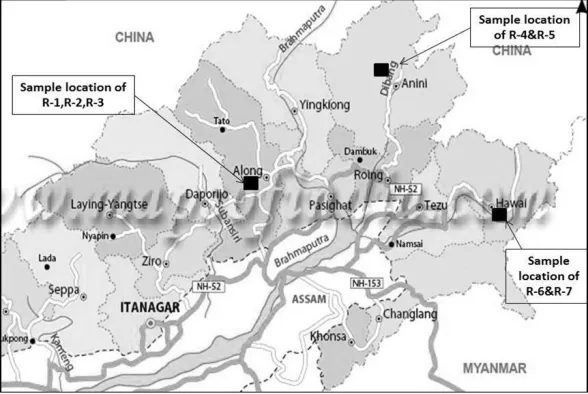
Fig.2: Sample locations of R-1, R-2, R-3, R-4, R-5, R-6&R-7 Table 1
Rock type and sources
ID Rock Type River Basin Type of Source Location
R1 Gneiss Siyom RBM Arunachal Pradesh
R2 Garnet Gneiss Siyom RBM Arunachal Pradesh
R3 Schist Gongri (Gang) RBM Arunachal Pradesh
R4 Garnet Schist Dihang/Dibang RBM Arunachal Pradesh
R5 Granodioritic Gneiss Dihang/Dibang Muck material Arunachal Pradesh
R6 Granodiorite Lohit Rock Quarry Arunachal Pradesh
R7 Granite Lohit RBM Arunachal Pradesh
All these samples were investigated in detail for mineralogy for finding the presence harmful ASR reactive minerals and also percentage of strain quartz and
undulatory extinction angle (UAE), also called as undulose or strain extinction. The details of seven samples are presented in Table 2:
Table 2:
Mineralogical composition of aggregate samples
ID Rock Type Strain
Quartz
UAE Quartz Feldspar Biotite Moscovite Iron
Oxide
R1 Gneiss 59-67 24-32 40-46 21-27 11-17 4-9 2-5
R2 Garnet Gneiss 74-80 28-35 30-36 22-30 8-13 6-9 2-5
R3 Schist 50-56 35-46 45-52 22-26 5-9 5-11 1-3
R4 Garnet Schist 75-85 35-42 35-40 25-30 5-10 - -
R5 Granodioritic Gneiss 82-90 35-40 25-30 35-40 8-15 - -
R6 Granodiorite 15-25 20-35 38-45 31-39 7-11 14-23 4-5
R7 Granite 60-80 10-15 65-74 15-20 2-3 6-7 -
# Minimum and maximum value of a set of three samples are given
These same samples were tested for chemical method for quick understanding of the reactiveness of the aggregate.
[image:5.612.159.453.136.333.2]International Journal of Emerging Technology and Advanced Engineering
Website: www.ijetae.com (ISSN 2250-2459,ISO 9001:2008 Certified Journal, Volume 4, Issue 8, August 2014)
[image:6.612.123.491.157.307.2]333
Table 3:
Silica dissolved and reduction in alkalinity of rock samples
ID Rock Type Silica
dissolved (Sc)
Milli moles/litre
Reduction in alkalinity
(Rc)
Milli moles/litre
Reactivity
R1 Gneiss 14.5 53.5 Innocuous
R2 Garnet Gneiss 25.0 128.3 Innocuous
R3 Schist 38.3 75.0 Innocuous
R4 Garnet Schist 16.5 103.8 Innocuous
R5 Granodioritic Gneiss 16.0 180.5 Innocuous
R6 Granodiorite 32.0 110.5 Innocuous
R7 Granite 24.5 105.5 Innocuous
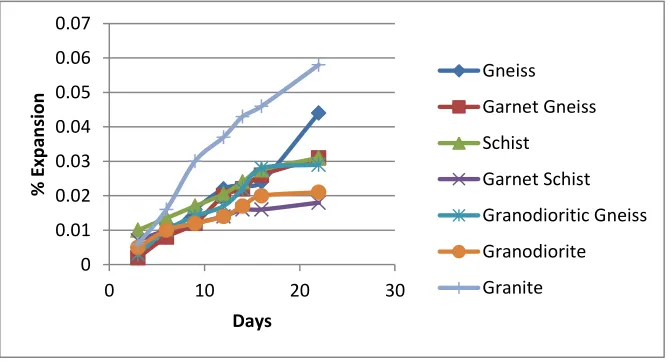
Even after petrographic and chemical method investigation, all samples wereinvestigated by adopting test procedure as per ASTM C1260 as confirmatory test because of the presence of reactive strain quartz.
[image:6.612.140.474.371.552.2]The test results are presented in Fig.3 and found the expansion with in the limit. This method was generally used by the construction industries because of its severity and time constraint during preliminary investigation for rock selection of any project.
Fig. 3: 16 days expansion of rock samples
ASR in India is mainly due to presence of silicious aggregates such as quartzites, granites, granodiorites, granite porphyry and diorites etc., containing strained quartz. The percentage of stain quartz and expansion at 16 days measured by adopting ASTM C 1260 of all samples were plotted in Fig-3. ICOLD (International Commission on Large Dam) Bulletin79 on alkali-reactivity reaction in concrete dams says that “more than 30% strained quartz as characterized by an undulatory extinction angle of 25o or more “are reactive component”.
Even though most of rocks having more than 30% strain quartz and more than 25oundulatory extinction angle these rock samples are showing expansion below 0.1%. This is because of all the rock samples does not have the presence of any other potentially deleterious reactive minerals other than strained quartz. The threshold value of the strain quartz in all the rock samples are not more than 30% by weight of highly strained quartz is also one of the reason.
0 0.01 0.02 0.03 0.04 0.05 0.06 0.07
0 10 20 30
%
E
xp
an
si
o
n
Days
Gneiss
Garnet Gneiss
Schist
Garnet Schist
Granodioritic Gneiss
Granodiorite
International Journal of Emerging Technology and Advanced Engineering
Website: www.ijetae.com (ISSN 2250-2459,ISO 9001:2008 Certified Journal, Volume 4, Issue 8, August 2014)
334
Fig.4: % strain quartz and %expansion at 16 days of rocks
V. CONCLUSION
Identifying the susceptibility of an aggregate before using any source of aggregate inmaking concrete is one of the most efficient practices for preventingdamage due to ASRin any major projects.Several tests have been developed for identifying aggregatessubject to ASR, but each method has its limitations. Hence, a desired, fast and practically accurate ASR test methods must be selected before using the aggregate source for making concrete. The best sequence of investigation of aggregate based on the above discussion is as follows:
Selecting suitable potential quarry based on the past history cornered to use of aggregate from the proposed quarry for construction of any major projects and its performance in concrete is important in ASR. If past service performance record of aggregate from quarry is not available, based on guidance of geologist aggregate sample must be collected and tested for its physical properties.If the aggregate samples are meeting the specification requirements for physical properties with the relevant standards,the same aggregate must tested for petrographic analysis for finding the presence of reactive minerals. The preliminary screening tests such as ASTM C 1260 and chemical method are adopted and results are interpreted along with the petrographic analysis report. If the aggregates fails, the dosage of supplementary cementatious materials needed for mitigation of ASR must be evaluated based on ASTM C 1567 in preliminary stage of the project. The detailed investigations are also initiatedsimultaneously, these test results will helpin understanding the actual field performance as well as best data-base for future projects.
In view of the above facts, aggregate samples must be tested with different test produces for concluding fine judgement of the potential reactivity of the aggregate. The use of supplementary cementatious materials must always be advantageous, what so ever be the percentage of strain quartz and undulatory extinction angle. This will not only help in mitigating the ASR, but also some more advantages like less heat of hydration in case massive structures, formation of more C-S-H gel because of pozolanic activity, pore refinement , eco-friendly and in totality improves the durability.
Acknowledgement
The authors are sincerely thanks to the staff of concrete group of CSMRS for their co-operation.
REFERENCES
[1 ] ASTM C 227-03: Standard test method for potential Reactivity of
cement-aggregate combination (Mortar-Bar Method)
[2 ] ASTM C289: Test methods for potential Alkali-Silica Reactivity of
aggregate(Chemical Method)
[3 ] ASTM C295: Guide for petrographic Examination of aggregates for
concrete
[4 ] ASTM C 1260 : Standard Test Method for potential Alkali
Reactivity of Aggregates (Mortar-Bar Method)
[5 ] ASTM C1293: Standard Test method for Determination of length
change of concrete due to alkali silica reaction
[6 ] ASTM C 1567 Standard test method for potential alkali reactivity of
aggregates (Mortar bar method)
[7 ] Highway Research Program, National Research Council,
Washington,DC
[8 ] Diagnosis and control of alkali aggregate reactions in concrete,
James A,Farny and Steven H.Kosmatka, Concrete Information,PCA
[9 ] The alkali silica reaction in concrete, R.N.Swamy
[10 ]ACI221.1R-98, Report on Alkali-aggregate Reactivity