Improvements to Data Transportation Security
in Wireless Sensor Networks
Elias EKONOMOU
School of Computing, Science and Engineering
University of Salford, Salford, UK
Submitted in Partial Fulfilment of the Requirements of the
ii
Table of contents
Table of contents ... ii
Lists of figures and tables ... vi
1. List of figures ... vi
2. List of tables ... vii
Acknowledgements ... viii
List of abbreviations ... ix
Abstract ... x
1. Introduction ... 2
1.1 Overview ... 3
1.2 Motivation ... 4
1.3 Contribution ... 6
1.4 Intended audience ... 7
1.5 Thesis structure ... 8
2. Literature review ... 10
2.1 Introduction to Wireless Sensor Networks ... 11
2.1.1 Overview ... 11
2.1.2 Operational scenarios ... 14
2.1.3 Hardware platform ... 19
2.1.4 Software platform ... 23
2.1.5 Networking ... 24
2.2. Security in Wireless Sensor Networks ... 28
2.2.1 Overview of security... 28
2.2.2 Threat model ... 31
2.2.3 Application of security... 35
2.3 Related work... 37
iii
2.3.2 Data transportation layer security schemes ... 41
2.3.3 Routing security... 45
2.3.4 Other work ... 47
2.4 Discussion ... 50
2.4.1 Baseline requirements ... 50
2.4.2 Aims ... 52
2.4.3 Research Challenges ... 53
2.4.4 Summary ... 54
3. System requirements ... 56
3.1 Basic security requirements... 57
3.1.1 Confidentiality ... 57
3.1.2 Authentication and integrity ... 57
3.1.3 Freshness ... 58
3.2 Additional security requirements ... 60
3.2.1 Regarding routing security ... 60
3.2.2 Availability ... 61
3.2.3 Hardware ... 62
3.3 Operation and efficiency requirements ... 63
3.3.1 Key management mechanism ... 63
3.3.2 Efficiency requirements ... 64
3.4 Other requirements ... 65
3.4.1 Essential deployment requirements ... 65
3.4.2 Other requirements and desirables ... 67
4. SecRose Specification and Design ... 69
4.1 Algorithmic description ... 70
4.1.1 Specification of concepts ... 70
4.1.2 SecRose operation: outgoing packets ... 75
4.1.3 Operation: incoming packets ... 77
4.1.4 Operation: authenticated acknowledgement transmission and reception ... 78
4.1.5 Operation: intermediate nodes ... 80
4.1.6 Operation: diagrams... 81
iv
4.2.1 System overview ... 83
4.2.2 Encryption component ... 85
4.2.3 Key management component ... 93
4.2.4 Authentication and integrity ... 102
4.2.5 Control component ... 105
4.2.6 Diagrams of system operation ... 108
4.3 Summary ... 111
4.3.1 Simple design, simple operation ... 111
4.3.2 Innovative features ... 112
4.3.3 Chapter conclusion ... 113
5. Implementation ... 115
5.1 TinyOS and SecRose ... 116
5.1.1 Description of TinyOS ... 116
5.1.2 Operation of TinyOS ... 117
5.1.3 Communication model and SecRose’s position ... 118
5.2 Algorithms, code and pseudocode ... 121
5.2.1 Encryption component ... 122
5.2.2 Authentication component ... 124
6. Evaluation ... 139
6.1 Evaluation of security provision ... 140
6.1.1 The threat model again ... 141
6.1.2 Provision of confidentiality ... 145
6.1.3 Provision of authentication and integrity ... 149
6.1.4 Provision of freshness ... 155
6.1.5 Additional security provision ... 157
6.1.6 Evaluation against other solutions ... 160
6.2 Performance evaluation ... 172
6.2.1 Explanation of methodology ... 172
6.2.2 Energy requirements ... 173
6.2.3 Latency ... 178
6.2.4 Memory ... 179
6.2.5 Comparisons ... 180
v
6.3.1 Essential deployment requirements ... 188
6.3.2 Other requirements and desirables ... 189
6.4 Summary ... 191
6.4.1 Critical security evaluation ... 191
6.4.2 Energy efficiency and non-functional requirements ... 193
6.4.3 Final comparison ... 195
7. Conclusion and Future Work ... 197
7.1 Conclusion ... 198
7.2 Future work... 199
7.2.1 Provision against current vulnerabilities ... 199
7.1.2 Alternatives on authenticated acknowledgements ... 200
7.2.3 Improvements on key management ... 202
7.2.5 Flexibility and customisation features ... 203
APPENDICES ... 205
IMPLEMENTATION CODE ... 206
File CC1000RadioIntM.ns ... 207
File SecRoseM.nc ... 224
vi
Lists of figures and tables
1. List of figures
Figure 1: an advanced sensor node. ... 21
Figure 2: SecRose packets, their fields and their security features ... 71
Figure 3: mixing of the initial key with the counter ... 73
Figure 4: pair key advancement and state preservation sequence ... 82
Figure 5: position of SecRose in TinyOS ... 84
Figure 6: the subcomponents of the encryption component and their interfaces ... 88
Figure 7: the principle of ciphertext stealing ... 89
Figure 8: the stealing subcomponent of SecRose ... 91
Figure 9: example of stealing applied to a long packet with two bytes data payload ... 92
Figure 10: key management: interfaces, interactions and subcomponents ... 93
Figure 11: key request process ... 97
Figure 12: key management tasks after packet transmission ... 98
Figure 13: process after acknowledgement reception ... 99
Figure 14: process after packet reception ... 100
Figure 15: revert to backup counter ... 101
Figure 16: MAC generation process ... 104
Figure 17: MAC validation process ... 104
Figure 18: transmission of packets and reception of acknowledgements by the sender. ... 109
Figure 19: reception of packets, validation and transmission of acknowledgements. ... 110
Figure 20: sequence diagram of packet injection attacks. ... 151
Figure 21: key changes and prevention of packet replays ... 155
Figure 22: CPU energy requirements for a SecRose transmitter ... 175
Figure 23: CPU energy requirements for a SecRose receiver. ... 176
Figure 24: radio energy requirements for a SecRose transmitter. ... 177
Figure 25: CPU energy requirements for both nodes. ... 182
Figure 26: radio energy requirements for both nodes... 183
Figure 27: energy requirements for both CPU and radio. ... 184
vii
Figure 29: accumulative radio energy consumption for both nodes ... 186
Figure 30: accumulative CPU energy consumption for both nodes ... 186
Figure 31: accumulative energy consumption for both nodes ... 186
Figure 32: normalised accumulative energy consumption for both nodes ... 186
2. List of tables Table 1: Routing attacks, their requirements and how they can be prevented. ... 46
Table 2: packet field utilisation by the stealing subcomponent... 92
Table 3: comparative summary of the provided security for each mechanism ... 168
Table 4: comparison of the security provision of SecRose and 802.15.14 ... 170
viii
Acknowledgements
ix
List of abbreviations
ACK Acknowledgement
AES Advanced Encryption Standard
AM Active Messages
API Advanced Programmer Interface
BP British Petroleum
CBC Cipher-Block Chaining
CMAC Cipher-block chaining Message Authentication Code CNSS Committee on National Security Systems, The
CNT counter
CPU Central Processing Unit CRC Cyclic Redundancy Check
EEPROM Electrically Erasable Programmable Read Only Memory GNU GNU is Not Unix (recursive)
GPL General Public Licence GPS Global Positioning System ID Identification number
IEEE Institute of Electrical and Electronic Engineers
IP Internet Protocol
IV Initialisation Vector LIFO Last In, First Out
MAC Message Authentication Code (not Medium Access Control) MSB Most Significant Bit
NIST National Institute of Standards and Technology OCB Offset Codebook Mode
OS Operating System
OSI Open System Interconnection
PC Personal Computer
PCB Printed Circuit Board PKI Public Key Infrastructure
PKT packet
RX receive
SSL Secure Sockets Layer
TX transmit
US United States
x
Abstract
Wireless Sensor Networks are computer networks consisting of miniaturised electronic devices that aim to gather and report information about their environment. The devices are limited in computational ability, temporary and permanent memory and communication ability. Furthermore, the devices communicate via a wireless unregulated medium and usually operate on finite power sources such as batteries.
Security in Wireless Sensor Networks is the research area that seeks to provide adequate level of security for the limited sensor devices, aiming to increase the possible applications of Wireless Sensor Networks and allow them to be deployed for a wider variety of tasks, including monitoring of critical conditions or valuable infrastructure. The area has to solve the problems associated with the limited nature of the devices. Traditional security mechanisms are inappropriate for Wireless Sensor Networks, because they were not designed for resource-constrained environments.
This research attempts to solve the problems associated with secure message exchange via an open medium without introduction of significant resource overheads. The result of this research is SecRose, a security mechanism for the data-transportation layer of Wireless Sensor Networks.
SecRose provides a higher level of security than the existing proposals while it demonstrates better performance characteristics. In particular, the mechanism introduces authenticated acknowledgements and key management, improves the provided cryptographic strength and helps in securing the routing protocols. On the other hand, the mechanism operates without significant computational or communication overhead and is backward compatible with existing sensor network applications.
1
Chapter 1
2
3
1.1 Overview
Wireless Sensor Networks constitute a promising technological advance that poses contradicting research challenges. The networks are limited, miniaturised computers that aim to sense and wirelessly report information about their environment. Typical networks are expected to be self-organising and able to operate with little or no human interaction.
Provision of security widens the possible application of sensor networks and is therefore a desirable marketing feature. On the other hand, security would require utilisation of energy resources, a precious commodity for the longevity of the battery powered wireless sensor networks.
This contradiction has posed a significant research challenge aiming to provide adequate security in a minimalistic resource-constrained environment. An area of research was created to explore the possibilities of providing Security in Wireless Sensor Networks [1]. A particular field of this research area is interested in the security of the exchanged messages. This field is the specific area of our research and is known as security for the data-transportation layer.
4
1.2 Motivation
The security in wireless sensor networks paradox
There is a significant amount of research literature regarding data-transportation layer security for wireless sensor networks. The literature includes contributions that range from simple frequency hopping systems to complex public-key cryptosystem attempts. The literature covers scenarios that range from human heartbeat monitoring military battlefields. Seemingly, many of these solutions were developed under unrealistic assumptions. Consequently, only a few of those solutions have made it to actual commercial products.
In our belief, three factors caused this paradox. Firstly, initial research set unrealistic targets. Secondly, improvements in microprocessors allowed conventional security mechanisms to be applied in many WSN applications. Finally, but most importantly, the assumptions of what is possible and profitable were narrowed down as sensor networks progressed.
As a consequence, there is only one proposal considered to be the de-facto standard in our area of research and that is the TinySec security architecture [2].
Inadequate security systems
TinySec is a relatively old mechanism that was publicly released six years ago and has not been updated since. TinySec is well designed, documented and most importantly fully implemented. On the other hand, it does not provide any cover for some of the available attacks or it provides limited level of security for others.
5
Our thesis
SecRose is a data-transportation layer security mechanism based on an alternative than the existing direction. The resulting mechanism provides adequate security in conjunction with fewer resource requirements.
In brief, SecRose provides:
Key management to facilitate frequent changing of used keys in a manner that is
energy efficient and does not leak information to adversaries
Authenticated acknowledgements which can secure third party routing protocols and
validate communication integrity
Up-to-date cryptographic strength using an established cryptographic cipher that
natively provides appropriate key length
Alternative solutions for semantic security and freshness that are subject to different
limitations and conditions than other proposals
Equal level of authentication as any other mechanism which provides acceptable level of confidence
In addition, SecRose manages all these features without requiring significant resources. Importantly, the mechanism is more efficient than TinySec, which acts as the primary basis of comparison.
SecRose is based on generic assumptions that are similar to other mechanisms. Most importantly, SecRose assumes that the node‟s hardware is secure and it cannot be tampered with.
6
1.3 Contribution
7
1.4 Intended audience
This document is intended to computer scientists. In particular, the document assumes that the reader is familiar with the following topics.
Principles of security
The document does not cover the generic principles of computer security, cryptography or the required mathematical background. Although complex, formal, explanations are present in very few sections, an understanding of network security and cryptographic principles is assumed.
Background reading includes references [3-6]
Computer and telecommunication networks
The mechanism operates on a computer network. Knowledge of computer communication techniques is assumed. In particular, knowledge of the OSI model and the protocols that operate at its lower layers is essential to follow the concepts described here. Some knowledge of telecommunications and the related electronic engineering is also assumed.
Background reading includes references [7-10]
Desirables
8
1.5 Thesis structure
This document is organised in seven chapters each addressing a different problem in relation to our research.
Chapter 1 introduces the research area, provides background information and gives statements of our thesis and motivation.
Chapter 2 is a literature review of the area, which includes an overview of wireless sensor networks, the application security on them and description of similar work. The chapter concludes by describing our desired research direction and baseline requirements.
Chapter 3 provides the system requirements for our proposal and gives rationale for each requirement.
Chapter 4 gives a detailed and clean design and operation the SecRose mechanism, its components and interfaces.
Chapter 5 provides a description of the proof-of-concept implementation.
Chapter 6 evaluates SecRose against the requirements, states the level of security provision and critically compares its security and performance with other proposals.
9
Chapter 2
10
2.
Literature review
11
2.1 Introduction to Wireless Sensor Networks
2.1.1 Overview
Terminology definition
The definition of Wireless Sensor Networks can be traced in research work appearing on or soon after 2000. The term is abbreviated as WSNs while they are also referred to as sensor networks. The terms are used to describe a network of sensor nodes connected together wirelessly. The definition of a sensor node was also provided in the same period but the exact first appearance of both terms is difficult to trace.
The most popular definition of a sensor node came by a survey work from Akyildiz et al. [1] when they said ―recent advances in wireless communications and electronics have enabled
the development of low-cost, low-power, multifunctional sensor nodes that are small in size
and communicate untethered in short distances.‖ They have also defined a sensor node to consist of ―sensing, data processing, and communicating components.‖ The work of Akyildiz
et al., cited by a considerable number of authors,is probably the most reputable survey paper of the area. Additionally, it was published after the field had matured and so their definitions are considered accurate.
Purpose
Sensor networks are a technologically improved version of the simple electronic sensor devices used in automation applications. Their main purpose is to monitor one or more environmental parameters and then report to one or more central locations, called base station(s) [1].
12 bio system monitoring [12], wildfire protection [13], global warming [14] and agriculture [15].
Characteristics
There is great debate on the detailed abilities and characteristics of sensor networks. Although most research recognises a set of properties what sensor networks should possess, they disagree on what the reality allows them to accomplish. The difference of theoretical and practical limitations fuels the academic debate and recent research tends to deny previous statements. For example Akyildiz et al. state that ―a sensor network is composed of a large
number of sensor nodes that are densely deployed‖ [1] while Gamage et al. claim that a such network is ―mythical‖ [16].
Although authors fail to agree on defining limits, there is consensus on a core set of generic characteristics. The characteristics listed by [1] are in agreement with both early publications, as in [17-19] and with later work, for example [20-22]. All the above authors characterize sensor networks as self-organising, able for in-network processing, fault tolerant and scalable. However, despite the agreement on the concept of scalability, the actual size of a typical network is a highly disputed property. Gamage et al. in [16] claim that a practical network size might be one hundred nodes while [23] use examples with network sizes of 10,000 nodes.
Limitations
Every published work agrees that the sensor devices are limited in computational, storing and communication capabilities when compared with traditional computer networks. However, the literature does not express a homogenous definition on the exact limitations of sensor devices.
13 The typical sensor device that dominates the literature is the MICA2 node [11]. It offers an 8MHz CPU and communication capabilities at the rate of 38.4KBps. This device can run TinyOS [31] and benefits from the TinySec [2] security mechanism. Much more capable [11] and less capable devices [32] also exist. Thus, differences in capabilities are usually associated with differences in the devices physical size as well.
Security considerations
The modern world is full of security risks and every networked computer system is a potential target [6]. Wireless Sensor Networks are no different; security must
be provided by in order to make them suitable for a wider range of applications [33].
Many of the potential application scenarios for wireless sensor networks are either too critical [34] or too valuable [35] to be run without an acceptable level of security. Therefore, security can help Wireless Sensor Networks to reach reaching their full potential by making them more attractive, a prospect that would result in fewer costs and easier use of WSNs everywhere.
14
2.1.2 Operational scenarios
Wireless sensor networks have been proposed for a variety of different applications [1]. This subsection presents popular application fields and gives a brief description of representing operational scenarios. The application fields that demonstrate similar characteristics can be grouped into four categories: military applications, automation systems, health monitoring and environmental monitoring. Finally, the importance of security in each of the different application scenarios is discussed.
Military applications
Wireless sensor networks are considered suitable for military applications, since their abilities make them attractive for C4ISRT1 systems [1]. Their ability to be deployed rapidly, self-organise and then operate while tolerating possible faults was valued as a cheap alternative to previously used military sensors.
Typical military applications assume that sensor networks are very large and aim to equip them with methods to resist intelligent attacks by the enemy. Their ultimate target is to allow the network to remain functional even when it is attacked. Military interests helped promote research in WSNs and in the area of security in particular. Notably, it has been suggested that the assumptions and requirements of military applications are unrealistic and that the limited nature of WSNs cannot support them [16].
The most difficult requirement is to maintain the security of the network using a system that does not trust any component. This idea posed an intriguing research question that produced important contributions to knowledge, primarily the probabilistic key management schemes for wireless sensor networks. Examples include the work presented in [23, 27, 36-39].
A prime example is the work of Eschenauer and Gligor [37] where the authors specifically designate a solution suitable for military sensor networks. They assume a wireless sensor network which may be deployed in hostile environments, consists of tens of thousands of nodes, its size is dynamically scalable, might be subject to eavesdropping attacks and most importantly; its limited nodes are susceptible to capture and intelligent manipulation by
1
15 adversaries. The authors provide a solution that limits the impact of attacks to a small subset of the network.
The security requirements of such applications are rather obvious; with lives and national interests at stake, the military cannot rely on a system that the enemy can disable. Current surveillance systems like satellites and drones are expensive and the WSNs promised a radical decrease in costs. If WSNs were proved equally secure and reliable, they could replace or complement existing surveillance methods.
Automation systems
This category includes applications that utilise a wireless sensor network to monitor the condition of a particular structure or machinery. Possible application fields include industrial applications and building automation. There are two examples to illustrate their characteristics.
The first example is [40], where BP uses a sensor network to monitor the vibrations of rotating machinery onboard a tanker ship. Vibrations are known to be representative of the condition of any rotating machinery. Therefore, BP can remotely monitor their equipment and plan servicing only when required. Consequently, both servicing costs and valuable port time is saved. The wireless nature of WSNs allows BP to retrofit this system on any of its tankers without special planning.
The second example, described by Huang in [41], is a sensor network that monitors temperature, humidity and airflow in the rooms of a building. Because of the accurate monitoring, the system is able to fine-tune the air conditioning parameters to save energy and produce a more pleasant environment.
These applications share a common set of characteristics. These sensor networks are: operated within a controlled environment, in a man-made structure
composed of a relatively small number of nodes
16 sensor network paradigm, the nodes analyse the gathered data and the central location now focused in utilising the information rather than obtaining it. The wireless nature of WSNs is cheaper and allows for much faster and easier deployment, especially in retrospective installations.
BP expects sensor network applications to make a high impact in the Industrial sector in the coming years [35] while Rabaey et al. claim $55 billion USD annual savings should air conditioning monitoring be improved by the use of wireless sensor networks in the US [42]. Those statements, accompanied with the low cost and ease of deployment, suggest that the generic market of commercial applications for wireless sensor networks will thrive in the future.
There are pragmatic reasons why security must be provided to automation applications, regardless of their importance. First and most importantly, any system might be attacked by anyone for no obvious reason [6]. Secondly, there are increasing concerns that an attack aiming to facilitate espionage or sabotage might happen in industrial automation systems and if successful it might incur costs and disruption[43]. Moreover, sensor networks are often parts of bigger systems. If they are not secured, they are a weak link risk to other systems.
Finally, security-aware organisations are unlikely to invest into systems that are not properly secured, regardless of the system‟s role. Security might act as catalytic influence when deciding to deploy a WSN. Consequently, security makes WSNs more marketable and gives them a higher chance of adaptation by companies.
Healthcare
17 References [34, 44] describe healthcare WSNs with the following characteristics:
they operate in a relatively safe indoors environment
the network consists of a small number of nodes, usually less than five they have to be small enough to be comfortable to wear
they are not limited by power as their user is able to replace the batteries
An example health application is the one described by Milenkovic et al. [44]. Their system is a wearable sensor network that has to be secure, reliable and interoperable. Its objective is to allow patients to live in their home while allowing the hospital to monitor them constantly. The system consists of few very small sensor nodes, a personal server and a base station. The patient wears the small sensors and the personal server while the base station can be located anywhere in the house as long as it is connected to the hospital via the internet. The small sensors report on the higher-capability personal server, which in turn transmits the information to the base station. From that point, information can be transmitted to the hospital. This solution allows the doctors to monitor the patient while they enjoy the comfort of their home.
Any health record is considered private in many jurisdictions and it is protected by appropriate legislation. For example, health condition is considered as “sensitive personal data” by the U.K. Data Protection Act 1998 [45]. Healthcare sensor networks might generate information classified as health records and thus they must conform to these legal requirements. On the other hand, fitness systems might not require security but high-end fitness systems might have security enabled as they can be used for health monitoring as well.
Environmental monitoring
This category includes various applications that aim to monitor some aspect of the natural world. Examples are applications intended to monitor bio systems [12], wildfire [13], the effects of global warming [14] and agriculture [15].
18 In the second example, the authors describe a wireless sensor network deployed in a forest [13]. The network monitors temperature and humidity and reports to other components of the system. This information can then be used to determine the risk of fire breaking out while temperature itself is a clear indicator of an actual fire ignited in the forest. The authors describe a system capable of accurately reporting the location of a fire.
The third example is part of a scientific project that “focuses on sub-glacial bed deformation” [14]. This system uses sensors deployed under the moving glacier at a depth of 50 to 80 meters. Once the custom sensors were deployed, they were non-recoverable and their longevity would rely on their battery. The sensors monitored temperature, pressure and tilt information.
The final scenario is a representative of systems that might be used in farms to assist in regular activities like farming and cattle grazing. The systems might consist of either static sensors that monitor ground moisture or mobile sensors attached to livestock. The authors describe systems for both objectives and there are companies that selling such systems commercially [11].
These applications are quite different and each has its own problems and requirements. However, they share a set of common characteristics:
the network covers a large geographical area, nodes might be separated by significant
distances
the nodes are deployed in the physical environment, exposed to harsh conditions the network is expected to function for a large period of time
the individual nodes might remain in network isolation for months the nodes might employ data aggregation and batch reporting techniques the network needs to be reliable and robust
the network might sleep for long periods of time before it activates and reacts to events
the network needs to be remotely managed the nodes might be fully mobile
19 the non-recoverability of the sensor nodes required them to remain in operation for as long as possible.
It is evident that wireless sensor networks might be used in a range of environmental monitoring applications for scientific, welfare or Health & Safety reasons. Since the current environmental concerns require even more remote monitoring capability, sensor networks will probably become a tool to scientists of other disciplines.
Many of these applications require security for reasons similar to the automation systems discussed before. For example, security is a perfectly justifiable requirement for wildfire monitoring WSNs. However, others applications might not seem to require security, for example seabird behaviour monitoring. Security is a desirable requirement even in these cases since any insecure system might be attacked even if there is no apparent reason or gain [6]. Provision of security in all applications would increase the confidence in the reliability of WSN-generated information.
2.1.3 Hardware platform
This subsection discusses the hardware in use for wireless sensor networks. The computational and communication abilities of hardware, the physical structure of sensor node hardware and the way that they are organised are discussed. This subsection concludes by analysing the implication of the hardware‟s abilities and limitations to the security of sensor networks.
Capabilities
One key advantage of wireless sensor networks against conventional sensors is their ability to process data and wirelessly communicate information only when that is required. In order to facilitate their advantage, sensor devices are equipped with a modern but lightweight central processing unit (CPU), and a radio communication component [1].
20 operating system. A variety of microcontrollers has been used in sensor devices. Their computational capabilities range from 16-bit 8MHz[46] to 32-bit 419MHz processors [47].
In addition, the hardware provides temporary and permanent storage. Typical nodes like the MICA2 node offer 4KB configuration EEPROM, 128KB program flash memory, 512KB serial flash memory [48].
Essentially, the sensor device is a very small computer with processor, memory and radio acting as input/output interface. The devices have to be minimalistic because they depend on a finite power source but current research is implementing features found on larger devices. Examples of such features are; security [2], fault-tolerance [49], scalability [50], multi-agent systems [51] and others, as described in [1]. In addition, the CPU allows for energy savings as demonstrated in [31, 52]. The radio component on the other hand acts as the input/output interface and enables devices to form a network.
Components and organisation
Sensor hardware follows a modular design where individual components form tailored sensor nodes suitable for all possible usages. There are four types of modules, as defined by [1];
main boards; provide computation, communication and storage sensing boards; host analogue or digital electronic sensors
connectivity boards; provide other than radio connectivity like USB power sources; provide energy
The typical sensor node consists of a sensor board, a sensing board and a power source [53]. The exact components are determined by the role of the node in the network. Some nodes might lack a sensing board or benefit from connectivity boards or auxiliary power sources. The components are connected in the form of a stack and enclosed in a case occupying about 100cm³ of volume. The sensor devices might utilise any existing sensing technology; from the simplest microphone, to complex cameras or anything else technology can sense [1, 11]. For an example sensor, see Figure 1.
21 sensing board, the processing unit and the transceiver are hosted in the main board. Primary and auxiliary power sources are also illustrated. Future sensor nodes might integrate all the components in a single chip, as shown by Khan et al. in [32].
Figure 1: an advanced sensor node.
The picture illustrates the sensing board, which includes a camera, the sensor board in the middle and a connectivity board on the bottom. The scale of the picture is close to real life size.
22
Security implications
As shown in the hardware explanation and examples, the devices are limited in their abilities but they are complete computers but they cannot handle large amounts of data, they are very slow in their processing and extensive utilisation of resources reduces their lifetime.
Therefore, any design of a security protocol must consider three important points in their proposal; the amount of permanent or temporary memory required to operate, the time it takes for the security computations to conclude and the energy overhead introduced.
Traditional security mechanisms often require ability to apply complex processing on large amounts of data. As explained in [2, 28-29], sensor devices lack storage capacity. In fact, they cannot even hold variables of sufficient size to accommodate a traditional security mechanism[29] like the Public Key Cryptography described by [54]. The security components that can be utilised for WSN use have to be selected while taking memory requirements as a criterion.
Another problem with traditional security is the processing overhead that it introduces. Although a sensor network‟s processor is capable of executing any calculation, it cannot do so fast enough. Many sensor network applications would require rapid response [13] from the sensor network and more significantly, some network communication methods are based on timeouts, they cannot operate if normal latency exceeds a certain threshold.
23
2.1.4 Software platform
Sensor networks are miniature computers that can run software. There is usually an operating system and an application which runs on it [1]. The software is often developed using PC simulators. This subsection describes the operating systems, the simulators and the security challenges associated with operating systems.
Operating systems
The Operating System (OS) provides the underlying mechanisms that allow the applications to interact with hardware. The purpose of the OS as defined by [31] is;
manage the limited resources of the device
perform the requirements of the sensor network in real-time balance modularity, flexibility and optimisation
provide a low power platform to run applications
In order to achieve its purpose, the OS provides reusable APIs to the applications. The tasks are executed via the APIs as desired by the application, allowing it to become the main component that controls the device‟s behaviour. This is a typical design found in operating systems suitable for low end devices, like the TinyOS [31]. High end devices might run different operating systems that allow for multitasking and are therefore based on different designs [56].
Although a number of operating system designs have been proposed, for example [56-58], TinyOS enjoys the highest popularity by researchers, organisations and commercial distributors, references [1, 12-13, 15, 28, 31, 40, 44, 59] directly or indirectly endorse TinyOS. It is a flexible, application-specific operating system for sensor networks. It is a component-based, event-driven operating system written in nesC, a dialect of C. TinyOS provides a lightweight networking architecture featuring Integrated-Layer Processing, power management, hardware/software transparency, precise time synchronisation and routing.
Simulators
24 personal computer in a manner that would assist research on sensor networks and development of applications.
As discussed in our survey paper on WSN simulators [61], there are many simulators available to potential developers. The present research has concluded that the TOSSIM [62] simulator is suitable for development stage and the Avrora [63] simulator should be used for evaluation purposes.
Security implications
The existence of a miniature OS is advantageous and does not pose any problems far as security is concern. In fact, the existence of the OS helps in providing efficient security as much as it helps with other WSN applications.
2.1.5 Networking
This subsection discusses the networking capabilities if hardware and how they are utilised by the TinyOS operating system to achieve wireless communication. The topology of sensor networks is also described. Finally, the security implications of the networking model of WSNs are analysed.
Network capabilities
As explained before, the sensor devices are miniature computers and the radio component acts as an input/output interface. The combination of radio with CPU and storage creates a network. Sensor networks benefit from features such as medium sharing [2, 64], self-organised routing [65] and packet division [64]. These features are similar to what is found in all computer networks, only greatly optimised and miniaturised for energy efficiency and better suitability on a constrained environment.
A variety of radio capabilities is observed. The exact details of radio operation and medium utilisation are defined by the operating system2 but the OS may or may not follow an international communication standard.
25 Low-end devices use customised communication methods designed for low power consumption. For example, the popular MICA2 node [48] provides a radio component able to communicate at 38.4KBps but relies on the operating system to define the method of medium access.
High-end devices with increased abilities have adapted existing communication standards to improve compatibility, such as Bluetooth [66] and IEEE 802.15.4 [67]. For example, the Imote2 [47] node is capable of 250KBps data rate and compatible with IEEE 802.15.4.
Typical network topology
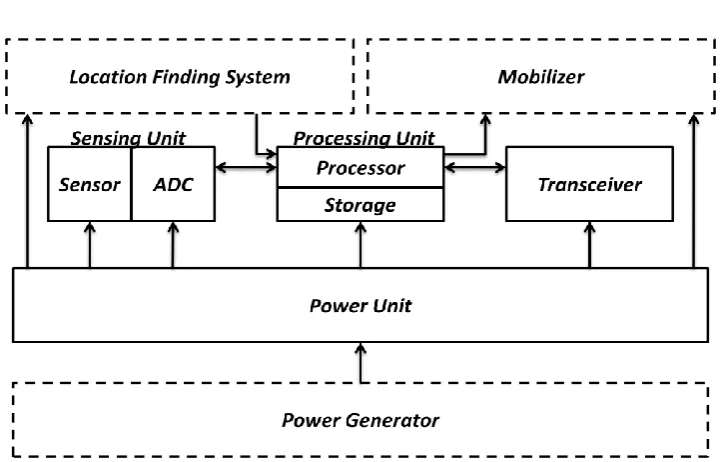
Wireless sensor networks follow loosely defined rules on network topology and deployment. As explained by [1] and illustrated in Figure 3, the networks are “usually scattered‖ in a
―sensor field.‖ Alternative topologies have also been identified, for example [19, 44, 68]. Nevertheless, each node performs a predefined role; it can be a sensor node, a cluster head or a base station.
The network design and the application‟s specifics dictate the exact role. Sensor nodes are devices that act as data generators and they need to communicate this information with the base station. Since the base station is often out of range, the sensor nodes can utilise neighbouring sensor nodes or cluster heads [19] to propagate their information [1].
26
Sink
Task Manager Node
User Sensor Field Sensor Nodes
Internet & Satellite
E D
C B
[image:36.595.92.463.70.288.2]A
Figure 3: a typical sensor network. Based on similar figure from [1].
Security implications
The devices are capable of communicating information in relatively small packets [29]. They cannot transfer data fast enough [28] and the act consumes a disproportionate amount of resources [69]. In addition, the network is prone to various DoS-type attacks [33], including routing attacks, and it may be unreliable[28]. Therefore, every security protocol must be designed to work with small packets and be resilient. Ultimately, they have to be energy efficient.
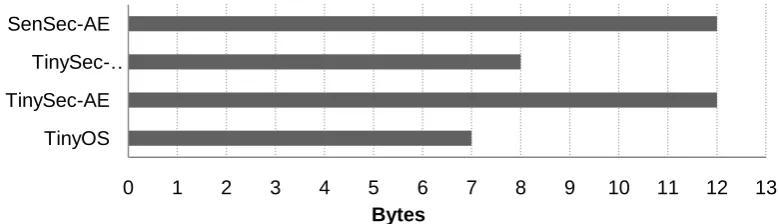
Security mechanisms require inclusion of additional information to function. For example, TinySec[2] introduces a 5-byte overhead compared with TinyOS. Assuming maximum payload of 29 bytes, the security overhead is about 12%. This affects resiliency, energy efficiency and latency. In contrast, if the packet could carry 200 bytes payload then the overhead would be 2.5% and its impact would be equally smaller. Clearly, the small packet size of WSNs affects the operational margins of security protocols.
27 efficiency and security mechanisms that operate at the transportation level have to account for this matter.
28
2.2. Security in Wireless Sensor Networks
This section explains what security is, its requirements and how they are applied in WSNs. A brief overview of security, and how it is applied in Wireless Sensor Networks, is given. Then the threat model is presented and the section concludes by explaining how different research groups apply security on different levels.
2.2.1 Overview of security
Definition
References to security in this work are shorthand for Information Security. The U.S. Code Collection [70] defines the term Information Security to mean “protecting information and information systems from unauthorized access, use, disclosure, disruption, modification, or destruction.” The same document defines that Information Security should provide;
Integrity; “guarding against improper information modification or destruction, and
includes ensuring information non-repudiation and authenticity”
Confidentiality; “preserving authorized restrictions on access and disclosure, including means for protecting personal privacy and proprietary information”
Availability; “which means ensuring timely and reliable access to and use of information”
The above is an idealistic description of what a secure system should provide. Practice has shown that computer systems that are operated by humans cannot fully meet the requirements to be unconditionally secure. For this reason, a system‟s security is considered satisfactory
when it makes the system computationally secure. Various degrees of security like
unconditional security, computational security, ad-hoc security and others are described by Menezes in [3].
29 security a system must provide in order for it to be considered secure varies greatly and depends primarily on the aim of the system and its limitations.
Importance
Security is rapidly becoming an important part of the modern world. Be it protection against national threats or safe monetary transactions, security is important and here to stay [5].
Wireless Sensor Networks are no different from other computer networks in the level of security that they must provide. The literature that highlights the importance of security of all computer systems;
every networked computer system is a potential target [6]
security will make WSNs suitable to a wider range of applications [2, 5, 33] security and privacy might be legal requirements [45]
applications may be critical [34] or valuable [35] enough to justify security
Each of the above references makes clear that the type of system is irrelevant to the security requirement.
Therefore, the security of WSNs has to be regarded as important as any other security system. The associated problems must be treated equally and the final solution must provide a security level that is comparable with other systems. After all, sensor networks are often parts of larger systems. If not equally secured they would become weak links on these systems.
Basic requirements
The aim of security in wireless sensor networks is no different that the aims for any computer network. As defined by [29], the basic requirements of a secure sensor network would be;
Data confidentiality; information stored or in transfer on a sensor network should not
be leaked to adversaries
Data authentication; messages must be authenticated so that trust on them can be
earned. Upon reception of a message, the receiver must be able to determine to trust or reject it
Data integrity; a trust requirement is that a receiver must be able to determine if a
message has been altered by an adversary while it was in transit
Data freshness; messages must demonstrate to the receivers that they are not replays of
30 These requirements comply with the generic information security definition and they represent what a basic security system should provide. Provision of these requirements in a sensor network would protect it from the attacks described in the threat model3.
Desired level of security provision
Different applications have different security requirements; there is no level of security provision uniform for all cases. However, analysis of the literature points to the minimum level of acceptable protection against security threats.
The level of confidentiality is directly related to encryption strength [3] which is determined by the effective key length [4]. Acceptable key lengths are provided by various organisation and researchers. Since they are related to technological advances, they differ for each calendar year. In reference [71], NIST proposes that that 80-bit keys should not be used after the year 2010, a fact supported by [72]. In addition, this argument is indirectly supported by [73] in which CNSS stated in 2003 that 128-bits encryption is “sufficient to protect classified information up to the SECRET level.‖
Authentication and integrity provides an assurance, or confidence, that the messages have not been forged or altered while in transit. It is suggested that the level of this assurance must be high enough to match the provisions of confidentiality [3].
As explained by [29], there are three levels of freshness; no freshness, weak freshness and strong freshness. References [29, 31] agree that most WSN applications require weak freshness and that it is up to the individual application to provide strong freshness when needed.
Since WSNs are limited, they should only be matching the minimum level of security but one might argue that even this is too high and unnecessary. Such argument does not properly consider the importance of security as discussed previously. In specific, it treats WSNs as less important parts of a system or as compelled to be unacceptably insecure. Nevertheless, attempts to provide WSNs with that level of security by a number of researchers are seen in the literature[30, 74].
31
2.2.2 Threat model
In addition to the basic requirements, the individual threats need to be accounted in order to provide the desired level of security. This subsection describes what these threats are, how they are carried out by attackers and what the possible evasive solutions are. The threat model is discussed and proposed countermeasures are explained. Some of these solutions are more closely connected to this research and thus discussed in detail in the next section.
Attacks on confidentiality
The wireless communication medium that sensor networks use to communicate implies that any receiver in range is capable of reading all radio traffic [33]. Therefore, data must be sealed from eavesdroppers and this constitutes the requirement of confidentiality, which is met via encryption. Sufficiently complex encryption schemes are implemented in WSNs with care, as strong encryption methods are associated with high computational overheads [29]. Nevertheless, most systems that attempt to achieve confidentiality introduce encryption schemes with varying computational difficulty. Attacks on confidentiality are known as cryptanalytic attacks, discussed in [3], and are characterised by a level of required computational complexity before they conclude by revealing the encryption key.
The most known cryptanalytic attack is the known-plaintext attack, popularly known as brute force attack. It involves obtaining a plaintext and the associated output ciphertext. By knowing two of the three inputs of the encryption function, the attacker can tries every possible key value until the correct key is revealed. Brute force attacks have a complexity equal to the effective key length of the encryption function. Longer keys provide greater confidentiality.
Other confidentiality attacks aim to reduce the level of computational complexity required by discovering a fundamental flaw in the mathematics underlying the encryption function. There are many types of cryptanalytic attacks in this category [3]. Cryptanalytic attacks usually require a number of conditions or pieces of the cryptographic input or output data to be acquired before they can be executed [3].
32 encryption function that is well analysed by the cryptographic community is a way to further protect the confidentiality of a secure cryptosystem.
Attacks on authentication and integrity
Communications via an open wireless medium allows attackers to alter or inject messages into the medium [33]. These attacks involve utilising a carefully crafted and powerful transceiver to overwrite the radio signals emitted by the network devices. Although it requires a skilful attacker, it is easier to conduct than a brute force attack on confidentiality, as it does not require great computational ability.
The efficient solution to this problem is to employ a cryptographic hash function to protect messages [3]. The function accepts the sender‟s identification information and the data as input and outputs a cryptographic signature. This is then appended to the data in the form of a Message Authentication Code (MAC). Each signature is associated with a probability of failure, known as confidence. Depending on the kind of hash function, the length of the input data and the amount of unique possible output, the exact probability that the protection might fail can be determined.
The hash function might be derived by the encryption function itself, as it was for example proposed in TinySec[2]. Under this solution, a possible attempt to inject authenticated messages or to alter existing messages would require knowledge of the authenticity mechanism‟s key, which in turn requires a cryptanalytic attack. Such authentication mechanism is believed to be as secure as the encryption function upon which is based [75].
Attacks on routing
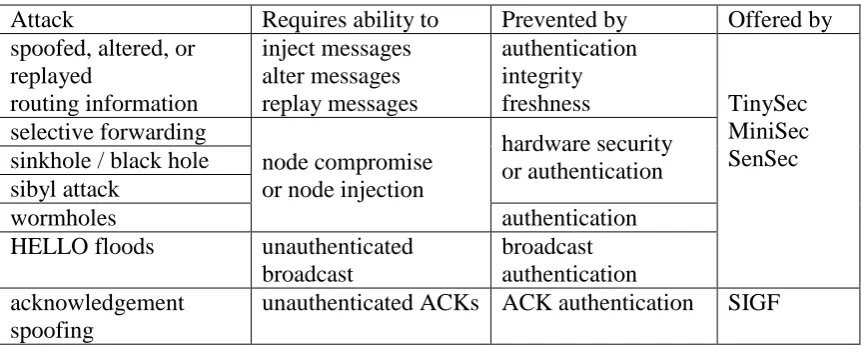
Routing security is not a direct threat since most routing protocols can be protected if the security requirements for message exchange are met. However, many attacks become available if the security mechanism fails to protect the routing messages. These vulnerabilities are clearly demonstrated by Karlof et al. [76]. The majority of routing attacks is briefly described here. Many of the routing attacks described here might be classified as Denial of Service (DoS) attacks in the literature. Other DoS attacks are further discussed later.
33 number of problems including routing loops, attract or repel network traffic, extend or shorten routes, generate false error messages, partition the network, increase end-to-end latency etc.
Black hole and Sibyl [77] attacks aim to place a malicious node inside the network. This node will be able to choose whether to forward or drop a packet; it will therefore conduct a
selective forwarding attack. The aim of the attacker is to provide a location on the network, which would look extremely attractive to the routing protocol and thus trick it to route traffic via the area under attack. Usually the method involves compromising a node or injecting nodes in the network. It therefore requires either insecure hardware or weak authentication.
A wormhole attack [78] creates and provides an actual high quality route between two points on the network using a communication medium normally unavailable to a sensor network. This route would quickly attract traffic and the attacker can then manipulate traffic in the way they choose. This attack requires the attacker to be able to inject packets or nodes in the network.
The HELLO flood attack utilises a powerful transceiver to broadcast a HELLO message that will trick distant nodes to believe that the attacker‟s node is neighbouring them. A laptop-class attacker can convince the whole network that they are a preferred route via a HELLO flood attack and thus it will make other attacks possible. This is another attack that requiring ability to inject nodes.
The final potential attack documented by [76] is acknowledgement spoofing. The attack involves recording and then replaying a legitimate acknowledgement message at the attackers will in order to pretend that a destroyed link is in good working order. That implies that the attacker can destroy nodes and hide that fact from the network. In addition, the attacker can trick the routing protocol and make it think that low quality routes are actually healthy routes. That would lead to higher energy consumption and increased latency. This attack requires the ability to inject acknowledgement messages.
Denial of Service attacks
34 transmission in order to jam the radio channel or to confuse the medium access control protocol.
Brutal DoS attacks involve completely blocking the communication medium by causing interference. The low power radio capabilities of sensor networks mean that it is relatively easy to create a portable transmitter with enough power to jam the network [76]. There is no easy defence against such attacks [28], although some groups are working on solutions given particular assumptions [79].
A survey of intelligent attacks and countermeasures is provided by Wood and Stankovic [80] who describe DoS attacks that do not rely on raw power but flaws in the design instead. It might be possible for an attacker to inject a small, maliciously structured message that would exploit a design vulnerability of the system. The target of the attacker is to trigger asymmetrical resource usage, in the sense that the attacker can cause a great problem to the system with little effort on their part.
Physical attacks
Secure systems are vulnerable if an attacker obtains physical access in the hardware that hosts the system. This is as true for sensor networks as for every other system. Initial research in sensor networks suggested that they would be vulnerable to physical attacks including node tampering and reading of memory contents.
Such potential attack would be catastrophic for a secure cryptosystem that relies on keys as those have to be stored on memory and thus revealed to the attacker in case of node tampering. It is therefore essential to design systems that would sustain physical attacks as well. Research in this area has taken many directions depending on different assumptions4.
Attacks on single points of failure
By definition, every system will have a component, which would be weaker than the other components. Examples of such components in wireless sensor networks might be cluster heads and base stations. A carefully designed secure wireless sensor network should disclose as little information as possible on the location of such singe points of failure. Additional, non-physical, points of failure might involve poorly designed components of the system.
35 The work of Deng et al. [81] analyses the security of the base station viewing it as a single point of failure. There are other examples in the literature that refer to the importance of single points of failure but very little published research considers just that.
2.2.3 Application of security
Security is a large area of research with lots of different branches. In sensor network security, there are at least three major branches: key management, data transportation security and routing security. There is also work that cannot be categorised, like hardware security or DoS attack prevention.
Each of these research areas attempt to solve security problems found at different levels. A uniform level of security must be provided to achieve effectiveness in the final solution. Any finalised security system will have to either be a combination of solutions from different areas or at least be compatible with other work. There may be no academic work assessing how various security systems could be combined to form a uniformly secure sensor network.
Key management
Key management is an important part of security in all computer networks [3]. In sensor networks, the term refers to the process of key agreement in a protected from adversaries method. In sensor networks, these keys are indented for use by the security mechanism of the data transportation layer.
Most key management schemes assume that that no component of the system can be trusted under almost any circumstance. These solutions expect that at least some component will be compromised and then used to launch an attack on the system. Sensor node hardware is believed to be susceptible to compromise, a problem known as node compromise.
36
Data-transportation layer security schemes
This research area attempts to provide security for the process of transporting messages between the sensor nodes. The solutions apply their security features on the sensor network equivalent of the OSI data transportation layer [66]. The systems are responsible for providing security properties like encryption and authentication for the data exchanged information.
These schemes are focused into providing energy efficient security and thus they rely heavily on the security of other components. Importantly, they ignore hardware and routing security. These problems are not considered relevant to this research area.
This research area is relatively more recent than other areas and there are not many well-cited solutions. There are no distinct categories in this research area.
Routing security
Routing refers to how a sensor network is organised and how available message paths are defined. This process involves exchange of information which if not secured might enable DoS attacks.
There are a number of proposals tackling the generic routing problem [17, 24, 65, 86-89] but most research is focused on providing energy-efficient routing. Surprisingly and despite the fact that most routing protocols seem vulnerable [76], very few articles consider both security and efficiency of routing.
Other areas
37
2.3 Related work
This section describes and critically analyses important work seen in the literature that relates to the proposed system. The proposal is primarily a security mechanism acting on the data transportation layer but it includes a key management system as an important part of the solution.
This section starts with an overview of the research area, explaining how security is applied in wireless sensor networks. Then it presents work that is both important and directly related to this proposal; key management and data transportation layer security schemes.
This section concludes by discussing routing security and other work, which is related to security in sensor networks but not directly related to this proposal, like routing security and other work.
2.3.1 Key management schemes
This subsection presents established key management schemes found in the literature.
Probabilistic key management
Probabilistic key management schemes work by clustering the network into virtual groups of nodes. Nodes in a group share the same security state but groups benefit from different states. This design limits the impact of node compromise to affect only its group instead off the entire network. The way distinctive groups are created and managed is what differentiates the solutions. Most of these proposals assume that the sensor network is large and dense.
38 probability of two neighbouring nodes sharing the same key can be calculated. A share probability greater than one guarantees that the vast majority of node pairs will be able to discover a common key loaded on both ends of the pair and secure communication can commence. On the other hand, attackers who compromise one node can only obtain a limited number of keys, which does not allow them to intercept the communications from the whole network.
A similar but more efficient approach is proposed by Pietro et al. [84]. The main difference is that nodes are loaded with keys from the pool while obeying a mathematical relation, which allows all nodes to know in advance which keys are loaded on every other node. This is done with the help of a pseudo-random number generator, which accepts the node ID as seed, effectively selecting keys using the node‟s ID as a selection criterion. Therefore, anyone who knows the node ID also knows the keys that are loaded on the node and thus nodes know in advance which key to use for communicating with another node, without the need of a key agreement process, saving key-agreement radio communication overheads.
Location-aware key management
Discovering the physical location of a node is rather straightforward for advanced nodes that incorporate GPS receivers in their sensing board. This information isa valuable asset, which can help improve not only efficiency and information gathering but security as well. The following are a set of different proposals that enhance the security assuming that the network‟s physical topology is known.
39 The work of [20, 85] relies on robots or robot-assisted manual determination of node location and of the keys that will be loaded in the nodes. After the nodes are randomly scattered in the environment the area is traversed by robots who note the location of the nodes and load keys on them using rules defined by the method. The system can provide highly enhanced security, even compared to public key cryptography but unfortunately, it involves the difficult requirement of utilising robots.
Other proposals
The literature includes proposals that are simpler that those discussed previously but still expect network hardware to be insecure. An example is provided here for completeness.
The proposal of Zhu et al. [83] works by categorising types of messages, and security requirements of these messages. The authors distinguish four types of messages and they establish four types of keys:
an individual key shared between each node and the base station a pair-wise key shared between other nodes
a cluster-key shared with multiple neighbouring nodes a global key shared by the whole network
They also provide a protocol for weak local broadcast authentication, based on the use of one-way key chains. The authors claim that they can use a master key for few seconds before an adversary can capture a node and obtain it. They use this key immediately after deployment to involve a simple handshake and then they derive a unique pair key using the information exchanged in the handshake and the master key. Finally, they erase the master key. After initial negotiation and agreement on the pair keys, the authors build upon this secure platform to share all the other keys they define in their mechanism.
Discussion
40 addition, the work on references [90-92]5 indicates that hardware can be secured, effectively solving the problem of complex key management.
In addition, even if complex key management is adapted, the sensor network will ultimately fail. Complex key management schemes can only delay the ultimate failure of the system and maybe allow for more time for corrective action to take place but they cannot infinitely do so. Therefore, complex key management will eventually fail as well.
In support to the above arguments, there is a clear tendency to ignore this problem by many other authors [2, 21, 30, 93-94]. This research sides with these authors and chooses not to actively seek a solution to the supposed hardware security problems.
Implications
Developers of wireless sensor networks are likely to agree with Gamage et al.[16], that complex key management is not necessary. However, there are few alternative, more simple, options, for example [83] which is probably too simple.
There is no key management mechanism in between the two options. A mechanism that would;
not use the same key for large groups of nodes
automatically change keys when they are likely to become a security liability keep its state secret and operate without leaking information over the radio not require storing large numbers of keys on the sensor nodes
Such hypothetical simple key management system would be less complex than other key management systems while it would provide better security than lack of key management. It would also require fewer resources than complex key management systems.
One might argue that data-transportation layer security mechanisms do not need to provide key management as this can be done at application level. Therefore, provision of a key management is unnecessary. However, a different key management system means that the cryptosystem is not designed comprehensively; it relies and trusts the security of other subsystems and it may therefore be inconsistent.
![Figure 3: a typical sensor network. Based on similar figure from [1].](https://thumb-us.123doks.com/thumbv2/123dok_us/8724126.884942/36.595.92.463.70.288/figure-typical-sensor-network-based-similar-figure.webp)